Showing posts with label Whitfield. Show all posts

Monday, August 26, 2024

City all aboard for restoration: Civil War-era depot made famous by 'Great Locomotive Chase' is on track to becoming a philanthropy center in NW Georgia

Rendering of changes to the exterior to better match original appearance (Montgomery & Peeples, Dalton)
A long-closed Western & Atlantic railroad depot that played a part in the Civil War’s “Great Locomotive Chase” is being reborn in a way that reaffirms its importance as a community gathering place in Dalton, Ga.

A philanthropic organization and developer are nearly midway through the restoration of the oldest commercial structure in the northwest Georgia city best known for its carpet industry. The goal is to have a unique setting where ideas and dreams for the public good can gain steam.

The Community Foundation of Northwest Georgia and Barrett Properties have partnered for the project, with the foundation planning to relocate its offices to a portion of the depot later this year or in early 2025.

David Aft, foundation president, told the Picket the reopened 1852 depot also will buttress revitalization in downtown Dalton. Officials want locals to spend their dollars there rather than nearby Chattanooga, Tenn., and to enjoy the Burr Performing Arts Park, among other venues.
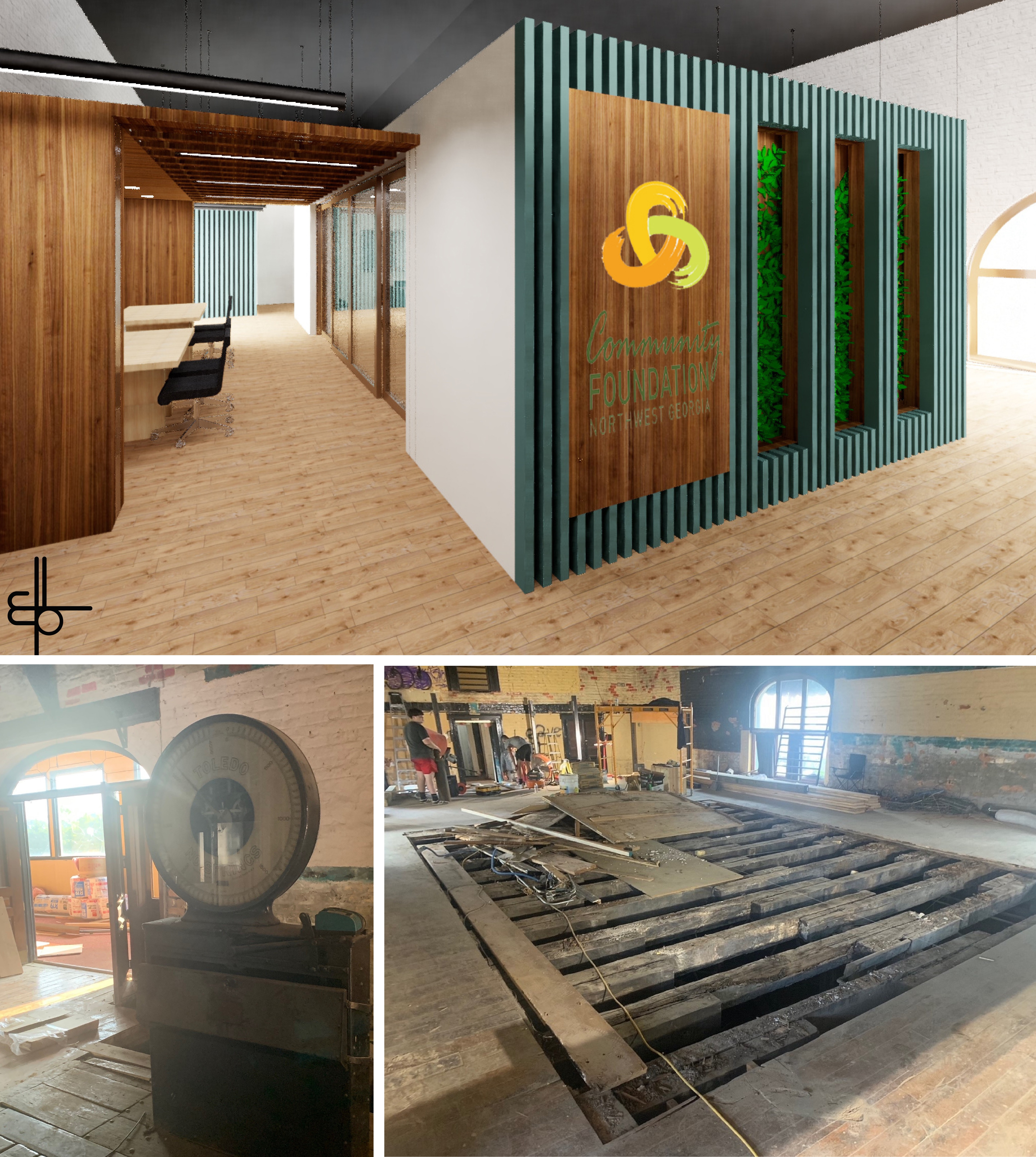
Glass-walled conference room, the old freight scale and floor work showing old timbers
 (Montgomery & Peeples rendering and David Aft photos)
“Working to renovate a building mothballed for 10 years is part of that, to bring life into old facilities.” The depot, he said, was the hub for commercial growth and the point of origination for surveys and maps in the 19th century.

The resilient depot has had some hard times since its heyday. A 1977 nomination form for the National Register of Historic Places said Dalton citizens were aware of its value but “concerned about the deterioration of the building.” At that time, it was being leased to a railroad.

The depot housed a tavern for about 25 years, but officials closed the building in late 2015, citing conditions that “posed potential health hazards to the public,” including mold, according to the Daily Citizen-News newspaper.

The Western & Atlantic depot back when it was boarded up (Georgia Trust for Historic Preservation)
The brick building sat empty for nearly a decade. Now, workers are on site, making repairs and modernizing the space to create an open, welcoming environment.

“I’m excited to see downtown Dalton continue to blossom, and to see the Dalton Depot once again be a hub in downtown Dalton,” said Mayor Annalee Sams.

Andrews Raiders plowed through Dalton

The Western and Atlantic Railroad line from Atlanta to Chattanooga was completed in the early 1850s and the Dalton depot opened in 1852 to provide passenger and freight service.

The building had its moment of fame on April 12, 1862, when Northern raiders who had commandeered the locomotive General in Big Shanty, above Atlanta, were chugging toward Chattanooga, intent on destroying parts of the railroad.

Union raiders on the General set a fire at a river crossing in Georgia (Wikipedia)
The pursuing locomotive Texas picked up a 17-year-old telegraph operator who rushed to the Dalton depot and wired Confederate troops ahead in Chattanooga.

Although not all his message got through, Edward Henderson’s alarm sent troops toward the track. The Andrews Raiders were captured near Ringgold when the General ran out of steam. They had accomplished little.

According to the National Registration nomination form, “the depot might have been partially destroyed when Union troops entered Dalton and set fire to several buildings in 1862. It appears that the essential structure of the depot was not damaged and the restoration was confined to roof and interior repair. Since the ornamental brackets are stylistically later than the date of the rest of the building, it is likely that they replaced others lost in the destruction.”

The 12,100-square-foot brick building is “a pretty high-style example of Georgia depot architecture” and has Greek Revival features. It features stone lintels, brick pilasters and door entablatures.

The old ticket counter is among the surviving features (Georgia Trust for Historic Preservation) 
Safeguarding depot's historic features a priority

A February news release on the project said “Barrett Properties will be giving careful consideration to the preservation of historical elements that pay homage to an era’s character while innovative additions will infuse a modern and dynamic flair.”

The city years ago contracted with the Georgia Trust for Historic Preservation to market the building. Officials wanted $500,000, but eventually sold it to Barrett Properties in 2018 for $300,000. At that time, Barrett said the area would be suitable for another restaurant/bar and perhaps a small museum.

The city required bidders to submit a written preservation plan and abide by a signed rehabilitation agreement.

Work crews have been on the site since spring (David Aft photo)
The trust's primary goal was seeing that historic features in the building are saved. The depot’s southern end retains features interior ticket windows, a freight scale and other rail service features.

The foundation has a 20-year lease with Barrett Properties, said Aft, who answered Picket questions on behalf of his group and the developer.

What the foundation does with charitable gifts

The five employees of the Community Foundation of Northwest Georgia, working with charitable givers, provide grants and funding for organizations in the area. Some of the endeavors involve mental health programs, historic preservation, neighborhood revitalization and other civic projects.

Undated photo and another from 1922 (Courtesy of the Bandy Heritage Center for Northwest Georgia)
Some grants come in the form of endowments, financial funds and scholarships to nonprofit groups or individuals. The organization oversees more than $90 million in charitable assets, said Aft.

The main economic engine for Dalton and Whitfield County is the carpet industry, while diversification has yielded a solar panel factory and supply chains for auto manufacturing.

“We are one of the country’s last bastions of manufacturing,” said Aft.

The area’s Latino population has grown considerably. Housing affordability is a big issue, compounded by the dearth of available land because of mountainous terrain, said Aft, indicating nearby counties have made strides. The Greater Dalton Chamber of Commerce is working toward increasing residential units, including hundreds of apartments, he added.

Depot and other downtown buildings in 1932 (Courtesy of the Bandy Heritage Center for Northwest Georgia)
The foundation currently works from the top floor of a building about a mile from the depot.

“We have kind of outgrown our space,” said Aft, indicating the foundation needs a larger facility in which to meet with donors and working groups and to conduct strategy sessions. “When you have 20 people in for a workshop, we don’t have great bathrooms.”

New office will mix the old and the new

Aft touts the new space as ideal for meetings -- by mixing the depot’s historic architectural features and modern office design.

“The most significant feature is a room built within that space. It will have an ability to open its glass side walls into a bigger convening space,” he said. The office includes other meeting areas and work nooks. (Rendering at left by Montgomery & Peeples)

The foundation is moving into what once was a nightclub area of the depot. “There was a lot of live music. People used it for event space.” The other half was a restaurant.

Photos from the current work show wear and tear, including some graffiti on the walls.

“The entirety of the super structure and brick work is original. Much of the underpinning foundation is original,” said Aft, adding the current budget for the work is below $1 million.

(Barrett Properties is still marketing the other half of the building, perhaps for offices, event space or a restaurant.)

While the interior is receiving an overhaul and plumbing and heating and air are being modernized, work has not yet began on the exterior, which will have a few modifications to provide its original look.

Barrett Properties sent out samples of the brick mortar to use the right type while fixing damage created by wear and passing trains. Much of the brick has been repointed.

Three cornices need to be rebuilt. “It will look more like from the photographs of 50 years ago then now,” said Aft. (See collection of depot photos here)

The finished product will pay homage to the “Great Locomotive Chase” in some form, perhaps through markers.

“We understand the valuable piece of real estate we are part of,” said Aft.

(At right, David Aft photo of foundation, including old timber)

Thursday, May 12, 2016

'So much potential': Resaca battle park has promise for county, Civil War visitors to region

A section of the Blue Battlefield Trail near I-75 (All photos by Picket)
Resaca Battlefield Historic Site put on its soft opening last weekend. The curious drove past replica defensive fortifications at the gate and down a road bordering a scenic valley and forested hills.

The peaceful scene that greeted them belied the fact that the May 1864 Battle of Resaca in northwest Georgia was the second-bloodiest of the Atlanta Campaign.

Ten cars came Friday, 20 on Saturday and about 30 on Sunday. Gordon County Administrator John King and Ken Padgett, head of the Friends of Resaca Battlefield, pointed out the first visitors were a Michigan family.

The Civil War park, which will have its grand opening ceremony this Friday at 3 p.m., in some ways carries the mantra, “If you build it, they will come.”

County officials and the friends group want the site to be an educational, recreational and historic beacon for local residents, travelers and Civil War buffs. The park contains significant remnants of earthworks, including an impressive length of trenches visible on the Red Battlefield Trail (Signs point out metal detectors are banned and artifacts cannot be removed).

And they would like to see the quiet Exit 320 interchange on I-75 and the town of Resaca get an economic boost.

Ken Padgett of the Friends of Resaca Battlefield
“There is so much potential,” King said earlier this week during an interview at the site’s picnic and restroom pavilion.

A big advantage is the park is right off Interstate 75 between Atlanta and Chattanooga, Tenn. (Construction of the interstate decades ago did destroy parts of the battlefield). While there are no signs or billboards noting the new venue on I-75, Gordon County officials are working with the state to have one installed.

For now, they are largely depending on websites, local media and groups and word of mouth to publicize the park. (They don’t know how the Michigan family learned of the site.)

Gordon County may benefit from a bit of synergy.

Just to the north is Whitfield County, which is believed to have the most surviving Civil War fortifications in the country. The Civil War Trust is working to buy and preserve a 309-acre tract there where Confederates built defensive works on Rocky Face Ridge before they slipped south to Resaca as Federal forces pushed on toward Atlanta. Whitfield officials plan to open a park, perhaps next year, according to CNHI newspapers.

Gordon and Whitfield counties are southeast of Chickamauga and Chattanooga National Military Park, which draws nearly 1 million visitors annually.

Section of trenches on Red Battlefield Trail
Jim Ogden, historian with the federal park, said he can now direct those interested in the Atlanta Campaign to a well-preserved site between Chickamauga and Pickett’s Mill or Kennesaw in suburban Atlanta.

“In addition to recently developed access at a couple more Dalton area sites, with the opening of the Resaca battlefield, there's now a lot more from that first epoch of the campaign for one to visit,” Ogden wrote in an email. “This also means, for Civil War round tables or other history-based groups, particularly if they'll do a little walking, there's now … enough in the Tunnel Hill-Dalton-Resaca area to make a multi-day tour of just that part of the campaign. With a good guide and a willingness to walk, there's potentially a day now at Resaca by itself.”

For now, the Resaca battlefield site will be open on Fridays, Saturdays and Sundays.

The park contains most of the battlefield on the early afternoon of May 14, 1864. Late-afternoon action is on the east side of the interstate. Chitwood Farm, site of an annual Battle of Resaca re-enactment, is a couple miles east of the new I-75 park.

While the battle was a stalemate, Confederates withdrew and Maj. Gen. William T. Sherman continued his eventually successful march on Atlanta. 


Ogden said the new historic site illustrates the growing strength of Rebel fortifications and the importance of Federal flanking attacks and movements.

Confederates manning the fortifications one sees in the park turned back several Union assaults,” he said. “This is not just reflective of the course of the Battle of Resaca itself but also of the larger Atlanta Campaign: W. T. Sherman would use his larger army to maneuver against Joe Johnston's flanks to force him out of positions that were seemingly ever more fortified as the campaign extended week by week.”

I spent several hours Monday at Resaca Battlefield Historic Site. A word to the wise: Bring plenty of water and good walking shoes. The 1.-2 mile Red Battlefield Trail on the south end is hillier than you’d expect, but the experience was enjoyable. I saw several deer at the top.

The 2.6 Blue Battlefield Trail on the northern side of the 483-acre park has a whole different feel. On its east side, you do walk through some hills that held Confederates, but as you walk counterclockwise much of it features gorgeous meadows in the valley that separated the two armies. The west side of the trail is where the Union brigades prepared for assaults. 

Bridges cross Camp Creek and other small streams. Butterflies flitted about and I saw a large snapping turtle as I neared the pavilion to conclude my hike.

The site features many state-produced interpretive panels, with some geared toward children (though they would be of interest to most anyone). King would like to see more of them along the trails.

Several include a helpful inset of a Battle of Resaca map made years ago by the late historian Bill Scaife. I wished those carried a “You are here” designation to better orient myself when looking at the park map and Scaife’s order of battle.

Wayside stops and loop trails offer plenty of opportunities to put the battle into perspective (though I wish a few had not been so jammed with text). King said three part-time park managers at the site and nearby Fort Wayne can help visitors with further questions on the battle.

Local residents began pushing for the park in the 1990s and the state acquired the property. The Friends of Resaca Battlefield organized support and raised money. Georgia appeared poised to build the visitors center after an October 2008 groundbreaking.

The Department of Natural Resources realized it did not have the money to finish the project. 

Frustrated, Gordon County stepped in and took over, agreeing to do the construction and staff and maintain the facility. But in March 2010, citing costs and inherited permit problems, Gordon County punted on building the site. The state agreed to take the project back, with the caveat that the county would operate it once the work was done. State budget woes put an end to plans for a visitor's center/museum and film.

Things have come together over the past year. Improvements have been made to signs and trails and a widening project on Ga. 136 at Interstate 75 has been finished, allowing for better access to the site.

Exit 320 is one of the least-developed I-75 interchanges in Gordon County. There’s only a large truck stop on the east side to offer refreshments to park patrons.

“It is not going to be a flip-the-switch to economic impact,” King said of the opening.

John King
Still, he touts in development possibilities and efforts toward building a more educated workforce. He cites the area’s schools and a new college and career academy in nearby Calhoun. (Gordon County is known for its floor-covering industry).

While King acknowledged there was some opposition to the project, particularly a few years ago during the economic slowdown, he said residents are starting to get on board.

“It’s very exciting,” he said. “(We originally thought) the baby was ugly, but it belongs to us. It's not an ugly baby. It’s beautiful. We are very proud of it.”

He wants to focus now on the opportunities the site will bring, and asks that groups and individuals help raise awareness and pitch in to make the historic site a success.

“We have always focused on getting to this point,” King said. “This is not the end of the campaign. It is just the beginning.”