Showing posts with label James Lile Lemon. Show all posts

Saturday, April 5, 2025

This Model 1840 sword wields a remarkable story. A Union sergeant bestowed it at war's end to a Confederate prisoner with whom he shared the name Lemon

Model 1840 sword, blade detail and leather frog (Picket photos), Capt. Lemon during the Civil War
Capt. James Lile Lemon might have walked with a limp to shield what he was carrying in his trousers. Or perhaps he somehow covered the gift as he left Fort Delaware for freedom after serving years in Union prisons.

Whatever the circumstances, the Confederate officer was determined to bring the item back to his home in Acworth, Ga. And that’s where it is kept today – 160 years later.

I visited the Lemon house recently during events marking two new Civil War markers out front, one describing Lemon’s service and the other the Federal occupation of the town in June 1864. Maj. Gen. William T. Sherman used the residence as his headquarters for a couple days.

I asked Mark Lemon, who was sitting in a rocker on his front porch, whether I could see any of the captain’s belongings. Lemon’s second great-grandfather was remarkable for not only his military service, but his penchant for saving nearly everything he owned during the Civil War.

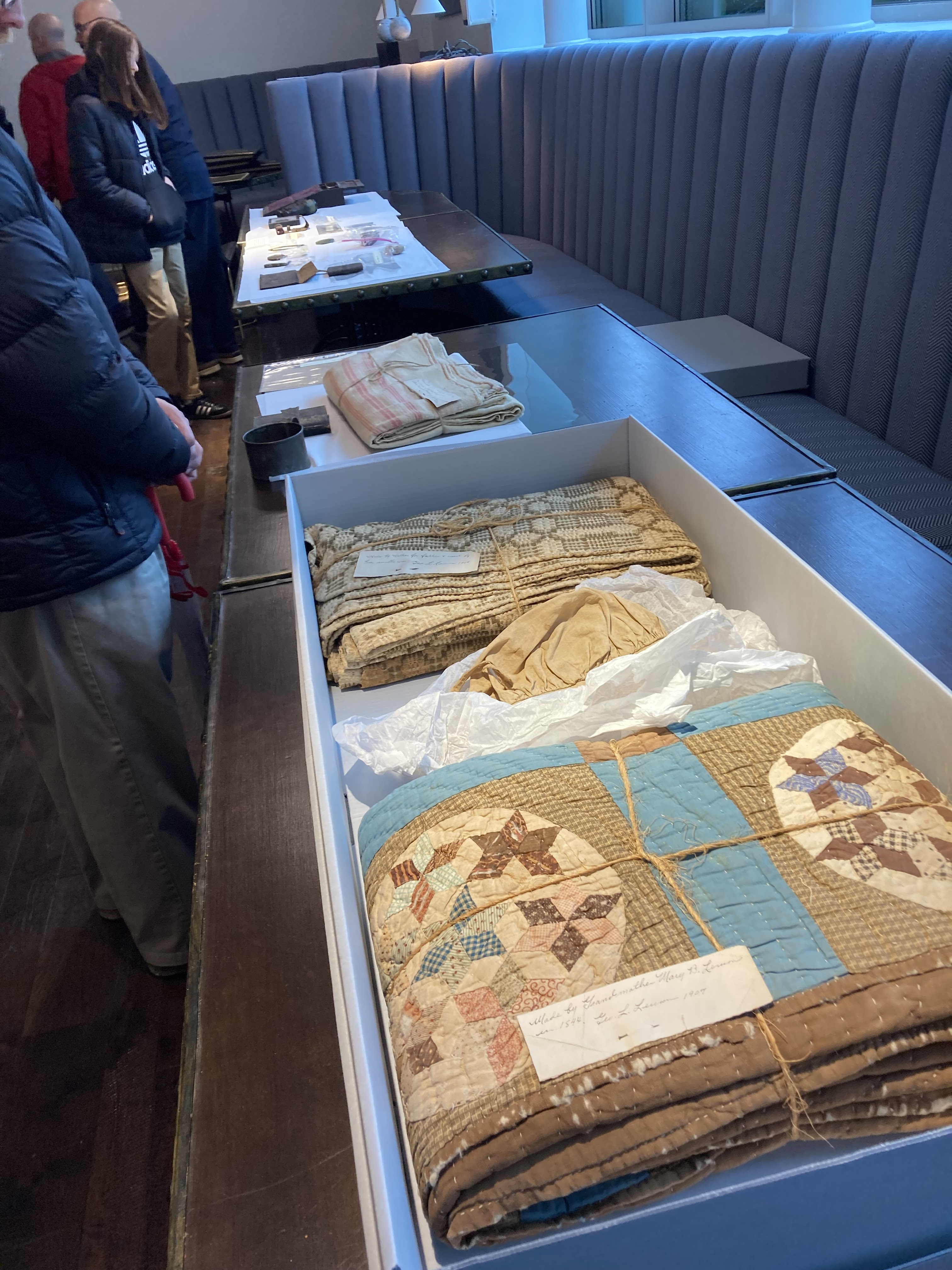
Most of the artifacts are in the collection of the Atlanta History Center, which purchased them in 2020 from the widow of a Macon, Ga., collector.

But one that stayed in the family is an NCO sword given to James Lemon at Fort Delaware in June 1865 after he finally took an oath of allegiance to the United States. The Confederate had earned the respect of one of the prison staff, who also had the name Lemon -- Sgt. Lemon Kline of the 215th Pennsylvania Infantry. It’s easy to speculate whether the shared name had anything to do with their apparent friendship.

I don’t know whether the two men – who were both in their 30s during the Civil  – maintained a friendship after the war, but Mark Lemon said the story goes Kline told James Lemon, “Tell your family you once knew a good Yankee.”

Mark Lemon showed me the sword and a framed piece of paper written by James Lemon, who routinely made notes on his belongings. The note mentioned how he came to receive the sword.

(Civil War Picket photo)
One side of the blade (above) records it was made by Ames Manufacturing of Chicopee, Mass., a significant provider of weapons and tools for the Union. Some consider Ames the Cadillac of US military sword makers during the period.

The reverse has the stamp:

U.S.
ADK
1863

I am no sword expert, so I turned to the Authentic Campaigner Facebook group for help.

Built for combat, used mostly for presentation

I quickly learned the weapon is a Model 1840 sword for use largely by infantry and artillery NCOs. The initials ADK indicate the name of the manufacture inspector. The handle is made of brass.

When I examined the blade, I noticed it was quite light and not sharpened. Some commenters compared it to the spadroon, a light sword with a straight-edged blade.

One commenter said this model was mostly a symbol of rank and authority. The military used the sword, based on French and English models, for about 70 years.

So it is understandable Kline, as a sergeant, would have carried one. (At left, a Union NCO holds a Model 1840 sword, Library of Congress). Some of the weapons were issued to musician NCOs.

Another commenter presented a brief history of the weapon and a different take on its usefulness.

“Don't believe the hype where folks say that swords were unimportant to the war. This particular model sword may not have been frequently used in combat, mostly because sergeants would be using their bayonet in hand-to-hand combat before resorting to the sword.

"Regardless, this design of sword was intended for combat, with a design used for over a century, and not exclusively for presentation.

The Model 1840 also could have been useful in “directing traffic” by keep troops and inmates in a straight line. 

Interestingly, the scabbard of Lemon's sword is made of leather. A few Authentic Campaigner commenters noted the "frog," a piece of leather which allows the wearer to carry a sword for a short time, likewise was in very good condition and at least as valuable as the sword.

Lemon items will get big play in next exhibit

Two years ago, the Atlanta History Center invited Lemon descendants to see the amazing collection, which is not currently on display. Mark Lemon showed the sword to AHC senior military historian and curator Gordon Jones.

Mark Lemon (left) brought the sword to the Atlanta History Center in 2023. (Picket photo)
The Lemon collection – which features  a captured drum, revolver, letters, canteen, photographs and much more -- will be showcased in its own case after a revamp of the center’s aged “Turning Point: The American Civil War” exhibit. (The sword will remain with the family).

“That story has a lot to say about Confederate soldiers' wartime experiences,” Jones recently told me.  

The historian said the new exhibit is set to open in June 2026. It will go deeper into “causes and results,” including slavery, politics and Reconstruction. There will still be plenty of weapons and military items on display in that space and the Goldstein gallery, Jones said.

The George Wray Jr. collection of rare Confederate weapons will be in the Goldstein space.

Confederate captain reluctantly took oath

Mark Lemon keeps this note by his ancestor near the Model 1840 sword (Picket photo)
James L. Lemon served with Company A, 18th Georgia Infantry, part of John Bell Hood’s Texas Brigade. He enlisted as a second lieutenant in 1861 for a three-year term. Lemon was described as having a “light complexion, dark hair, blue eyes, [and] 6 feet” in height.

The regiment fought in numerous Eastern battles – including Antietam, Fredericksburg, Second Manassas and Chancellorsville. The farmer and merchant from Acworth had a close call at Gettysburg, when a Yankee bullet struck his canteen, causing it to strike his head.

His combat days came to a close in November 1863, when Lemon was severely wounded by a Minie ball in the pharynx and taken prison after an assault on Fort Sanders in Knoxville, Tenn. .

By the time he arrived at Fort Pulaski, Ga., in October 1864, Lemon had already been in at three Federal prisons: One in Louisville, Ky; Camp Chase in Ohio and Fort Delaware, Delaware. He kept several diaries. The officer etched his name onto a wall at Pulaski.

Capt. Lemon etched his name and regiment into a wall at Fort Pulaski (Picket photo)
In March 1865, the Rebel officers, including Lemon, were returned to Fort Delaware, where they were held until the end of the war. Shortly after their return to Delaware, the captain’s diary describes harsh conditions at Fort Pulaski and alleged mistreatment by his captors. 

“We have recently returned to this place after a most brutal & cowardly outrage against humanity. I cannot now speak of the sufferings & deprivations & humiliations we were subjected to. Many among us are now dead from starvation, disease, shot or beaten to death and the rest of us are about used up from the shameful journey forced upon us by the Yanks. I know not of the reason for this but we are told it is for some reported offense against a few of their prisoners in Charleston.”

He held off taking the oath for two months after Appomattox but finally relented.

In his journal, Lemon wrote: “I have done the unspeakable but I am now paroled & today set out for home. My duty to my country is done, mine to my family remains.”

Lemon returned to Acworth and had 11 children with his wife Eliza. He was a retail merchant and then a bank executive. He was serving as president of the bank when he died on June 12, 1907, at age 71.

Mark Lemon has lived in the house for 30 years and with the help of friends, has been restoring the home’s exterior and side buildings, with plans to turn to the interior.

The house is painted in bright yellow (a suitable color?), but he says it was clad in white for at least a short time in the 19th century.

Illness sidelined Lemon Kline in two great battles

I have been unable to learn a great deal about Kline, beyond service and pension records. The blue-eyed farmer lived in York County before and following the Civil War.

Much of what I learned comes from a Findagrave page, which lists his birth as July 24, 1830.

Sgt. Lemon Kline's Pennsylvania veterans card via Fold3
Rosters indicate he first enlisted in the 30th Pennsylvania Infantry

“Admitted to a Washington hospital on September 9, 1862, for illness, he almost certainly missed the battle of Antietam. He returned to duty but was again hospitalized January 18 through July 1, 1863, thus missing the battle of Gettysburg,” says the page.

He was transferred to the state’s Veteran Reserve Corps and honorably discharged in June 1864.

Kline reenlisted in late March 1865 in Lancaster, joining the 215th Pennsylvania. Presumably at Fort Delaware, he was promoted to first sergeant on April 21. He was mustered out with his company on July 31.

He apparently got a disability pension in 1878. The 1880 census lists the veteran, his wife, Catharine, and three daughters and three sons. Kline died at age 69 in November 1899 and his widow received a pension. She died in 1904.

The York County History Center has not been able to locate a photograph of the soldier.

“However, it does seem we have some information on him and his family, including census abstracts, his marriage record, and cemetery record,” said library assistant Emma Streb.

(At right, Findagrave photo courtesy ajtarman710)

A view of the sword and scabbard on the porch of the Lemon house in Acworth, Ga. (Picket photo)

Thursday, April 13, 2023

Treasure trove: Capt. James Lile Lemon kept spoils of war and all his belongings. Descendants got to see them at the Atlanta History Center

Gordon Jones with drum, a revolver and James L. Lemon's prize watch (Picket photos)
Last weekend, dozens of Civil War-period items were laid out on tables in the Atlanta History Center’s Cox Room. Almost all related to a single soldier -- a curator's dream.

There were personal items, a captured drum, revolver, letters, canteen, photographs and much more. Many artifacts were labeled with handwritten notes by Capt. James Lile Lemon of Company A, 18th Georgia Infantry, who fought in the Virginia theater and survived a year and a half in Union prison camps.

“I am speechless at this entire collection, to see it all together, said Heather Spann, of Kennesaw, Ga., a third great-granddaughter of Lemon (left).

“It is amazing how meticulous he was in keeping records,” said Fred Aiken, a member of the Atlanta Civil War Round Table.

Aiken, along with about 20 members of the Lemon family, most living in northern Georgia, were invited to the AHC to see the impressive collection the institution purchased from the widow of a Macon, Ga., collector in 2020. The set includes three wartime diaries.

“He literally saved everything,” said host Gordon Jones, senior military historian and curator at the AHC. Lemon was “an individual who was thinking ahead about his own legacy.”

Jones told the Lemon family that their ancestor is a quintessential example of the human experience in the Civil War. “This is storytelling stuff. People love it.” It is the history center’s fortune to have such a complete collection, he added.

Lemon descendants and others before seeing collection (Picket photo)
Before the Atlanta Cyclorama painting was moved to the AHC a few years ago, visitors filed through the exhibit “Turning Point: The American Civil War.” Many of the artifacts were collected by an Atlanta father and son team decades ago.

While “Turning Point” still attracts visitors, the AHC believes it is a dinosaur, and it is raising money for a new exhibit that will offer newer, fresher and more inclusive perspectives of the conflict. The Lemon collection, Jones said, will be shown to the public as part of that effort.

When the war broke out, Lemon was living in Acworth, about 30 miles northwest of Atlanta. His family had seven enslaved persons, and Lemon wrote in his memoirs that he freed them. There is some dispute over the claim, according to the AHC.

Descendant Mark Lemon lives in the Acworth home 
Early in the war, the 18th Georgia was part of John Bell Hood’s Texas Brigade. Lemon enlisted as a second lieutenant in 1861 for a three-year term in the Confederate army. 

The regiment fought in numerous Eastern battles – including Antietam, Fredericksburg, Second Manassas and Chancellorsville. The farmer and merchant had a close call at Gettysburg, when a Yankee bullet struck his canteencausing it to strike his head.

His combat days came to a close in November 1863, when Lemon was severely wounded by a Minie ball in the pharynx and taken prison after an assault on Fort Sanders in Knoxville, Tenn. 

Mark Lemon (left) brought sword given by Union NCO to J.L. Lemon (Picket photo)
By the time he arrived at Fort Pulaski near Savannah, in October 1864, Lemon had already been at three Federal prisons: One in Louisville, Ky; Camp Chase in Ohio and Fort Delaware, Delaware. 

The captain’s brief time at Pulaski is part of the story of the "Immortal 600", a fascinating footnote to the conflict. The story is involved, but here’s a summary:

In summer 1864, Confederate Maj. Gen. Samuel Jones essentially used 600 captured Union officers as human shields, in a section of Charleston, S.C., in the line of fire. The North retaliated by transporting 600 POWs from Fort Delaware to Morris Island, S.C., in direct line of Rebel guns.

“For nearly three months, the stalemate continued. It wasn’t until yellow fever broke out in the city of Charleston that the Confederacy removed the Union prisoners to newly erected prison camps further inland,” the National Park Service says. “With the Union prisoners removed from Charleston and no longer under fire from Union artillery, there was no need to keep the Confederate prisoners on Morris Island. With this realization, the next phase of their journey began and the Immortal 600 began the journey south, to Cockspur Island and Fort Pulaski.”

While held at Fort Pulaski, Lemon etched his name into a wall. (At right, blanket near top of photo was given to Lemon while he was held there. Click to enlarge)

Lemon and other prisoners were returned to Fort Delaware toward the war’s end.

He earned the respect of one of the prison staff, who also had the name Lemon. Sgt. Lemon Kline of the 215th Pennsylvania Infantry gifted him an NCO sword when the Confederate was paroled. Lemon, who somehow managed to get the weapon back to Georgia, wrote a notation about it, as was his practice.

Mark Lemon, great-great grandson of Lemon and author of “Feed Them the Steel!”, a history of Lemon and his regiment, brought the sword to the AHC, eliciting much excitement from Jones. The book, written as a narrative, includes many battle and POW accounts written by James Lile Lemon.

Lemon lives in the home built by his ancestor in 1856.

At war’s end, James Lile Lemon refused to take an oath of allegiance to the United States, citing his treatment, but he eventually did take it in June 1865. Family today considers him a “diehard” Confederate.

In his journal, Lemon wrote: “I have done the unspeakable but I am now paroled & to day set out for home. My duty to my country is done, mine to my family remains.”

The officer returned to Acworth and had 11 children with his wife Eliza. He was a retail merchant and then a bank executive, serving as president of the bank when he died on June 12, 1907, at age 72. Lemon had published a compelling memoir in 1886, the same year the Cyclorama was painted.

For Jones, Lemon’s meticulous record-keeping has paid off. “The story was there. It was just matching it to the artifacts.”

Here are some highlights from the AHC’s Lemon collection that were shown to the family:-

(Picket photo of sketch)
-- Original pen and ink sketch by Harper's Weekly artist Theodore Davis of the Lemon home in Acworth when used by William T. Sherman as his headquarters in early June 1864. “This is the only original Davis wartime sketch I have ever seen,” says Jones

-- An Adams revolver with “JL” and “18th GEO” carved into the grips (see photo at top of this post). Jones believes the officer gave the gun to his brother Smith, who used it while serving in the Georgia State Line. It saw action at the Battle of Atlanta in July 1864. (Lemon’s gun that he lost at Knoxville is today in a private collection in Milwaukee.)

-- Lemon’s engraved gold watch, made in Liverpool, presented by his brother Smith Lemon on October 27, 1861. Lemon lost the watch when he was wounded at Knoxville, but later spotted it on a Union soldier and managed to retrieve it, according to his memoir. (See photo at top of this article)

(Picket photo)
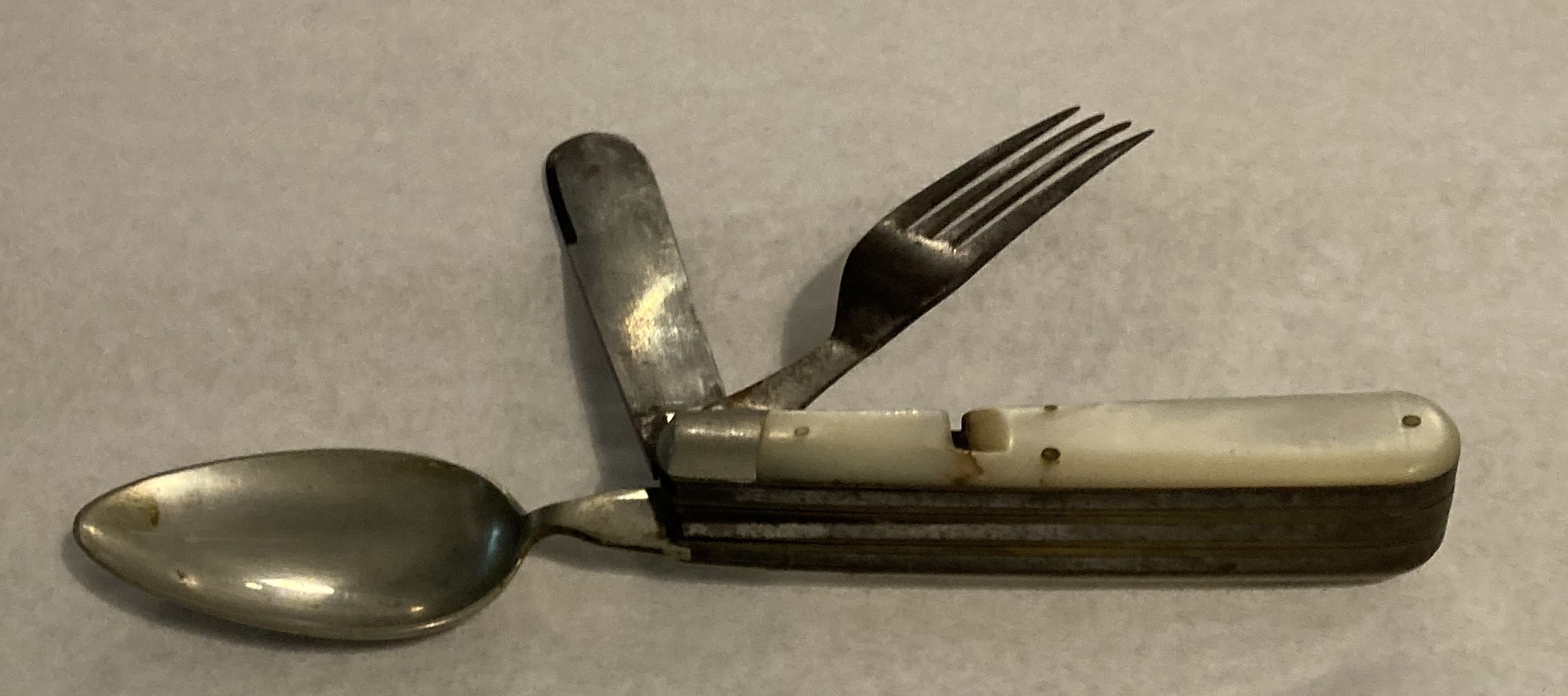
-- Knife/ fork/ spoon set Lemon took from a dead Federal soldier on the battlefield of Salem Church in Virginia, May 1863. He wrote in his memoir: “That evening, as we rested near the church, I had occasion to walk the field nearby. The ground was fairly strewn with every conceivable article of war, hundreds of Yankee dead and wounded lay everywhere, as well as scores of muskets, bayonets, accouterments of every type, haversacks and canteens ... As for myself, I allowed myself but one trophy, a nice little penknife with several blades and attachments, which an unfortunate Yankee corporal would no longer need. (It afterwards served me well and I have it still.”

-- Union canteen (below) Lemon picked up in the Wheatfield at Gettysburg after his own canteen had been ruined by a bullet (a Yankee bullet hit the canteen, and it struck the head of Lemon, who thought he had been shot). The strap bears Lemon's initials, date and initials of the dead 4th Michigan soldier from whom he got it.

(Picket photo)
-- Drum captured from two frightened young Pennsylvania drummer boys the day before the Battle of Sharpsburg (September 1862). Lemon tells the story of its capture by Pvt. Frank A. Boring in his memoir. The drumhead bears Boring's name in ink. This is James Lemon's handwriting, as indicated by pages in the diary and maps of battles shown in the memoir, according to Jones.  

Lemon wrote Pvt. Boring's name into drumhead (Picket photo)
Here is Lemon’s colorful account of the drummer boys, as written in his memoir:

“On the evening of the 16th our briggade was ordered to form line of battle & we advanced into a cornfield & into a piece of timber where we met almost by accident a force of the enemy. We drove them with style back through the woods, capturing some Yanks from the 1st & 3rd Penn'a Reserves. Among this bunch were a couple of drummer-boys, about 12 or 13 years old who were trying hard to "put on a brave face," but who were clearly terrified.

"Col. Ruff ordered their drums confiscated & then released as we were not equipped or inclined to care for children. Our drum had been damaged & thrown away at Groveton, so we took theirs as "spoils of war." Private Boring captured the boys. As he was driving them to the rear at point of bayonet they heaped so much abuse upon him -- out of their fear or nervousness -- that he had to be restrained from striking them with the clubbed musket.

"Of course, instantly the target of many wags among our company who joked with him about "scaring little boys" & etc. He replied that he would be d---d if he'd take such abuse from "d---d Yankee whelps." The boys were release(d) & "beat a hasty retreat" back to their lines, with Boring giving them a rite hard look as they went.”

One of James Lile Lemon's journals (Picket photo)