Showing posts with label maryland. Show all posts

Monday, December 22, 2025

Old-school cool: Monocacy's electric map has retired but will still have a use. The new digital version in revamped museum has more bells and whistles, sans nostalgia


People of a certain age (myself included!) remember visiting battlefields or museums in their youth and gazing in wonder at electric maps, which had topographic features and blinking lights showing troop movements. It was all so mesmerizing.

Well, time and newer technology eventually overcame these delightful displays. Replacement parts and folks who could make repairs became harder to find.

While many long ago were retired, the upstairs electric map at Monocacy National Battlefield near Frederick, Md., operated until the museum closed for a significant renovation. (Above, Picket video of map in August 2024).

The recently reopened museum about 45 miles west of Baltimore has a high-tech map that tells a wider story and is not prone to breaking down (at least so far).


Derek Schaerdel (above, NPS photo)) of Troop 1812 in Frederick built a display case and rolling tabletop for the old electric map. He did this as his Eagle Scout project, the park said in a recent Facebook post.

Park officials said they will touch up the map and use it as an orientation piece (more below). It will no longer be electrified, but it can be wheeled into different areas of the visitor center.

At Monocacy on July 9, 1864, outnumbered Federals delayed Confederates bent on taking Washington, D.C. By the time Rebel troops reached the capital’s outskirts, Union reinforcements had arrived. 

Ranger Matt Borders answered the Picket’s questions about the old and new maps. His emailed responses have been edited for brevity and order.

Q.  How old is this old map? Has it always been on display till the renovation?

A. The old map was part of the new museum when the visitor center opened in 2007. There have been times through the years when it wasn't working until we could find someone to work on it, which wasn't easy. Lights were changed over to LED, the guts were rewired or redirected.

We had a retired NASA volunteer work on it at one point and contracted with another company to give it a bit of an overhaul. For that type of technology. 18 years is a pretty good run. The new program won't have that issue. (Map in 2024, Picket photos)

Q. Did it occasionally "break down" -- lose lights? Will the new presentation eliminate that kind of thing?

A. The former map was 18 years old and was feeling its age. While most guests would not have noticed it, there were parts of the program that had stopped working and were not able to be repaired. 

The larger problem (was) the parts for the old map were no longer available, specifically the specialized light bulbs that the fiber optics used. 

Q. What are the tradeoffs of the "new" map vs. this one?

A. Not only does the new map program cover more of the overall campaign but includes aspects of the battle that had not been covered previously, such as the fighting near Jug Bridge north of the National Park Service property. 

The biggest benefit is that the program is now digital and is not restricted by a physical map board. The program can be run on other displays, making it more flexible and less technical for repairs. If a screen stops working, we can have that looked or replaced, as opposed to changing lighting and timing belts that would have to occur with the previous map.

Q. Can you please describe the new map presentation?

A. The digital map presentation is a push button start and lasts for 10 minutes. It is narrated with accompanying, music and sound effects. The narration is also close captioned. (NPS photo, left)

The new program is closer to a movie than the previous presentation and uses two large flat screens to present it. This program follows (Confederate) Lt. Gen. Jubal Early's Army of the Shenandoah District north, through the Shenandoah Valley to Harpers Ferry and then over the Potomac River into Maryland. Concurrently, the map program shows the movement of Federal forces, once they are aware of the threat, reacting to the Confederate incursion from both Baltimore and, eventually, the Petersburg front. 

The program then zooms into the battlefield itself showing the movements of the troops across the landscape, as well as the eventual retreat of United States forces from the field. The program then concludes by showing the Confederate movement continues toward Washington and the eventual retreat to Virginia.  

Q. The post said rangers will touch up and add to the electric map. What specifically? How will it be used in the future and where?

A. The map is old and dinged up. We want to touch up the paint and the terrain features for future use. (It) will no longer be an electric presentation and instead will be a giant topographic map of the battlefield that will be utilized for orientation programs, school visits and the like. 

This will assist the rangers with a visual element they can use when explaining the battlefield landscape and how the battle progressed, especially when they are not on the battlefield itself.

Matt Borders and Derek Schaerdel with old electric map (NPS photo)

Thursday, November 20, 2025

An inside look at how Monocacy's new museum has taken shape: Better technology and overlapping stories of soldiers, civilians and the Maryland landscape

The story of Monocacy, the battle and its people, is told in an upstairs museum (NPS photos)
Having weathered delays, a broken air conditioning system and the government shutdown, staff at Monocacy National Battlefield near Frederick, Md., are putting the finishing touches on exhibits in the park’s revamped museum.

The museum is undergoing a soft opening currently …We still have a few pieces to put out and some cosmetic elements to finish in-house,” park ranger Matt Borders said in e-mail to The Civil War Picket on Thursday.

The exhibits are upstairs in the visitor center.

The museum closed late last year for a long-overdue overhaul. Revamped exhibits are telling a wider story than when the old iteration opened in 2007, officials said.

"What is currently up are the big exhibits, the digital program, etc., that were done by the museum exhibit contractors and (look) really nice," Borders said of the new offerings.

The new museum themes include, combat, terror and tedium, care for the wounded and civilian-military interaction.

Their stories overlap and those relationships are important to the story of Monocacy, and we want to focus on more personal stories,” said Tracy Evans, chief or resource education and visitor services.

Borders said reviews from visitors who have seen the new exhibits since the shutdown ended have been positive. One big change is a new map of the battle and troop movements. It will be projected onto a white surface rather the old physical map that sometimes had broken parts.

At Monocacy on July 9, 1864, outnumbered Federals delayed Confederates bent on taking Washington, D.C. By the time Rebel troops reached the capital’s outskirts, Union reinforcements had arrived. 

The staff shared three photos showing the phases of the work and Borders provided details, told in chronological order.

DECONSTRUCTION


Last December, Monocacy National Battlefield staff, along with staff from the Harpers Ferry Training Center, began the deconstruction of the visitor center museum. The museum space and exhibits were nearly 20 years old, so it was time for an upgrade. The removal of the central island in the museum, which had housed the electronics for the previous museum, opened up the floor plan and will allow guests to move much more freely around the space. We have also opened up the overheard, making the museum space brighter and utilizing the architecture of the building. 

TIME FOR DRYWALLING


While the center of the room was opened, we have also pushed out the walls, particularly on the east side of the building. This additional space will allow the new museum to focus more on the Monocacy Campaign than the previous museum had been. To do this. we will have several themes utilized throughout the museum, looking at not only the soldiers of the American Civil War, but also the civilian stories of the farms and those of the enslaved that worked the farms. 

PAINTED WALLS, READY FOR CARPET


With new paint and very shortly to have new carpets, the museum has really been coming together. One of the big questions we have received throughout this process has been, "Will you still have the electric map?"

Yes, sort of. The fiberoptic map was at the end of its life, so the entire map program has been redone and expanded upon. It will be located in the center of the museum now, to better accommodate guests, especially in large groups and will be on two large display screens to provide easy viewing and closed captioning. 

Wednesday, November 20, 2024

This ID tag belonged to a Ohio private who likely died at Monocacy. The battlefield in Maryland will display 3 disks on a rotating basis after its museum overhaul

The Edward Mathess tag (NPS) and ranger Matt Borders with photo of Gen. Wallace
In early July 1864, the 126th Ohio Volunteer Infantry and other regiments were rushed from Petersburg, Va., to Baltimore and then Frederick, Md., in a desperate attempt to blunt Confederate Lt. Gen. Jubal Early’s move on Washington, D.C.

The 126th OVI, part of Ricketts’ Division, subsequently put up a furious fight on July 9 at Monocacy, repelling at least one attack in the heart of the battle. The outnumbered Federal army, under the command of Maj. Gen. Lew Wallace, eventually was pushed off the field, albeit buying time for more reinforcements to reach and save the nation’s capital.

Among the scores of 126th OVI casualties was Pvt. Edward Mathess, Company B, listed as missing in a newspaper article and in the regimental history. (The 126th was formed in Belmont County in September 1862)

I learned about Mathess this past summer during a visit to Monocacy National Battlefield, a beautiful park set among western Maryland farms and a busy highway. There, I asked the staff (curator Brian Robinson, left, Picket photo) to show me identification badges that belonged to soldiers who fought there.

The U.S. military did not provide dog tags during the Civil War or have any formal way of tracking the status soldiers beyond roll call. Sometimes, soldiers would write their name on paper and pin it to their uniform before going into action.

Those who could afford it bought metal tags with their names so loved ones would know their fate should they die in battle.

Robinson, wearing white gloves, brought the boxed artifacts to a counter. I was familiar with two tags, having written about Pvt. Samuel M. Weigel (below) and Sgt. Nicholas G. Wilson of the 138th Pennsylvania

But I was unaware of the corroded metal disk for Mathess. One side shows an image of Union general George B. McClellan and the words “Union and Liberty.” On the reverse is stamped “E. Mathess, Co. B, 126 REG OVI.”

The three disks have not yet been displayed in the visitor center’s upstairs museum, which is closing in early December for a long-planned overhaul. "Everything is getting torn down," said Tracy Evans, chief or resource education and visitor services. The goal is to reopen the museum in April.


Evans said she expects the ID tags will be displayed on rotation once the museum reopens.

What we know about the Edward Mathess tag

Park officials believe Mathess died at Monocacy. I wonder when the Ohio private became separated from his ID tag. We’ll likely never know.

But I got a few details from Lynn Bristol, president of the Monocacy National Battlefield Foundation, a nonprofit that supports the park. The foundation purchased the disk for $1,500 in March 2023. It was described as very rare and possibly made from pewter.

The most intriguing part of the sale and packaging of the item, to me, was the word “excavated.”

Did someone dig this up on the battlefield before the park was established in 1934? Even then, many parcels had not been acquired. The Thomas Farm, near where the 126th OVI fought, wasn’t purchased until 2001, when it then gained federal protection from relic hunting.
Dealer packaging for the Mathess tag (Monocacy National Battlefield Foundation)
Cal Packard, owner of Museum Quality Americana, told the Picket in an email he doesn’t have record or notes on the Mathess tag he sold to the foundation. “As I recall, that was one of 20 or so ID (tags) that we offered from a lifetime collection.”

Joe Stahl, an ID disks collector and author on the subject, told the Picket the tags were effective in identifying a killed comrade.

In “Forty-Six Months with the Fourth R.I. Volunteers,” Cpl. George H. Allen of Company B wrote about finding a casualty at the Battle of the Crater (Petersburg) in 1864, said Stahl.

Comrade Thomas Arnold and myself made our way out to the field in search of any dead or wounded of our company,” Allen wrote. “The dead were then unrecognizable, except by medals or letters found upon them. -- We found Augustus T. Thornton of our company --- I removed what few trinkets he had about him, and his medal, and a few days after sent them home to his father.”

Photo and ID tag of KIA Cpl. Alvin Williams of the 11th New Hampshire (Library of Congress)
It’s hard for Americans to understand the chaos of mass casualties and trauma during the Civil War.

I asked followers of the Authentic Campaigner Facebook page to explain why so men were listed as missing. Their take: Some men were taken prisoners, some wandered off in shock for some time or became stragglers, while others were obliterated by artillery fire. Others might be hospitalized or trying to escape capture.

“Keep in mind battles are confusion, and the reports are taken in the aftermath,” said one respondent. “Some men saw one thing, some saw another. And in the follow up the NCOs and officers are filling reports based usually on the men’s response to roll call. If no one came forward saying they saw x,y,z happen that soldier is ‘missing.’”

Tags were affordable, a way to leave behind a name

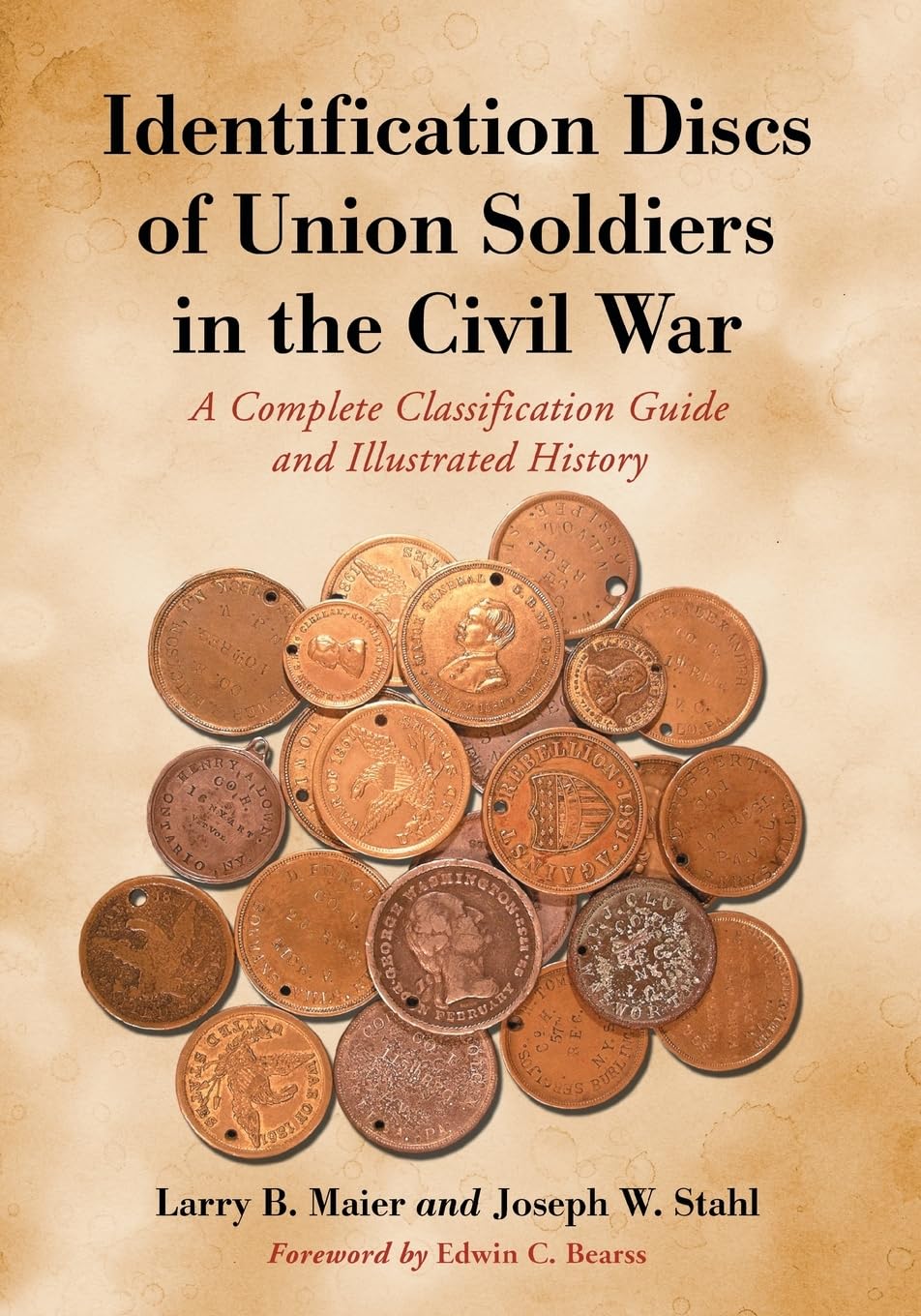
Stahl co-authored with Larry B. Maier the 2010 volume “Identification Discs of Union Soldiers in the Civil War.” They detailed 49 designs, including eagles and patriotic motifs, sold by vendors at camps and elsewhere.

The first thing to note, he said, is such disks were not available to Southern soldiers. Brass was too coveted and used solely in artillery and other military purposes.

Coin and token manufacturers such as Scoville could turn out discs for 5 cents to 10 cents, with a design on the front. They were probably sold to soldiers for less than 50 cents. One side was left blank so sutlers could stamp the buyer’s name and unit. A hole was typically drilled in at the bottom for a string or rawhide. Soldiers sometimes bought two; they wore one and sometimes sent one home as a love token.

Higher-end, more expensive tags made of silver were generally sold to officers. They were often engraved.

Stahl, who has about 110 ID badges, said he began collecting in the early 1980s. The items were affordable while manuscripts and signatures became expensive. 

Legendary Civil War historian Ed Bearss encouraged Stahl to submit articles about individual soldiers and disks to Gettysburg Magazine.

“When I started buying they were a couple hundred bucks.  If you can find something (today) less than $1,000 you are doing good,” said the collector. (At left, reverse of Sgt. Wilson pin at Monocacy, Picket photo)

Stahl warns buyers to be wary of counterfeits.

“The thing that is usually a dead giveaway for a modern reproduction is the fonts on the letters are incorrect.”

He mentioned the letter F as an example. While the originals have a line for the short bar of the letter, forgers might get lazy and punch a small triangle instead. Stahl’s also known of one soldier’s name appearing on tags for different regiments.

Ohio soldier's fate, family history are unknown

Besides digging deeper into ID disks, I wanted to know more about Mathess – but I did not get very far. The 1860 census lists a 25-year-old Edward Mathess from Ross County, Ohio. His occupation is listed as engineer.

Listed with him is a young woman, Notura Mathess, 17, Idia, 1, and William, a baby. I assume they were a family. The only other document I came across was an 1890 military pension request by his father, Obijah (right). I could not glean anything about these individuals.

Edward enlisted in August 1862 for a three-year term. An 1888 volume about Ohio soldiers in the “War of Rebellion” only says he was missing. “No further record found.”

I wondered: Did Edward fall on the battlefield and his remains never found? Was he buried elsewhere? Or did he somehow survive? The latter seems unlikely.

Pvt. Mathess is listed as missing at Monocacy in regimental history, with no further mention
“It is always possible that there are still partial remains on the battlefield, however the vast majority of the dead were removed from the field and buried in Mt. Olivet Cemetery here in Frederick shortly after the battle,” said Monocacy ranger Matt Borders. “The Confederate dead remain there to this day. The Federal dead were disinterred and reburied in Antietam National Cemetery in 1866/67 in time for the opening of the National Cemetery in 1867.”

Mathess does not appear in the roster of Antietam National Cemetery, so most likely he is one of the 1,400 unknowns buried there, Borders told the Picket.

Foundation bought 2 tags, photo of Confederate officer

Bristol said the foundation has purchased two tags – Weigel and Mathess -- and a CDV image of Confederate Col. William Raine Peck, who also fought at Monocacy.

Robinson said the colonel was at Monocacy with Hays’ Louisiana Brigade. “He would have been part of the main effort under Gen. John Brown Gordon's division that assaulted the Federal flank and forced a retreat.”

The image (right) was not signed.

“Given the paucity of Confederate artifacts overall, it is my humble opinion that the Peck CDV is well worth its price, quite possibly appreciating in value as time goes by,” said Bristol.

The tags and Peck photo are in the park’s collection.

“Matt Borders is a sleuth in identifying objects of interest and he has directed us toward those items. I myself am a collector of letters and prints: three letters I own are from Grant, Sherman and Lincoln, respectively,” Bristol wrote in an email.

Wilson’s ID tag was made of silver and Weigel’s made of brass. Vendors who sold these disks priced them on a sliding scale to meet a soldier’s income: Silver, brass to other/pewter, said Bristol.

Upstairs museum finally getting a refresh

The two-story visitor center at Monocacy National Battlefield opened in 2007 and the upstairs museum is due for a refresh, with enhanced technology. Park officials said the museum will  close after December 3 for several months.

One big change will be a new map of the battle and troop movements. The map "will be a projection onto a white surface. Then we don't have to worry about specialty parts breaking that are no longer made," said Evans

The park has made repairs on the feature (Picket photo, left) over the years but it is near its end of life. “We are looking into a second life for the topographic portion of the program. Other elements of the museum that involved any type of technology, which includes at least five exhibits, no longer work," said Evans.

The new map will physically be more accessible. "We are including the action at the Jug Bridge into the battle map as well,” Evans told the Picket. 

The revamped  exhibits will tell a wider story, officials said.

 “We will be focusing on both the civilians and soldiers who were here throughout the Civil War and specifically the day of the battlefield,” said Evans. “Their stories overlap and those relationships are important to the story of Monocacy, and we want to focus on more personal stories,” she said.

Robinson pointed out people were forced at act quickly when war came to Monocacy Junction. That included fleeing to a basement or cellar, hiding valuables and sending away livestock and horses.

The park also focuses on free and enslaved African-Americans whose lives and actions were integral to the battle and the Civil War as a whole. A recruiting station for the U.S. Colored Troops was established at Monocacy Junction.

Among the signature items in the museum are a bullet-struck Bible, a captured Confederate battle flag, Union Maj. Gen. Lew Wallace’s frock coat, cavalry items, an engraved musket and a frock coat worn by the 14th New Jersey’s Maj. Peter Vredernburgh Jr., who survived Monocacy but died two months later at Third Winchester.

"Certain elements, such as the tent/field office set up, and Glenn Worthington watching the battle through the boarded-up windows will be integrated back into the exhibit," said Evans.

The Monocacy visitor center is currently closed on Tuesday and Wednesday.

Friday, April 19, 2024

Andrew Banasik named next superintendent at Antietam National Battlefield

Longtime Civil War history enthusiast Andrew Banasik next month will become superintendent of Antietam National Battlefield in Maryland.

“I'm humbled to be chosen to care for such a consequential treasure of American history,” Banasik said in a news release. “I'm excited to bring my passion for caring for park staff and resources, serving our visitors and partnering for the future.” He starts May 19.

The National Park service tallies 22,720 men on both sides killed, wounded or missing/captured at the Battle of Antietam on Sept. 17, 1862, making it the bloodiest single day in U.S. history.

Banasik will move from a similar position at Monocacy National Battlefield, about 25 miles away. He has had a couple stints at that Civil War site near Frederick.

NPS regional director Kym A. Hall touts Banasik’s 25 years of park experience.

“At Monocacy, he integrated the park’s natural and cultural resources management programs, and preserved and protected historic structures, archeological sites, historic landscapes and wildlife habitat,” Hall said in the release. “He also expanded recreation opportunities by improving trails and park view sheds. I believe he will bring that tenacity and creative problem solving to his new role at Antietam.”

Banasik has also worked at Catoctin Mountain Park in Maryland and for the National Capital Region Exotic Plant Management Team.

Wednesday, April 10, 2024

At Andersonville and elsewhere, crossing the 'deadline' meant death. Whatever the number of incidents, the existence of these barriers kept men in line

A.J. Klapp's drawing of a deadline shooting at Andersonville (Brown University Library)
Before the word deadline became synonymous with getting something done by a specific time, it was associated with a deadly feature of Civil War prisons. A captive crossing the deadline risked death, and there are instances of guards on both sides shooting them.

The deadline was intended to prevent the prison’s growing population from getting too close to the stockade wall, making escape more difficult. It was also supposed to reduce fraternization and trading between the prisoners and guards, according to the National Park Service.

Andersonville National Historic Site on Sunday marked the 160th anniversary of the completion of the deadline at the site (April 7, 1864). Stockade commander Capt. Henry Wirz had made this a priority.

The light railing was made from posts 3 to 4 feet long and driven into the ground. Horizontal pieces of wood topped the design, which was roughly 18-19 feet inside the stockade wall.

Confederate guards in sentry boxes kept a sharp eye for POWs who extended any part of their body past the deadline. (Not all camps had such features).

The first Union POW to die at Andersonville for crossing the deadline was Caleb Coplan (Copeland), a young Ohioan shot just two days after it was completed.

The prisoner was wandering the northeast corner of the stockade, apparently in search of material to patch his shelter or clothing, wrote William Marvel in “Andersonville: The Last Depot.” (Photo at left courtesy of John Banks' Civil War Blog)

“Something under the dead line caught his eye -- a scrap of flannel, some said -- and he ducked under the line to retrieve it. The guard brought his cumbersome old smoothbore to his shoulder and let fly with a charge of buck-and-ball. The range was too short to miss, and the .75-caliber ball bored through Coplan’s breast near the heart. Onlookers carried him to the hospital tents a few yards away, where he died the next day -- the first man killed at the dead line.” (Photo below of his grave at Andersonville courtesy of Kevin Frye.)

There would be more to come, at Andersonville and other prisons. Archaeology at Camp Lawton near Millen, Ga., has uncovered two Confederate bullets possibly fired at captives.

Those who have researched these prisons express caution about try to tabulate the number of shootings at the deadline.

Prisoners often exaggerated the number; at Andersonville this claim amounted to hundreds. “Sometimes this was done on purpose and sometimes they were simply mistaken or remember incorrectly,” says Teri A. Surber, park guide at Andersonville.

Regardless of where they occurred, shootings at the deadline had a profound psychological impact on POWs.

Surber and Michael Gray, a history professor and author of “Crossing the Deadlines: Civil War Prisons Reconsidered,” said Union prisoners might receive more pension money by showing they suffered during confinement. There was an incentive to lie about being a prisoner or witnessing horrific incidents, they say.

Bob Crickenberger, president of the Friends of Point Lookout (a Union prison in Maryland), said people should be leery of  hearsay stories told years after the war, particularly those that begin with, “I was told”, “I heard,” or “it’s been said.”

“Unless a prisoner was there and was an eyewitness to the shooting, and there were many witnesses, should (a story) be taken as truth. Kind of like all those folks that said Sherman burned their farms when they were miles out of the way when he came through.”

Was this .57-caliber bullet fired at a POW at Camp Lawton? (Georgia Southern U.)
Gray notes that in the last two years of the war, prisoners were often manned by older, extremely young or disabled soldiers and training was an issue. “You are going to send the best men to the front.”

By any measure, life in a Civil War prison was marked by privation and despair. Matters worsened after prisoner exchanges ended by mid-war, resulting in a huge increase in camp populations on both sides.

Between the skill of the guards and the desperation of prisoners, there are documented cases of shootings at the deadline or elsewhere in a camp. Firm numbers are impossible to ascertain, but here’s a look at several, including Elmira, Camp Lawton and Point Lookout:

ANDERSONVILLE/CAMP SUMTER (Georgia – Confederate camp)

A.J. Riddle photo of prisons in August 1864 (Library of Congress)
At Andersonville alone, nearly 13,000 men died over 14 months – an average of more than 30 a day in that span. (Overall, 30,000 Union and 26,000 Confederate soldiers died in captivity during the Civil War). A relative few were shot by guards.

Drawings of men being shot at the deadline were widely reprinted in Northern newspapers, and today, the term is almost synonymous with Andersonville prison,” according to the NPS.

Surber said there are eight documented cases of a guard shooting a prisoner.. A firm number will likely never be known.

"The only time guards shot at prisoners was when they crossed the deadline or if someone near them crossed it. There is an instance where a man reached over the line to get something, and the guard accidentally shot the man sleeping next to him," the park guide says.

(If someone had a gunshot wound from a battle, they were usually listed as having died of "wounds.")

“One confirmed shooting that I would say was the (wounding) of a man the prisoners called ‘Chickamauga.’ Robert Kellogg and several others wrote about the incident in their diaries or memoirs and also testified about it during the (Henry) Wirz trial. Another is Pvt. William Stewart, 9th Minnesota Infantry, whose cause of death is recorded as ‘gunshot.’"

During the trial, prisoner George Gray testified that Wirz himself shot Stewart and took some money from him. Wirz (left) denied anything to do with Stewart. “There were rumors that guards were given a 30-day furlough for shooting a prisoner, but there is no actual evidence of that,” Surber says, adding there is no evidence Wirz shot prisoners.

Albert Harry Shatzel of the 1st Vermont Cavalry wrote that he saw a shooting at the deadline.

“One of the poor Boys shot dead by Guard while geting a cup of watter,” Shatzel wrote, according to Civil War blogger John Banks. “The Ball passed through his head. He stuck his head under the Dead Line to get some watter but he will never go there again. Dam the laws of such men as those are hear for they consider it an honor to murder a man …all in all they are not to blame for they a Furlough of 35 days for every man they kill.”

Surber provided a list of the rare successful escapes at Andersonville.

None of the 33 dug out from the inside; they were already outside or on a work detail when they made a break for freedom.

The answer to how many were shot while trying to escape is fairly easy,” Surber says. “None, as far as we know. All eight of these men were shot for crossing the deadline and were inside the prison. Of course, it is possible that someone could have been shot while trying to escape, as would be the practice of the day, but there is no way to know for certain.”

(Photo above, re-creation of POWs arriving at Camp Sumter / NPS)

CAMP LAWTON (Georgia – Confederate camp)

POW Robert Knox Sneden's map shows deadline and sentry boxes (Library of Congress)
Camp Lawton operated for about six weeks in the fall of 1864. Prisoners were sent from Andersonville amid worries Union raiders would try to liberate the camp. Of 10,000 troops held at Lawton, at least 750 Federal soldiers died.

Ryan McNutt, director of the Camp Lawton archaeological project at Georgia Southern University, said historical sources are not complete enough to come up with a full count of POWs shot by guards.

“As ever, there are confused and scattered references,” he tells the Picket. “(POW John) McElroy states that he couldn't recall anyone being shot at Lawton for crossing the deadline, and he raised it as a curiosity since every other camp he was at had at least a few instances of executions by guards. However, Cpl. Aldrich said, ‘Once in a while the guards would shoot a poor fellow just to keep his hand in it, still, there was not as much shooting as at Andersonville. One poor fellow was shot within 10 feet of my tent one night and he was not within 10 feet of the deadline.’"

John K. Derden, author and professor emeritus of East Georgia College, said while there are diary accounts mentioning shootings, he found only one incident that was seemingly corroborated. Regardless, there were fewer shootings than at Andersonville.

James Vance wrote in his diary for Nov. 6, 1864). “2 men shot 1 killed. The first ones.” Sgt. Amos Yeakle wrote in his diary the same day, “There was one shot dead by the guard and one wounded for getting over the dead-line.”  

Work more than a decade ago at Confederate barracks area (GSU)
Derden, author of “The World’s Largest Prison: The Story of Camp Lawton,” contends prisoners might hear a guard firing to clear a musket and assume the round was meant for a Federal soldier.

“As for the climate in the prison, I believe that things were a bit less fractious because of the lack of overcrowding, the water situation that allowed prisoners to bathe and even swim, and (at least initially) the somewhat better food supply. Also, Commandant Vowles was generally well liked by the prisoners as opposed to their bitter attitudes toward Wirz at Camp Sumter.”

Regarding the deadline, archaeology seems to indicate about a 30-foot clear space between shebang remains and the wall, says Derden.

McNutt said students have recovered at least two Confederate bullets that may have been fired at the inside of the Lawton stockade. The team in early 2023 found a poorly cast ball, likely fired from a Springfield Model 1842 percussion cap musket (photo below, courtesy of Camp Lawton project).

Produced in large numbers, and floating around most of the arsenals in the South, these were still used despite the lack of accuracy and range in both the front lines and on the home front by militia. With a maximum range of 365 meters, and an average effective range from 90 to 275 meters, the location of the ball is well within range of the guard towers. And while most of the POWs at Camp Lawton recalled few instances of guards shooting POWs, our fired musket ball, along with other fired rounds from previous work inside the stockade, is a sobering reminder that Lawton still had many ways to die,” the professor writes.

Students led by Lance Greene, his predecessor, in 2010 found a spent .57-caliber bullet at the stockade. The round “has clear signs of rifling from being fired: deformation on the tip seems to show it only striking sand, though this doesn't preclude it having impacted a human,” McNutt says

Later analysis showed three groves and a right-hand twist indicating it was probably fired from a Pattern 1853 Enfield rifled musket. “Deformation on the nose matches experimental archaeology of impacts into soft surfaces, like sand or loamy soil,” according to McNutt. 

ELMIRA (New York – Union camp)

Confederate POWs at Elmira (Library of Congress)
Elmira did not have a deadline, even though it was a stockade prison. The camp was dubbed “Hellmira” by prisoners because of its 24 percent mortality rate. Gray said there are records of a Union guard shooting a Confederate prisoner.

According to the Star Gazette newspaper, Granville Garland shot A.P. Potts of the 38th Georgia Infantry during a July 31, 1864, disturbance. Potts survived.

Inmates at Elmira weathered hunger, illness and melancholia and, even worse, exposure to the cold weather, according to the National Park Service.

POINT LOOKOUT (Maryland – union camp)

(Library of Congress)
The overcrowded prison saw 4,000 Confederate prisoners succumb to various causes, especially disease. Some were killed by guards, according to experts and histories. About 52,000 Union soldiers went through the prison.

The camp’s deadline was a ditch inside the prison approximately 15 feet from the parapet wall. The ditch was a foot wide by a foot deep.

Official records show African-American guards, some formerly enslaved, sometimes shot prisoners for crossing the deadline or trying to escape, says Gray. The prison is known for its racial tension.

“One commanding officer claimed that the black guards were more zealous than the white when it came to enforcement of prison regulations and were apt to fire first while calling for the corporal of the guard,” says Crickenberger.

He estimates 19 prisoners were shot and killed or wounded by white and black guards between November 1863 and August 1864 alone. Prisoners reported that there were instances where guards fired at prisoners without inflicting casualties. (Photo, Friends of Point Lookout)

“They shot frequently but missed more often than they hit,” Crickenberger says. “Regardless of the accuracy of the guard, such incidents kept prisoners on their toes making them wary and continually fearful of being shot either night or day.”

A Confederate prisoner drew notable watercolors of life at the prison, including interactions with guards. It should be noted that black POWs held at Andersonville faced discrimination from friend and foe alike.

The friends group has helped restore the fort, the southwest corner of the stockade and assists with living histories and demonstrations of camp life.

ROCK ISLAND (Illinois-Iowa – Union camp)

The deadline at Rock Island consisted of a series of white stakes (left, photo Rock Island Arsenal Museum) that were illuminated by lanterns at night, according to the NPS.

The barracks were enclosed by a stockade fence 1,300 feet long, 900 feet wide and 12 feet high. Sentry boxes were placed every 100 feet.

During the 20 months the prison was open, 1,960 prisoners and 171 Union guards died.

The North had reduced rations in retaliation for the treatment of Union prisoners at Andersonville. Conditions at Federal prisons often were deplorable.