Showing posts with label killed. Show all posts

Wednesday, August 19, 2026

The bedridden Widow Henry was killed by artillery fire in the chaos of First Manassas. The park now has her drop-leaf table that was struck by two bullets

Bullet damage along top of leaf and on pedestal (Manassas NBP) and ruins of home (Library of Congress)
The drums of war were beating in Washington, D.C., and the Confederacy’s Northern Virginia in late May 1861, when Hugh Fauntleroy Henry wrote home. His sister Ellen was living with their mother Judith at Spring Hill Farm at rural Manassas.

"Should troops be passing about the neighborhood, you and mother need not fear them, as your entire helplessness, I should think, would make you safe,” said the schoolteacher working in Alexandria, across the river from the capital.

He could not have been more wrong.

Two months later, the property was a maelstrom of ringing gunfire and accompanying bloodshed. The Civil War’s first great battle raged on Henry Hill, and Ellen and Judith were trapped in the middle.

Believing no civilians were inside, and firing upon Confederate sharpshooters, a Union artillery battery pulverized the home, fatally wounding Judith and wounding Ellen and Lucy Griffith, an enslaved girl. Judith Carter Henry, who was confined to bed, is considered the first civilian casualty of the war.

The 1870 rebuilt Henry House and the famous Henry Hill monument at Manassas (Picket photo)
Another casualty apparently was a drop-leaf table that belonged to the family.

“There are two bullets embedded in the table,” said Manassas National Battlefield Park museum specialist Jim Burgess. “One bullet bore a hole through the lower leaf and embedded in the central pedestal of the table while another bullet was stopped by the leaf but caused a crack in the entire length of the leaf along the grain."

The park was unaware of the table until last year, when a Vermont man reached out and asked whether it might be interested in purchasing the piece. Money was needed to pay for care for the table’s owner, said the friend, who had a power of attorney.

A typed note with the table provided details on its story. 

Park officials agreed to pay more than $10,000 for the antique.

 “It was a once in a lifetime acquisition,” added Burgess. “It certainly has plausibility.”

Sketch of Henry House by Capt. Leon Fremaux of the 8th Louisiana shortly after the battle
The curator hopes the table will one day go on exhibit with expanded information on the poor widow Judith Henry, who was 84 or 85 when she was killed.

“We certainly want to put it on exhibit once we have room for it,” said Burgess, adding that would require renovation to the visitor center and museum.

The provenance of the table is a little fragmented.

Like many historic items that turn up years later, the furniture has made a circuitous journey, including ownership by a renowned surgeon.

Henry House was in constant line of fire that day

Warder & Catlett map of First Manassas, note Henry House at center left)
The table likely originally belonged to Elizabeth "Betsy" Carter, daughter of Landon Carter Jr. of Pittsylvania house, and sister of Judith Carter Henry. 

When Elizabeth died in 1822, her home, Spring Hill Farm, and the table passed to Judith. Officials have not analyzed the wood furniture, which may date to the late 18th century.

Judith’s husband, Isaac, a surgeon who served with the U.S. Navy, died in 1829. A portrait, of Isaac now belonging to the park (right), hung in the home during the battle.

The afternoon of July 21, 1861, was pure chaos as Confederate and Union forces exchanged ground on Henry Hill. Union Capt. James B. Ricketts turned his guns on the home, trying to kill or chase off sharpshooters.

Legend has it that Judith had been carried earlier from the house on a mattress but brought back inside to the second floor to obtain some form of safety. It wasn’t enough

Amid a cascade of splinters, boards and shingles, Judith suffered a severe foot injury and other wounds from cannon fire. (For his part, Ricketts was wounded four times, captured and later exchanged.)

“The house was peppered by Confederate fire just as much as Union fire. We really don’t know for sure what” killed Judith, said Burgess.

According to a National Park Service archaeological report on the site, Pvt. Otho Scott Lee of the 1st Virginia Cavalry recollected assisting in burying the dead and collecting abandoned equipment on the battlefield.

"I then rode over to the Henry house where Mrs. Henry had been killed during the battle. I saw her dead body in the bed where she had been killed, with her family around her,” Lee wrote.  “During the battle a grape shot pierced the house and passed through her body, killing her instantly.”

Visitors to Manassas can see the small burial plot where Judith, Hugh and Ellen rest together. (NPS photo, left)

The mother’s headstone reads:

The Grave of Our Dear Mother

Judith Henry

Killed near this spot, by the explosion of shelling in her dwelling, during the Battle of the 21st of July, 1861. When killed she was in her 85th year and confined to her bed by the infirmities of age. She was the daughter of Landon Carter Sen., and was born within a mile of this place. Her husband, Dr. Isaac Henry, was a Surgeon in the United States Navy, on board the frigate Constellation, Commanded by Com. Truxton, one of the six Captains appointed by Washington in the organization of the Navy, 1794. Our Mother through her long life, thirty five years of which were spent at this place, was greatly loved and esteemed for her kind, gentle and Christian spirit."

Famous doctor took table in lieu of cash

 After Judith was killed and the Henry House suffered battle damage, the surviving members of the family found refuge at nearby Pageland. Their old homestead was picked over by souvenir hunters.

“The table and other valuables had to have been recovered from the house before it was completely destroyed the following winter,” said Burgess. “Hugh Henry and sister Ellen lived in a new house built in the 1870s on the site of the original Spring Hill house until their deaths in the 1890s.” Nephew Arthur Lee Henry then acquired the place.

Abdominal and gynecological surgeon Dr. Joseph Price at some point entered the picture. The Virginia native acquired the table prior to his death in 1911 as payment for services rendered on an unnamed member of the Henry family.

“It is uncertain whether he got the table from Hugh or from Arthur,” said Burgess.

Price, who was only 8 at the time of First Manassas, gained fame for his skills and advancement of surgical techniques. He later moved to the Philadelphia area. An article in the Buffalo Medical Journal after his death had this fascinating detail: (Price at right, Pennsylvania Academy of the Fine Arts) 

“For two weeks Dr. Price had been ill and was confined to his bed most of the time. The day of his death he was informed that a girl patient whom he had previously cared for had been received at his hospital suffering with appendicitis. He rose from his sick bed and did an appendectomy on this patient. Within an hour after the completion of the operation he complained of pain and informed his assistants that he was suffering with acute appendicitis and that an immediate operation was imperative. He superintended the preparations for the work and in a short time was operated. A few hours later he died not having recovered from the shock of the operation.”

Price was 58 years old.

The dining table passed to his daughter, Anne, and eventually to her second husband, Eric Renwick. Ann died in 1984. Eric survived her by 10 years and at some time he typed up an undated note about the table for a niece or nephew. He signed it “Uncle Eric.”

He incorrectly called Judith and Betsy “Henry sisters” – only Judith had that married name. Renwick describes Joseph Price as his father-in-law, though it is unlikely they knew each other; Eric was only 5 when the doctor died.


Renwick said the doctor was raised near Harrisonburg and operated up and down the region. “On one occasion he operated on one of the Henry’s. By this time they were short of funds and gave Dr. Price the table in lieu of cash.” The table was transported to Whitford, Pa., where the surgeon lived. (Click photo above to enlarge, Manassas NBP)

Renwick based his note on information passed down by Price and Anne. “I do not know when the table was made or who made it but knowledgeable people have told me that it was an antique in 1861.”

Vermont collector had a passion for antiques

Eric Renwick died in 1994; Burgess believes the table went to the niece or nephew and then to a Barre, Vt., resident whose business interests included a ski area and fuel companies.

He was a flea market and garage sale enthusiast as well as a noted local historian, the man’s February 2026 obituary says.

Marker at Henry Hill, the center of the Manassas battlefield (Shane Oliver, HMdb.org)
The 84-year-old was a respected antique collector and dealer in Vermont and the Eastern United States. His friend told the Picket he does not know how the collector got the table.

Manassas National Battlefield Park received the table in September 2025 and it remains in storage.

Eric Renwick concluded his note about the table with this line, which may one day come true:

“In several generations I feel that the table will be a museum piece.”

Wednesday, November 20, 2024

This ID tag belonged to a Ohio private who likely died at Monocacy. The battlefield in Maryland will display 3 disks on a rotating basis after its museum overhaul

The Edward Mathess tag (NPS) and ranger Matt Borders with photo of Gen. Wallace
In early July 1864, the 126th Ohio Volunteer Infantry and other regiments were rushed from Petersburg, Va., to Baltimore and then Frederick, Md., in a desperate attempt to blunt Confederate Lt. Gen. Jubal Early’s move on Washington, D.C.

The 126th OVI, part of Ricketts’ Division, subsequently put up a furious fight on July 9 at Monocacy, repelling at least one attack in the heart of the battle. The outnumbered Federal army, under the command of Maj. Gen. Lew Wallace, eventually was pushed off the field, albeit buying time for more reinforcements to reach and save the nation’s capital.

Among the scores of 126th OVI casualties was Pvt. Edward Mathess, Company B, listed as missing in a newspaper article and in the regimental history. (The 126th was formed in Belmont County in September 1862)

I learned about Mathess this past summer during a visit to Monocacy National Battlefield, a beautiful park set among western Maryland farms and a busy highway. There, I asked the staff (curator Brian Robinson, left, Picket photo) to show me identification badges that belonged to soldiers who fought there.

The U.S. military did not provide dog tags during the Civil War or have any formal way of tracking the status soldiers beyond roll call. Sometimes, soldiers would write their name on paper and pin it to their uniform before going into action.

Those who could afford it bought metal tags with their names so loved ones would know their fate should they die in battle.

Robinson, wearing white gloves, brought the boxed artifacts to a counter. I was familiar with two tags, having written about Pvt. Samuel M. Weigel (below) and Sgt. Nicholas G. Wilson of the 138th Pennsylvania

But I was unaware of the corroded metal disk for Mathess. One side shows an image of Union general George B. McClellan and the words “Union and Liberty.” On the reverse is stamped “E. Mathess, Co. B, 126 REG OVI.”

The three disks have not yet been displayed in the visitor center’s upstairs museum, which is closing in early December for a long-planned overhaul. "Everything is getting torn down," said Tracy Evans, chief or resource education and visitor services. The goal is to reopen the museum in April.


Evans said she expects the ID tags will be displayed on rotation once the museum reopens.

What we know about the Edward Mathess tag

Park officials believe Mathess died at Monocacy. I wonder when the Ohio private became separated from his ID tag. We’ll likely never know.

But I got a few details from Lynn Bristol, president of the Monocacy National Battlefield Foundation, a nonprofit that supports the park. The foundation purchased the disk for $1,500 in March 2023. It was described as very rare and possibly made from pewter.

The most intriguing part of the sale and packaging of the item, to me, was the word “excavated.”

Did someone dig this up on the battlefield before the park was established in 1934? Even then, many parcels had not been acquired. The Thomas Farm, near where the 126th OVI fought, wasn’t purchased until 2001, when it then gained federal protection from relic hunting.
Dealer packaging for the Mathess tag (Monocacy National Battlefield Foundation)
Cal Packard, owner of Museum Quality Americana, told the Picket in an email he doesn’t have record or notes on the Mathess tag he sold to the foundation. “As I recall, that was one of 20 or so ID (tags) that we offered from a lifetime collection.”

Joe Stahl, an ID disks collector and author on the subject, told the Picket the tags were effective in identifying a killed comrade.

In “Forty-Six Months with the Fourth R.I. Volunteers,” Cpl. George H. Allen of Company B wrote about finding a casualty at the Battle of the Crater (Petersburg) in 1864, said Stahl.

Comrade Thomas Arnold and myself made our way out to the field in search of any dead or wounded of our company,” Allen wrote. “The dead were then unrecognizable, except by medals or letters found upon them. -- We found Augustus T. Thornton of our company --- I removed what few trinkets he had about him, and his medal, and a few days after sent them home to his father.”

Photo and ID tag of KIA Cpl. Alvin Williams of the 11th New Hampshire (Library of Congress)
It’s hard for Americans to understand the chaos of mass casualties and trauma during the Civil War.

I asked followers of the Authentic Campaigner Facebook page to explain why so men were listed as missing. Their take: Some men were taken prisoners, some wandered off in shock for some time or became stragglers, while others were obliterated by artillery fire. Others might be hospitalized or trying to escape capture.

“Keep in mind battles are confusion, and the reports are taken in the aftermath,” said one respondent. “Some men saw one thing, some saw another. And in the follow up the NCOs and officers are filling reports based usually on the men’s response to roll call. If no one came forward saying they saw x,y,z happen that soldier is ‘missing.’”

Tags were affordable, a way to leave behind a name

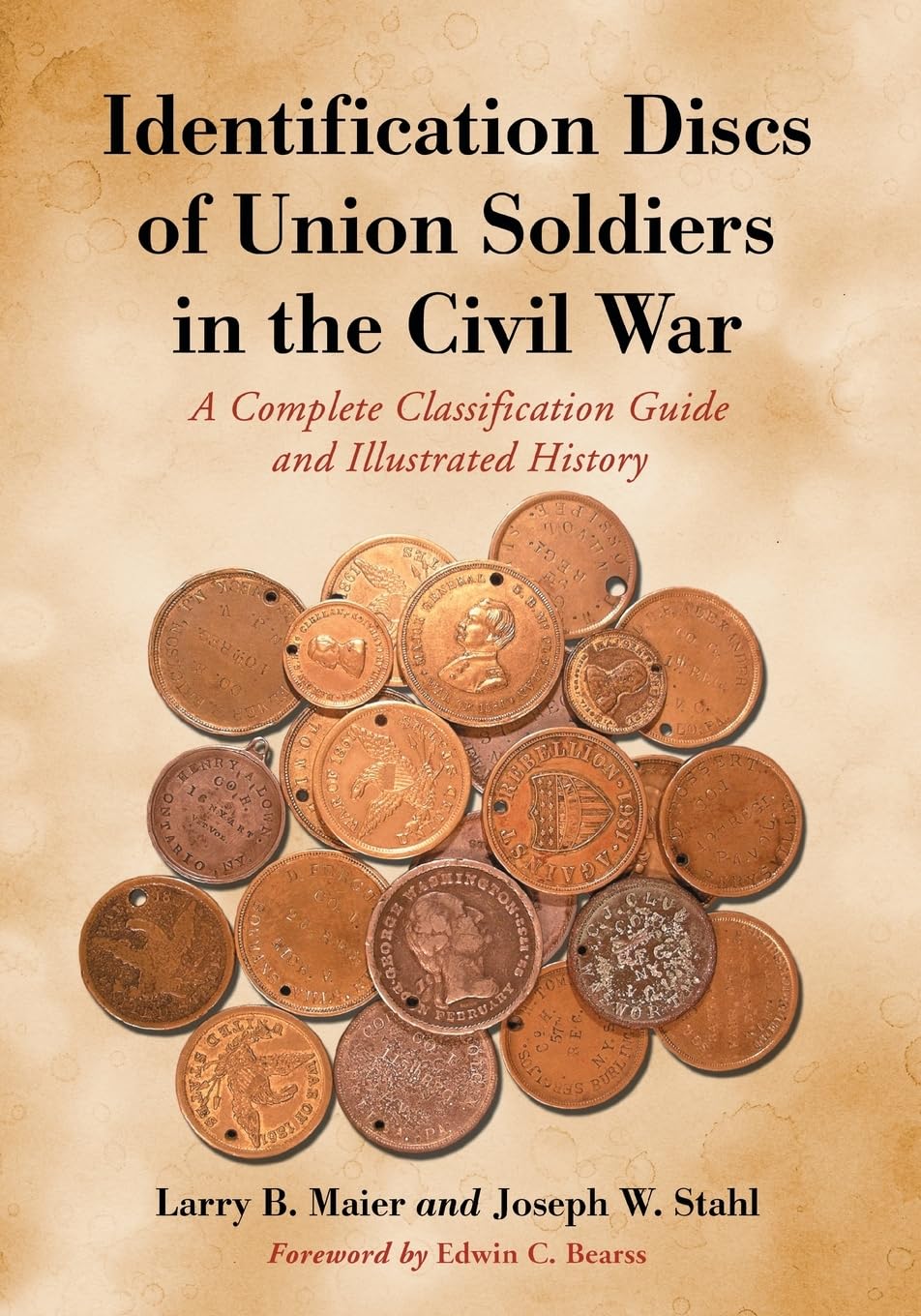
Stahl co-authored with Larry B. Maier the 2010 volume “Identification Discs of Union Soldiers in the Civil War.” They detailed 49 designs, including eagles and patriotic motifs, sold by vendors at camps and elsewhere.

The first thing to note, he said, is such disks were not available to Southern soldiers. Brass was too coveted and used solely in artillery and other military purposes.

Coin and token manufacturers such as Scoville could turn out discs for 5 cents to 10 cents, with a design on the front. They were probably sold to soldiers for less than 50 cents. One side was left blank so sutlers could stamp the buyer’s name and unit. A hole was typically drilled in at the bottom for a string or rawhide. Soldiers sometimes bought two; they wore one and sometimes sent one home as a love token.

Higher-end, more expensive tags made of silver were generally sold to officers. They were often engraved.

Stahl, who has about 110 ID badges, said he began collecting in the early 1980s. The items were affordable while manuscripts and signatures became expensive. 

Legendary Civil War historian Ed Bearss encouraged Stahl to submit articles about individual soldiers and disks to Gettysburg Magazine.

“When I started buying they were a couple hundred bucks.  If you can find something (today) less than $1,000 you are doing good,” said the collector. (At left, reverse of Sgt. Wilson pin at Monocacy, Picket photo)

Stahl warns buyers to be wary of counterfeits.

“The thing that is usually a dead giveaway for a modern reproduction is the fonts on the letters are incorrect.”

He mentioned the letter F as an example. While the originals have a line for the short bar of the letter, forgers might get lazy and punch a small triangle instead. Stahl’s also known of one soldier’s name appearing on tags for different regiments.

Ohio soldier's fate, family history are unknown

Besides digging deeper into ID disks, I wanted to know more about Mathess – but I did not get very far. The 1860 census lists a 25-year-old Edward Mathess from Ross County, Ohio. His occupation is listed as engineer.

Listed with him is a young woman, Notura Mathess, 17, Idia, 1, and William, a baby. I assume they were a family. The only other document I came across was an 1890 military pension request by his father, Obijah (right). I could not glean anything about these individuals.

Edward enlisted in August 1862 for a three-year term. An 1888 volume about Ohio soldiers in the “War of Rebellion” only says he was missing. “No further record found.”

I wondered: Did Edward fall on the battlefield and his remains never found? Was he buried elsewhere? Or did he somehow survive? The latter seems unlikely.

Pvt. Mathess is listed as missing at Monocacy in regimental history, with no further mention
“It is always possible that there are still partial remains on the battlefield, however the vast majority of the dead were removed from the field and buried in Mt. Olivet Cemetery here in Frederick shortly after the battle,” said Monocacy ranger Matt Borders. “The Confederate dead remain there to this day. The Federal dead were disinterred and reburied in Antietam National Cemetery in 1866/67 in time for the opening of the National Cemetery in 1867.”

Mathess does not appear in the roster of Antietam National Cemetery, so most likely he is one of the 1,400 unknowns buried there, Borders told the Picket.

Foundation bought 2 tags, photo of Confederate officer

Bristol said the foundation has purchased two tags – Weigel and Mathess -- and a CDV image of Confederate Col. William Raine Peck, who also fought at Monocacy.

Robinson said the colonel was at Monocacy with Hays’ Louisiana Brigade. “He would have been part of the main effort under Gen. John Brown Gordon's division that assaulted the Federal flank and forced a retreat.”

The image (right) was not signed.

“Given the paucity of Confederate artifacts overall, it is my humble opinion that the Peck CDV is well worth its price, quite possibly appreciating in value as time goes by,” said Bristol.

The tags and Peck photo are in the park’s collection.

“Matt Borders is a sleuth in identifying objects of interest and he has directed us toward those items. I myself am a collector of letters and prints: three letters I own are from Grant, Sherman and Lincoln, respectively,” Bristol wrote in an email.

Wilson’s ID tag was made of silver and Weigel’s made of brass. Vendors who sold these disks priced them on a sliding scale to meet a soldier’s income: Silver, brass to other/pewter, said Bristol.

Upstairs museum finally getting a refresh

The two-story visitor center at Monocacy National Battlefield opened in 2007 and the upstairs museum is due for a refresh, with enhanced technology. Park officials said the museum will  close after December 3 for several months.

One big change will be a new map of the battle and troop movements. The map "will be a projection onto a white surface. Then we don't have to worry about specialty parts breaking that are no longer made," said Evans

The park has made repairs on the feature (Picket photo, left) over the years but it is near its end of life. “We are looking into a second life for the topographic portion of the program. Other elements of the museum that involved any type of technology, which includes at least five exhibits, no longer work," said Evans.

The new map will physically be more accessible. "We are including the action at the Jug Bridge into the battle map as well,” Evans told the Picket. 

The revamped  exhibits will tell a wider story, officials said.

 “We will be focusing on both the civilians and soldiers who were here throughout the Civil War and specifically the day of the battlefield,” said Evans. “Their stories overlap and those relationships are important to the story of Monocacy, and we want to focus on more personal stories,” she said.

Robinson pointed out people were forced at act quickly when war came to Monocacy Junction. That included fleeing to a basement or cellar, hiding valuables and sending away livestock and horses.

The park also focuses on free and enslaved African-Americans whose lives and actions were integral to the battle and the Civil War as a whole. A recruiting station for the U.S. Colored Troops was established at Monocacy Junction.

Among the signature items in the museum are a bullet-struck Bible, a captured Confederate battle flag, Union Maj. Gen. Lew Wallace’s frock coat, cavalry items, an engraved musket and a frock coat worn by the 14th New Jersey’s Maj. Peter Vredernburgh Jr., who survived Monocacy but died two months later at Third Winchester.

"Certain elements, such as the tent/field office set up, and Glenn Worthington watching the battle through the boarded-up windows will be integrated back into the exhibit," said Evans.

The Monocacy visitor center is currently closed on Tuesday and Wednesday.

Thursday, February 25, 2021

A lucky cannon shot killed the 'Fighting Bishop.' The officer whose battery fired it was killed by a sharpshooter days later

Rebel gun emplacements remain at memorial site (Picket photo)
He was called the “Fighting Bishop.” Lt. Gen. Leonidas Polk believed fervently in the Southern cause and the almighty and was known to conduct religious services between battles. On the morning of June 14, 1864, it was, therefore, not surprising that he knelt in prayer.

The Episcopal clergyman-turned-soldier had kept his headquarters for a few days at the George Hardage home near Kennesaw, Ga.

Hardage home near Kennesaw (Picket photo)
On that morning, the 58-year-old rode with Gen. Joseph E. Johnston --commander of the Confederate army trying to defend Atlanta -- to Pine Mountain. There, the officers met up with Lt. Gen. William Hardee. They wanted to check on a division they believed may have been placed too far forward.

Capt. Simonson
It was on this ridge that Polk’s destiny would intersect with that of Capt. Peter Simonson, commander of the 5th Battery, Indiana Light Artillery, which was among the horde of Federal units below the mountain.

Maj. Gen. William T. Sherman noticed the Southern generals on the ridge just 600 yards away. “How saucy they are,” he is reported to have said. The commander ordered Federal batteries to spring into action.

Simonson’s battery opened fire and after one shot went over the generals’ heads, a colonel urged them to move to the rear. Johnston and Hardee moved away, with Polk trailing.

“Two more shots came whining down in quick succession. One of these two … struck Polk in the left arm, ripped through his chest and tore his right arm before exploding against a tree,” author and historian Russell Bonds wrote in the May 2006 issue of Civil War Times. “He was blown back toward the crest of the hill, and lay with his feet toward the enemy. ‘General Polk is killed!’ the men in (Capt. Rene) Beauregard’s gun emplacement cried.”

News of Polk’s death spread quickly. The Union command intercepted wigwag messages that asked, “Why don’t you send me an ambulance for General Polk’s body?”

So it was very likely that Simonson knew that his battery could take credit, although others claimed to have fired the lucky shot. But he wouldn’t live to tell the story in old age. On June 16, Simonson, was shot and killed just a few miles away from Pine Mountain.

I recently visited the death sites for Polk (left) and Simonson in neighborhoods full of Civil War history. It was here that both sides bobbed and weaved as Sherman relentlessly marched on Atlanta. He would have a significant setback at Kennesaw Mountain two weeks after Polk died before his troops won several key battles and took Atlanta -- a huge blow to the Confederacy.

Polk’s death site features a fenced memorial erected in 1902. It is near the remnants of three Confederate gun emplacements and a couple homes. While the mountaintop had been cleared of trees at the time of the fighting, the neighborhood is now wooded. The memorial is just a short walk from Beaumont Drive. (Note: Cobb County roads are largely busy and I suggest special care when stopping to look at memorials and signs.)

A stone pillar contains some information about the general, who was extremely popular in the South but is considered by most historians to be arrogant and a mediocre general, at best.

Alfred Waud depiction of Polk's 
death (Library of Congress)
In flowery language typical of the time, the words include this passage:

“Folding his arms across his breast, He stood gazing on the scenes below, Turning himself around as if to take a farewell view. Thus standing a cannon shot from the enemy's guns crashed through his breast, and opened a wide door through which his spirit took its flight to join his comrades on the other shore.”

Interestingly, on the reverse are the words, “NORTH. Veni Vidi Vici. With 5 to 1.”

According to the American Battlefield, Polk was “loved by his men, due in large part to his geniality, commanding presence, and lax attitude towards discipline.” He felt comfortable being a warrior and a clergyman wrapped in one.

While Polk was a West Point graduate, he had no other military experience before he joined the Confederate army. In the intervening years, he had been a clergyman in Tennessee and Louisiana.

An expedition led by Polk into neutral Kentucky early in the war prompted the state to ask for Northern aid, a blow to the Confederacy. In 1862 and 1863, Polk led troops at Shiloh, Perryville, Stones River and Chickamauga. He feuded often with Gen. Braxton Bragg but had favor with President Jefferson Davis.

Over the years, the Leonidas Polk Memorial Society and Sons of Confederate Veterans have held memorial services at the site. A 2017 article in the Marietta Daily Journal provided details of one such SCV event.

“The blood of a hero baptized this mountaintop, and the baptism still resonates to this day,” one attendee said of Polk, wearing his uniform at left.

A post on the society website says Polk was a martyr who fought for liberty and freedom.

The monument does not mention that Polk, born to a wealthy family in North Carolina, owned scores of enslaved persons and was a full supporter of secession.

“Our ancestors fought and died for something they believed in, and whether we believe in it or not, we want to honor them, because they are our ancestors,” the lieutenant commander at the Leonidas Polk SCV Camp told the newspaper. “People just don’t realize what’s gone on around here and the truth about the war. I think they should come to these things that we invite everyone to. We don’t care about what race they are; we don’t condone slavery.”

A few miles from the Polk memorial (detail at right), the spot where Simonson fell is marked by a green marker in front of a home on Frank Kirk Road. The text reads:

CAPTAIN PETER SIMONSON 5th Indiana Battery

Acting chief of artillery for the 1st Division (4th Army Corps), Simonson on June 16, 1864 was busy entrenching here a 4-gun battery of artillery when he was killed by a Confederate bullet. The Confederate was perhaps a sharpshooter armed with an English made rifle with scope known as a Whitworth. The Whitworth fired a six-sided bullet that could kill a target one-half mile away. However, the two armies were within a few hundred feet of each other at this point, so it is not unreasonable to believe he could have been killed by a common Confederate rifleman.

Park ranger Lee White, in a post several years ago for Emerging Civil War, described the Whitworth.

“Whitworth Rifles were an engineering marvel, hexagonal bore with an accurate range of over one thousand yards when sporting the 14-inch Davidson scope along the side of its barrel. In the hands of a trained marksman, these were a force to be reckoned with.”

(Civil War Picket photo)
Federal soldiers soon came to fear sharpshooters and would desperately search for cover if they believed they were near.

“Simonson, who only two days before had ordered the shot that killed Leonidas Polk, and who had stopped Hood’s flank attack at Resaca, rolled a log along the ground as he crawled on his belly with some infantry skirmishers along a rise several hundred yards in front of the Confederate line,” White wrote for Emerging Civil War.

“All of the sudden, he stopped and lay with his face to the ground as a crimson patch began to expand from his head. Simonson had ventured a brief peek above his log at the Confederate line and was instantly shot through the forehead, depriving the army of one of its most talented artillerists.”

Simonson’s loss was lamented in the army. A March 1894 article in the Indianapolis News about his daughter details some of the captain’s service.

Click to enlarge (Library of Congress)
According to Bonds’ article in Civil War Times, it’s clear that Simonson’s battery fired the shot that killed Polk. A Federal map from the time (above) notes the location of Polk’s death and the Indiana battery and generals gave Simonson credit in their report.

Bonds also shoots down part of a 1932 Sherman biography that claims a battery of Ohioans commanded by former Prussian artillerist Capt. Hubert Dilger was responsible.

Polk the clergyman
“It is a compelling account -- the buckskin-clad officer clapping his hands and ordering his men to “Shust teeckle them fellers” -- but it is not true. No firsthand testimony supports this claim, and Dilger’s battery was in fact positioned far to the northeast of Pine Mountain and could not have fired the shot.”

Today, Simonson is little remembered. But Polk is, despite his death being considered by many historians as not a great loss to the Confederacy.

Pvt. Sam Watkins, who saw the general’s mangled body being carried from Pine Mountain on a litter, later wrote: “My pen and ability is inadequate to the task of doing his memory justice. Every private soldier loved him. Second to Stonewall Jackson, his loss was the greatest the South ever sustained.”

Thursday, December 12, 2019

Who killed Tom Cobb? The Georgia general fell at Fredericksburg, but was it from artillery shrapnel, a sniper -- or fragging? These 8th graders were determined to find out

Cobb's and Kershaw's troops at the stone wall (Library of Congress)
This much is indisputable: On Dec. 13, 1862, Confederate Brig. Gen. Thomas R.R. Cobb bled out after he was wounded while leading his men along Fredericksburg’s Sunken Road.

“I am only wounded boys,” said the 39-year-old Georgia officer as he was rushed to a field hospital. “Hold your ground like brave men.” Hit within sight of where his mother was born, Cobb was dead shortly after he received medical care.

What is debated is how he was wounded and by whom. Most historians – including staffers at Fredericksburg & Spotsylvania National Military Park in Virginia -- attribute the ghastly wound to shrapnel from a Federal artillery shell. Brig. Gen. Joseph Kershaw and Col. E.P. Alexander, however, reported that Cobb was felled by a sharpshooter.

Nearly 40 years would pass before a zinger of a claim came to light. In 1901, a veteran of the war told the Marietta (Ga.) Journal that a member of Phillips Legion, commanded during the battle by Cobb, killed the general in retribution for an incident that occurred weeks before the battle.

T.R.R. Cobb (NPS photo)
Gen. Cobb, whom contemporaries said had a promising military career ahead, was fragged by one of his men?

The revenge story is mentioned in the book To Honor These Men: A History of the Phillips Georgia Legion Infantry Battalion.” It’s occasionally discussed in Civil War forums.

John Hennessy, chief historian and chief of interpretation at Fredericksburg, isn’t buying it. He and Eric Mink, also with the park, cite sources of information, including from J.H. Lumpkin, Cobb’s father-in-law, to show he died from shrapnel.

“I think the evidence is clear that he was not wounded by his own men,” Hennessy said this week.

The fragging theory was the subject of a summer 2017 article in the magazine of the Watson-Brown Foundation, which operates the T.R.R. Cobb House in Athens, Ga.

Sam Thomas, curator at the home, wrote of all three theories, and left the debate a little open. So he and home’s staff decided to throw the whodunit to a group that would have no bias or prejudice – a class of eighth-graders.

“I was watching an episode of ‘Law and Order’ one night,” Thomas told the Picket. “This is kind of like the death of Tom Cobb. You have several men claim they saw him killed but there is nothing definitive. What if we do an investigation into his death?

The “Who Killed Tom Cobb?” project was on.

From politician to military officer

Thomas Reade Rootes Cobb came from a prominent slaveholding family. Cobb was an ardent secessionist and he and his brother, Howell, were well-known on the political stage in the years leading up to Fort Sumter.

Thomas Cobb’s “An Inquiry into the Law of Negro Slavery in the United States of America” was a rigorous defense of the institution and presented racist views of African Americans. Cobb was a professor, lawyer, author and helped write the Confederate constitution. 

Within months of secession, he turned toward military service and formed Cobb’s Legion. He led the regiment in Virginia and Maryland, but felt Confederate President Jefferson Davis and Gen. Robert E. Lee were not treating him fairly.

Cobb was keen for promotion and equally paranoid of people seeking to undermine him. He felt that General Lee condescended to him and his political enemies were withholding his promotion,” the National Park Service says. “Unknown to Cobb, Lee personally recommended him for promotion, and on November 1, 1862, Cobb rose to the rank of Brigadier General within James Longstreet's Corps.

T.R.R. Cobb's home in Athens, Ga., is open to the public.
'Glorious light went out forever'

Just over a month later, Cobb was at the center of the maelstrom at Fredericksburg – the Sunken Road, which was bordered by a stone wall and just below Marye’s Heights.

“His men successfully repulsed repeated Union assaults on their position throughout the day on December 13, the park says on its website. “Between the first and second major wave of attacks against the Confederate position, Cobb was hit with shrapnel and mortally wounded. He had been standing behind the Stephens House when an artillery shell exploded through the house.”

In the book, “The Gallant Dead: Union and Confederate Generals Killed in the Civil War,” Derek Smith cites both the shrapnel and sniper accounts.

“However it was sustained, the general’s wound was severe. The projectile had ripped his left thigh, shattering bone and slicing the femoral artery,” Smith writes. A chaplain accompanied the semiconscious Cobb to the rear and said, “He could not be aroused, and soon the glorious light went out forever.”

Old soldier details incident at the creek

In their Mercer University Press book about Phillips Legion, Richard Coffman and Kurt Graham include details of the 1901 Marietta Journal article entitled, “Who Killed General Cobb?”

An unnamed veteran of Phillips Legion told the paper that Cobb had confronted him and a soldier named Sam during a march. They had dropped out to fill canteens at a creek and Cobb ordered them to empty them, the article.

The newspaper article says: “This Confederate soldier noted for his courage, told General Cobb he wouldn’t do it. General Cobb drew his sword and told him he would use it on him if he didn’t obey. The Confederate soldier replied to ‘use it.’ General Cobb put up the sword, drew his pistol and rode up to the defying soldier and said, ‘If you don’t pour that water out of that canteen at once, I will shoot your head off.’

“The soldier madly replied, ‘Sir you can kill me, but you can’t scare me. I will not pour out the water. Now shoot me.’ … General Cobb put up his pistol and rode off. The Confederate soldier called out to him, ‘I will kill you the first opportunity I get.’”

(In his 2017 article, Thomas, of the Cobb House, said the general wrote to his wife in late October 1862 that he had had problems with stragglers.)

The 1901 article continued: “At the battle of Fredericksburg, this gentleman tells us that he and another Confederate soldier were sent back to the rear to get some ammunition.” They saw Cobb ride up, a shot rang out near where Phillip’s Legion was in line, and Cobb fell from his horse, according to the account.

“This old Confederate soldier, on returning to the ranks, accosted the soldier who had threatened General Cobb’s life and asked, ‘Sam, did you shoot General Cobb?’ ‘Well, I got him.’ Shortly after that Sam was shot by a Federal through the breast and was placed in the hospital. This old Confederate soldier went to see him and said, ‘Sam, you are going to die and I want you to tell me did you kill General Cobb?’ He replied, “I did. I always do what I say I will.’ The man died, and in the ‘great beyond’ the private and general met face to face, the avenger and the victim.”

Coffman and Graham identified Sam as Pvt. Samuel Drake of Company M, Phillips Legion. The soldier died on Dec. 24, 1862, and is buried in Richmond.

Other Confederate veterans fire back

The claim was immediately disputed after it was published in the newspaper. (Drake was a 28-year-old farmer from Cobb County, which is home to Marietta.)

An article in The Atlanta Journal, under the headline “General Cobb was a Gallant and Magnanimous Soldier,” quoted veterans saying they didn’t believe the story and that Cobb was kind to his troops and would not have ordered a soldier to empty his canteen. .. “The shot which caused his death was fired from a cannon of a Federal battery," the veterans said.

One veteran who wrote to reject the Drake story did say the canteen incident did occur, but that Cobb stopped the soldiers from filling them because of possibly poisoned or tainted water.

Coffman and Graham wrote: “One question that troubled us is why the old legion veteran would come forward in 1901 to relate such a story if it were not true. It is hard to believe that he could have anticipated it would bring him any great acclaim, as Cobb had, by then, become an icon of the Lost Cause."

8th graders weigh in on debate

Bear Creek Middle School students at Cobb House
Earlier this year, and after a first session at their school, the Cobb House invited a class of middle schoolers from Bear Creek MIddle School in Barrow County to come to Athens. They broke into teams and examined the death theories. They worked from a map, personal accounts, a painting, photographs and other papers.

“What we were teaching kids was primary documents,” Thomas said. “A lot of what you get from these generals' reports was second-hand.”

Their school teacher, David Kendrick (right in photo), handed out certain bits of information as the students did their research. “They weren’t given everything at one time. Sort of like a murder investigation goes,” said the curator.

Was Cobb hit by artillery from a Rhode Island unit? Was he hit by a bullet fired from a member of the charging 116th Pennsylvania (Irish Brigade) or by an Ohio sharpshooter? And what about Sam Drake?

Their findings? “Half of them wanted the fragging (scenario) and half was sharpshooters," said Thomas.

They presented to a local historian, an archivist with the University of Georgia and Vince Dooley, the legendary Bulldogs football coach and a Civil War enthusiast. The children asked questions of other groups and the discussion was spirited, Thomas said.

Evidence for an artillery round

Gen. Cobb (Library of Congress)
Hennessy, with the National Park Service, said he found two accounts supporting the shrapnel theory to be believable.

One was written on Dec. 30, 1862, by J.H. Lumpkin, Cobb’s father-in-law, to a daughter. “While he was not present at Fredericksburg, he writes with some knowledge of the condition of the body,” the park historian said.

Lumpkin described the shell exploding outside the Stephens house, the fragment hitting his son-in-law above the knee, the removal of the general from the field, the cause of death and the funeral in Athens, Ga.

An 1897 article written by Confederate veterans H.D.D. Twiggs, who was not present at the battle, provides a detailed description of Cobb’s wounds. He cited Maj. Gen. Lafayette McLaws’ and others’ memory of that day.

“(Cobb) sustained a compound, comminuted fracture of the thigh bone. The bone was completely shivered and the wound terrible. I was informed by members of his staff that after he was struck, he sank into collapse from the shock and that amputation was impracticable,” Twiggs wrote, adding the wound could not have come from a musket ball.

Twiggs was in Richmond when the general’s body arrived on its way to Georgia. He provided this graphic description:

“The broken leg could be moved in any direction, or even doubled upon itself, so complete was the fracture, and I, myself, kept it straight, by holding it in place. From the character of this terrible wound, I was not at all surprised at the shock which so soon resulted in death. The members of his staff told me at the time, that the fracture was produced by the large fragment of a shrapnel shell, which struck the ground, ricocheted and exploded immediately in front of the general, and I have no doubt from the nature of the wound of the accuracy of this statement.”

Fredericksburg battle map used by students (Courtesy of TRR Cobb House)
Back in 1995, David Preston, now a history professor at The Citadel on Charleston, S.C., wrote in the Civil War Regiments journal that Cobb was hit by artillery shrapnel.

It has been a while since I have examined the evidence, but I definitely recall this story about the fratricide and dismissed it,” Preston wrote to the Picket in May 2020.

It all boils down to this: Do we trust a single letter written in 1901, or do we trust the huge preponderance of evidence (including eyewitnesses!) from December 1862? As I pointed out in my essay, no contemporary source supports Cobb being wounded by another Confederate or being wounded by a musket shot (with the sole exception of Kershaw's report -- but Kershaw admitted that he was only reporting something he had heard second-hand).

With these accounts, it seems, so much for the fragging theory.

What does Thomas of the Cobb House think?

He agrees with the shrapnel theory. The 1901 newspaper article, he said, is the earliest reference to the homicide story. “It doesn’t hold up under a lot of scrutiny.”

“Sam Drake is also the only one in the company who died in that battle. That seemed to be coincidental.”

-----

Addendum: A reader of this post (see 2021 comment below) cited an historical society page about Charles Lyman of the 14th Connecticut. It contends Lyman claimed he hit Cobb with a rifle shot. In December 2022, I asked John Hennessy, now retired from the park service, about this. Here is Hennessy's response:

Whenever a general died on the field, opponents rushed to claim credit. I do believe this is the first individual claim to killing Cobb that I have seen. In the mayhem that was the Bloody Plain -- the 14th CT attached at the climax of it all -- it's virtually impossible that any US soldier could have known he killed Cobb. We have probably two dozen such claims for wounding Jackson at Chancellorsville. I confess that absent some corroboration, I reject or at least set aside claims like this. Is it possible? Sure. Is it likely? Not at all.