Showing posts with label frederick. Show all posts

Monday, December 22, 2025

Old-school cool: Monocacy's electric map has retired but will still have a use. The new digital version in revamped museum has more bells and whistles, sans nostalgia


People of a certain age (myself included!) remember visiting battlefields or museums in their youth and gazing in wonder at electric maps, which had topographic features and blinking lights showing troop movements. It was all so mesmerizing.

Well, time and newer technology eventually overcame these delightful displays. Replacement parts and folks who could make repairs became harder to find.

While many long ago were retired, the upstairs electric map at Monocacy National Battlefield near Frederick, Md., operated until the museum closed for a significant renovation. (Above, Picket video of map in August 2024).

The recently reopened museum about 45 miles west of Baltimore has a high-tech map that tells a wider story and is not prone to breaking down (at least so far).


Derek Schaerdel (above, NPS photo)) of Troop 1812 in Frederick built a display case and rolling tabletop for the old electric map. He did this as his Eagle Scout project, the park said in a recent Facebook post.

Park officials said they will touch up the map and use it as an orientation piece (more below). It will no longer be electrified, but it can be wheeled into different areas of the visitor center.

At Monocacy on July 9, 1864, outnumbered Federals delayed Confederates bent on taking Washington, D.C. By the time Rebel troops reached the capital’s outskirts, Union reinforcements had arrived. 

Ranger Matt Borders answered the Picket’s questions about the old and new maps. His emailed responses have been edited for brevity and order.

Q.  How old is this old map? Has it always been on display till the renovation?

A. The old map was part of the new museum when the visitor center opened in 2007. There have been times through the years when it wasn't working until we could find someone to work on it, which wasn't easy. Lights were changed over to LED, the guts were rewired or redirected.

We had a retired NASA volunteer work on it at one point and contracted with another company to give it a bit of an overhaul. For that type of technology. 18 years is a pretty good run. The new program won't have that issue. (Map in 2024, Picket photos)

Q. Did it occasionally "break down" -- lose lights? Will the new presentation eliminate that kind of thing?

A. The former map was 18 years old and was feeling its age. While most guests would not have noticed it, there were parts of the program that had stopped working and were not able to be repaired. 

The larger problem (was) the parts for the old map were no longer available, specifically the specialized light bulbs that the fiber optics used. 

Q. What are the tradeoffs of the "new" map vs. this one?

A. Not only does the new map program cover more of the overall campaign but includes aspects of the battle that had not been covered previously, such as the fighting near Jug Bridge north of the National Park Service property. 

The biggest benefit is that the program is now digital and is not restricted by a physical map board. The program can be run on other displays, making it more flexible and less technical for repairs. If a screen stops working, we can have that looked or replaced, as opposed to changing lighting and timing belts that would have to occur with the previous map.

Q. Can you please describe the new map presentation?

A. The digital map presentation is a push button start and lasts for 10 minutes. It is narrated with accompanying, music and sound effects. The narration is also close captioned. (NPS photo, left)

The new program is closer to a movie than the previous presentation and uses two large flat screens to present it. This program follows (Confederate) Lt. Gen. Jubal Early's Army of the Shenandoah District north, through the Shenandoah Valley to Harpers Ferry and then over the Potomac River into Maryland. Concurrently, the map program shows the movement of Federal forces, once they are aware of the threat, reacting to the Confederate incursion from both Baltimore and, eventually, the Petersburg front. 

The program then zooms into the battlefield itself showing the movements of the troops across the landscape, as well as the eventual retreat of United States forces from the field. The program then concludes by showing the Confederate movement continues toward Washington and the eventual retreat to Virginia.  

Q. The post said rangers will touch up and add to the electric map. What specifically? How will it be used in the future and where?

A. The map is old and dinged up. We want to touch up the paint and the terrain features for future use. (It) will no longer be an electric presentation and instead will be a giant topographic map of the battlefield that will be utilized for orientation programs, school visits and the like. 

This will assist the rangers with a visual element they can use when explaining the battlefield landscape and how the battle progressed, especially when they are not on the battlefield itself.

Matt Borders and Derek Schaerdel with old electric map (NPS photo)

Thursday, November 20, 2025

An inside look at how Monocacy's new museum has taken shape: Better technology and overlapping stories of soldiers, civilians and the Maryland landscape

The story of Monocacy, the battle and its people, is told in an upstairs museum (NPS photos)
Having weathered delays, a broken air conditioning system and the government shutdown, staff at Monocacy National Battlefield near Frederick, Md., are putting the finishing touches on exhibits in the park’s revamped museum.

The museum is undergoing a soft opening currently …We still have a few pieces to put out and some cosmetic elements to finish in-house,” park ranger Matt Borders said in e-mail to The Civil War Picket on Thursday.

The exhibits are upstairs in the visitor center.

The museum closed late last year for a long-overdue overhaul. Revamped exhibits are telling a wider story than when the old iteration opened in 2007, officials said.

"What is currently up are the big exhibits, the digital program, etc., that were done by the museum exhibit contractors and (look) really nice," Borders said of the new offerings.

The new museum themes include, combat, terror and tedium, care for the wounded and civilian-military interaction.

Their stories overlap and those relationships are important to the story of Monocacy, and we want to focus on more personal stories,” said Tracy Evans, chief or resource education and visitor services.

Borders said reviews from visitors who have seen the new exhibits since the shutdown ended have been positive. One big change is a new map of the battle and troop movements. It will be projected onto a white surface rather the old physical map that sometimes had broken parts.

At Monocacy on July 9, 1864, outnumbered Federals delayed Confederates bent on taking Washington, D.C. By the time Rebel troops reached the capital’s outskirts, Union reinforcements had arrived. 

The staff shared three photos showing the phases of the work and Borders provided details, told in chronological order.

DECONSTRUCTION


Last December, Monocacy National Battlefield staff, along with staff from the Harpers Ferry Training Center, began the deconstruction of the visitor center museum. The museum space and exhibits were nearly 20 years old, so it was time for an upgrade. The removal of the central island in the museum, which had housed the electronics for the previous museum, opened up the floor plan and will allow guests to move much more freely around the space. We have also opened up the overheard, making the museum space brighter and utilizing the architecture of the building. 

TIME FOR DRYWALLING


While the center of the room was opened, we have also pushed out the walls, particularly on the east side of the building. This additional space will allow the new museum to focus more on the Monocacy Campaign than the previous museum had been. To do this. we will have several themes utilized throughout the museum, looking at not only the soldiers of the American Civil War, but also the civilian stories of the farms and those of the enslaved that worked the farms. 

PAINTED WALLS, READY FOR CARPET


With new paint and very shortly to have new carpets, the museum has really been coming together. One of the big questions we have received throughout this process has been, "Will you still have the electric map?"

Yes, sort of. The fiberoptic map was at the end of its life, so the entire map program has been redone and expanded upon. It will be located in the center of the museum now, to better accommodate guests, especially in large groups and will be on two large display screens to provide easy viewing and closed captioning. 

Friday, April 19, 2024

Andrew Banasik named next superintendent at Antietam National Battlefield

Longtime Civil War history enthusiast Andrew Banasik next month will become superintendent of Antietam National Battlefield in Maryland.

“I'm humbled to be chosen to care for such a consequential treasure of American history,” Banasik said in a news release. “I'm excited to bring my passion for caring for park staff and resources, serving our visitors and partnering for the future.” He starts May 19.

The National Park service tallies 22,720 men on both sides killed, wounded or missing/captured at the Battle of Antietam on Sept. 17, 1862, making it the bloodiest single day in U.S. history.

Banasik will move from a similar position at Monocacy National Battlefield, about 25 miles away. He has had a couple stints at that Civil War site near Frederick.

NPS regional director Kym A. Hall touts Banasik’s 25 years of park experience.

“At Monocacy, he integrated the park’s natural and cultural resources management programs, and preserved and protected historic structures, archeological sites, historic landscapes and wildlife habitat,” Hall said in the release. “He also expanded recreation opportunities by improving trails and park view sheds. I believe he will bring that tenacity and creative problem solving to his new role at Antietam.”

Banasik has also worked at Catoctin Mountain Park in Maryland and for the National Capital Region Exotic Plant Management Team.

Wednesday, February 28, 2024

Artillery Capt. William Hawley was wounded at Monocacy. The New Yorker's conserved kepi and frock coat will be part of revamped park museum in Md.

Capt. Hawley's frock coat and kepi in a 2nd-floor exhibit at Monocacy (NPS photo)
A mended kepi belonging to a New York officer wounded at Monocacy has been returned to the Maryland battlefield ahead of a planned overhaul of its museum.

Capt. William Hawley, Company E, 9th New York Heavy Artillery, was wounded in the arm on July 9, 1864. His hat and frock coat have been on display at Monocacy National Battlefield near Frederick since 2007.

Tracy Evans, acting chief or resource education and visitor services at the park, said Caring for Textiles of Washington, D.C., patched 10 small holes in the kepi's wool and reattached several open seams, including the leather trim.

At Monocacy, outnumbered Federals delayed Confederates bent on taking Washington. Union artillery did a lot to slow the Confederate advance, despite the latter having more guns. Jubal Early did not use the majority of his ordnance because he believed only militia was in his way. (Hawley's unit served as infantry at Monocacy.)

By the time Rebel troops reached the capital’s outskirts, Union reinforcements had arrived. 

Park officials say the revamped museum will tell more of the individual stories of soldiers and others. (Hawley's frock coat at left, NPS photo)

“The currently fiber-optic battle map will become a much larger map in the center of the museum that will be accessible,” Evans said in an email. “Surrounding exhibits will talk about all the people who lived on the farms, and how their stories intersect with the war and the Battle of Monocacy.

“It will also explore information about the campaign, battle, soldiers, post-battlefield hospital, (and) aftermath of the war/memorialization/effect of postwar on the people the war ultimately freed,” the ranger said.

Park officials anticipate the visitor center museum will close for renovation in September and reopen prior to Thanksgiving. 

Collector Richard Abel, in a comment on the park’s Facebook post about the kepi, said the Hawley cap and the coat were purchased from the family via an antique store in Gettysburg, Pa.

“I was always proud of this gift, to return the uniform to where it belongs, the field of battle, & to be viewed by the public,” he said. Abel donated many items, which were first kept at Gambrill Mill when it served as park headquarters.

Evans said Abel’s donations helped make up for a shortage of artifacts at the time. She added officials do not know whether Hawley wore that specific kepi and coat at Monocacy, only that he had them during the war.

Hawley was in his early 40s when he enrolled in Auburn as a lieutenant in the 138th New York Infantry in August 1862. The unit was designated as the 9th New York Heavy Artillery a few months later.

9th New York Heavy Artillery at a Washington, D.C., fort (Library of Congress)

The regiment helped defend Washington and participated in the Overland Campaign in Virginia before it fought at Monocacy, both times fighting as infantry. It served until the war’s end, suffering 461 casualties, nearly half from combat.

Hawley, who led a company, was honorably discharged in September 1864. Some newspaper accounts said his arm injury was slight, but it may have been more serious. He apparently applied for a pension in 1880 and died at age 77 in Wolcott, N.Y.,  in 1897, according to findagrave.com.

Evans says Hawley’s coat, featuring red shoulder boards and artillery buttons, is in very good condition. “The conservator created some padding to add to the mannequin to ensure the shoulders did not sag.”

While he was a captain at Monocacy, Hawley's shoulder bars are those for a lieutenant.

The coat was "rested" from the effects of light in spring 2020. "In the new museum, the frock coats will be rotated so that they have some rest from the mannequins and light," Evans said. 

At Monocacy, Union Maj. Gen. Lew Wallace’s troops used his limited artillery and the terrain to their advantage, says park ranger Matt Borders.

“Deployed along the ridge south of the Monocacy River, these cannons had a wonderful field of fire and high ground from which to engage. The scattered deployment of the artillery also gave the impression of more cannons than there actually were or the possibility that the ridge hid more cannons,” he says.

Ranger Evans adds curatorial stuffing to arm of frock coat  (NPS photo)
The cautious Confederates were targeted by an effective 24-pound smoothbore howitzer. Early’s cavalry looked for other crossing options at Worthington Ford on the Monocacy River.

“As Confederate forces got south of the river, more of the Federal artillery was shifted to the left of their line; eventually five of the six rifled artillery pieces were deployed on the rising ground near Thomas Farm to engage Confederate infantry and some of their artillery support,” Borders wrote in an email.

“It was the presence of these cannon that helped hold the Federal flank until 4 p.m., at which point they had used all their long-range ordnance and were compelled to retire. The Federal infantry stayed in line from 4ish to 5 p.m. in large part to make sure their artillery can successfully withdraw from the field."

All the while, Confederate artillery, which had been pushed forward into the very front yard of Best Farm, was firing across the Monocacy River enfilading the Federal line.

"Hawley and his men were some of the troops holding the line as the Federal artillery withdrew and were eating that enfilading fire coming from across the Monocacy River," said Borders.

This fire, along with an infantry attack against that same flank, eventually unhinged the Federal position, forcing it to give way around 5 p.m.“

Wednesday, August 24, 2022

Civil War medicine conference will include program on prosthetic limbs

Civil War enthusiasts and some in the medical profession are expected in the Frederick, Md., area late next month for the 28th Conference on Civil War Medicine. The event is hosted by the National Museum of Civil War Medicine. John Lustrea, director of education for the museum, says, “We recently had some prosthetic limbs restored in our collection, and we’re going bring those out for people to get a close up look at. We’re to have the conservator on hand as well to answer questions and say a little piece of the process in preserving the limbs.” -- Article

Monday, December 20, 2021

If he were to die, this Pennsylvania soldier wanted his family to know his fate. Monocacy battlefield in Maryland now has wounded private's ID tag

This metal disk was customized to provide info about Weigel (NPS photos)
Back in October, Matt Borders was on eBay, searching for anything connected to the 138th Pennsylvania Infantry, a unit that was involved in extensive combat during the Civil War.

Borders, a park ranger at Monocacy National Battlefield near Frederick, Md., came across something remarkable -- a rare identification Civil War badge for sale. It bore the name of Pvt. Samuel M. Weigel, who fought with Company G of the 138th at the July 9, 1864, Battle of Monocacy.

Civil War soldiers were afraid of dying in battle unidentified and being laid in an unmarked grave -- their loved ones not knowing their fate. They often would write their name on a piece of paper and attach it to their clothing. Better yet would be a metal disk, such as the one Weigel purchased from a vendor. He likely carried it during several campaigns, including Monocacy, where at age 24 he was seriously wounded.

Matt Borders
Borders spoke with others at the park about the find and whether it could help further tell the story of the battle in which outnumbered Federals delayed Confederates bent on taking Washington, D.C. By the time Jubal Early’s Rebel troops reached the capital’s outskirts, Union reinforcements had arrived.

“We looked to see if it was within the scope of the collection and it fits very nicely,” Jana Friesen McCabe, chief of interpretation at the park, told the Picket.

The National Park Service cannot make purchases on eBay, so the Monocacy National Battlefield Foundation stepped in. The group paid about $1,700 for the tag from a reputable seller on eBay and donated Weigel’s tag to the park, which announced the acquisition last week.

The "final stand" at Monocacy battlefield (NPS)
“It is amazing that after 157 years, this ID disk is returning to the battlefield,” said Andrew Banasik, superintendent of Monocacy National Battlefield, in the press release. “This small piece of metal is a tangible reminder of the price paid by so many to save Washington.”

Telling more stories of the everyman

The donation comes at a fortuitous time for the park.

“We are currently in the process of planning to redo our exhibits, and one of the things we really wanted to highlight and focus (on is) the individual stories of the soldier and the cost of the battle to soldiers and people in the community,” said Friesen McCabe. Among such items already in the park’s collection is a Bible struck by a bullet during the fighting.

The silver ID tag for Sgt. Nicholas G. Wilson (NPS photos)
The Union suffered about 1,300 casualties at Monocacy. The 138th Pennsylvania, which engaged in some of the fiercest fighting, suffered nearly 70, according to its regimental history. Among the severely wounded were Weigel and Sgt. Nicholas G. Wilson, also of Company G. Wilson was shot in the right hand, losing two fingers.

The battlefield already had Wilson’s identification tag. The foundation did not assist with its acquisition.

While Weigel’s disk is believed to be made of copper alloy and customized from a mass-produced design, Wilson’s tag is silver and is in the shape of a shield. The reverse of Weigel's tag features an American stars and stripes shield and the words "AGAINST REBELLION."

Before the United States military provided standard issue identification tags – often called ‘dog tags,’ -- soldiers had to find their own way to ensure their bodies could be identified,” the park says. “Because soldiers had to purchase these tags with their own money, there is no standardized style and no official record of how many soldiers had them.

The men of Company G came from towns in Adams County about 10 miles north of Gettysburg, Pa., according to the Battlefield Back Stories blog. Wilson and Weigel were from the Bendersville farming community.

Wilson was a farmer and blacksmith before the conflict and served to its end, mustering out in June 1865 after being hospitalized in Baltimore and York, Pa. (He is in the photo at left, part of the Library of Congress' collection.)

He had an impressive career afterward, serving as superintendent at the national cemetery in Gettysburg for 15 years, on the local city council and school board and as a state representative for two years.

He died in 1907 at age 75, having worked for years to help develop the Gettysburg battlefield for visitors.

Samuel Meals Weigel’s story is not so well known, according to park officials. He was married to Martha Ann Harmon and they had two boys and two girls.

The retired carpenter died at age 82 in 1922 of intestinal nephritis, according to his death certificate, and was buried in Harrisburg.

Jana Friesen McCabe has served 20 years with the NPS
Park officials say they want to learn more about the private and any descendants. They do not have a photograph of the soldier.

“That is always the dream -- to make those connections and learn if the family has stories to pass down,” said Friesen McCabe. “You find a little piece of something and you have to dig for the other nuggets and threads associated with it.”

Regiment endured fierce fighting

The 138th Pennsylvania was mustered in Harrisburg in 1862. While it missed the fighting at Gettysburg in July 1863, it saw heavy action and casualties at the Wilderness, Cold Harbor and other campaigns in Virginia.

At the November-December 1863 Battle of Mine Run in Orange County, Va., Wilson, shown in a later photo at left, survived a bizarre incident.

“During the engagement a rebel bullet ripped through his knapsack -- in which he had stored 40 rounds of ammunition. The bullet ignited those rounds, and his knapsack was blown right off his back,” says Battlefield Back Stories. “Wilson was otherwise unhurt, and lived to record the tale in a book of personal wartime sketches individually recorded by members of the Corporal Skelly G.A.R. Post 9, today preserved at the Adams County Historical Society.

The regiment was assigned to the Army of Potomac’s VI Corps and took part in Grant’s Overland Campaign. An estimated 27 soldiers with the 138th died at the Wilderness.

In July 1864, the 138th and several other battle-hardened regiments were rushed from Petersburg to Baltimore and by train to Monocacy to help intercept Confederate troops, says Borders, the park ranger. Early had invaded Maryland in a bold plan, and caught the North off-guard.

“They are part of the veteran soldiers who were brought in, says Borders, saying the other half of the Federal troops on site were green. “They are going to have the stiffest fighting along the Thomas Farm portion of the battlefield. They will turn to guard against the flank attack … that is attempting to roll up the Union line.”

By 5 p.m. on July 9, the much larger Confederate force had outstretched the Federal flanks. Having run out of artillery ammunition, troops are ordered by Maj. Gen. Lew Wallace (right) to leave the field and fall back toward Baltimore. While a tactical victory for the South, the battle saved Washington by buying time for Grant to rush men to defend the city.

The regimental history, which transposes the spelling of his name to Wiegel, does not detail Weigel’s wounds. A regimental muster roll spells his name as “Weigle,” says he enlisted in August 1862 and that he was absent following his wounding.

Dedication of the Pennsylvania monument in 1908 (NPS photo)
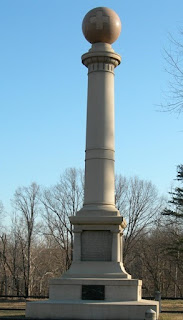
It is possible Weigel attended the November 1908 dedication of the Pennsylvania monument at Monocacy. The memorial recognizes the service of the 67th, 87th and 138th regiments. About 200 survivors attended the event. (A modern view of the monument is below)

Are there any Weigel descendants?

It’s somewhat providential that Borders, who collects carte de visites, or small portraits of soldiers, came across Weigel’s ID tag, which includes the name Bendersville, his hometown, on the bottom.

Using his private eBay account, Borders every few weeks types in the names of Federal regiments that were at Monocacy and sees what comes up.

The ranger theorizes the artifact probably came from an estate sale to a collector before being offered by the seller on eBay, but officials at this early juncture don’t which descendants may have had it and why it was not kept.

“That is something we are actively working on,” he said.

Borders and Friesen McCabe say Weigel’s ID disk will help tell the story of the battle, its aftermath and medical care (the National Museum of Civil War Medicine is in Frederick).

Alan Duke, president of the Monocacy National Battlefield Foundation, told the Picket:

“The Foundation was very pleased to be able to purchase the ID tag for the Battlefield's museum, especially since it will fit in very nicely with an upcoming planned exhibit.”

Park officials have no firm timetable for the revamped exhibits, but they stress the Weigel tag will help highlight new stories.

“It is a tangible touchstone to talk about Samuel, his injuries, the medical care, survival,” says Friesen McCabe. “A lot of men survived their injuries but they are scarred for life.”

Tuesday, March 23, 2021

Maryland resident given a live cannonball found near Monocacy battlefield calls the bomb squad

Cannonball before its disposal (Maryland State Fire Marshal)
A live Civil War cannonball found near Maryland’s Monocacy battlefield was disposed of after a homeowner who was given the ordnance became alarmed and called authorities.

The office of the Maryland State Fire Marshal on Tuesday said it got the call a day earlier from a homeowner in Jefferson in Frederick County.

The homeowner was given the cannonball by a family member who had found it near the site of the 1864 battle. Another family member told the resident that it could be live. Bomb technicians determined the fuse was intact, removed the artifact and conducted an emergency disposal, officials said.

“As proven today, the finding of military ordnance from the Civil War is not uncommon in Maryland, and these devices pose the same threat as the day they were initially manufactured,” the office said in a Facebook post.

Oliver Alkire, senior deputy state fire marshal, told the Frederick-News Post that the homeowner’s relative was using a metal detector near Monocacy National Battlefield, which does not permit them. No charges are expected, because the cannonball was found outside the park.

The cannonball was at the home for several months, Alkire told the newspaper, which indicated the round was blown up. "It would have caused significant damage" if it went off.

“If you should uncover or are unsure if an unidentified object may be military ordnance, be safe rather than sorry. Stay away and call 911,” said State Fire Marshal Brian S. Geraci.  “Marylanders need to be mindful that military ordnance, even vintage artifacts from previous conflicts, have the potential to explode.”

The fire marshal’s office did not specify what kind of shell was found. Some on social media lamented that the shell had not been defused by authorities and saved, but others said it may have been unstable and there are plenty of safe shells housed in museums and historic sites.

Wednesday, January 27, 2021

Maryland's Heart of the Civil War Heritage Area gets boost

The Hagerstown (Md.) City Council on Tuesday voted to approve expansion of the Heart of the Civil War Heritage Area. With so many local economies having been rocked by the loss in tourism due to the coronavirus, the city was looking for ways to replace some of that revenue. Hagerstown is home to some significant sites from the Civil War. WDVM article

Sunday, February 22, 2015

Learn how to give programs on CW medicine

The National Museum of Civil War Medicine will host its annual Civil War Medicine Living Historians Workshop on March 14 in Frederick, Md. The workshop is an all-day symposium featuring some of the skills, knowledge and resources necessary to provide quality living history programs to the public. • Details

Friday, September 28, 2012

Yosemite as a soothing place to heal?

You might not connect Yosemite National Park to the Civil War. But Frederick Law Olmsted, co-creator of Central Park, certainly did. Eyewitness to the horrific destruction wrought by the war when he served as general secretary of the United States Sanitary Commission, a Red Cross-like operation for the North, Olmsted despaired as the nation became, in his words, a "republic of suffering." In 1864, when he was briefly relocated to California, Olmsted envisioned the Yosemite Valley as a convalescent, even redemptive, site of national healing. • Column

Read more here: http://www.mercedsunstar.com/2012/09/27/2561980/william-deverell-yosemite-was.html#storylink=cpy

Read more here: http://www.mercedsunstar.com/2012/09/27/2561980/william-deverell-yosemite-was.html#storylink=cpy

Thursday, March 1, 2012

Medicine museum partners with businesses

A century and a half ago, many of Frederick’s downtown buildings served as hospitals to care for wounded soldiers from both sides of the Civil War. Merchants in the Maryland city were urged recently to use that connection to bring in tourists. • Article
Picket profile of Civil War medicine museum

Monday, September 13, 2010

Barbara Fritchie House on the market

A piece of Civil War literary history is for sale in Frederick. The Barbara Fritchie House is on the market with an asking price of $185,000, according to the Associated Press.

The two-story, red-brick structure is a replica of the house from which the 90-something widow defiantly waved a Union flag at Confederate General Stonewall Jackson in John Greenleaf Whittier's poem.

"'Shoot, if you must, this old gray head, but spare your country's flag,' she said," according to the poem. Historians say the incident was never documented.

Sunday, June 27, 2010

Lessons we've learned from Civil War medicine

John Dunbar had to make a decision -- quickly.

Lying in a field hospital where treatment decisions are made in moments or on a whim, Dunbar surveyed a pile of military boots. In the background, surgeons talked while preparing for yet another amputation: His bloodied right leg.

The Union lieutenant painfully pulled his boot back on and hobbled away to a fence on the Tennessee battlefield. Spying a horse, he climbed aboard and made his famous ride between Union and Confederate lines, arms lifted and a serene expression on his face. He awaited a bullet that would end the misery.

A bullet, of course, never found the mark. Dunbar, better known as actor Kevin Costner, eventually got medical attention from a general’s doctor and rode on to other adventures in the 1990s film “Dances With Wolves.”

Books and movies have often depicted a trip to the Civil War field hospital as a lesson in futility.

The reality, however, was a little more on the positive side, argues the executive director of the National Museum of Civil War Medicine in Frederick, Md., which has trained 4,000 members of the military in aspects of treating casualties.

“The idea that all hospitals look like the one in ‘Gone With the Wind’ is inaccurate,” argues George Wunderlich.

Wunderlich says that the Civil War actually brought huge advancements in the treatment of soldiers, notably at the September 1862 Battle of Antietam.

Ninety-five percent of Union doctors used anesthesia. And although there were no antibiotics such as penicillin, medical staff understood the importance of sanitation. Some hospitals had mortality rates as low as 7 percent-10 percent.

Still, having enough supplies and cleaning materials was difficult, especially at the front. “They never were able to manufacture all the necessary ambulances and conveniences,” Wunderlich (below, at Antietam) says of the Confederacy.

The mortality numbers are frightening enough, even without the tales of men terrified about going to a military hospital.

Death by disease led deaths by wounds 2-1. Statistics for the Union armies list 67,000 killed in action, 43,000 deaths from wounds and 224,000 lost to disease. The numbers were probably worse in Southern armies.

Wunderlich argues soldiers, even through World War II, had a high risk of infection. Couple that with the fact that medicine was years away from advancements in treating gut wounds, severe head injuries and damage to the thorax.

Lifestyle and conditions in the field had the deadliest consequences.

“The biggest killer of the Civil War was the fact that Boy Scouts had not been invented yet,” he says.

Troops had very poor personal hygiene and drank from polluted water often used as a latrine. Wunderlich contends 100,000 lives would have been saved with a concerted hygiene push.

The wounds were also horrific. The .50-caliber minie balls that smashed there way through the body left shards of bones that brought sure infection and, likely, death. “The best way to save a life was amputation.”

The museum has two principal missions. One is to educate the public about advancements brought by the war, including plastic surgery, anesthesia and reconstructive surgery. An Atlanta hospital, for example, specialized in maxillofacial surgery and Turner’s Lane Hospital in Philadelphia had a neurological focus.

The 7,000, three-story building consists of five immersion exhibits that recreate aspects of Civil War medical issues: life in an army camp, evacuation of the wounded from the battlefront, a field dressing station, a field hospital and a military hospital ward.

“Our most surprising audience is the U.S. military,” says Wunderlich.

His 17 full- and part-time staff, augmented by about 30 volunteers – most with medical backgrounds – teach Army corpsmen and general alike about field hospitals and surgery fundamentals, such as evacuation and triage. “We want corpsmen to know how to read terrain to find good aid stations.”

The center accomplishes this both at Frederick and at Pry House Field Hospital Museum (right) at Antietam National Battlefield in western Maryland. Through an arrangement with the National Park Service, the museum runs the Pry house and re-creates fundamentals of war medicine that are as common in Afghanistan today as they were at Gettysburg.

The house and barn served as Gen. George B. McClellan’s headquarters during the battle. But it also was a hospital for 400 wounded soldiers, including Major Gen. Joseph Hooker.

“We tell soldiers today, ‘We’re going to put you on the Antietam battlefield. You are going to work on problems Letterman worked on,’” Wunderlich says.

Letterman was Maj. Jonathan Letterman, who McClellan brought to the Army of the Potomac to to fix a “broken system” and is now regarded as the father of modern battlefield medicine.

Letterman (left) fired bad surgeons, emphasized sanitation, implemented command and control and increased the medical staff. His contributions included staffing and training men to operate horse teams and wagons to pick up wounded soldiers from the field and to bring them back to field dressing stations for initial treatment. This was the nation's first Ambulance Corps.

He developed the three-tiered system still in use: Field dressing stations, field hospitals (M*A*S*H) and larger hospitals away from the battlefield.

“Our modern medical system was developed into a unified system here in 1862,” Wunderlich says.

Click here for more information on the National Museum of Civil War Medicine.