Showing posts with label body. Show all posts

Saturday, October 10, 2026

First on the Picket: Newly released photos of 2024 excavation of Civil War soldier's remains at Manassas battlefield. The teen will be buried soon at Arlington

National Park Service archaeologists with human remains at Manassas in March 2024 (NPS)
Sometime in the coming weeks, an unknown Civil War soldier whose remains were found in a surgeon’s burial and limb pit at the Second Manassas battlefield will be buried at Arlington National Cemetery.

The National Park Service in August announced the March 2024 discovery of the young man, saying he was apparently buried in a New York infantry jacket after his August 1862 death in Northern Virginia.

The Picket has been checking in since then with the agency regarding plans for burial and photographs of the excavation.

“The National Park Service is coordinating with the U.S. Army for the dignified burial of an unknown Civil War soldier later this fall. The date and time of the service are not being released at this time,” the agency said in response Thursday. 

National Park Service staff check in on the Manassas work in March 2024 (NPS))
The Picket on Friday received access to an NPS photo gallery; this post may be the first time the images have been published. Officials said they have only recently been made available to the media.

The limb pit was discovered in 2014 during excavations associated with water pipe maintenance at Manassas National Battlefield Park. Two bodies and seven (possibly eight) amputated limbs were removed in 2015. The burial occurred near the site of a field hospital.

The entire pit was not excavated at the time, apparently because of time and funding limitations. While archaeologists believed there were more partial remains, they did not expect a whole set to be found when they returned in 2024.

An archaeologist uses a brush for fine work in 2024 at Manassas National Battlefield Park (NPS)
Archaeologists found six brass New York State Excelsior coat buttons and seven brass cuff buttons with the soldier, who was between 16 and 19 years old.

NPS documents studied by the Picket indicate the excavation also yielded four new surgically amputated limbs. “Found in direct association with this soldier's interment was a rubber pocket comb,” the agency said. The Army has requested personal effects, including the comb, for burial.

In total, three sets of human remains and 16 amputated limbs were excavated and removed from the property in 2015 and 2024. The remains of the first two unknown soldiers were buried in a new section of Arlington National Cemetery in September 2018 

Marker at the battlefield includes sketch showing Dogan house, where wounded were treated (Devry Jones, HMdb.org)
The field hospital was established at the John Dogan farm, not far from the Deep Cut section of the battlefield. The property was known as Rosefield at the time.

Union soldiers occupied this property on Aug. 29, 1862, first using it as an artillery placement site, and later as a hospital after surgeons “took control of the house” for the remainder of the three-day battle, the NPS said.

Park officials say they have not been able to identify the soldier or his New York unit or exactly where on the battlefield he fought. He apparently suffered a neck wound.

Soil conditions, historic plowing and backhoe excavation during the water line project led to his remains being in poor condition, according to the NPS.

An archaeologist excavates human remains at Manassas National Battlefield Park (NPS)
Roughly 40% of the remains were intact, and “no complete long bones were present. Historic plowing of the area crushed and relocated the skull (minus an occipital bone) and right arm” documents show. “The knees may also have been affected by the backhoe during waterline excavation. Fragments of assorted bones and teeth were found in soil within the excavated area. Little of the pelvis remained.”

Asked by the Civil War Picket whether there has been an attempt to identify the soldier via DNA, the NPS in August said extensive archaeological and osteological analysis was done.

"Professional archaeological evaluations concluded that additional analysis was unlikely to yield significant new information. Throughout this process, our focus has remained on treating the soldier with dignity and respect while following professional standards and applicable preservation laws."

The Picket reached out Saturday to Arlington National Cemetery, which is managed by the U.S. Army, for details about the upcoming interment.

(NPS)

Thursday, August 13, 2026

Manassas National Battlefield Park announces 'unanticipated' discovery of third body at 1862 field hospital limb pit. The young soldier, who wore New York infantry jacket, will be buried at Arlington National Cemetery

Marker at the battlefield includes sketch showing Dogan house, where wounded were treated (Devry Jones, HMdb.org)
A young man apparently buried in a New York infantry jacket is the third Federal soldier whose body was discovered by archaeologists in a surgeon's limb pit near a field hospital associated with the Second Battle of Manassas.

The National Park Service on Thursday said like the other two, this soldier found in March 2024 at the site in Northern Virginia will be buried at Arlington National Cemetery. The agency has not released details on the man -- who apparently died from a neck wound -- until now.

Documents indicate the remarkable discovery of the third soldier was “unanticipated.” Archaeologists found six brass New York State Excelsior coat buttons and seven brass cuff buttons.

"Every soldier who fought on this battlefield has a story, even if we may never know their name," said Manassas National Battlefield Park Superintendent Kristofer Butcher (left) in a news release. "It has been our privilege and responsibility to care for these remains with dignity, guided by science, respect, and our commitment to preserving America's history. We are honored that this soldier will now receive a final resting place at Arlington National Cemetery." 

No date for that burial has been announced. USA Today reported it is expected to occur in the fall.

Asked by the Civil War Picket whether there has been an attempt to identify the soldier via DNA, the NPS on Friday said extensive archaeological and osteological analysis was done. "Professional archaeological evaluations concluded that additional analysis was unlikely to yield significant new information. Throughout this process, our focus has remained on treating the soldier with dignity and respect while following professional standards and applicable preservation laws."

NPS documents studied by the Picket indicate the 2024 excavation yielded four new surgically amputated limbs and the body of the soldier. “Found in direct association with this soldier's interment was a rubber pocket comb,” the agency said. The Army has requested personal effects, including the comb, for burial.

The limb pit was discovered in 2014 during excavations associated with water pipe maintenance at the park. Two burials and seven (possibly eight) amputated limbs were removed in 2015. Excavations continued in 2024.

In total, three sets of human remains and 16 amputated limbs were excavated and removed from the property. (At right, femur with lodged bullet, Kate D. Sherwood, Smithsonian Institution)

The field hospital was established at the John Dogan farm, not far from the Deep Cut section of the battlefield. The property was known as Rosefield at the time.

Union soldiers occupied this property on August 29, 1862, first using it as an artillery placement site, and later as a field hospital after surgeons “took control of the house” for the remainder of the three-day battle, the NPS said.

Second Manassas was a decisive victory for the Confederacy..

Park officials say they have not been able to identify the soldier, his New York unit or exactly where he was wounded. 

Excelsior Brigade was in fierce fighting

The NPS provided details of the initial find in 2018, saying it was the first time a surgeon’s “limb pit” from the conflict has been excavated and studied.

Brandon Bies, then park superintendent, told NPR that the men were likely wounded during a charge up Deep Cut, held by thousands of Confederates. “As (Union soldiers) start to get closer, within 300, 400 yards, they start to receive rifle fire and musket fire," he says. "Men are dropping left and right." 

The Excelsior Brigade, made up of several New York regiments and a veteran of multiple campaigns, fought near the Dogan farm and Deep Cut. Daniel Sickles organized the brigade, but it was led by Col. Nelson Taylor (right) in this battle.

Analysis of the third soldier indicates he was approximately 16 to 19 years old and standing between 5 foot 1 and 5 foot 3 inches.

Soil conditions, historic plowing and backhoe excavation during the water line project led to the remains being in poor condition, according to the NPS.

Roughly 40% of the human remains were intact, and “no complete long bones were present. Historic plowing of the area crushed and relocated the skull (minus an occipital bone) and right arm” documents show. “The knees may also have been affected by the backhoe during waterline excavation. Fragments of assorted bones and teeth were found in soil within the excavated area. Little of the pelvis remained.”

Other items found with the individual include a jacket clothing hook and the hard rubber comb. A report concludes that “A lead artillery case shot ball recovered from the neck area of the remains could indicate cause of death, although this remains inconclusive.”

The soldier may or may not have been in the Excelsior Brigade or wounded near Deep Cut. It's possible he was wounded the evening of Aug. 29 in the fight at Groveton.

Examination of bones showed severity of wounds

A glance of photographs of the amputated limbs of the soldiers found in 2015 shows the bleak realities of war. Surgeons sawed them off with precision because the bullets caused so much damage and soldiers needed an opportunity to ward off deadly infection.

As casualties piled into tents not far from the fighting, Civil War surgeons had to make quick decisions on who might have a chance of going home – without an arm or leg – and who was too seriously hurt to be operated on.

That appeared to be the case with the two soldiers.

The first was in his 20s and died of injuries from an Enfield bullet striking his upper leg.

“Surprisingly, the bullet was still lodged in the femur bone, likely because it slowed as it passed through the man’s cartridge box, the National Park Service said at the time

The second skeleton was that of a man estimated to be between 30 and 34 years old. (At left, Brandon Bies assists in 2015 dig / Kate D. Sherwood, Smithsonian Institution)

He died as a result of a buck and ball shot to the upper arm, pelvis and leg.

The bones were found in a shallow pit, indicating they likely were buried in haste. According to Smithsonian Institution experts, the surgeons were allowed by Confederates to conduct the hasty operations after the battle, when the wounded had been in the sun and rain for days. They may not have had chloroform at their disposal.

The entire pit was not excavated in 2015, apparently because of time and funding limitations. While archaeologists believed there were more partial remains, they did not expect a whole set to be found when they returned in 2024. Officials have been tightlipped about the project for more than two years.


The remains of the first two unknown soldiers were buried in a new section of Arlington National Cemetery in September 2018 (At far right in Picket photo, above).

At the time, Bies said analysis of isotopes in the bones, which looked at what had been in drinking water the men consumed, indicated they are likely from New York or New England, according to CNN.

The NPS news article did not include photos, but the agency said it was reviewing them for possible release. "Any materials that are shared publicly will be carefully reviewed to ensure they protect sensitive archaeological information and maintain respect for the soldier's remains."

The public can see the related documents on this page.

Thursday, January 1, 2026

Brother, where art thou? A dogged New Yorker traveled twice to Virginia to retrieve body of sibling killed at the Wilderness. A Fredericksburg park volunteer and a descendant put together the poignant story, which is showcased in an exhibit

2nd Lt. Horace Hill (NY State Military Museum via Wayne Historians Organization), national colors of the 111th New York (NY State Military Museum) and park volunteer Steve Morin 
In spring 1864, Francis Abner Hill set out to do something thousands of others in his situation would have wanted to do, but did not have the money, time or tenacity.

Francis planned to bring back to Upstate New York the body of his younger brother, 2nd Lt. Horace Gilbert Hill, killed just a week before, on May 5, while leading his company at the Wilderness in Virginia.

The military action was still too hot in the area and Francis wasn’t allowed to search for the grave. But signs of his persistence were evident in his many visits to military hospitals in Washington, D.C., apparently to glean helpful information from wounded members of the 111th New York Infantry. He wanted to know if any of them knew where Horace was laid to rest.

Those interviews and letters sent to veterans and families after his return to Wayne County set the ground work for his second – and successful – trip to find Horace and bring the 23-year-old home (Hill family monument, right, courtesy Nancy Rosin).

“Francis Hill’s successful recovery efforts were not a common occurrence in the Civil War,” wrote Steve Morin, a retired federal government researcher and volunteer at Fredericksburg & Spotsylvania National Military Park, in a report about the sibling’s search for Horace. And such efforts did not blunt the pain.

“Returning a Civil War soldier’s remains helped to establish a degree of closure, but it didn’t erase the lifelong anguish caused by the loss," according to Morin.

For years, the volunteer has transcribed documents for the park’s historical database. His curiosity routinely takes him to the internet to learn more about his subjects, as was the case in the Hills.

This spring, Morin turned to Ancestry.com for photographs and learned of a Hill family tree put together by Nancy Rosin of Rochester. “She answered my Ancestry message and I was floored when she told me she was Francis’s great-great-granddaughter,” he told the Picket in an email. Rosin is related through the maternal side of her family.

Using records (including a copy of Francis Hill's diary) already held by the park and letters and photographs from Rosin, the pair completed a compelling portrait of a family that sought closure amid its grief. 

On Friday evening (5p-7p Jan. 2), Morin spoke at a reception at the city's Fredericksburg Visitor Center about the project. The reception kicked off an exhibit about volunteers and their roles in supporting the mission of the federal park. 

“Finding Nancy was fortunate because she possessed so many letters, images, etc. that filled in gaps and provided personal insights into the family members,” Morin said. (At left, Francis and his wife Sophia, courtesy Nancy Rosin)

The researcher told FXBG Neighbors he likens his work using primary documents to solving a puzzle. (Read this Picket article about how he helped identify a grave at Fredericksburg National Cemetery)

“I have always loved the way he views history,” Ashley Ranalli, volunteer coordinator at Fredericksburg & Spotsylvania National Military Park, told FXBG Neighbors.

“To me, Steve is looking to understand the people he is researching and make a connection.”

Rosin told the Picket that Morin provided context on documents her family kept for 165 years. Other relatives also have material related to the brothers.
Lt. Horace Hill's 1864 pocket diary (NPS photo)
"My collaboration with Steve centered on the letters themselves. In the collection, there were about 40 letters written following Lieut. Hill’s death, from fellow soldiers and military officials tending to the details of pay owed, the return of personal effects, etc." Rosin said.

"But many of the letters were from area families whose sons had also died in the Wilderness and who, similarly, wanted to bring their remains home. Those letters were very helpful in unraveling the story of Francis’s recovery of his brother’s remains."

'Ready to defend the stars and stripes'

Horace Hill enlisted early in the war when he was 19 years old, Rosin said.

"A description of him written by a friend described him as popular with the girls and fond of staying out late at parties/social gatherings. When he left for the war, Horace and a young woman named Amanda Franklin were in a serious relationship and some of his letters home indicate they were planning a life together at war’s end," she wrote in an email. (Horace, left, before the war. Courtesy Nancy Rosin)

Hill served in another New York regiment before joining the 111th. He rose to sergeant and then second lieutenant in 1863. He fought in numerous battles, including Gettysburg, where the regiment suffered heavy casualties.

In March 1863, he wrote to Francis saying he wish he had expressed more appreciation for their relationship. "Your kindness is fully appreciated by a brother who tonight is a soldier sitting in his tent shedding bitter tears of regret as he remembers how little he manifested the love of a brother in days gone."

Horace Hill had a premonition of his death, according to a fellow officer with the 111th.

On the evening  of May 5, 1864, in the vicious fighting at the Wilderness, Company A tangled with Confederates. According to “Military History of Wayne County,” Hill was waving his sword, trying to rally his men, when he was instantly killed by a ball passing through his chin and neck. His body was found after Confederates retreated.

NPS map of Wilderness fighting around the time Lt. Horace Hill was killed.
The 111th New York is indicated near rectangle bearing Barlow's name. Click to enlarge
The young officer was buried at a farm with other soldiers. His family did not know the location.

The Rochester Express carried this pithy article about his death, according to a Facebook page about the 111th New York.

“Lieutenant Hill was almost idolized by the men under his command. He had gained that respect, not only by being an ever true and faithful soldier, but also by kindly caring for his men. His heart swelled with proud emotions at the thought of his country's glory, and he was ever ready to defend the stars and stripes from the insults of traitors. Though comparatively unknown his name may well stand side by side with Ellsworth, Lyon, Wadsworth, Sedgwick, and a host of others; heroes whose names generations yet unborn shall love to read and revere. He fell as a hero falls. Amid the carnage of battle, he yielded up his life, a noble sacrifice, for ‘God and home, and native land,’ and that God in whom he trusted will surely reward him.”

Francis Hill, an Ontario, N.Y., businessmen who cared for his ailing parents rather than enlist, decided to quickly find his brother’s remains. He used Horace’s 1857 diary, according to Morin, to take notes of his trip, including expenditures and notations. 

The diary highlighted the extensive planning, research, logistics and costs associated with returning Lt. Hill to his home near Lake Ontario, according to Morin. While he was not permitted to travel to the front in May 1864, Francis visited numerous hospitals in the Washington area.

Morin’s report -- which includes an extensive bibliography -- summarizes what Francis learned during and after his first visit to Virginia. Among the findings was his brother was buried near fellow New York 2nd Lt. James W. Snedaker (right, courtesy Wayne Historians Organization).

The plots were on the farm of William A. Stephens of Spotsylvania County, close to the battlefield.

Interestingly, Horace’s sword and scabbard had been sent to a Washington hospital after his death. The family later acquired it but Rosin said she is unaware of who has it in their possession.

Brother, father of another soldier communicated

Francis Hill, who was often called Abe or Abner by friends, planned to return to Virginia in late November 1864 and he received a letter (left, click to enlarge) from the U.S. Army authorizing his travel to the grave site. 

Business and personal matters, however, delayed his trip to summer 1865, shortly after the war ended.

In the diary, Francis noted directions to the Stephens farm, which held the bodies of several 111th New York soldiers.

At some point, Francis communicated with Adrastus Snedaker, father of killed Lt. James Snedaker. Francis and Adrastus had been in touch with a private who saw Horace after the latter's death and helped bury him, carving out a marker with an ax.

"This soldier wrote a very detailed letter to Francis that described his brother’s burial, the condition of the remains, and what he carved on the grave marker," said Morin. 

Adrastus Snedaker retrieved his son’s body in June 1865, one month before Francis was able to go and find Horace’s remains. Horace Hill was laid to rest at Ontario Center Cemetery. (Findagrave.com photo below courtesy Bob Davis)

"Horace now lies buried in a small pioneer cemetery on Ridge Road in Ontario, just a short distance from the Hill family homestead and the old mill pond, surrounded by three generations of his family," Rosin told the Picket.

One of his older military coats belongs to the Sterling Historical Society in New York.

For his part, Francis Hill, a prominent farmer, miller and town official, was married to Martha Sophia Patterson and they had five children, three of whom lived to adulthood. Their daughter, Martha Stella Hill, is Rosin's great-grandmother.

According to a diary, Francis wrote on April 24, 1874, about being at the beside of his dying mother.

“Her sufferings have been severe, but her death was peaceful and apparently easy and she retained consciousness almost to the last moment. A few minutes before she ceased to breathe and while laying partially on the left side she opened her eyes in apparent pleasure and exclaimed 'Horace G: Why Horace' as though she saw him & then spoke to him.”

Francis died in Ontario, N.Y., in 1903 at age 68.

"This story is important because it describes in such a personal way the impact of war on the lives of ordinary people. I think of my family, living in a small farming community, then their lives upended by the outbreak of the war," said Rosin.

"People often focus on the 'pomp and circumstance' of war -- the battles, the valor, etc. I think the story of Francis and Horace brings home the loss and grief in war’s aftermath. And of course, it’s a very touching story about the love of family…as Lieut. Hill put it, 'those near and dear to me.'”

Exhibit will look at work of park volunteers

Ranalli, the volunteer coordinator at Fredericksburg & Spotsylvania National Military Park, said the exhibition will be in place through Feb. 2. The visitor center is at 601 Caroline St., Fredericksburg, Va.

Morin was given the Hill documents to transcribe and found them to be intriguing, Ranalli said.

“Steve’s research into the story of the Hill brothers was inspired by several primary sources from the park’s bound-volume collection,” she said in an email. “This collection was started in the 1970s by then-chief of Interpretation Bob Crick, who sent college students to campuses across the country to photocopy primary documents related to the park. In the 1990s, the collection was opened to the public, and this particular item was likely donated by a visitor, possibly a relative of the Hill family.”

Rosin said the Francis Hill diary came to the park through relatives of one of his sons. She was not aware it existed until the park contacted her.

The exhibit portion about the Hills is entitled “In Search of Rest” and was created in partnership with the Fredericksburg tourism bureau.

“This marks the first time the Fredericksburg City Visitor Center has featured an exhibit highlighting the work of National Park Service volunteers,” added Ranalli.

A letter from Horace to his mother Elvira

Rosin provided the Picket a letter Lt. Horace Hill wrote to his mother shortly before his death.

Camp of 111th N.Y.V. Inf.

                                                                                                  April 23/64

My Dear Mother

     It being a kind of lonely dreary night and not feeling much like going to bed yet awhile I have taken my pen to write you a little. For the past two weeks we have been busy much of the time in preparing to move & we have gotten about ready so that should it not storm within a day or two, I think we will strike tents & be off for where of course I know not. But most likely it will not be very long ere we come upon the enemy at some point. With what anxiety are the soldiers of this army contemplating the results of the next few months which are fast drawing near. Not only the army but those at home are anxiously awaiting to know the fate of our army. Nearly everyone has a son, brother or some near relative here who is about to risk his life amid the dangers of the battlefield. Some will fall. A battle cannot be fought without some lives being lost. Who are the fated ones is the question asked by all of us. None of us think that it is ourselves or at least have a hope that it is not yet. We all run the same risk. I have been lucky thus far but for all of that I may be the first of many to stand in the way of some fatal shell. But I feel it is my duty to stand by my country as long as she is in trouble & if I fall while protecting her right against her enemies I shall die in a noble cause. One for whom thousands have laid down their lives. Am I not ready and willing to do as much if it will help to plant the standard of right over our nation? I am. Is it not better to die than live under the hand of tyranny, despotism?

     Yet when I think of home & friends who are dear I cannot help feeling sad & in a measure dread what is before us. I may pass through unharmed but there are many who will not. They have parents and friends who to them are as dear as mine. It is the same for them to leave them that it is for me. O Mother it is a sad, sad thing to look upon & I would to God that this evil war would cease before another life is lost upon the battlefield. But there are not such thoughts that cheer the soldiers’ hearts as is the thought of the happy days in store for him when he shall have cleared the land of the nations enemies & he shall have laid down his implements of warfare & returned to his home there to meet again his friends & associates & enjoy their society in peace under a reunited government.

     This perhaps is if we move the last letter I shall write to you for some time & may be the last one I shall ever write to you. Dear Mother do not feel sad because I speak thus for your boy is under the protection & guidance of Him who rules the universe. In Him is my trust. His will and mine be done. I go forth ready to receive whatever fate is in store for me.

     Should this be the last time given me to address you I would for your comfort have you know that although I am a wild and sinful boy yet have I remembered my God & through His power & agency have I learned to look for protection amid the trying scenes of life. Through His power alone can I be spared to return to you. Therefore let us trust it all to Him & all will be well in life or in death.

     Write as often as you can. Your letters may not reach us immediately. But it will come round after awhile. Give my love to father & tell him that I would like a taste of his sugar sap & that maybe I will be home next fall before it is all gone…I will close by bidding you goodnight. With much love

 I am ever affectionately your son      

­­                                                                                           H. G. Hill­

At the bottom of this page Horace’s father Ira Hill had written:

This is the last letter written by Lieut. Horace G. Hill to his mother.

                                                                                     Ira A Hill

Hill was killed 13 days later, May 5, 1864, at the Wilderness

Monday, December 20, 2021

If he were to die, this Pennsylvania soldier wanted his family to know his fate. Monocacy battlefield in Maryland now has wounded private's ID tag

This metal disk was customized to provide info about Weigel (NPS photos)
Back in October, Matt Borders was on eBay, searching for anything connected to the 138th Pennsylvania Infantry, a unit that was involved in extensive combat during the Civil War.

Borders, a park ranger at Monocacy National Battlefield near Frederick, Md., came across something remarkable -- a rare identification Civil War badge for sale. It bore the name of Pvt. Samuel M. Weigel, who fought with Company G of the 138th at the July 9, 1864, Battle of Monocacy.

Civil War soldiers were afraid of dying in battle unidentified and being laid in an unmarked grave -- their loved ones not knowing their fate. They often would write their name on a piece of paper and attach it to their clothing. Better yet would be a metal disk, such as the one Weigel purchased from a vendor. He likely carried it during several campaigns, including Monocacy, where at age 24 he was seriously wounded.

Matt Borders
Borders spoke with others at the park about the find and whether it could help further tell the story of the battle in which outnumbered Federals delayed Confederates bent on taking Washington, D.C. By the time Jubal Early’s Rebel troops reached the capital’s outskirts, Union reinforcements had arrived.

“We looked to see if it was within the scope of the collection and it fits very nicely,” Jana Friesen McCabe, chief of interpretation at the park, told the Picket.

The National Park Service cannot make purchases on eBay, so the Monocacy National Battlefield Foundation stepped in. The group paid about $1,700 for the tag from a reputable seller on eBay and donated Weigel’s tag to the park, which announced the acquisition last week.

The "final stand" at Monocacy battlefield (NPS)
“It is amazing that after 157 years, this ID disk is returning to the battlefield,” said Andrew Banasik, superintendent of Monocacy National Battlefield, in the press release. “This small piece of metal is a tangible reminder of the price paid by so many to save Washington.”

Telling more stories of the everyman

The donation comes at a fortuitous time for the park.

“We are currently in the process of planning to redo our exhibits, and one of the things we really wanted to highlight and focus (on is) the individual stories of the soldier and the cost of the battle to soldiers and people in the community,” said Friesen McCabe. Among such items already in the park’s collection is a Bible struck by a bullet during the fighting.

The silver ID tag for Sgt. Nicholas G. Wilson (NPS photos)
The Union suffered about 1,300 casualties at Monocacy. The 138th Pennsylvania, which engaged in some of the fiercest fighting, suffered nearly 70, according to its regimental history. Among the severely wounded were Weigel and Sgt. Nicholas G. Wilson, also of Company G. Wilson was shot in the right hand, losing two fingers.

The battlefield already had Wilson’s identification tag. The foundation did not assist with its acquisition.

While Weigel’s disk is believed to be made of copper alloy and customized from a mass-produced design, Wilson’s tag is silver and is in the shape of a shield. The reverse of Weigel's tag features an American stars and stripes shield and the words "AGAINST REBELLION."

“Before the United States military provided standard issue identification tags – often called ‘dog tags,’ -- soldiers had to find their own way to ensure their bodies could be identified,” the park says. “Because soldiers had to purchase these tags with their own money, there is no standardized style and no official record of how many soldiers had them.”

The men of Company G came from towns in Adams County about 10 miles north of Gettysburg, Pa., according to the Battlefield Back Stories blog. Wilson and Weigel were from the Bendersville farming community.

Wilson was a farmer and blacksmith before the conflict and served to its end, mustering out in June 1865 after being hospitalized in Baltimore and York, Pa. (He is in the photo at left, part of the Library of Congress' collection.)

He had an impressive career afterward, serving as superintendent at the national cemetery in Gettysburg for 15 years, on the local city council and school board and as a state representative for two years.

He died in 1907 at age 75, having worked for years to help develop the Gettysburg battlefield for visitors.

Samuel Meals Weigel’s story is not so well known, according to park officials. He was married to Martha Ann Harmon and they had two boys and two girls.

The retired carpenter died at age 82 in 1922 of intestinal nephritis, according to his death certificate, and was buried in Harrisburg.

Jana Friesen McCabe has served 20 years with the NPS
Park officials say they want to learn more about the private and any descendants. They do not have a photograph of the soldier.

“That is always the dream -- to make those connections and learn if the family has stories to pass down,” said Friesen McCabe. “You find a little piece of something and you have to dig for the other nuggets and threads associated with it.”

Regiment endured fierce fighting

The 138th Pennsylvania was mustered in Harrisburg in 1862. While it missed the fighting at Gettysburg in July 1863, it saw heavy action and casualties at the Wilderness, Cold Harbor and other campaigns in Virginia.

At the November-December 1863 Battle of Mine Run in Orange County, Va., Wilson, shown in a later photo at left, survived a bizarre incident.

“During the engagement a rebel bullet ripped through his knapsack -- in which he had stored 40 rounds of ammunition. The bullet ignited those rounds, and his knapsack was blown right off his back,” says Battlefield Back Stories. “Wilson was otherwise unhurt, and lived to record the tale in a book of personal wartime sketches individually recorded by members of the Corporal Skelly G.A.R. Post 9, today preserved at the Adams County Historical Society.”

The regiment was assigned to the Army of Potomac’s VI Corps and took part in Grant’s Overland Campaign. An estimated 27 soldiers with the 138th died at the Wilderness.

In July 1864, the 138th and several other battle-hardened regiments were rushed from Petersburg to Baltimore and by train to Monocacy to help intercept Confederate troops, says Borders, the park ranger. Early had invaded Maryland in a bold plan, and caught the North off-guard.

“They are part of the veteran soldiers who were brought in, says Borders, saying the other half of the Federal troops on site were green. “They are going to have the stiffest fighting along the Thomas Farm portion of the battlefield. They will turn to guard against the flank attack … that is attempting to roll up the Union line.”

By 5 p.m. on July 9, the much larger Confederate force had outstretched the Federal flanks. Having run out of artillery ammunition, troops are ordered by Maj. Gen. Lew Wallace (right) to leave the field and fall back toward Baltimore. While a tactical victory for the South, the battle saved Washington by buying time for Grant to rush men to defend the city.

The regimental history, which transposes the spelling of his name to Wiegel, does not detail Weigel’s wounds. A regimental muster roll spells his name as “Weigle,” says he enlisted in August 1862 and that he was absent following his wounding.

Dedication of the Pennsylvania monument in 1908 (NPS photo)
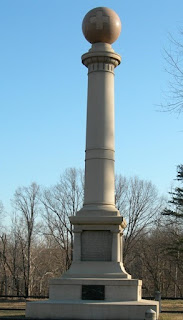
It is possible Weigel attended the November 1908 dedication of the Pennsylvania monument at Monocacy. The memorial recognizes the service of the 67th, 87th and 138th regiments. About 200 survivors attended the event. (A modern view of the monument is below)

Are there any Weigel descendants?

It’s somewhat providential that Borders, who collects carte de visites, or small portraits of soldiers, came across Weigel’s ID tag, which includes the name Bendersville, his hometown, on the bottom.

Using his private eBay account, Borders every few weeks types in the names of Federal regiments that were at Monocacy and sees what comes up.

The ranger theorizes the artifact probably came from an estate sale to a collector before being offered by the seller on eBay, but officials at this early juncture don’t which descendants may have had it and why it was not kept.

“That is something we are actively working on,” he said.

Borders and Friesen McCabe say Weigel’s ID disk will help tell the story of the battle, its aftermath and medical care (the National Museum of Civil War Medicine is in Frederick).

Alan Duke, president of the Monocacy National Battlefield Foundation, told the Picket:

“The Foundation was very pleased to be able to purchase the ID tag for the Battlefield's museum, especially since it will fit in very nicely with an upcoming planned exhibit.”

Park officials have no firm timetable for the revamped exhibits, but they stress the Weigel tag will help highlight new stories.

“It is a tangible touchstone to talk about Samuel, his injuries, the medical care, survival,” says Friesen McCabe. “A lot of men survived their injuries but they are scarred for life.”