Showing posts with label Arlington National Cemetery. Show all posts

Saturday, October 10, 2026

First on the Picket: Newly released photos of 2024 excavation of Civil War soldier's remains at Manassas battlefield. The teen will be buried soon at Arlington

National Park Service archaeologists with human remains at Manassas in March 2024 (NPS)
Sometime in the coming weeks, an unknown Civil War soldier whose remains were found in a surgeon’s burial and limb pit at the Second Manassas battlefield will be buried at Arlington National Cemetery.

The National Park Service in August announced the March 2024 discovery of the young man, saying he was apparently buried in a New York infantry jacket after his August 1862 death in Northern Virginia.

The Picket has been checking in since then with the agency regarding plans for burial and photographs of the excavation.

“The National Park Service is coordinating with the U.S. Army for the dignified burial of an unknown Civil War soldier later this fall. The date and time of the service are not being released at this time,” the agency said in response Thursday. 

National Park Service staff check in on the Manassas work in March 2024 (NPS))
The Picket on Friday received access to an NPS photo gallery; this post may be the first time the images have been published. Officials said they have only recently been made available to the media.

The limb pit was discovered in 2014 during excavations associated with water pipe maintenance at Manassas National Battlefield Park. Two bodies and seven (possibly eight) amputated limbs were removed in 2015. The burial occurred near the site of a field hospital.

The entire pit was not excavated at the time, apparently because of time and funding limitations. While archaeologists believed there were more partial remains, they did not expect a whole set to be found when they returned in 2024.

An archaeologist uses a brush for fine work in 2024 at Manassas National Battlefield Park (NPS)
Archaeologists found six brass New York State Excelsior coat buttons and seven brass cuff buttons with the soldier, who was between 16 and 19 years old.

NPS documents studied by the Picket indicate the excavation also yielded four new surgically amputated limbs. “Found in direct association with this soldier's interment was a rubber pocket comb,” the agency said. The Army has requested personal effects, including the comb, for burial.

In total, three sets of human remains and 16 amputated limbs were excavated and removed from the property in 2015 and 2024. The remains of the first two unknown soldiers were buried in a new section of Arlington National Cemetery in September 2018 

Marker at the battlefield includes sketch showing Dogan house, where wounded were treated (Devry Jones, HMdb.org)
The field hospital was established at the John Dogan farm, not far from the Deep Cut section of the battlefield. The property was known as Rosefield at the time.

Union soldiers occupied this property on Aug. 29, 1862, first using it as an artillery placement site, and later as a hospital after surgeons “took control of the house” for the remainder of the three-day battle, the NPS said.

Park officials say they have not been able to identify the soldier or his New York unit or exactly where on the battlefield he fought. He apparently suffered a neck wound.

Soil conditions, historic plowing and backhoe excavation during the water line project led to his remains being in poor condition, according to the NPS.

An archaeologist excavates human remains at Manassas National Battlefield Park (NPS)
Roughly 40% of the remains were intact, and “no complete long bones were present. Historic plowing of the area crushed and relocated the skull (minus an occipital bone) and right arm” documents show. “The knees may also have been affected by the backhoe during waterline excavation. Fragments of assorted bones and teeth were found in soil within the excavated area. Little of the pelvis remained.”

Asked by the Civil War Picket whether there has been an attempt to identify the soldier via DNA, the NPS in August said extensive archaeological and osteological analysis was done.

"Professional archaeological evaluations concluded that additional analysis was unlikely to yield significant new information. Throughout this process, our focus has remained on treating the soldier with dignity and respect while following professional standards and applicable preservation laws."

The Picket reached out Saturday to Arlington National Cemetery, which is managed by the U.S. Army, for details about the upcoming interment.

(NPS)

Tuesday, December 26, 2023

Confederate monument removed from Arlington could end up at New Market

A Confederate memorial that was removed last week from Arlington National Cemetery and could be relocated to the New Market Battlefield State Historical Park in the Shenandoah Valley if Virginia Gov. Glenn Youngkin gets his way. The park is operated by the Virginia Museum of the Civil War, which is run by the Virginia Military Institute. The sculptor attended VMI. -- Article

Friday, May 15, 2020

At Arlington National Cemetery, an opened 1915 time capsule yields two items tied to the Civil War and national reconciliation

Caitlin Smith, Tim Frank open copper box containing capsule
"Confederate Dead" pamphlet (Arlington National Cemetery)
On Oct. 13, 1915, President Woodrow Wilson made the short journey from the White House to Arlington National Cemetery, where rows of headstones are set on the hills overlooking Washington. Surrounded by thousands of spectators – including veterans of the Civil War and Spanish-American War – Wilson laid the cornerstone for a new Memorial Amphitheater.

A crane lowered the hollow cornerstone to rest above a copper box that contained items those attending hoped Americans would find meaningful when opened a century later.

Among other items, there were maps and plans of Washington, a signed photograph of Wilson, a 46-star US flag, local newspapers, a signed Bible and two artifacts tied to the Civil War: A program for the recent 49th encampment of the Grand Army of the Republic near the U.S. Capitol and a pamphlet, labeled “Confederate Dead,” which detailed burial places for Southern soldiers in the area, including – in recent years – Arlington.

Items in amphitheater lower chapel (Elizabeth Fraser, Arlington National Cemetery)
Last month, the box was opened as part of the centennial of Memorial Amphitheater’s opening on May 15, 1920. The marble structure is used for services and special events, including the president’s annual Memorial Day address.

The cemetery is marking the amphitheater anniversary this week with the launch of an online exhibit. The Washington Post first detailed the opening of the time capsule.

Among those opening the box and examining its near-pristine contents on April 9 was cemetery historian Tim Frank, who described the “once-in-a-lifetime experience” in a cemetery blog post. The capsule included a Boyd’s Directory of the District of Columbia, and Frank was able to find a listing for an ancestor. 


Frank had the privilege of removing the contents of the box one by one, according to the Post. (Video above includes the examination of the items)

“These items were carefully tied, wrapped and arranged in the inner box, which was soldered shut,” he would later write in the blog. “That box was then surrounded by pieces of plate glass to keep an air gap between it and the larger copper box, ensuring that no condensation would damage the precious documents and mementos inside.”

The “Confederate Dead’ pamphlet’s cover was printed in gray, and featured the Southern battle flag and the words “Charles Broadway Rouss Camp 1101 United Confederate Veterans Washington, DC”

Removal of copper box before its opening (Elizabeth Fraser, ANC)
I was able to find a copy of the 1901 booklet online. Scattered throughout are references to and diagrams of Confederate burials at Arlington. About 400 Rebel soldiers are buried in that section.

The cemetery devotes an online page to the subject. Confederate soldiers were allowed to be reinterred at Arlington 35 years after the war’s end. The article notes the end of the 19th century brought a spirit of national reconciliation, at least for the white population.

In 1898, then-President William McKinley said, “In the spirit of fraternity we should share with you in the care of the graves of Confederate soldiers…. Sectional feeling no longer holds back the love we feel for each other. The old flag again waves over us in peace with new glories.”

President Wilson dedicates amphitheater cornerstone (Library of Congress)
The article points out that the “spirit of fraternity” cited by McKinley did not include African-Americans, who had largely been disenfranchised in the South.

“In 1871, a group of black soldiers had petitioned the War Department to relocate the graves of hundreds of United States Colored Troops (USCT) from the “Lower Cemetery,” where they were buried alongside former slaves and poor whites, to the main cemetery near Arlington House, where white Civil War veterans lay at rest. The War Department denied the petition. Arlington National Cemetery would remain segregated until 1948, when President Harry S. Truman desegregated the armed forces by executive order.”

The second Civil War item found in the capsule – which was moved a couple times since 1915 -- was a program for the Sept. 27-Oct. 2, 1915, meeting of the Grand Army of the Republic in Washington. This gathering of former Union soldiers was marking the 50th anniversary of the end of the conflict.

Tim Frank holds GAR program (Elizabeth Fraser, Arlington National Cemetery)
By then, membership in the organization had dwindled as time and wounds took the lives of tens of thousands. The succeeding Sons of Union Veterans of the Civil War describes why veterans sought such fellowship, even into their 70s and 80s.

“Men who had lived together, fought together, foraged together and survived, had developed an unique bond that could not be broken. As time went by the memories of the filthy and vile environment of camp life began to be remembered less harshly and eventually fondly. The horror and gore of battle lifted with the smoke and smell of burnt black powder and was replaced with the personal rain of tears for the departed comrades. Friendships forged in battle survived the separation and the warriors missed the warmth of trusting companionship that had asked only total and absolute commitment.”

(The final encampment of the Grand Army of the Republic was held in Indianapolis in 1949.)

Ceremony at US Capitol during 1915 GAR meeting (Library of Congress)
President Wilson, just two weeks before the laying of the Memorial Amphitheater cornerstone, spoke to the group during its Capitol encampment, citing their reconciliation with former foes.

“You feel, as I am sure the men who fought against you feel, that you were comrades even then, though you did not know it, and that now you know that you are comrades in a common love for a country which you are equally eager to serve.”

By their nature, time capsules are meant to provide a snapshot of what was important for those who left them for future generations. Cemetery command historian Steve Carney told the Post that 1915 was a time of nostalgia about the Civil War and Arlington was a symbol of reconciliation between North and South.

“You’re really transporting yourself back,” he told the newspaper. “You’re putting yourself in the mind-set of those individuals in 1915 that were saying, ‘Okay … what do we put in? What makes the cut?’ ”

Arlington National Cemetery plans to install later this year a time capsule to be opened in 100 years. Details on what might be included are not yet available.

David Ferriero, archivist of the US, with contents (Elizabeth Fraser, ANC)

Wednesday, March 6, 2013

Bringing them home: Details of services, burial of two USS Monitor crew members


USS Navy photo of Monitor crew
Thursday, on an airport tarmac in suburban Washington, D.C., in a choreographed military display of respect, flag-draped caskets bearing the remains of two men who died on active duty will be taken from a plane to waiting hearses.

Unlike service members who died in Afghanistan, Iraq or other places, no one knows these men, or for that matter, their identities.

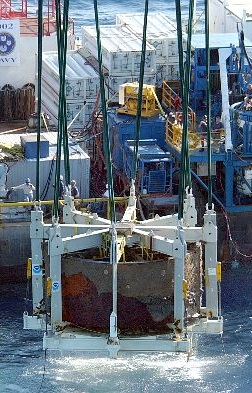
They were lost along with 14 of their shipmates, more than 150 years ago, when the ironclad USS Monitor sank off Cape Hatteras, N.C. The bodies of the two were found in the Union vessel’s gun turret in 2002.

Years of intense research and forensic analysis thus far have not ascertained their identity, but efforts continue at Joint POW/MIA Accounting Command (JPAC) in Hawaii.

Facial reconstructions of two sailors
The U.S. Navy is providing full honors to the two sailors, expected to be the last seamen from the Civil War whose remains will be located. Burial is scheduled for Friday afternoon at Arlington National Cemetery. Members of the public can attend the interment.

"The fact it has been 150 years or two days (since a death) doesn't make any difference,” said Stuart B. McLean, director of ceremonies and special events in Naval District Washington.

Ten families that possibly may be descendants of the sailors will attend. Each family has been assigned a casualty assistance officer.

The Picket this week learned details of events related to the USS Monitor crew interment.

THURSDAY, MARCH 7, ABOUT 11:30 AM

The event at Dulles International Airport in Virginia is called a “dignified transfer of remains.”

The caskets are being carried aboard a commercial flight from Honolulu, home to the Joint POW/MIA Accounting Command (JPAC), where the bones and teeth were analyzed. Based off those, experts have narrowed down from 16 individuals that were missing from the Monitor to about six who could be the two sailors.

2002 expedition (U.S. Navy)
Media will be on hand to witness the flag-covered caskets being taken from a conveyor attached to the plane. “Hand salute” and other commands will be uttered as the remains are solemnly carried by teams to the two hearses on the tarmac.

"It will be quick, but stirring,” McLean said of the remains transfer.

The remains will be held overnight at an area funeral home.

FRIDAY, MARCH 8

Midday
Descendants of the Monitor crew will attend a luncheon hosted by the National Marine Sanctuary Foundation in Alexandria, Va.

4 p.m., invitation-only funeral service at Fort Myer Memorial Chapel.

Family members, dignitaries and others will attend the non-denominational Christian service. It was determined that the sailors were Christian, McLean told the Picket.

Speakers are Navy Secretary Ray Mabus; Kathryn Sullivan, former astronaut and acting under secretary of commerce for oceans and atmosphere; and Civil War historian and author James B. McPherson.

Scripture readings and a homily are planned, as well as the singing of the Navy hymn, “Eternal Father.”

About 4:30 p.m.

The caskets will be carried on caissons from the chapel to Arlington National Cemetery. 

Family members and mourners will follow the Army’s Old Guard military escort.

Burial will take place in section 46 of the cemetery, which is between the amphitheater and the USS Maine Mast memorial.

“There’s lot of interest” by members of the public in attending the interment, said McLean, although he could not estimate how many might attend. At least 50 people in period costume will be on hand, but weapons of any kind are not allowed.

Driving to the grave site also is prohibited and the public cannot take part in the funeral procession. Attendees may park in the ANC Welcome Center parking garage and either walk or take, for a fee, the Martz tour tram to the Amphitheater.

Turret recovery (U.S. Navy)
The specific date of the interment was chosen to recognize the Monitor's role in the Battle of Hampton Roads 151 years ago on March 8-9. The Monitor sank off the North Carolina coast on Dec. 31, 1862.

A monument bearing the names of the 16 lost sailors will be erected at a later date, according to McLean.

IN THE FUTURE

Forensic experts will continue their efforts to identify the two sailors. Military records from the Civil War aren’t good and there are no dental X-rays, making the task very challenging.

"What I would like people to know is that we're here, and committed to the ideal of bringing home our fallen," says U.S. Army Sgt. Maj. Danang McKay, JPAC command senior enlisted leader. "It doesn't matter if that happened during World War II or it happens in future conflicts, we will always be here. We'll bring you home."

The biological profiles concluded that the sailors were both white males, one was 17 to 24 years old; the other was in his 30's. Both stood about 5 foot 7 inches tall.

Forensic anthropologist Robert Mann, director of the Forensic Science Academy for JPAC, in a statement said teams are trying to locate other descendants of other missing Monitor crew members to take DNA samples.

"We will never give up trying to identify these sailors," said Mann.