Showing posts with label crew. Show all posts

Friday, September 2, 2022

Rally to the sound of the guns: Fort Pulaski near Savannah is looking for cannon crew volunteers. Here's what you need to know before enlisting

Crew fires a Parrott gun and trains on a howitzer; Doherty in foreground (NPS photos)
WANTED: Able-bodied men and women. No experience required. Applicants will undergo training and must pass a test. Requirements include working well with others and following orders. Job includes wearing a woolen uniform in hot weather. The position is a lot of fun, but safety comes first -- always. You’ll be firing cannons.

Fort Pulaski National Monument outside Savannah, Ga., recently took to social media to find folks for its cannon crew, with a special focus on Saturdays. While the Facebook post was not written quite like the Picket’s mock ad above, the job does entail those requirements.

Shannon L. Doherty, a park guide at Pulaski and its historic weapons supervisor, says it’s been tough to always field a crew because core volunteers sometimes can’t attend every event and staffers can’t always work extra days.

That’s where you might come in.

The cannon crew has typically been made up of older volunteers, many military veterans. But Doherty welcomes all those who can qualify.

“No experience is fine, because you have to be trained either way,” she says. “Firing a historic cannon is exhilarating. It’s loud and there’s the sulfur smell. The visitors come up and talk about how much they enjoyed it.”

The Fort Pulaski cannon crew portrays Union artillerymen.

They fire a reproduction 30-pounder Parrott rifle -- which recoils a bit -- and a 12-pounder smoothbore field howitzer, both made by Steen. The latter was not used in the Pulaski siege, but was a common anti-infantry weapon during the war.

National Park Service cannon and rifle crews do not fire period weapons. Chief Ranger George Elmore of Fort Larned National Historic Site in Kansas told the Picket in 2014 the agency does not want to risk destroying an historic artifact.

Various stages of the making of artillery rounds, not in sequence.
Doherty, trained in black powder, supervises  the work. (NPS photos)
Fort Pulaski has about two dozen cannons, several of which date to the Civil War. The Confederate masonry fortification surrendered in April 1862 after withering fire from Federal rifled guns destroyed parts of the wall and threatened its magazine. The innovative rifled weapons brought an end to that type of fort construction.

NPS venues that fire reproduction 18th and 19th century small arms and artillery must have an employee certified in their use and safety. Of course, actual rounds are not fired. Doherty, who underwent required NPS black-powder training in March, must be present at all cannon firings and she trains and supervises the crew.

Crew members must have awareness and aptitude

Both of Fort Pulaski’s demonstration weapons are in the parade ground. Each is fired during a typical 25-minute program. “We are trying to connect it to the theme of the park,” says Doherty. One example is the freedom story – how the Federal army helped the emancipation process.

National parks that fire cannons must follow a lengthy safety manual that is remarkably close to standards during the Civil War. “We try to be historically accurate and as safe as possible,” says Doherty.

Cannoneers sponge the Parrott barrel at Pulaski (NPS photo)
Accidents are exceedingly rare, but the work does come with danger. In 2014, the breech of a gun fired at Fort McHenry National Monument failed, leaving one member of the cannon crew slightly injured.

Fort Pulaski requires volunteers to read the rules and take a 24-question test on safety. A couple questions are, “If the cannon fails to fire, what command is given?” and “The minimum waiting time before the piece is reprimed after a misfire is:”

The NPS manual of instruction begins with a sobering reminder for crews to be well-trained and prepared. It lists the four primary causes of accidents in historic weapons demonstrations using artillery:

1. Rapid firing

2. Poorly maintained or improper equipment

3. Improper drill

4. Improper ammunition

Cannon crew members march in for a demonstration at Pulaski (NPS photo)
During the Civil War, guns typically had a crew of eight. Crews firing replica weapons typically have six members, with one member fulfilling three spots, involving retrieving a charge and moving it up to the cannon.

Doherty makes sure they go over equipment and members understand all positions. Unlike, the Civil War, when all those in a battery needed to be interchangeable because of death or injury, volunteers don’t have to serve at every position.

For example, the No. 1 position involves sponging the barrel and ramming the round down the tube. “That can freak some people out.” 

The crew drills the morning of any cannon firings.

“(It’s) being comfortable into whether it was in one position or others, feeling confident. Not being shaky on anything,” Doherty says. “I am watching to see proficiency, if someone isn’t doing too well.” (At right, Parrott sponger, rammer and wormer at Fort Pulaski, NPS photo)
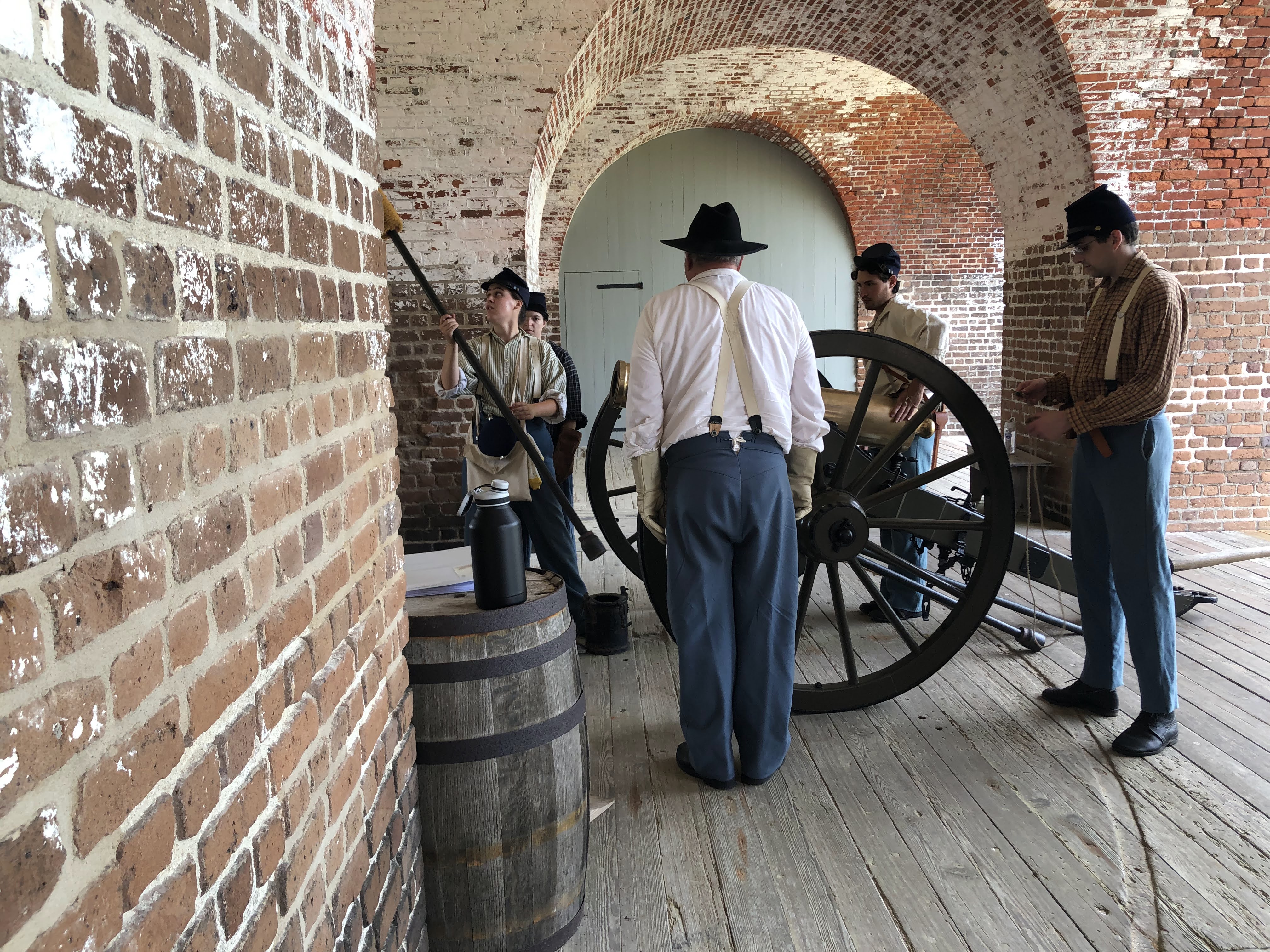
Another view of the howitzer training (NPS photo)
Elmore, who has conducted safety courses for NPS staffers, said each park is required to have its own magazine, meet ATF (Bureau of Alcohol, Tobacco, Firearms and Explosives) requirements and to have a loading area.

Doherty says the crew routinely goes over equipment, for example ensuring there are no holes in hand gloves are splinters in the sponge rammer. They are equipped with hearing protection.

The cannon cannot be fired more than once every 10 minutes. Visitors are 50 feet away and no one can be downrange of the barrel.

“This is not a race. We do need to be deliberate in the steps and not a rush. That’s when errors happen.”

Making the rounds safely is exacting work

Doherty – following ATF and NPS rules -- works with a mold to make the replica rounds, which contain aluminum foil, black powder and peat moss; the latter adds length and volume to the shell. On the day of firing, a friction primer causes ignition, setting off the black powder.

Black powder, finished rounds are kept in powder magazine
The black powder and finished rounds are stored in a World War II-era magazine.

The powder comes in a plastic bottle. The larger Parrott gun requires all 16 ounces while the howitzer uses about half of that.

Doherty takes the powder from the magazine, places it in a locked non-sparking box and works in another room after park hours.

While Doherty solely can do a few of the steps, others can help certain parts of the preparation – but only under her supervision.

To prevent a fire or explosion, Doherty works with a wooden table that has no exposed nails. It takes about 30-45 minutes to prepare six rounds, enough for three firings a day.

The rounds, weighing about a pound, are returned to the magazine for future use.

When the Picket wrote about NPS black-powder training in 2014, powder cost about $15 a pound. Like everything else, it’s gotten a lot more expensive.

A recent order of 50 pounds cost about $1,200 with shipping, Doherty says.

Fort Pulaski has helped other parks, including Fort Sumter National Monument, with supply.

More crew members, more cannon firings

The venue hopes the addition of a few more volunteers might ensure Saturday firings throughout the year.

Interestingly, the park did artillery demonstrations on Wednesdays during June and July because of higher staffing that day and the fact that visitors tended to travel on the weekends.

A crew moves the limber in the Fort Pulaski parade ground (NPS photo)
Fort Pulaski is particularly busy in November and December for holidays, thus the push to recruit more crew members. Doherty has three core members, all area retirees, to depend on, but she needs a bigger pool of recruits.

Sometimes, re-enactors come in with different standards. Doherty stresses people need to be open to learning and follow NPS rules.

For all the safety concerns, serving on a crew has its rewards.

“We can provide unrivaled weekend entertainment and outstanding camaraderie,” the park’s callout said.

Recruits can enlist with the Fort Pulaski cannon crew by emailing Historic Weapons Supervisor Shannon Doherty at shannon_Doherty@nps.gov. Applicants will also speak with the park's volunteer coordinator.

Thursday, July 8, 2021

H.L. Hunley: Sub's commander was a sharp-dressed man. Experts are piecing together a report on what crew wore when they made history

Nick DeLong and Johanna Rivera with Dixon clothing (Friends of the Hunley)
He was dressed more for a night on the town than for a moonlit submarine journey toward Union vessels blocking Charleston Harbor. Lt. George Dixon was decked out in a three-piece outfit, mid-calf suede boots and silver suspender buckles bearing his initials. Dixon’s clothing clearly demonstrated attention to how the young man presented himself.

So when he led his eight-man crew of Confederates on their mission, the soldier (rendering below) brought along the confidence that had sustained him since the early years of the Civil War. In addition to jewelry and a gold pocket watch, he carried a disfigured gold coin that absorbed a bullet during the April 1862 fighting at Shiloh and saved his leg.

“My life Preserver” was engraved on one side of the coin.

On Feb. 17, 1864, H.L. Hunley made history by becoming the first submarine to sink an enemy warship. The 40-foot iron vessel -- bullets pinging off its iron exterior -- planted a torpedo in the hull of the Union ship USS Housatonic, setting off a charge that sent the Federal vessel and five crew members to the sandy bottom within minutes.

The Hunley disappeared beneath the waves and entered the realm of legend. To this day, historians, scientists and others debate what caused it to end up on the ocean floor. Discovered a few miles off Charleston in 1995, and raised in 2000, the Hunley is being conserved at Clemson University’s Warren Lasch Conservation Center in North Charleston.

Experts have been analyzing the incredible array of artifacts found inside the submarine and are now working on a volume about the crew, including personal effects such as clothing, buttons and shoes. They hope to have the volume, which they are preparing for the U.S. Navy, finished later this year.

"The Hunley as a crew did not have a set uniform at all. They wore what they were comfortable or what they were used to,” said Nick DeLong, maritime archaeologist at the center. Six of the eight wore something that was part of a military uniform. 

G.E.D. is engraved in the suspender buckles (Friends of the Hunley)
Dixon’s clothing was the best-preserved of the group. Like the others, his remains were found at his station. “A lot of it (looked) like a disarticulated ball of wool and fabric,” DeLong told the Picket.

The Friends of the Hunley -- which supports the ongoing conservation of the submarine -- a few months ago posted photographs of much of Dixon’s clothing. The items had completed conservation a few years before.

DeLong and others are trying to put together a deeper picture of the crew from the many artifacts and the clothing they left behind. “He has interesting garments and we want to know a little more about the man himself,” he said of Dixon.

One of the first people brought in on the project to help with the analysis of the textiles was Mary Ballard, senior textile conservator at the Smithsonian Institution.

Conrad Wise Chapman depiction of the Hunley (Wikipedia)
“She was crucial in the identification of some of the fibers and helped the team determine that Dixon was wearing cashmere,” DeLong said. Textile curator Virginia Theerman of the Charleston Museum also was consulted and provided examples of clothing that might have matched what Dixon wore on the mission. It's possible he was wearing a sack coat, which is designed to fit more loosely than a tailored jacket.

The conservators are seeking additional experts to help determine what the crew members were wearing.   

DeLong and senior conservator Johanna Rivera have been carefully studying Hunley artifacts. Because the interior of the submarine was intact and filled with sediment, virtually everything the crew was wearing or carrying survived, although much of it is in fragments.

Dixon’s clothing had an impressive array of 19th century buttons (below, courtesy of Friends of the Hunley) made of several materials, including bone, brass and mother of pearl.

“We probably have all the buttons associated with him. Missing one or two can drastically change our understanding of what the garment looks like,” DeLong said.

The fabric itself is piecemeal, extremely fragile and it’s impossible to fully recreate each garment. Dixon’s undergarments, likely made of cotton, did not survive 135 years of being underwater, even in relative air-tight conditions.

The clothing appears to be brown, but experts are pretty certain its original color was black. DeLong said the cashmere wool was of high quality.

Conservators once thought that the clothing remnants included a cashmere vest, but DeLong says they have determined the vest no longer exists. It may have been made of a silk blend that deteriorated.

“We are trying to piece it all together. It’s a big puzzle and no picture to put it together,” he says of the endeavor to present some kind of picture of each man’s appearance.

The team hopes to get a fuller understanding what Dixon was wearing. “It could tell us more of the man himself, and the thought process going into the night of the attack.”

Traditional methods of excavating the human remains and textiles were not particularly effective because of the Hunley’s unique situation. Instead, a block-lift technique was used nearly 50 times to minimize damage to the items. Here’s how the center describes the process:

“The block-lifting technique consisted of probing the sediment and dividing the areas along major bone groups and sensitive artifacts. Steel plates were then slid under each block to separate the section from the rest of the sediment. The purpose of using block lifts was to safely retrieve the extremely fragile textiles that archaeologists were unable to excavate using traditional archaeological methods. The block lift would be removed intact and later x-rayed, documented, and excavated for small or fragile artifacts.”

A section of Dixon's cashmere coat (Friends of the Hunley)
DeLong said not much is known about Dixon before Shiloh. He was a Mason and is not believed to be Southern-born, though it appears he had some kind of social stature. In 1860, he was a steamboat engineer on the Mississippi River.

He enlisted in the Confederate army, likely in Mobile, Ala., and served with the 21st Alabama. At Shiloh, Dixon suffered a serious wound to the upper thigh when a bullet hit the gold coin, which is on display at the Lasch Center. Conservators found evidence of a healed wound while examining his skeletal remains.

At some point, Dixon returned to Mobile during the construction of the Hunley and became involved in the effort.

Dixon was perhaps in his mid- or late 20s when he became the Hunley’s third captain (two previous crews had died in sinkings). He had sandy hair and an athletic build, scientists determined from his remains. Gold fillings are another indication of some wealth.

As commander, Dixon navigated the submarine, using only a compass bearing and the limited visibility provided by the view ports in the forward conning tower,” the Friends of the Hunley say in an online biography. “Dixon controlled the movement of the rudder and the dive planes, which dictated the inclination and level of submersion of the submarine.

"Ultimately, Lt. Dixon was the crewmember who triggered the explosive device that would send the USS Housatonic  to the bottom of the Atlantic ocean, a maritime first that changed the landscape of naval warfare worldwide.”

DeLong said the Dixon clothing, as depicted in the photographs, will likely stay in those positions. It’s possible the center can do a more visual presentation if it knows how the items were constructed and pieced together. (The photo above left includes suspender parts and buttons.)

“There will be no stitching back together,” he said of the fragile cloth.

A portion of Dixon's clothing before conservation (Friends of the Hunley)

Friday, August 14, 2020

Cannonballs galore: They were turning earth for condos in Pittsburgh and came across cannonballs at site of Union arsenal. A lot of it.

Dozens of artillery rounds at site (Pittsburgh Police Facebook post)

A construction crew building condominiums in Pittsburgh last month came across a cache of artillery rounds near the site of an arsenal that supplied the Union army during the Civil War.
Pittsburgh police on Thursday posted photographs of the July 2 find in the Lawrenceville area while crews were turning soil. The number of shells has not been determined. Police described the cannonballs as live.
Jack Melton, who publishes the Civil War News and the Artilleryman magazine, told the Picket the rounds are 12-pounder cannonballs with Bormann fuses.
“Thankfully, this excavator operator had some prior experience and promptly called the Pittsburgh Police Bomb Squad when he recognized what his machinery had hit; a cache of Civil War era cannonballs," police said on Facebook.
“This was the same employee who had helped unearth 715 cannonballs while working not far from here in March of 2017, the site of the former Allegheny Arsenal, an important supply and manufacturing center for the Union Army during the American Civil War.”
Some Facebook commenters say this is a Bormann time fuze.
The Facebook post said the rounds are the property of the Army, and police will handle “mitigation” in coordination with the military. It’s not immediately known whether they will be destroyed.
According to the Pittsburgh Post-Gazette, the discovery is not unusual for the area, located at the site of the U.S. Allegheny Arsenal, which produced 128,000 rifle cartridges a day for Union troops during the Civil War. 
In 1862, 78 people were killed when three explosions erupted in a building called the laboratory. It was one of the worst civilian disasters during the Civil War, according to the newspaper. 
Ground was being turned for construction (Pittsburgh Police)
Police told the Post-Gazette they kept the discovery quiet so that the rounds could be removed without endangering the curious. They had no map or drawings from which to work.

Thursday, May 7, 2020

H.L. Hunley fascination: Social media post about past conservation of bandana found in Civil War submarine quickly goes viral

James A. Wicks' conserved bandana (Photos courtesy of Friends of the Hunley)
The item shortly after recovery and during the conservation process
When it comes to interest in the innovative Civil War submarine H.L. Hunley, items pertaining to its crew are near the top, just behind the ongoing debate over what caused the vessel to be lost in battle

A Friends of the Hunley social media post Wednesday about the conservation of a knotted bandana worn around the neck of crew member James A. Wicks garnered more than 950 shares within 24 hours.

James A. Wicks
The exacting work on the artifact was detailed in the winter 2007 issue of The Blue Light, the newsletter of the Friends group.

“We will at times showcase past work on the project,” Kellen Butler, president and executive director of the nonprofit museum, told the Picket via email.

Since its recovery from the Charleston (S.C.) Harbor in 2000, the Confederate submarine has been undergoing extensive conservation at the Warren Lasch Conservation Center in North Charleston. From time to time, the Friends of the Hunley posts photographs of an item before and after conservation. Such was the case with Wicks' silk bandana.

When what appeared to be nothing more than a blob of mud was found in the Hunley crew compartment during excavation, it was hard to detect is was a fascinating – and beautiful – piece of history,” reads a Facebook post.

Wicks and seven others lost their lives in the Hunley during a mission that made history.

On the moonlit evening of Feb. 17, 1864, the 40-foot iron vessel -- bullets pinging off its iron exterior -- planted a torpedo in the hull of the Union ship USS Housatonic, setting off a charge that sent the Federal vessel and five crew members to the sandy bottom outside Charleston Harbor within minutes. The Hunley became the first submarine to sink an enemy warship.

Conservators several years ago at lab in North Charleston (Friends of the Hunley)
The Hunley, too, was lost, but exactly why remains a mystery. A host of theories -- from pressure emitted by the explosion, suffocation, a "lucky shot," drowning or other factors -- has been debated for decades. The position of the crew found during conservation showed no signs of panic. 

Wicks and the conservation of his fragile garment each have an interesting story.

Mary W. Ballard, a senior textile conservator at the Smithsonian Institution, consulted by phone and traveled to the museum and assisted in the challenging work of bringing the bandana back to life.

“Saving this unique artifact created a challenging question for conservators: how do you dry a fabric that has been waterlogged for over a century? Complicating matters, the bandana was also completely covered with mud and a metallic-like concretion,” reads The Blue Light article.

Conservators first tested dozens of detached small samples with various chemical treatments before deciding how to treat the bandana itself.

Details of the bandana during and after conservation (Friends of the Hunley)
To remove water, they applied a technique called vacuum freeze-drying. The process dries the fabric without applying tension to its fragile fibers.

“We will never know the true color of the bandana since the fabric’s vegetable dye was lost long ago,” the article states. “Still, the completed artifact speaks to the delicate skill of conservation and offers a rare insight into the divided loyalties many may have felt during the Civil War.”

What divided loyalties?

Wicks -- a Southerner by birth -- was in the U.S. Navy at the outbreak of the Civil War. When the USS Congress was crippled by the Confederate warship CSS Virginia at the Battle of Hampton Roads in March 1862, he switched sides, according to the Friends of the Hunley. 

He was about 45 years old when he died in the Hunley mission.

Given his personal history, it is not surprising Wicks is the only crew member known to be wearing a bandana around his neck, a common practice for enlisted Union sailors during that time,” The Blue Light surmises.

Exhibit at the Hunley museum in North Charleston (Civil War Picket photo)
Wicks served on the CSS Indian Chief before Hunley skipper Lt. George Dixon chose him to be part of the eight-member crew.

The Friends of the Hunley says the father of four girls stood nearly 5 feet 10 inches tall and was a heavy tobacco user. He had blue eyes and brown hair, according to records. His family was living in Florida when war broke out.

Wicks had the Hunley’s sixth crank position and in an emergency, his job was to release the aft keel block, should weight needed to be jettisoned so that the submarine could rise from the ocean floor.

His remains were found associated with seven US Navy buttons, which is consistent with his military service, according to the Friends of the Hunley. 

Friday, July 13, 2018

The USS Monitor overcame doubters. Its crew trusted the ironclad, even during the terrible storm that sank the famous ironclad.

Monitor crew in July 1862 on James River in Va.  (Library of Congress)

Robert Williams (right)
On a summer day in 1862, a contingent of the USS Monitor’s crew gathered in front of its battle-scarred turret. A few sailors played checkers while others gazed toward a camera.

None of them looked more intensely at the photographer than Robert Williams, a fireman first class from Wales. His sleeves were rolled up, exposing his brawny, crossed forearms.

“There is a cockiness,” said David Alberg, superintendent of the Monitor National Marine Sanctuary, which protects the remnants of the Monitor. “That is the look of the hero.”

But that air of confidence couldn’t have been predicted just a few months before.

On March 6, 1862, the new Union ironclad – its radical design dubbed “Ericsson’s folly” by its doubters -- steamed down New York City’s East River for the short journey to Virginia. There were doubts about whether the Monitor could withstand the seas and intense enemy firepower; it fired only two cannons from the revolving turret.

“People thought these 70 men were going to their deaths,” Alberg told the Picket. “The crew was unconvinced. Many were seasick.”

But the small ship quickly challenged the heavily armored CSS Virginia upon arrival and ended the latter’s rampage against Federal ships. The stalemate at Hampton Road changed naval warfare and foreshadowed the end of wooden warships.

Harper's Weekly rendering of Monitor sinking (public domain)
While much of the USS Monitor’s wreckage remains where it sank during a storm off Cape Hatteras, N.C, on Dec. 31, 1862, the turret, guns, anchor, engine components and thousands of artifacts are housed at the Mariners’ Museum and Park in Newport News, Va.

An exhibit that opened last year features personal items – including shoes, a comb, buttons and pocket knives -- found near or with the remains of two sailors found in the turret when it was recovered in 2002. Sixteen men, including four officers, perished when the Monitor went down.

Despite advanced forensics testing and physical descriptions of sailors noted during their Civil War service, the identities of the two crew members remain unknown.

Sailor 1 is believed to be William H. Eagan, 21, or Jacob Nicklis (Nickles), 21. Sailor 2 is likely either William Bryan, 31, or Williams, 30, who worked in the engine room. A spoon on display has the initials “J.N.” and is believed to have belonged to Nicklis. In the top photo in this post, Bryan may be the kneeling man to Williams' right.

Judging from contemporary accounts and what was found in the turret (discarded footwear, silverware and clothing), there was a mad rush to escape through the turret when it became clear the Monitor was going to sink.

David Alberg
Lifeboats from the steamer USS Rhode Island, which was towing the ironclad to Beaufort, N.C., plowed through 30-foot waves to scoop up survivors in midnight maelstrom. Some onboard likely couldn’t swim, while others’ best chance was leaping from the deck into a rescue boat.

It’s unclear why the two men found in the turret remained on board. “They probably said, ‘Maybe the storm will lie down and they will send another boat back,’” said Alberg.

In the minds of the crew, he said, the ironclad had gone from an “iron coffin” on March 6 to an icon in December. “And it had served them well.” Amid the storm, their confidence “kept them on that boat.” 

USS Monitor was 'a strange ship'

Like much of the US Navy, the Monitor’s crew was a cross-section of 19th century America. A few, including Williams and Eagan, were born in Europe. Three African-Americans were lost with the vessel off Hatteras.

The crew lived below the waterline, and oil lamps burned to make up for the lack of natural light in the iron vessel. Officers had better food and quarters while the enlisted men slept on hammocks in a common room behind the wardroom.

The USS Monitor is a “strange ship” for those accustomed to canal boats and traditional wooden vessels, said John Quarstein, director emeritus of the USS Monitor Center at the museum. For example, it had pressurized commodes. “Half of those people had never seen a commode.”

As one can imagine, life on the boat was almost unbearable during the summer months. A photo taken after the CSS Virginia clash shows a shade awning above the turret.

The crew did a fair bit of drilling, said Quarstein, and their work was subject to weekly inspections.

Panels in crew exhibit at Mariners' Museum (Picket photos)
Not a lot is known about Bryan and Eagan.

Bryan, like Williams, served on the ironclad during the battle with the Virginia. The New York native was an experienced yeoman.

Nicklis and Eagan, a relatively inexperienced landsman born in Ireland, were replacements brought on at the Washington Navy Yard while the boat was undergoing repairs in the autumn of 1862. By then, crowds cheered the Monitor and its occupants.

A good bit is known about Nicklis because of surviving letters in the museum’s collection, written to his father from Oct. 27, 1862, to Dec. 28, 1862. The young seaman from Buffalo, New York, stood 5 feet 7 inches and had a ruddy complexion.

Nicklis had enlisted in the Navy at age 16, but re-enlisted in 1862 for a one-year term.

Officers on the deck in July 1862 (Library of Congress)
Throughout his letters, Nicklis expresses his misgiving on serving on board the Monitor. He states that the turret is “getting weak” and that “they say we will have a pretty rough time a going around Hatteras but I hope it will not be the case.” 

The USS Monitor returned to Hampton Roads in November after it was repaired, and then it was ordered on Christmas Eve to steam to Beaufort.

Terrifying storm put it under

The pride of the US Navy left on Dec. 29, 1862. Two days later, it encountered a strong storm that had it floundering in the Atlantic waves. Not built to withstand the forces of the open seas, the ironclad bounced up and down, resulting in loosened bolts that allowed water to come in.

Landsman Francis Butts, standing atop the structure, later wrote that the waves “would leap upon us and break far above the turret” with “a shock that would sometimes take us off our feet.”

Commander John Bankhead ordered a red lantern (right) be hoisted to signal distress to the Rhode Island. The line between the two vessels was cut to minimize the chance of them colliding. The flooding continued during the rescues by leaky and overloaded lifeboats. Eventually, Bankhead ordered the crew to abandon ship.

Quarstein, author of “The Monitor Boys,” called the rescue of 47 USS Monitor crew members “a tremendous story of heroism” by the crew of the Rhode Island’s commander, Stephen Decatur Trenchard.

There was no requirement at the time of being a proficient swimmer, and most of the men knew if they fell into the water they were lost. A few slipped off the deck to their deaths, while others missed lifeboats.

“The people who are left in the turret when the second boat goes back, they are called to get into the boat by Bankhead. They are either too afraid or they think the boat is so overloaded.”

Rhode Island Acting Master’s Mate D. Rodney Browne and members of his crew rowed back for them (at least one member of the USS Monitor crew was below deck). The USS Monitor was gone.

Quarstein estimates about half of the 16 who died drowned, while the remaining went down when the USS Monitor capsized, turned over and hit the bottom.

Clash of the CSS Virginia and Monitor (Library of Congress)
Deep affection for Monitor's service

The USS Monitor retains its special place in US naval history. While it never engaged with the CSS Virginia again (the latter was destroyed to avoid capture after it was bottled up by the Monitor), the boat took part in the Battle of Drewry’s Bluff, firing on a Confederate fort on Virginia’s James River.

But it’s best remembered for its heroics on March 9, 1862, a day after the Virginia sank the USS Cumberland and pulverized the USS Congress, which was set afire after capture.

The Monitor’s skipper at the time, Lt. John Worden, was ordered to protect the steam frigate USS Minnesota. The Virginia plowed toward the Minnesota but the Monitor interceded and the two circled for hours, firing broadsides and looking for weakness in the other’s armor. Both sides claimed victory.

The Minnesota was saved outright by the Monitor. According to the USS Monitor Center, “One Minnesota crew member had his tombstone designed to look like the Monitor -- the ship that saved his life.”

Fast forward to March 2013, when the remains of the two unidentified men found in the turret were buried with full military honors at Arlington National Cemetery. (The bodies of the other 14 have not been recovered)

Reverse of coin has image of old USS Minnesota (NOAA)
Alberg, the superintendent of the Monitor marine sanctuary, told the Picket he has vivid memories of the day. About 140 descendants of the crew were on hand. “Some were of men who clearly survived. I have a photo of a lady laying her hands on the casket. I was very moved at how all 140 people viewed them as theirs.”

Front of coin (NOAA)
He keeps a coin given to him that day by the commanding officer of the new advanced nuclear submarine USS Minnesota. The reverse side includes an image of the Civil War-era USS Minnesota.

The gift was a token of appreciation – 151 years later – for the Monitor’s saving of the Minnesota.

“That short 10-second exchange will stick with me forever,” said Alberg. “It really showed … the power of the Monitor story."

• Part 1: These two sailors went down with the USS Monitor. Now you can see items they carried or were found near them.