Showing posts with label replica. Show all posts

Tuesday, December 9, 2025

This old soldier won't fade away: Residents of Ohio village can now look eye-to-eye at Civil War statue reassembled after a big rig crushed monument into pieces

The old statue was moved into village administration building (LHS and Village of LaGrange)
“Sherman,” the Ohio Civil War statue that was shattered by a big rig and put back together again, has come in from the cold.

LaGrange village and township employees – using machine and muscle – late last week moved the granite man from the unheated old fire station to the village’s administration building.

“They rented a gun safe dolly. They used a lot of muscle, too,” said Jan King, treasurer of the LaGrange Historical Society. “He is inside where it is temperature controlled.”

The new home for the statue brings the story full circle for the Picket, which first reported on the matter in summer 2022 after a tractor trailer driver apparently fell asleep at the village’s traffic circle. The rig smashed the 1903 memorial into pieces.

The community was determined to make things whole.

Master stone carver Nicholas Fairplay glued “Sherman” back together and used him as a model for a replica. Cleveland Quarries rebuilt the monument base below the soldier.

Both were installed on the rural village’s circle in May 2025.

The old “Sherman” was moved around the same time to the fire station (photo, left), where he stood for seven months before the recent move.

The statue, which weighs about 1,500 pounds, is now in a hallway close to the historical society (he’s too big to fit inside the group’s small museum and learning center). It is being kept for now in a protective wooden frame.

“We will have to anchor him down,” said King. “There is a possibility he could be pushed over.”

That would be especially tragic for the old fellow, having already suffered the indignity of losing his head (it broke off) when the truck pulverized the original memorial. (Photos below from LaGrange Township)


Local folks call the statue “Sherman,” but King was quick to quash that moniker during our phone call.

The correct name is “the statue” or “the flag bearer,” she said.

So how did the stone soldier come to be called “Sherman”?

The monument base carried the names of LaGrange area residents who served during the war, the names of a few battles and of Union generals Ulysses S. Grant, William T. Sherman, Philip Sheridan and George Thomas. Sherman was an Ohioan.

Sherman’s name on the monument base was directly below the front of the statue, so that name stuck.


I asked King, whose family has lived in the community southwest of Cleveland for generations, to describe the old statue, now that he is on ground level.

The retired seamstress is impressed by the craftsmanship – the flag’s carved stars, stitch marks on his lapel and the deep-set eyes. “There is a lot of detail to it.” (Photos above, LaGrange Historical Society)

The society and village office are in a former school building on Liberty Street. “Sherman” is next to a trophy case.

The historical society is open on the third Sunday of each month and on special request. There are old records, photos and a buggy inside, all signaling LaGrange’s rural roots. “It used to be an agricultural city but it is getting more away from that,” said King.

A group of third-graders once stopped by and King was able to show some of them graduation photos of their grandparents.

New statue at studio in Vermilion and monument installation in LaGrange (Courtesy Cleveland Quarries)
Safety measures have helped reduce intrusions into the traffic circle, which is at the intersection of routes 301 and 303 (Main Street).

Villagers used to blow horns and drive around the circle when they got married; school buses still take victory laps when athletes return victorious from competitions elsewhere, King added.

Whatever he is called, the replica Union flag bearer is a fixture in LaGrange and watches over those passing through.

Saturday, July 13, 2024

Here's the recipe for the new bombproofs and traverses going up at North Carolina's Fort Fisher: Do research. Add precast concrete. Cover with a whole lot of dirt

Bombproof construction begins, pieces for tunnel entrance next to original traverses (Fort Fisher)
A construction project this summer at Fort Fisher State Historic Site in North Carolina is something you don’t see every day – or will likely see anywhere else.

Sections of precast concrete were placed Friday near a giant mound of dirt as crews begin to build a replica bombproof -- an earth- and timber-covered structure that protected a garrison from shelling.

The Civil War site near Kure Beach and contractors are engaged in an extraordinary effort to recreate three traverses, bombproofs, a magazine and a sally port that were vital parts of the Confederate fort, which fell in furious hand-to-hand combat in January 1865.

“This is a one-of-a-kind project,” said Ben Warren project manager with Bordeaux Construction of Morrisville, N.C. “We build much larger projects, but many things on this project are unique.”

Rendering of traverses, sally port and visitor center behind (Fort Fisher)
A portion of the vital fort’s earthworks was leveled during World War II to make way for an airstrip when the area was used to train anti-aircraft and coastal artillery units. The work is in conjunction with a new visitor center, also being built by Bordeaux Construction.

The earthworks project requires nearly three dozen pieces of precast concrete. About half have arrived, said Warren. The pieces were made by the Alcrete plant in Jacksonville, N.C.

Chad Jefferds, assistant site manager at Fort Fisher, told the Picket there will be a new tunnel allowing visitors to pass through the fort at the center sally port, as would have been the case originally, along with bombproofs under the traverses.

The traverses are being built in the same line as those that have withstood the effects of time and change. Rebuilding the fort will involve the reconstruction of the 7th, 8th, and 9th traverses.

Click to enlarge to see rebuilt features, including tunnel and bombproof (Fort Fisher)
“You will not see the precast concrete tunnels, as they will be clad in wood, such that the tunnels will appear as though they were built from timber, same as they were built originally,” Warren said in an email.

Jefferds said the concrete will be placed, waterproofed and buried over the next several weeks “so that work can begin on the gun emplacements atop the recreated mounds. The current timeline for the work has everything being completed by early September, but this is all highly dependent on weather.”

The site, with the exception of a tour stop, closed in April. The new 20,000 square-foot visitor center, a significant upgrade, is just north of the east-west line mounds of earth known as traverses that were part of the defenses. Much of the eastern part of the fort has been claimed by the ocean. 

Visitors will use tunnel to explore  features in new traverses (Fort Fisher)
Crews will work to ensure any exposed portions of the concrete will be made to look like they appeared during the battle.

“Visitors will be able to walk through the tunnel and bombproofs, as well as up into the gun emplacements themselves,” said Jefferds.

“We are in the process of sourcing reproduction munitions, boxes, barrels, etc. to make the bombproofs appear as they may have during the Civil War.”

With the three traverses will come two gun emplacements, which will have a heavy cannon in each, along with two 12-pounder Napoleons in the center sally port.

The project will allow people to interact with the fort in a whole new way, as the tunnels and bombproofs have been caved in and inaccessible since the late 19th century, said Jefferds.

The new visitor center rises to the north of construction area (Fort Fisher)
The design of the recreated earthworks is based on historic maps, photographs and descriptions. Architectural and engineering firm Clark Nexsen made the designs, which will be similar to the original mounds, said Warren.

Dennis Stallings, design director for Clark Nexsen, said it had an archaeological consultant on its team, Commonwealth Heritage Group, which “provided documentary research along with archeological research and provided a comprehensive report on the original fort and its construction."

There were archeological investigations in 1970 and another in 1981 that provided context.

“We aimed to create earthworks that appeared historically accurate while seamlessly incorporating modern construction techniques,” Stallings wrote in an email. “This endeavor presented a unique challenge, as we found little precedent to guide us.”

“The reward is a project that is immensely satisfying as architects. It is a one-of-a-kind endeavor that millions of people will interact with over the coming decades,” he said.

New visitor center is in the middle, at left is current one, new traverses far left (Bordeaux Construction)
Fort Fisher was built on the peninsula between the Cape Fear River and the Atlantic Ocean, south of Wilmington.

On Jan. 15, 1865, after a naval bombardment, the Federal army attacked from the western, river side while Marines pushed in from the northeast bastion. The fall of the “Gibraltar of the South” cut off blockade runners and the last supply line through Wilmington to Robert E. Lee’s Army of Northern Virginia. U.S. Colored Troops were among those taking part in the attack.

Essentially everything between Shepherd’s Battery on the western end of the fort’s land face and the center sally port were the scenes of intense fighting during the US Army’s assault. The fighting went from along the traverses from west to east and was often hand-to-hand.

Jefferds said planning is underway for a grand opening ceremony, which should take place toward the end of September “if everything stays on schedule.”

Montage of Timothy O'Sullivan wartime photos of traverses; click to enlarge
The new museum will be three times larger than the current one, with more room for groups, educational space, rental opportunities, staff offices, etc. The exhibit area is also larger and will be based on the experiences of the place by the people who lived, fought, and died here.

While Fort Fisher is still the focus, the approach in developing our exhibits was much more driven by people, including underrepresented groups, said Jefferds.

“The (visitor center) exhibit casework and artifact installation will begin next week and will wrap up on the last week of August, at which time the only remaining work will be on the earthworks and fortifications,” said Warren.

The old visitor center has been torn down.

"Doing so allows us to create a better viewshed of the fort from the new visitor center as well as create green space for programming," said Jefferds.

Saturday, January 27, 2024

Pennsylvania State Police want to know who dumped a replica Civil War revolver in the trash can at a Gettysburg Walmart. It's a 'legit firearm'

This weapon was found in a store trash can in Gettysburg (Photo: Pennsylvania State Police)
Some news outlets in Pennsylvania this week wrote that a Civil War revolver was found Tuesday by a Walmart employee in Gettysburg while emptying a trash can in the parking lot.

All of that is true – except for the fact that the weapon does not date to the war. It’s a replica made by an Italian company.

An incident report filed by a Pennsylvania State Police trooper described the gun as a Pietta 1851 Confederate Navy Revolver (the short report does not include the words Civil War).

Trooper Megan E. Frazer, a public information officer for the Harrisburg station, told the Picket in an email Friday that the unloaded firearm is believed to be a black powder-style .44-caliber revolver with a brass frame. She said the investigating officer did not believe the weapon to be authentic “based on machined markings and 2020 marked on the underside of the barrel," but called it a "legit firearm."

"It appeared to have been used," Frazer said.

Frazer said there were no leads in the investigation into how it came to be in a trash can in the city famous for the July 1863 Battle of Gettysburg, and whether it is tied to any Civil War venues or sites.

Jason Martz, spokesman for Gettysburg National Military Park, said nothing has been reported missing or stolen from its collections.

On its website, Pietta says the firm is “synonymous with the most faithful and refined reproductions of historical weapons and high quality hunting rifles.”

F.LII Pietta makes several versions of the Colt 1851 Navy revolver, one of the most famous firearms from the Civil War. They are listed as either Yank or Confederate, with .36-caliber and .44-caliber variations.

More Picket coverage

-- Gettysburg hopes Little Top will reopen in early July
-- Virginia's Henrico County buys farm that was scene of several Civil War events

Friday, September 2, 2022

Rally to the sound of the guns: Fort Pulaski near Savannah is looking for cannon crew volunteers. Here's what you need to know before enlisting

Crew fires a Parrott gun and trains on a howitzer; Doherty in foreground (NPS photos)
WANTED: Able-bodied men and women. No experience required. Applicants will undergo training and must pass a test. Requirements include working well with others and following orders. Job includes wearing a woolen uniform in hot weather. The position is a lot of fun, but safety comes first -- always. You’ll be firing cannons.

Fort Pulaski National Monument outside Savannah, Ga., recently took to social media to find folks for its cannon crew, with a special focus on Saturdays. While the Facebook post was not written quite like the Picket’s mock ad above, the job does entail those requirements.

Shannon L. Doherty, a park guide at Pulaski and its historic weapons supervisor, says it’s been tough to always field a crew because core volunteers sometimes can’t attend every event and staffers can’t always work extra days.

That’s where you might come in.

The cannon crew has typically been made up of older volunteers, many military veterans. But Doherty welcomes all those who can qualify.

“No experience is fine, because you have to be trained either way,” she says. “Firing a historic cannon is exhilarating. It’s loud and there’s the sulfur smell. The visitors come up and talk about how much they enjoyed it.”

The Fort Pulaski cannon crew portrays Union artillerymen.

They fire a reproduction 30-pounder Parrott rifle -- which recoils a bit -- and a 12-pounder smoothbore field howitzer, both made by Steen. The latter was not used in the Pulaski siege, but was a common anti-infantry weapon during the war.

National Park Service cannon and rifle crews do not fire period weapons. Chief Ranger George Elmore of Fort Larned National Historic Site in Kansas told the Picket in 2014 the agency does not want to risk destroying an historic artifact.

Various stages of the making of artillery rounds, not in sequence.
Doherty, trained in black powder, supervises  the work. (NPS photos)
Fort Pulaski has about two dozen cannons, several of which date to the Civil War. The Confederate masonry fortification surrendered in April 1862 after withering fire from Federal rifled guns destroyed parts of the wall and threatened its magazine. The innovative rifled weapons brought an end to that type of fort construction.

NPS venues that fire reproduction 18th and 19th century small arms and artillery must have an employee certified in their use and safety. Of course, actual rounds are not fired. Doherty, who underwent required NPS black-powder training in March, must be present at all cannon firings and she trains and supervises the crew.

Crew members must have awareness and aptitude

Both of Fort Pulaski’s demonstration weapons are in the parade ground. Each is fired during a typical 25-minute program. “We are trying to connect it to the theme of the park,” says Doherty. One example is the freedom story – how the Federal army helped the emancipation process.

National parks that fire cannons must follow a lengthy safety manual that is remarkably close to standards during the Civil War. “We try to be historically accurate and as safe as possible,” says Doherty.

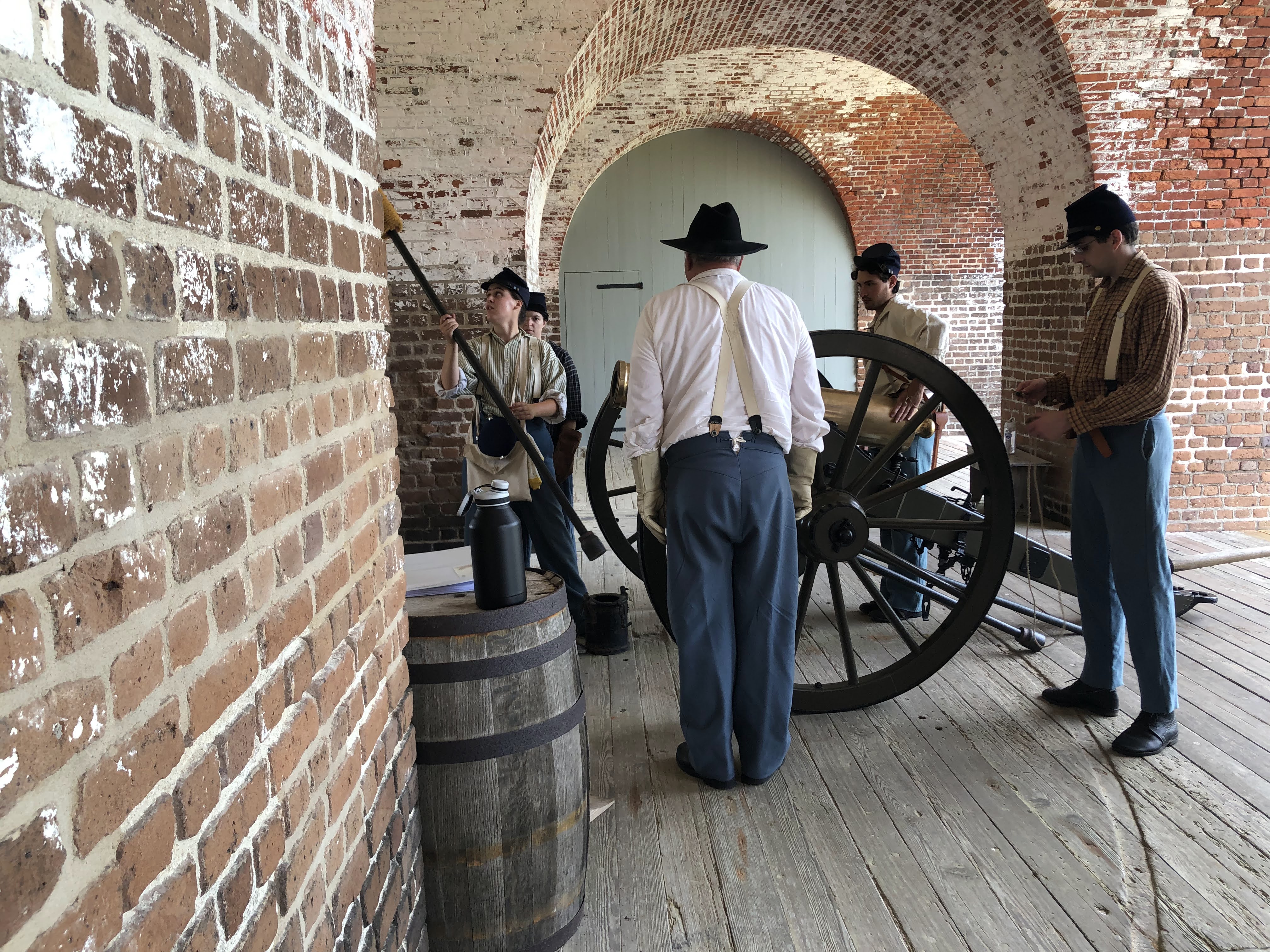
Cannoneers sponge the Parrott barrel at Pulaski (NPS photo)
Accidents are exceedingly rare, but the work does come with danger. In 2014, the breech of a gun fired at Fort McHenry National Monument failed, leaving one member of the cannon crew slightly injured.

Fort Pulaski requires volunteers to read the rules and take a 24-question test on safety. A couple questions are, “If the cannon fails to fire, what command is given?” and “The minimum waiting time before the piece is reprimed after a misfire is:”

The NPS manual of instruction begins with a sobering reminder for crews to be well-trained and prepared. It lists the four primary causes of accidents in historic weapons demonstrations using artillery:

1. Rapid firing

2. Poorly maintained or improper equipment

3. Improper drill

4. Improper ammunition

Cannon crew members march in for a demonstration at Pulaski (NPS photo)
During the Civil War, guns typically had a crew of eight. Crews firing replica weapons typically have six members, with one member fulfilling three spots, involving retrieving a charge and moving it up to the cannon.

Doherty makes sure they go over equipment and members understand all positions. Unlike, the Civil War, when all those in a battery needed to be interchangeable because of death or injury, volunteers don’t have to serve at every position.

For example, the No. 1 position involves sponging the barrel and ramming the round down the tube. “That can freak some people out.” 

The crew drills the morning of any cannon firings.

“(It’s) being comfortable into whether it was in one position or others, feeling confident. Not being shaky on anything,” Doherty says. “I am watching to see proficiency, if someone isn’t doing too well.” (At right, Parrott sponger, rammer and wormer at Fort Pulaski, NPS photo)

Another view of the howitzer training (NPS photo)
Elmore, who has conducted safety courses for NPS staffers, said each park is required to have its own magazine, meet ATF (Bureau of Alcohol, Tobacco, Firearms and Explosives) requirements and to have a loading area.

Doherty says the crew routinely goes over equipment, for example ensuring there are no holes in hand gloves are splinters in the sponge rammer. They are equipped with hearing protection.

The cannon cannot be fired more than once every 10 minutes. Visitors are 50 feet away and no one can be downrange of the barrel.

“This is not a race. We do need to be deliberate in the steps and not a rush. That’s when errors happen.”

Making the rounds safely is exacting work

Doherty – following ATF and NPS rules -- works with a mold to make the replica rounds, which contain aluminum foil, black powder and peat moss; the latter adds length and volume to the shell. On the day of firing, a friction primer causes ignition, setting off the black powder.

Black powder, finished rounds are kept in powder magazine
The black powder and finished rounds are stored in a World War II-era magazine.

The powder comes in a plastic bottle. The larger Parrott gun requires all 16 ounces while the howitzer uses about half of that.

Doherty takes the powder from the magazine, places it in a locked non-sparking box and works in another room after park hours.

While Doherty solely can do a few of the steps, others can help certain parts of the preparation – but only under her supervision.

To prevent a fire or explosion, Doherty works with a wooden table that has no exposed nails. It takes about 30-45 minutes to prepare six rounds, enough for three firings a day.

The rounds, weighing about a pound, are returned to the magazine for future use.

When the Picket wrote about NPS black-powder training in 2014, powder cost about $15 a pound. Like everything else, it’s gotten a lot more expensive.

A recent order of 50 pounds cost about $1,200 with shipping, Doherty says.

Fort Pulaski has helped other parks, including Fort Sumter National Monument, with supply.

More crew members, more cannon firings

The venue hopes the addition of a few more volunteers might ensure Saturday firings throughout the year.

Interestingly, the park did artillery demonstrations on Wednesdays during June and July because of higher staffing that day and the fact that visitors tended to travel on the weekends.

A crew moves the limber in the Fort Pulaski parade ground (NPS photo)
Fort Pulaski is particularly busy in November and December for holidays, thus the push to recruit more crew members. Doherty has three core members, all area retirees, to depend on, but she needs a bigger pool of recruits.

Sometimes, re-enactors come in with different standards. Doherty stresses people need to be open to learning and follow NPS rules.

For all the safety concerns, serving on a crew has its rewards.

“We can provide unrivaled weekend entertainment and outstanding camaraderie,” the park’s callout said.

Recruits can enlist with the Fort Pulaski cannon crew by emailing Historic Weapons Supervisor Shannon Doherty at shannon_Doherty@nps.gov. Applicants will also speak with the park's volunteer coordinator.

Monday, May 15, 2017

Working replica cannon set at courthouse

A thunderous boom announced the arrival the newest addition to the Montgomery County Courthouse lawn: A working replica of a Civil War-era cannon. The Leaf-Chronicle of Clarksville, Tenn., reports the gun is a gift from the Rotary Club to celebrate its 100th anniversary. It was built using original drawings of a Model 1841 6-pounder field piece. • Article

Thursday, September 6, 2012

Replica artillery put in Memphis park

Just in time for the 150th anniversary of the Civil War, four replica cannons were installed in Confederate Park in downtown Memphis on Wednesday. Two 12-pound field howitzers, a three-inch ordnance rifle and a six-pound field gun were bolted in place at a park overlooking Mud Island and the Mississippi River. • Article

Friday, February 3, 2012

Balloon replica to find air in July

The Genesee Country Village & Museum in New York will be getting a big lift this summer with the arrival of a replica of a Civil War military balloon. The Intrepid is expected to make its debut during the July 4 holiday. Just as in Civil War times, the balloon will stay tethered to the ground. • Article

Wednesday, December 8, 2010

Hunley lantern replica given to museum

Pennsylvania students' efforts to re-create history are part of a museum display. The National Civil War Museum, Harrisburg, has accepted a replica of a lantern such as those that may have been used on the Confederate submarine, the H.L. Hunley. • Article