Showing posts with label powder. Show all posts

Friday, September 2, 2022

Rally to the sound of the guns: Fort Pulaski near Savannah is looking for cannon crew volunteers. Here's what you need to know before enlisting

Crew fires a Parrott gun and trains on a howitzer; Doherty in foreground (NPS photos)
WANTED: Able-bodied men and women. No experience required. Applicants will undergo training and must pass a test. Requirements include working well with others and following orders. Job includes wearing a woolen uniform in hot weather. The position is a lot of fun, but safety comes first -- always. You’ll be firing cannons.

Fort Pulaski National Monument outside Savannah, Ga., recently took to social media to find folks for its cannon crew, with a special focus on Saturdays. While the Facebook post was not written quite like the Picket’s mock ad above, the job does entail those requirements.

Shannon L. Doherty, a park guide at Pulaski and its historic weapons supervisor, says it’s been tough to always field a crew because core volunteers sometimes can’t attend every event and staffers can’t always work extra days.

That’s where you might come in.

The cannon crew has typically been made up of older volunteers, many military veterans. But Doherty welcomes all those who can qualify.

“No experience is fine, because you have to be trained either way,” she says. “Firing a historic cannon is exhilarating. It’s loud and there’s the sulfur smell. The visitors come up and talk about how much they enjoyed it.”

The Fort Pulaski cannon crew portrays Union artillerymen.

They fire a reproduction 30-pounder Parrott rifle -- which recoils a bit -- and a 12-pounder smoothbore field howitzer, both made by Steen. The latter was not used in the Pulaski siege, but was a common anti-infantry weapon during the war.

National Park Service cannon and rifle crews do not fire period weapons. Chief Ranger George Elmore of Fort Larned National Historic Site in Kansas told the Picket in 2014 the agency does not want to risk destroying an historic artifact.

Various stages of the making of artillery rounds, not in sequence.
Doherty, trained in black powder, supervises  the work. (NPS photos)
Fort Pulaski has about two dozen cannons, several of which date to the Civil War. The Confederate masonry fortification surrendered in April 1862 after withering fire from Federal rifled guns destroyed parts of the wall and threatened its magazine. The innovative rifled weapons brought an end to that type of fort construction.

NPS venues that fire reproduction 18th and 19th century small arms and artillery must have an employee certified in their use and safety. Of course, actual rounds are not fired. Doherty, who underwent required NPS black-powder training in March, must be present at all cannon firings and she trains and supervises the crew.

Crew members must have awareness and aptitude

Both of Fort Pulaski’s demonstration weapons are in the parade ground. Each is fired during a typical 25-minute program. “We are trying to connect it to the theme of the park,” says Doherty. One example is the freedom story – how the Federal army helped the emancipation process.

National parks that fire cannons must follow a lengthy safety manual that is remarkably close to standards during the Civil War. “We try to be historically accurate and as safe as possible,” says Doherty.

Cannoneers sponge the Parrott barrel at Pulaski (NPS photo)
Accidents are exceedingly rare, but the work does come with danger. In 2014, the breech of a gun fired at Fort McHenry National Monument failed, leaving one member of the cannon crew slightly injured.

Fort Pulaski requires volunteers to read the rules and take a 24-question test on safety. A couple questions are, “If the cannon fails to fire, what command is given?” and “The minimum waiting time before the piece is reprimed after a misfire is:”

The NPS manual of instruction begins with a sobering reminder for crews to be well-trained and prepared. It lists the four primary causes of accidents in historic weapons demonstrations using artillery:

1. Rapid firing

2. Poorly maintained or improper equipment

3. Improper drill

4. Improper ammunition

Cannon crew members march in for a demonstration at Pulaski (NPS photo)
During the Civil War, guns typically had a crew of eight. Crews firing replica weapons typically have six members, with one member fulfilling three spots, involving retrieving a charge and moving it up to the cannon.

Doherty makes sure they go over equipment and members understand all positions. Unlike, the Civil War, when all those in a battery needed to be interchangeable because of death or injury, volunteers don’t have to serve at every position.

For example, the No. 1 position involves sponging the barrel and ramming the round down the tube. “That can freak some people out.” 

The crew drills the morning of any cannon firings.

“(It’s) being comfortable into whether it was in one position or others, feeling confident. Not being shaky on anything,” Doherty says. “I am watching to see proficiency, if someone isn’t doing too well.” (At right, Parrott sponger, rammer and wormer at Fort Pulaski, NPS photo)
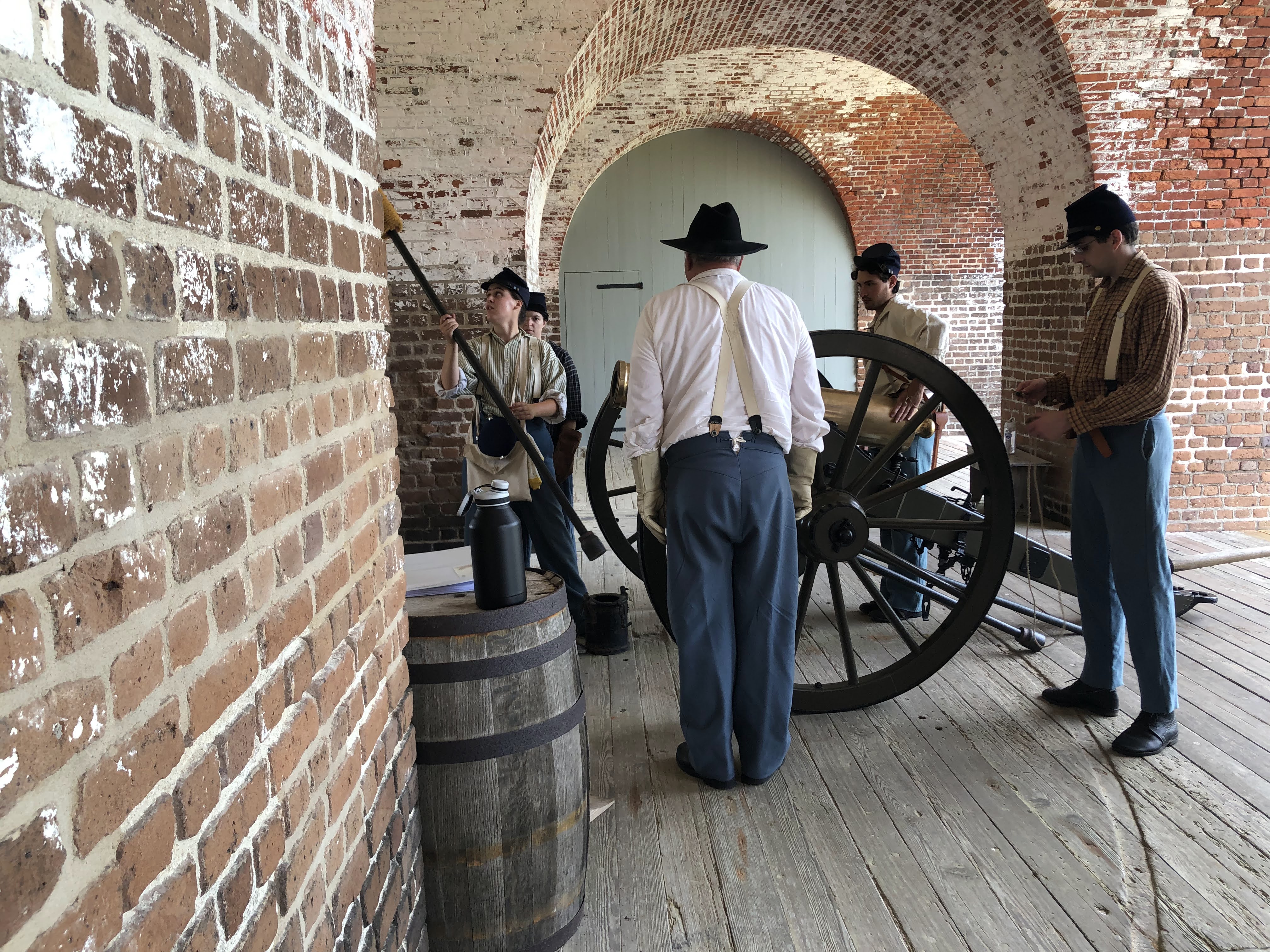
Another view of the howitzer training (NPS photo)
Elmore, who has conducted safety courses for NPS staffers, said each park is required to have its own magazine, meet ATF (Bureau of Alcohol, Tobacco, Firearms and Explosives) requirements and to have a loading area.

Doherty says the crew routinely goes over equipment, for example ensuring there are no holes in hand gloves are splinters in the sponge rammer. They are equipped with hearing protection.

The cannon cannot be fired more than once every 10 minutes. Visitors are 50 feet away and no one can be downrange of the barrel.

“This is not a race. We do need to be deliberate in the steps and not a rush. That’s when errors happen.”

Making the rounds safely is exacting work

Doherty – following ATF and NPS rules -- works with a mold to make the replica rounds, which contain aluminum foil, black powder and peat moss; the latter adds length and volume to the shell. On the day of firing, a friction primer causes ignition, setting off the black powder.

Black powder, finished rounds are kept in powder magazine
The black powder and finished rounds are stored in a World War II-era magazine.

The powder comes in a plastic bottle. The larger Parrott gun requires all 16 ounces while the howitzer uses about half of that.

Doherty takes the powder from the magazine, places it in a locked non-sparking box and works in another room after park hours.

While Doherty solely can do a few of the steps, others can help certain parts of the preparation – but only under her supervision.

To prevent a fire or explosion, Doherty works with a wooden table that has no exposed nails. It takes about 30-45 minutes to prepare six rounds, enough for three firings a day.

The rounds, weighing about a pound, are returned to the magazine for future use.

When the Picket wrote about NPS black-powder training in 2014, powder cost about $15 a pound. Like everything else, it’s gotten a lot more expensive.

A recent order of 50 pounds cost about $1,200 with shipping, Doherty says.

Fort Pulaski has helped other parks, including Fort Sumter National Monument, with supply.

More crew members, more cannon firings

The venue hopes the addition of a few more volunteers might ensure Saturday firings throughout the year.

Interestingly, the park did artillery demonstrations on Wednesdays during June and July because of higher staffing that day and the fact that visitors tended to travel on the weekends.

A crew moves the limber in the Fort Pulaski parade ground (NPS photo)
Fort Pulaski is particularly busy in November and December for holidays, thus the push to recruit more crew members. Doherty has three core members, all area retirees, to depend on, but she needs a bigger pool of recruits.

Sometimes, re-enactors come in with different standards. Doherty stresses people need to be open to learning and follow NPS rules.

For all the safety concerns, serving on a crew has its rewards.

“We can provide unrivaled weekend entertainment and outstanding camaraderie,” the park’s callout said.

Recruits can enlist with the Fort Pulaski cannon crew by emailing Historic Weapons Supervisor Shannon Doherty at shannon_Doherty@nps.gov. Applicants will also speak with the park's volunteer coordinator.

Monday, March 17, 2014

National Park Service black-powder course: Teaching the authentic and safe use of historic weapons


Castillo de San Marcos in Florida (NPS)
Last year, 1.1 million people who flocked to America’s national parks witnessed 9,145 programs involving historic weapons. Venues that fire reproduction 18th and 19th century small arms and artillery must have an employee certified in their use and safety. Of course, actual rounds are not fired. The National Park Service recently concluded a 10-day black-powder course at Fort McClellan Army National Guard Training Center near Anniston, Ala. Course coordinator George Elmore, chief ranger at Fort Larned National Historic Site in Kansas, talked with the Picket about the course, which featured 11 instructors, and the value of living history programs that use such weapons. Here is an edited version of our conversation:

Q. Why are these weapons programs put on at park?

Elmore: What makes a powerful demonstration is when you have successfully created the illusion you could be a soldier from the Civil War or Revolutionary War, and you draw persons so much into the talk and program, that you created a picture in their mind of what an individual soldier went through.

Training participants (NPS)
Q. Why is the course held?

A. The purpose of the course is to keep the use of firearms safe. You can lose a hand. You will see that occasionally in (non-park) re-enactments. We have never had a major accident in the park service. We are very concerned about safety. Each park is required to have its own magazine, meet the ATF (Bureau of Alcohol, Tobacco, Firearms and Explosives) requirements and to have a loading area.

Q. You had about 80 participants this year. Where are they from?

A. We had a couple from San Juan National Historic Site (Puerto Rico), those using early Spanish iron-type cannons at Castillo de San Marcos in St. Augustine, Fla., Civil War parks, Revolutionary War Parks, War of 1812, cannon and flintlocks. It is just a broad spectrum. We also have people from state sites. We had 11 from those and two U.S. Forest Service employees.

Q. Participants bring their weapons. How much experience do they have?

A. We do have safety inspections (of weapons brought to course). We found a couple problems -- gun locks that did not work correctly, weapons not properly cleaned or malfunctioning in strikes. About half are novices. We have people who never handled a weapon. You have some experienced people, perhaps some who have re-enacted. You have to start with the lowest level and bring everybody up to speed.

(NPS photo)
Q. Can you tell us a little more about the curriculum of the course?

A. This is a supervisory course that involves black powder, drill manuals and how to manage those weapons. It is a combination of teaching accurate interpretation and safety. We actually use the original manuals. The people have to study the manuals, learn how it was done then and proficiently drill using that manual. It is kind of like training the trainer. There is a lot of repetition and hands-on drill until they get the muzzle safety down. We have to teach ATF regulations, how to move black powder from point A to point B without blowing yourself up and how to store black powder safely. Those who are certified supervise the program at their park, and they train (those who fire weapons). We try to impress upon them the importance of what they are doing. To be sure, no matter what, to be safe.

Q. Anything else about the course?

A. We make sure when they leave they have passed required written exams and tests. They must look professional (and wear period clothing). None failed this year, but we have had that happen. We have sent people home halfway through.

Q. What is the role of the historic weapons supervisor at his or her park? I understand they work with staff members and, occasionally, re-enactors.

(NPS photo)
A. Each person cannot personally supervise more than 40 people firing those weapons. For demonstrations, they have to inspect each weapon, and go through the loading procedure. He or she has to get to know their leaders and have knowledge of these people. Sometimes before an event, you may have to pull someone from the line (if they don’t meet specifications). There are a lot of cheap replicas that were never intended to be fired that someone has adapted to fire a blank round. We require hearing protection. A lot of re-enactors don’t use it elsewhere.

Q. The National Park Service doesn’t use original weapons. Why?

A. We cannot use period weapons. No more is being made. If someone drops it and cracks a stock, it is gone. You have destroyed an original item from the 1860s or whatever era you are using.

Q. So you use exact replicas. What does that mean?

A. The replicas are never as good as the originals. We train them what to watch and look for (in quality and components). Some replicas have a two-piece stock. They have to know how to totally disassemble the weapon. The biggest safety problem is the quality of the (commercially produced) equipment being used today. Almost nothing today would pass the original ordnance specifications of the time.

Graduating class of 2014 - click to enlarge (NPS)
Q. What kind of weapons are fired at national parks?

A. The most common are 6 pounders and 12 pounders, howitzers and Napoleons. Some parks have 3-inch ordnance. With side arms, Colt and Remington, Army and Navy, .44-caliber and .36-caliber. Civil War can include Springfield musket models 1861 and 1863, Spencer carbines and Henrys.

Q. How much does black powder cost?

A. We buy it commercially at about $15 a pound. Cannons will use a half pound per round. Some of the larger ordnance requires more. With the (cost) and time of staff to perform it … it gets to be an expensive program. (But) it is one of most popular interpretive programs we do.

Safety first for Civil War re-enactors (NPS)
Q. What are some of the more scenic places at which these weapons are fired?

A. Fort Pulaski in Georgia, Fort McHenry in Baltimore, San Juan, Castillo de San Marcos. These fortresses make for great views. You can walk through the portal and you can take yourself back. It sometimes can be eerie.

The Picket also spoke with Willie Johnson, historian at Kennesaw Mountain National Battlefield Park in Georgia. Johnson is certified as a historic weapons supervisor. In June, for the 150th anniversary of the Atlanta Campaign battle, re-enactors will be at encampments and will perform weapons demonstrations. Black-powder supervisors from other parks will assist Johnson.

Q. What is your role when it comes to re-enactors?

Johnson: To ensure that their drill is correct and they are safe. You basically make sure that the lock functions properly, the weapon is clean and it is not loaded.

Q. What if, say, a musket doesn’t pass muster?

A. Sometimes we turn someone down. We have some weapons used by staff. If there were to be a weapon not pass inspection, I might check him one out temporarily.”

Tuesday, February 15, 2011

Debate over black powder limits, safety

Civil War re-enactor Bill Safford says a typical weekend battle can require up to 100 pounds of black powder. But in Washington state, the legal limit for storing and transporting black powder is five pounds. Rep. Barbara Bailey has introduced a bill that would significantly increase the limit for storing and transporting black powder to match federal regulations. • Article