Showing posts with label NPS. Show all posts

Tuesday, October 22, 2024

USS Cairo gets a much-needed deep cleaning at Vicksburg. The hope is one day the ironclad removed from the Yazoo River will be moved inside to safeguard its future

A conservator studies the white oak and yellow pine used in construction (NPS photo)
The first step in ensuring long-term protection of the remnants of USS Cairo, the first armored vessel sunk by an electrically detonated torpedo, has included the removal of 555 pounds of dirt and debris – and counting.

Terra Mare Conservation has been at Vicksburg National Military Park in Mississippi since September, conducting dry and wet cleaning of the canopy-covered Union vessel. Park officials say it’s the first time in more than a decade the vessel has undergone “critically needed cleaning and conservation work.”

Superintendent Carrie A. Mardorf told the Picket in an email that nothing is being rebuilt or replaced. “The NPS is taking a strictly preservation approach to the gunboat.”

Terra Mare also is repairing and stabilizing any damaged areas of the white oak and yellow pine used in construction. Corrosion on the bow and cannons is being treated and paint is being touched up.

The Cairo and accompanying museum officially opened in 1980 (NPS)
The ironclad sank in the Yazoo River on Dec. 12, 1862, after it struck a floating Confederate mine. It went down in 12 minutes. Recovered in the 1960s, the Cairo has been a popular draw at the Civil War park since the late 1970s.

The park has posted a couple updates on Facebook, prompting some commenters to ask why the famed wreck is not in a building, away from the elements..

“Enclosing the USS Cairo in an interior setting with climate control is ultimately the best way to preserve the boat for future generations,” Mardorf told the Picket. “All of the recent science and studies that the park has completed in the past year recommend protecting the gunboat with an interior enclosure; however, doing so would require specialized construction funding.”

Congress is currently considering reauthorization of the Great American Outdoors Act (GAOA), she said. “If renewed, GAOA may provide some funding for the long-term preservation of the USS Cairo.”

Recent work on the site and vacuum bags containing dirt and debris (NPS)
For now, conservators are giving the warship TLC and a top-to-bottom cleaning, removing dirt, dust, pollen, rodent and bird nests, bird guano and trash.

“The biggest surprise thus far has been the amount of dirt removed. As Terra Mare cleans, they are learning a lot more about the condition of the wood and metals, which will be summarized in a final report for the park,” said Mardorf.

The team this week is cleaning the metal pilot house and boilers.

Work is expected to conclude in mid-November. Further temporary closures of the exhibit are possible to protect the public from airborne particles.


The USS Cairo has been treated with a variety of chemical sprays and coatings since the 1970s. Additional studies will be carried out to determine if fungal and insect infestations are present, according to a park summary of the project. “Long-term, the park will embark on a regular, cyclic cleaning and conservation schedule for the ship.”

Mardorf says all of what the public sees is original, with the exception of the 1980s Glulam structure that holds the boat in place.  

The end comes in the Yazoo River above Vicksburg

The USS Cairo’s fame has far exceeded its brief history. Built in a hurry in Mound City, Ill., and commissioned in January 1862, the ironclad sank only 11 months later.

The USS Cairo at anchor in 1862 (Library of Congress)
At 175 feet long and with a top speed of six knots, the vessel carried 13 guns and 251 officers and men. Seven shallow-draft City Class river ironclads prowled the Mississippi River and connecting shallow waterways, menacing Confederate supply lines and shore batteries, the National Park Service says.

The Cairo saw limited action at Plum Point (Fort Pillow), Tenn., in May 1862 and Memphis the following month. Before the Federal attack on Haynes Bluff, Cairo skipper Lt. Cmdr. Thomas O. Selfridge Jr. (below) led a small flotilla of gunboats into the hazardous confines of the Yazoo River on Dec. 12, 1862.

“Tasked with destroying Confederate batteries and clearing the river of torpedoes (underwater mines) the flotilla inched its way up the murky waters. As the Cairo reached a point seven miles north of Vicksburg the flotilla came under fire and the aggressive Selfridge ordered his guns to the ready and called for full steam, bringing the ironclad into action,” the NPS says.

“Seconds later, disaster struck. Cairo was rocked by two explosions in quick succession. The first tore and gaping hole into the port (left) bow of the wooden hulled ironclad. The second detonated a moment later near the armored belt amidships on the starboard side. The hole on the bow proved to be catastrophic.”

Selfridge ordered the Cairo to be beached and the crew to abandon ship. The Cairo slid from the river bank into 36 feet of water with no loss of life. About a half dozen sailors were injured.

Mud protected the ironclad for almost 100 years

The ill-fated ironclad disappeared into history for nearly a century.

Using maps and an old military compass, the legendary Ed Bearss, a historian at Vicksburg National Military Park at the time, and two comrades found the mud-encased ironclad in 1956.

Despite financial shortfalls, barge problems and a zero-visibility river that deposited silt at an alarming rate, the vessel was eventually raised in 1960 and 1964-65.

A portion of the casemate rests on a barge in the Yazoo River (NPS)
Hopes of lifting the ironclad and her cargo of artifacts intact were crushed in October 1964 when the three-inch cables being used to lift the Cairo cut deeply into its wooden hull. It then became a question of saving as much of the vessel as possible. The decision was made to recover the USS Cairo in three sections.

Barges carried the remnants to Pascagoula, Ms. The wreck was moved in 1977 to the Vicksburg park, where it was partially reconstructed and placed on a concrete foundation.

The recovery of artifacts revealed a trove of weapons, munitions, naval stores, and personal property that help tell the story of the sailors that once called the ship home, according to the NPS.

Sunday, March 29, 2020

Pea Ridge National Military Park will expand with 140-acre historic farm that was site of troop movements, near field hospital

Williams Hollow Farm and bordering stream (Copyright The Conservation Fund)

A 140-acre parcel that was the scene of Confederate troop movements and a hospital during the March 1862 Battle of Pea Ridge in northwest Arkansas has been bought by a coalition of conservation and historical groups, with plans to donate it to the National Park Service.

The Williams Hollow Farm is surrounded on three sides by Pea Ridge National Military Park; the acquisition in effect fills in a missing puzzle piece.

The Conservation Fund and the Northwest Arkansas Land Trust earlier this month announced the purchase. Spokeswoman Ann Simonelli with The Conservation Fund told the Picket the seller is an extended family that has owned the property since the time of the battle.

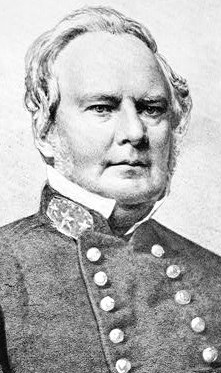
Maj. Gen. Price
“There is nothing on the land at the moment. It is currently made up of forest and degraded field. The park service aims to eventually do restoration of the field to manage it as vegetation from the 1862 time period,” Simonelli said.

While the groups did not disclose the purchase amount, it is believed to be in the hundreds of thousands. The Pea Ridge National Military Park Foundation is helping with fund-raising to cover the purchase and eventual donation of the property to the federal government.

Among those efforts is NWA (Norwest Arkansas) Gives on April 2.

The March 6-9, 1862, Battle of Pea Ridge (Elkhorn Tavern) has been called by some historians “the Gettysburg of the West.” Forces under Union Maj. Gen. Samuel Curtis defeated the men of Confederate Maj. Gen. Earl Van Dorn, whose leadership has been faulted by historians. The Union won control of Missouri and weakened the Confederate hold in Arkansas.

“It is no exaggeration to say that the Pea Ridge campaign permanently altered the balance of power in the Trans-Mississippi. Few Civil War operations had such an impact on the course of events,” according to the National Park Service.

Kurz & Allison's fanciful depiction of battle (Library of Congress)
Jami Lockhart with the Arkansas Archeological Survey performed research on the Williams Hollow Farm and surrounding areas that played a part in the battle.

Confederate and Federal units clashed at Cross Timber Hollow and the Tanyard area north of Elkhorn Tavern. Rebel troops likely traversed the ground comprising the purchased property. Missouri State Guard troops under Maj. General Sterling Price emerged from Williams Hollow on March 7 as part of a drive on the Union right flank, according to histories.

The coalition cited other historical aspects of the area.

Lockhart wrote: “The historic Telegraph Road approaches to within 150 feet of the conservation property, and runs roughly parallel with the property along the entirety of its eastern boundary. Telegraph Road (also known as Old Wire Road) is integral to the history of the region. This road formed a portion of the route associated with the forced relocation of thousands of Native Americans, and is commonly known as the Trail of Tears. It was the route of the Butterfield Overland Mail and Stage line serving the area between St. Louis and San Francisco during the period 1858 to 1861. Telegraph Road was also the primary transportation artery in the area during the Civil War. Telegraph Road is especially well-known for its central role in the Battle of Pea Ridge.”

Sunset at Pea Ridge National Military Park (NPS)
During the night of March 7 into March 8, 1862, both armies concentrated forces on Telegraph Road. A powerful Union bombardment and assault on March 8 put Confederates into a retreat.

It’s not just the Civil War aspect of Williams Hollow Farm that is important, the groups said in their announcement.

“Once protected, the Williams Hollow Farm will secure the view shed of the Pea Ridge National Military Park and conserve mature forest habitat for migratory songbirds and rare bats, including the threatened northern long-eared bat. Keeping the property undeveloped will also help provide water quality protection of Sugar Creek within the Elk River watershed.”

Pea Ridge National Military Park Superintendent Kevin Eads told the Picket the acquisition would help protect and preserve cultural and natural resources. 

Jackie Crabtree, mayor of the town of Pea Ridge and head of the Pea Ridge National Military Park Foundation, said during the time of fundraising the Northwest Arkansas Land Trust will work with the park staff to keep the property maintained. The tract currently has a large open field surrounded by timber.

Rock formations at Williams Hollow Farm (Copyright The Conservation Fund)
Crabtree said the purchase was a rare opportunity to protect such property during a time of rapid growth in the region.

Needless to say, the Civil War is an important part of the town’s background and tourism.

“There are several families still in the area that were here during the battle,” Crabtree told the Picket. “The thing that makes Pea Ridge unique however is the naming of our streets. North/South streets are named for Union soldiers who fought in the battle. East/West streets are named for Confederate soldiers. This is set in city ordinance for developers.”

Wednesday, November 13, 2019

Gettysburg National Military Park, Eisenhower National Historic Site name Steve Sims as new superintendent

Steve Sims will begin his new job early next year (NPS photo)

A West Point graduate and longtime National Park Service employee has been named the new superintendent of Gettysburg National Military Park and Eisenhower National Historic Site in Pennsylvania.

Steven Sims will begin his duties at Gettysburg in January, the park said in a recent press release.

“As a former Army Officer, I feel a deep responsibility to care for the hallowed grounds of Gettysburg, moreover, honoring the legacy of one of the most notable military generals and presidents of our nation is a privilege. I look forward to serving these parks and our neighbors in this new role,” Sims said in a statement.

Sims is currently serving as superintendent of Valley Forge National Historical Park, Hopewell Furnace National Historic Site and the Washington-Rochambeau Revolutionary Route National Historic Trail.

He will replace Ed Clark as the new permanent superintendent, according to the Hanover Evening Sun. Clark went on special assignment in 2017 and is now the branch chief for the National Park Service Search and Rescue Program in the Washington Support Office. Since he left, the parks have filled in the position with various other hires for 120-day periods, the newspaper said. The current acting superintendent is Thomas Forsyth.

Gay Vietzke, a regional director for the NPS, said Sims “brings a broad set of skills that will be very beneficial to both park units. He is experienced at bringing partners together to work towards a common goal and values the importance of community engagement.”

Sims led Valley Forget through a $14 million visitor center renovation and the production of five new park orientation films scheduled for completion next summer, Vietzke said.

“His background as a West Point graduate and (US Army) military officer will provide the valuable leadership that is needed to define and carry out the mission of the parks. In his current assignment, Steve has made significant strides in reducing the park’s maintenance backlog and preserving park resources,” the director said.

Thursday, June 21, 2018

Amputated limbs recovered from shallow pit at Manassas provide insight into surgeons' work

Erin Godwin excavates limb / Kate D. Sherwood, Smithsonian Institution
The extraordinary discovery of the remains of two Civil War soldiers buried next to 11 amputated limbs at Manassas National Battlefield Park in Virginia has brought new insight into how surgeons treated the critically wounded.

The National Park Service on Wednesday announced it’s the first time a surgeon’s “limb pit” from the conflict has been excavated and studied. It dates from the Second Battle of Bull Run in August 1862, a decisive victory for Confederates.

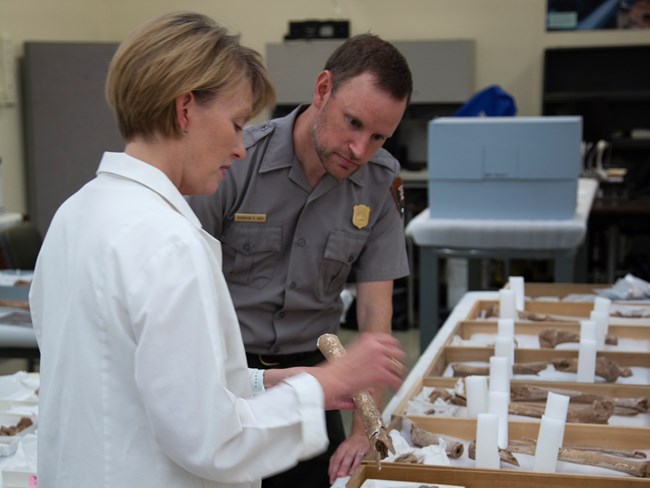
Bone fragments were found in an undisclosed area of the park during a utility project in 2014. The next year, NPS and Smithsonian Institution archaeologists excavated the site.

Beneath the surface, they found two nearly complete human skeletons, and several artifacts including buttons from a Union sack coat, a .577 Enfield bullet, three pieces of .31 caliber lead buckshot, and an assemblage of eleven arms and legs,” the park said.

Femur with lodged bullet / Kate
D. Sherwood, Smithsonian Institution
The team was able to determine that the bones belonged to Union soldiers. On Tuesday, the two skeletal remains were transferred to the U.S. Army, which will bury them at Arlington National Cemetery in caskets made from a fallen tree on the battlefield.

A glance of photographs of the amputated limbs shows the bleak realities of war. Surgeons sawed them off with precision because the bullets caused so much damage and soldiers needed an opportunity to ward off deadly infection.

As casualties piled into tents not far from the fighting, Civil War surgeons had to make quick decisions on who might have a chance of going home – without an arm or leg – and who was too seriously hurt to be operated on.

That appeared to be the case with the two soldiers.

The first was in his 20s and died of injuries from an Enfield bullet striking his upper leg.

“Surprisingly, the bullet was still lodged in the femur bone, likely because it slowed as it passed through the man’s cartridge box, the National Park Service said.

Cut marks show surgeon's skill / Kate D. Sherwood, Smithsonian Institution
Doug Owsley, lead physical anthropologist at the National Museum of Natural History, told the Smithsonian's online magazine that the soldier was shot in the buttocks while retreating.

The slug went in at an angle, causing a longitudinal fracture that caused the femur to snap, with bits splintering off inside his leg. “This is just so difficult to treat,” says Owsley, adding the wound was too high for amputation. The man was set aside and died.

The second skeleton is that of a man estimated to be between 30 and 34 years old. He died as a result of a buck and ball shot to the upper arm, pelvis and leg.

Regarding the amputated limbs, Owsley said the surgeon was skilled, given the precision of the cuts.

Brandon Bies assists in 2015 dig /
Kate D. Sherwood, Smithsonian Institution
“There’s a lot of choices that those surgeons had to make when they realized they were left and supplies were not coming in, and they basically had to fend for themselves along with thousands of wounded,” Kari Bruwelheide, a Smithsonian anthropologist, said in a video.

Manassas Superintendent Brandon Bries said, “We can start to have a personal connection to these soldiers and these remains. So instead of some bones, you are looking at somebody who was between 30 and 34 years old and was from the state of New York. That person may have had a wife, may have had children.”

The NPS said research on the recovered limbs continues and its possible they could be matched with a name.

“By examining the cuts, it is possible to determine the skill of the surgeon and even his physical position relative to the patient. With help from historical records, researchers believe it may be possible to match the bones with a specific surgeon and maybe even the soldier they belonged to, a truly unique discovery.

Bruwelheide, Bies examine bones / Nathan King, NPS
Bies, an archaeologist, told NPR that the men were likely wounded during a charge up Deep Cut, held by thousands of Confederates. “As (Union soldiers) start to get closer, within 300, 400 yards, they start to receive rifle fire and musket fire," he says. "Men are dropping left and right." 

Bullet entrance wound /
Kate D. Sherwood, Smithsonian Institution
Surgeons had a standard kit, with a variety of saws.

"If you could imagine sitting with a horrific wound of your own and hearing the moans and screams and seeing a growing pile of limbs from the surgeon, and knowing that your turn was coming, I can't possibly imagine what that would have been like,” Bies told NPR.

The bones were found in a shallow pit, indicating they likely were buried in haste. According to Smithsonian experts, the surgeons were allowed by Confederates to conduct the hasty operations after the battle, when the wounded had been in the sun and rain for days. They may not have had chloroform at their disposal.

Remains are in Army custody / Bradley Waldron, NPS
Foot of amputated leg / Kate D. Sherwood, Smithsonian Institution

Wednesday, March 29, 2017

Fort Pulaski took a beating from Hurricane Matthew, but worked hard to bounce back

Water poured in from flooded dike system (NPS photo)

Saturday’s Park Day – a nationwide service project organized by the Civil War Trust – comes as Fort Pulaski National Monument nears a critical point in its recovery from last October’s Hurricane Matthew. It’s transitioning from six months of recovery to fully focusing on its mission of educating visitors about this important siege early in the war. The fort is looking for volunteers to help clear a popular trail and vegetation that morning. Joel Cadoff, spokesman and chief of interpretation, this week spoke with the Picket about the $1.8 million in damage and efforts to get the park near Savannah, Ga., back on its feet.

BATTENING DOWN THE HATCHES

As the hurricane approached, its exact target unknown, the staff removed items from the floor and secured facilities. “Everybody was in pure prep mode,” Cadoff said. The park, aware that the site was susceptible to flooding, had a week before sent most of the park’s collection to Fort Frederica National Monument on St. Simons Island, south of Savannah. 

Lee drawing's (NPS)
Among the items that made the trip were drawings of wildlife on Cockspur Island by a young Robert E. Lee when he was a lieutenant stationed at Fort Pulaski, and clothing belonging to Union Brig. Gen. Quincy Adams Gillmore, in charge of the 1862 victorious siege of Pulaski.

THE DEVASTATION

The park was closed when Matthew made landfall on Oct. 8. The staff was at first optimistic that Pulaski had weathered the storm with minimal to moderate damage. “One of the (aerial) images showed the masonry fort surrounded by water, but the inside looked dry other than one of the pecan trees having been uprooted,” said Cadoff.

But an early inspection showed two bridges crossing the moat and leading to the fort had been washed away. (One of those wooden bridges was found just last month, several hundred yards away.)

Location of washed-away bridge
(NPS photos)

The parade ground had endured up to 18 inches of water, and the ranger office and restroom in the fort were damaged by water. “Every park feature was affected one way or the other,” said Cadoff. The visitor center and maintenance shop also received water and heating and air systems were damaged.

Some 300 trees were down across the site.

Designed by Lee, a dike system outside Fort Pulaski allowed for tide control and drainage that aided in the construction before the Civil War. The system was built to handle a 12-foot tide, but Matthew pushed in several inches more – and the water had to go somewhere. “Basically you had water pouring in.”

It could have been worse – during a storm in the 1890s, lighthouse keepers had to deal with 5 feet of water inside the brick fort.

(NPS photo)

THE SLOW ROAD TO RECOVERY

Fort Pulaski was closed for about a month as initial cleanup began. That included everything from removing muck to clearing trees and other debris. “It wasn’t safe to have visitors,” Cadoff said. A National Park Service team came in days after Matthew left and helped do triage.

When the fort reopened in November (photo, above), only guided programs were conducted. (Visitors since then have been able to wander about, as they did before Matthew.)

The staff no longer uses office space in the fort and the only restroom is at the visitor center. The facility inside the fort won’t be replaced.

PROFESSIONALS PITCH IN

(NPS photos)

The NPS’ Historic Preservation Training Center in Frederick, Md., sent in a team in early March to help repair roof damage and interior flooring.

About 90 percent of the wooden floors in the casemates were displaced by Matthew. The team reset the timbers and replaced any that had rotted over the years.

SITUATION TODAY

When asked to rate how much the site has bounced back to what it was pre-Matthew, Cadoff gave a figure of 85-90 percent. Visitors still notice the tree losses and some trails remain closed.

One of two teams in Saturday morning’s Park Day will focus on the popular 1.-7 mile Lighthouse Trail, which goes from the visitor center, past the fort and to near the famous Cockspur Island Lighthouse.

The park will restore living history programs in the fall. A group of authentic Civil War re-enactors plans to hold a Confederate garrison event in April 2018 to help Pulaski "get back in the saddle."


MOVING FORWARD

Cadoff said Hurricane Matthew is a reminder that such rare storms in Georgia can come along: “It can happen, it will happen again.” He said the staff was as ready as it could be, but “there is always room for improvement.”

Was there a positive side? Cadoff believes so. Tthere has been strong moral support from those reviewing recovery updates on the park’s social media.

Seventeen staff members, who had to deal with the storm’s impact on their own homes, put in a ton of work to clean up and move Fort Pulaski forward.

“It has brought us closer together," Cadoff said.

Friday, January 13, 2017

First NPS site focusing on Reconstruction

NPS photo

President Obama has designated three new national monuments devoted to civil rights history, including the first National Park Service site dedicated to Reconstruction. The monument includes several sites near Beaufort, S.C., which fell under Union control in November 1861, and became one of the first places where emancipated slaves voted, bought property and created churches, schools and businesses. • Article

Wednesday, April 6, 2016

On Shiloh's 154th anniversary, an ode to a Union fifer who was there, and a note about social media

Veteran W.Y. Jenkins plays his fife (Courtesy of R. Serroels)

Shiloh National Military Park this week is marking the 154th anniversary of the epic contest in the Civil War’s Western Theater. Visitors are tromping through fields and woods for hikes and tours that are bringing the battle to life.

Many more people are following activities through the federal site’s “aggressive” social media, which provide real-time updates for certain programming, such as today (April 6).

That outreach can elicit responses that add richness and context to the story of the two-day clash in southern Tennessee on April 6-7, 1862. Such was the case last weekend after the park posted photos of a whiteboard filled on both sides with the names of soldiers and their units.

Rangers had asked visitors to list ancestors who fought in the Civil War. They, like the men who fought here, tend to be from the Midwest or Deep South.

Richard Serroels, who has not been to Shiloh in about 30 years, was among those responding to a park Facebook post showing the whiteboard.

“My maternal great-grandfather, Warren Young Jenkins, was a fife player at Shiloh,” the Marietta, Ga., resident wrote. “The family donated his fife to the museum and it was put on display along with other battlefield instruments from the war. He was with the 9th Illinois Infantry.”

Jenkins' fife is on display at Shiloh (Courtesy NPS)

The Picket spoke to Shiloh ranger Chris Mekow and Serroels on Tuesday, curious about the impact of social media and the story of Jenkins, who survived the war, was married for more than six decades and ended his days in Canon City, Colo.

In later years, Jenkins wrote a riveting account of the carnage at Shiloh, which saw more than 23,000 casualties and, eventually, a Union victory.

The 9th Illinois, part of Hurlbut’s division, suffered enormous losses as it bore the brunt of Confederate assaults throughout April 6. Some 103 men were killed and 263 wounded, one of the highest rates for a unit at the battle. (Interestingly, the 9th Illinois was positioned not far from where Confederate commander Gen. Albert Sydney Johnston was mortally wounded.)

Like other musicians, Jenkins, a private, served as a medical orderly when bullets and artillery rounds started flying. After one Rebel shell landed, the Company H fifer carried two wounded soldiers to the rear and went back for a third and found him sitting behind a large stump.

Jenkins, then age 23, wrote later:

“I said, ‘Come, now, and I will take you to the field hospital to have your wound dressed.’ He said, ‘Oh, no, I am mortally wounded; see here!’ and he opened his clothing, uncovering his wound. The shell had torn out three or four ribs on his left side and I could see his heart throbbing. He took out his watch and handed it to me, telling me to send it to his girl (I suppose his intended wife, a German name that I cannot remember). I wrote his name on a small bit of paper and closed it up in the back of the watch and later gave it to his captain with the written instructions to send it to the lady at Belleville, Illinois.” (Jenkins was from Hillsboro, Ill., about 50 miles south of Springfield.)

Jenkins came across the soldier’s remains three days later while on burial detail.

Whiteboard filled with soldiers' names at Shiloh (NPS)

He provided other details of the fighting, including his attempt to fire a weapon belonging to a killed comrade. He asked another soldier for a cap to prime the gun.

“He looked down to get a cap and a ball from the enemy passed through his cartridge box and blowed the cartridge box all to splitherines with 30 or 40 rounds of cartridges right up into both of his eyes and my left eye,” recounted the musician. “The injury to Arthur's eyes turned out serious in after years. He went totally blind. My left eye was injured for life.”

Later in the evening, Jenkins cared for more wounded at a steamboat landing and helped build a makeshift coffin and bury an orderly sergeant who had suffered intensely.

Today, Jenkins’ fife, which he was known to proudly play throughout his life, is on display at Shiloh’s museum. The family donated it in the early 1990s, Mekow told the Picket.

The ranger said the whiteboard, which was labeled “Find Your Park” as part of the National Park Service’s centennial celebration, is part of an effort to get more interaction with visitors, whether in person or via social media. Many interested in the battle – such as Serroels -- cannot get to the remote location. “You have got to make a trip to get here,” said Mekow.

The park is active on five platforms: Facebook, Twitter, Instagram, YouTube, Flickr. 

“Shiloh has the most active and so far most engaging Facebook page of any Civil War park in the Southeast,” said Mekow. “We have been very aggressive. We are a daily poster. We follow live events in real time.”

“(This) actually gets our programs to people who will never be able to step foot on this battlefield.”

Two comrades in arms, music (R. Serroels)

Posts and video’s aren’t just about the military action, though there is plenty of that. Some look at the park’s natural features, or music. Readers really like the behind-the-scenes stuff, Mekow said, such as remodeling or work on a park feature.

An example was then-and-now photos of a monument dedicated in 1913. “That one went off the charts.”

Shiloh National Military Park has several activities planned to mark the NPS’s 100th birthday, including a summer concert series. In November, memorial luminaries will be placed in the park’s Corinth, Ms., unit and around that city.

Shiloh and other NPS sites regularly tell the stories of men such as Jenkins, who served a couple stints before mustering out in August 1864. (Jenkins tells a sweet story of visiting home a few months before he got out, playing “Home, Sweet Home” on the fife to his mother.)

Jenkins described the scene as he and other boys returned home.

“Nearly every one of the 29 men that arrived at Hillsboro August 29, 1864, had been absent since April 17, 186(1), 3 years, 4 months and 12 days. When we left there were 110 of us marched to the depot. Where were the 81 missing boys? Why most of them were sleeping the sleep that knows no waking. Some of them in unknown graves.”

9th Illinois monument (background) at Shiloh cemetery (NPS)

The 9th Illinois went on to take part in the Atlanta Campaign and March to the Sea, and seeing further action in the Carolinas before mustering out after war’s end. It listed 417 men having died from wounds or disease.

A few months before the farmer mustered out, Jenkins had married Susan – a union that produced numerous children and lasted 62 years until her death in 1926. They lived in Illinois and Kansas before moving to Colorado in 1899. Jenkins was active in the Grand Army of the Republic and assisted a fellow veteran in receiving benefits. He would occasionally play his fife, a wooden flute that produces shrill notes. He passed away in 1929 at 90.

A member of a GAR lodge in Colorado a decade before adapted a seven-stanza ode to honor Jenkins’ “historical fife,” which he continued to play on Memorial Day. The verse concludes:

Now worn and gray like the comrades brave,
Who faced the bullet and screaming shell,
It sounds no more in the camps or field
The old commands in a thrilling swell.

When Jenkins answers the last roll call,
And departs from this mortal sphere,
I am sure he would rest more peaceful all
If he knew his old fife was near.