Showing posts with label pea ridge. Show all posts

Saturday, December 26, 2020

2020's top 10 Picket posts: A treasure of artifacts hauled to surface; arson fire at museum, USS Monitor and innovative Colt revolving rifle

Recovered round from Colt revolving rifle (Prairie Grove Battlefield State Park)
Articles on arson at the National Civil War Naval Museum, an amazing trove of artifacts from a scuttled Confederate ironclad, historian Ed Bearss and battlefields in Arkansas were among the top 10 Picket posts -- by page views -- in 2020.

We’ve got a few items in the works, so we look forward to rolling those and others out in 2021. Thanks so much for your interest – and Happy New Year!

10. MYSTERY TIMBER:  Forty years ago, someone walking North Carolina’s Kure Beach found a curved piece of timber pocked with holes and containing a piece of iron. Its donation to the state earlier this year raised questions over whether it belonged to a blockade runner.  -- Read more

One of the two Dahlgrens that were cleaned (The Mariners' Museum and Park)
9. USS MONITOR’S BIG GUNS:  This February post previewed the cleaning of the famed Union ironclad’s two Dahlgren artillery pieces. “By boring the guns, we will finally have the ability to remove trapped ocean salts from the interiors of these massive artifacts; which sets the stage for us to dry and put the guns on display,” said Will Hoffman of The Mariners' Museum and Park. -- Read more

8BELOVED ED BEARSS: By the beginning of 2020, it was clear that the legendary Civil War historian, author and mesmerizing guide was no longer able to lead tours. One of his publishers encouraged fans to send Bears letters of appreciation. Bearss (left) died in September at age 97. -- Read more

7. SAVING THE STRAIN: A tabby structure that survived the federal burning of Darien, Ga., seemed destined for the wrecking ball just a year and a half ago. But an Atlanta-area couple came through, and they are restoring the Adam Strain building in the coastal town. -- Read more

6. PRAIRIE GROVE FIREPOWER: Removal of underbrush at the epicenter of a ferocious battle in northwest Arkansas has allowed archaeologists to recover about 400 Civil War artifacts, including spent bullets fired from innovative Colt revolving rifles. -- Read more

5. USS MONITOR REDUX: Earlier this year, conservators at The Mariners’ Museum and Park in Newport News, Va., removed the last concretion from inside the barrels of the two large turret guns. They used a special drill to remove the hardened mix of sediment and sea life.  --  Read more

4. PUZZLE PIECE AT PEA RIDGE: A 140-acre parcel that was the scene of Confederate troop movements and a hospital during the March 1862 battle was bought by a coalition of conservation and historical groups, with plans to donate it to the National Park Service. -- Read more

Inverted fantail of the CSS Jackson (Picket photo)

3. RARE IRONCLAD FANTAIL BURNED: A suspected arson fire roared through a boat shed where rare components of two Confederate vessels are stored at the National Civil War Naval Museum in Columbus, Ga. Among the items heavily damaged was the ironclad CSS Jackson’s fantailwhich the museum has described as “a very unique piece of naval architecture." -- Read more

2. STAGGERING HAUL OF ARTIFACTS: An estimated 13,601 artifacts brought ashore from the Confederate ironclad CSS Georgia wreck site in Savannah were trucked to Texas for conservation. What’s known about the ship’s design, construction, propulsion, armament and life aboard the "Mud Tub" are detailed in a massive report about the CSS Georgia's recovery. -- Read more 

CSS Georgia Dahlgren cannon, bayonet hilt, breast plate (USACE-Savannah)
1. ARSON INVESTIGATION CONTINUES: Investigators have been pursuing leads in a suspected arson fire that damaged rare artifacts and destroyed modern vessels in a storage area at the National Civil War Naval Museum-- Read more

Wednesday, April 1, 2020

Colt revolving rifle bullets fired by Illinois troops among hundreds of artifacts recovered at Arkansas' Prairie Grove battlefield park

Recovered round from Colt revolving rifle (Prairie Grove Battlefield State Park)
Colt revolving rifle (center) -- Hmagg, Wikipedia
Removal of underbrush at the epicenter of a ferocious battle in northwest Arkansas has allowed archaeologists to recover about 400 Civil War artifacts, including spent bullets fired from innovative Colt revolving rifles.

The Colt Model 1855 was used by two flanking companies of the 37th Illinois Infantry at the Battle of Prairie Grove on Dec. 7, 1862. The design was similar to Colt revolvers – with a rotating cylinder – and the weapon became a repeating rifle by adding a stock and barrel. 

While it had mixed success during the war, the rare rifle was largely effective at Prairie Grove and two other prominent battles.

Experts said the location of seven recently recovered Colt bullets may alter maps of the precise position where the regiment fought during a Federal charge on Confederate artillery and infantry at the Archibald Borden house. Its commander, Lt. Col. John Black, would receive a Medal of Honor for his leadership during the battle.

(Arkansas Archeological Survey)
Staff with the Fayetteville office of the Arkansas Archeological Survey conducted the survey at Prairie Grove Battlefield State Park in late February and the first two weeks of March. The coronavirus pandemic has halted the work and analysis of the artifacts. (June 7 update: Work recently resumed)

The four acres being studied in front of the Borden house are believed to never have been touched by metal detectors before. Mike Evans, station assistant with the survey, said he has worked many sites, but never with this many concentrated artifacts. “This area was wooded and fairly inaccessible. We wanted to take a look at the heart of the battle.”

“This is as central to that battle as you can get,” he told the Picket this week. The slope in front of the house, an orchard and other parts of the farm were the scene of two assaults each by Federal and Confederate troops.

The survey found numerous bullets, artillery shell fragments, friction primers, casings and canister. Interestingly, few personal items, such as buttons or insignia, were recovered.

“It is rich. It looks pretty thick,” Evans said of the artifacts, which he expects to number 1,000 when the crew eventually can return to the park to complete the survey. “And you are seeing little clusters. You are seeing a hot spot down the hill.”

(Note: Officials with the park and survey, which are partnering in the survey, emphasize that metal detecting and removal of artifacts from Prairie Grove by the public is prohibited.)

Confederate troops under Maj. Gen. Thomas Hindman squared off against the men of Union Brig. Gens. James Blunt and Francis Herron at Prairie Grove. While the fighting ended in somewhat of a draw, the Rebels withdrew from the field, giving the Union a strategic victory. Northwest Arkansas and Missouri would remain under Federal control for the rest of the conflict.

Casualties totaled about 2,700.

Park wanted terrain to look like 1862

Sampling of items from Prairie Grove (Arkansas Archeological Survey/AAS)
Bormann fuse for artillery (Prairie Grove Battlefield State Park)

The clearing of underbrush and thinning of trees below the Borden hill and along a foot trail was the impetus for the archaeological work, said Matt Mulheran, park interpreter at Prairie Grove since autumn 2018.

The growth “had not allowed anyone to get in there with a metal detector. All of those artifacts were there in pristine condition waiting to tell a story,” he said. The park for years had wanted to do the clearing project, and the interpreter got the ball rolling last year.

Official reports and soldier accounts showed the modern terrain was not accurate to the battle.

“That hillside was very open and the Borden family had taken a lot of time clearing the underbrush,” said Mulheran. “We wanted to get back to that landscape.”

Minie ball with impact damage, dropped.58-caliber and Enfield round (Prairie Grove BSP)
The Bordens lived on a large farm and were not aware of what was to come on the morning of Dec. 7, 1862. "A Confederate officer knocks on their door and tells them they have to flee.”

They rushed to a neighbor’s resident, where the families huddled in a cellar. The Bordens emerged after the fighting to find their home burned by Federal troops. Caldonia Borden Brandenburg years later spoke of the loss of livestock and stored food.

“All of the kinfolks and neighbors gave us food, clothing and bedding and household goods that they could spare, to help us get started again,” she said. “As soon as it was safe for us kids to go on the battle fields, we went and picked up clothes, canteens, blankets and anything we found to use. We had to put everything in boiling water to kill the “grey backs” [body lice] …”

Around 1870, the Borden family rebuilt the distinctive yellow home on the same site. They eventually moved west, Mulheran said, and others farmed the land until the 1940s or 1950s. The house eventually fell into disrepair. “There were trees growing out of the porch.”

Borden house in 1976 (Prairie Grove Battlefield State Park)
The property was acquired by the state in 1979 and rehabilitated.

Volunteers and a Bobcat with a mulching attachment have removed the undergrowth and the park will continue tree thinning and grooming this summer.

“It has come a long way in the time I have been here,” said Mulheran. “People can (now) see it just as the soldiers saw it.”

Some items came from filming of miniseries

Complicating the archaeological dig has been the presence of artillery and long gun components associated with Civil War reenactors who took part in events at the state park over the years.

Officials believe some of the recovered items date back to the filming of the 1982 television miniseries, “The Blue and the Gray,” which starred Stacy Keach and Gregory Peck and was based on Bruce Catton’s book.

Co-producer Harry Thomason spoke with The New York Times about why filming was done in the region.

''We are being extremely accurate in the spirit of this production,'' he told the newspaper. ''If purists want to say we should have filmed this picture exactly where the actual events happened, they have not visited many of those places lately. Some don't even exist anymore, and many have been overrun with commercialism. Most of the actual battlefields are covered with monuments and statues. We had 21 critical location scenes for this picture. We looked all over the country, and this 90-mile strip of western Arkansas met our requirements better than anywhere else.''

Evans, with the Arkansas Archeological Survey, says some of the artillery friction primers may be associated with reenactors.

But numerous items come from the period: Minie balls, grapeshot, Bormann fuses, exploded artillery, .69-caliber round balls, the tip of a bayonet scabbard and a piece of brass sash buckle, among them.

Much of the recovered debris is from Union guns fired from the valley toward Confederate artillery. “The hill was catching all that stuff,” Evans told the Picket.

Reenactors advance upon Borden home (Arkansas State Parks)
37th Illinois locked in fierce fighting

The ridge where the Borden home sat was the highest terrain on the battle and was an obvious place for the Confederates to place a large part of their artillery, as was done by Capt. William Blocher’s Arkansas battery. It provided a good view of a wide valley and Fayetteville-Cane Hill Road below. Gunners trained their weapons on a ford on the Illinois River.

Federal guns opened up below the Borden house, allowing for the Federal assaults. The 37th Illinois – the only veteran unit in the assaults -- took part in the second wave.

Lt. Col. John Black
Commanding them was Lt. Col. Black, who was still recovering from a wound he suffered in the right arm at the Battle of Pea Ridge (about 40 miles north, ninth months before). Black rode in to battle on horseback, his disabled arm in a sling, and led his men up the slope to the orchard. Gunfire wounded his left arm during the pitched struggle.

Although the regiment became surrounded, Mulheran told the Picket, their experience and the five-shot Colt revolving rifle somewhat evened the circumstances. Eventually, they were forced to withdraw to the valley, where they fought off a determined Confederate counterattack and protected artillery.

Decades later, Black received the Medal Honor for extraordinary heroism: “Lieutenant Colonel Black gallantly charged the position of the enemy at the head of his regiment, after two other regiments had been repulsed and driven down the hill, and captured a battery; was severely wounded,” read the citation.

Black and his brother, Capt. William Black (for heroism at Pea Ridge), were among the few siblings to receive the Medal of Honor.

The 37th had about 15% of its men killed or wounded at Prairie Grove.

A flawed weapon had its moments

The Colt revolving rifles did find success, and when used by experienced troops, they could result in a higher rate of fire.

Enfield bullet, blank from miniseries, fired Minie ball (AAS)
“They were a superior weapon but they did have a lot of trouble with them,” said Evans.

Carl Drexler, assistant research professor and station archeologist with the Arkansas Archeological Survey, said the 37th Illinois was issued about 200 of the revolving rifles prior to Pea Ridge (about 18,000 were manufactured until 1862).

Companies A and K had them, as did several Confederate regiments. But those Southern units went east of the Mississippi River before Prairie Grove.

Drexler provided this summary of the weapon by email:

As far as their efficacy and importance, it was a bit of a mixed bag. The idea behind them was to increase the individual firepower of a common soldier. The .56-caliber version (most often carried in the West) used a 5-shot cylinder that could be swapped out when empty, which made any unit armed with them a formidable opponent. Also, unlike other multi-shot weapons of the period, they did not use metallic cartridges, meaning they were usable by Confederates or anyone with a bullet mold. That was the good.

Jessica Kowalski at work (Ark. Archeological Survey)
“The bad was, well, pretty crippling to the use of the weapon. If you’ve ever fired a cap-and-ball revolver you know that you have to seal the chambers very well to prevent loose powder being exposed, because flash and hot gasses from one chamber firing can ignite exposed powder in other cylinders, causing what is called ‘chain fire.’ Given the orientation of the cylinder to the barrel, this means you’re basically shooting bullets into the frame of the gun, which usually destroys it. It also means that you have bits of lead and gun frame flying sideways. That’s startling if you’re holding a pistol out in front of you, but if you’re firing a long arm, you’re expected to be aiming with your left hand resting on the fore stock… in front of the cylinder. You now have lead, iron, brass, and flame flying at your left forearm and hand, and many soldiers wound up maimed for life as a result.

“I think around 5,000 such weapons were ordered by the U.S. Army for the war, and the above flaws kept them from being ordered in larger numbers and made them very unpopular with the troops. They are known to have been crucial in several situations, though. The 37th Illinois used them to good effect at Pea Ridge, and the 21st Ohio defended Horseshoe Ridge at the Battle of Chickamauga, Georgia, with them in the early fall of 1864. They were an interesting and fairly logical idea (turn a functioning pistol design into a shoulder arm), but I would prefer to have had a Spencer.”

More work and research lie ahead

Mulheran and Evans say the discovery of the Colt rounds may put the regiment in a slightly different position than believed, perhaps a couple hundred yards away.

“By tracing where these bullets landed we can document the movement of this regiment,” Mulheran said.

Borden house is at right center (Arkansas State Parks)
Finds during the survey indicate a possible location for a Confederate battery.

More excavations and analysis are required for any new conclusions to be made.

A Facebook post from Prairie Grove Battlefield State Park summarizes what can be gleaned by such research.

Battlefield archaeology is an important science that allows researchers to gain a better understanding of what happened during the Battle of Prairie Grove. The evidence can provide new details on how we interpret the battle and completely change the current perception of events. We look forward to seeing the results of this survey.”
Before and after of hillside (Prairie Grove Battlefield State Park

Sunday, March 29, 2020

Pea Ridge National Military Park will expand with 140-acre historic farm that was site of troop movements, near field hospital

Williams Hollow Farm and bordering stream (Copyright The Conservation Fund)

A 140-acre parcel that was the scene of Confederate troop movements and a hospital during the March 1862 Battle of Pea Ridge in northwest Arkansas has been bought by a coalition of conservation and historical groups, with plans to donate it to the National Park Service.

The Williams Hollow Farm is surrounded on three sides by Pea Ridge National Military Park; the acquisition in effect fills in a missing puzzle piece.

The Conservation Fund and the Northwest Arkansas Land Trust earlier this month announced the purchase. Spokeswoman Ann Simonelli with The Conservation Fund told the Picket the seller is an extended family that has owned the property since the time of the battle.

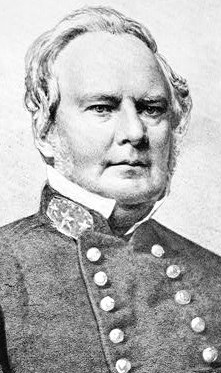
Maj. Gen. Price
“There is nothing on the land at the moment. It is currently made up of forest and degraded field. The park service aims to eventually do restoration of the field to manage it as vegetation from the 1862 time period,” Simonelli said.

While the groups did not disclose the purchase amount, it is believed to be in the hundreds of thousands. The Pea Ridge National Military Park Foundation is helping with fund-raising to cover the purchase and eventual donation of the property to the federal government.

Among those efforts is NWA (Norwest Arkansas) Gives on April 2.

The March 6-9, 1862, Battle of Pea Ridge (Elkhorn Tavern) has been called by some historians “the Gettysburg of the West.” Forces under Union Maj. Gen. Samuel Curtis defeated the men of Confederate Maj. Gen. Earl Van Dorn, whose leadership has been faulted by historians. The Union won control of Missouri and weakened the Confederate hold in Arkansas.

“It is no exaggeration to say that the Pea Ridge campaign permanently altered the balance of power in the Trans-Mississippi. Few Civil War operations had such an impact on the course of events,” according to the National Park Service.

Kurz & Allison's fanciful depiction of battle (Library of Congress)
Jami Lockhart with the Arkansas Archeological Survey performed research on the Williams Hollow Farm and surrounding areas that played a part in the battle.

Confederate and Federal units clashed at Cross Timber Hollow and the Tanyard area north of Elkhorn Tavern. Rebel troops likely traversed the ground comprising the purchased property. Missouri State Guard troops under Maj. General Sterling Price emerged from Williams Hollow on March 7 as part of a drive on the Union right flank, according to histories.

The coalition cited other historical aspects of the area.

Lockhart wrote: “The historic Telegraph Road approaches to within 150 feet of the conservation property, and runs roughly parallel with the property along the entirety of its eastern boundary. Telegraph Road (also known as Old Wire Road) is integral to the history of the region. This road formed a portion of the route associated with the forced relocation of thousands of Native Americans, and is commonly known as the Trail of Tears. It was the route of the Butterfield Overland Mail and Stage line serving the area between St. Louis and San Francisco during the period 1858 to 1861. Telegraph Road was also the primary transportation artery in the area during the Civil War. Telegraph Road is especially well-known for its central role in the Battle of Pea Ridge.”

Sunset at Pea Ridge National Military Park (NPS)
During the night of March 7 into March 8, 1862, both armies concentrated forces on Telegraph Road. A powerful Union bombardment and assault on March 8 put Confederates into a retreat.

It’s not just the Civil War aspect of Williams Hollow Farm that is important, the groups said in their announcement.

“Once protected, the Williams Hollow Farm will secure the view shed of the Pea Ridge National Military Park and conserve mature forest habitat for migratory songbirds and rare bats, including the threatened northern long-eared bat. Keeping the property undeveloped will also help provide water quality protection of Sugar Creek within the Elk River watershed.”

Pea Ridge National Military Park Superintendent Kevin Eads told the Picket the acquisition would help protect and preserve cultural and natural resources. 

Jackie Crabtree, mayor of the town of Pea Ridge and head of the Pea Ridge National Military Park Foundation, said during the time of fundraising the Northwest Arkansas Land Trust will work with the park staff to keep the property maintained. The tract currently has a large open field surrounded by timber.

Rock formations at Williams Hollow Farm (Copyright The Conservation Fund)
Crabtree said the purchase was a rare opportunity to protect such property during a time of rapid growth in the region.

Needless to say, the Civil War is an important part of the town’s background and tourism.

“There are several families still in the area that were here during the battle,” Crabtree told the Picket. “The thing that makes Pea Ridge unique however is the naming of our streets. North/South streets are named for Union soldiers who fought in the battle. East/West streets are named for Confederate soldiers. This is set in city ordinance for developers.”

Wednesday, March 4, 2020

University of Central Arkansas names archaeological center for Jamie Brandon, who led student excavations at Pea Ridge

Dr. Jamie Brandon
The University of Central Arkansas has established a center named for the late Dr. Jamie Chad Brandon, a professor and station archaeologist whose research included Civil War battlefields.

The Department of Sociology, Criminology, and Anthropology said this week that the Jamie C. Brandon Center for Archaeological Research will “emulate his devotion to student-based opportunities in archaeological fieldwork and research.”

Brandon, 47, died in December 2018 after a battle with cancer.

He was of invaluable assistance to the Picket in our coverage of ongoing archaeological investigations at Pea Ridge National Military Park. The Arkansas Archeological Survey has sent staffers and employees to work with the National Park Service on excavations at the site of the 1862 Civil War battle.

The university said the center will assist with funding and mentor support for student research projects, costs of travel to conferences and sponsor participation in the archaeology field school.

“Prior to his untimely passing in 2018, Dr. Brandon routinely devoted his time to conducting research within a pedagogical framework as an undergraduate and graduate mentor. He regularly provided student opportunities to do fieldwork and conduct archaeological research,” the department said.

According to his obituary, Brandon’s three decades of experience covered many topics, including Caddoan cultures in Arkansas, ethnicity and race relations. He also focused on land use through time and historical memory in the pre-industrial South.

Thursday, January 3, 2019

Jamie Brandon, archaeologist who led student excavations at Pea Ridge, is remembered for outreach, mentoring

Jamie Brandon at Pea Ridge in 2017 (University of Arkansas)

I was saddened to read about the recent passing of Dr. Jamie Chad Brandon, who was of invaluable assistance to the Picket in our coverage of ongoing archaeological investigations at Pea Ridge National Military Park.

Brandon, 47, was a professor and station archaeologist with the Arkansas Archeological Survey, which has sent staffers and employees to work with the National Park Service on excavations at the site of the 1862 Civil War battle. He died on Christmas Eve after a battle with cancer.

According to his obituary, Jamie’s three decades of experience covered many topics, including Caddoan cultures in Arkansas, ethnicity and race relations. He also focused on land use through time and historical memory in the pre-industrial South.

I last communicated with Brandon in April. Over nearly three years, I would check in with he and other survey staffers doing work at Pea Ridge. Among the subjects we discussed were digs at a hamlet that endured combat and a study of artifacts and whether they could show the locations of artillery positions. Brandon also did research connected with Prairie Grove Battlefield State Park, site of a December 1862 Civil War battle.

One of his colleagues, Carl Drexler, posted on social media that “no single person in archaeology has been a greater mentor, friend, and colleague."

A University of Arkansas article Thursday said: "In addition to producing an impressive record of scholarly research, Brandon is remembered for his unparalleled devotion to outreach activities to the general public about archeological discoveries and their relationship to understanding modern society. He was also a popular teacher and mentored a host of students through internships, theses and dissertation projects."

The Picket extends condolences to Brandon’s wife, Lydia Rees, and other survivors.

Sunday, April 8, 2018

Where cannon roared: Pea Ridge excavation yields a trove of artillery, other artifacts

Bucket of artifacts, marker flags (Courtesy of Arkansas Archeological Survey)
Canister round (Courtesy AAS)
Students, volunteers, park staffers and archaeology hobbyists recently recorded and recovered about 1,000 artifacts – most of them related to a ferocious artillery fire exchange – at Pea Ridge National Military Park in northwest Arkansas.

The spring break dig comes in the third of four years that the Arkansas Archeological Survey is working with the National Park Service to better understand the battle and civilian life in the area. The March 6-9, 1862, Battle of Pea Ridge (Elkhorn Tavern) has been called by some historians “the Gettysburg of the West.” The Union won control of Missouri and weakened the Confederate hold in Arkansas.

The Picket spoke with AAS station archaeologist Carl Drexler, who headed up the dig in mid-March, and a Pea Ridge park ranger. Students got important field experience and mapping crews used GPS technology to mark precise locations of the artifacts. The finds will now be cleaned and curated. AAS archaeologist Jamie Brandon assisted. The effort had help from about 30 people a day over six days.

Belches of flame on the ridge tops

(Photo courtesy of Arkansas Archeological Survey)

Drexler (right) and NPS staffer
The dig primarily focused on the hilly terrain north of Elkhorn Tavern. The Confederacy’s Missouri State Guard placed 21 guns hub-to-hub on Broad Ridge on the first day of the battle, exchanging fire with the plucky, if smaller 1st Iowa Battery. 

The Iowans' four guns were trying to slow the Rebel push and were about only a quarter mile away. “They were firing mostly canister back and forth at each other,” Drexler said. “They were trying to kill off the gunners.”

The excavation worked in an area where the Federal artillery fire landed, so most of artifacts were fired by those artillerymen, who eventually had to give way. The tree cover is denser today than at the time of the battle.

The volunteers also worked the area of a smaller artillery action to the south of Broad Ridge.

Bullet is encrusted with soil (Courtesy of AA)

What kind of artillery projectiles, pieces were found during the dig?

Most were related to canister – rounds packed with bullets, pieces of metal or other material – designed to cut through infantry or artillery crews. Whole balls, pieces of explosive case, .69-caliber Minie balls and .58-caliber bullets also were among the finds. Some were likely case shot balls, Drexler said.

(Courtesy of Arkansas Archeological Survey)

A trio of cool finds last month

The shoulder armor scale (above) was often worn by artillerymen. “The idea was if you were getting overrun by cavalrymen swinging sabers, it gave a little defense as they rode past,” according to Drexler. By the Civil War, sometimes they were used on dress uniforms.

The second item is a musket hammer lock (left) and the third (below) is part of a pistol handle frame.

Where were the Confederate guns?

While historians knew the general area from which the Iowans fired, the National Park Service has been interested in determining the precise location for the Missouri State Guard.

Troy Banzhaf, chief of interpretation at Pea Ridge, told the Picket that he was able to firm that up after the dig and by studying first-hand accounts, previous survey work where the Iowans were located, the short distance between the foes and the only geographical spot on Broad Ridge possible to put 21 guns.

(Courtesy of AAS)
It is the only explanation for the large concentration of artillery fragments and canister that you would find from two hours of artillery engagement. On the map, the distance between the two is around 500 yards, well within canister range,” Banzhaf said.

“Although used at close range against massed troops, canister can still travel well over 800 yards, it just loses its tight spread pattern over a greater distance and thus limits it effectiveness. However, since guns are spread out. too, canister can work effectively when fired at an enemy battery.”

How was the archaeological work done?

Drexler would place flagging tape along corridors through the words. Metal detector operators then swept the ground. “We are trying to get the general distribution of artifacts in the area.”

The finds were plentiful, most between 6 inches and 12 inches below the surface. Rock in the Ozarks generally prevents artifacts from sinking further, Drexler said. (Note: It is against the law for individuals to remove relics from a national battlefield.)

(Courtesy of Arkansas Archeological Survey)

“We weren’t specifically trying to find hot spots. We were trying to cover areas the park service knew had never been archaeologically covered before,” Drexler said.

After items were recovered, GPS would note the items within a half meter of the discovery. The items will be curated at a research facility and used for educational purposes or display.

“I was really quite astounded about how it went, how many artifacts were discovered, how many people volunteered,” Drexler said of the dig.

Other Picket Pea Ridge articles: