Showing posts with label volunteer. Show all posts

Wednesday, May 22, 2024

Pvt. Christopher Fritz was a tip of the spear clearing roads during the Atlanta Campaign. At Kennesaw Mountain, a descendant is paying tribute this week

John Fritz describe weapons during a  talk May 22 at Kennesaw Mountain (NPS photo)
John Fritz’s great-great-grandfather, Christopher, toted a rifle and a whole lot more during his service in the 105th Illinois Volunteer Infantry -- namely, axes, hatchets, files, saws and augers.

Pvt. Fritz was likely picked for an Army of the Cumberland XX Corps detachment known as pioneers because he was a carpenter and dependable. During the Atlanta Campaign, the acting engineers followed Union skirmishers and made sure roads and bridges were in place or passable for the main army, among other duties.

They were, in essence, tips of the spear.

John Fritz, a reenactor from Chandler, Ariz., this week is making short presentations about Federal infantry weapons at Kennesaw Mountain National Battlefield Park near Atlanta. He has a pioneer chevron on his uniform sleeve as a tribute to his ancestor, who fought in many campaigns, including in June 1864 at Kolb’s Farm near Kennesaw Mountain.

“Those guys had their work cut out from them,” the electronic engineer told me over the phone, without first realizing the pun. “They were responsible for going ahead and clearing the roads and muddy creek crossings.”

Fritz, 61, will give talks at 1:30 p.m. Thursday and Friday near the park visitor center. (Photo left, National Park Service)

Fritz has volunteered at the park for the last 10 years during visits to Georgia to attend events. He just attended a reenactment in Resaca, Ga. (where the 105th Illinois fought), and will attend an anniversary event Saturday at the Pickett’s Mill battlefield west of Kennesaw Mountain.

Fritz wanders the Kennesaw Mountain battlefield and talks with visitors about the life of an infantrymen and specifically his ancestor, who fought in North Georgia and at Peachtree Creek in Atlanta. “I feel people like to hear that connection.”

This week, he has set up a table displaying four guns the Federal army used.

The reenactor did not know of his great-great-grandfather’s service until his father died in 2011. “The family didn’t say anything about it, even my grandparents,” John Fritz told the Picket.

His father, Dale, was from Elgin, Illinois, and the family moved to Southern California when John was young.

He has since learned that Christopher Fritz, a native of Germany, enlisted early in the war while in his early 30s. He served in the 105th's Company G.

“I basically followed his whole route, pretty much traced his footsteps from Belvidere, Illinois, to Washington, DC,” where Christopher mustered out in June 1865, two weeks after the Grand Review of the Armies.

The soldier lost a thumb to gunfire while on guard duty for several months at Fort Negley in Nashville. The incident apparently was accidental, John Fritz says. Christopher received a pension about 15 years after the war

The veteran had a family in Belvidere and died in August 1903 at age 73. John helped arrange for a new Veterans Administration headstone to be placed at the grave.(Photo courtesy of John Fritz)

John is a member of the Scottsdale Civil War Roundtable in Arizona. He has been to several battlefields where the 105th Illinois fought, including a couple in North Carolina.

“I just really got interested in learning about my ancestor and it turned into a project to honor him, learn more about him. I enjoy traveling. I had never been to the South.” 

Friday, September 2, 2022

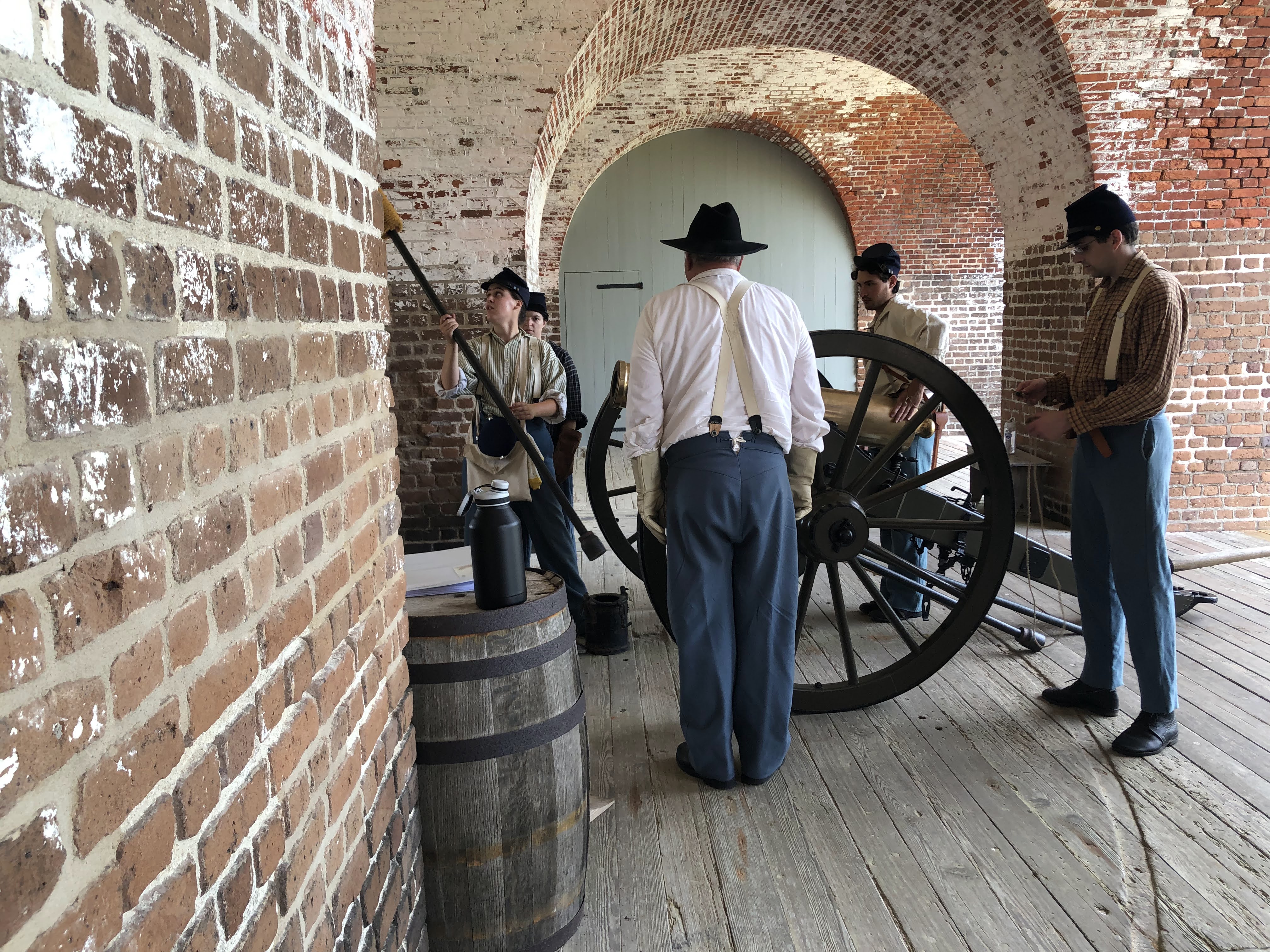
Rally to the sound of the guns: Fort Pulaski near Savannah is looking for cannon crew volunteers. Here's what you need to know before enlisting

Crew fires a Parrott gun and trains on a howitzer; Doherty in foreground (NPS photos)
WANTED: Able-bodied men and women. No experience required. Applicants will undergo training and must pass a test. Requirements include working well with others and following orders. Job includes wearing a woolen uniform in hot weather. The position is a lot of fun, but safety comes first -- always. You’ll be firing cannons.

Fort Pulaski National Monument outside Savannah, Ga., recently took to social media to find folks for its cannon crew, with a special focus on Saturdays. While the Facebook post was not written quite like the Picket’s mock ad above, the job does entail those requirements.

Shannon L. Doherty, a park guide at Pulaski and its historic weapons supervisor, says it’s been tough to always field a crew because core volunteers sometimes can’t attend every event and staffers can’t always work extra days.

That’s where you might come in.

The cannon crew has typically been made up of older volunteers, many military veterans. But Doherty welcomes all those who can qualify.

“No experience is fine, because you have to be trained either way,” she says. “Firing a historic cannon is exhilarating. It’s loud and there’s the sulfur smell. The visitors come up and talk about how much they enjoyed it.”

The Fort Pulaski cannon crew portrays Union artillerymen.

They fire a reproduction 30-pounder Parrott rifle -- which recoils a bit -- and a 12-pounder smoothbore field howitzer, both made by Steen. The latter was not used in the Pulaski siege, but was a common anti-infantry weapon during the war.

National Park Service cannon and rifle crews do not fire period weapons. Chief Ranger George Elmore of Fort Larned National Historic Site in Kansas told the Picket in 2014 the agency does not want to risk destroying an historic artifact.

Various stages of the making of artillery rounds, not in sequence.
Doherty, trained in black powder, supervises  the work. (NPS photos)
Fort Pulaski has about two dozen cannons, several of which date to the Civil War. The Confederate masonry fortification surrendered in April 1862 after withering fire from Federal rifled guns destroyed parts of the wall and threatened its magazine. The innovative rifled weapons brought an end to that type of fort construction.

NPS venues that fire reproduction 18th and 19th century small arms and artillery must have an employee certified in their use and safety. Of course, actual rounds are not fired. Doherty, who underwent required NPS black-powder training in March, must be present at all cannon firings and she trains and supervises the crew.

Crew members must have awareness and aptitude

Both of Fort Pulaski’s demonstration weapons are in the parade ground. Each is fired during a typical 25-minute program. “We are trying to connect it to the theme of the park,” says Doherty. One example is the freedom story – how the Federal army helped the emancipation process.

National parks that fire cannons must follow a lengthy safety manual that is remarkably close to standards during the Civil War. “We try to be historically accurate and as safe as possible,” says Doherty.

Cannoneers sponge the Parrott barrel at Pulaski (NPS photo)
Accidents are exceedingly rare, but the work does come with danger. In 2014, the breech of a gun fired at Fort McHenry National Monument failed, leaving one member of the cannon crew slightly injured.

Fort Pulaski requires volunteers to read the rules and take a 24-question test on safety. A couple questions are, “If the cannon fails to fire, what command is given?” and “The minimum waiting time before the piece is reprimed after a misfire is:”

The NPS manual of instruction begins with a sobering reminder for crews to be well-trained and prepared. It lists the four primary causes of accidents in historic weapons demonstrations using artillery:

1. Rapid firing

2. Poorly maintained or improper equipment

3. Improper drill

4. Improper ammunition

Cannon crew members march in for a demonstration at Pulaski (NPS photo)
During the Civil War, guns typically had a crew of eight. Crews firing replica weapons typically have six members, with one member fulfilling three spots, involving retrieving a charge and moving it up to the cannon.

Doherty makes sure they go over equipment and members understand all positions. Unlike, the Civil War, when all those in a battery needed to be interchangeable because of death or injury, volunteers don’t have to serve at every position.

For example, the No. 1 position involves sponging the barrel and ramming the round down the tube. “That can freak some people out.” 

The crew drills the morning of any cannon firings.

“(It’s) being comfortable into whether it was in one position or others, feeling confident. Not being shaky on anything,” Doherty says. “I am watching to see proficiency, if someone isn’t doing too well.” (At right, Parrott sponger, rammer and wormer at Fort Pulaski, NPS photo)

Another view of the howitzer training (NPS photo)
Elmore, who has conducted safety courses for NPS staffers, said each park is required to have its own magazine, meet ATF (Bureau of Alcohol, Tobacco, Firearms and Explosives) requirements and to have a loading area.

Doherty says the crew routinely goes over equipment, for example ensuring there are no holes in hand gloves are splinters in the sponge rammer. They are equipped with hearing protection.

The cannon cannot be fired more than once every 10 minutes. Visitors are 50 feet away and no one can be downrange of the barrel.

“This is not a race. We do need to be deliberate in the steps and not a rush. That’s when errors happen.”

Making the rounds safely is exacting work

Doherty – following ATF and NPS rules -- works with a mold to make the replica rounds, which contain aluminum foil, black powder and peat moss; the latter adds length and volume to the shell. On the day of firing, a friction primer causes ignition, setting off the black powder.

Black powder, finished rounds are kept in powder magazine
The black powder and finished rounds are stored in a World War II-era magazine.

The powder comes in a plastic bottle. The larger Parrott gun requires all 16 ounces while the howitzer uses about half of that.

Doherty takes the powder from the magazine, places it in a locked non-sparking box and works in another room after park hours.

While Doherty solely can do a few of the steps, others can help certain parts of the preparation – but only under her supervision.

To prevent a fire or explosion, Doherty works with a wooden table that has no exposed nails. It takes about 30-45 minutes to prepare six rounds, enough for three firings a day.

The rounds, weighing about a pound, are returned to the magazine for future use.

When the Picket wrote about NPS black-powder training in 2014, powder cost about $15 a pound. Like everything else, it’s gotten a lot more expensive.

A recent order of 50 pounds cost about $1,200 with shipping, Doherty says.

Fort Pulaski has helped other parks, including Fort Sumter National Monument, with supply.

More crew members, more cannon firings

The venue hopes the addition of a few more volunteers might ensure Saturday firings throughout the year.

Interestingly, the park did artillery demonstrations on Wednesdays during June and July because of higher staffing that day and the fact that visitors tended to travel on the weekends.

A crew moves the limber in the Fort Pulaski parade ground (NPS photo)
Fort Pulaski is particularly busy in November and December for holidays, thus the push to recruit more crew members. Doherty has three core members, all area retirees, to depend on, but she needs a bigger pool of recruits.

Sometimes, re-enactors come in with different standards. Doherty stresses people need to be open to learning and follow NPS rules.

For all the safety concerns, serving on a crew has its rewards.

“We can provide unrivaled weekend entertainment and outstanding camaraderie,” the park’s callout said.

Recruits can enlist with the Fort Pulaski cannon crew by emailing Historic Weapons Supervisor Shannon Doherty at shannon_Doherty@nps.gov. Applicants will also speak with the park's volunteer coordinator.

Thursday, October 11, 2018

Smoldering resentment: Walking tour will look at how volunteer firefighters in Alexandria, Va., dealt with Federal occupation during war

US military led this fire operation in Alexandria in 1863 (Library of Congress)
Before the Civil War broke out and hordes of Federal soldiers crossed the Potomac River to occupy the city, volunteer firefighters in Alexandria, Va., brimmed with pride and purpose.

19th century firefighter (Library of Congress)
Firefighting companies – Friendship, Hydraulion, Relief, Star and Sun, among them – maintained equipment and kept their fellow residents safe from infernos that could rampage through a row of homes or businesses in no time.

It wasn’t just about saving lives and property: The companies were part of the fabric of the community.

“They were involved in boosterism and came out for parades and such,” said Kristin Lloyd, acting director of the Friendship Firehouse Museum in Historic Alexandria. “If there was a fire, everybody in the community helped. We had laws on how many buckets each household had to have to fight a fire.”

Friendship, the oldest of the fraternal groups, was formed in 1774.

There was a lot of prestige in which company got to a fire first (mind you, the men ran – horses were not yet in use) or threw quenching water the farthest. A strong performance could get you written up in the local newspaper -- so there was occasional competition and raucous moments.

But those good old days faded quickly on May 24, 1861, a day after Virginia seceded from the Union. Thousands of Union troops poured in from Washington and turned the bucolic river port into a major military supply and hospital center. Martial law was declared. A curfew was enforced. And one very famous incident led to the first death of a Union officer in the conflict.

Suction pumper at Friendship Firehouse Museum (City of Alexandria)
Once some administration took hold and it became apparent it needed to become involved -- in part because so many able-bodied residents were gone -- the Union army took over firefighting in the city.

The 11th New York Infantry, known informally as the First Fire Zouaves, for a time took the lead.

While the military occupation did modernize firefighting – the Federals brought in the first two steam pumpers – it put a lot of locals on the defensive, requiring them to take an oath of allegiance to the United States or use a password to assist in putting out a blaze.

That uneasy relationship is the subject of the "We've Been Burned: Alexandria Firefighters During the Civil War" walking tour this Saturday. Participants will learn how the volunteer companies were treated and what happened to their firehouses, among other topics. The city tour will stop by four surviving firehouses in the charming downtown historic district.

Participants will learn that several of the volunteer companies disbanded by 1863, partly because so many members were fighting for the Confederacy.

Friendship museum (City of Alexandria)
But there was at least one other reason for the decline in the volunteer efforts, according to a history of firefighting in the city: “Company disbanded … due to destruction wrought by Yankees on equipment.”

The venerable Alexandria Gazette wrote glowingly about Federal troops and local firefighters harmoniously working together. But records kept by volunteer companies often painted another picture, said Catherine Weinraub, a museum aide for Historic Alexandria who will lead the biannual tour.

A Friendship notation speaks volumes about its members’ smoldering resentment:

"When a fire occurred the military assumed control of the fire apparatus and directed its action while old and efficient firemen were rebuked, annoyed [sic] and sometimes knocked down by men who were wholly ignorant of the mode of attaching to plugs or Engine or of judiciously using the pipe when a suply [sic] of water had been secured.”

Firefighting was a whole lot different

The United States has seen quite a transformation in how its communities fight fires. Following rudimentary “bucket brigades” during colonial days, volunteer companies sprang up, fostering a celebration of youth, heroism and camaraderie.

It soon became a business in some cities, such as in New York and Baltimore, where street gangs used firefighting as a way of fighting each other and to control turf. Insurance companies often had contracts with private or volunteer crews.

A column written in 2011 for Huffington Post had this to say: “The way it functioned was the first club at the scene got money from the insurance company. So, they had an incentive to get there fast. They also had an incentive to sabotage competition. They also often ended up getting in fights over territory and many times buildings would burn down before the issue was resolved. They were glorified looters.”

Postwar Hydraulion volunteers (Alexandria Fire Department)
Lloyd said there was no evidence of such chaos in Alexandria. There are no known insurance company plaques on buildings, she added.

Alexandria was divided into four wards. Every station had its own bell. The closest person (to the fire) would ring the bell in the ward in which it was discovered. While there was an attempt to organize response by company, firefighters would rush to just about any fire after grabbing equipment at their firehouse (this was before they would be stationed around the clock in a building).

The fastest member of a company would run to a fire plug, or hydrant, and try to hold it until his colleagues showed up with equipment. That meant keeping other units from tapping in. “He is not going to let that happen,” Weinraub told the Picket.

Firefighting could be a dangerous occupation: In 1855, six members of the Star company and one with Friendship were killed in a warehouse wall collapse on King Street. The fire was the work of an arsonist. The tragedy hit the town hard.

Local boys were disenchanted

Six years after that tragedy, tension in Alexandria reached the boiling point over President Abraham Lincoln’s election and the secession vote.

Federal units, including the 11th New York infantry, were sent to the city, effectively ending the sale of enslaved persons while taking control of buildings and businesses that were of use to the Northern war effort.

Death of Ellsworth (Library of Congress)
“Alexandria is filled with ruined people; they walk as strangers through their ancient streets, and their property is no longer theirs to possess,” wrote George Alfred Townsend for the New York Herald in 1863.

The 11th New York was organized by Col. Elmer Ellsworth. “He thought firefighters would make good Zouaves,” said Lloyd. Many firefighters that served in the Union army were of Irish descent.

Ellsworth on May 24, 1861, became the first Union officer to die in the Civil War when he removed a Confederate flag from the roof of the Marshall House in Alexandria because it could be seen from the White House. The owner of the house gunned down Ellsworth before being killed by a Federal soldier.

While the men of the 11th New York Infantry knew how to fight fires, they were soon shipped to the front, leaving the duties in the hands of soldiers with a lot less passion and skill for the work.

“These soldiers were really bored and they didn’t know how to put out fires,” said Weinraub.

Local volunteers were angry because they had to meet so many conditions – including the oath of allegiance, badges, passwords and curfew limitations – in order to take part in firefighting. Sometimes they were just told to go home.

They grumbled about what became of their equipment. This notation was in the Friendship minutes book:

“The Friendship Suction and eleven sections of hose were conveyed to Fort Elsworth and there exposed for weeks to sunshine and rain, and when the Suction was returned at the urgent solicitation of the Company, it was so unsightly and unservieably [sic] that the Company was disinclined to incur any expence [sic] for its repair while subject to such abuse. The eleven sections of hose have not been yet returned, at portion being in use at the Provost Office and the rest at adjacent forts.” 

Quartermaster's Wharf during the war (Library of Congress)
All this came at a time when the city was teeming with soldiers and civilians who were meeting their primal needs, with venues that included saloons and houses of prostitution.

“There was a military governor. Troops were moving in and out, particularly in the beginning of the war,” Lloyd told the Picket. “They were pretty rowdy and rambunctious. A military governor came in and maintained better order.”

The Gazette did its best to keep the community up on the news and it painted a cheery picture of the cooperation between Yankee and local firefighters.

A January 1865 article described a blaze that broke out on a Royal Street frame house and spread.

“The U.S. steam engine No. 2, and the fire engine companies, Friendship, and Sun, were promptly on the ground, and deserve great credit for the efficient manner in which they succeeded in extinguishing the flames and preventing more damage than was done. The military police were present and prevented any loss of property from the burning building.”

(Alexandria Fire Department)
Columbia firehouse is now a restaurant
Major changes were on the way

Despite the strain and anguish of being occupied for four years, Alexandria apparently did not have a major fire during that time. And because it was within the extensive Federal defenses of Washington, there was no fighting and, thus, no civilian casualties.

After the war, the population ballooned to nearly 17,000 residents, many of them Northerners and freed blacks, according to a 2011 Washington Post article.

“The impact (of the war) on Alexandria took years to recover as a city, just as the (fire) companies themselves took a while,” Weinraub said.

Major changes were on the way. By the 1860s, with heavier and more expense equipment, and the need for horses to pull it, communities began establishing professional fire crews. Alexandria created its city department in 1866.

Hose reel at museum (City of Alexandria)
Most of the volunteer companies reorganized for a time after the war and later ceded the job to the city force. Friendship refused to join because its members wanted to keep their name.

“They went back to fighting fires (but) it was becoming less necessary as the city was involved,” said Lloyd. Friendship stopped fighting fires in the 1880s and the rest of the companies eventually dissolved.

Today, the Friendship Firehouse Museum has equipment, including a giant hose reel, and information on the volunteer companies, among other topics. The building got a boost during the 1950s and was deeded to the city in 1991. It is supported by the Friendship Veterans Fire Engine Association.

“They are involved in helping maintain the preservation of the firehouse and they think of it as their heritage and they support other causes related to firefighting,” said Lloyd.

The city still uses this Relief station (Alexandria Fire Department)
Of the other three firehouses on the sidewalk tour, two are private homes and one houses Columbia Firehouse, a restaurant on St. Asaph Street. It got its name from the Columbia Steam Fire Engine Company, which succeeded the Star volunteer group.

The city has a fire station next to the old Relief firehouse, which is one of the residences. It used to feature a tower to dry canvas fire hoses.

The tour is held in the spring and fall.

“We are just hoping to bring more attention to the museum, but also the larger subject of firefighting history and how it is very relevant,” said Lloyd. “All of it informed how firefighting is done to today, how cities are formed today, how codes are formed today.”

The tour lasts from 11 a.m. to 1 p.m. on Saturday, Oct. 13. It begins at the Friendship Firehouse Museum, 107 South Alfred St. The cost is $6 for adults and $4 ages 10-17.  Reservations are required, as space is limited. Call 703-746-4994 or 707-746-3891.