Showing posts with label tour. Show all posts

Wednesday, August 7, 2024

At Nashville's renovated Sunnyside mansion, you can look through windows at Civil War battle damage, view artifacts found in rifle pit and click to cool 3D images

Augmented reality view of Sunnyside and reveal windows showing battle and bullet damage (MNHC)
Visitors to Nashville’s Sunnyside mansion, which was struck by bullets from a Federal assault during the Civil War, now have a variety of ways – including the use of augmented reality – to experience the site’s rich history.

Built in 1852 in what is now Sevier Park, Sunnyside and a connected log cabin have undergone an extensive rehabilitation since 2022. While visitors can see the outside of the home and peer through windows to see the cabin logs and bullet damage, offices of the Metro Nashville Historical Commission open to the public Aug. 19.

Sunnyside’s main room now has architectural and historical displays; interpretive markers outside cover its early history, enslaved people, the Battle of Nashville, later owners and the 20-acre Sevier Park, near the 12South neighborhood.

“It is truly exciting to see how much history we were able to recover and to provide to the public,” said Adam Fracchia, an archaeologist with the commission. “The aim is to tell a wider story.”

Bottom floor of extension (ell) has five small windows showing bullet damage (MNHS)
I first spoke with Fracchia last year about a project involving Nashville police and archaeologists. The team has been analyzing the trajectory and proximity of gunfire from a Union attack from the north and west during the Dec. 15-16, 1864, battle. They wanted to solve the mystery regarding embedded bullets and holes discovered last year in the cabin walls. 

It has long been known that dozens of bullets, including Minie balls, were left on the porch door and columns on the big house at Sunnyside, which was occupied by Confederates. They were eventually forced to retreat.

A rifle pit was found during the renovation, along with evidence of a trench. A new display case in the commission’s main room has artifacts from the battle, including percussion caps, melted lead and burned iron nails found in the rifle pit.

A ribbon cutting and open house was held in mid-July (MNHC photo)
The commission, working with partners, has created Nashville Sites, which provides overviews of city fixtures, with text, audio and virtual tour options. “We want them to get an understanding of what the building looked like,” Fracchia said of Sunnyside

The tour menu includes civil rights, a Civil War driving program, downtown Nashville and certain neighborhoods. The tour on Sunnyside covers its history since indigenous dwellers.

“Recovered artifacts from the pit, like burned nails and charcoal, suggest that soldiers made fires to stay warm using wooden planks from the side of the house or outbuildings After the battle, Sunnyside was used as a field hospital for wounded soldiers.”

I called Fracchia (left) this spring and we have since communicated via email about the renovation. His responses to my questions have been edited for brevity:

Q. What is your overall impression of the work and how it adds to the story of the site? You told me the new exhibits/upgrades will tell a wider story.

A. The renovations at Sunnyside attempt to preserve as much of the building as possible while making the mansion a usable office space for the Metro Historical Commission.  Along with the renovations, we have added several features to the site to allow interpretation of the long history of the property.

We have added six interpretative panels telling the history of the site from its Indigenous inhabitants to the Civil War to the modern urban park. One of the panels also discusses the details we know about the peoples enslaved at Sunnyside. With three of these panels we have added augmented reality views of the building to allow visitors to use their phones to see what the building may have looked like at different points at time. The tour is also available digitally as a Nashville Sites tour.
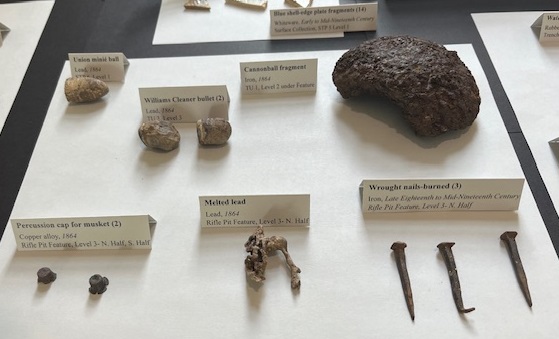
(Clockwise, top) Bullets, artillery fragment, wrought iron nails, melted led and percussion caps
We were able to add Plexiglass windows to the log cabin façade to show some of the damage to the cabin from the battle. One of the log outbuildings will receive additional interpretative panels and a glass window in the floor so that a pier and a log sill plate will be visible.

Additionally, in the office, we have added an exhibit case of the artifacts excavated in the last 1.5 years ahead of the renovation and a wall of historic architectural pieces from Nashville. We hope that another exhibit case could be used as a floating exhibit in other locations.

Q. How many static exhibits are in the renovated office? Can you tell me the range of topics they cover?

A. The display case has artifacts from 3,000 to 5,000 years ago to the mid-20th century and is meant to cover the history of the site. This includes artifacts from the Civil War. The architectural wall has several different architectural elements that were salvaged or donated from around Nashville.

Civil War Williams Cleaner bullets and iron nails found last year in rifle pit (MNHC)
Q. What specifically from the Civil War-era/the battle are now on display, and in what context?

A. On display, we have artifacts recovered from the battle such as bullets as well as melted lead, burnt nails and percussion caps from the rifle pit. We recently found more artifacts during the removal of the roadbed in front of the mansion. We recovered fragments of a cannonball, top of a tent stake, a gun tool and bullets.

Q. Are any of the interpretive displays outside, or they all inside, or a mix? You mentioned there might be five-six panels. Does one pertain to the Battle of Nashville?

A. All artifacts are inside the building but we have the five panels on the north face of the log cabin that show bullet damage and projectile damage. People can also see the construction of the log building including different chinking material and Roman numerals used to match the logs.

Q. You said three of the panels might have QR codes and viewers will be able to use their phones to move. Can you describe, please?

A. One of the AR (augmented reality) images shows the building in 1864 with lines representing the bullet trajectories. These AR images are now accessible and were built in collaboration with the MHC and the Vanderbilt Institute for Spatial Research.

Q. Do any of the new features tell the story of a specific person/people related to Sunnyside’s history before, during or shortly after the battle?

A. We tried to focus on the enslaved persons and later owners with the panels, specifically, Granville Sevier and Dr. L. G. Noel.  

Q. Can you tell me about the two cabins that were at Sunnyside during the Civil War?

A. The historic building had a historic ell (perpendicular building extension) that had fallen into disrepair. Inside the ell, there were two log cabins, one of which had to be partially deconstructed. The other log structure was incorporated into the new building that is connected via a glass connector and serves as a conference/meeting room.

One of six interpretive markers surrounding the mansion and buildings (MNHC)
Q. Anything recent on the police and forensic examination and analysis of the bullet trajectories?

A. We are trying to find more information on the battle at Sunnyside and determine the distance at which the Union firing lines were at. We hope we can find information from a metal detection survey in the fall.  We received a grant from the Tennessee Historical Commission to conduct a systematic and metal detector survey with the public.

Q. Anything new on the dendrochronology of the timbers used in the cabins? You told me at least one building had wood felled from the winter of 1823-1824.

A. We have not received any update on the dendrochronology yet. 

---------------

Postscript: Work at Sunnyside will continue into the fall. One area is what was believed to be the original smokehouse but, instead, is a domestic structure from the 19th century. “When we test below the floor we found evidence of earlier piers for another building,” said Fracchia, adding there were household artifacts and a trash pit. An investigation of that area will continue, as well as the reconstruction of a summer house near the well, the city says.

The commission also had this tidbit in its August "History Gram":

"The removal of the gravel roadbed around Sunnyside has exposed more history of the park. Artifacts from the Civil War were recovered just below the gravel, including cannon ball fragments, a bullet, tent hardware, and a gun tool (right). These artifacts were uncovered directly in front of the mansion along with charcoal stains in the soil which indicate the location of a Federal or Confederate encampment likely associated with the Battle of Nashville."

The items will be treated and eventually displayed.

---------------

Guidelines for visiting Sunnyside mansion

“When you visit the park, start at the pedestrian entrance near 12th Ave. S/ Granny White Pike and read the historical marker, then follow the path around the house to see all six interpretive panels, as well as the viewing windows to the original cabins (now in the rear ell of the building) and the interpretation in the log outbuilding (formerly called the Smokehouse).

You can scan the QR codes on the panels to learn more about each era of Sunnyside’s history through the Nashville Sites walking tour; some of the panels also have 3-D augmented reality (AR) models so you can picture yourself in the past.

“Feel free to enter the office lobby Monday-Friday from 7:30 am-4 pm. Additional photos, artifact  and brochures are available there. The rest of the house is not open to the public or available for tours. Public restrooms are available behind the house in the white building between the log outbuilding and the Carriage House café."

Architectural features and cabin door at Sunnyside (Photos MNHC)

Sunday, May 14, 2023

Gettysburg to remember fallen from Civil War to Vietnam: Pliny White lingered a month after losing arm; Abel G. Peck fell early in battle

Pliny White (top) and Abel G. Peck are buried at the park cemetery
Some of America’s war heroes are famous, their names etched on buildings, remembered in the movies or painted on the transom of a Navy ship.

But the vast majority are lesser-known. This Memorial Day weekend, Gettysburg National Military Park and Eisenhower National Historic Site will share a few of their stories. The program at Gettysburg National Cemetery will discuss the site's creation and highlight several service members, from the Civil War through the Vietnam. They were among 6,000 men and women laid to rest in the hallowed ground between 1863 and 1971.

The free, 90-minute guided program takes place on Saturday, May 27, at 6 pm. Meet at the Taneytown Road entrance of the cemetery.

Park spokesman Jason Martz told the Picket that two Civil War soldiers will be among those featured: Sgt. Abel G. Peck of the 24th Michigan and Pvt. Pliny Fisk White of the 14th Vermont. Peck is believed to be buried at the cemetery as unknown.

Here’s more about the two soldiers:

Pvt. Pliny Fisk White, 14th Vermont, Addison County

When the war brought out in 1861, White was encouraged to stay home to take care of his widowed mother. But he decided to enlist in October 1862 for a nine-month term. After months stationed in the Washington, D.C., area, the regiment was attached to the Army of the Potomac.

While in the army, White frequently wrote home. His correspondence is excerpted from “Among the Things That Were: Letters of a Vermont Farm Family,” by Barbara Freund (2001)

White is buried in Vermont section (Gettysburg National Military Park
He wrote his sister in January 1863:

“After Virginia comes forth from her fiery trial purified it will be a good place to plant northern institutions. In looking at the devastation on every side occasioned by the war, one can but be reminded that the too long unheeded cry of oppressed is being amply avenged. As the tide of oppression commenced here & rolled southward so it may be yes must be with the merited retribution which slavery thus far has met.”

White wrote a letter to Lemira, believed to be his fiancée, on the day before his unit went to the front:

“The chances are very favorable that to-day we shall go into battle. Though it is said that we are to be held in reserve. I do not doubt but before the fight is over we shall be called. I am ready and willing to go into battle and can trust myself in the hands of Him who is our only trust. Though I do not fear, yet it may be if I go into battle this may be the last time I shall write to you. Already the firing has commenced but not briskly. I would like to see you, but as I cannot I thought just a word would be better than nothing. I love you as ever and think of you often, and if we meet no more on earth, I hope I shall be worthy to meet you where there will be no more parting words.”

On July 3, the final day of the Battle of Gettysburg, the 25-year-old was wounded by a shell fragment as his regiment engaged with a Florida brigade that was supporting Pickett's Charge.

“His shattered arm was amputated soon after the battle and Pliny was taken to a field hospital set up in Gettysburg's Lutheran Seminary,” the National Park Service says. “There the doctors and nurses believed Pliny would recover.”

Nearly a month after his wounding, on July 31, White wrote his sister again:

“Through the kindness of a good brother I will tell you how I am. I would not have you mourn on account of my condition for I feel reconciled to my lot, although it is hard. You know that we are taught in God’s Holy Word that ‘all things shall work together for the good of those that love God.’ I have excellent care and good nurses, who are doing all they can for me and take a deep interest in my recovery -- I have good food also. I’ve had some fever and my pulse is quite high yet.”

White did not recover and died on Aug. 5 at a field hospital set up in Gettysburg's Lutheran Seminary. He was later buried in the Vermont section of the national cemetery.

“Had he survived Gettysburg, he would have by that date been back at home with his family in Vermont, for the nine-month term of service of the 14th Vermont expired in late July and the regiment was mustered out of service,” says the NPS. (14th Vermont monument at Gettysburg, Wikipedia)

Sgt. Abel G. Peck, 24th Michigan

The 24th Michigan was organized in Detroit in August 1862 and became part of the famed Iron Brigade. The regiment had seen limited action until Gettysburg, but it had a real baptism of blood on those three July days.

At age 42, Abel Peck was an old soldier, by standards of the day. The farmer was a father of two girls and twice a widower. “There must have been something about Peck's bravery and integrity for he was soon after selected to carry the regimental flag of the 24th Michigan, a post of high and great honor in a Civil War regiment,” says the park service.

24th Michigan veterans at Gettysburg in 1889
Peck wrote his daughter Alice in August 1862, “With a heart beating high with emotion I attempt to address you. it becomes my duty to say to you that i have enrolled my self as a volunteer for our Country and its flag. pain full as it is I feel it to be my duty.”

And a letter to a few months later: “… if we have to fight I expect to have to take my part and if I fal you must not morn for I think I cam dooing my duty and you must think that the honor of having a Father die in the defense of his Country will make up for the loss you will sustane ..”

Peck was felled on July 1, early in the battle, as the Iron Brigade clashed with Confederate troops in pitched fighting. His commanding officer, Col. Henry Morrow, would later eulogize Peck, calling him a "brave and faithful soldier," and "a man greatly admired for his almost saintly character."

Shot through by twenty-three bullets and its staff splintered, the flag was reduced to a tatter seen here, according to the Michigan History Center. The regiment fulfilled its vow to protect the banner: the flag was never surrendered. (At left, a small piece of the flag, GNMP)

Peck was buried where he fell, but when the color bearer was reinterred at the national cemetery, his remains were not identified and he is likely marked as unknown.

The 24th Michigan’s casualties at Gettysburg were staggering: It went into action with 496 officers and men. Some 89 were killed or mortally wounded, 218 wounded and 56 captured, for a total of 363 casualties. Five color bearers were killed. But the regiment helped buy time for Union forces to occupy the vital Cemetery Ridge.

Sunday, April 16, 2023

Seats available for May bus tour of NW Georgia Civil War sites: Former military institute, Resaca and Rocky Face Ridge

Sketch of the Georgia Military Institute made by a Union soldier before it was burned.
The Civil War Round Table of Cobb County in northwest Georgia is inviting members of Civil War or history-related organizations to join them in a May 6 bus tour of three sites.

The 8:30 a.m.-6:30 p.m. program begins in Marietta at the site of the former Georgia Military Institute, which operated 13 years until it was destroyed by the Union army.

Local historian Michael Hitt will lead the walking tour and the bus will pass GMI-related sites on the way to Resaca, which is between Atlanta and Chattanooga, Tenn.

GMI graduates joined Confederate units and cadets fought at the front line during the May 1864 Battle of Resaca. Participants in the tour will see the railroad depot where cadets arrived in Resaca and where they skirmished on May 9, 1864.

Among the tour guides is David Wynn Vaughan, a noted collector of Civil War portraits, including those of GMI cadets.

Lunch will be at Resaca Battlefield Historic Site, just off Interstate 75 in Gordon County,

Reproduction 3-inch ordnance rifle at Rocky Face Ridge Park (Picket photo)
The third stop is Rocky Face Ridge Park in Whitfield County near Dalton, about 20 miles north of Resaca. The May 7-8, 1864, battle was the first in what became known as the Atlanta Campaign. About 1,400 men from both sides became casualties in the fighting over several days. The park opened last summer.

Chickamauga and Chattanooga National Military Park staff historian Jim Ogden will provide an overview and lead a walking tour at Rocky Face Ridge Park.

The cost for the trip is $99, which includes the charter bus, box lunch, tour guides, talks and handouts.

Contact Terry H. Kingery, 770-906-5635, tkingery2@bellsouth.net for more information and to make a reservation. Only a few seats remain.

Wednesday, May 4, 2022

Remembering the versatile and passionate Ed Bearss: The public is invited to June celebration of life in Gettysburg

Bearss and former University of Georgia football coach Vince Dooley (Georgia Battlefields Assn.)
The public is invited to Gettysburg, Pa., for a celebration of life for renowned Civil War historian, battlefield guide and preservationist Edwin Cole Bearss, who died in September 2020 at age 97.

The American Battlefield Trust announced that the Bearss family has invited people to attend the 1 p.m. June 26 celebration – what would have been Bearss’ 99th birthday -- on land the trust preserved near the Seminary Ridge Museum and Education Center, a nonprofit venue on the campus of the United Lutheran Seminary.

Speakers include retired Marine Corps  Lt. Gen. Richard P. Mills; Jerome A. Greene, retired historian for the National Park Service; and O. James Lighthizer, president emeritus of the American Battlefield Trust.  

Bearss was a legendary figure in the Civil War world. Tour participants hung on his every word as he walked the grounds and gave precise details of what happened there, usually without notes. His voice, itself riveting, was described as thunderous or booming.

As "History's Pied Piper," he more than lived up to the title of Jack Waugh's 2003 biography of the decorated Marine Corps veteran and National Park Service chief historian emeritus.

The American Battlefield Trust detailed his career as a decorated Marine severely wounded during World War II, National Park Service historian, author, preservationist and lecturer. Commenters on the trust’s Facebook page this week remembered his tours and knowledge of battles to exacting detail.

Bearss gained fame for the discovery and raising of the USS Cairo in the 1960s, when he was historian at Vicksburg National Military Park. The majority of the public came to know him from his appearance in Ken Burns' 1990 “The Civil War” series on PBS.

The widower, after living 50 years in Arlington, Va., moved in 2018 to Mississippi, where he had family (Above, in Athens, Ga., in 2019. Photo courtesy of Georgia Battlefields Association.)

The American Battlefield Trust said the one-hour June 26 event will be tented, with seating available and water and light refreshments provided. Portable toilets and indoor restrooms will be nearby. 

Click this link for an email address in which you can express your intention to attend. For those unable to attend in person, a video of the celebration will be posted later.

Thursday, October 11, 2018

Smoldering resentment: Walking tour will look at how volunteer firefighters in Alexandria, Va., dealt with Federal occupation during war

US military led this fire operation in Alexandria in 1863 (Library of Congress)
Before the Civil War broke out and hordes of Federal soldiers crossed the Potomac River to occupy the city, volunteer firefighters in Alexandria, Va., brimmed with pride and purpose.

19th century firefighter (Library of Congress)
Firefighting companies – Friendship, Hydraulion, Relief, Star and Sun, among them – maintained equipment and kept their fellow residents safe from infernos that could rampage through a row of homes or businesses in no time.

It wasn’t just about saving lives and property: The companies were part of the fabric of the community.

“They were involved in boosterism and came out for parades and such,” said Kristin Lloyd, acting director of the Friendship Firehouse Museum in Historic Alexandria. “If there was a fire, everybody in the community helped. We had laws on how many buckets each household had to have to fight a fire.”

Friendship, the oldest of the fraternal groups, was formed in 1774.

There was a lot of prestige in which company got to a fire first (mind you, the men ran – horses were not yet in use) or threw quenching water the farthest. A strong performance could get you written up in the local newspaper -- so there was occasional competition and raucous moments.

But those good old days faded quickly on May 24, 1861, a day after Virginia seceded from the Union. Thousands of Union troops poured in from Washington and turned the bucolic river port into a major military supply and hospital center. Martial law was declared. A curfew was enforced. And one very famous incident led to the first death of a Union officer in the conflict.

Suction pumper at Friendship Firehouse Museum (City of Alexandria)
Once some administration took hold and it became apparent it needed to become involved -- in part because so many able-bodied residents were gone -- the Union army took over firefighting in the city.

The 11th New York Infantry, known informally as the First Fire Zouaves, for a time took the lead.

While the military occupation did modernize firefighting – the Federals brought in the first two steam pumpers – it put a lot of locals on the defensive, requiring them to take an oath of allegiance to the United States or use a password to assist in putting out a blaze.

That uneasy relationship is the subject of the "We've Been Burned: Alexandria Firefighters During the Civil War" walking tour this Saturday. Participants will learn how the volunteer companies were treated and what happened to their firehouses, among other topics. The city tour will stop by four surviving firehouses in the charming downtown historic district.

Participants will learn that several of the volunteer companies disbanded by 1863, partly because so many members were fighting for the Confederacy.

Friendship museum (City of Alexandria)
But there was at least one other reason for the decline in the volunteer efforts, according to a history of firefighting in the city: “Company disbanded … due to destruction wrought by Yankees on equipment.”

The venerable Alexandria Gazette wrote glowingly about Federal troops and local firefighters harmoniously working together. But records kept by volunteer companies often painted another picture, said Catherine Weinraub, a museum aide for Historic Alexandria who will lead the biannual tour.

A Friendship notation speaks volumes about its members’ smoldering resentment:

"When a fire occurred the military assumed control of the fire apparatus and directed its action while old and efficient firemen were rebuked, annoyed [sic] and sometimes knocked down by men who were wholly ignorant of the mode of attaching to plugs or Engine or of judiciously using the pipe when a suply [sic] of water had been secured.”

Firefighting was a whole lot different

The United States has seen quite a transformation in how its communities fight fires. Following rudimentary “bucket brigades” during colonial days, volunteer companies sprang up, fostering a celebration of youth, heroism and camaraderie.

It soon became a business in some cities, such as in New York and Baltimore, where street gangs used firefighting as a way of fighting each other and to control turf. Insurance companies often had contracts with private or volunteer crews.

A column written in 2011 for Huffington Post had this to say: “The way it functioned was the first club at the scene got money from the insurance company. So, they had an incentive to get there fast. They also had an incentive to sabotage competition. They also often ended up getting in fights over territory and many times buildings would burn down before the issue was resolved. They were glorified looters.”

Postwar Hydraulion volunteers (Alexandria Fire Department)
Lloyd said there was no evidence of such chaos in Alexandria. There are no known insurance company plaques on buildings, she added.

Alexandria was divided into four wards. Every station had its own bell. The closest person (to the fire) would ring the bell in the ward in which it was discovered. While there was an attempt to organize response by company, firefighters would rush to just about any fire after grabbing equipment at their firehouse (this was before they would be stationed around the clock in a building).

The fastest member of a company would run to a fire plug, or hydrant, and try to hold it until his colleagues showed up with equipment. That meant keeping other units from tapping in. “He is not going to let that happen,” Weinraub told the Picket.

Firefighting could be a dangerous occupation: In 1855, six members of the Star company and one with Friendship were killed in a warehouse wall collapse on King Street. The fire was the work of an arsonist. The tragedy hit the town hard.

Local boys were disenchanted

Six years after that tragedy, tension in Alexandria reached the boiling point over President Abraham Lincoln’s election and the secession vote.

Federal units, including the 11th New York infantry, were sent to the city, effectively ending the sale of enslaved persons while taking control of buildings and businesses that were of use to the Northern war effort.

Death of Ellsworth (Library of Congress)
“Alexandria is filled with ruined people; they walk as strangers through their ancient streets, and their property is no longer theirs to possess,” wrote George Alfred Townsend for the New York Herald in 1863.

The 11th New York was organized by Col. Elmer Ellsworth. “He thought firefighters would make good Zouaves,” said Lloyd. Many firefighters that served in the Union army were of Irish descent.

Ellsworth on May 24, 1861, became the first Union officer to die in the Civil War when he removed a Confederate flag from the roof of the Marshall House in Alexandria because it could be seen from the White House. The owner of the house gunned down Ellsworth before being killed by a Federal soldier.

While the men of the 11th New York Infantry knew how to fight fires, they were soon shipped to the front, leaving the duties in the hands of soldiers with a lot less passion and skill for the work.

“These soldiers were really bored and they didn’t know how to put out fires,” said Weinraub.

Local volunteers were angry because they had to meet so many conditions – including the oath of allegiance, badges, passwords and curfew limitations – in order to take part in firefighting. Sometimes they were just told to go home.

They grumbled about what became of their equipment. This notation was in the Friendship minutes book:

“The Friendship Suction and eleven sections of hose were conveyed to Fort Elsworth and there exposed for weeks to sunshine and rain, and when the Suction was returned at the urgent solicitation of the Company, it was so unsightly and unservieably [sic] that the Company was disinclined to incur any expence [sic] for its repair while subject to such abuse. The eleven sections of hose have not been yet returned, at portion being in use at the Provost Office and the rest at adjacent forts.” 

Quartermaster's Wharf during the war (Library of Congress)
All this came at a time when the city was teeming with soldiers and civilians who were meeting their primal needs, with venues that included saloons and houses of prostitution.

“There was a military governor. Troops were moving in and out, particularly in the beginning of the war,” Lloyd told the Picket. “They were pretty rowdy and rambunctious. A military governor came in and maintained better order.”

The Gazette did its best to keep the community up on the news and it painted a cheery picture of the cooperation between Yankee and local firefighters.

A January 1865 article described a blaze that broke out on a Royal Street frame house and spread.

“The U.S. steam engine No. 2, and the fire engine companies, Friendship, and Sun, were promptly on the ground, and deserve great credit for the efficient manner in which they succeeded in extinguishing the flames and preventing more damage than was done. The military police were present and prevented any loss of property from the burning building.”

(Alexandria Fire Department)
Columbia firehouse is now a restaurant
Major changes were on the way

Despite the strain and anguish of being occupied for four years, Alexandria apparently did not have a major fire during that time. And because it was within the extensive Federal defenses of Washington, there was no fighting and, thus, no civilian casualties.

After the war, the population ballooned to nearly 17,000 residents, many of them Northerners and freed blacks, according to a 2011 Washington Post article.

“The impact (of the war) on Alexandria took years to recover as a city, just as the (fire) companies themselves took a while,” Weinraub said.

Major changes were on the way. By the 1860s, with heavier and more expense equipment, and the need for horses to pull it, communities began establishing professional fire crews. Alexandria created its city department in 1866.

Hose reel at museum (City of Alexandria)
Most of the volunteer companies reorganized for a time after the war and later ceded the job to the city force. Friendship refused to join because its members wanted to keep their name.

“They went back to fighting fires (but) it was becoming less necessary as the city was involved,” said Lloyd. Friendship stopped fighting fires in the 1880s and the rest of the companies eventually dissolved.

Today, the Friendship Firehouse Museum has equipment, including a giant hose reel, and information on the volunteer companies, among other topics. The building got a boost during the 1950s and was deeded to the city in 1991. It is supported by the Friendship Veterans Fire Engine Association.

“They are involved in helping maintain the preservation of the firehouse and they think of it as their heritage and they support other causes related to firefighting,” said Lloyd.

The city still uses this Relief station (Alexandria Fire Department)
Of the other three firehouses on the sidewalk tour, two are private homes and one houses Columbia Firehouse, a restaurant on St. Asaph Street. It got its name from the Columbia Steam Fire Engine Company, which succeeded the Star volunteer group.

The city has a fire station next to the old Relief firehouse, which is one of the residences. It used to feature a tower to dry canvas fire hoses.

The tour is held in the spring and fall.

“We are just hoping to bring more attention to the museum, but also the larger subject of firefighting history and how it is very relevant,” said Lloyd. “All of it informed how firefighting is done to today, how cities are formed today, how codes are formed today.”

The tour lasts from 11 a.m. to 1 p.m. on Saturday, Oct. 13. It begins at the Friendship Firehouse Museum, 107 South Alfred St. The cost is $6 for adults and $4 ages 10-17.  Reservations are required, as space is limited. Call 703-746-4994 or 707-746-3891.

Thursday, August 3, 2017

Turret tours Q&A: Visitors next week can touch shot damage to famed USS Monitor, examine marvel of engineering

Turret after previous draining (Courtesy of The Mariners' Museum and Park)

The turret of the ironclad USS Monitor is drained for only a short time each year to allow access for conservation work. John Quarstein, an author, historian and director of the USS Monitor Center at the Mariners’ Museum and Park in Newport News, Va., this week has been meeting visitors at the platform overlooking the turret to explain the current work. He will be giving tours of the giant artifact on Aug. 8-11. The Picket asked him about that presentation. (A reservation is required and a $100 donation toward the center’s work is requested).

Q. What will you be conveying to the audience next week?

John Quarstein
A. Basically, we interface with a few portions of the “Ironclad Revolution” exhibit and then enter the Batten Conservation wet lab to enter the turret tank. We will walk around the turret and touch shot damage, etc. It is truly an awesome experience. Then we will go up into the dry lab, where we will handle items found inside the turret. I will be telling stories about the USS Monitor and CSS Virginia relating to the artifacts and other aspects of the “Ironclad Revolution” exhibit.

Q. What about the turret interests you the most -- Is it the artifact itself? Or its story? How do you relate that to people?

A. I find the turret fascinating for a multitude of reasons ....the shot dents are all awesome, especially one from a 7-inch Brooke bolt that hit the USS Monitor during the 15 May 1862 (Battle of Drewry’s Bluff). The bolt screwed into the layers of iron plate protecting the turret. I am thrilled every time that I stand in the turret because of those who tested the Monitor during the 9 March 1862 battle with the CSS Virginia. The turret is a major part of the sinking story and is all about survivors and those who were lost at sea. Everyone had to pass through the turret to seek safety.

Sections of conserved coat. (The Mariners' Museum and Park)

Q. When you show off the items found in the turret, which generally are of the most interest to visitors?

A. I think the pilot's coat found in the turret is the most unusual item. It has been conserved and is now on exhibit. I have a piece of Monitor coal on my desk in the USS Monitor Center which I … reflect about.