|
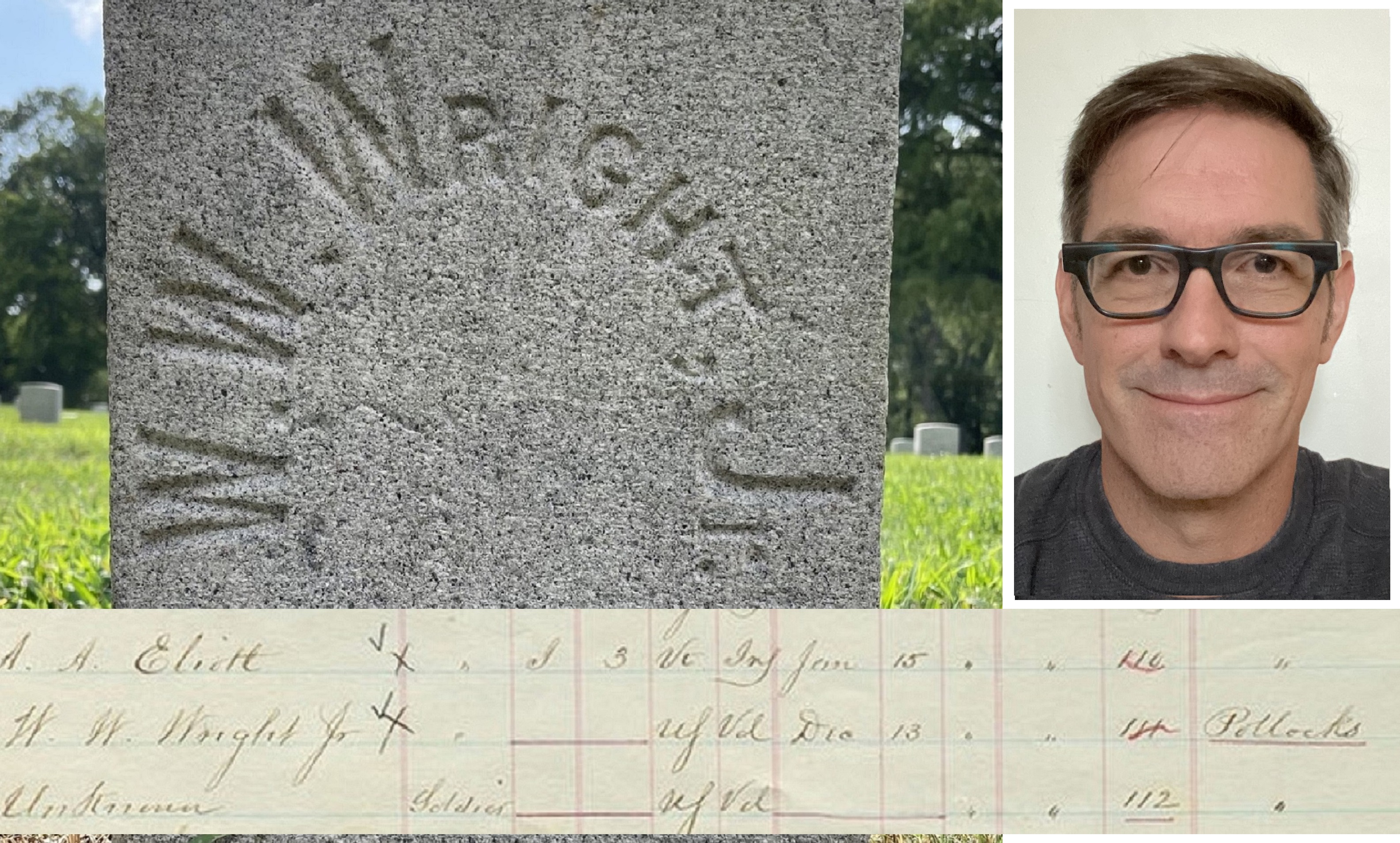
| The grave in question (Peter Maugle/NPS), the registry for a W.W. Wright Jr. and citizen historian Mark Fischer |
The recent identification
of graves for two Iron Brigade soldiers killed near Fredericksburg, Va., is due
to persistent research by a citizen historian and a retired FBI researcher who
dug up an 1870 newspaper article that provided crucial information.Officials
credit Mark Fischer of Livonia, Mich., and Steve Morin, a volunteer at Fredericksburg and Spotsylvania National Military Park, for gleaning information used to properly identify the graves of
Sgt. Wallace Winfield Wight of the 24th Michigan and Pvt. John S. Waller of the 19th Indiana.
Wight’s grave at Fredericksburg National Cemetery has the wrong surname and Waller’s
has only initials (photo below by Peter Maugle/NPS). Records now have been updated to show who lies beneath each stone.
The turning point in the quest for identification was the discovery of a Detroit Free Press article,
something the park said was akin to finding a needle in the haystack.
The effort is
remarkable for a number of reasons, starting with how it came to be. Usually,
the park initiates an ID search, sometimes from markers that might only have
initials or scant information.
An email from
Fischer to the park in 2023 was an exception to the rule.
“What makes
Wight unique is someone out of the blue contacts the park on his own mission. He
started with a name, we start with a grave,” said park historian and ranger
Peter Maugle. “This has happened only one other time (to) my knowledge.”
Wight’s
headstone at Fredericksburg National Cemetery is mislabeled as W.W. Wright Jr.
-- one letter off from Wight. While one would think the mystery should have
been solved easily, it took some digging for everything to add up, Maugle told
the Picket.
Both soldiers
were members of the Army of the Potomac’s Iron Brigade, known for its
unflinching courage and high casualties during the war. They were known for wearing black felt Hardee hats.
The brigade, made up of several Midwestern regiments saw limited
action at Fredericksburg, but was bloodied at First and Second Manassas, Antietam, South Mountain and Gettysburg. (Iron Brigade hat, below, worn by Elmer D. Wallace, 24th Michigan // University of Michigan Bentley Historical Library)
While
cemetery records have now been updated for Wight (Grave 4953) and Waller (Grave
5588), officials say the discoveries are not definitive. Without DNA samples,
it is impossible to formally identify any of the 12,000 soldiers marked as
unknown at Fredericksburg.
“We feel like this is 99.9% accurate,” says Maugle of Wight’s
identity. “We don’t exhume.”
The headstones will not be corrected, due to their historical nature and other factors. (More about that below).
Fischer’s research actually began with Wight’s father, an
officer in the same regiment and who is buried in Livonia. A nearby stone with
Wallace Wight’s named appeared to be a cenotaph -- an empty
grave for someone who is believed to rest elsewhere. But that was not a
certainty.
Fischer reached out the park, wanting to know
whether the younger Wight rests there. “I
could not find an obituary for Wallace that would have suggested his remains”
had been taken home to Michigan.
That first contact did not prove fruitful because park
officials could not find a Wight in their cemetery records (though the register
did show a Wright, as later research came to show). So Fischer kept at it,
looking at diaries, letters and old newspapers.
Subsequent correspondence between Fischer and Morin led to
the latter eventually finding the Detroit article, which broke the whole story
open.The lengthy article in December 1870 about a Grand Army of the Republic reunion included
information about the deaths of Wight, Waller and other men in 1862
and 1863.
It said the meeting was the second of the regimental association and involved toasts and speeches, resulting in a "pleasant and successful" gathering at Young Men's Hall in Detroit.
After the Wight identification, Morin was able to do the same
for Waller, whose grave is marked simply “J.S.W.”
Maugle credits Fischer for instigating the gathering “of the
pieces of the puzzle.”
“This guy figured it out for us. He was persistent.”
He became curious about graves in his Michigan town
Fischer, 52,
grew up in Ann Arbor, Mich., and lives in Livonia, where he works in IT.
When he and
wife moved back to Livonia from Pennsylvania, Fischer stopped by a “cemetery that I
have driven by thousands of times.”
He saw the 24th Michigan on several
tombstones. The regiment had fought at Gettysburg. “That struck a chord with
me.” Among those buried there was Lt. Col. William Walker Wight (photo below is cenotaph for Wallace W. Wight, courtesy Mark Fischer)
A self-described books guy, Fischer dug into
histories, learning the father, then a captain, recruited his son, Wallace, and
commanded him at Fredericksburg with Company K. (Another son, Gurdon, was
wounded and survived the war.)
Fischer got service records from the National Archives. “The central question to
me was, did Wallace make it home?”
He could not
find any documentation. The fact that the marker in Livonia is shared with a
brother-in-law and is not a government-provided stone made him curious whether
Wallace Wight was buried at the Fredericksburg cemetery or nearby.
Morin asked
for photos of Wallace’s grave. “The appearance of stone led him to think it to
be just a marker.”
Wallace’s
cenotaph is about six feet from his father’s grave and close to that of his
sister. The marker also lists his brother-in-law, according to Fischer.
“How does the
father lose the son and carry on? That is what I am trying to understand.”
Fredericksburg team's dogged pursuit to honor dead
Over the years, Maugle (right) and his team have been able to
“better” identify about 200 graves at Fredericksburg. The process comes with a
host of challenges.
First off, those who opened and operated the cemetery 160
years ago had little time to pursue identification, and there was no national cemetery
system.
Remains -- sometimes only a few bones – arrived in dribs and drabs
between 1866 and 1868. Most came with no name or, as possible in Wight’s case, with
a weathered wooden marker. Stone markers did not replace wooden ones for
several years.
The park
pointed out in a Facebook post in September no soldier with the name Wight
appears on Army rolls or casualty lists. The soldier and several comrades were killed on Dec. 13, 1862, and buried
twice, including at Pollock’s Farm in Stafford County, before Wight was moved
to Fredericksburg National Cemetery.
 |
| The graves at Fredericksburg were wooden until the mid-1870s (NPS). |
Maugle told the Picket the wooden marker placed above Wight
had to survive three years until reburial parties cam. “It may have been
degraded until it is barely visibly.”
Morin wrote in his report about the grave it is possible that the misinterpretation of the surname ‘Wight’ as ‘Wright,’ sergeant
as private and the missing company and regimental designations could be due to
the grave marker’s exposure to the Virginia elements for several years,
particularly if the inscriptions were written in pencil.
Initial emails led to no match for soldier
Most soldiers
did not carry ID tags and unlike at other Civil War cemeteries, Maugle said,
few of the Union soldiers passed away at nearby hospitals, where identification
would have been easier. “They were
buried on the field very hastily.”
The
Fredericksburg cemetery has dead from four major battlefields and names were
entered on the register – which, of course, is unsearchable – apparently when
they arrived.
In Wight’s
case, he was listed in the register as W.W. Wright Jr., along with a notation
of burial at Pollock’s Farm prior to relocation to Fredericksburg. No regiment
or rank was listed and the soldier was mistakenly identified as a private. The
notation says “US Vol.” (Click image, courtesy NPS, to enlarge. Wright is near the bottom)
When Fischer
first contacted the park, they only discussed a soldier named Wight. No one
brought up the possibility of him being listed as Wright. Officials searched
the register for anyone with the 24th Michigan and the name Wight.
No match.
Unfortunately,
no one had yet seen the newspaper article, which showed the sergeant was buried
at Pollock’s Farm before the postwar move of remains to the current cemetery.
The email
exchange ended in a dead end. “We
kind of threw our hands up,” said Maugle.
Fischer got back to work.
One find led to another, to another, to another
Sgt. Wallace
Winfield Wight, 18, and several others in the 24th Michigan were killed
on December 13, 1862. He and at least one other soldier were believed to be
decapitated by a Confederate shell.
Wight’s remains
were recovered by his father (left).
The history of the 24th Michigan by O. B. Curtis says, "It was
truly a mournful event when the Captain of Company K, that night, searched for
the trunkless head of his son upon the battlefield, while the canister was
whistling above him, and placed it with the young boy's remains for
burial."
The men were
first buried on the south side of the Rappahannock River.
“During the
Chancellorsville campaign, his body was disinterred on April 30, 1863, and
reburied at the Pollock House on the north side of the river. According to a
May 1, 1863, letter written by Sullivan Dexter Green, Company F, 24th
MI, Sergeant Wight’s grave was still fully marked when his body was moved.”
Morin wrote. “Diary entries written on June 10, 1863, by Lieutenant Colonel Mark Flanigan, 24th MI, detailed a visit he made to the grave of ‘W.W.
Wight, Jr.’ near the Pollock House on the north side of the Rappahannock River.”
Much of the
above information was researched by Fischer and relayed to Maugle and Morin (right, NPS photo),
who then found the newspaper article. Fischer said Green was essentially an
embedded reporter for the Free Press while serving with the regiment.
Maugle said
the newspaper article, while it does not mention the Pollock house by name, makes reference to "the hospital building ... on the opposite side of the road near
the bank of the rive," narrowing it down.
At that point, the park thumbed through the register looking for burials
at Pollock’s Farm.
They came across W.W. Wright Jr.
“That name stuck out then,” said Maugle.
Bingo.
The
mislabeled Wright marker includes a “Jr.”, likely because the teen and his
father had the same initials.
Morin then
turned his attention to Waller, whose grave is marked “J.S.W.”
According to
the park, his grave lies between two casualties
from the Army of the Potomac's crossing of the Rappahannock River at the outset
of the Chancellorsville campaign in late April 1863. Cemetery records indicate
the occupant is a U.S. soldier who died in 1863 and was initially buried
at Fitzhugh's Farm in Stafford County.
 |
| Overlay shows Pollock's Mill/Farm in center, farm of Henry Fitzhugh (NPS) |
“The 1870 article lists the names of several
soldiers originally interred at the farm. One of them, Private John S. Waller
of the 19th Indiana, fit the description and is likely the occupant of this
grave. Cemetery records were updated to reflect that deduction.”There are no known photos of Waller or Wallace Wight.
Why the NPS does not alter historic markers
When the park publicized the Wight story in September, some
commenters asked why his marker could not be replaced with appropriate
information.
In a nutshell, National Park Service policy does not allow the
altering of historic gravestones due to errors of fact.
 |
| Lt. Col. Flanigan wrote about visit to Wight grave at Pollock's Farm (NPS) |
Maugle said one reason is the cost and labor for replacing them. Some
would receive a stone with a newer design, affecting the historic nature of the
original.There are some exceptions, such as if a tree fell and destroyed a
marker.
There is another reason – going back to the concept that identification
cannot be 100 percent confirmed. “What if someone
comes in and says it belongs to someone else. We are in a quandary and we
decided to make an adjustment to the grave,” said Maugle.
The citizen historian is invited to memorial event
Back in Michigan, Fischer wants to concentrate on what started this
journey – a biography of William Walker Wight.
“Researching the father is how I became aware of the
uncertainty about his son's final resting place,” he said. “A father lost his son under
extraordinary circumstances.”
Lt. Col. Wight soldiered on as an officer – he was wounded at Gettysburg
-- a citizen and a patriot.
Fischer has been invited to the park’s 2025 Memorial Day activities,
notably a May 24 luminaria. Some 15,300 candles will be placed in bags to brighten the Fredericksburg National Cemetery. (Photo NPS)
Maugle said Fischer will primarily speak about
Wallace Wight’s life and service.