Showing posts with label weapons. Show all posts

Thursday, May 1, 2025

First on the Picket: Compelling artifacts and technology acquired in recent years will tell a bigger story in an Atlanta History Center exhibition opening next year. The aim is to get you to think about what the Civil War meant then -- and its impact today

The Atlanta History Center
is closing a longtime Civil War exhibit to make way for two new galleries that will feature breathtaking artifacts and a broader discussion of issues that engage the republic to this day: our belief systems, victory, defeat, reconciliation and the evolving meaning of freedom.

Atlanta, museum officials say, is ideal to tell a bigger national story about the Civil War in a striking way. Beyond being the capital of the South and a melting pot, it’s recognized by historians as a crucial battleground for saving the presidency of Abraham Lincoln and the United States itself.

For 30 years, relics collected by an Atlanta father and son formed the core of “Turning Point: The American Civil War.” The exhibit focused on the soldiers in blue and gray and how they did their deadly work, and visitors were awed by the incredible collection of uniforms, weapons, personal items -- and just about every conceivable type of artillery shell.

While “Turning Point” did address some big questions about the Civil War, there was limited discussion on technology, slavery and the home front. New, more diverse generations – distanced even more from the Civil War era – are asking deeper questions, the museum says, about why the war happened, how 4 million enslaved Americans gained their freedom, Reconstruction and what the conflict, which took at least 720,000 lives, means today.

Sheffield Hale with Union 20th Corps wagon that traveled near what is now the AHC (Picket photo)
“Thirty years ago, we (had) white, middle-class older folks,” Gordon Jones, the AHC’s senior military historian and curator, told the Picket about the exhibit’s key audience at the time. “We are a changed city. Demographics have changed. Our audience asks different questions.”

The history center is investing $15 million and more than 15,000 square feet for the new exhibition, which has not been formally named. It is expected to open in summer 2026, when the AHC marks its centennial.

“Turning Point” will close on May 25, but Civil War aficionados can still get their fix during construction with the giant Cyclorama painting of the Battle of Atlanta, related exhibits and the locomotive Texas, one half of the famous “Great Locomotive Chase” in 1862.

Jones came to the history center in early 1991 and cataloged the vast artifacts collection of Beverly M. DuBose Jr., whose name is on the current gallery. The collection became the basis for much of “Turning Point," which now has an outdated feel.

Flags and other items in the current "Turning Point" exhibit (Picket photo)
The curator could not conceive in the early 1990s what the internet and online auctions would mean for the history center, which has since purchased scores of artifacts, many of which will be displayed for the first time in the exhibition.

“More is better. It’s what gets people excited,” said Jones. “Artifacts are what speak to you emotionally, through your heart.”

Two flags and messages they sent to formerly enslaved

Make no mistake, Confederate and Union bayonets, swords, flags, rifles and revolvers will still be a big part of the presentation. To that end, Jones and AHC CEO and president Sheffield Hale are excited about plans to include two large collection of dug relics.

But they are particularly excited about the artifacts related to U.S. Colored Troops. The impetus for that came about in 2019, when the history center bought a hand-painted flag made for the 127th USCT infantry. It depicts a soldier waving farewell to Columbia, a symbol of the United States, with the words “We Will Prove Ourselves Men.”

“It’s an iconic knock-your-socks-off artifact,” Jones (At left in Picket photo) said at the time. Even an enlisted man’s USCT uniform wouldn’t be as historically significant as this flag.”

There’s another flag (top photo of this post) the curator said will be his favorite item in the new exhibit.

Most of the American flag is long gone, save for the 34 stars and upper-left canton. It flew over a camp on Craney Island near Hampton Roads, Va., that protected escaped slaves, whom Jones said were active in their liberation. The camp operated for just over a year before closing in September 1863; it was one of dozens of such camps in southeast Virginia housing an estimated 70,000 formerly enslaved people, according to the AHC. The tattered flag, which originally was 10 feet tall by 20 feet long, is undergoing conservation for display.

While the flag for the 127th USCT largely symbolized pride and duty, this one was a symbol of freedom, welcoming those who arrived safely after a dangerous journey.

 “If I get to that flag, I get my freedom, Jones said a refugee might think. “The choice to whom I can marry, to find my family.”

A closer look at the fascinating 'new' artifacts

I met Monday with Hale and Jones to talk about the new exhibition, which officials say will be heavy on “cutting-edge technology and immersive storytelling” and the benefits of newer scholarship. (Afterward, Jones showed me several artifacts in a storage area in the building’s basement)

They outlined some of what visitors will see in the galleries and other items in the center's vast collection. Below is just a smattering of what we discussed:

Patent for Morse breech-loading firearm (Atlanta History Center)
-- The downstairs Goldstein gallery, which is empty, will focus on technology and the Civil War. In part, it will feature the singular collection of the late George W. Wray Jr., showcasing some of the rarest Confederate firearms, swords, uniforms, flags and other items. Some were one of a kind. When it went on temporary display in 2015, the theme was the weapons were an attempt by a slave-based society to fight an industrial war. The South was hampered by limited manufacturing and the Union blockade of foreign goods.

-- A projection on one wall will feature a timeline of the war, key moments and maps, Hale said. The AHC will display elements of its interactive “War in Our Backyards” collaboration with The Atlanta Journal Constitution about 10 years ago.

-- Utilizing an online database about the Atlantic slave trade, the former DuBose space will feature an animated screen showing their routes, destinations and other details.

Gordon Jones with 18th century British blunderbuss (Picket photo)
Two items will show the connection of the U.S. slave trade and the practice elsewhere:

-- One is a circa 1750s short-barreled firearm, or blunderbuss, made by the John Whately family in England. The European slave cartel traded guns for enslaved persons along the West African coast. It was typical for the buyers to supply weapons, iron bars, printed cloth and other metals as part of the barter. "This one is extremely lightweight, cheaply made, and incredibly rare to find in this condition," said Jones, who believes this one may have been a sample weapon. 

“It was just rotten and evil from the start to finish,” the historian said of the slave trade.
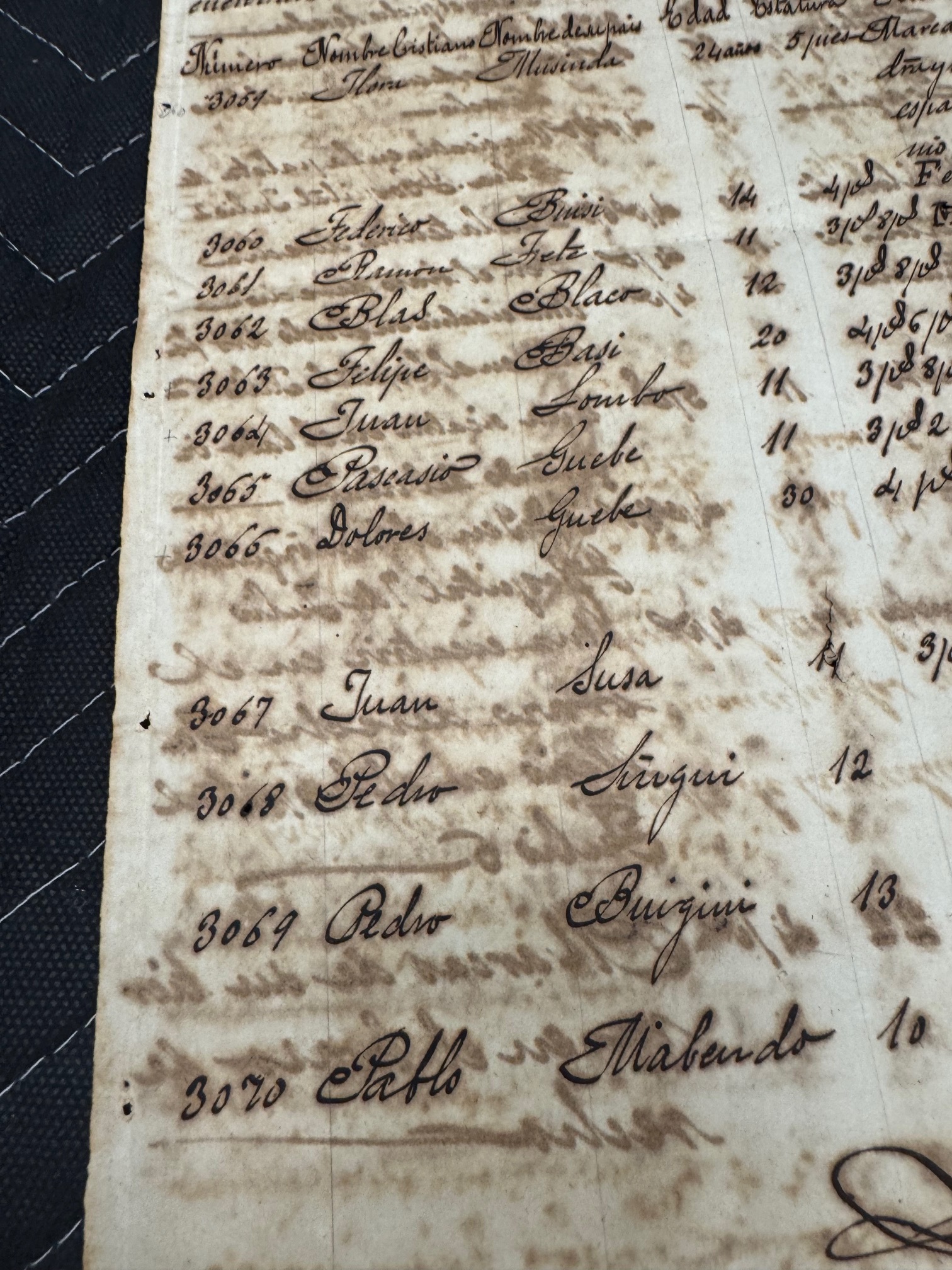
-- Documents written on parchment in 1868 detailing enslaved persons brought to Cuba five years before. The ledger includes Christian names, their age, condition and, most chillingly, the branding mark burned in their bodies. Visitors will learn the international slave trade continued until the late 1880s. (Picket photo, right)

-- A presentation on Confederate and Union monuments, including their locations.

-- Documents from the Maj. Henry Thomas Massengale collection. The Confederate States Quartermaster Bureau in Atlanta was responsible for manufacturing, procuring and transporting military supplies such as clothing, camp equipment, forage, and draft animals, to the Army of Tennessee before, during, and after the Atlanta campaign. Some of the notations are about enslaved persons, including one about a requisition for pants, drawers, shirts and hats for three. “The clothing is required for Negroes employed on the Fortifications that were confined in the Smallpox Hospital and their clothing had to be burned to prevent contagion.” The papers are available at the AHC's Kenan Research Center.

-- Personal items belonging to Capt. James Lile Lemon of the 18th Georgia. “He literally saved everything,” said Jones. Among the artifacts is a drum (photo at top of post) captured from two young Pennsylvania drummer boys on Sept. 16, 1862, the day before the Battle of Sharpsburg (Antietam). Lile later wrote about the capture of the boys by Pvt. Frank A. Boring:

"As he was driving them to the rear at point of bayonet they heaped so much abuse upon him - out of their fear or nervousness - that he had to be restrained from striking them with the clubbed musket. Of course, instantly the target of many wags among our company who joked with him about "scaring little boys" & etc. He replied that he would be d---d if he'd take such abuse from "d---d Yankee whelps." The boys were release & "beat a hasty retreat" back to their lines, with Boring giving them a rite hard look as they went."

-- A portion of the DuBose family Civil War dug relic collection is one of two never-before-exhibited relic collections to be included in the new exhibits. “These collections are comprised of approximately 50,000 artifacts recovered from the 1930s through the 1990s from Tennessee to Virginia, with special emphasis on the Atlanta area,” said the AHC. “They include Minie balls, shell fragments, bayonets, belt plates, gun parts and personal items of every description: the detritus of war left in and on the ground, often in our own backyards.” (Photo courtesy Atlanta History Center)

-- A fascinating lithograph copy of South Carolina’s ordinance of secession. Black troops with the 102nd USCT, mainly comprised of Michigan and Canadian men, seized it in March 1865 at a Charleston home. The Union troops listed four companies within the regiment.

They called the signed sheet a “scroll of treason.” (the original document is in the South Carolina archives). The AHC has a pistol that belonged to one of the White officers listed at the bottom.

Crucial to all this, Hale and Jones said, is being authentic and honest about artifacts and context. At a time of growing use of artificial intelligence and a distrust among many of museums, it’s important visitors know where items came from, said Hale.

Notation on copy of South Carolina secession document calls it a "scroll of treason" (Picket photo)

The aim is to be thought-provoking

Part of the exhibit will look at how the United States went from the Revolutionary War and subsequent conflicts to the Civil War, and what was resolved and what was not during those 80 years.

Some of the fractures continue today, said Jones, adding it is important to raise questions but let visitors make their own conclusions. “We want to change … the traditional ways we examined the Civil War.”

The AHC has utilized focus groups and feedback as it plotted the direction of the exhibit. Jones considers history professor Carolina Janney of the University of Virginia, historian and former president of the University of Richmond Ed Ayers and Cynthia Neal Spence, associate professor of sociology at Spelman College, among his mentors. Spence was featured in an AHC documentary about the legacy of Stone Mountain.

At the end of the day, compelling artifacts, context and interactive features will combine to entertain and educate, the AHC believes.

“We want them to say, ‘Dang, I never realized that,’” Jones said.

Thursday, June 13, 2024

Until these Civil War Enfield rifles are conserved, they will stay in an aquarium tank at a Georgia state park. Here's how specialists gently clean the exhibit

DNR team removes water and gently cleans Enfield rifles (Danielle Grau/Sweetwater Creek State Park)
Items you might find in a garage or utility shed turn out to be handy tools when protecting precious artifacts that help tell the story of the Civil War.

A team with the Georgia Department of Natural Resources this week used a garden hose, small pump, spray nozzle and a wet-dry vacuum to clean and refill a 300-gallon aquarium tank that holds -- of all things -- 18 Pattern 1853 Enfield rifles.

Josh Headlee, curator and historic preservation specialist with the DNR, has done the task a couple times a year since 2013. He travels to Sweetwater Creek State Park in Douglas County, Ga., west of Atlanta. (Surprised visitors to the museum there ask where the weapons were found and why they are in water, says park clerk Danielle Grau.)

The water is siphoned out of the tank to a sink (Danielle Grau)
The English-made rifles were carried by a Confederate blockade runner and lost when it hit a sandbar and sank in Charleston, S.C, in 1863. They were recovered from the wreckage of the CSS Stono in the late 1980s.

Headlee says the rare guns remain in a state of limbo as they await conservation, with the goal of exhibiting them out of water. Removing harmful corrosive salts from their time in the ocean and using fresh-cycled water in the tank keep them stable.

Unfortunately, the iron rifle barrels, locks and bayonets are heavily deteriorated or gone. A tin and lead lining that sealed the cargo from salt air and ensured the rifles were not tampered with likewise is in bad conditionThe trigger guards, butt plates and nose caps at the end of the barrels are made brass and still intact.

Matt Sanford, Josh Snead and Josh Headlee clean interior (Danielle Grau)
We asked Headlee to describe the cleaning of the tank. This week, he worked with DNR archaeologist Matt Sanford and Josh Snead, a field interpreter for Georgia State Parks. All the photos were taken by Grau.

WHY THEY CLEAN THEM: The staff at Sweetwater keeps Headlee up on the condition and clarity of the tank, and he cleans it about twice a year. The main purpose is to remove algae, sediment or muck that could further harm the rifles, metal lining and the exterior crate. Headlee makes sure the aquarium pump and filter are working property. “The most important thing is to keep the water moving.”

PUMP IT UP AND OUT: The team uses a garden hose and transfer pump to draw the water out before the gentle cleaning. “There are no high-tech gadgets we are using,” says Headlee. “How do we get the water out, how do we get the water back in.” The removal takes about an hour.

Brass rifle butts after draining, the weapons during refilling (Danielle Grau)
NEXT STEP: The team used a sprayer and wet-dry vacuum to remove any debris; no cleaning agents are used. We use a “light spray to get any type of algae off.” They don’t scrub the rifles or the other contents, but do use soft-bristle brushes and towels on the glass. Over the years, they find less debris. Early on, Headlee used a colander to sift wood and metal for examination back at the lab. He notes that the malleable tin lining will pose the biggest conservation challenge. “I am not sure what we will be able to do.”

THE GREAT REFILL: After lunch, the team removed any remaining debris and begins filling the tank after brushing the sides. They turned the water off a few times in the filling process to make sure the filter pump was going to work properly and not leak. A fungicide was added. The water refilling took close to 1.5 hours.

Josh Headlee takes a close look during the tank refilling (Danielle Grau)
FINIS! The work is done by late afternoon and the visibility is markedly improved, to the benefit of the rifles and visitors. Headlee says it is even better the following day because of settling and the dissolving of the fungicide.

Getting the artifacts out of water and through conservation will save maintenance, time and effort, says Headlee. Two rifles were removed from the tank in 2022 to test a wood preservative. They are being held in fresh water at another state facility.

There’s no timetable for the conservation work, with other projects at the front of the line. Still, he is hopeful.

“They are not forgotten by any means,” he said.

Wednesday, February 15, 2023

Civil War rifles: Atlanta History Center collection includes carbine sent to Japan, terrifying Whitworth sniper gun and a Texas firearm not up to snuff

Carbine has Japanese cartouche, mums on stock, barrel (AHC, Picket photos)
A surplus Civil War carbine, sold to the Japanese government in 1868 and marked with  imperial chrysanthemums and another design, has been acquired by the Atlanta History Center for its growing collection of firearms.

The history center, home to the Cyclorama painting depicting the Battle of Atlanta and a major exhibit on the Civil War, has acquired dozens of weapons in the past couple of years, bringing the total inventory to nearly 400. It purchased the Starr carbine in November 2022 from a private dealer.

Gordon L. Jones, senior military historian and curator at the AHC, recently showed me some of the firearms kept in the museum's secured basement. We examined the carbine and two notable weapons – one highly regarded and the other considered subpar -- from the existing George W. Wray Jr. collection of rare Confederate guns at the history center.

While some of the long guns at the AHC are in the long-standing exhibit “Turning Point: The American Civil War,” the vast majority are awaiting their time in the daylight, minus the occasional special exhibit.

Gordon L. Jones with guns from the Wray collection (Picket photo)
The AHC would like in coming years to revamp “Turning Point” with a new and expanded area that would showcase many of the stored firearms, says Jones. He said it would compare to the impressive Fuller Gun Collection at Chickamauga & Chattanooga National Military Park.

The Starr carbine and many other surplus American weapons were shipped to Japan shortly after the Civil War.

There was significant upheaval there amid “the beginning of Westernization,” said Jones. The .54-caliber gun may have been used in the Boshin War (Japanese Civil War) in the late 1860s. Some experts say many were procured by the Tokugawa shogunate, which was desperate for such weapons.

New York arms dealer Schuyler, Hartley & Graham provided the gun to the Meiji government of Japan.

“It is marked with (the) chrysanthemum (photo, left) and what is believed to be a Japanese military school cartouche (not yet positively identified). The 1853-1854 visit of U.S. Commodore Matthew Perry opened the once-closed society of Japan and started a race between rival clans to acquire modern firearms from the West.

"What followed was the rapid Westernization and militarization of Japan under the Meiji emperors, ultimately culminating in war against Britain and the United States in 1941,” the AHC says.

“This carbine helps tell the story of the long term and sometimes unintended international consequences of the American Civil War, which will be a key theme in the new exhibition.”

The newly acquired gun will be displayed with another Starr carbine already in the DuBose Collection that was sold to Great Britain and used in the defense of Canada against the Irish Fenian incursions of 1866 and 1870.

The Starr carbine was a single-shot, breech-loading weapon. Not many were used by the U.S. military, relative to those put out by other manufacturers.

Other guns acquired in the past two years include:

-- A British Pattern 1853 rifle-musket of Pvt. Robert Marold, Company K, 143rd New York, used at Battle of Peachtree Creek and the Atlanta Campaign, 1864. (Interestingly, actor Chris Evans, who has portrayed Captain America, is a descendant of Marold)

-- U.S. Model 1861 rifle-musket, modernized with the patented Needham breech-loading system, as used by the Governor’s Guard, a Black volunteer militia in Atlanta in 1879.

-- U.S. Starr Arms Company breech-loading carbine with markings indicating use by the 1st Arkansas Cavalry, a U.S. regiment comprised of white unionists from Arkansas and West Tennessee.

-- Eleven European firearms shipped to Union and Confederate troops from 1861-1864.

Jones points to damage on the AHC's Texas contract rifle (Picket photo)
During my visit, Jones brought out two guns from the Wray collection as examples of the best and worst utilized by Confederates.

Visitors to the AHC’s “Confederate Odyssey” exhibit in 2014 learned how the Confederacy successfully adapted to modern warfare. They also saw failures or limitations: poorly crafted bayonets or makeshift clothing. Examples came from firearms, swords, uniforms, flags and other items collected by the late Wray over the years.

Southern manufacturers struggled to make firearms that could stand up to extensive wear and campaigns. Jones showed me a so-called Texas contract rifle, used for a time by William Malloy, a trooper with the 29th Texas Cavalry.

"William Malloy" is carved into the gun's buttstock (Atlanta History Center)
Jones believes the 1863 contract rifle, made by a small private company, is the crudest weapon in the Wray collection.

“This has a thick heavy barrel with tiny iron bands,” the curator told me in 2014. “It is poorly balanced and the back action lock is weak.” The wood behind the bolster was chipped away, despite a nail inserted as a repair.

One officer said of the carbines, “These things are more dangerous to my men than the enemy.”

“Malloy” and “Tex” are carved into the buttstock. It is unknown whether Malloy was still with the unit at its most famous battle at Honey Springs, Indian Territories, facing the First Kansas (colored) Infantry in 1863.

The star of the Wray collection is a Whitworth rifle made in England and shipped to the South during the war. The Whitworth was the first sniper weapon and was incredibly effective, supplied to only the best marksmen. About 50 came over and only 18 are known to survive, Jones said.

Several Federal generals were killed by Whitworths, perhaps mostly notably Maj. Gen. John Sedgwick at Spotsylvania in 1864..

The weapon had a range up to 1,500 years and had an open site on the barrel and a side-mounted Davidson telescopic sight (right), giving the shooter two options. The Whitworth had much tighter rifling than an Enfield, making it that much more deadly.

The AHC believes the one Wray purchased was likely used in the Western Theater, though the telescopic sight on the AHC weapon is a restoration with 20th century optics.

A book on the Wray weapons has this to say: “Although it is impossible to say when or where this particular rifle was used, as one of the Confederacy’s most valued weapons, it certainly did see use. Just as certainly, it killed and wounded many Union soldiers.”

Gordon L. Jones with a rare Whitworth sniper rifle used by the South (Picket photo)
AHC acquisitions from the past couple years (Picket photo)

Wednesday, January 21, 2015

Cache of weapons may have been found

A huge cache of weapons dumped in a South Carolina river 150 years ago may soon be unearthed, thanks to an environmental cleanup. Historians are salivating over the prospect of finding cannonballs, bayonet scabbards and sabers seized by Maj. Gen. William T. Sherman's Union forces during the sacking of Columbia on Feb. 17, 1865. • Article

Monday, July 14, 2014

'Confederate Odyssey': Atlanta exhibit's rare artifacts, guns give insight to war effort

Patent for Morse breech-loading firearm (Atlanta History Center)

George W. Wray Jr. apparently had a photographic memory: He could remember in vivid detail what he had seen and read.

That attribute helped set him apart while attending Civil War gun and relic shows. Everyone watched Wray as he walked the aisles and spoke with dealers.

The other buyers shared one thought, said Gordon L. Jones, senior military historian and curator at the Atlanta History Center.

“’He must know something we don’t know.’”

George W. Wray Jr.
What Wray, an Atlanta businessman, must have known was how to build a singular collection of some of the rarest  Confederate firearms, swords, uniforms, flags and other items, according to Jones. Some were one of a kind.

The history center’s signature exhibit, “Turning Point: The American Civil War,” has at its heart the DuBose collection, which drew from Federal and Confederate artifacts, with the former in higher numbers.

“George Wray set out, on the other hand, to just collect Confederate-made or used materials,” said Jones. “All of them have a Confederate association.”

“It is a perfect complement to the DuBose collection,” said Jones.

After much anticipation and preparation, “Confederate Odyssey: The George W. Wray Jr. Civil War Collection,” goes on exhibit at the AHC this Friday, timed to coincide with events marking the 150th anniversary of the Battle of Peachtree Creek in north Atlanta. The exhibit will run through March 15, 2015.

The central theme of “Confederate Odyssey” is the attempt by a slave-based society to fight an industrial war. “Every piece we have is a piece of evidence of how they were or were not able to do that,” Jones said in an interview while he was preparing a sword for the exhibit.

Some of the Wray artifacts (AHC)

About 200 items from the extensive Wray collection will tell that story.

Some people will swoon over an item because it belonged to a famous person,” said Charlie Crawford, president of the Georgia Battlefields Association. “The Wray Collection is more about showing the everyday items of privates and relative unknowns, thus giving a viewer more of an idea of what life was like for the great majority of people who participated.”

Visitors will see where the Confederacy successfully adapted to modern warfare. They also will see some failures or limitations: poorly crafted bayonets or makeshift clothing.

“On one hand, it is very creative,” said Jones. “On the other, it is making due.”

The Confederacy was hampered by short supplies of materials, skilled labor and interchangeable parts.

Gordon Jones
The story of George Morse, a New Hampshire gunmaker who set up shop in Greenville, S.C., during the Civil War, typifies the challenges, said Jones.

The exhibit has a Morse patent model for an innovative breech-loading firearm.

The gunmaker altered U.S. Army muzzle loaders, but was only able to make about 1,000 carbines, and they were restricted to South Carolina troops.

“He made a terrible professional move by going to the South,” said Jones. “The capacity to muster the raw materials to Greenville over a single railroad and to make it work profitably… they couldn’t make the quantity to make a difference.”

The exhibit includes two Morse firearms made for the U.S. government and four for the Confederacy.

Southern manufacturers struggled to make firearms that could stand up to extensive wear and campaigns.

“Would a Southern-made gun kill you the same as a Northern one?” Jones said. “Yes. But would it last as long on the battlefield? No.”

(Texas rifle, AHC)

The constant challenge was making them en masse without a lot of raw materials. The show includes a Texas contract rifle (above) made by a private company.

“This has a thick heavy barrel with tiny iron bands,” said the curator. “It is poorly balanced and the back action lock is weak.”

One officer said, according to Jones, “’These things are more dangerous to my men than the enemy.’”

(Alexander carbine, AHC)

A breech-loading Alexander carbine was made by a maker who was granted workspace at the Richmond, Va., armory but absconded with the prototype and tried in vain to win a lucrative contact.

Collectors and historians knew the gun (above) existed, but Wray found the patent model listed in a weapons publication in 1981 and recognized its value, said Jones.

There were some successful adaptations, and small manufacturers around the South made decent weapons, albeit in limited numbers. The Confederacy was able to get 500,000 rifled muskets from Europe through the onerous Union blockade. “That is how the Confederacy survived,” said Jones.

The AHC said the exhibit provides poignant stories of bravery, resourcefulness and sacrifice during the four-year war.

Bloodied frock coat worn by soldier, 17


Jones points to a frock coat worn by Benjamin Schumpert, a 17-year-old Georgia soldier who fell at the Battle of Chickamauga in September 1863. It is an unusual garment make from homespun cotton ticking.

“He lied about his age to get in there. He is shot in the head and you see the garment he was wearing is stained with his blood. He is an American soldier who gave everything he had for this cause,” said Jones. “When you see that blood -- that is not an experience you see in a movie and the Internet. You can only have this at a museum, (by) looking at the actual artifact. That is a hell of a thing.”

Jones said Wray, who died in 2004, was a private man who invited him to lunch in December 2001. 

“He came to us with this wonderful collection,” the result of travel and thorough research.

The center acquired the collection in 2005. While Jones would not divulge the price of the investment, he said, “This is the largest collection purchase the AHC has ever made. It was not something we did lightly.”

Weapons are placed in "Confederate Odyssey" exhibit (AHC)

The University of Georgia Press is publishing a 450-page companion book-catalog, “Confederacy Odyssey,” with a list price of $49.95. Available for pre-order, the book is due to come out in mid-October.

About 900 color photographs by Jack W. Melton Jr. will include detail shots of the interior details and marks on weapons, showing both quality and shortcomings. Jones researched and wrote the text for the book.

His work on the DuBose and Wray collections rank at the top of his accomplishments while at the Atlanta History Center, Jones said.

Even after the Wray exhibit ends, “this collection will always be here.”

Battle flag for 33rd Texas Cavalry (AHC)
The curator hopes visitors will appreciate the fact Confederate soldiers were willing to die for their cause.

As for the performance by the Southern governments, businesses and industry? Jones gives them an “A” for effort, but an “F” for ultimately failing.

“The whole economic system in the South was just not suited for the demands that would be placed on it,” said Jones, adding Confederate leaders expected the war to be over quickly. “They knew of Northern industrial capacity. In a short war, that difference will not be decisive. That difference did turn out to be decisive.”

Monday, March 17, 2014

National Park Service black-powder course: Teaching the authentic and safe use of historic weapons


Castillo de San Marcos in Florida (NPS)
Last year, 1.1 million people who flocked to America’s national parks witnessed 9,145 programs involving historic weapons. Venues that fire reproduction 18th and 19th century small arms and artillery must have an employee certified in their use and safety. Of course, actual rounds are not fired. The National Park Service recently concluded a 10-day black-powder course at Fort McClellan Army National Guard Training Center near Anniston, Ala. Course coordinator George Elmore, chief ranger at Fort Larned National Historic Site in Kansas, talked with the Picket about the course, which featured 11 instructors, and the value of living history programs that use such weapons. Here is an edited version of our conversation:

Q. Why are these weapons programs put on at park?

Elmore: What makes a powerful demonstration is when you have successfully created the illusion you could be a soldier from the Civil War or Revolutionary War, and you draw persons so much into the talk and program, that you created a picture in their mind of what an individual soldier went through.

Training participants (NPS)
Q. Why is the course held?

A. The purpose of the course is to keep the use of firearms safe. You can lose a hand. You will see that occasionally in (non-park) re-enactments. We have never had a major accident in the park service. We are very concerned about safety. Each park is required to have its own magazine, meet the ATF (Bureau of Alcohol, Tobacco, Firearms and Explosives) requirements and to have a loading area.

Q. You had about 80 participants this year. Where are they from?

A. We had a couple from San Juan National Historic Site (Puerto Rico), those using early Spanish iron-type cannons at Castillo de San Marcos in St. Augustine, Fla., Civil War parks, Revolutionary War Parks, War of 1812, cannon and flintlocks. It is just a broad spectrum. We also have people from state sites. We had 11 from those and two U.S. Forest Service employees.

Q. Participants bring their weapons. How much experience do they have?

A. We do have safety inspections (of weapons brought to course). We found a couple problems -- gun locks that did not work correctly, weapons not properly cleaned or malfunctioning in strikes. About half are novices. We have people who never handled a weapon. You have some experienced people, perhaps some who have re-enacted. You have to start with the lowest level and bring everybody up to speed.

(NPS photo)
Q. Can you tell us a little more about the curriculum of the course?

A. This is a supervisory course that involves black powder, drill manuals and how to manage those weapons. It is a combination of teaching accurate interpretation and safety. We actually use the original manuals. The people have to study the manuals, learn how it was done then and proficiently drill using that manual. It is kind of like training the trainer. There is a lot of repetition and hands-on drill until they get the muzzle safety down. We have to teach ATF regulations, how to move black powder from point A to point B without blowing yourself up and how to store black powder safely. Those who are certified supervise the program at their park, and they train (those who fire weapons). We try to impress upon them the importance of what they are doing. To be sure, no matter what, to be safe.

Q. Anything else about the course?

A. We make sure when they leave they have passed required written exams and tests. They must look professional (and wear period clothing). None failed this year, but we have had that happen. We have sent people home halfway through.

Q. What is the role of the historic weapons supervisor at his or her park? I understand they work with staff members and, occasionally, re-enactors.

(NPS photo)
A. Each person cannot personally supervise more than 40 people firing those weapons. For demonstrations, they have to inspect each weapon, and go through the loading procedure. He or she has to get to know their leaders and have knowledge of these people. Sometimes before an event, you may have to pull someone from the line (if they don’t meet specifications). There are a lot of cheap replicas that were never intended to be fired that someone has adapted to fire a blank round. We require hearing protection. A lot of re-enactors don’t use it elsewhere.

Q. The National Park Service doesn’t use original weapons. Why?

A. We cannot use period weapons. No more is being made. If someone drops it and cracks a stock, it is gone. You have destroyed an original item from the 1860s or whatever era you are using.

Q. So you use exact replicas. What does that mean?

A. The replicas are never as good as the originals. We train them what to watch and look for (in quality and components). Some replicas have a two-piece stock. They have to know how to totally disassemble the weapon. The biggest safety problem is the quality of the (commercially produced) equipment being used today. Almost nothing today would pass the original ordnance specifications of the time.

Graduating class of 2014 - click to enlarge (NPS)
Q. What kind of weapons are fired at national parks?

A. The most common are 6 pounders and 12 pounders, howitzers and Napoleons. Some parks have 3-inch ordnance. With side arms, Colt and Remington, Army and Navy, .44-caliber and .36-caliber. Civil War can include Springfield musket models 1861 and 1863, Spencer carbines and Henrys.

Q. How much does black powder cost?

A. We buy it commercially at about $15 a pound. Cannons will use a half pound per round. Some of the larger ordnance requires more. With the (cost) and time of staff to perform it … it gets to be an expensive program. (But) it is one of most popular interpretive programs we do.

Safety first for Civil War re-enactors (NPS)
Q. What are some of the more scenic places at which these weapons are fired?

A. Fort Pulaski in Georgia, Fort McHenry in Baltimore, San Juan, Castillo de San Marcos. These fortresses make for great views. You can walk through the portal and you can take yourself back. It sometimes can be eerie.

The Picket also spoke with Willie Johnson, historian at Kennesaw Mountain National Battlefield Park in Georgia. Johnson is certified as a historic weapons supervisor. In June, for the 150th anniversary of the Atlanta Campaign battle, re-enactors will be at encampments and will perform weapons demonstrations. Black-powder supervisors from other parks will assist Johnson.

Q. What is your role when it comes to re-enactors?

Johnson: To ensure that their drill is correct and they are safe. You basically make sure that the lock functions properly, the weapon is clean and it is not loaded.

Q. What if, say, a musket doesn’t pass muster?

A. Sometimes we turn someone down. We have some weapons used by staff. If there were to be a weapon not pass inspection, I might check him one out temporarily.”