Showing posts with label freedom. Show all posts

Thursday, May 1, 2025

First on the Picket: Compelling artifacts and technology acquired in recent years will tell a bigger story in an Atlanta History Center exhibition opening next year. The aim is to get you to think about what the Civil War meant then -- and its impact today

The Atlanta History Center
is closing a longtime Civil War exhibit to make way for two new galleries that will feature breathtaking artifacts and a broader discussion of issues that engage the republic to this day: our belief systems, victory, defeat, reconciliation and the evolving meaning of freedom.

Atlanta, museum officials say, is ideal to tell a bigger national story about the Civil War in a striking way. Beyond being the capital of the South and a melting pot, it’s recognized by historians as a crucial battleground for saving the presidency of Abraham Lincoln and the United States itself.

For 30 years, relics collected by an Atlanta father and son formed the core of “Turning Point: The American Civil War.” The exhibit focused on the soldiers in blue and gray and how they did their deadly work, and visitors were awed by the incredible collection of uniforms, weapons, personal items -- and just about every conceivable type of artillery shell.

While “Turning Point” did address some big questions about the Civil War, there was limited discussion on technology, slavery and the home front. New, more diverse generations – distanced even more from the Civil War era – are asking deeper questions, the museum says, about why the war happened, how 4 million enslaved Americans gained their freedom, Reconstruction and what the conflict, which took at least 720,000 lives, means today.

Sheffield Hale with Union 20th Corps wagon that traveled near what is now the AHC (Picket photo)
“Thirty years ago, we (had) white, middle-class older folks,” Gordon Jones, the AHC’s senior military historian and curator, told the Picket about the exhibit’s key audience at the time. “We are a changed city. Demographics have changed. Our audience asks different questions.”

The history center is investing $15 million and more than 15,000 square feet for the new exhibition, which has not been formally named. It is expected to open in summer 2026, when the AHC marks its centennial.

“Turning Point” will close on May 25, but Civil War aficionados can still get their fix during construction with the giant Cyclorama painting of the Battle of Atlanta, related exhibits and the locomotive Texas, one half of the famous “Great Locomotive Chase” in 1862.

Jones came to the history center in early 1991 and cataloged the vast artifacts collection of Beverly M. DuBose Jr., whose name is on the current gallery. The collection became the basis for much of “Turning Point," which now has an outdated feel.

Flags and other items in the current "Turning Point" exhibit (Picket photo)
The curator could not conceive in the early 1990s what the internet and online auctions would mean for the history center, which has since purchased scores of artifacts, many of which will be displayed for the first time in the exhibition.

“More is better. It’s what gets people excited,” said Jones. “Artifacts are what speak to you emotionally, through your heart.”

Two flags and messages they sent to formerly enslaved

Make no mistake, Confederate and Union bayonets, swords, flags, rifles and revolvers will still be a big part of the presentation. To that end, Jones and AHC CEO and president Sheffield Hale are excited about plans to include two large collection of dug relics.

But they are particularly excited about the artifacts related to U.S. Colored Troops. The impetus for that came about in 2019, when the history center bought a hand-painted flag made for the 127th USCT infantry. It depicts a soldier waving farewell to Columbia, a symbol of the United States, with the words “We Will Prove Ourselves Men.”

“It’s an iconic knock-your-socks-off artifact,” Jones (At left in Picket photo) said at the time. Even an enlisted man’s USCT uniform wouldn’t be as historically significant as this flag.”

There’s another flag (top photo of this post) the curator said will be his favorite item in the new exhibit.

Most of the American flag is long gone, save for the 34 stars and upper-left canton. It flew over a camp on Craney Island near Hampton Roads, Va., that protected escaped slaves, whom Jones said were active in their liberation. The camp operated for just over a year before closing in September 1863; it was one of dozens of such camps in southeast Virginia housing an estimated 70,000 formerly enslaved people, according to the AHC. The tattered flag, which originally was 10 feet tall by 20 feet long, is undergoing conservation for display.

While the flag for the 127th USCT largely symbolized pride and duty, this one was a symbol of freedom, welcoming those who arrived safely after a dangerous journey.

 “If I get to that flag, I get my freedom, Jones said a refugee might think. “The choice to whom I can marry, to find my family.”

A closer look at the fascinating 'new' artifacts

I met Monday with Hale and Jones to talk about the new exhibition, which officials say will be heavy on “cutting-edge technology and immersive storytelling” and the benefits of newer scholarship. (Afterward, Jones showed me several artifacts in a storage area in the building’s basement)

They outlined some of what visitors will see in the galleries and other items in the center's vast collection. Below is just a smattering of what we discussed:

Patent for Morse breech-loading firearm (Atlanta History Center)
-- The downstairs Goldstein gallery, which is empty, will focus on technology and the Civil War. In part, it will feature the singular collection of the late George W. Wray Jr., showcasing some of the rarest Confederate firearms, swords, uniforms, flags and other items. Some were one of a kind. When it went on temporary display in 2015, the theme was the weapons were an attempt by a slave-based society to fight an industrial war. The South was hampered by limited manufacturing and the Union blockade of foreign goods.

-- A projection on one wall will feature a timeline of the war, key moments and maps, Hale said. The AHC will display elements of its interactive “War in Our Backyards” collaboration with The Atlanta Journal Constitution about 10 years ago.

-- Utilizing an online database about the Atlantic slave trade, the former DuBose space will feature an animated screen showing their routes, destinations and other details.

Gordon Jones with 18th century British blunderbuss (Picket photo)
Two items will show the connection of the U.S. slave trade and the practice elsewhere:

-- One is a circa 1750s short-barreled firearm, or blunderbuss, made by the John Whately family in England. The European slave cartel traded guns for enslaved persons along the West African coast. It was typical for the buyers to supply weapons, iron bars, printed cloth and other metals as part of the barter. "This one is extremely lightweight, cheaply made, and incredibly rare to find in this condition," said Jones, who believes this one may have been a sample weapon. 

“It was just rotten and evil from the start to finish,” the historian said of the slave trade.
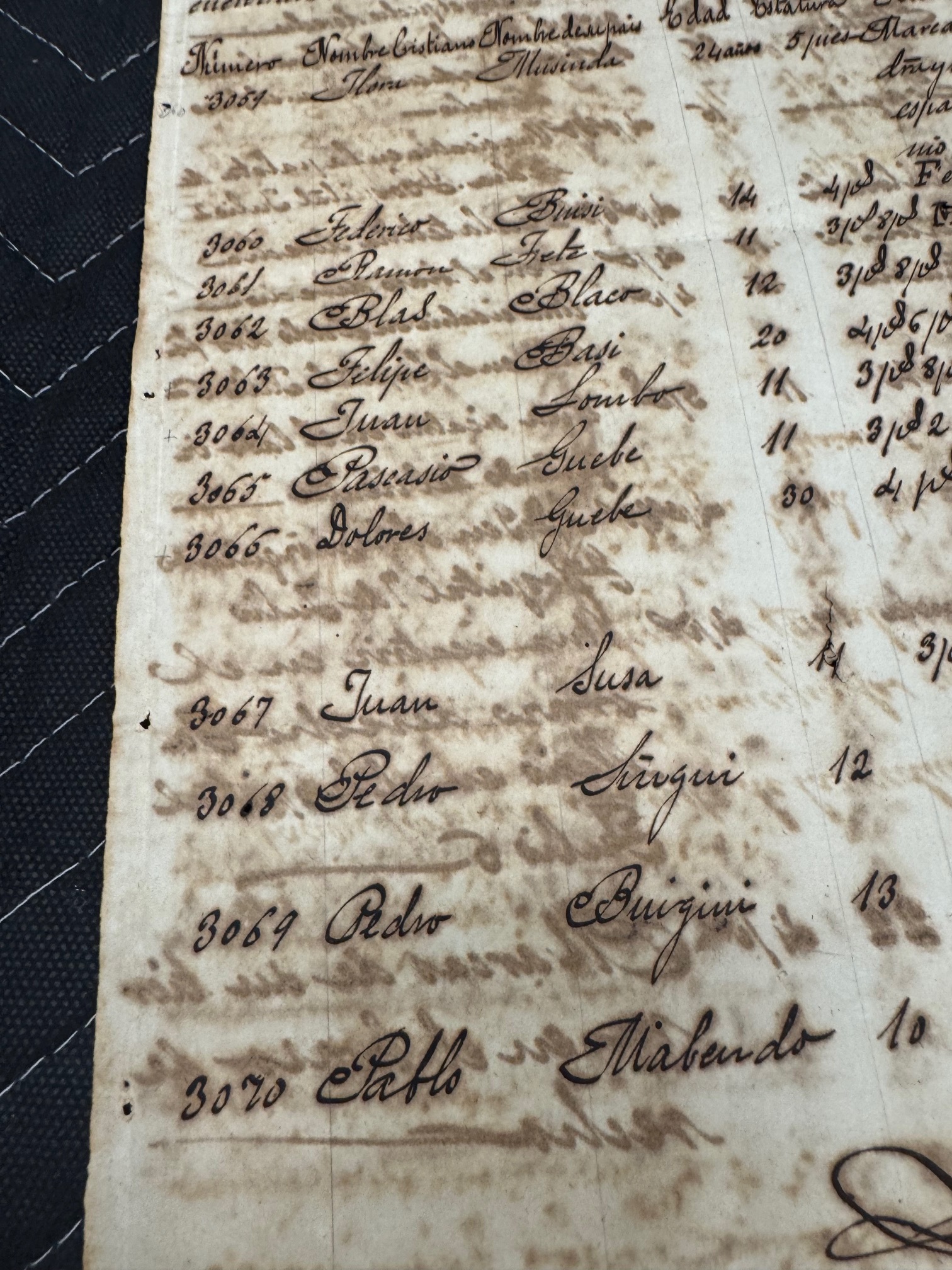
-- Documents written on parchment in 1868 detailing enslaved persons brought to Cuba five years before. The ledger includes Christian names, their age, condition and, most chillingly, the branding mark burned in their bodies. Visitors will learn the international slave trade continued until the late 1880s. (Picket photo, right)

-- A presentation on Confederate and Union monuments, including their locations.

-- Documents from the Maj. Henry Thomas Massengale collection. The Confederate States Quartermaster Bureau in Atlanta was responsible for manufacturing, procuring and transporting military supplies such as clothing, camp equipment, forage, and draft animals, to the Army of Tennessee before, during, and after the Atlanta campaign. Some of the notations are about enslaved persons, including one about a requisition for pants, drawers, shirts and hats for three. “The clothing is required for Negroes employed on the Fortifications that were confined in the Smallpox Hospital and their clothing had to be burned to prevent contagion.” The papers are available at the AHC's Kenan Research Center.

-- Personal items belonging to Capt. James Lile Lemon of the 18th Georgia. “He literally saved everything,” said Jones. Among the artifacts is a drum (photo at top of post) captured from two young Pennsylvania drummer boys on Sept. 16, 1862, the day before the Battle of Sharpsburg (Antietam). Lile later wrote about the capture of the boys by Pvt. Frank A. Boring:

"As he was driving them to the rear at point of bayonet they heaped so much abuse upon him - out of their fear or nervousness - that he had to be restrained from striking them with the clubbed musket. Of course, instantly the target of many wags among our company who joked with him about "scaring little boys" & etc. He replied that he would be d---d if he'd take such abuse from "d---d Yankee whelps." The boys were release & "beat a hasty retreat" back to their lines, with Boring giving them a rite hard look as they went."

-- A portion of the DuBose family Civil War dug relic collection is one of two never-before-exhibited relic collections to be included in the new exhibits. “These collections are comprised of approximately 50,000 artifacts recovered from the 1930s through the 1990s from Tennessee to Virginia, with special emphasis on the Atlanta area,” said the AHC. “They include Minie balls, shell fragments, bayonets, belt plates, gun parts and personal items of every description: the detritus of war left in and on the ground, often in our own backyards.” (Photo courtesy Atlanta History Center)

-- A fascinating lithograph copy of South Carolina’s ordinance of secession. Black troops with the 102nd USCT, mainly comprised of Michigan and Canadian men, seized it in March 1865 at a Charleston home. The Union troops listed four companies within the regiment.

They called the signed sheet a “scroll of treason.” (the original document is in the South Carolina archives). The AHC has a pistol that belonged to one of the White officers listed at the bottom.

Crucial to all this, Hale and Jones said, is being authentic and honest about artifacts and context. At a time of growing use of artificial intelligence and a distrust among many of museums, it’s important visitors know where items came from, said Hale.

Notation on copy of South Carolina secession document calls it a "scroll of treason" (Picket photo)

The aim is to be thought-provoking

Part of the exhibit will look at how the United States went from the Revolutionary War and subsequent conflicts to the Civil War, and what was resolved and what was not during those 80 years.

Some of the fractures continue today, said Jones, adding it is important to raise questions but let visitors make their own conclusions. “We want to change … the traditional ways we examined the Civil War.”

The AHC has utilized focus groups and feedback as it plotted the direction of the exhibit. Jones considers history professor Carolina Janney of the University of Virginia, historian and former president of the University of Richmond Ed Ayers and Cynthia Neal Spence, associate professor of sociology at Spelman College, among his mentors. Spence was featured in an AHC documentary about the legacy of Stone Mountain.

At the end of the day, compelling artifacts, context and interactive features will combine to entertain and educate, the AHC believes.

“We want them to say, ‘Dang, I never realized that,’” Jones said.

Wednesday, March 10, 2021

Robert Smalls became a hero for bold escape with other enslaved persons. An Army ship named for him travels to where it happened

Maj. Gen. Robert Smalls in Kuwait (US Army photo)
The first Army vessel named for an African American will sail next week to Charleston, S.C., the city where Robert Smalls commandeered a Confederate ship and became a hero to the Union cause.

At the start of the Civil War, the enslaved Smalls was a pilot on the steamship CSS Planter. On the morning of May 13, 1862, Smalls led the takeover of the ship by its slave crew, sailed past the harbor's formidable defenses and surrendered the vessel to the Union blockade fleet. His wife and children were among those on board who gained freedom.

The Maj. Gen. Robert Smalls LSV-8 -- which carries troops, equipment and supplies – has been with the Army since 2007. It has been reassigned to Hawaii and transferred from the reserves to active duty, Maj. Oliver Schuster, an Army spokesman, said in a statement to the Picket.

The voyage from Virginia via the Panama Canal will take about 34 days.

LSV-8 will be part of the 8th Theater Sustainment Command in Hawaii. The command is led by Maj. Gen. David Wilson, a Charleston native and Citadel graduate. Wilson, a member of the Class of 1991, is the first African American graduate from the Citadel to become a two-star general.

“This voyage is unique as it will be the only time a vessel named after a son of Charleston will be in Charleston while in a unit commanded by another son of Charleston,” Schuster said in an email.

Harpers Weekly article on Smalls' daring ride (Library of Congress)
The vessel is expected to arrive in Charleston on or about March 15, Schuster said.

The 8th Theater Sustainment Command saved LSV-8 from being decommissioned by bringing it to active service in Hawaii, he said.

Smalls, 23 at the time, was celebrated across the North for his daring ride to freedom and he served as a ship’s pilot for the rest of the conflict.

After the war, Smalls returned to his hometown Beaufort and bought his former master’s home. After serving in South Carolina’s Legislature, he was elected to the U.S. House of Representatives and served several terms.

The congressman fought against the disenfranchisement of black voters across the South, according to the American Battlefield Trust. He also fought against segregation within the military.

Robert Smalls' portrait on ship's bridge (U.S. Army photo)
Smalls died in 1915 at age 75.

The Maj. Gen. Robert Smalls LSV-8 was inducted into the Army’s water fleet at a commissioning ceremony in September 2007 in Baltimore.

"This is a great day, and one I will never forget," Freddy Meyer, great-great grandson of Smalls, said at the event.

"Maj. Gen. Smalls was a renaissance man -- an educator, a politician, a soldier, a businessman and a family man, and the Army could not have picked a better person to name this ship after."

Friday, February 24, 2012

Part 2: 'Forgotten hero' Octavius Catto pushed equality in Union army, society

War was on the horizon in Pennsylvania in June 1863. After a stunning victory at Chancellorsville, Gen. Robert E. Lee finally had found the opportune moment to put the Union army on the defensive.

In Philadelphia, and across the state, a call to arms was sounded. Volunteers for the militia were needed as gray legions marched toward the fields of southern Pennsylvania and an eventual fateful turn to Gettysburg.

“MEN OF COLOR. To Arms! Arms! NOW OR NEVER” read a large banner posted in downtown Philadelphia.

Fifty-five individuals placed their names at the bottom, among them O.V. Catto.

Just 24, Octavius Valentine Catto was a graduate and instructor at the Institute for Colored Youth. He had founded the Banneker Literacy Institute and was inducted into the Franklin Institute, a scientific organization. His many accomplishments included a stint as a professional baseball player.

The intellectual turned his attention to politics and public service. Catto, born in South Carolina to a Presbyterian minister, was determined to wage war on discrimination.

During that summer of 1863, Catto helped form a company of nearly 100 African-Americans.

“Answering the urgent call for volunteers as announced by the governor, they reported to the city arsenal for duty,” according to Andy Waskie, a Temple University professor who has written and lectured on Catto’s life and legacy. “They were uniformed and equipped and sent by train to Harrisburg to join the army. But the authorities there under General Couch ingloriously rejected the unit with the excuse that black troops were not authorized.”

Catto returned to Philadelphia and spent the next two years raising 11 African-American regiments for the Union cause. The units were organized at Camp William Penn, trained, equipped and sent to the front.

In 1864, Catto helped organize the Equal Rights League.

African-Americans at that time were not guaranteed the vote, and they did not have full access to the city’s street cars. Catto would devote the last few of his 32 short years to remedying those problems.

In 1870, an approved state amendment provided for African-American men to vote. Catto, a Republican supporter, actively campaigned for equality at the polls.

On Oct. 10, 1871, “voting transpired with acts of violence and intimidation,” Waskie told the Picket. “The police were in support of this. They were pushing black men out of line.”

An unarmed Catto was shot to death that tumultuous day, as he tried to stop the violence. Six years later, Frank Kelly, a white Democratic Party operative, was acquitted of the murder.

Catto became a martyr to the cause of equality -- only to slip into relative obscurity. A marker on his grave reads, “Forgotten Hero.”

Catto’s life story is finally drawing more recognition. The city is helping fund a statue in his honor and two ceremonies this weekend will recognize his sacrifice and service to the community. • (Related Picket article)

“Octavius Catto was not exceptional,” his great-great-nephew, Leonard Smith, told the Picket this week. “There were thousands of Octavius Cattos.”

Still, Smith feels pride in what his ancestor accomplished.

Smith, 68, said he principally learned from his grandmother about Catto and Catto’s father, William, whom Smith finds to be even more admirable.

“Civil rights has been a struggle in this country since the first landing and the first slave,” said Smith, a Williamsburg, Va., resident. “It did not start in the 1960s.”

The retired hospital administrator has done extensive research on his family, including those who helped in the Underground Railroad. Smith spoke with the authors of 2010’s "Tasting Freedom: Octavius Catto and the Battle for Equality in Civil War America.”

Service, Smith said, runs deep in his family.

“There is pride and a feeling you must have education and help others,” Smith told the Picket. “There are certain things that are ingrained.”

Storyteller Bob Branch, 58, is a historical re-enactor in Philadelphia who portrays Catto around town.

Two summers ago, he began working for Historic Philadelphia, an organization that interprets history and makes it relevant at several venues in the city.

“In school, the overwhelming (percentage of) black and white Philadelphians never heard of who he was,” said Branch, who grew up there.

“Each presentation I tailor to the audience. I will go the first person and dress as he would dress. I will intersperse direct quotes from Catto,” said Branch, who also makes appearances for other Philadelphia groups and churches.

Branch, an engineer, said he has a personal identification for the struggle for equality. His father, he said, was not allowed to play baseball for his school. Branch’s physics teacher in high school singled him out for “wasting time.” And a college professor did not think he was cut out for his eventual profession.

“I was free, but I wasn’t equal,” said Branch.

Younger people, especially, want to know why Catto was murdered.

“The question is, ‘How come we haven’t heard of him before?’ My answer is that history is quite often selective,” said Branch.

Despite gains made during and since Catto’s time, Branch said he remains concerned about equal access to education. And Smith cited economic inequities.

Saturday, Catto will be remembered in an annual wreath-laying ceremony and at the Union League, where the Pennsylvania National Guard will reissue a medal in his honor, to two Guard members who have exemplified remarkable public service.

Murray Dubin, co-author of “Tasting Freedom,” said Catto and others helped lead America’s first civil rights movement.

"I'd love to tell you that Martin Luther King knew about Catto and that's why he did what he did, but I can't prove that," Dubin told NPR in 2010. But it was the shoulders of Catto and dozens of other men and women "that Martin Luther King and Rosa Parks and Ralph Abernathy ... stood on top of."

Photo of Robert Branch as Octavius Catto, J. Holder for Historic Philadelphia, Inc. Wreath photo courtesy of Gen. George Meade Society