Showing posts with label flags. Show all posts

Sunday, June 21, 2026

For $18.63, you can sponsor an American flag and remember a soldier who fell at Gettysburg. The 7,000 flags will be on view in November

Eternal Light Peace Memorial on the battlefield (Gettysburg Foundation)
The Gettysburg Foundation is asking the public to sponsor a U.S. flag for $18.63 through “A Field of Remembrance,” a campaign to memorialize the 7,000 men killed at the battle.

The foundation, which supports the National Park Service at Gettysburg National Military Park, launched the effort earlier this month. The campaign runs through Veterans Day.

The field installation of 7,000 flags near Eternal Light Peace Memorial will be on view from Nov. 12 through Nov. 23.

“The field will reflect the estimated number of soldiers killed during the battle, while remembering all who were killed, wounded, captured or missing at Gettysburg,” totaling about 51,000, said the foundation.

Proceeds will support the Gettysburg Foundation's preservation and education work.

The flag installation and the David Wills Houses reopening in November are part of Gettysburg’s PA250 Adams County commemoration.

President Abraham Lincoln finalized his Gettysburg Address at the Wills residence (left, Library of Congress).

“One makes the human cost of the battle visible; the other returns visitors to the room where Lincoln shaped the words that have carried that cost forward ever since,” said the foundation.

Campaign participants may sponsor one or more flags, with tribute naming available at all levels. Sponsorships are now open here.

After the remembrance, the flags will be kept for flag-placing ceremonies, such as Memorial Day at Gettysburg National Cemetery.

Friday, February 6, 2026

This weekend's Civil War show in Dalton, Ga., features tons of relics and four lectures, including one on Confederate flags at Fort Donelson and Fort Henry

Guns and other collectibles at the 2018 show in Dalton (Civil War Picket photo)
Civil War historian and author Gregg Biggs will speak Saturday at the annual Chickamauga Civil War Show in Dalton, Ga., about Confederate flags flown during the Henry-Donelson Campaign in Tennessee.

The 31st edition of the annual firearms, artifacts and relics show at the Dalton Convention Center, 2211 Tony Ingle Parkway, takes place Saturday and Sunday. Mike Kent, who has been producing Civil War shows for 35 years, said vendors will set up items on about 450 tables.

Biggs is one of four speakers scheduled Saturday

Many Confederate flags were captured as Union forces under Brig. Gen. Ulysses S. Grant took Fort Henry and Fort Donelson in February 1862 and gained vital land and river areas in the Western Theater. About 13,000 Confederates were taken prisoner.

Biggs, a noted flag expert, told the Picket his afternoon program will cover three major flag patterns in use: The first national flag of the Confederacy, Virginia state flags used by Brig. Gen. John Floyd’s brigade, and the first use of the Hardee pattern flag by Brig. Gen. Simon Bucker’s division. (Hardee example at left is 3rd Tennessee in a private collection. It was captured by the 14th Missouri.)

Buckner designed the flag while in Bowling Green, Ky., in January 1862. Hardee pattern flags had a blue field and a circular or rectangular white center. They are most identified with units in the Army of Tennessee.

The units holding the forts were from Tennessee, Alabama, Kentucky, Mississippi, Texas and Virginia. Biggs’ talk will cover existing flags and captured flags that cannot be located today.

"None of the captured CS flags from Henry or Donelson were ever sent to the War Department, which makes tracking them difficult," Biggs told the Picket. "Some were sent home by Union officers and most of those remain missing today."

A few days after Fort Donelson fell, Clarksville and Nashville were captured; the latter the first capital of a Confederate state to go into Union hands.

The lectures Saturday are in Room 1-A on the lower level of the trade center. Seminars are for paying attendees only, said Kent.

Other speakers on the schedule

11 a.m.: Michael J. Manning, author of “They Fought Like Veterans:The Military History of the Civil War in the Indian Territory.” A summary of the book says the strife of the Civil War severely fractured the Five Civilized Tribes, splitting allegiances between the Union and the Confederacy. 

Noon: Historian and author Scott Sallee on the assassination of President Abraham Lincoln. He will present the theory that the killing had nothing to do with the Confederacy but, instead, the radical faction of the Republican Party and the highest levels of the U.S. government.

1 p.m.: Greg Biggs (see above)

2 p.m.: Fort Donelson expert and battlefield tour guide John Walsh will discuss photography during the Civil War. Walsh operates Fort Donelson Relics.

Relic shows are a major place for sellers, museum curators, authors, collectors and others to network.

Show hours are 9 a.m.-5 p.m. on Saturday and 9 a.m.-3 p.m. on Sunday.  Admission is $12 for adults; children 12 and under are free.

Wednesday, July 16, 2025

13th Alabama Infantry flag is back at Gettysburg for the first time since Pickett's Charge. Read all about its close call, intrepid color bearer, capture and conservation

13th Alabama flag (Alabama Archives); Pickett receiving orders from Longstreet at Gettysburg on July 3, 1863, and Confederate veterans at the grand Gettysburg reunion in 1913 (Library of Congress)
A half mile away from where it was captured – but not before its color bearer inflicted an ugly wound on a Yankee – the battle flag of the 13th Alabama Infantry is on display at Gettysburg for the first time since the July 1863 battle.

The regiment, part of Archer’s Brigade, suffered a staggering 62 percent casualty rate in the three days of fighting; many members were captured during Pickett’s Charge, where the flag was lost to the 1st Delaware Infantry near the Angle.

Gettysburg National Military Park is showcasing the flag at the visitor center’s main museum gallery until February 2027.

Cool to see this flag coming for a visit,” Civil War flag expert and researcher Greg Biggs told the Picket in an email.

The park reached out to the Alabama Department of Archives and History for the loan. The effort was assisted by the Gettysburg Foundation.

The flag has been at the Alabama Archives since 1905, when numerous Civil War flags were returned to states by order of President Theodore Roosevelt as a symbol of reconciliation. It was conserved in 1991 and, until this year, has only been on display at the Archives and Confederate Memorial Park, said Ryan M. Blocker, a curator at the archives.

Three veterans at Alabama soldiers' home in 1902 (Confederate Memorial Park)
Confederate Memorial Park in Chilton County, Ala., routinely displays Civil War flags, said site manager Calvin Chappelle. The park is on the site of a soldiers’ home that operated from 1902 to 1939. Several residents were veterans of the 13th Alabama.

“Each flag has a story to tell. It obviously it was very important to the men who fought underneath them,” Chappelle said of the rotating displays.

A provenance report on the flag provides compelling details on its near capture on the first day at Gettysburg and how it apparently was attached to a lance for the Rebel attack at the Union center on July 3, 1863.

“I think its survival in itself is significant,” said Blocker. “The flag has not been back to Gettysburg since 1863, and we were honored to partner with the curators at Gettysburg to temporarily return the flag to the site where Alabamians carried it through one of the most significant battles of the Civil War.”

This flag was a replacement crafted in Richmond

The 13th Alabama was formed in Montgomery in July 1861 and it joined the Army of Northern Virginia, where it took part in numerous campaigns in Maryland and Virginia, ending at Appomattox.

Made of wool bunting, this flag was issued to the regiment after it lost its flag at Antietam in September 1862. Biggs noted the flag was made by the Richmond Clothing Bureau, one of 14 Confederate quartermaster clothing bureaus.

The depot also manufactured shell jackets (right, Library of Congress)

The RCB contracted with a local painter, Lewis Montague, to stencil the regimental designations and battle honors onto flags.

Blocker said the 13th Alabama flag – which was conserved by Textile Preservation Associates -- is in “good, exhibitable” condition. The artifact is mostly intact, with about 5 percent of its fabric missing.

There is some insect damage in the wool and accumulations of soil from exposure to a polluted environment, possibly a coal or oil-heated atmosphere,” she said in an email.

Before conservation, the flag exhibited sharp crease lines from being folded for many years. Crease lines can develop into weak points over time, Blocker said. If left unaddressed, the fibers would have broken, leading to additional damage.

Color bearer took a stab at bluecoat foe

13th Alabama is part of the Fry command at left center; click to enlarge (Hal Jespersen / Wikipedia)
The 13th Alabama was at Gettysburg from the battle’s beginning. Its brigade tangled with the Federal Iron Brigade at Willoughby Run.

“As the fighting intensified, Federal troops appeared on the regiment’s right flank, resulting in the capture of approximately 100 of its soldiers and forcing the remainder back across the run,” says a National Park Service article about the exhibit at Gettysburg. “Before the withdrawal, however, Private William Castleberry tore the 13th Alabama Infantry’s battle flag from its staff, saving it from capture.”

On July 3, regimental commander Col. Birkett Davenport Fry (right) noticed the flag bearer had attached a “formidable looking lance head to this staff,” according to the provenance report.

The condition of this flag indicates that at the time Castleberry tore it from the staff on July 1, the leading edge was ripped, tearing away the two top eyelets, leaving only one by which the flag could be attached to a staff. “So, what Colonel Fry apparently saw was the flag of the 13th Alabama Infantry attached to a lance which had been used to replace the missing staff,” the provenance report says.

The 13th Alabama pushed to the front of the doomed Confederate assault and the flag was carried by multiple bearers. The 1st Delaware captured it and two other flags. A total of 38 flags from 50 Rebel regiments were seized at Pickett’s Charge.

Pvt. Bernard McCarren of Company C, 1st Delaware Infantry, was credited with the capture of the flag of the 13th Alabama Infantry and he received the Medal of Honor the following year.

Fry, who lost a leg in the charge and was taken prisoner, later said he encountered a Federal soldier with a serious shoulder wound from the lance.

The flag was eventually forwarded to the U.S. War Department, where it was assigned Capture Number 60.

Handwritten words across the top of the artifact say, “Confederate Flag of the 13th Alabama Reg. Captured by Company C. 1St Del. Vols.” The center star bears the inked inscription: “captured by Co. C., 1st Delaware Volunteers Regt., Gettysburg Pa., July 3d 1863.”

These graybeard Alabamians attended reunion

The 13th Alabama flag was on display at the 102-acre Confederate Memorial Park from 2021-2022.

The park, which the state opened during the Civil War centennial in 1964, contains the site of the original veterans home and other historic structures, as well as a museum, research facility and two soldier cemeteries.

13th Alabama flag while on display in Chilton County, Alabama (Confederate Memorial Park)
Chappelle, the site manager, told the Picket the park typically displays a few flags from the Alabama Archives on a rotating basis. Currently on display are ones for the 18th Alabama, Hilliard’s Legion and the Rifle Scouts.

Five soldiers from the soldiers’ home attended the famous Gettysburg 50th reunion in 1913. Two served in the 13th Alabama, notably Capt. James M. Simpson, head of the home. He was wounded during Pickett’s Charge.

Confederate Memorial Park, in a Facebook post last year, quoted a June 25, 1913, article in the Montgomery Advertiser, Simpson was "very much gratified over the prospects of such a happy reunion at Gettysburg. Monday morning before the reunion begins, Captain Simpson has an engagement to meet old comrades at Reynolds’ monument on the battlefield at Gettysburg, the spot where they entered the great fight."

There is no evidence the 13th Alabama flag was brought to Gettysburg for the reunion, Blocker said.

“There may have been a sense of reunion, but not complete reconciliation or equality. Regardless, it was a start to the long process that we are perhaps still enduring today,” Confederate Memorial Park said on social media.

James M. Simpson was commandant of the home from 1906-1916 (Confederate Memorial Park)
Among the residents at the Alabama home was Pvt. Oscar Williams, who served with the 6th Alabama, which suffered heavy casualties at Gettysburg.

A database about the soldiers, created by Chappelle and late park director Bill Rambo, says Williams was “the toast of veterans” at a reunion, according to a 1911 Montgomery Advertiser article. That’s because he was shot twice on July 2 at Gettysburg while carrying the colors of the regiment.

It was apparent then, as in any conflict, a unit’s flag elicited much pride and emotion.

Flags need time to rest for a few years

While the 13th Alabama flag wasn’t back at Gettysburg until earlier this year, the 5th Alabama’s did pay a visit in 2009 during a meeting of the Artist Preservation Group. The Montgomery, Ala., chapter of the organization helped fund that flag’s conservation.

“Our chief curator at the time drove the flag up to the conservator, passing through Gettysburg. The flag was displayed temporarily at the Gettysburg convention center during the convention,” said Blocker.

Photo of the 13th Alabama flag during conservation (Alabama Dept. of Archives and History)
I asked the curator about how often the 13th Alabama flag has been displayed. She described how the archives came to protect them from light, heat and humidity.

When the Archives moved to its current location in 1940, these flags were exhibited in cases lining the hallways of the second floor. In the 1980s, the flags were removed from display and placed in storage to assess their condition, Blocker wrote.

A flag conservation program was established in the early 1990s, and the 13th was sent for conservation in 1991. After its conservation, it was featured in the “Tattered Banners” exhibit at the Archives, which was on display until the early 2010s. Flags in this exhibit were rotated in and then out as new flags underwent conservation.

“Our policy on displaying flags has evolved over time as our understanding of best practices for the storage and display of textiles has improved,” Blocker said. ”We aim to limit the duration that a flag is loaned or displayed to a maximum of two years. The conditions for display are very specific; for example, light levels must stay within certain foot-candle measurements, and temperature and humidity must remain within defined parameters.”

Union veterans (background) at Gettysburg face Confederate men in 1913 (Library of Congress)
After a flag is displayed, it rests for several years before being exhibited again.

After its time at Confederate Memorial Park, the 13th Alabama flag rested until earlier this year, when it was shipped to Gettysburg. “While the timeframe was shorter than our regular practice would allow, we thought it was a good opportunity for the flag to make its return to Gettysburg,” said Blocker.

She and other curators and conservators stress the condition of a flag helps tell its story. So the focus is on conservation and preservation, rather than restoring them to their original state.

“The flags reveal the harsh realities of war; some have holes where shrapnel has torn through, and others have whole sections of the flag missing. These holes and marks are an integral part of the flag's history,” said Blocker.

Thursday, May 1, 2025

First on the Picket: Compelling artifacts and technology acquired in recent years will tell a bigger story in an Atlanta History Center exhibition opening next year. The aim is to get you to think about what the Civil War meant then -- and its impact today

The Atlanta History Center
is closing a longtime Civil War exhibit to make way for two new galleries that will feature breathtaking artifacts and a broader discussion of issues that engage the republic to this day: our belief systems, victory, defeat, reconciliation and the evolving meaning of freedom.

Atlanta, museum officials say, is ideal to tell a bigger national story about the Civil War in a striking way. Beyond being the capital of the South and a melting pot, it’s recognized by historians as a crucial battleground for saving the presidency of Abraham Lincoln and the United States itself.

For 30 years, relics collected by an Atlanta father and son formed the core of “Turning Point: The American Civil War.” The exhibit focused on the soldiers in blue and gray and how they did their deadly work, and visitors were awed by the incredible collection of uniforms, weapons, personal items -- and just about every conceivable type of artillery shell.

While “Turning Point” did address some big questions about the Civil War, there was limited discussion on technology, slavery and the home front. New, more diverse generations – distanced even more from the Civil War era – are asking deeper questions, the museum says, about why the war happened, how 4 million enslaved Americans gained their freedom, Reconstruction and what the conflict, which took at least 720,000 lives, means today.

Sheffield Hale with Union 20th Corps wagon that traveled near what is now the AHC (Picket photo)
“Thirty years ago, we (had) white, middle-class older folks,” Gordon Jones, the AHC’s senior military historian and curator, told the Picket about the exhibit’s key audience at the time. “We are a changed city. Demographics have changed. Our audience asks different questions.”

The history center is investing $15 million and more than 15,000 square feet for the new exhibition, which has not been formally named. It is expected to open in summer 2026, when the AHC marks its centennial.

“Turning Point” will close on May 25, but Civil War aficionados can still get their fix during construction with the giant Cyclorama painting of the Battle of Atlanta, related exhibits and the locomotive Texas, one half of the famous “Great Locomotive Chase” in 1862.

Jones came to the history center in early 1991 and cataloged the vast artifacts collection of Beverly M. DuBose Jr., whose name is on the current gallery. The collection became the basis for much of “Turning Point," which now has an outdated feel.

Flags and other items in the current "Turning Point" exhibit (Picket photo)
The curator could not conceive in the early 1990s what the internet and online auctions would mean for the history center, which has since purchased scores of artifacts, many of which will be displayed for the first time in the exhibition.

“More is better. It’s what gets people excited,” said Jones. “Artifacts are what speak to you emotionally, through your heart.”

Two flags and messages they sent to formerly enslaved

Make no mistake, Confederate and Union bayonets, swords, flags, rifles and revolvers will still be a big part of the presentation. To that end, Jones and AHC CEO and president Sheffield Hale are excited about plans to include two large collection of dug relics.

But they are particularly excited about the artifacts related to U.S. Colored Troops. The impetus for that came about in 2019, when the history center bought a hand-painted flag made for the 127th USCT infantry. It depicts a soldier waving farewell to Columbia, a symbol of the United States, with the words “We Will Prove Ourselves Men.”

“It’s an iconic knock-your-socks-off artifact,” Jones (At left in Picket photo) said at the time. Even an enlisted man’s USCT uniform wouldn’t be as historically significant as this flag.”

There’s another flag (top photo of this post) the curator said will be his favorite item in the new exhibit.

Most of the American flag is long gone, save for the 34 stars and upper-left canton. It flew over a camp on Craney Island near Hampton Roads, Va., that protected escaped slaves, whom Jones said were active in their liberation. The camp operated for just over a year before closing in September 1863; it was one of dozens of such camps in southeast Virginia housing an estimated 70,000 formerly enslaved people, according to the AHC. The tattered flag, which originally was 10 feet tall by 20 feet long, is undergoing conservation for display.

While the flag for the 127th USCT largely symbolized pride and duty, this one was a symbol of freedom, welcoming those who arrived safely after a dangerous journey.

 “If I get to that flag, I get my freedom, Jones said a refugee might think. “The choice to whom I can marry, to find my family.”

A closer look at the fascinating 'new' artifacts

I met Monday with Hale and Jones to talk about the new exhibition, which officials say will be heavy on “cutting-edge technology and immersive storytelling” and the benefits of newer scholarship. (Afterward, Jones showed me several artifacts in a storage area in the building’s basement)

They outlined some of what visitors will see in the galleries and other items in the center's vast collection. Below is just a smattering of what we discussed:

Patent for Morse breech-loading firearm (Atlanta History Center)
-- The downstairs Goldstein gallery, which is empty, will focus on technology and the Civil War. In part, it will feature the singular collection of the late George W. Wray Jr., showcasing some of the rarest Confederate firearms, swords, uniforms, flags and other items. Some were one of a kind. When it went on temporary display in 2015, the theme was the weapons were an attempt by a slave-based society to fight an industrial war. The South was hampered by limited manufacturing and the Union blockade of foreign goods.

-- A projection on one wall will feature a timeline of the war, key moments and maps, Hale said. The AHC will display elements of its interactive “War in Our Backyards” collaboration with The Atlanta Journal Constitution about 10 years ago.

-- Utilizing an online database about the Atlantic slave trade, the former DuBose space will feature an animated screen showing their routes, destinations and other details.

Gordon Jones with 18th century British blunderbuss (Picket photo)
Two items will show the connection of the U.S. slave trade and the practice elsewhere:

-- One is a circa 1750s short-barreled firearm, or blunderbuss, made by the John Whately family in England. The European slave cartel traded guns for enslaved persons along the West African coast. It was typical for the buyers to supply weapons, iron bars, printed cloth and other metals as part of the barter. "This one is extremely lightweight, cheaply made, and incredibly rare to find in this condition," said Jones, who believes this one may have been a sample weapon. 

“It was just rotten and evil from the start to finish,” the historian said of the slave trade.

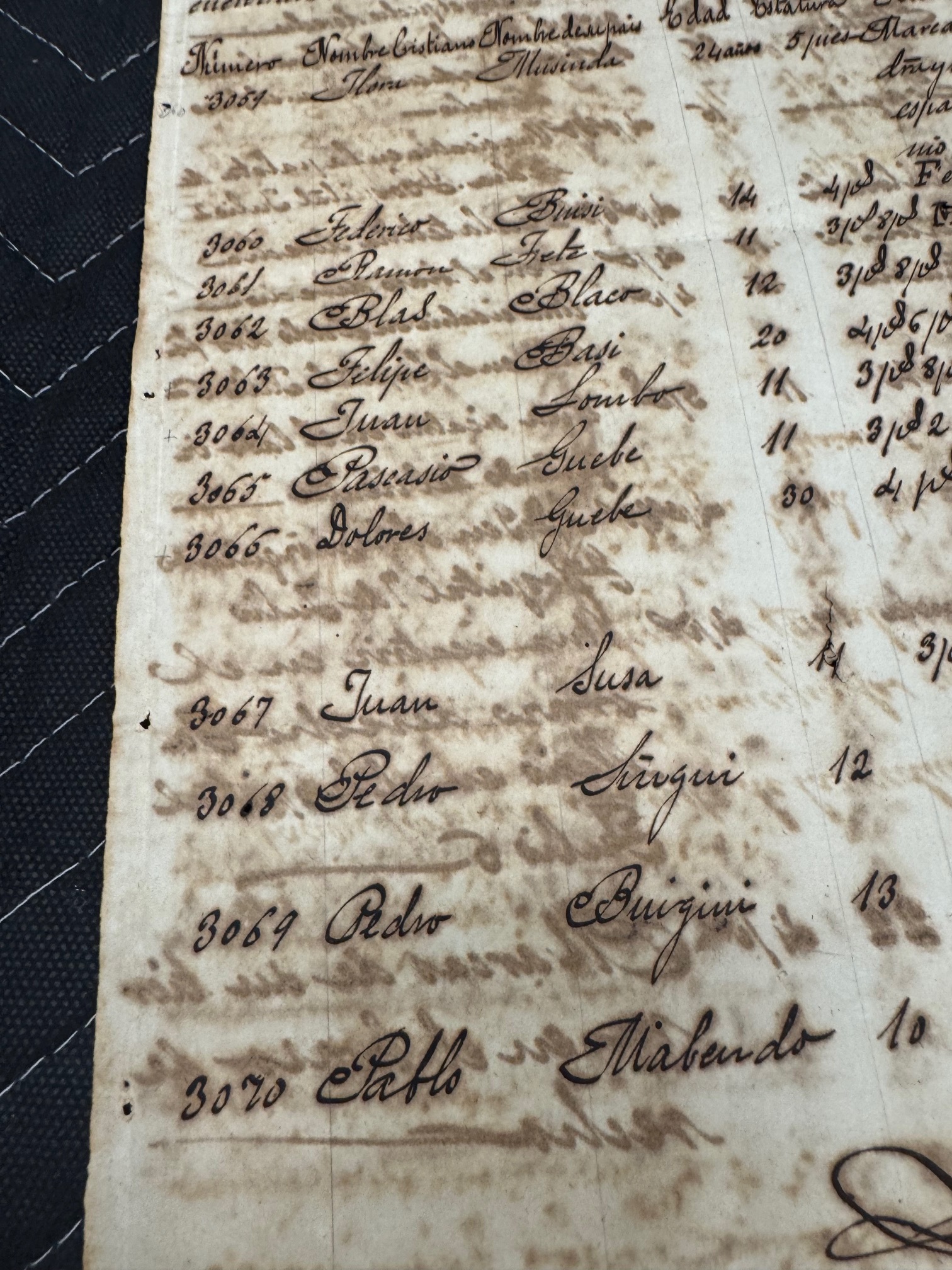
-- Documents written on parchment in 1868 detailing enslaved persons brought to Cuba five years before. The ledger includes Christian names, their age, condition and, most chillingly, the branding mark burned in their bodies. Visitors will learn the international slave trade continued until the late 1880s. (Picket photo, right)

-- A presentation on Confederate and Union monuments, including their locations.

-- Documents from the Maj. Henry Thomas Massengale collection. The Confederate States Quartermaster Bureau in Atlanta was responsible for manufacturing, procuring and transporting military supplies such as clothing, camp equipment, forage, and draft animals, to the Army of Tennessee before, during, and after the Atlanta campaign. Some of the notations are about enslaved persons, including one about a requisition for pants, drawers, shirts and hats for three. “The clothing is required for Negroes employed on the Fortifications that were confined in the Smallpox Hospital and their clothing had to be burned to prevent contagion.” The papers are available at the AHC's Kenan Research Center.

-- Personal items belonging to Capt. James Lile Lemon of the 18th Georgia. “He literally saved everything,” said Jones. Among the artifacts is a drum (photo at top of post) captured from two young Pennsylvania drummer boys on Sept. 16, 1862, the day before the Battle of Sharpsburg (Antietam). Lile later wrote about the capture of the boys by Pvt. Frank A. Boring:

"As he was driving them to the rear at point of bayonet they heaped so much abuse upon him - out of their fear or nervousness - that he had to be restrained from striking them with the clubbed musket. Of course, instantly the target of many wags among our company who joked with him about "scaring little boys" & etc. He replied that he would be d---d if he'd take such abuse from "d---d Yankee whelps." The boys were release & "beat a hasty retreat" back to their lines, with Boring giving them a rite hard look as they went."

-- A portion of the DuBose family Civil War dug relic collection is one of two never-before-exhibited relic collections to be included in the new exhibits. “These collections are comprised of approximately 50,000 artifacts recovered from the 1930s through the 1990s from Tennessee to Virginia, with special emphasis on the Atlanta area,” said the AHC. “They include Minie balls, shell fragments, bayonets, belt plates, gun parts and personal items of every description: the detritus of war left in and on the ground, often in our own backyards.” (Photo courtesy Atlanta History Center)

-- A fascinating lithograph copy of South Carolina’s ordinance of secession. Black troops with the 102nd USCT, mainly comprised of Michigan and Canadian men, seized it in March 1865 at a Charleston home. The Union troops listed four companies within the regiment.

They called the signed sheet a “scroll of treason.” (the original document is in the South Carolina archives). The AHC has a pistol that belonged to one of the White officers listed at the bottom.

Crucial to all this, Hale and Jones said, is being authentic and honest about artifacts and context. At a time of growing use of artificial intelligence and a distrust among many of museums, it’s important visitors know where items came from, said Hale.

Notation on copy of South Carolina secession document calls it a "scroll of treason" (Picket photo)

The aim is to be thought-provoking

Part of the exhibit will look at how the United States went from the Revolutionary War and subsequent conflicts to the Civil War, and what was resolved and what was not during those 80 years.

Some of the fractures continue today, said Jones, adding it is important to raise questions but let visitors make their own conclusions. “We want to change … the traditional ways we examined the Civil War.”

The AHC has utilized focus groups and feedback as it plotted the direction of the exhibit. Jones considers history professor Carolina Janney of the University of Virginia, historian and former president of the University of Richmond Ed Ayers and Cynthia Neal Spence, associate professor of sociology at Spelman College, among his mentors. Spence was featured in an AHC documentary about the legacy of Stone Mountain.

At the end of the day, compelling artifacts, context and interactive features will combine to entertain and educate, the AHC believes.

“We want them to say, ‘Dang, I never realized that,’” Jones said.

Sunday, December 22, 2024

Our flag was still there: 'The Demon of Unrest' brings attention to the march to war, Fort Sumter's brave commander and the return of Old Glory after Union triumph

Souvenir from April 1865 flag-raising (Courtesy Glen Hayes), Peter Hart puts flag back up during 1861 bombardment
If you look closely at the illustration on the dust jacket for Erick Larson’s “The Demon of Unrest,” you will notice something small, but colorful at dead center. The object is surrounded by Fort Sumter’s brick walls, flames and smoke and the bright streaks of incoming artillery fire.

It's the U.S. flag flying defiantly as garrison commander Col. Robert Anderson and his soldiers bravely withstand the furious Confederate bombardment that launched the Civil War in April 1861. Anderson felt not only the burden of defending the bastion, but also safeguarding the American flag. He surrendered only after his supplies were depleted, parts of the interior were on fire and his exhausted, outnumbered troops could not carry on.

I read Larson’s compelling book a couple months back and thought back to two posts I have written about the National Park Service taking three historic Fort Sumter flags off display last year to give them time to rest from exposure to light. Among them is the 20-foot-by 10-foot storm flag, which flew during the 34-hour bombardment.

As Larson recounts, Anderson told Confederates hours before the attack he would not fire “unless compelled to do so by some hostile act against this fort or the flag of my Government."

Some members of the flag-removal team in front of the storm flag at Fort Sumter (NPS photo)
Rebel batteries, naturally, took aim at the storm flag, which has 33 stars, once the early-morning assault began, and they eventually brought it down.

“A ball or shell shattered its staff and the great flag collapsed into the smoke below. ‘Then arose the loudest and longest shout of joy – as if this downfall of the flag, with its cause, was the representation of our victory,’ Southern firebrand Edmund Ruffin wrote in his diary,” Larson writes.

The flag, to the Union garrison, was “a tactile representation of nationhood” and must be made to fly again. (Robert Anderson, left)

“Sumter’s unofficial infantryman, Peter Hart, the New York City police officer who had accompanied Anderson’s wife on her surprise visit to the fort, set off through the smoke and fire and came back with a long spar to replace the shattered flagstaff,” Larson writes. “Hart also retrieved the flag and nailed it by its edge to the spar. He then fixed the spar to a gun carriage on the parapet level, all this while fully exposed to Confederate fire. Once again the wind caught the flag. It did not fly as high as it had, but at intervals wind gusts created temporary clearings that revealed the flag gamely flying amid striations of smoke.”

Confederates treated Anderson and his men honorably after the surrender, and he took the storm flag with him. It immediately became a patriotic symbol for the remainder of the conflict and raised the status of the Star-Spangled Banner to what we know today. Anderson was treated as a hero in North.

As Military Images publisher Ronald S. Coddington wrote, Anderson later told an acquaintance of the flag: “I knew that it would never come down in disgrace.”

In a twist of fate, Anderson, a retired general, returned to Charleston at war’s end to raise the flag again over the battered fortress (more about that below). An aside: Visitors to the fort today who take the first boat river over in the morning can help rangers raise the U.S. flag.

Q&A with Fort Sumter staffer about impact of book

I recently asked Brett Spaulding, chief of interpretation for Fort Sumter and Fort Moultrie National Historical Park, about the renewed interest on the site brought by “The Demon of Unrest.” (At right, damaged flagpole after Confederate bombardment, Library of Congress)

Q. I am curious as to what kind of attention or questions the book has posed to rangers at the park. Do guests or historians bring up particular aspects of the book's scholarship?

A. “The Demon of Unrest” is frequently mentioned by visitors to Fort Sumter as a reason for their interest in visiting our site. Common questions are about the mindsets of the major players of the pre-Civil War standoff – the courage and inner conflict of Major Robert Anderson, and the march to war among both hardcore secessionists and typical white Charlestonians.

Q. Did the park provide any resources or materials for Larson? Did the staff learn new things from the book that might be helpful with interpretation?

A. Fort Sumter & Fort Moultrie NHP was not involved in the research or writing of “The Demon of Unrest”, though writer Erik Larson visited the fort in the spring of 2024. The book reinforced existing research on the environment of pre-war Charleston, and helped visitors make connections between influential “fire-eater” secessionists and the crisis at Fort Sumter.

Q. The storm flag in particular: Have you learned anything new about it? What details does the park have on its status and location during the bombardment?

A. The book, unfortunately, gives an inaccurate impression of which of our historic flags flew during the bombardment. On page 10, Larson refers to Anderson, within an hour of the bombardment, raising a flag “twenty feet high by thirty-six long” over Fort Sumter. However, a New York Times article dated May 21, 1861, citing conversations with Major Anderson, specifically states that Anderson flew the smaller of his two flags. The smaller of the two flags in our collection, the storm flag, measures ten by twenty feet and was the original flag that flew during the bombardment. Based on historic images of the fort, we believe the flagpole’s original location to be near the left flank of the fort, not far from the fort’s modern-day entrance. (The larger garrison flag was taken down shortly before the bombardment and replaced by the sturdier storm flag.)

Storm flag, top, garrison flag and the Confederate Palmetto Guard flag (NPS)
Q. The Palmetto Guard flag -- Have you learned anything new about it? Did Edmund Ruffin carry it into the fort and hold it during Anderson's surrender? Do you have any idea where it was made and when?

A. We do not have further information on the origins of the Palmetto Guard flag. The earliest citation we have found for it is The New York Times article of December 1, 1860.

Edmund Ruffin’s presence in the Palmetto Guard is backed up by the historical record. We do not have evidence to dispute that the Guard chose to let Ruffin bear the flag – he was a well-known secessionist leader and had been given the honor of firing the first shot from their battery. Contemporary accounts do place Ruffin in the fort on April 14, the day of the ceremony.

Q. Can you please tell me where all three flags are currently being stored, and in what fashion (tube, flat, etc.)? (At left, one of the flags being removed in 2023, NPS photo)

A. The Palmetto flag and the storm flag are both stored in our curatorial facility. The garrison flag is stored in a trusted specialty art storage facility in Texas via government contract due to its immense size and more fragile nature. All three flags are stored and were professionally packed by a team of conservators, museum staff and art movers. The flags are interleaved with and wrapped with archival materials and are stored rolled an archival tube for preservation purposes. 

Q.  I know the Harpers Ferry Center experts have said they all will need some kind of work, mounts, repairs, new frames, etc. at some point. Has any of that work begun, or is it too early?

A. The garrison flag specifically has been identified as needing additional conservation work. Plans for this work have been prepared but will not go into effect until the permanent home for this flag is ready (this includes facility and exhibit renovations). This is to ensure the flag is packed and moved as few times as possible while it transitions from its current storage unit to the conservation lab, and finally to its permanent home. We are currently speculating that this work may be able to be scheduled in approximately three years.

Q. How long do you think each banner will be kept in the dark, so to speak?

A. Currently, the answer to this question is uncertain. The park does not plan on returning any flags to exhibit at Fort Sumter specifically due to the difficulty with accessing this site in the event of an emergency, and the higher difficulty with safely moving the flags to and from this site. The flags could go on exhibit at other sites and through other means. The most likely involves ongoing plans for a redesign of exhibit spaces at Liberty Square. 

Q. Has any decision or further discussion been had on the fate of the three flags?

A. Discussions about the flags are active and ongoing. The park is devoted to ensuring that all flags are properly cared for and stored. The garrison flag has been the largest point of discussion and planning since it is the only flag currently off site and in need of conservation. The Palmetto and storm flags are both stable, and their future plans will be determined when exhibit renovations are scheduled and planned.

POSTSCRIPT: Collector has flag-raising relic

Storm flag (waving behind white pole) about to be raised in 1865 (Library of Congress)
Glen Hayes of New York has collected Gettysburg artifacts and memorabilia for about 57 years (more on that in a future post), but he also has a few Fort Sumter-related items.

The most prominent is a souvenir from April 14, 1865, when Anderson, 59, and his son returned to the fort to again raise the storm flag he took with him in 1861. In June 2023, Military Images magazine wrote about ferns, loose flowers and bouquets that had been placed near the flag before its raising, a symbol of a restored union.

Hayes bought the relic that features mounted remnants of the flora and a portrait of Anderson and an uncommon photograph taken inside the fort that day, showing the large flag attached to two poles decorated with bunting.

The Military Images article states Anderson cried and told the large crowd that it had been “the cherished wish of my heart” to restore the flag to its rightful place. With him was Peter Hart, the man who reattached the flag during the bombardment four years before.

Photo of Robert Anderson by Brady (Courtesy Glen Hayes) / Storm flag (Library of Congress)
“With the reading of Psalms concluded, Hart stepped forward carrying a mailbag that contained the original flag, nail holes and all. At this the crowd broke into a tumult of cheers. Three Navy sailors attached the flag to a halyard; they added roses, mock orange blossoms, and an evergreen wreath,” wrote Larson.

Hayes told the Picket in an email he bought the item from a relic dealer in about 1981. The caption reads: “Some of the leaves & ferns that fell from the boquet on the flag raised in position from where the Confederates made us take it down at Fort Sumpter SC in the Civil War. 1865”

The maker of the collage is not known.

“I purchased it because it was a good example of the end of the Civil War. Also, the relic is what you would call a ‘silent witness’ to the events of that day,” Hayes said. “Also, because it had the uncommon scene of the actual flag as it was being raised. It is ironic looking at the picture and seeing all the happy people in the photo, they not knowing that that evening Pres. Lincoln would be assassinated. Also, that Lincoln had been invited to the ceremony but couldn't attend. How history could have changed if he went.”

Gun tool for Austrian weapon (Courtesy Glen Hayes)
Hayes years ago acquired a piece of wood from the Star of the West, a vessel Confederates fired upon in January 1861 when it attempted to supply the Federal garrison, an episode thoroughly documented in “The Demon of Unrest.”

The other item is a gun tool for a model 1854 Austrian Lorenz rifle. “Both sides used that rifle but seeing how the Confederates occupied Fort Sumter for 4 years it was probably from a Confederate soldier,” Hayes told the Picket.