Showing posts with label wagon. Show all posts

Sunday, September 7, 2025

Artifacts in the round: Archaeologists provide fascinating conservation update on shattered wagon wheel, Confederate munitions found in S.C. river cleanup

Wheel before treatment began and in shower stall more recently for cleaning, 6-pounder and 12-pounder shells (SCIAA); George Barnard photo of damage in Columbia after the Civil War (Library of Congress)
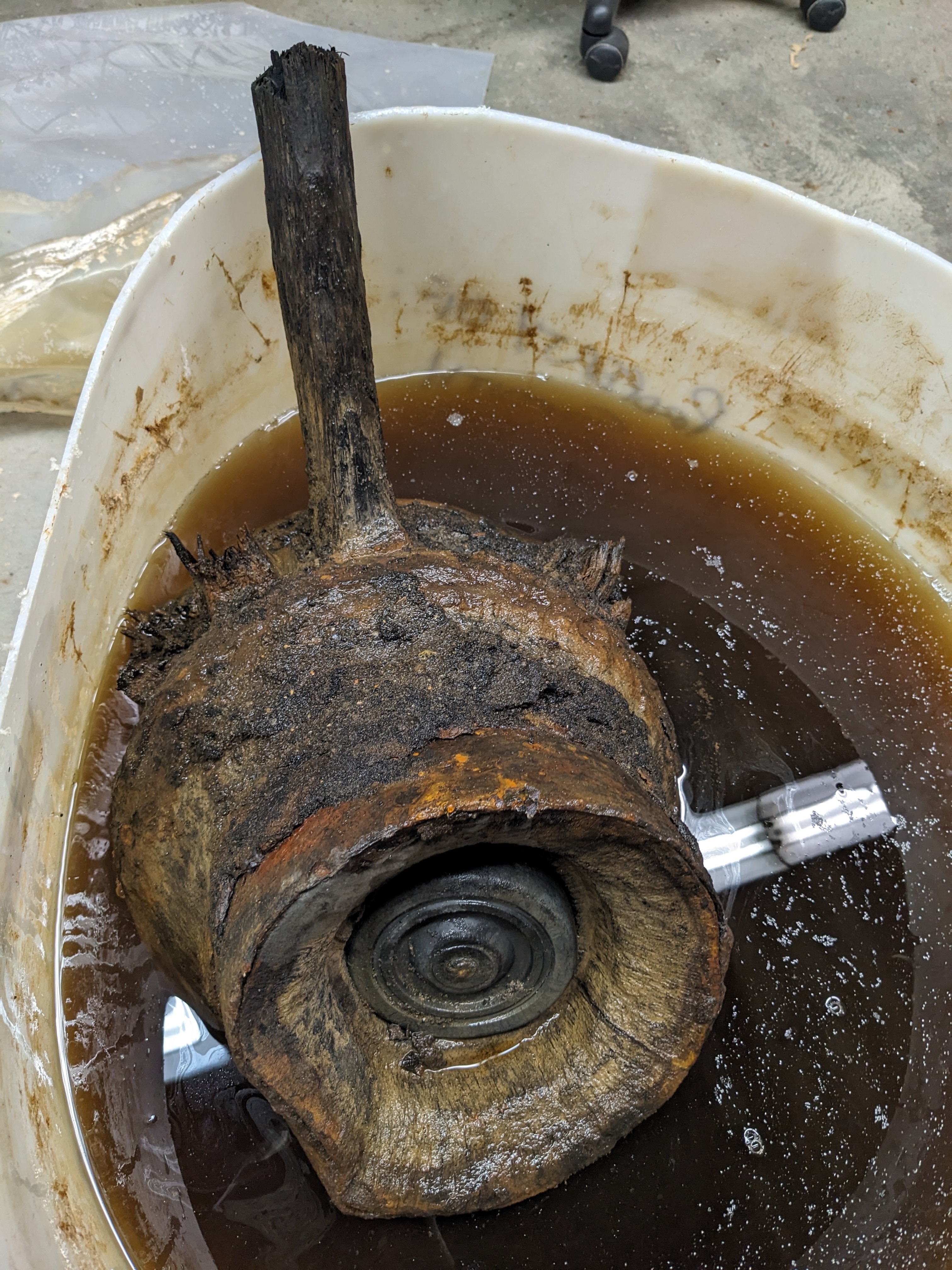
Maybe it’s just me (it probably is), but an unusual Civil War artifact undergoing conservation in Columbia, S.C., looks like a king crab or spider with a few of its legs missing.

There, I said it.

I have been fascinated by the remnants of a wagon wheel believed destroyed on Feb. 19, 1865, when Federal forces sacked the South Carolina capital and dumped captured Confederate ammunition and materiel into the Congaree River.

A metal detector first noticed the round object buried in the bed of the Congaree. Archaeologists surmised it was a just another rubber tire -- one of many found during an extensive river cleanup a few years back. More than 500 Civil War-related artifacts were recovered during the project, and this is among the most unexpected.

Jim Legg, public archaeologist for the 
South Carolina Institute for Archaeology and Anthropology (SCIAA), this month provided an update to the Picket on the conservation of the artifact and other pieces, none of which were believed to be fired. (At right, a sample of grapeshot and canister, SCIAA photo)

Hundreds of items emerged in 2022 and 2023 as crews removed century-old coal tar along the Congaree shoreline. Since then, Legg’s office and TRC Companies, a subcontractor for Dominion Energy, have been working to conserve items with a wide range of dates.

The completed military part of the collection will go to South Carolina Confederate Relic Room and Military Museum in Columbia for eventual exhibit.

The wheel hub, which has evidence of charring, will take at least another year to preserve. Archaeologists did not find any other wheels, metal hubs or large pieces of wood near the artifact.

“I have always thought the wheel was from (an) explosion. One thing that threw it off was that black rubber disk in the middle of the hub (left, TRC companies photo),” Legg wrote in an email.

"I finally just took it out to see what it was, and found that it was the rubber wheel from a 20th century kid's wagon. Either it floated into that location, or maybe one of the EOD (explosive ordnance disposal) guys picked it out of the junk pile and dropped it in there. It was a perfect fit.”

Even with that oddity, Legg is comfortable calling the fragment a casualty of Maj. Gen. William T. Sherman’s troops.

The features are consistent with a 1860s wagon wheel and it was found where at least one heavy wagon was blown to pieces.

“There is no record of any guns or gun carriages being destroyed/dumped in the river,” he added.

Something blowed up real good at river

Federal troops threw Confederate war materiel into the river after they took what they wanted before marching to North Carolina. Much of the state capital went up in flames, from a variety of sources, after its surrender.

Sean Norris, program archaeologist for TRC Companies, previously said of the wheel:

William Waud depiction of the burning of Columbia in 1865 (Library of Congress)
“The official records mention the explosion and the destruction of a wagon and a team of mules in a couple correspondences. It seems possible that what was left of the wagon after it was destroyed was thrown in the river along with everything else that was being dumped. There would be no specific reason for the wagon parts to be discarded elsewhere.”

The wheel at first was treated in a basic solution at the Relic Room before Legg moved it to his laboratory. Most of the recovered iron items considered the most important have been conserved.

The wheel has presented some challenges

Legg keep the wheel fragment in a shower stall for about a month during rinsing and hand cleaning. The artifact then went into a small tank, where it is undergoing polyethylene glycol (PEG) treatment for about another year.

“For size comparison this thing appears to be the same size as those seen on the NPS field artillery carriages -- fairly massive,” Legg wrote. In any case, they are the same basic design as a heavy wagon wheel hub.” (A gun carriage wheel at Chickamauga, Jim Legg photo)

I asked Legg whether the wheel has presented a conservation challenge.

“Yes, the fact that it is heavily encased in wrought iron hardware. Ideally, it would be cut apart, and the iron bands would be treated with electrolysis while the wood underwent the PEG process, then reassembled.” He said the cost for that would be enormous.

“I did a lot of manual cleaning of the iron before I started the PEG, but the bands are still fairly crusty. The iron will pretty much have to fend for itself, and I can only hope that it is not too unstable after the process is done. I can probably do some hand cleaning at that stage, perhaps with air abrader (a tool used to reduce corrosion), which will at least make it look better.”

A few items are distinctively modern

Norris said the project encountered Native American ceramics and projectile points and typical historic glass and ceramics that you would expect to find in river a flowing through a city.

The Relic Room exhibit on the Congaree finds will include a few non-Civil War items. Legg provided a photo (above) with a range: A brass hose nozzle, an iron sash weight, a Waterbury Clock Company winding key, an iron fork with wood handle (possibly Civil War), a silver plate fork from the Seaboard Coast Line Railroad, two .50-caliber BMG cartridges dated 1944, a pocket knife and a fire department button from the 1890s. 

Legg will produce a report on 1865 ordnance dump and a exhibit, possibly to open in 2027, at the Relic Room in Columbia.

“I have recently had some preliminary discussions with the museum about the exhibit, and the permanent curation of the collection there,” he said.

A group of 24-pounder and 12-pounder Confederate canister plates (SCIAA photo)
I asked Legg, who has helped produce three exhibits at the museum, how it might interpret the hundreds of historic artifacts found in the Congaree River cleanup.

“My thinking right now is to put the ordnance dump in the more general context of the Federal destruction of military resources in and around Columbia. I will also want to cover the pollution mitigation project itself, which was an amazing thing to see, even aside from the archaeology component.”

The Picket has reached out to the Relic Room for comment.

Recent view of the wagon wheel hub undergoing conservation in Columbia (SCIAA photo)

Thursday, May 1, 2025

First on the Picket: Compelling artifacts and technology acquired in recent years will tell a bigger story in an Atlanta History Center exhibition opening next year. The aim is to get you to think about what the Civil War meant then -- and its impact today

The Atlanta History Center
is closing a longtime Civil War exhibit to make way for two new galleries that will feature breathtaking artifacts and a broader discussion of issues that engage the republic to this day: our belief systems, victory, defeat, reconciliation and the evolving meaning of freedom.

Atlanta, museum officials say, is ideal to tell a bigger national story about the Civil War in a striking way. Beyond being the capital of the South and a melting pot, it’s recognized by historians as a crucial battleground for saving the presidency of Abraham Lincoln and the United States itself.

For 30 years, relics collected by an Atlanta father and son formed the core of “Turning Point: The American Civil War.” The exhibit focused on the soldiers in blue and gray and how they did their deadly work, and visitors were awed by the incredible collection of uniforms, weapons, personal items -- and just about every conceivable type of artillery shell.

While “Turning Point” did address some big questions about the Civil War, there was limited discussion on technology, slavery and the home front. New, more diverse generations – distanced even more from the Civil War era – are asking deeper questions, the museum says, about why the war happened, how 4 million enslaved Americans gained their freedom, Reconstruction and what the conflict, which took at least 720,000 lives, means today.

Sheffield Hale with Union 20th Corps wagon that traveled near what is now the AHC (Picket photo)
“Thirty years ago, we (had) white, middle-class older folks,” Gordon Jones, the AHC’s senior military historian and curator, told the Picket about the exhibit’s key audience at the time. “We are a changed city. Demographics have changed. Our audience asks different questions.”

The history center is investing $15 million and more than 15,000 square feet for the new exhibition, which has not been formally named. It is expected to open in summer 2026, when the AHC marks its centennial.

“Turning Point” will close on May 25, but Civil War aficionados can still get their fix during construction with the giant Cyclorama painting of the Battle of Atlanta, related exhibits and the locomotive Texas, one half of the famous “Great Locomotive Chase” in 1862.

Jones came to the history center in early 1991 and cataloged the vast artifacts collection of Beverly M. DuBose Jr., whose name is on the current gallery. The collection became the basis for much of “Turning Point," which now has an outdated feel.

Flags and other items in the current "Turning Point" exhibit (Picket photo)
The curator could not conceive in the early 1990s what the internet and online auctions would mean for the history center, which has since purchased scores of artifacts, many of which will be displayed for the first time in the exhibition.

“More is better. It’s what gets people excited,” said Jones. “Artifacts are what speak to you emotionally, through your heart.”

Two flags and messages they sent to formerly enslaved

Make no mistake, Confederate and Union bayonets, swords, flags, rifles and revolvers will still be a big part of the presentation. To that end, Jones and AHC CEO and president Sheffield Hale are excited about plans to include two large collection of dug relics.

But they are particularly excited about the artifacts related to U.S. Colored Troops. The impetus for that came about in 2019, when the history center bought a hand-painted flag made for the 127th USCT infantry. It depicts a soldier waving farewell to Columbia, a symbol of the United States, with the words “We Will Prove Ourselves Men.”

“It’s an iconic knock-your-socks-off artifact,” Jones (At left in Picket photo) said at the time. Even an enlisted man’s USCT uniform wouldn’t be as historically significant as this flag.”

There’s another flag (top photo of this post) the curator said will be his favorite item in the new exhibit.

Most of the American flag is long gone, save for the 34 stars and upper-left canton. It flew over a camp on Craney Island near Hampton Roads, Va., that protected escaped slaves, whom Jones said were active in their liberation. The camp operated for just over a year before closing in September 1863; it was one of dozens of such camps in southeast Virginia housing an estimated 70,000 formerly enslaved people, according to the AHC. The tattered flag, which originally was 10 feet tall by 20 feet long, is undergoing conservation for display.

While the flag for the 127th USCT largely symbolized pride and duty, this one was a symbol of freedom, welcoming those who arrived safely after a dangerous journey.

 “If I get to that flag, I get my freedom, Jones said a refugee might think. “The choice to whom I can marry, to find my family.”

A closer look at the fascinating 'new' artifacts

I met Monday with Hale and Jones to talk about the new exhibition, which officials say will be heavy on “cutting-edge technology and immersive storytelling” and the benefits of newer scholarship. (Afterward, Jones showed me several artifacts in a storage area in the building’s basement)

They outlined some of what visitors will see in the galleries and other items in the center's vast collection. Below is just a smattering of what we discussed:

Patent for Morse breech-loading firearm (Atlanta History Center)
-- The downstairs Goldstein gallery, which is empty, will focus on technology and the Civil War. In part, it will feature the singular collection of the late George W. Wray Jr., showcasing some of the rarest Confederate firearms, swords, uniforms, flags and other items. Some were one of a kind. When it went on temporary display in 2015, the theme was the weapons were an attempt by a slave-based society to fight an industrial war. The South was hampered by limited manufacturing and the Union blockade of foreign goods.

-- A projection on one wall will feature a timeline of the war, key moments and maps, Hale said. The AHC will display elements of its interactive “War in Our Backyards” collaboration with The Atlanta Journal Constitution about 10 years ago.

-- Utilizing an online database about the Atlantic slave trade, the former DuBose space will feature an animated screen showing their routes, destinations and other details.

Gordon Jones with 18th century British blunderbuss (Picket photo)
Two items will show the connection of the U.S. slave trade and the practice elsewhere:

-- One is a circa 1750s short-barreled firearm, or blunderbuss, made by the John Whately family in England. The European slave cartel traded guns for enslaved persons along the West African coast. It was typical for the buyers to supply weapons, iron bars, printed cloth and other metals as part of the barter. "This one is extremely lightweight, cheaply made, and incredibly rare to find in this condition," said Jones, who believes this one may have been a sample weapon. 

“It was just rotten and evil from the start to finish,” the historian said of the slave trade.

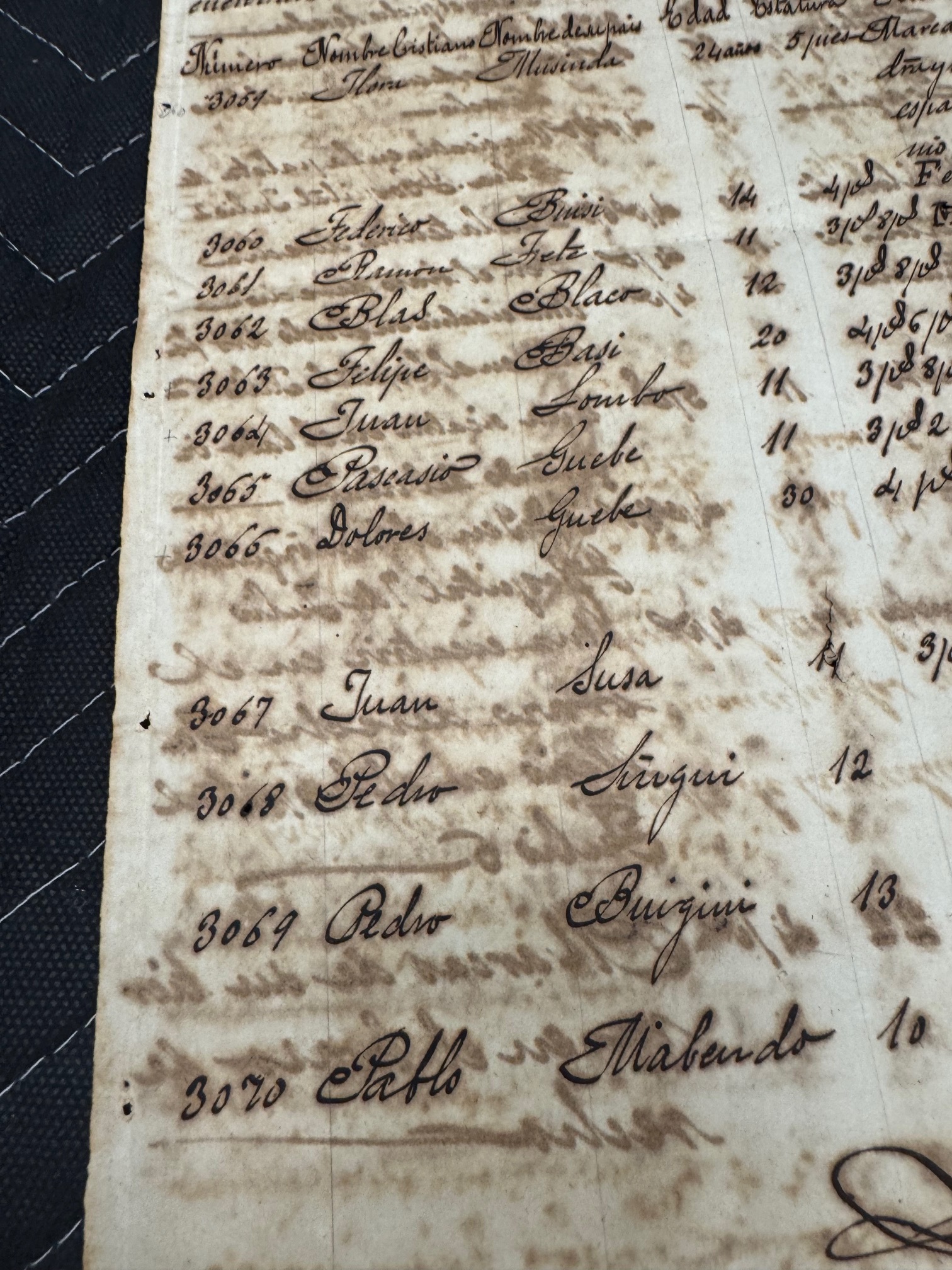
-- Documents written on parchment in 1868 detailing enslaved persons brought to Cuba five years before. The ledger includes Christian names, their age, condition and, most chillingly, the branding mark burned in their bodies. Visitors will learn the international slave trade continued until the late 1880s. (Picket photo, right)

-- A presentation on Confederate and Union monuments, including their locations.

-- Documents from the Maj. Henry Thomas Massengale collection. The Confederate States Quartermaster Bureau in Atlanta was responsible for manufacturing, procuring and transporting military supplies such as clothing, camp equipment, forage, and draft animals, to the Army of Tennessee before, during, and after the Atlanta campaign. Some of the notations are about enslaved persons, including one about a requisition for pants, drawers, shirts and hats for three. “The clothing is required for Negroes employed on the Fortifications that were confined in the Smallpox Hospital and their clothing had to be burned to prevent contagion.” The papers are available at the AHC's Kenan Research Center.

-- Personal items belonging to Capt. James Lile Lemon of the 18th Georgia. “He literally saved everything,” said Jones. Among the artifacts is a drum (photo at top of post) captured from two young Pennsylvania drummer boys on Sept. 16, 1862, the day before the Battle of Sharpsburg (Antietam). Lile later wrote about the capture of the boys by Pvt. Frank A. Boring:

"As he was driving them to the rear at point of bayonet they heaped so much abuse upon him - out of their fear or nervousness - that he had to be restrained from striking them with the clubbed musket. Of course, instantly the target of many wags among our company who joked with him about "scaring little boys" & etc. He replied that he would be d---d if he'd take such abuse from "d---d Yankee whelps." The boys were release & "beat a hasty retreat" back to their lines, with Boring giving them a rite hard look as they went."

-- A portion of the DuBose family Civil War dug relic collection is one of two never-before-exhibited relic collections to be included in the new exhibits. “These collections are comprised of approximately 50,000 artifacts recovered from the 1930s through the 1990s from Tennessee to Virginia, with special emphasis on the Atlanta area,” said the AHC. “They include Minie balls, shell fragments, bayonets, belt plates, gun parts and personal items of every description: the detritus of war left in and on the ground, often in our own backyards.” (Photo courtesy Atlanta History Center)

-- A fascinating lithograph copy of South Carolina’s ordinance of secession. Black troops with the 102nd USCT, mainly comprised of Michigan and Canadian men, seized it in March 1865 at a Charleston home. The Union troops listed four companies within the regiment.

They called the signed sheet a “scroll of treason.” (the original document is in the South Carolina archives). The AHC has a pistol that belonged to one of the White officers listed at the bottom.

Crucial to all this, Hale and Jones said, is being authentic and honest about artifacts and context. At a time of growing use of artificial intelligence and a distrust among many of museums, it’s important visitors know where items came from, said Hale.

Notation on copy of South Carolina secession document calls it a "scroll of treason" (Picket photo)

The aim is to be thought-provoking

Part of the exhibit will look at how the United States went from the Revolutionary War and subsequent conflicts to the Civil War, and what was resolved and what was not during those 80 years.

Some of the fractures continue today, said Jones, adding it is important to raise questions but let visitors make their own conclusions. “We want to change … the traditional ways we examined the Civil War.”

The AHC has utilized focus groups and feedback as it plotted the direction of the exhibit. Jones considers history professor Carolina Janney of the University of Virginia, historian and former president of the University of Richmond Ed Ayers and Cynthia Neal Spence, associate professor of sociology at Spelman College, among his mentors. Spence was featured in an AHC documentary about the legacy of Stone Mountain.

At the end of the day, compelling artifacts, context and interactive features will combine to entertain and educate, the AHC believes.

“We want them to say, ‘Dang, I never realized that,’” Jones said.

Monday, December 4, 2023

Was this wagon wheel shattered in explosion as Sherman's troops took S.C. capital? Experts hope to learn more when they conserve hundreds of artifacts

The wheel hub recovered from the Congaree River (Courtesy of Sean Norris, TRC Companies)
A metal detector first noticed the round object buried in the bed of the Congaree River in Columbia, S.C. Archaeologists surmised it was a just another rubber tire -- one of many found during an extensive river cleanup.

After all, some 2.5 tons of debris – including trash, tires and scrap metal – were carted off during the removal of toxic, century-old coal tar along the shoreline, Dominion Energy announced last month.

Crews decided to dig out the object by hand, expecting an item made well past the Civil War-era.

“Once it was exposed, we knew we had something much more interesting than that,” said Sean Norris, program archaeologist for TRC Companies, a subcontractor for Dominion Energy.

The item was the shattered hub of a wagon wheel, and it’s possible it was damaged in an explosion when Union troops who took the city in February 1865 dumped tons of captured Confederate ordnance into the Congaree. (Photo below, courtesy of South Carolina Confederate Relic Room and Military Museum)

The artifact was found an area where numerous rounds of Civil War ammunition were recovered.

“We had a few folks from the (South Carolina Confederate Relic Room and Military Museum) take a preliminary look and our consensus was that this wheel fit the time frame for a Civil War-era wagon. The location in association with other artifacts of that time period lead us to believe that this wheel was deposited around the same time the other ordnance was dumped in the river,” Norris said in an email.

“The official records mention the explosion and the destruction of a wagon and a team of mules in a couple correspondences. It seems possible that what was left of the wagon after it was destroyed was thrown in the river along with everything else that was being dumped. There would be no specific reason for the wagon parts to be discarded elsewhere.”

Wartime reports indicated three Federal soldiers, including Capt. Williamson M. Davis, died in the explosion. Another 20 or so troops were injured.

The wheel, which shows signs of charring, currently rests in a plastic vat at the Relic Room in Columbia as it awaits conservation.

The museum typically has it covered with a wet towel and plastic bag to keep in moisture. Exposed wood -- if left to dry before conservation -- can disintegrate, experts said.

Archaeologists recovered about 500 Civil War artifacts during the project. Most of those will go to the Relic Room after treatment, which could take up to 18 months, said Chelsea Sigourney, curator of exhibits and collections.

Exhibit on burning of Columbia (Courtesy South Carolina Confederate Relic Room and Military Museum)
“Some artifacts will be stabilized in distilled water and later go through electrolysis” at the South Carolina Institute for Archaeology and Anthropology (SCIAA), Sigourney told the Picket.

“I’d like to be able to have a small exhibit about what is collected from the dig, but that is a project for the future. I wouldn’t even attempt to set a date for that until we hear conservation is complete,” the curator said.

The Relic Room has exhibits that mention Sherman’s occupation and the burning of the capital.

Remnants of Rebel sword, canister and iron spike points (James Legg, SCIAA)
James Legg, public archaeologist for SCIAA, said the agency will handle the bulk of the conservation work. 

“I think I currently have about 200 Civil War artifacts and an assortment of other metal artifacts. This is essentially what the EOD (explosive ordnance disposal) teams recovered during excavation, and it was convenient to bring it on over here to SCIAA in anticipation of the TRC contract,” Legg told the Picket.

“TRC still has a collection of similar or somewhat smaller size that was recovered during the off-site screening process. They may conserve some or all of that group,” he said.

Numerous cannonballs were recovered (James Legg, SCIAA)
The Civil War-related artifacts found during the project include some 6-pounder, 12-pounder and 10-inch projectiles, a large number of canister and grape shot balls, canister plates, small arms ammunition and a Confederate sword blade. Only the lead bullets will not require conservation

“The entire collection (or the half or more that I do) will take about a year to complete, once we begin. I will use electrolytic reduction, manual cleaning and other neutralization techniques before sealing each piece,” Legg wrote in an email.

He said it was unclear who would do the work on the wagon wheel. 

Allen Roberson, executive director of the Relic Room, said he has submitted a proposal for funding of an exhibit room on the discoveries.

Details of Sherman's campaign (Courtesy South Carolina Confederate Relic Room and Military Museum)
“Some of that dig is fascinating,” Roberson told the Carolina News and Reporter. “I think the archaeological recovery is almost as insane as what you pull out of the river.”

He told the news outlet that the exhibit may open in a year and a half to two years.

Norris said most of the river artifacts are at a TRC Companies laboratory, awaiting conservation and curation. He expects analysis of the wheel to begin in the new year.

Archaeologists did not find any other wheels, metal hubs or large pieces of wood near the wheel.