Showing posts with label USCT. Show all posts

Wednesday, April 22, 2026

Compelling Civil War artifacts are among 100 objects the Atlanta History Center is highlighting to mark its centennial. Among them: USCT flag, ammo crate, a girl's diary, Sherman calling card, Cleburne sword, a Union map and a revolver

Solomon Luckie, Union map of Atlanta, 127th USCT flag, sketch for Cyclorama (Courtesy AHC)
Through items big (the locomotive Texas weighing in at 53,000 pound) and small (less than an ounce for Gen. William T. Sherman’s calling card), nearly 20 Civil War-related artifacts are featured in “Atlanta in 100 Objects,” a book and accompanying exhibition that opens Friday at the Atlanta History Center.

The AHC, celebrating its 100 anniversary this year, is inviting visitors to examine artifacts in galleries, rooms and exhibits across its 33 acres. There is a big variety, from a disco ball and Peachtree Street sign (below right, AHC) to a letter from the Rev. Martin Luther King Jr. and an Atlanta Crackers baseball jersey.

While many of the Civil War items, including the calling card and a map used by Sherman’s troops, are now on display, others (a diary by a 10-year old Atlanta girl and the fascinating flag of an African-American regiment) won’t debut or return until the July opening of “More Perfect Union: The American Civil War Era.”

Officials say visitors will see photographs of the Civil War objects being unveiled during the summer. That exhibition will feature breathtaking artifacts and a broader discussion of issues that engage the republic to this day: our belief systems, victory, defeat, reconciliation and the evolving meaning of freedom.

If you can’t travel to the history center to see the 100 objects, the $24.95 coffee table book (left) features photographs and descriptions “that offer a vibrant portrait of Atlanta through the objects that define it.”

The finely produced volume offers just a snippet of what's at the history center. There are thousands of items in the history center's collection, including those pertaining to Reconstruction and civil rights.

Here’s a closer look at the “Atlanta in 100 Objects” artifacts that are directly related to the Civil War.

Much of the information is from the AHC book, while other portions are from previous Picket reporting on these artifacts, many of which have been at the museum for some time.

Adapting the first map of Atlanta for military use

You know how annoying it can be: Unfolding and folding a road map often leads to rips in the paper. Commanders in the Army of the Cumberland besieging Atlanta were issued a linen version -- preventing that problem.

British-born engineer and cartographer Edward A. Vincent made a map for the young city of Atlanta in 1853. Of course, Atlanta was a much smaller town (about 2,600 residents) and Vincent created a circle with a one-mile radius.

“Vincent beautifully illustrated the curved lines that gave Atlanta streets their unusual layout,” a caption in the book states. The Western & Atlantic’s Zero Milepost was in the center (more on that below).

Sherman’s army adapted Vincent’s creation (he also designed Union Station). The one held by the AHC was made July 25, 1864. It was drawn and printed in the field by the topographical engineer office for the Army of the Cumberland, commanded by Maj.Gen. George H. Thomas.

The other two large Federal armies in Georgia were the Army of the Ohio and the Army of the Tennessee. (Photo courtesy Atlanta History Center; click to enlarge)

Solomon and Nancy Luckie

Amid the bustle of Civil War Atlanta, 40 residents were an anomaly. Neither white nor enslaved, they were free blacks -- but they were not free in the fullest sense of the word. The residents toiled under restrictions and were always under a cloud of uncertainty.

Among them were successful barber and bathhouse owner Solomon Luckie, his wife Nancy (left, courtesy AHC) and their three children. The AHC has portraits of the couple; in his, Solomon wears a waistcoat, jacket and gold pinkie ring.

Luckie’s success story ended on Aug. 9, 1864, when one of thousands of Union artillery shells raining on besieged Atlanta hit a lamppost. Shrapnel struck the businessman, who was conversing with white businessmen at the intersection of Whitehall (Peachtree) and Alabama streets. He died hours later.

The lamppost for years was at the Underground Atlanta venue. It was moved to the AHC nearly a decade ago. It can be seen in an upstairs gallery associated with the Cyclorama.

Nancy and their children survived the war. “His descendants would live to see decades of success and struggles for Black Atlantans,” the book says of Solomon.

Zero Milepost

The granite post that marked the birth of Atlanta and survived the Civil War today sits next to the locomotive Texas at the AHC.

Zero Milepost (Picket photo, right) was placed in the 1850s at the southeastern terminus of the Western & Atlantic Railroad in what is now downtown Atlanta, near Georgia State University. “It was this railroad that provided the impetus for the beginning and subsequent growth of the city of Atlanta and marks the center of the city from which the Atlanta city limits were measured,” says the National Park Service.

The Western & Atlantic was vital for the Confederacy, sending both supplies and troops to the front.

For 70 years, the marker sat in the open, but the growth of the city’s viaduct system led to the Central Avenue Bridge above it and the feature was enclosed in a building in the 1980s. With the exception of a few groups, the marker had not been visible to the public since 1994.

In 2018, the milepost was moved to the history center, sparking criticism by preservation and civic groups. A replica was left in the remote site. The museum and state officials said the original needed protection from planned construction work

At the time, an official with the Atlanta Preservation Center said news of the move was a dark day for preservation. “It is always better to leave things in their original location,” said David Mitchell.

The replica milestone as of this writing is inaccessible because of some kind of project being done ahead of the World Cup.

Battle of Atlanta revolver

In 2006, descendants of Union artillery Capt. Francis DeGress discovered a small pocket revolver (Picket photo, below) that their great-grandfather carried into the Battle of Atlanta on July 22, 1864.

In the Cyclorama painting, galloping furiously to the rescue of Union troops who were briefly overrun at the Troup Hurt house is Maj. Gen. John A. “Black Jack” Logan, head of the Army of the Tennessee. Behind him is a revolver-toting DeGress.

DeGress, already a respected veteran, is about to become a folk hero to the Northern cause. He retakes the four 20-pounder Parrott guns that briefly fell into Confederate hands.

“He is an example of the sort of mid-level officer who was a natural leader, on whom the troops really came to depend. On whom the battle depended,” said AHC senior military historian and curator Gordon Jones.

The 1863 weapon was made by L.W. Pond Machine & Foundry Company in Worcester, Mass. It has been on display with other artifacts in the Cyclorama galleries.

According to “100 Objects,” descendants found a letter by artist Theodore Davis, a witness to the battle, friend of DeGress and a historical adviser to the Cyclorama painters. “The letter revealed that it was Davis who recommended DeGress’s dramatic pose with this revolver.”

Capt. Francis DeGress gallops behind Maj. Gen. Logan (Picket photo)
Battle of Atlanta Cyclorama painting and sketch

There’s a lot that can be said of the immense painting, which was made in the 1880s by mostly German artists with the American Panorama Company. Photos are helpful, but you really have to see this depiction in person to appreciate the artistry and chaos of battle.

Visitors at the AHC today stand or sit on a viewing platform and enjoy a powerful presentation projected onto the painting (Picket photo, right).

The book includes a foldout, 360-degree view of the painting and a preliminary sketch of the focal point – the furious fighting at the Troup Hurt house.

The Cyclorama, which was painted in Milwaukee to show a Union victory, was later modified and misinterpreted in Atlanta as showing a Southern triumph – however brief.

“Through the Cyclorama (visitors) can explore the larger question of how our memory and knowledge about the past can be shaped or mis-shaped, in the convergence of history, art, entertainment and myth,” says the book.

Patrick Cleburne’s presentation sword

One of the most compelling items in the former “Turning Point” exhibit was a sword presented by Rebel troops to Irish-born Confederate Maj. Gen. Patrick Cleburne. It is expected to come back on view.

An unknown maker produced the sword in Solingen, Prussia, circa 1864. Hammond Marshall of Atlanta, a dentist and jewelry maker, engraved the weapon.

(Photo courtesy Atlanta History Center)
Soldiers of the 15th Arkansas Infantry – Cleburne’s adopted state -- presented him the sword on April 18, 1864. The scabbard features an Irish harp and the state seal of Arkansas is on the blade.

Cleburne was among six Confederate generals killed later that year at Franklin, Tenn. Before he set out, the officer uttered, “Well if we are to die, let us die like men.”

The “100 Objects” book features this postscript:

“Cleburne staff sent the sword to his fiancĂ©e, Susan Tarleton, in Alabama. It remained in the Tarleton family until 1944. It was discovered in an umbrellas stand in a New England antique store in the 1950s, after which it was purchased and donated to Atlanta History Center.”

Sherman’s photographer George N. Barnard

The AHC in 2024 purchased a rare copy of George N. Barnard’s “Photographic Views of Sherman’s Campaign,” thought to belong to Maj. Gen. William T. Sherman and signed in 1886 by his son Philemon.

Barnard traveled twice in 1864 to Atlanta following the Confederate surrender. The volume -- featuring 10 x 13 inches images -- includes scenes of the occupation of Nashville, the 1864 battles around Chattanooga and Lookout Mountain, the Atlanta Campaign, Savannah, Ga., and South Carolina. In May 1866, Barnard traced the route of Sherman's North Georgia campaign, taking pictures at Resaca and elsewhere.

(Photo courtesy Atlanta History Center)
Keith F. Davis, the leading authority on Barnard, said the photographer ranks among the top echelon of Civil War photographers – Gardner, O’Sullivan, Cook, Rees, Reekie, Gibson and Brady. “None of them surpassed Barnard in terms of technical or creative skill,” says Davis, a photography curator, author and collector. “It’s hard to say that any one of them was 'the best' but Barnard was second to none.” 

Charlie Crawford, president emeritus of the Georgia Battlefields Association, said Barnard's contract with the Army called for him to principally take photos of fortifications, and he took many.

“We're lucky that he had time to take photos of the Ponder house, car shed, etc.” says Crawford, who has led many tours of  key sites in Civil War Atlanta.

The “100 Objects” book includes this summary of the difficult work:

“Working with glass negatives, Barnard required a portable field darkroom and time to set up, chemically prepare the plates, expose the image, and develop the negative – all performed on site. Transported in wagons over dirt roads, the glass negatives were always at risk for breakage. His photographs are not enlargements, they are the same size as the glass negative, some as large as 12-by-15 images.”

Civil War diary – Carrie Berry

“We were fritened almost to death last night. Some mean soldiers set several houses on fire in different parts of the town. I could not go to sleep for fear that they would set our house on fire. We all dred the next few days to come for they said that they would set the last house on fire if they had to leave this place.”

Thus read the Nov. 12, 1864, journal entry of Carrie Berry, a 10-year-old girl living in Atlanta during the fall and occupation of the city. Hers is a very personal account of the shelling of her neighborhood, hiding in the family cellar and taking care of younger siblings.

(Photo courtesy Atlanta History Center)
In between were the seemingly mundane tasks of sewing and ironing. Carrie kept this diary from  August 1864 to January 1865.

The Berry family lived on Harris Street about a mile from the heart of downtown.

“Berry records her desires, reminding us that she is still a child,” according to the book.

In August 1864, she writes, ‘How I wish the federals would quit shelling us so that we could get out and get some fresh air. “Days earlier, she shared that it was her birthday, “But I did not have a cake – times were too hard so I celebrated with ironing.’”

Berry, who later married and had three children, died in 1921. She is buried at Oakland Cemetery, the resting place for Civil War soldiers and civilians alike.

The diary will go on display in July when “More Perfect Union” opens.

Confederate ammunition crate

(Photo courtesey Atlanta History Center)
On Aug. 20, 1960, construction workers digging the roadbed for interstate highways I-75 and I-85 near downtown Atlanta uncovered one of the largest assortments of Confederate artifacts in Atlanta’s history.

According to the history center, the find is known in local tradition as the “Expressway Cache.” (I was unfamiliar with the term). It was at a site that was near four railroad lines during the Civil War. Buried in the mud of a collapsed underground timber and earth supply depot were hundreds of muskets, projectile, railroad tools and other supplies.

The Atlanta Journal said “a mad scramble” of workers, highway department employees and onlookers looted the site.

This well-preserved crate, likely made in 1864, has a shipping address on one side: “To Gen’l Johnston / Atalanta (sic) / GA.”.

Locomotive Texas

A line of text in “100 Objects” makes a pretty grand assertion:

“Given Atlanta’s establishment as a railroad hub, the 1856 locomotive Texas is perhaps the most significant object in the city.”

The Texas is lit up at night and is visible from the road (Civil War Picket photo)
The Texas, saved from destruction years after its prominent role in “The Great Locomotive Chase,” can be seen through an AHC window along West Paces Ferry Road.

While it is most famous for the Andrews Raid in 1862, the steam locomotive – which was at Grant Park before it was restored in 2017 and relocated to the AHC – symbolizes something else about the city.

AHC officials have long stressed the engine tells a much larger story of the postwar growth of the city, and they decided to paint it in an 1886 scheme, rather than the bright colors it wore at Grant Park -- in part because its surviving parts date closer to that year than the Civil War.

Like the locomotive General, the object of the chase, the Texas was saved (in 1907) from the scrap heap. The General presides at the Southern Museum of Civil War and Locomotive History in Marietta, Ga. The Texas and General are the sole surviving locomotives of the Western & Atlantic Railroad, which played a large part in Atlanta’s early development.

Silk regimental flag of the 127th USCT

A prize artifact acquired in 2019 by the Atlanta History Center captures the essence of why about 180,000 African Americans volunteered in the Union army during the Civil War. It will go on display in July, officials said.

“We Will Prove Ourselves Men” reads the motto on the striking flag that belonged to the 127th Regiment, U.S. Colored Troops, which was formed in Pennsylvania of free men and some who had escaped bondage. The reverse side features a bald eagle and the national motto, “E Pluribus Unum” –out of many, one.

(Photo courtesy Atlanta History Center)
This is one of three surviving examples of at least 12 USCT flags painted by David Bustill Bowser.

The 127th trained at Camp William Penn near Philadelphia in 1864. It took part in combat during the siege of Petersburg and the surrender at Appomattox. USCT units -- which helped turn the tide in several campaigns and battles -- were led by white officers and it took time for soldiers to receive pay equal to their white counterparts.

They had limited opportunities and faced racism within the Union army. Some freed men captured by Confederate units were sold into slavery and in some instances, such as at Fort Pillow, black troops were victims of racially motivated atrocities.

Carpetbag

In the South, two terms of derision came to the fore in the years following the Civil War.

A scalawag was a white Southerner who did not conform to postwar expectations. They backed Reconstruction policies and, usually, the Republican Party.

Carpetbaggers were outsiders and, as the AHC says, “travelers from the North who came to the South to profit off the war; ravage local populations; and take advantage of efforts to rebuild the region’s economy, politics and social order.”

The AHC has a small carpetbag in its collection and describes such items this way:

“As the network of railways spread in the US during the prewar period, trains were connecting peoples and places quickly and efficiently. As a result, small industry developed to supply cheap travel bags. The bags were made from secondhand carpet scraps and sold for one or two dollars.”

Grand Army of the Republic reunion pot

The Grand Army of the Republic (GAR) was a large fraternal organization made up of Civil War Union veterans.

This commemorative Boston bean pot was presented to GAR members in Savannah, Ga., by veterans from Beverly, Mass. Three sides are adorned with the coats of arms of the states of Georgia and Massachusetts, as well as that of the Grand Army of the Republic. (Photo courtesy Atlanta History Center)

According to the AHC, the pot was given in gratitude for the care of a grave of a Beverly veteran, Erastus B. Davis, who died in Georgia in 1887. Savannah veterans decorated his unmarked grave, pledging to “keep it in proper order and mount it with the flag for which he offered up his life.”

A chaplain at one graveside service for a veteran said, “The blue and the gray … now lie side by side. All strife has been ended and only the olive branch prevails.”

Gen. William T. Sherman’s calling card

In the 19th century, these small items were the equivalent of today’s business cards, though most did not include contact information.

That’s because they were often mailed or given out at battlefields, veteran reunions and public events. Former generals dispensed them as a sign of goodwill, rather than the pursuit of business.

Such was the case in January 1879, when William T. Sherman returned to Atlanta for the first since he vanquished his foes there. Over three days, Sherman met with local and state officials and gave out cards. 

“Sherman received a warm welcome. Atlantans gathered at the train station to welcome the Commanding General of the United States Army, with only the occasional sly comment about fire,” says “Atlanta in 100 Objects.”

Other items with ties to the Civil War

-- Death mask of railroad engineer Lemuel P. Grant, who designed Confederate fortifications protecting Atlanta

-- Wallet, library card and driver’s license for Margaret Mitchell Marsh, author of “Gone With the Wind”

-- Wilbur Kurtz’s easel. The artist and historian (right) in the 1930s oversaw the restoration of The Battle of Atlanta Cyclorama and the addition of diorama figures.                                                

The AHC says patrons can enhance their experience through the Bloomberg Connects app, which offers additional audio and visual storytelling to enhance the “100 Objects” show.

Thursday, October 23, 2025

'Recognized as soldiers': A Black regiment fought on this NW Georgia tract that has been recently saved. The site includes Confederate earthworks and redoubts

Sgt. Charles Tyree of the 14th USCI was born into slavery  (Indiana Historical Society, M0470), Garrity Battery's site (at right) and Washington Artillery position on the top of 61 acres (Courtesy Bob Jenkins)
Sixty-one acres that feature impressive Confederate artillery and infantry earthworks and were the site of the first Civil War combat in Georgia involving Black troops have been saved following a 20-year effort.

Save the Dalton Battlefields recently trumpeted the preservation of 61.43 acres just north of Interstate 75. The American Battlefield Trust, among its partners in the effort, closed on the property last month after it and numerous groups and individuals raised $677,000.

SDB president Bob Jenkins said the site would likely have been converted to residential use if the sale had not occurred.

“The property immediately below (to the south of) this property was developed into four apartment buildings in the past couple of years and we lost earthworks on that property,” Jenkins told the Picket in an email. “Also, there are other condo units and apartments adjacent to this property to the east, as well.”

Parcel marked in green is near Rocky Face Ridge Park (American Battlefield Trust map)
Unlike Atlanta, Northwest Georgia has numerous remaining Civil War fortifications, including at Rocky Face Ridge Park, which is near the 61-acre site. About 300 acres in the Resaca battlefield have recently been saved, officials said.

For those who closely study troop movement and action during the Atlanta Campaign, the names of Confederate units defending the land the first months of 1864 are familiar: Stanford’s Mississippi Battery, Washington Artillery from Louisiana, Garrity’s Alabama Battery, Baker’s and Clayton’s Alabama infantry brigades and Stovall’s Georgia brigade.

Between them, they erected numerous lunettes, redoubts and earthworks -- much of which survive..

Save the Dalton Battlefields' sign about Black Civil War regiments in the area
But it was the infantrymen belonging to the 14th U.S. Colored Infantry who made history months after those Rebel units left.

They became the first Blacks troops to see combat in the Peach State during the war.

Black regiment was drawn from formerly enslaved

The clash involving the 14th USCI came months after important battles in Whitfield County, including Rocky Face Ridge. By August 1864, most of the fighting was happening well south, in and around Atlanta.

The regiment – organized in Gallatin, Tenn., mainly of former slaves -- was part of a Federal force that came in two trains from Chattanooga, Tenn., before dawn on Aug. 15, 1864, after Confederate cavalry commander Maj. Gen. Joseph Wheeler and his force threatened Dalton with the intent of destroying railroad tracks and supplies.

Black troops are shown in this camp scene near Citico Mound in Chattanooga ( photo CL 491 (44), Isaac Bonsall Collection, The Huntington Library, San Marino, Calif.)
“The three Union regiments disembarked from the trains on the west side of Mill Creek Gap where they deployed, with the 14th USCI placed in the front left of the formation and given the honor of leading the predawn attack,” said Jenkins. They were part of the skirmish line.

“This regiment swept across the southern end of the newly acquired property on their way to Wheeler’s cavalrymen, who were encamped along the banks of Mill Creek to the east.”

Eventually, Wheeler withdrew.

In his memoirs, Col. Thomas Jefferson Morgan (left), wrote the fight was short, with few casualties.

“To us it was a great battle, and a glorious victory. The regiment had been recognized as soldiers. It had taken its place side by side with a white regiment. The men had behaved gallantly. A colored soldier had died for liberty. Others had shed their blood in the great cause.”

The regiment marched into Dalton in a rain. A White regiment, standing at rest, “swung their hats and gave three rousing cheers for the Fourteenth Colored," wrote Morgan.

The 14th later took part in the siege of Decatur, Ala., and the Battle of Nashville. The Slaves to Soldiers website features remarkable information about the regiment and other Black units.

Hikers will be able to see site near Rocky Face Ridge

Jenkins said numerous groups were involved in the preservation project, including the Georgia Battlefields Association, Open Space Institute, Georgia Piedmont Land Trust, various Civil War roundtables and Whitfield County officials.

“While it is not contiguous with Rocky Face Ridge Park, it is to be added to the profile of that park and managed accordingly, but without any bike trails or other high-density use,” he said. “This property is to be used for only hiking, historic and environmental preservation, i.e. low density use.

Lunettes were shaped as a half moon to protect men. (Courtesy Bob Jenkins)
While the terrain is not as rugged as Rocky Face Ridge, the parcel does not have easy car access.

Jared Herr, communications associate with the American Battlefield Trust, said the nonprofit negotiated the purchase agreement. He said the trust has championed several Civil War properties in the region, including Rocky Face Ridge, Ringgold Gap, Kennesaw Mountain and Resaca.

Once the Trust places a conservation easement on the 61 acres, it intends to transfer the property to Whitfield County. “Trails and interpretive signage will be installed on the property. Save the Dalton Battlefields will work on the signage under the guidance of the county. The Trust will lend its expertise, including sign text review, to the process.”

Brian Chastain, chief of Whitfield County parks, said he recently toured the site and said the earthworks are particularly notable. “It is a great asset.”

“While the property is not yet open to the public, I can provide private tours of the property on a limited basis and for now would like to limit that to our donors or potential future donors,” said Jenkins. “There’s no timetable yet for the public, but we will be working to get the property and hiking trails safe and ready to be dedicated and opened to the public as soon as possible.”

Bragg, Johnston deployed guns to slow Yankees

Another lunette at the 61-acre site (Courtesy Robert Jenkins)
It’s important to note Dalton and Whitfield County were occupied by Confederate and Union troops at different times during Sherman’s Atlanta Campaign. The Rebel artillery was in place around the time or during the Battle of Rocky Face Ridge.

Charlie Crawford, president emeritus of the Georgia Battlefields Association laid out this timeline:

The four-gun batteries were part of the defensive line Braxton Bragg (for the initial weeks) and Joseph E. Johnston (subsequently) built from December 1863 through April 1864. The artillery was positioned more to defend Mill Creek Gap than the ridge, said Crawford.

When Maj. Gen. George Thomas was ordered to attack Rocky Face Ridge in late February 1864, he determined quickly that a direct assault with the forces then at hand (only the Army of the Cumberland at that point, whereas Gen. William T. Sherman would have three armies when he approached the site in early May) would just result in casualties. But Thomas’s assault did have the effect of Johnston being allowed to recall two divisions he had been ordered to send to assist Polk in Mississippi. Thomas withdrew.

“There were certainly artillery exchanges in this area in February and May, but the principal infantry assaults were elsewhere. In one sense, the defenses here accomplished their purpose of defending the gap,” said Crawford.

Atlanta Campaign got bloody start at Rocky Face Ridge

The well-known Battle of Rocky Face Ridge came on May 7-8, 1864. It was the first significant clash of what became known as the Atlanta Campaign.

In 2022, Bob Jenkins (left) with reproduction 3-inch ordnance rifle at Rocky Face Ridge Park. (Picket photo)
Sherman sent troops from the Chattanooga area as a feint while Maj. Gen. James B. McPherson rushed to Snake Creek Gap in a bid to cut Rebel forces off from a vital railroad.

But the feint did not come without cost: About 1,400 men from both sides became casualties in the fighting over several days at Rocky Face Ridge, known for its steep terrain.

Johnston, surprised by McPherson’s move and seeing that Sherman was moving south, evacuated troops off the ridge and rushed them to Resaca.

The Federal strategy had failed, given McPherson moved back to Snake Creek Gap when he thought his army might be in a precarious position. Sherman was angry about McPherson’s failure to attack and perhaps cut Johnston off from the railroad. The Battle of Resaca ensued, with Johnston having consolidated his troops.

Here's when the Rebel batteries were in place at site

Jenkins provided these details on what occurred on the 61 acres.

There were two artillery battery sites on this property used by three different Confederate units: the one near the top of the ridge used by Garrity’s Alabama battery, and the one on the lower part of the ridge used at various times by the Washington Artillery and Stanford’s Mississippi Battery.

-- Garrity’s Alabama Battery served in the redoubt near the top of the property in action in May (May 6-13) 1864.

Georgia Division reenactors take part in 2022 ribbon cutting at Rocky Face Ridge Park (Picket photo)
-- The Washington Artillery served in the redoubt near the bottom of the property in action in February (24-26, 1864), May and October (13, 1864).

-- Stanford’s Mississippi Battery also served in the lower redoubt in May 1864. (Different batteries were pulled up into line and after 24 hours, pulled back and replaced to rest) But not Garrity’s Battery, because they were up on top and harder to get up and down.

-- The August 1864 action saw no artillery on this property, but instead was a running fight as the Federals lined up west of Mill Creek Gap, swept through the gap, including the 14th USCI across the lower half of this property, as they surprised and swept Wheeler’s sleeping Confederate cavalrymen in the predawn hours of August 15, 1864, along the banks of Mill Creek between just west of the gap and down toward Dalton.

Friday, June 27, 2025

Names of 30 Black soldiers are added to an Illinois monument

A plaque featuring two rows of 15 names has been added to the Civil War memorial on the square in Jacksonville, Ill. Those named were Black soldiers who fought for the Union, almost all members of the U.S. Colored Troops. The more than 3,000 names on the memorial before the update included a few Black service members — but some people noticed a gap. The 30 men whose names were added served mostly with the Third Heavy Artillery and 29th Infantry. -- Article

Thursday, May 1, 2025

First on the Picket: Compelling artifacts and technology acquired in recent years will tell a bigger story in an Atlanta History Center exhibition opening next year. The aim is to get you to think about what the Civil War meant then -- and its impact today

The Atlanta History Center
is closing a longtime Civil War exhibit to make way for two new galleries that will feature breathtaking artifacts and a broader discussion of issues that engage the republic to this day: our belief systems, victory, defeat, reconciliation and the evolving meaning of freedom.

Atlanta, museum officials say, is ideal to tell a bigger national story about the Civil War in a striking way. Beyond being the capital of the South and a melting pot, it’s recognized by historians as a crucial battleground for saving the presidency of Abraham Lincoln and the United States itself.

For 30 years, relics collected by an Atlanta father and son formed the core of “Turning Point: The American Civil War.” The exhibit focused on the soldiers in blue and gray and how they did their deadly work, and visitors were awed by the incredible collection of uniforms, weapons, personal items -- and just about every conceivable type of artillery shell.

While “Turning Point” did address some big questions about the Civil War, there was limited discussion on technology, slavery and the home front. New, more diverse generations – distanced even more from the Civil War era – are asking deeper questions, the museum says, about why the war happened, how 4 million enslaved Americans gained their freedom, Reconstruction and what the conflict, which took at least 720,000 lives, means today.

Sheffield Hale with Union 20th Corps wagon that traveled near what is now the AHC (Picket photo)
“Thirty years ago, we (had) white, middle-class older folks,” Gordon Jones, the AHC’s senior military historian and curator, told the Picket about the exhibit’s key audience at the time. “We are a changed city. Demographics have changed. Our audience asks different questions.”

The history center is investing $15 million and more than 15,000 square feet for the new exhibition, which has not been formally named. It is expected to open in summer 2026, when the AHC marks its centennial.

“Turning Point” will close on May 25, but Civil War aficionados can still get their fix during construction with the giant Cyclorama painting of the Battle of Atlanta, related exhibits and the locomotive Texas, one half of the famous “Great Locomotive Chase” in 1862.

Jones came to the history center in early 1991 and cataloged the vast artifacts collection of Beverly M. DuBose Jr., whose name is on the current gallery. The collection became the basis for much of “Turning Point," which now has an outdated feel.

Flags and other items in the current "Turning Point" exhibit (Picket photo)
The curator could not conceive in the early 1990s what the internet and online auctions would mean for the history center, which has since purchased scores of artifacts, many of which will be displayed for the first time in the exhibition.

“More is better. It’s what gets people excited,” said Jones. “Artifacts are what speak to you emotionally, through your heart.”

Two flags and messages they sent to formerly enslaved

Make no mistake, Confederate and Union bayonets, swords, flags, rifles and revolvers will still be a big part of the presentation. To that end, Jones and AHC CEO and president Sheffield Hale are excited about plans to include two large collection of dug relics.

But they are particularly excited about the artifacts related to U.S. Colored Troops. The impetus for that came about in 2019, when the history center bought a hand-painted flag made for the 127th USCT infantry. It depicts a soldier waving farewell to Columbia, a symbol of the United States, with the words “We Will Prove Ourselves Men.”

“It’s an iconic knock-your-socks-off artifact,” Jones (At left in Picket photo) said at the time. Even an enlisted man’s USCT uniform wouldn’t be as historically significant as this flag.”

There’s another flag (top photo of this post) the curator said will be his favorite item in the new exhibit.

Most of the American flag is long gone, save for the 34 stars and upper-left canton. It flew over a camp on Craney Island near Hampton Roads, Va., that protected escaped slaves, whom Jones said were active in their liberation. The camp operated for just over a year before closing in September 1863; it was one of dozens of such camps in southeast Virginia housing an estimated 70,000 formerly enslaved people, according to the AHC. The tattered flag, which originally was 10 feet tall by 20 feet long, is undergoing conservation for display.

While the flag for the 127th USCT largely symbolized pride and duty, this one was a symbol of freedom, welcoming those who arrived safely after a dangerous journey.

 “If I get to that flag, I get my freedom, Jones said a refugee might think. “The choice to whom I can marry, to find my family.”

A closer look at the fascinating 'new' artifacts

I met Monday with Hale and Jones to talk about the new exhibition, which officials say will be heavy on “cutting-edge technology and immersive storytelling” and the benefits of newer scholarship. (Afterward, Jones showed me several artifacts in a storage area in the building’s basement)

They outlined some of what visitors will see in the galleries and other items in the center's vast collection. Below is just a smattering of what we discussed:

Patent for Morse breech-loading firearm (Atlanta History Center)
-- The downstairs Goldstein gallery, which is empty, will focus on technology and the Civil War. In part, it will feature the singular collection of the late George W. Wray Jr., showcasing some of the rarest Confederate firearms, swords, uniforms, flags and other items. Some were one of a kind. When it went on temporary display in 2015, the theme was the weapons were an attempt by a slave-based society to fight an industrial war. The South was hampered by limited manufacturing and the Union blockade of foreign goods.

-- A projection on one wall will feature a timeline of the war, key moments and maps, Hale said. The AHC will display elements of its interactive “War in Our Backyards” collaboration with The Atlanta Journal Constitution about 10 years ago.

-- Utilizing an online database about the Atlantic slave trade, the former DuBose space will feature an animated screen showing their routes, destinations and other details.

Gordon Jones with 18th century British blunderbuss (Picket photo)
Two items will show the connection of the U.S. slave trade and the practice elsewhere:

-- One is a circa 1750s short-barreled firearm, or blunderbuss, made by the John Whately family in England. The European slave cartel traded guns for enslaved persons along the West African coast. It was typical for the buyers to supply weapons, iron bars, printed cloth and other metals as part of the barter. "This one is extremely lightweight, cheaply made, and incredibly rare to find in this condition," said Jones, who believes this one may have been a sample weapon. 

“It was just rotten and evil from the start to finish,” the historian said of the slave trade.

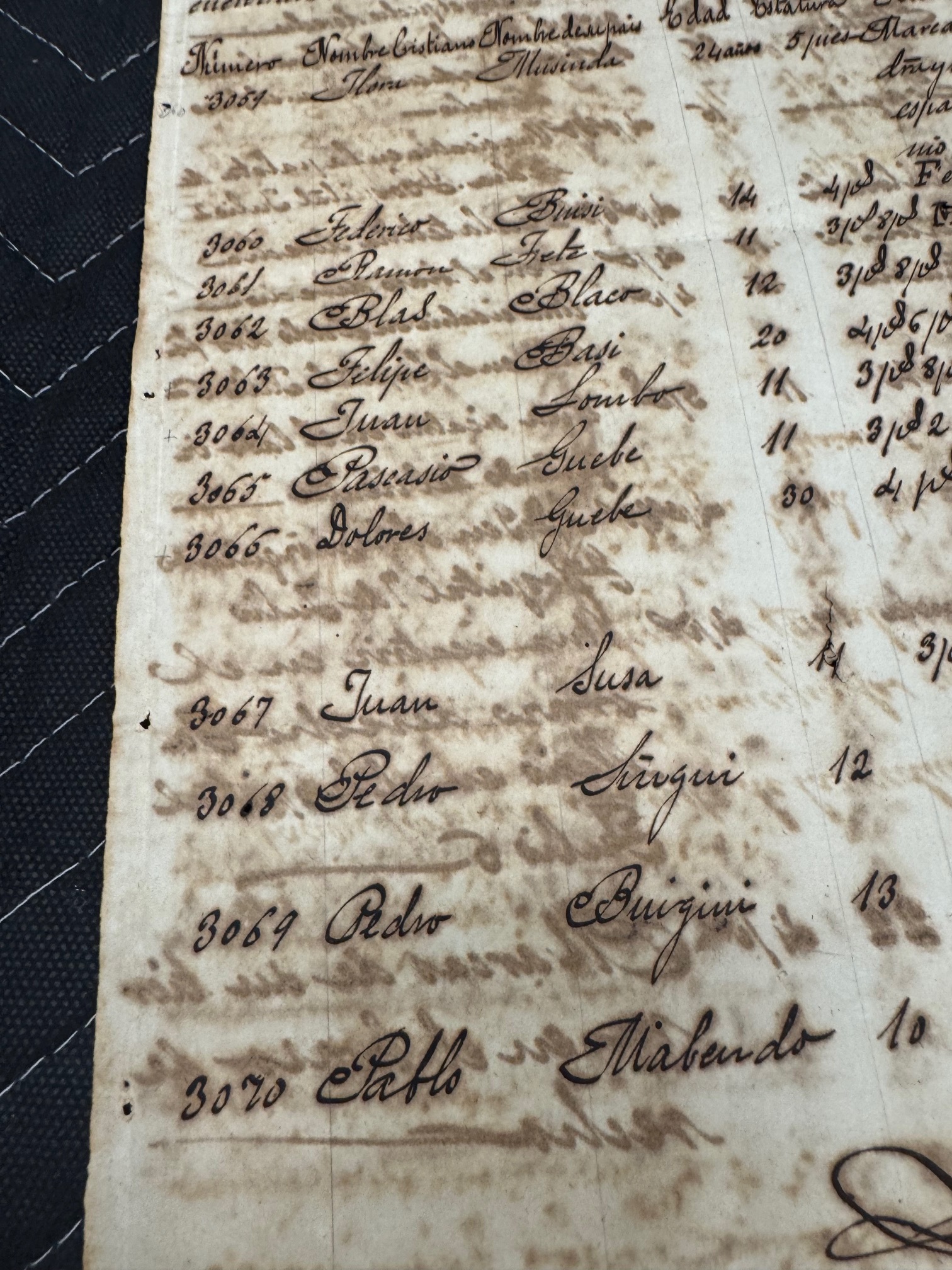
-- Documents written on parchment in 1868 detailing enslaved persons brought to Cuba five years before. The ledger includes Christian names, their age, condition and, most chillingly, the branding mark burned in their bodies. Visitors will learn the international slave trade continued until the late 1880s. (Picket photo, right)

-- A presentation on Confederate and Union monuments, including their locations.

-- Documents from the Maj. Henry Thomas Massengale collection. The Confederate States Quartermaster Bureau in Atlanta was responsible for manufacturing, procuring and transporting military supplies such as clothing, camp equipment, forage, and draft animals, to the Army of Tennessee before, during, and after the Atlanta campaign. Some of the notations are about enslaved persons, including one about a requisition for pants, drawers, shirts and hats for three. “The clothing is required for Negroes employed on the Fortifications that were confined in the Smallpox Hospital and their clothing had to be burned to prevent contagion.” The papers are available at the AHC's Kenan Research Center.

-- Personal items belonging to Capt. James Lile Lemon of the 18th Georgia. “He literally saved everything,” said Jones. Among the artifacts is a drum (photo at top of post) captured from two young Pennsylvania drummer boys on Sept. 16, 1862, the day before the Battle of Sharpsburg (Antietam). Lile later wrote about the capture of the boys by Pvt. Frank A. Boring:

"As he was driving them to the rear at point of bayonet they heaped so much abuse upon him - out of their fear or nervousness - that he had to be restrained from striking them with the clubbed musket. Of course, instantly the target of many wags among our company who joked with him about "scaring little boys" & etc. He replied that he would be d---d if he'd take such abuse from "d---d Yankee whelps." The boys were release & "beat a hasty retreat" back to their lines, with Boring giving them a rite hard look as they went."

-- A portion of the DuBose family Civil War dug relic collection is one of two never-before-exhibited relic collections to be included in the new exhibits. “These collections are comprised of approximately 50,000 artifacts recovered from the 1930s through the 1990s from Tennessee to Virginia, with special emphasis on the Atlanta area,” said the AHC. “They include Minie balls, shell fragments, bayonets, belt plates, gun parts and personal items of every description: the detritus of war left in and on the ground, often in our own backyards.” (Photo courtesy Atlanta History Center)

-- A fascinating lithograph copy of South Carolina’s ordinance of secession. Black troops with the 102nd USCT, mainly comprised of Michigan and Canadian men, seized it in March 1865 at a Charleston home. The Union troops listed four companies within the regiment.

They called the signed sheet a “scroll of treason.” (the original document is in the South Carolina archives). The AHC has a pistol that belonged to one of the White officers listed at the bottom.

Crucial to all this, Hale and Jones said, is being authentic and honest about artifacts and context. At a time of growing use of artificial intelligence and a distrust among many of museums, it’s important visitors know where items came from, said Hale.

Notation on copy of South Carolina secession document calls it a "scroll of treason" (Picket photo)

The aim is to be thought-provoking

Part of the exhibit will look at how the United States went from the Revolutionary War and subsequent conflicts to the Civil War, and what was resolved and what was not during those 80 years.

Some of the fractures continue today, said Jones, adding it is important to raise questions but let visitors make their own conclusions. “We want to change … the traditional ways we examined the Civil War.”

The AHC has utilized focus groups and feedback as it plotted the direction of the exhibit. Jones considers history professor Carolina Janney of the University of Virginia, historian and former president of the University of Richmond Ed Ayers and Cynthia Neal Spence, associate professor of sociology at Spelman College, among his mentors. Spence was featured in an AHC documentary about the legacy of Stone Mountain.

At the end of the day, compelling artifacts, context and interactive features will combine to entertain and educate, the AHC believes.

“We want them to say, ‘Dang, I never realized that,’” Jones said.