“I am not
sure if Meade had a preferred style of hat but, maybe his preference was more
utilitarian; e.g., wearing the slouch hat on active campaign because it kept
the sun and rain off of him; whereas wearing the kepi in static locations such
as a winter quarters and formal occasions,” says Mike Kwolek, museum exhibition
specialist for the foundation.
The general’s
hometown was Philadelphia. For
more than 70 years after his grandchildren donated them in 1937, Meade’s
belongings were housed at the Civil War Museum of Philadelphia. Other items at the museum were donated by former Union officers, members of the Military Order of the Loyal Legion
of the United States (MOLLUS). Meade died in 1872 at age 56.
Museum officials had hoped to erect a new building after it closed in
2008, but funding never came through and hundreds of artifacts went to the
Gettysburg Foundation. (Paper documents relating to the officers are kept by
the Union League of Philadelphia)
Gettysburg’s collection has many sources, including what was at the
Philadelphia museum. (Photo at left, Courtesy of Gettysburg Foundation, from the collection of the Civil War Museum of Philadelphia; CWMP 86.13.32, Frock Coat)
I spoke with Kwolek – whose duties include designing and executing museum exhibits,
collections management and registration – about a half dozen items in the Meade inventory. (I am grateful for his help and patience when I
peppered him with myriad follow-up questions)
Here’s a close look at the six artifacts:
MEADE'S FELT SLOUCH HAT
 |
Courtesy of Gettysburg Foundation, from the collection of the Civil War Museum of Philadelphia
CWMP 86.13.33, Slouch Hat |
Talk about a close call. The general came to Gettysburg with
two bullet holes in the hat, from fighting several months before at
Fredericksburg, Va.
Army regulations allowed for officers to wear black felt
hats. The height of the crown could be a little over 6 inches. The bindings
were made of black ribbed silk. It features a bullion hat cord and insignia.
“These
examples were similar, yet more elegant than the 1858 Hardee hat; however, many
officers went to the private market and purchased black felt hats in a variety
of shapes and sizes. The one that Maj. Gen. Meade wore, and housed at the
Museum and Visitor Center, is one of those privately purchased hats,” says the
foundation.
 |
Meade, seated at far left, at Massaponax Church (Library of Congress)
His slouch hat has a pinched crown (click to enlarge) |
The park
doesn’t know when Meade got the hat, which he wore with the brim down. Kwolek said this headgear may have been
produced in Philadelphia by the hatter William F. Warburton; who, in 1862, held
three patents for military caps and hats.
Conservation
was performed on the hat in 2012. The bullet holes, above his major general’s
insignia, were stabilized during that work, said Kwolek.
C. Paul Loane, co-author of “US Army Military Headgear, 1812-1872,”.recalls seeing the hat when it was at the museum in Philadelphia.
“It appeared
to be the standard black felt headgear with black silk edging around the brim
worn by most officers, he said. "His hat cords were all gold as called for in regulations for a general officer."
The hat and
coat have been off-exhibit since 2016, following the park’s “Treasures of the Civil War” exhibit.
CHASSEUR-STYLE
KEPI
 |
Courtesy of Gettysburg Foundation, from the collection of the Civil War Museum of Philadelphia
CWMP 86.13.34, Kepi |
Of the Meade-associated items described here, only the wool kepi is
currently (February 2024) on display. The exhibit has the words “Old Snapping
Turtle,” a nickname given to the commander because of his famous ill temper.Text below the kepi reads:
“Although often seen in contemporary photographs wearing his favored
slouch hat in the field, Meade wore this regulation officer's cap (with gold
trim for general officers) for dress and ceremonial occasions."
 |
| National Archives, Library of Congress photos of Meade wearing a kepi; click to enlarge |
This is the
French style of cap that Maj. Gen. George B. McClellan advocated that officers
use after his observations during the Crimean War, says Kwolek. Meade’s kepi was made by Wanamaker’s of Philadelphia,
his hometown. The company was founded in 1861 and operated at Market and
Sixth streets. Meade purchased it in 1862 or 1863.
Loane told
the Picket the cap is “a
slightly brighter blue than most examples (which flirt with being a
midnight/almost black shade) and had a subtle ‘bagginess’ about it we
collectors like. Two silver stars of a major general were affixed to the front
within a gold embroidered wreath backed with black velvet. Staff officer
buttons secured the chin strap and narrow black tape trimmed the sides and top.”
The classic-period
kepi went through restoration in 2012, which included cleaning and
stabilization.
MAJOR GENERAL FROCK COAT
 |
Courtesy of Gettysburg Foundation, from the collection of the Civil War Museum of Philadelphia
CWMP 86.13.32, Frock coat; Meade photo Library of Congress |
The maker of
this dark blue frock is not known, but Meade is known to have worn it from at
least Gettysburg onward. Kwolek wondered whether it was made by Brooks Brothers,
which made uniforms for Federal officers. Brooks Brothers. told the Picket in an
email it has no existing record of Meade.
The coat
conforms to 1861 regulations and bears the rank of major general on its
epaulets. For that rank, the coat had two rows of buttons on the breast, nine
in each row, extending to the waist. Four buttons were on the back and skirt of
the coat, according to the Gettysburg Foundation. The interior chest/torso
region of the jacket exhibits quilting with patriotic motifs.
The coat went
through extensive cleaning and stabilization 2012. Its condition before
treatment exhibited extensive use, according to Kwolek.
ARMY OF THE POTOMAC HEADQUARTERS FLAG
 |
Courtesy of Gettysburg Foundation, from the collection of the Civil War Museum of Philadelphia
CWMP 86.2.4, 34‐star Headquarters Flag |
This flag has
the distinction of the one that flew at Meade’s headquarters at Gettysburg. His
descendants provided the provenance for this 34-star silk flag.Kwolek says
Maj. Gen. Joseph Hooker may have flown it before Meade took command of the army
in late June 1863, just days before Gettysburg.
ARMY OF THE POTOMAC HEADQUARTERS FLAG
(May 1864)
 |
Courtesy of Gettysburg Foundation, from the collection of the Civil War Museum of Philadelphia
CWMP 86.2.5, Army of the Potomac Headquarters Flag |
This
short-lived flag was most likely made by Sisco Brothers of Baltimore,
according to the Gettysburg Foundation. It was made of faded soprano silk with
a dark blue laurel wreath surrounding a gold eagle with arrows and laurel in
its talons.It has a swallowtail design with silk ties. It was used only in May
1864, in Virginia, and was replaced by a small national flag. According to
Kwolek, this reversal might be due to Gen. Grant’s reaction to it, which was
recorded by artist Alfred R. Waud: “What’s this! Is Imperial Caesar anywhere
about here?”
ARMY OF THE POTOMAC V CORPS FLAG
 |
Courtesy of Gettysburg Foundation, from the collection of the Civil War Museum of Philadelphia
CWMP 86.23, 5th Corps flag
|
Meade commanded the corps for only a month, six months
before Gettysburg. The flag conforms to the Army of the Potomac's general order
No. 10 that specified flags to be used for corps headquarters as blue
swallowtailed, with the number of the corps in red on a white botonee-style
cross.Kwolek believes Maj. Gen. George Sykes may have flown it at Gettysburg
when he led V Corps. The flag was probably returned to Meade once the 1864
style of headquarters flags were issued. The flag was donated to what was then
the War Library and Museum in 1937 by his grandchildren and
great-grandchildren.
Other Pennsylvania venues that highlight Meade
Meade’s legacy is covered at several institutions in Philadelphia, including
the Grand Army of the Republic Civil War Museum & Library. It has an exhibit on the general, including many photos, and another unusual item – the
head of Old Baldy, Meade’s war horse.
The National Constitution Center, while it has no Meade items in its
permanent collection, does have several on loan from the Gettysburg Foundation for the exhibit “Civil War & Reconstruction:
The Battle for Freedom and Equality.” Those are the general’s sword and
scabbard, dress spurs and field glasses with case (shown in photo below among other artifacts).
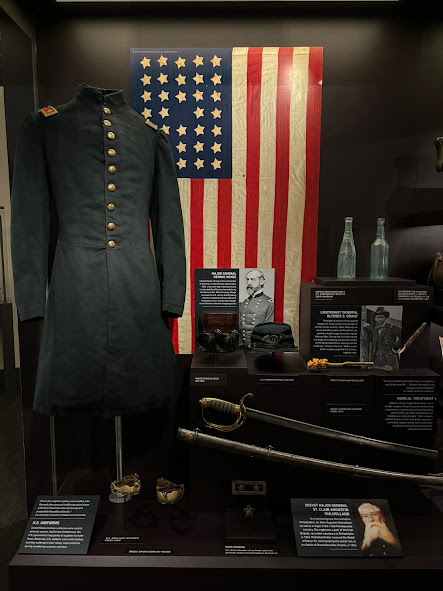 |
From the collection of the Civil War Museum of Philadelphia, on loan from Gettysburg Foundation
and National Constitution Center, photo courtesy NCC |
"The
sword is a M1839 Topographical Engineers sword used by Meade and supposedly the
one where he broke the tip of the blade off while striking a soldier at
Fredericksburg,” said Kwolek.
The Union League has multiple papers, orders,
photographs and other items related to Meade. Click here and here for
examples.
“Our archives and collections are available to the public through
research appointments,” Keeley Tulio, archivist and collections manager with
the group’s Heritage Center, said in an email.
Meade was awarded The Union League of Philadelphia Silver
Medal in 1863 and The Union League of Philadelphia Gold Medal in 1866.


.jpg)


