|
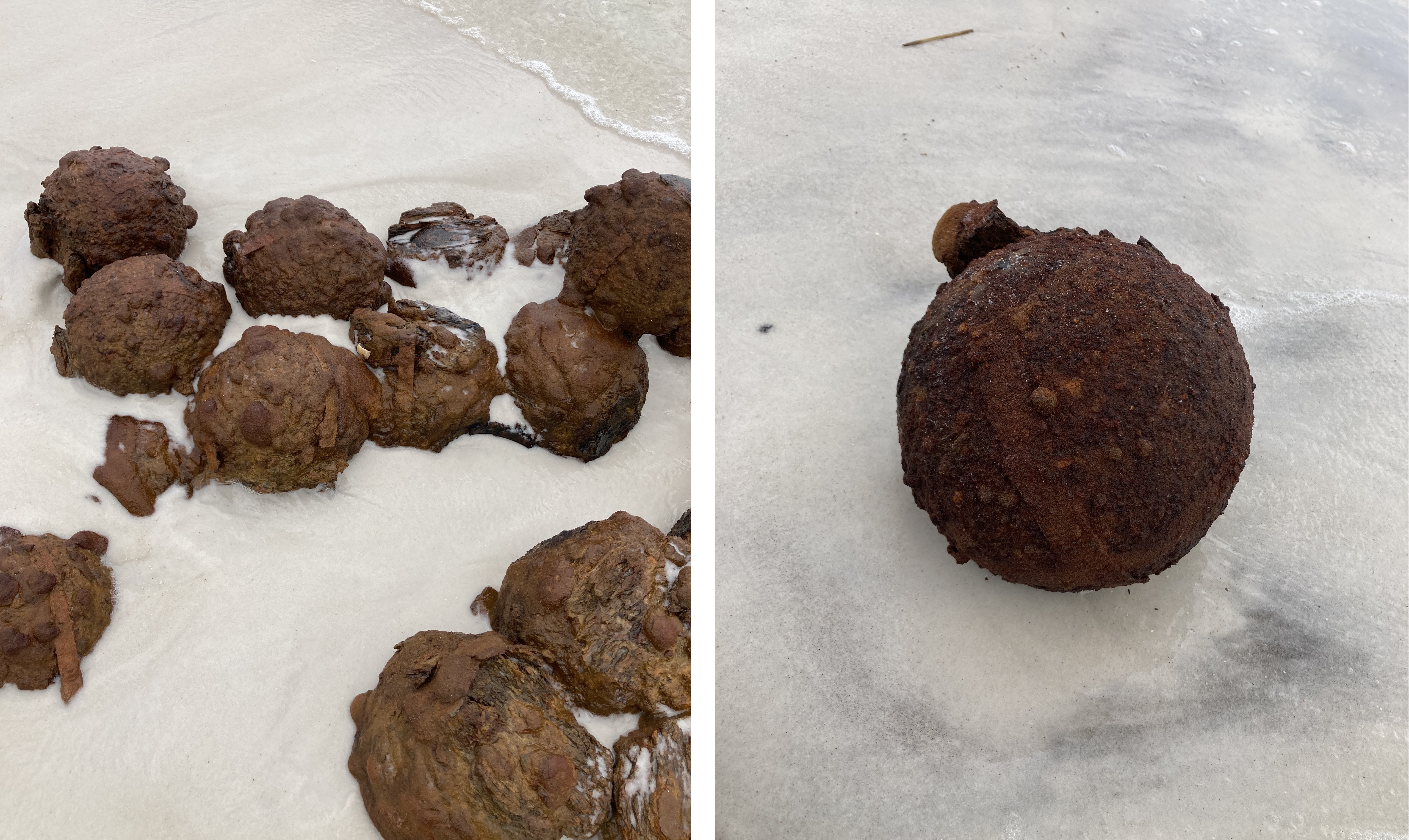
| Iron canister balls, 12-pounder solid shot and iron points used for defenses (James Legg, SCIAA) |
Laboratories in South Carolina and Georgia are using
electrical currents and soda ash to clean and conserve hundreds of Civil War iron artifacts that were
recovered during a cleanup of the Congaree River in Columbia, S.C.Some of the captured weapons and
ammunition that Union Maj. Gen. William T. Sherman’s troops dumped into
the river in the last months of the Civil War reemerged in 2022 and 2023 as crews removed century-old
coal tar along the shoreline.
About 2.5 tons of debris – including trash, tires
and scrap metal – were carted off, with the project concluding 10 months ago.
The Civil War-related artifacts include 6-pounder, 12-pounder and 10-inch projectiles, a
large number of canister and grape shot balls, canister plates, a wagon wheel remnant, small arms ammunition and a Confederate sword blade. Only the lead bullets
do not require conservation. The wheel is believed to be from that era and is in a large tank while experts research its age.
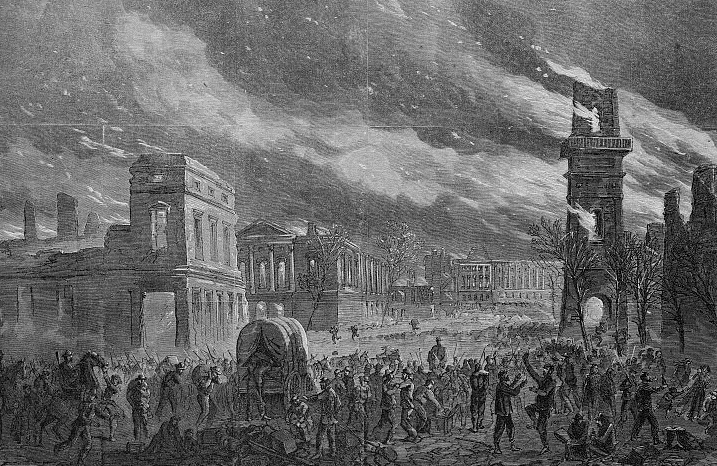
In February 1865, Sherman’s men threw
Confederate war materiel into the river after they took what they wanted before
marching to North Carolina. Much of the South Carolina
capital went up in flames, from a variety of sources, after its surrender. (Left, artifacts shown to the media last year, SCIAA)
The Picket has stayed in touch with Sean Norris, program archaeologist for TRC Companies, a subcontractor for Dominion Energy, and Jim Legg, public
archaeologist for the South Carolina Institute for Archaeology
and Anthropology (SCIAA).
TRC and SCIAA are dividing the
conservation, with the aim of tendering the artifacts to the South Carolina Confederate Relic Room
and Military Museum in Columbia for an eventual exhibit.
The Picket
asked the pair for an update on the conservation, with the following responses
sent by Norris. Some have been edited for brevity or context.
Q. How many Civil War artifacts are currently
under conservation treatment? How many have been completed, roughly?
A. More
than 500 Civil War related artifacts were recovered during the project. All
of the iron artifacts are currently undergoing electrolysis. This is a
long process and they will be in electrolysis tanks for a few months.
 |
| Electrolysis tanks treating Congaree River dumped Civil War ordnance(James Legg, SCIAA) |
Q. Can you tell me a little more about the
electrolysis? How large are the tanks, what is the process?
A. Electrolytic
reduction (electrolysis) is undertaken on iron artifacts with two important
goals, including (1) the removal of soil/iron product concretion and
substantially mineralized iron, and (2) the electrolytic removal of chlorides
and other contaminants from porous surfaces on and within the objects.
Electrolysis
tanks use sheet stainless steel anodes in a mild solution of sodium carbonate
(soda ash) as electrolyte. Ordinary manual battery chargers or modulated power
supplies provide the current for what is essentially a wet cell battery. Tanks
of varying in size from a gallon to 20 gallons are used.
 |
| A range of bullets and shot pulled from the river muck (Sean Norris, TRC Companies) |
Q. Do some artifacts take a longer electrolysis
time than others? Can you briefly describe a scenario like that?
A. Smaller
iron objects from relatively uncontaminated terrestrial sites can be considered
conserved in as little as 15-20 days. Large objects and complex shapes might
run as long as two months. Normally, a tank of several terrestrial iron objects
can run for an extended period with its initial setup and solution, with as few
as one tank change at some point in the process. The artifacts are also
manually cleaned several times, using steel wire brushes and dental picks.
This
manual process is repeated in the course of tank changes as well as between
changes. This lengthy treatment serves to loosen the iron product material that
had replaced varying depths of metallic iron on the objects, and to expel
contaminants dwelling primarily at the iron/iron products transition.
 |
| Alfred R. Waud's illustration of Columbia on fire in February 1862 (Library of Congress) |
Q. What can you tell me about the iron spikes that were found?A. We believe that the iron spikes are the tip ends to a chevaux-de-frise (made of timber) that was likely placed in the water or around the roads and bridges of Columbia as defensive obstacles.
Q. Is electrolysis the final stage for most of
these items? Or do some receive other treatments?
A. The
next step is intensive, repeated boiling, with the goal of removing any
contaminants still present. This involves boiling artifacts in a mildly basic
solution, typically about a teaspoon of sodium carbonate in a two-gallon
stainless steel pot. After about an hour of vigorous boiling, the artifacts are
rinsed in cold water for several minutes, and then returned to boiling in a
fresh basic solution. This cycle is repeated several times for each batch of
artifacts. For the final boil, the solution is nearly neutral, so as flush
excess sodium carbonate from porous surfaces. Additional rinsing follows, in
hot and cold tap water. (If sodium carbonate is not thoroughly rinsed from an
artifact, white crystals may eventually appear on the surface). Heat drying follows the boiling phase. This is
accomplished on an ordinary electric stove burner on low to medium heat. Immersion
in microcrystalline wax is the next step, one undertaken primarily to cover the
surface and fill the porous elements of the iron object to exclude air and
moisture. I submerge the objects, several at a time, in a pan of molten
microcrystalline wax to seal the artifacts.
 |
| Canister ball (left) undergoing treatment, 10-inch shells awaiting their turn (James Legg, SCIAA) |
Q. I assume this stage will continue into 2025?
A. The
conservation phase will take several months for all the artifacts.
Q. Are the river iron points, canister, 6- and
12-pound shells, along with bullets, all Confederate? Any idea what the 10-inch shells were fired by?
A. We
believe all are Confederate. None were actually fired. They were all
removed from the various armories around Columbia. Most of the artillery rounds
are solid shot. The 10-inch balls were shells with open fuse holes but did not
contain any black powder.
Q. The stirrup under conservation -- Federal or
Confederate? Is the type of
saddle known?
A. We
are now leaning toward a non-military stirrup (right).
Q. Anything particularly interesting on location,
context, etc, for the artifacts?
A. In general, these artifacts were in a dynamic,
constantly changing environment since (the) time they were discarded in the
river. After first being thrown into the river, their positions were shifted
around by the current, past recovery attempts and flood events. Their
depositional context would be considered disturbed, meaning that we really can’t
interpret much information from their location. The majority of the artifacts
were recovered close to the riverbank (as was expected) with only a few
recovered closer to the middle of the river channel.