 |
| View today of Espy Room (©Bernadette Kazmarski) |
 |
| And in 1911 catalog (Andrew Carnegie Free Library & Music Hall) |
Item 48 in
the collection of the Grand Army of the Republic, Capt. Thomas Espy Post 153,
Department of Pennsylvania:
“Cotton: Was picked from the cotton
bushes in 1881 by W. H. H. Lea, late Lieutenant of Co. I, 112th Reg., Pa.
Vols., while on a visit to the Virginia battlefield, from the narrow strip of
ground between the Union and rebel lines and directly in front of the rebel
fort at Petersburg, Va., blown up July 30, 1864. Over this ground the charging
columns passed. Almost every foot of this ground was covered with Union dead or
stained by as brave blood as ever flowed from the veins of American soldiers.”
In 1906, Lea donated
this clump of cotton for the GAR post’s new meeting room and artifact collection in a 24-foot-by-24
foot space in the upper floor of the Andrew Carnegie Free Library in Carnegie,
a borough just west of Pittsburgh.
 |
| Cotton donated by Union veteran (©Bernadette Kazmarski) |
While cotton may not seem a likely collectible, it must have meant something special for Lea to hold on to it for 25 years, well after the Civil War ended.
Each of the dozens
of artifacts the members possessed or acquired – a rifle, drum, bayonet, Bible and
even a canteen enveloped by a hornet’s nest – conjured to aging veterans who
met in the handsome room for three decades a precious link to their service to
country during the Civil War.
In 1937, the last member of the fraternal
organization’s local post passed away.
“This was an
outlet for them,” says Diane Klinefelter, who this month began serving as
part-time curator for the Espy Post room. “Veterans today have a hard time talking
about experiences to other than someone who went through it. These veterans
were no different.”
Klinefelter’s
duties at what is now called the Andrew Carnegie Free Library & Music Hall will include maintaining the
artifacts collection and detailed manuscripts
of the post’s operation, raising awareness of the room and organizing Civil
War-related programming.
 |
| Portrait of Capt. Espy (Maggie Forbes) |
 |
| Gavel made from trees at Gettysburg (©Bernadette Kazmarski) |
“There are
people who are lifelong members of the library who never come up and look at
the Espy Post,” according to Executive Director Maggie Forbes.
The story of
the mill town’s library and the Civil War room is remarkable, one that saw the charming
building ensconced on a hill endure “water, age and poverty” until a rebirth about
10 years ago.
The Espy Room
had been largely shuttered since 1937. Dozens of items disappeared, some
perhaps taken as a “badge of honor” by local youth. Poor stewardship accompanied
the deterioration of the building.
“Water was pouring
(in),” Forbes recently told the Picket. “We were hanging on by our fingernails.”
An effort got
underway to raise money – about $7.5 million has been netted so far -- to bring
the venue, which includes what Forbes calls an acoustically superb performance
center, back to its original glory.
A Pittsburgh
man originally from Birmingham, Ala., made a donation that largely covered the
restoration of the Espy Post room, leading to is reopening in February 2010. The result is a faithful version of the original, down to even the wall color:
Pumpkin chiffon pie.
The room,
deemed a national treasure by the library, is open to visitors on Saturdays and
by appointment.
 |
| Members of the post circa 1904 (ACFLMH) |
Company A of 9th Pennsylvania Reserves, a living history and re-enactment unit, helped launch the restoration and has participated in events at the library.
Company
A of the 9th Pennsylvania Reserves 38th Pa. Volunteer Infantry - See
more at:
http://www.carnegiecarnegie.org/espy-post/9th-pa-reserves/#sthash.r23HwleV.dpuf
Through the efforts of staff and volunteers, the community
has honored an agreement issued more than 100 years ago by members of the GAR
post.
“When every veteran of the Espy Post
has answered his last roll call, we leave for our children and their children,
this room full of relics hoping they may be as proud of them as we are, and
that they may see that they are protected and cared for – for all time.”
There to give a helping hand
Within a few
years of the Civil War, thousands of GAR posts were fixtures in communities
that sent boys in blue to fight.
At its peak,
about a half million veterans were part of an organization that served the
needs of its members, widows and children. It quickly became a
Republican-supporting political force, lobbying for soldiers’ pensions and
voting rights for black veterans.
The Espy Post
was a relative rarity – it was integrated.
 |
| Records of veterans' service ( ©Bernadette Kazmarski) |
A photograph
taken on Memorial Day in 1903 or 1904 of Espy Post members gathered outside the
library depicts at least four African-Americans, according to Klinefelter.
Among them is
Jonathan Grinage, Company C, 8th U.S. Colored Troops. His
descendants have visited the Espy Post in recent years. “To have his relatives
here meant a lot to us,” says Klinefelter, who previously served as the library’s
director.
The local GAR
chapter was chartered in 1879 in memory of Capt. Thomas Espy, who died during
the Peninsula Campaign of 1862 in Virginia. His portrait presides over the Espy
Room.
The post met
in several locations in Carnegie, then a railroad and mill town, before
settling on the library room in 1906. “It conveyed a sense of importance and
permanence,” says Forbes.
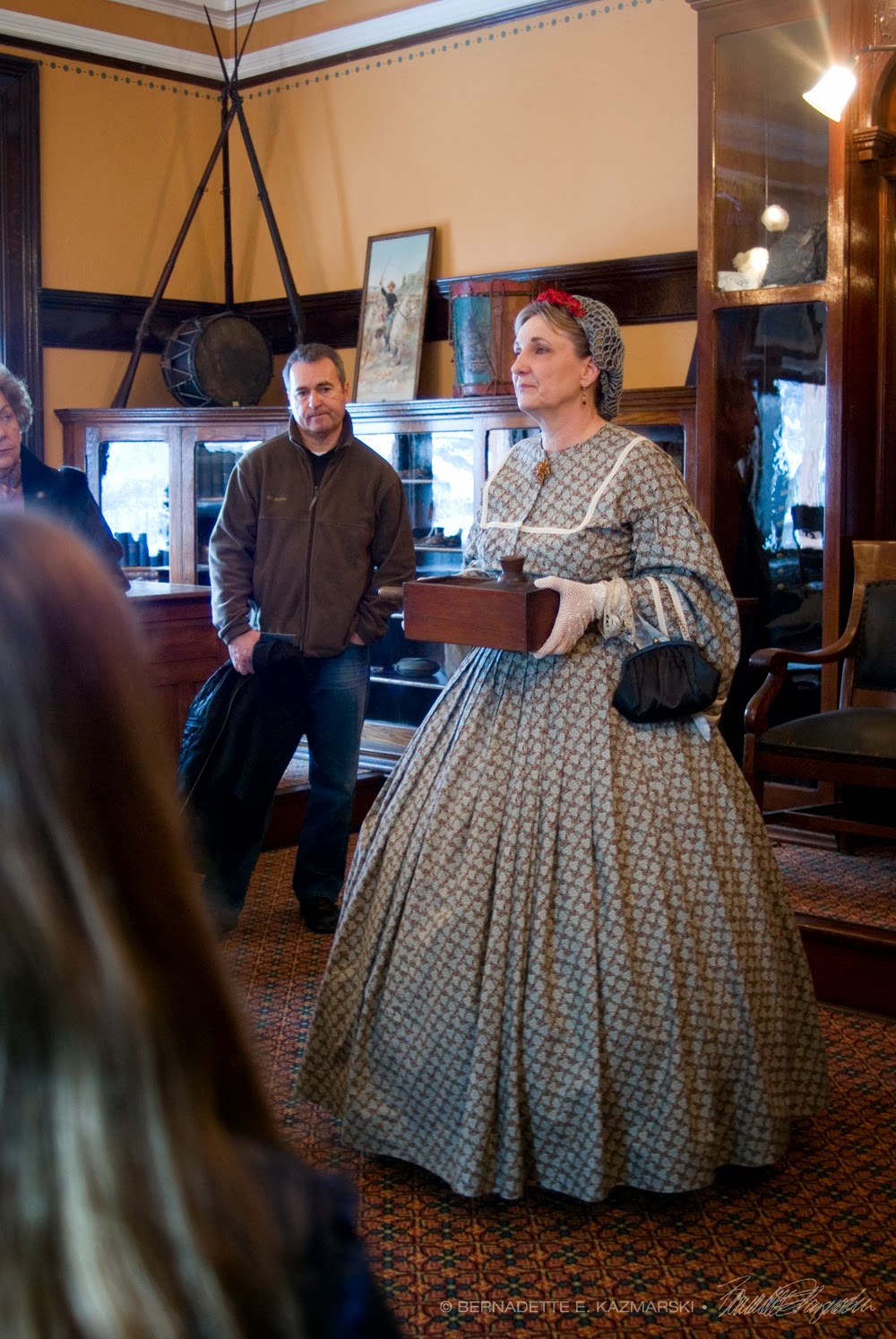 |
| Diane Klinefelter shows ballot box ( ©Bernadette Kazmarski) |
The library
in Carnegie is one of only four libraries in United States endowed by
industrialist and philanthropist, Andrew Carnegie. It opened in 1901. The
borough, also named for the Scottish-born magnate, resulted from the 1894 merger
of two communities, Mansfield and Chartiers.
The GAR meeting
room clearly was a man’s domain, from pictures of Custer’s Last Charge
(postwar) to spittoons neatly positioned on the carpeted floor.
The room
features four double windows and 12-foot ceilings. Artifact cases and furniture
are abundant. “It is very Masonic,” says Forbes, referring to an altar in the
center.
A women’s
auxiliary, Ladies of the GAR, eventually took on much of the post’s benevolent
mission while the veterans concentrated on pensions and political matters.
 |
| ( ©Bernadette Kazmarski) |
Most members
were middle class, with farming, carpentry, iron and mill work and
blacksmith as listed occupations. Membership dues provided help to families.
“If you
needed a shipment of coal, and you did not have the money, the post would chip
in,” according to Klinefelter.
The veterans voted
on those who would be allowed to join. While some veterans had legitimate
service records, others were found to be impostors or dishonorably discharged.
The Espy Post
had about 200 members over its lifetime.
The library
still has the wooden ballot box that contains marbles. After a prospective
member was interviewed, the members would drop either a white or black marble
into the box, signifying their vote.
 |
| Two floors of the building contain the music hall (©Bernadette Kazmarski) |
The GAR very much had a social aspect, woven into the fabric of the community.
“We also have
their dishes,” Klinefelter says of the collection. “They were very big on
potluck suppers. Baked beans and buttered bread were very popular.”
One of the curator’s favorite items in the relic
collection is the commander’s gavel, “because it is quite unique.”
The head, containing a bullet, is from a tree at the
famed Devil’s Den below Little Round Top at Gettysburg.
The handle is fashioned
from wood from Spangler’s Spring, on the same 1863 Pennsylvania battlefield.
 |
| Another corner in the room ( ©Bernadette Kazmarski) |
|
 |
| How it looked in 1911 (ACFLMH) |
The gavel was featured in a commemoration last year for the
150
th anniversary of President Abraham Lincoln’s Gettysburg Address.
The veterans’ soldierly eye for detail and organization
is evident in the room’s manuscript collection of applications, membership information, financial records and
correspondence.
While some may find the manuscripts dry, they are like a
“time capsule” for researchers who want to learn more about the GAR, according
to Klinefelter. A PhD candidate last year did some research at the Civil War
room.
Forbes, Klinefelter and others are especially grateful
for a 1911 catalog produced by the Espy Post. It includes photos of the room’s
four walls and its artifacts – an invaluable guide to restoring the room after
despairing conditions the veterans likely did not envision.
 |
| Epaulettes belonging to Capt. Espy ( ©Bernadette Kazmarski) |
“Thank God for the post historian,” says Klinefelter.
“They realized they all would be gone. Every artifact has a number. Some of the
artifacts have heartbreaking stories for them.”
Splendor,
years of neglect, rebirth
Item 52 in
the collection of the Capt. Thomas Espy Post 153:
“Sword: Presented to Lieut. Samuel H.
Davis by Company I, 112th Regiment, Pa. Vet. Vols., February,1863. Lieut. Davis
was killed at Cold Harbor, Va., June 1, 1864. The sword was covered with his
blood. Lieut. Thos. C. Sharp, while keeping the sword to be shipped to Lieut.
Davis’s parents at the first opportunity, was killed at Petersburg, Va., June
17, 1864, while wearing the sword, and was covered with his blood. The sword
was then shipped to Mr.George Davis, father of Lieutenant Davis, by Adams
Express Co. to Pittsburg, Pa. Mr. and Mrs. George Davis being noted rebel
sympathizers, refused to pay the express charges of one dollar on the sword of
their loyal son who gave his life for his country….”
Over the
years, the Davis sword, like dozens of other items – including Capt. Espy’s
uniform -- went missing.
Forbes one
day got a call from an individual who would not give his name. He returned a
rifle, shotgun and two swords.
One was the
Davis sword.
 |
| ( ©Bernadette Kazmarski) |
Items that currently
are in the collection include a Bible carried in knapsack of a soldier wounded
at Cedar Creek, Va.; a bullet that stuck a cavalry soldier who donated it to
the memorial hall in 1911; a pine knot with grape shot from Chickamauga; and a
carbine found beneath the body of a Confederate soldier after the Battle of
Shiloh.
The GAR was destined to die, because its
charter called for membership of those who served during the Civil War. It
effectively went out of operation in 1956.
According to
the Sons of Union of Union Veterans of the Civil War, its successor
organization, “The final Encampment of the Grand Army of the Republic was held
in Indianapolis, Indiana, in 1949 and the last member, Albert Woolson died in
1956 at the age of 109 years.”
As members of
the Espy Post became infirm or died away, the frequency of meetings upstairs
decreased.
 |
| Replica corps flag with uniforms ( ©Bernadette Kazmarski) |
When Woolson
died, the Espy Room had been closed nearly 20 years. Over the next decades,
water, mould, vermin and pilferers or artifact “borrowers” took their toll.
By 2003, the
Carnegie facility was in rough shape. It had $136 in its checking account,
according to Forbes.
Fund-raising
began, eventually resulting in renewed splendor to the facility.
People ‘fall in love with it’
Item 173 in
the collection of the Capt. Thomas Espy Post 153:
“Bayonet: Was found by James A. Boles,
about 1891. Mr. Boles, while passing through the timber on the battlefield of
Chancellorsville, Va., the bayonet was seen high up, sticking in the trunk of a
pine tree. The tree was cut down and the bayonet and wood cut out. The theory
is that a Confederate sharp shooter had stuck the bayonet in the tree to
support his leg or used it for a rest for his rifle. The tree was in the
Confederate lines, opposite the Chancellorsville house. …”
 |
| ( ©Bernadette Kazmarski) |
Half of the
building today is a library. It has largely an older clientele, although youths
from a public housing complex use it for school work.
The music
hall, which also features theatrical productions, covers two floors. While it
may seem unusual for a performance center and library to be in the same
building, it was common in Carnegie libraries, according to Forbes.
“The building
is very handsome,” she says. “People who come in for the first time fall in
love with it.”
The
restoration of the Espy Post room included work on the plaster walls and the
installation of a new air conditioning system. The walls were dirty and gray; a
paint sample from behind a heating radiator was sent off to a lab at Bryn Mawr
so that its true color could be determined.
 |
| ( ©Bernadette Kazmarski) |
The carpet
was replaced with one featuring a design that closely approximates the
original. Remarkably, most of the furniture was in pretty good shape, although
one chair was replaced.
Klinefelter’s
curator position is funded by a grant through the Massey Charitable Trust. She
has written two books about the conflict.
“To combine a
library with a Civil War component and one of the last GAR posts that is intact
is a chance of a lifetime.”
She hopes to
form an advisory board and develop some programming related to the room. One
idea is an educational workshop. “We have a very devoted, albeit small number
of volunteers.”
The library
is planning an April 5 living history in most of the building. Officials want
to concentrate on the aftermath of the Battle of Gettysburg and its impact on
townspeople. The day will include a photo exhibit to mark the 150th
anniversary of the Battle of Petersburg in Virginia.
 |
| Various items in collection (ACFLMH) |
Klinefelter
says an examination of ledger books with biographical information about post
members showed many served at Gettysburg in July 1863.
The curator,
who has ancestors who fought on both sides, says she is interested primarily in
the social context of the post and its vital part in the community.
“I don’t
focus on the battle statistics. I am more of a social historian.”
Not used for
events, the Espy Post room speaks to the public through its records and relics. The
long-gone veterans might ask: Will people of today pay attention to stories of
sacrifice and service?
Forbes hopes
to see more visitors and perhaps expanded hours at some point. One thing is
certain.
The Civil War Room has captured a moment in time.
“There is an
aura that you feel they just left the room.”
********
Espy Post hours:
Saturdays 11 a.m. to 3 p.m. or weekdays by appointment. Groups interested in
a tour should call, 412-276-3456, x5 to make special arrangements.


