Showing posts with label Grand Army of the Republic. Show all posts

Tuesday, March 26, 2024

Black veterans formed GAR posts to remember their service, do public good. The Lincoln Presidential Library is ensuring precious post documents endure

(Clockwise from top left) Delany post charter, Maj. Martin R. Delany, damaged charter from other post
(charter photos: ALPLM), Gustavus or Henry Booth with 5th Mass. Cavalry; same unit as Lewis Thompson
(Richard Carlile Collection as printed in Military Images; click all to enlarge)
Pvt. Enos Bond and the 17
th U.S. Colored Troops fought at the Battle of Nashville. Pvt. Lewis H. Thompson’s 5th Massachusetts Cavalry took part in an assault on Confederates near Petersburg. And Sgt. Shederick Conaway of the famed 54th Massachusetts Infantry Regiment survived the pitched fighting at Fort Wagner, the climactic scene in the film “Glory.”

Years later, these three men and seven other African-American veterans in Chicago founded Martin R. Delany Post #663 of the Grand Army of the Republic, a fraternal organization of Union Civil War veterans. (Delany, an influential abolitionist and author, was the first Black field officer in the U.S. Army. Photo below)

The Delany post met for at least a few years to socialize, discuss their war experiences and trauma, and support monuments, memory and charity – no doubt proud to have helped end slavery in the United States.

The charter of Post #663, which cemented the bond among Conaway and the others, recently underwent conservation at the Abraham Lincoln Presidential Library and Museum in Springfield, Ill. Experts at ALPLM, which has 269 charters of GAR posts in its collection, have been cleaning, mending and rehousing scores of the documents.

“During their active lives (as documents) the charters were very often displayed, framed or unframed and exposed to light and unfavorable storage conditions,” Christopher Schnell, ALPLM manuscripts manager, told the Picket in an email.

Schnell says the GAR charters, made official with signatures and foil seals, are a boon for researchers and historians, and that’s why restoration is crucial.

“By working on individual documents, or by taking the time to examine an individual set of records, we can raise up the stories of underrepresented members of our collective past,” Schnell wrote in an article about the GAR foundational documents.

Member of 54th Massachusetts survived Fort Wagner

We don’t know exactly how the 10 men who started the Delany post may have known each other. Two, Lewis McGowan and Moses McGowan, served in the 109th USCT and may have been related. It’s also difficult to ascertain how many may have been born into slavery.

1850 census lists Robert Conaway and  his children, including Shederick
Conaway is believed to have been born free in New Bern, which on the eve of the war had one of the largest concentrations of free people of color in North Carolina, according to the Craven County visitors center. (One source says he was actually born in Newton, N.C.)

His family moved to Cleveland, where Conaway worked as a waiter before enlisting in the 54th Massachusetts.

A look at fold3.com, military and pension records and genealogy indexing services show multiple variations of the soldier’s first name (Shad, Shadrack, Shedrick, Shederick, Shaderick, Shadrick) and last name (Conway, Conaway).

List of Delany post members, including Conaway. Click to enlarge (Chicago History Museum)
Conaway was 19 when he enlisted in a Boston neighborhood in April 1863. One history says he was wounded at Fort Wagner.

The 54th Massachusetts saw action at Olustee in Florida (Conaway was in the hospital at the time) and on islands around the Charleston area of South Carolina.

Conaway participated with Company G in the Battle of Honey Hill west of Beaufort, S.C, in November 1864, according to Schnell.

The soldier, who was promoted twice, was mustered out in August 1865.

The soldiers home in Milwaukee, which still provides services today (Wikipedia)
“After the war he went back to work in Cleveland and Chicago restaurants and hotels, married, and had at least one child. Near the end of his life, he moved into the Soldiers Home hospital in Milwaukee suffering from ’asthma’ and ‘heart disease,’” Schnell told the Picket.

Conaway died in February 1894 at age 50. He’s buried at a national cemetery in Milwaukee. I have been unable to come up with a photo of Conaway or any of the other nine charter members.

GAR was widespread, powerful and integrated

The names of the Delany post’s charter members – Bond (a retired police officer), Conaway, the McGowans, Thompson, William Banks of 1st Michigan Colored Infantry, William French of the 109th USCT, Peter French of the 6th U.S. Colored Cavalry, Walter E. Johnson of 14th Regiment, Rhode Island Heavy Artillery, and Alexander Jackson, 17th USCT, were written into history through the September 1888 charter. (Schnell believes the post eventually had 26 members.)

The GAR got its start in Illinois in 1866 and posts spread across the United States, with a peak membership of 400,000 in 1890. The Delany charter was issued three years after the death of its namesake. Illinois had nearly 800 posts.

It had a profound effect on late-19th century politics, with its membership providing the Republican Party, the party of Lincoln and Grant, with a solid voting bloc in Northern states,” according to ALPLM. “The organization used this political power to encourage the federal government to establish a robust veteran’s pension program.” (GAR medal left, courtesy of ALPLM)

By being a racially integrated public institution, the GAR was extremely unusual for its time. Illinois had about 48 integrated posts, while Chicago has at least two all-Black (including Delany #663) and 37 all-white posts.

Historian Barbara A. Gannon, in “The Won Cause: Black and White Comradeship in the Grand Army of the Republic” (UNC Press, 2011),” wrote that “although black veterans still suffered under the contemporary racial mores, the GAR honored its black members in many instances and ascribed them a greater equality than previous studies have shown.”

Gannon told the Picket that before her book, people often described the GAR as a segregated group under the assumption that the posts were segregated by direction of the organization. Instead, she says, black veterans asked the state GAR to charter their posts and they had reasons for doing so.

“For example, they named their post after a famous African-American in the Civil War as was their prerogative.” Gannon says. “They did so to remind white Americans of their Civil War experience.”

According to Schnell, black posts participated alongside white and integrated posts in traditional GAR  activities “to observe Memorial Day cemetery exercises and church services to honor the Civil War dead, to march together in patriotic parades, such as one held in Chicago to commemorate the Constitution centennial in 1887, and to attend annual meetings, like when the Martin R. Delany post joined the 7,000 member Illinois delegation to attend the national ‘encampment’ at Detroit in 1891.”

James Lewis Henry (right, ALPLM photo), a veteran in the John Brown post in Chicago, was a statewide leader in the organization and helped organize suc activities. A free black man, Lewis fought in Federal cavalry units and later became a lawyer.

The Delany post, like others, maintained a small charity account for members in need, but other than holding meetings, “we don’t know about the inner workings of the group,” said Schnell.

The Chicago History Museum has a roster book and minute book for the Delany GAR post.

While the surviving charter at ALPLM is from 1888, the CHM roster book is marked 1879-1890. It’s possible the post’s first charter had to be replaced.

CHM reference librarian Maggie Cusick says the minute book is more narrative and contains about 60 pages of content.

One of the pages about the post’s activity is written by acting adjutant Bushrod Washington.

A soldier by that name served in the 26th USCT, according to the National Park Service. Washington, a Virginian, died in Chicago in 1890, just a month after making the entry.

One of the Delany post volumes at the Chicago History Museum (Courtesy of CHM)
Mending these important documents follows a formula

When GAR posts ceased operating (the date for the Martin R. Delany post is unclear), records were turned to headquarters and folded several times. Charters often were 17 inches by 22 inches. The Illinois State Historical Society for many years held them once the GAR became inactive. The ALPLM eventually took charge of the documents.

“When retrieving post records for researchers, ALPLM staff would occasionally find charters, or the remains of them, that had to be placed on hold for conservation before they could be viewed or imaged,” says Schnell.

In 2019, conservators Bonnie Parr and Ginny Lee began the exacting work of carefully “relaxing,” or unfolding long-folded documents, cleaning, mending, removing acid and rehousing them (Mylar sleeves and oversize folders stored in flat drawers).

While the Delany charter needed just basic cleaning and mending, other documents are in pieces, officials say. About 40 GAR charters in the most serious condition are yet to be treated. (At left, a Delany post record with names of members. Courtesy ALPLM, click to enlarge)

“There have been a few charters with notes to the effect that they are replacements for originals destroyed by fire (and even one destroyed by a tornado). I’ve wondered about those incidents and how they affected the GAR members of those posts,” says Parr.

As an example of her work, Parr sent a photo of the much-folder, yellowed and brittle charter for Post #468 in Downers Grove. She believes some of its wear is due to long-term light exposure while in a GAR hall.

Parr recently completed work on a charter for the Gov. Richard Yates Post #687, an African American chapter, in Jacksonville, Ill. She put the document in a humidity chamber – made up of a rack in a sink, with damp towels nearby. The sink was covered with plastic. During the day, she gradually unfolded the paper as it “relaxed” from high humidity. The paper was dried and flattened between blotters.

“My satisfaction comes from taking the folded paper – which can’t be handled without damage – through conservation treatments that unfold and stabilize the fragile paper so that it can be read and be accessible for research,” says Parr.

Post #687 charter before unfolding, treatment area and the dried document (Courtesy ALPLM)
Parr uses specific tools during the process of lining – which involves a support system for the document while undergoing the final stages of conservation.

“I use a sheet of acid-free Japanese tissue for the lining and wheat starch paste to attach the GAR document to the tissue. I let it air dry for several days,” she says.

"Then, I use a metal spatula to carefully lift the tissue/charter off the lining surface, trim the excess tissue from the edges, deacidify the document, place it in a polyester film (a chemically inert plastic) sleeve, and send it back to the Manuscripts Department (where it ‘lives’).

The #687 charter during the lining process and the final product (Courtesy ALPLM)
Schnell tells the Picket the GAR charters are among the most heavily used manuscripts at the library.

“People interested in family history use the records to search for their veteran forebearer. Local historians seek information about the veterans (and their activities) who lived in their communities in the past,” he says.

Museums have asked for reproductions of the documents for purposes of exhibit. The charter conservation project was started because a county historical society asked for a scan of their local post charter and it needed repair before digital scanning.

With restored charters as a starting point, we can continue the GAR’s work of honoring the sacrifices of Civil War veterans by going beyond the ink and paper to recover the stories of the people who once fought to restore the Union and end slavery,” Schnell wrote in his blog post.

Friday, October 7, 2022

More than a century after his death, research leads to a black Civil War naval veteran finally receives a headstone in Tacoma, Wash.

Wreaths were placed near new headstone Saturday (Oakwood Hill Cemetery)
Updated Oct. 10

In life, David Franklin and David Phillips may have rubbed elbows at a Tacoma, Wash., post of the Grand Army of the Republic in which they were members. Custer Post No. 6 was a home away from home for those who served the Union during the Civil War -- a place where veterans shared food and drink and accounts of their harrowing experiences while they were younger.

Sketch of David Franklin (Alan Archambault)
In the hereafter, Franklin and Phillips lie within steps of each other. But while Phillips, a white man who served in the 4th Minnesota, has a marked grave, the final resting spot of Franklin, Tacoma’s only black Civil War naval veteran, was topped only by grass.

That unfortunate situation was rectified this week with the installation of a marble Veterans Administration-approved headstone.

A dedication ceremony Saturday morning (Oct. 8) at Oakwood Hill Cemetery in Tacoma finally brought Franklin an honor he has long deserved.

The effort to recognize Franklin, who died in 1920 at age 79, was led by Loran Bures, Phillips’ second great-grandson. Bures, a member of the Sons of Union Veterans of the Civil War, the successor to the GAR, came across Franklin in 2017 while conducting research on veterans who lived in Pierce County, home to Tacoma.

The SUVCW’s mission includes researching GAR records, the registration of graves and Civil War memorials and monuments.

Bures (pronounced Burruss) came across a biographical card produced in 1939 during research by the Works Progress Administration into Civil War veterans in the area.

“It speaks volumes the information it doesn’t have,” Bures told the Civil War Picket this week.

The card does indicate Franklin died of heart disease on March 16, 1920, and was buried in the GAR section at Oakwood Hill.

But it had no information on any marker, the veteran’s military service and the fact that Franklin was black. While the GAR was open to all ethnicities, there were only three black sailors among the 2,000-5,000 Civil War veterans living in Washington, according to Bures, a 69-year-old retired librarian, archivist and researcher.

Bures came across Franklin’s death certificate and a National Park Service database that showed the man served as officers’ steward and cook on the USS Dawn. The steam-powered vessel took part in Federal blockades and captured several ships. Much of its service was on the James River in Virginia.

The USS Dawn’s most famous action came in May 1864 in the defense of Wilson’s Wharf in Virginia. The vessel’s guns and the Federal garrison made up of U.S. Colored Troops drove back the Confederate assault.

As a cook and steward, Franklin’s primary role would not have been combat, but it was common practice for a crew member to have a second duty station.

The USS Dawn was built in 1857. (Wikipedia)
At Wilson’s Wharf, “he most likely was helping bring powder and ammunition below deck to the three guns on the deck,” said Bures, adding there is no way to verify that.

Franklin is listed as an ordinary seaman in the NPS file.

Group does not know of living relatives

There are gaps in what’s known about Franklin, including when he moved to Washington and whether he ever married. His death certificate says he was widowed, but Bures said he has found no information about a spouse. The local SUVCW is asking any possible descendants or relatives to contact the organization.

It is known that Franklin was born in 1840. “He was born free in New York City to parents who were free people of color,” said Bures.

Franklin joined the Navy at age 23 in November 1863, midway through the Civil War. The NPS database lists him as being 5 foot 5 inches tall and working as a cook. He served on USS Dawn until near war’s end, mustering out in March 1865.

Bures believes the veteran came to Pierce County between 1885 and 1888. He is listed in a GAR roster for the latter year and a 1907 volume includes Franklin among 752 members (comrades) in the Custer post.

Records show that Franklin joined the Washington National Guard infantry as a cook in 1906.

Ensuring proper honors for veteran

Bures traveled to Oakwood Hill Cemetery several months ago to inspect Franklin’s grave.

He suspected it might be unmarked because of the WPA card and a Findagrave profile that had no photo of a headstone. (Researchers have been unable to find a photograph of Franklin. Bures' second great-grandfather, 1st Sgt. David Phillips, is buried at Tacoma Mausoleum, which adjoins the cemetery.)

Oakwood Hill verified the seaman was buried there and had not been exhumed, officials told the Picket .

Franklin’s resting place was a gap in a row of headstones for other GAR members. Bures and others put together verification information for the VA, including evidence of a Navy pension.

Franklin's graves was marked only by a flag (Loran Bures)
Bures would speculate on why Franklin’s grave received no marker. “There could be a lot of reasons for it.” Oakwood Hill Cemetery co-owner Corey Gaffney told the Picket he, too, did not know why a headstone was not set in 1920.

Gaffney, who purchased the business with his wife, Jennifer, in 2021, told theTacoma News-Tribune the cemetery was providing resources to ensure Franklin received proper honors.

The grave is among weathered headstones that appear not to have been cleaned in recent years. The businessman told the Picket that the couple is working to make improvements at the cemetery and funeral home and restore the site to "its former glory."

"We believe that in 3-5 years this property will be completely viable and unrecognizable to some. That’s our hope and our goal."

Gaffney told the Picket in an email after the ceremony that "the definition of integrity is doing the right thing when no one is looking. While we did have coverage of this event and dedication, there are countless other actions we’ve took for the benefit of this cemetery that have gone unnoticed.  We do not do things for accolades; more for knowing at the end of the day that we acted appropriately on behalf of those in our care that cannot do so anymore themselves."

Bures said there are other unmarked graves of Civil War veterans across the state.

“It is important they receive recognition for their service to the Union, as any veteran deserves proper recognition.”

The SUVC's Gov. Isaac Stevens Camp No. 1, in which Bures is an officer, led Saturday's headstone dedication. The ceremony included a wreath laying, remarks, a biography of Franklin and funeral honors performed by re-enactors.

Loran Bures stands on Franklin's grave before marker was placed; behind is a mausoleum. 

Thursday, August 5, 2021

Tablets honoring Civil War soldiers -- including 21 African-Americans -- are back on display in Amherst, Mass., after nearly 25 years in storage

(Jen Reynolds, Senior Services, town of Amherst)
After a 25-year absence, marble tablets containing the names of more than 300 Union soldiers and sailors – including members of the famed 54th Massachusetts -- are on display in Amherst, Mass., fulfilling the dream of descendants of five African-Americans who are among those listed.

E.M. Stanton Post 147 of the Grand Army of the Republic, a national Civil War veterans group, donated the tablets to the town in 1893. They were unusual for the time by mentioning 21 Black soldiers, seven of whom fought with the 54th Massachusetts and 14 in the 5th Massachusetts Volunteer Cavalry (Colored). Five died during the war.

The tablets are in the Bangs Community Center (Jen Reynolds, Senior Services)

Among the names on the tablets are the Thompson siblings: Christopher, Henry and John served with the 5th Massachusetts Colored Cavalry while James joined the 54th. Christopher’s son, Charles, also was part of the 5th Cavalry.

Dudley J. Bridges Sr. (right), a veteran of World War II, worked for years to have the tablets -- which were put in storage in the mid-1990s -- restored and put on display.

He died in 2004, but townspeople, officials and Bridges' daughter Debora Bridges and granddaughter Anika Lopes, who are descendants of Christopher Thompson, continued the effort to have the heavy, but fragile monuments refurbished and reinstalled in a suitable setting. (Dudley Bridges Sr.’s wife, Doris, was a direct descendant of Christopher Thompson).

Juneteenth -- the day in 1865 when blacks in Galveston, Texas, learned they were no longer slaves – became a federal holiday this year, bringing the dream to fruition: The tablets are now featured in a room at Bangs Community Center that includes photographs and history of the service of African-American troops during the war.

The western Massachusetts town recently announced exhibit hours at the Bangs Community Center.

“It’s absolutely amazing to finally get them out” of storage, Debora Bridges told the Picket last week. “My dad was adamant about getting them displayed.”

Lopes said her grandfather wanted all the troops and sailors – white and Black – remembered. “The focus was on the 54th and 5th for part of that, as well as unifying the town. Because they were all Union soldiers,” she said.

54th Massachusetts reenactors at West Cemetery this year (Anika Lopes)
The 54th Massachusetts, of course, is most known for its valiant attack on Battery Wagner near Charleston, S.C., in July 1863, a scene depicted in the movie “Glory.”

“This was one of the first major actions in which African American soldiers fought for the Union in the American Civil War. The courage of the soldiers in the 54th convinced many politicians and Army officers of their value, prompting the further enlistment of black soldiers,” according to the National Park Service.

The 5th Massachusetts Cavalry fought in Virginia, including around Richmond and Petersburg, and guarded prisoners in Maryland. It was sent to Clarksville, Texas, east of Dallas, at war’s end.

According to family history, Christopher T. Thompson volunteered with his three brothers. He was a 44-year-old farmer when he enlisted in January 1864. (Photo at left courtesy of Anika Lopes)

John died from an accident while in training and James mustered out in August 1865.

Christopher and his son, Charles, and Henry were with the 5th Cavalry in Texas in June 1865 when news was brought of the liberation of enslaved persons. Henry died of typhoid in October 1865 while guarding Confederate prisoners in Brazos Santiago near the border with Mexico.

Several of the Thompson brothers and Charles are buried at the town’s West Cemetery.

The tablets were displayed in Town Hall until the building was renovated in the mid-1990s. They were placed in storage in 1997 and had been away from the public’s eye since. Four list veterans and a fifth tablet lists those who died during the conflict.

Dudley Bridges Sr. developed a plan to move the tablets from a storage area at a nearby gravel pit to an intersection above Amherst College, not far from Town Hall. The plan was approved in 2001 and the tablets were restored by a Connecticut firm in 2010. The next steps in getting the tablets in the public stalled for a while.

Christine Brestrup, the town’s planning director, told the Picket that the Amherst Historical Commission was instrumental in having the plaques restored and eventually put on display.

Amherst Town Hall was built in the late 1800s (Wikipedia)
She said the tablets, once donated by the GAR, were housed for decades in a stairwell area and the basement of Town Hall before it was renovated. They were then moved to the gravel pit.

“It is not a very charming location but it is weatherproof. It kept them dry and they were in wooden crates. They were very well-protected” after restoration, Brestrup told the Picket.

The town thought about placing them back in Town Hall but wasn’t keen about major structural work to handle their size and weight. And it eventually ruled out an exterior location. “We don’t want them to be subject to being weather-beaten. Marble is very susceptible to acid rain, freezing and thawing and cracks,” she said.

Planner Ben Breger said: “In a way, we have been lucky that they have always been kept inside. The marble is in some of the best condition of any tablets in Massachusetts.”

(Jen Reynolds, Senior Services, town of Amherst)
Lopes and a committee formed last year made a renewed effort to have them displayed and publicized their cause, bringing synergy  to the campaign.

Their work was very influential in getting the tablets back on display, officials said, and the endeavor benefited from a fortuitous situation. Brestrup said the Covid-19 pandemic put a halt to most activities at the Bangs center, leaving space available for the tablets.

Brestrup said there has always been an intention to get them back in the public eye. “Things in Amherst take a long time, but we eventually get things done.”

After the decision was made to move them to the community center, the town marked Juneteenth this year with several events, including commemoration of the tablets, which weigh between 600 and 800 pounds each.

Ancestors of Debora Bridges and Anika Lopes (courtesy of Lopes)
Amherst is a progressive college town and is cognizant of the contributions of black businessman and residents over the years. A private website details related historical sites in and around town.

Another website, Amherst Historical, says this of wartime life:

“In spite of the major impact of the war, life in Amherst continued. Students remained at Amherst College, committed to their education along with their newly required military drills. Emily Dickinson composed poetry prolifically during the war years and continued to correspond with family and friends. At the Bee Hive, black residents of Amherst continued to enjoy fewer privileges than their white neighbors. However, some black citizens contributed to the war a few joined the prestigious 54th Regiment and others took advantage of the still limited educational opportunity to study at Amherst Academy in the evenings.”

Many Civil War dead from the region are buried at West Cemetery.

(Jen Reynolds, Senior Services, town of Amherst)
These tablets speak volumes and there are so many people in the community who have reached out,” said Lopes.

Debora Bridges serves as guide and curator for the new exhibit. She said these soldiers fought for the freedom of African-Americans, and those with black units were at risk of retribution if captured.

Now it’s time to educate visitors about the sacrifices of all 300 men and their families.

The search continues for a permanent home for the restored and cleaned tablets. Town officials say Jones Library, which may be renovated, might be the right home for them.

“It’s been a long, sleepy journey but I feel we have a lot of positive energy and intention to move this forward,” said Lopes.

The project has been a labor of love for her, given her grandfather’s commitment to the tablets.

“When I touched them, they really came to life,” she said.

The Civil War tablets are at Bangs Community Center, 70 Boltwood Walk, Amherst. Hours are 10 a.m.-4 p.m. Monday, Tuesday and Thursday. Call (413) 259-3060 for more information. 

Sunday, January 12, 2014

Intact GAR relics-meeting room in Pa.: A singular spot to share their war experiences

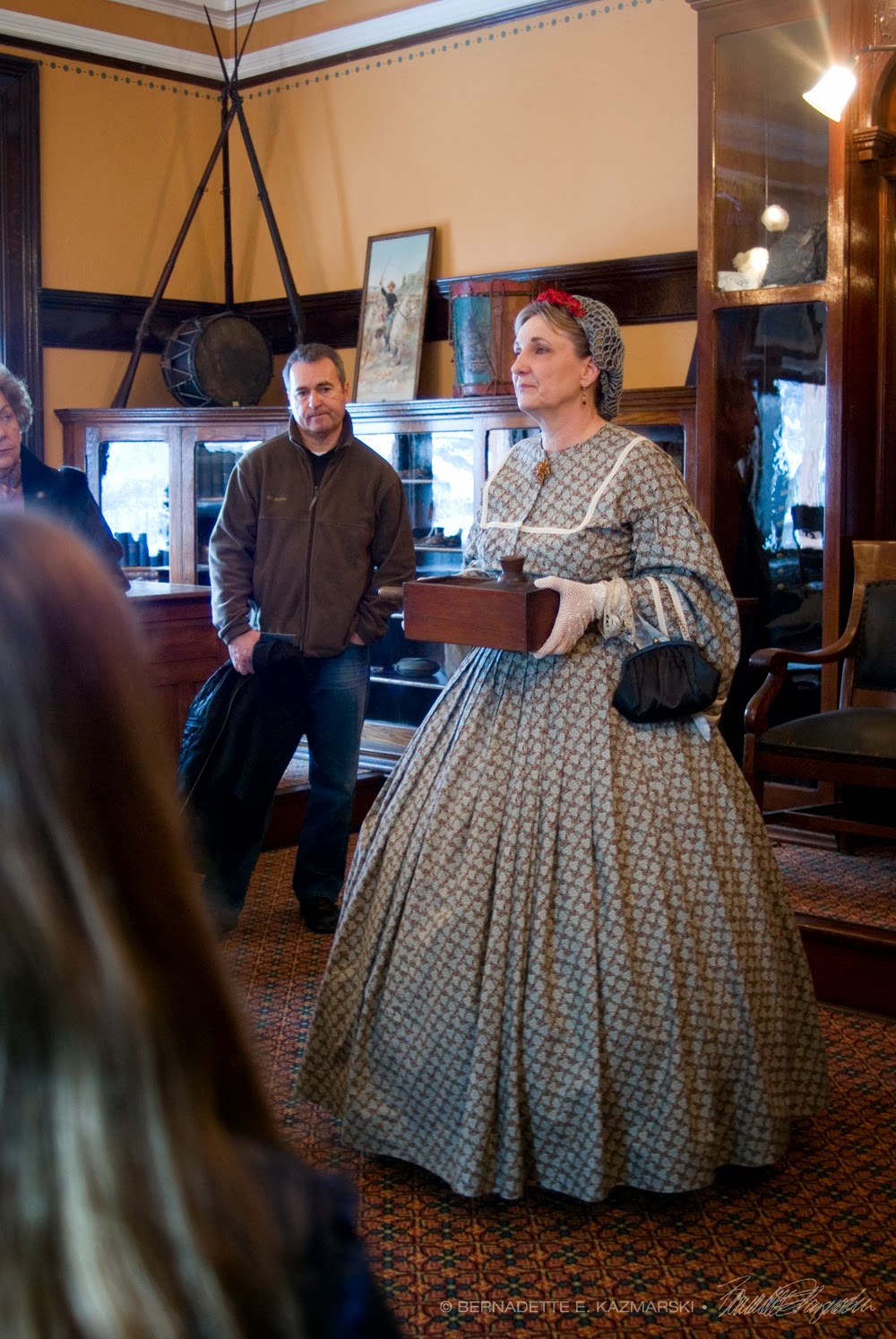
View today of Espy Room (©Bernadette Kazmarski)
And in 1911 catalog (Andrew Carnegie Free Library & Music Hall)

Item 48 in the collection of the Grand Army of the Republic, Capt. Thomas Espy Post 153, Department of Pennsylvania:
 
“Cotton: Was picked from the cotton bushes in 1881 by W. H. H. Lea, late Lieutenant of Co. I, 112th Reg., Pa. Vols., while on a visit to the Virginia battlefield, from the narrow strip of ground between the Union and rebel lines and directly in front of the rebel fort at Petersburg, Va., blown up July 30, 1864. Over this ground the charging columns passed. Almost every foot of this ground was covered with Union dead or stained by as brave blood as ever flowed from the veins of American soldiers.”

In 1906, Lea donated this clump of cotton for the GAR post’s new meeting room and artifact collection in a 24-foot-by-24 foot space in the upper floor of the Andrew Carnegie Free Library in Carnegie, a borough just west of Pittsburgh.

Cotton donated by Union veteran (©Bernadette Kazmarski)

While cotton may not seem a likely collectible, it must have meant something special for Lea to hold on to it for 25 years, well after the Civil War ended.

Each of the dozens of artifacts the members possessed or acquired – a rifle, drum, bayonet, Bible and even a canteen enveloped by a hornet’s nest – conjured to aging veterans who met in the handsome room for three decades a precious link to their service to country during the Civil War.

In 1937, the last member of the fraternal organization’s local post passed away.

“This was an outlet for them,” says Diane Klinefelter, who this month began serving as part-time curator for the Espy Post room. “Veterans today have a hard time talking about experiences to other than someone who went through it. These veterans were no different.”

Klinefelter’s duties at what is now called the Andrew Carnegie Free Library & Music Hall will include maintaining the artifacts collection and detailed manuscripts of the post’s operation, raising awareness of the room and organizing Civil War-related programming.

Portrait of Capt. Espy (Maggie Forbes)
Gavel made from trees at Gettysburg (©Bernadette Kazmarski)

“There are people who are lifelong members of the library who never come up and look at the Espy Post,” according to Executive Director Maggie Forbes.

The story of the mill town’s library and the Civil War room is remarkable, one that saw the charming building ensconced on a hill endure “water, age and poverty” until a rebirth about 10 years ago.

The Espy Room had been largely shuttered since 1937. Dozens of items disappeared, some perhaps taken as a “badge of honor” by local youth. Poor stewardship accompanied the deterioration of the building.

“Water was pouring (in),” Forbes recently told the Picket. “We were hanging on by our fingernails.”

An effort got underway to raise money – about $7.5 million has been netted so far -- to bring the venue, which includes what Forbes calls an acoustically superb performance center, back to its original glory. 

A Pittsburgh man originally from Birmingham, Ala., made a donation that largely covered the restoration of the Espy Post room, leading to is reopening in February 2010. The result is a faithful version of the original, down to even the wall color: Pumpkin chiffon pie.

The room, deemed a national treasure by the library, is open to visitors on Saturdays and by appointment.

Members of the post  circa 1904 (ACFLMH)

Company A of  9th Pennsylvania Reserves, a living history and re-enactment unit, helped launch the restoration and has participated in events at the library.
Company A of the 9th Pennsylvania Reserves 38th Pa. Volunteer Infantry - See more at: http://www.carnegiecarnegie.org/espy-post/9th-pa-reserves/#sthash.r23HwleV.dpuf

Through the efforts of staff and volunteers, the community has honored an agreement issued more than 100 years ago by members of the GAR post.

“When every veteran of the Espy Post has answered his last roll call, we leave for our children and their children, this room full of relics hoping they may be as proud of them as we are, and that they may see that they are protected and cared for – for all time.”

There to give a helping hand

Within a few years of the Civil War, thousands of GAR posts were fixtures in communities that sent boys in blue to fight.

At its peak, about a half million veterans were part of an organization that served the needs of its members, widows and children. It quickly became a Republican-supporting political force, lobbying for soldiers’ pensions and voting rights for black veterans.

The Espy Post was a relative rarity – it was integrated.

Records of veterans' service ( ©Bernadette Kazmarski)

A photograph taken on Memorial Day in 1903 or 1904 of Espy Post members gathered outside the library depicts at least four African-Americans, according to Klinefelter. 

Among them is Jonathan Grinage, Company C, 8th U.S. Colored Troops. His descendants have visited the Espy Post in recent years. “To have his relatives here meant a lot to us,” says Klinefelter, who previously served as the library’s director.

The local GAR chapter was chartered in 1879 in memory of Capt. Thomas Espy, who died during the Peninsula Campaign of 1862 in Virginia. His portrait presides over the Espy Room.

The post met in several locations in Carnegie, then a railroad and mill town, before settling on the library room in 1906. “It conveyed a sense of importance and permanence,” says Forbes.

Diane Klinefelter shows ballot box ( ©Bernadette Kazmarski)

The library in Carnegie is one of only four libraries in United States endowed by industrialist and philanthropist, Andrew Carnegie. It opened in 1901. The borough, also named for the Scottish-born magnate, resulted from the 1894 merger of two communities, Mansfield and Chartiers.

The GAR meeting room clearly was a man’s domain, from pictures of Custer’s Last Charge (postwar) to spittoons neatly positioned on the carpeted floor.

The room features four double windows and 12-foot ceilings. Artifact cases and furniture are abundant. “It is very Masonic,” says Forbes, referring to an altar in the center.

A women’s auxiliary, Ladies of the GAR, eventually took on much of the post’s benevolent mission while the veterans concentrated on pensions and political matters.

( ©Bernadette Kazmarski)
Most members were middle class, with farming, carpentry, iron and mill work and blacksmith as listed occupations. Membership dues provided help to families.

“If you needed a shipment of coal, and you did not have the money, the post would chip in,” according to Klinefelter.

The veterans voted on those who would be allowed to join. While some veterans had legitimate service records, others were found to be impostors or dishonorably discharged.

The Espy Post had about 200 members over its lifetime.

The library still has the wooden ballot box that contains marbles. After a prospective member was interviewed, the members would drop either a white or black marble into the box, signifying their vote.


Two floors of the building contain the music hall (©Bernadette Kazmarski)

The GAR very much had a social aspect, woven into the fabric of the community.

“We also have their dishes,” Klinefelter says of the collection. “They were very big on potluck suppers. Baked beans and buttered bread were very popular.”

One of the curator’s favorite items in the relic collection is the commander’s gavel, “because it is quite unique.”

The head, containing a bullet, is from a tree at the famed Devil’s Den below Little Round Top at Gettysburg.

The handle is fashioned from wood from Spangler’s Spring, on the same 1863 Pennsylvania battlefield.

Another corner in the room ( ©Bernadette Kazmarski)
How it looked in 1911 (ACFLMH)

The gavel was featured in a commemoration last year for the 150th anniversary of President Abraham Lincoln’s Gettysburg Address.

The veterans’ soldierly eye for detail and organization is evident in the room’s manuscript collection of applications, membership information, financial records and correspondence.

While some may find the manuscripts dry, they are like a “time capsule” for researchers who want to learn more about the GAR, according to Klinefelter. A PhD candidate last year did some research at the Civil War room.

Forbes, Klinefelter and others are especially grateful for a 1911 catalog produced by the Espy Post. It includes photos of the room’s four walls and its artifacts – an invaluable guide to restoring the room after despairing conditions the veterans likely did not envision.

Epaulettes belonging to Capt. Espy ( ©Bernadette Kazmarski)

“Thank God for the post historian,” says Klinefelter. “They realized they all would be gone. Every artifact has a number. Some of the artifacts have heartbreaking stories for them.”

Splendor, years of neglect, rebirth

Item 52 in the collection of the Capt. Thomas Espy Post 153:

“Sword: Presented to Lieut. Samuel H. Davis by Company I, 112th Regiment, Pa. Vet. Vols., February,1863. Lieut. Davis was killed at Cold Harbor, Va., June 1, 1864. The sword was covered with his blood. Lieut. Thos. C. Sharp, while keeping the sword to be shipped to Lieut. Davis’s parents at the first opportunity, was killed at Petersburg, Va., June 17, 1864, while wearing the sword, and was covered with his blood. The sword was then shipped to Mr.George Davis, father of Lieutenant Davis, by Adams Express Co. to Pittsburg, Pa. Mr. and Mrs. George Davis being noted rebel sympathizers, refused to pay the express charges of one dollar on the sword of their loyal son who gave his life for his country….”

Over the years, the Davis sword, like dozens of other items – including Capt. Espy’s uniform -- went missing. 

Forbes one day got a call from an individual who would not give his name. He returned a rifle, shotgun and two swords.

One was the Davis sword.

( ©Bernadette Kazmarski)

Items that currently are in the collection include a Bible carried in knapsack of a soldier wounded at Cedar Creek, Va.; a bullet that stuck a cavalry soldier who donated it to the memorial hall in 1911; a pine knot with grape shot from Chickamauga; and a carbine found beneath the body of a Confederate soldier after the Battle of Shiloh.

The GAR was destined to die, because its charter called for membership of those who served during the Civil War. It effectively went out of operation in 1956. 

According to the Sons of Union of Union Veterans of the Civil War, its successor organization, “The final Encampment of the Grand Army of the Republic was held in Indianapolis, Indiana, in 1949 and the last member, Albert Woolson died in 1956 at the age of 109 years.”

As members of the Espy Post became infirm or died away, the frequency of meetings upstairs decreased.

Replica corps flag with uniforms ( ©Bernadette Kazmarski)

When Woolson died, the Espy Room had been closed nearly 20 years. Over the next decades, water, mould, vermin and pilferers or artifact “borrowers” took their toll.

By 2003, the Carnegie facility was in rough shape. It had $136 in its checking account, according to Forbes.

Fund-raising began, eventually resulting in renewed splendor to the facility.

People ‘fall in love with it’

Item 173 in the collection of the Capt. Thomas Espy Post 153:

“Bayonet: Was found by James A. Boles, about 1891. Mr. Boles, while passing through the timber on the battlefield of Chancellorsville, Va., the bayonet was seen high up, sticking in the trunk of a pine tree. The tree was cut down and the bayonet and wood cut out. The theory is that a Confederate sharp shooter had stuck the bayonet in the tree to support his leg or used it for a rest for his rifle. The tree was in the Confederate lines, opposite the Chancellorsville house. …”

( ©Bernadette Kazmarski)

Half of the building today is a library. It has largely an older clientele, although youths from a public housing complex use it for school work.

The music hall, which also features theatrical productions, covers two floors. While it may seem unusual for a performance center and library to be in the same building, it was common in Carnegie libraries, according to Forbes.

“The building is very handsome,” she says. “People who come in for the first time fall in love with it.”

The restoration of the Espy Post room included work on the plaster walls and the installation of a new air conditioning system. The walls were dirty and gray; a paint sample from behind a heating radiator was sent off to a lab at Bryn Mawr so that its true color could be determined.

( ©Bernadette Kazmarski)

The carpet was replaced with one featuring a design that closely approximates the original. Remarkably, most of the furniture was in pretty good shape, although one chair was replaced.

Klinefelter’s curator position is funded by a grant through the Massey Charitable Trust. She has written two books about the conflict.

“To combine a library with a Civil War component and one of the last GAR posts that is intact is a chance of a lifetime.”

She hopes to form an advisory board and develop some programming related to the room. One idea is an educational workshop. “We have a very devoted, albeit small number of volunteers.”

The library is planning an April 5 living history in most of the building. Officials want to concentrate on the aftermath of the Battle of Gettysburg and its impact on townspeople. The day will include a photo exhibit to mark the 150th anniversary of the Battle of Petersburg in Virginia.

Various items in collection (ACFLMH)

Klinefelter says an examination of ledger books with biographical information about post members showed many served at Gettysburg in July 1863.

The curator, who has ancestors who fought on both sides, says she is interested primarily in the social context of the post and its vital part in the community.

“I don’t focus on the battle statistics. I am more of a social historian.”

Not used for events, the Espy Post room speaks to the public through its records and relics. The long-gone veterans might ask: Will people of today pay attention to stories of sacrifice and service?

Forbes hopes to see more visitors and perhaps expanded hours at some point. One thing is certain. 

The Civil War Room has captured a moment in time.

“There is an aura that you feel they just left the room.”

********

Espy Post hours: Saturdays 11 a.m. to 3 p.m. or weekdays by appointment. Groups interested in a tour should call, 412-276-3456, x5 to make special arrangements.