Showing posts with label dedication. Show all posts

Friday, November 3, 2023

New marker on Hilton Head Island pays tribute to Black regiment that helped build Fort Howell to protect freedmen

Marker is unveiled at Fort Howell entrance (town of Hilton Head Island)
A new marker on Hilton Head Island, SC., highlights the role of the 32nd U.S. Colored Infantry in the construction of Fort Howell, built to defend Mitchelville, a village populated by formerly enslaved people during the Civil War.

“This is a great day for Hilton Head Island because it shines a light on a piece of our past that needed to be explained more in depth and needed to be spotlighted properly,” Mayor Alan Perry said in prepared remarks for Wednesday’s ceremony at the well-preserved site. 

Much of coastal South Carolina fells into Union hands relatively early in the war and the Federal army needed to create camps for tens of thousands of newly freed families.

Mitchelville was the first such community in the area. (At left, a photo at Fort Howell of a metal figure depicting a 32nd USCT sergeant, courtesy of Hilton Head Island Land Trust)

While a previous sign at the well-preserved Fort Howell declared the earthen fortification's purpose and for whom it was named, the new marker lists the 32nd USCT and the 144th New York infantry as its builders in the latter half of 1864.

The army wanted to thwart any Confederate raids on Mitchelville. A large military encampment called Camp Baird was built near the fort.

The town worked with the Hilton Head Island Land Trust, which owns and maintains the site, and the South Carolina Department of Archives and History to create the new marker. 

George Banino, president of the land trust’s board, told the Picket the marker was changed in response to comments, especially the Gullah community, about telling the human story. 

“As the location of the U.S. headquarters for the Union's Department of the South from six months after the start of the war until a year after the end of the war, Hilton Head Island has an important history to tell,” Banino said.  

Bridge at entrance crosses remains of moat (Wikipedia photo)

Perry said the new marker "conveys a single cohesive narrative of our history."

The Picket also reached out to Historic Mitchelville Freedom Park for comment.

Historical records show 500 officers and men from the 32nd USCT worked a few months to create the 3-acre Fort Howell. It was designed to be manned by artillerymen and as many as 27 large weapons, according to a news release from the town.

New marker at left replaced one at right. (Town of Hilton Head and Mike Sroud, HMdb.org)
USCT members faced discrimination within the U.S. Army and were not recognized as soldiers by the Confederacy, which threatened to execute or return them to slavery.

More than 180,000 men served in the USCT, about 10% of all Federal soldiers. More than 40,000 died of combat, illness and disease.

The post is named for Union Brig. Gen. Joshua B. Howell, who died in September 1864 after falling from his horse in Virginia.

Plan for the five-sided Fort Howell (National Archives)
Though Fort Howell never saw action, it is significant for its design and its structural integrity. It was listed in the National Register of Historic Places in 2011, according to the Historical Marker Database. 

“The fort, an essentially pentagonal enclosure constructed of built-up earth, is quite discernible despite natural erosion and the growth of trees and other vegetation,” says HMdb.org.

Fort Howell is the best-preserved earthen Civil War fort in South Carolina, although erosion has taken away some fine features, the trust says.

Rendering of what the fort, surroundings may have looked like
 (Mary Ann Browning Ford for Hilton Head Island Land Trust)
Over the past 10 years or so, the park has been transformed from a site containing some low earthen mounds covered by dense vegetation to a learning center for all visitors, Banino said. Improvements include extensive signage and walking paths.

“A large portion of the vegetation has been removed to enable visitors to view the structure of the fort, although enough vegetation has been retained to provide protection from continued erosion,” he said.

Exterior wall of fort across from moat (Hilton Head Island Land Trust)
Fort Howell, at 160 Beach City Road near the island’s airport, is open to the public with adjacent areas for parking. It has several interpretive signs and metal figures represent soldiers and others. It is open from dawn to dusk, according to the trust.

The town says Fort Howell is a key site on the National Park Service's Network to Freedom, which encompasses the Underground Railroad and the Civil War Discovery Trail.

Tuesday, December 13, 2022

Unveiling of marker in Nashville will be the latest in the area to honor service of black Union troops (USCT) during the Civil War

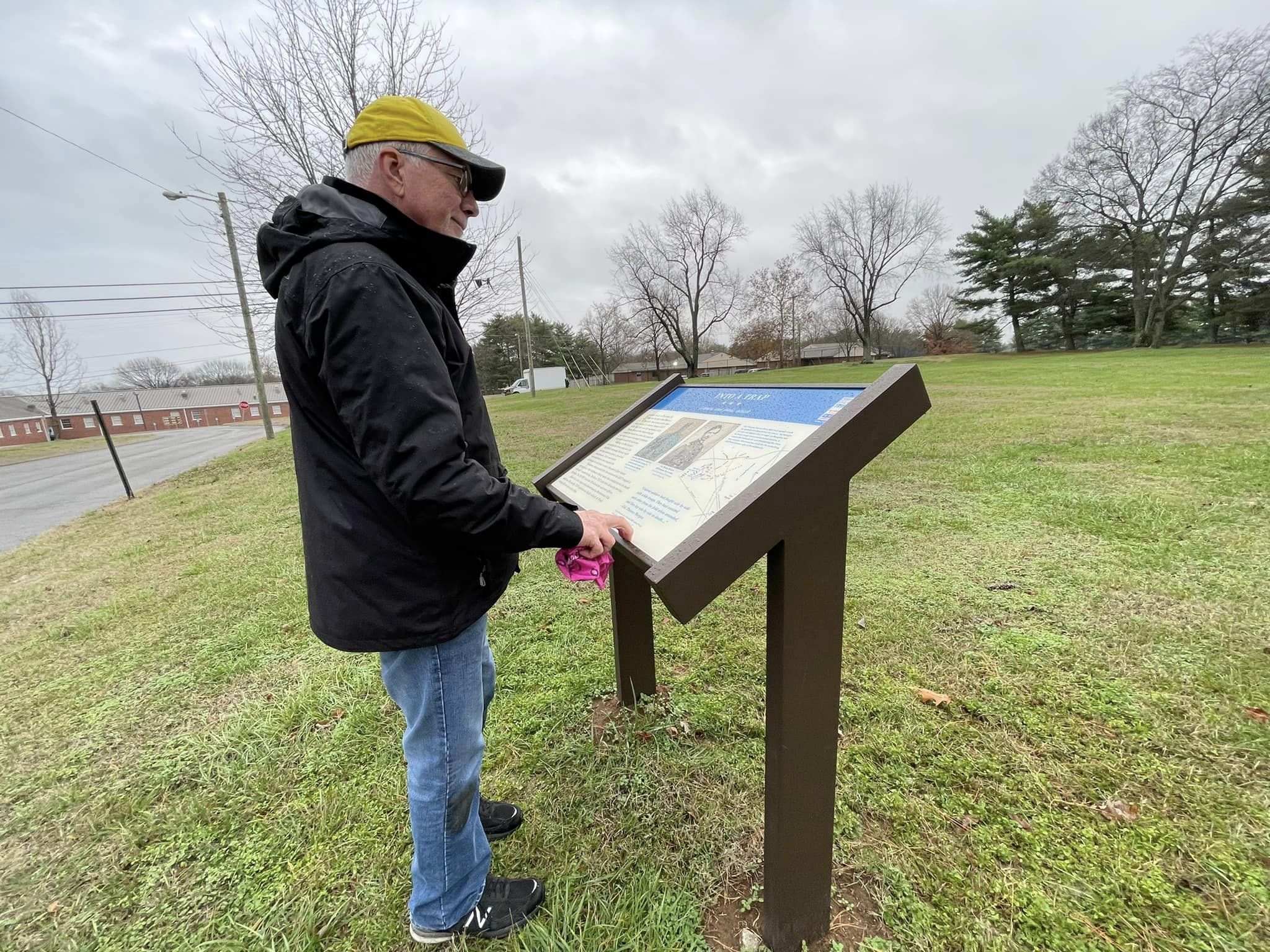
Jack Richards checks out the new Civil War Trails sign (Courtesy of John Banks)
African-American troops --- many former slaves seeing combat for the first time – will be remembered this week in Nashville with the dedication of the latest sign in the region to honor their valor during the Civil War.

The Battle of Nashville Trust, local officials and STEM Prep Academy backed the Civil WarTrails marker focusing on U.S. Colored Troops (USCT).

“The fact that this small sliver of battlefield survives and is the place where this monumental event occurred is amazing.” Drew Gruber, executive director of Civil Trails, said in a press release. “It’s not hard to stand at the new sign and imagine the United States flags being unfurled as these men charged forward charting a new course for our nation.” 

The event is scheduled for 10 a.m. Thursday (Dec. 15) at the school.

A fanciful depiction of Nashville includes Black troops (Library of Congress)
Three USCT regiments (14th, 17th and 44th) took part in a futile attack on fortifications on Dec. 15, 1864, the first day of the battle. The sign, on school property, is placed where troops advanced that morning.

Their object was the so-called Granbury’s Lunette, named for a Southern general who died two weeks earlier at fighting in nearby Franklin. A deep railroad cut, stronger than expected forces and artillery doomed the USCT assault. A maneuver by seasoned troops trapped them, and the USCT regiments and white Union troops were forced to retreat within 10 minutes.

The 17th had nearly 120 casualties in the fighting.

Other USCT troops had a bit more success the next day in fighting at Peach Orchard Hill, which led to a Confederate retreat after intense combat. The 13th USCT suffered crushing casualties.

Granbury's crescent lunette was strongly defended (Battle of Nashville Trust)
The Tennessee Wars Commission provided grants for the new marker and one planned for Peach Orchard Hill. In 2021, the Tennessee Historical Commission erected a sign about a half mile from Granbury’s Lunette, emphasizing the role of African-American troops.

Also in 2021, the Battle of Franklin Trust and local officials unveiled a statue honoring former slaves who fought for the Union.

USCT units were relatively new when the Battle of Nashville took place and there were questions of whether they would make an effective fighting force.

Federal Maj. Gen. George Thomas inspected the battlefield and said to his staff, “Gentlemen, the question is settled; Negroes will fight.”

About 180,000 black men served in Union forces during the conflict.

Dedication of a related marker in October 2021 (Battle of Nashville Trust)

Friday, October 7, 2022

More than a century after his death, research leads to a black Civil War naval veteran finally receives a headstone in Tacoma, Wash.

Wreaths were placed near new headstone Saturday (Oakwood Hill Cemetery)
Updated Oct. 10

In life, David Franklin and David Phillips may have rubbed elbows at a Tacoma, Wash., post of the Grand Army of the Republic in which they were members. Custer Post No. 6 was a home away from home for those who served the Union during the Civil War -- a place where veterans shared food and drink and accounts of their harrowing experiences while they were younger.

Sketch of David Franklin (Alan Archambault)
In the hereafter, Franklin and Phillips lie within steps of each other. But while Phillips, a white man who served in the 4th Minnesota, has a marked grave, the final resting spot of Franklin, Tacoma’s only black Civil War naval veteran, was topped only by grass.

That unfortunate situation was rectified this week with the installation of a marble Veterans Administration-approved headstone.

A dedication ceremony Saturday morning (Oct. 8) at Oakwood Hill Cemetery in Tacoma finally brought Franklin an honor he has long deserved.

The effort to recognize Franklin, who died in 1920 at age 79, was led by Loran Bures, Phillips’ second great-grandson. Bures, a member of the Sons of Union Veterans of the Civil War, the successor to the GAR, came across Franklin in 2017 while conducting research on veterans who lived in Pierce County, home to Tacoma.

The SUVCW’s mission includes researching GAR records, the registration of graves and Civil War memorials and monuments.

Bures (pronounced Burruss) came across a biographical card produced in 1939 during research by the Works Progress Administration into Civil War veterans in the area.

“It speaks volumes the information it doesn’t have,” Bures told the Civil War Picket this week.

The card does indicate Franklin died of heart disease on March 16, 1920, and was buried in the GAR section at Oakwood Hill.

But it had no information on any marker, the veteran’s military service and the fact that Franklin was black. While the GAR was open to all ethnicities, there were only three black sailors among the 2,000-5,000 Civil War veterans living in Washington, according to Bures, a 69-year-old retired librarian, archivist and researcher.

Bures came across Franklin’s death certificate and a National Park Service database that showed the man served as officers’ steward and cook on the USS Dawn. The steam-powered vessel took part in Federal blockades and captured several ships. Much of its service was on the James River in Virginia.

The USS Dawn’s most famous action came in May 1864 in the defense of Wilson’s Wharf in Virginia. The vessel’s guns and the Federal garrison made up of U.S. Colored Troops drove back the Confederate assault.

As a cook and steward, Franklin’s primary role would not have been combat, but it was common practice for a crew member to have a second duty station.

The USS Dawn was built in 1857. (Wikipedia)
At Wilson’s Wharf, “he most likely was helping bring powder and ammunition below deck to the three guns on the deck,” said Bures, adding there is no way to verify that.

Franklin is listed as an ordinary seaman in the NPS file.

Group does not know of living relatives

There are gaps in what’s known about Franklin, including when he moved to Washington and whether he ever married. His death certificate says he was widowed, but Bures said he has found no information about a spouse. The local SUVCW is asking any possible descendants or relatives to contact the organization.

It is known that Franklin was born in 1840. “He was born free in New York City to parents who were free people of color,” said Bures.

Franklin joined the Navy at age 23 in November 1863, midway through the Civil War. The NPS database lists him as being 5 foot 5 inches tall and working as a cook. He served on USS Dawn until near war’s end, mustering out in March 1865.

Bures believes the veteran came to Pierce County between 1885 and 1888. He is listed in a GAR roster for the latter year and a 1907 volume includes Franklin among 752 members (comrades) in the Custer post.

Records show that Franklin joined the Washington National Guard infantry as a cook in 1906.

Ensuring proper honors for veteran

Bures traveled to Oakwood Hill Cemetery several months ago to inspect Franklin’s grave.

He suspected it might be unmarked because of the WPA card and a Findagrave profile that had no photo of a headstone. (Researchers have been unable to find a photograph of Franklin. Bures' second great-grandfather, 1st Sgt. David Phillips, is buried at Tacoma Mausoleum, which adjoins the cemetery.)

Oakwood Hill verified the seaman was buried there and had not been exhumed, officials told the Picket .

Franklin’s resting place was a gap in a row of headstones for other GAR members. Bures and others put together verification information for the VA, including evidence of a Navy pension.

Franklin's graves was marked only by a flag (Loran Bures)
Bures would speculate on why Franklin’s grave received no marker. “There could be a lot of reasons for it.” Oakwood Hill Cemetery co-owner Corey Gaffney told the Picket he, too, did not know why a headstone was not set in 1920.

Gaffney, who purchased the business with his wife, Jennifer, in 2021, told theTacoma News-Tribune the cemetery was providing resources to ensure Franklin received proper honors.

The grave is among weathered headstones that appear not to have been cleaned in recent years. The businessman told the Picket that the couple is working to make improvements at the cemetery and funeral home and restore the site to "its former glory."

"We believe that in 3-5 years this property will be completely viable and unrecognizable to some. That’s our hope and our goal."

Gaffney told the Picket in an email after the ceremony that "the definition of integrity is doing the right thing when no one is looking. While we did have coverage of this event and dedication, there are countless other actions we’ve took for the benefit of this cemetery that have gone unnoticed.  We do not do things for accolades; more for knowing at the end of the day that we acted appropriately on behalf of those in our care that cannot do so anymore themselves."

Bures said there are other unmarked graves of Civil War veterans across the state.

“It is important they receive recognition for their service to the Union, as any veteran deserves proper recognition.”

The SUVC's Gov. Isaac Stevens Camp No. 1, in which Bures is an officer, led Saturday's headstone dedication. The ceremony included a wreath laying, remarks, a biography of Franklin and funeral honors performed by re-enactors.

Loran Bures stands on Franklin's grave before marker was placed; behind is a mausoleum. 

Monday, June 30, 2014

'Blood of heroes': Kennesaw Mtn ceremony remembers the fallen 150 years later

Boy Scouts light memorial luminaries below Cheatham Hill

“We are the country’s millions ….”

The words rolled forth Saturday night from the hilltop where men in gray poured out lethal fire 150 years ago.

The words rushed downward, into the audience sitting where men in blue desperately dug into the earth, seeking protection from that windstorm of projectiles.

“… Our country was founded in 1776. But our nation was forged between 1861 and 1865.”

The words kept on, pushing into the wide, green meadow where bodies once were piled in heaps. They traveled over memorial luminaries – 3,138 of them – that flickered in the night.

“. … The ground on which we stand today was soaked with the blood of heroes in 1864.”


When the words finally reached the tree line, they echoed back up the hill. They told of a momentary Southern victory that gave way to defeat less than a year later.

“… Confederate independence failed. The Union restored,” said Gordon Jones, senior military historian and curator at the Atlanta History Center. “Slavery abolished. One nation, not two. One vision of the future realized. Another denied.”

Jones was among the speakers at the centennial dedication of the recently-restored Illinois Monument on Cheatham Hill at Kennesaw Mountain National Battlefield Park.

The ceremony was the most solemn event at the weekend commemoration of the 150th anniversary of the Battle of Kennesaw Mountain in North Georgia during the Atlanta Campaign.

Jones referred to Sgt. Josiah Chaney of the Union Army, who wrote he and his comrades fought “for the sake of the country’s millions who are to come after us.”

While Saturday’s audience, which included re-enactors -- some portraying Confederate, some portraying Federals -- listened, Jones told the crowd that “we are the people they fought for.”


He spoke of the bravery of thousands of Union troops who had to cover 580 yards up Cheatham Hill, the strong center of the Confederate line, on the morning of June 27, 1864.

Federal army commander William Tecumseh Sherman was determined to dislodge Confederate troops from Pigeon Hill and Cheatham Hill.

Two divisions were assigned to take Cheatham Hill, taking on boys who fought for Benjamin "Frank" Cheatham and Patrick Cleburne.

The assault ended in disaster for Federal troops, who were pummeled by an enemy that held a much better position with seasoned troops. Hundreds were pinned down at the “Dead Angle” for several days, before the Confederate troops were withdrawn.

Click to enlarge to see luminaries panorama

It wasn’t just Illinois men that charged up Cheatham Hill, says park historian Willie Johnson. McCook’s, Harker’s and Mitchell’s brigades included many regiments from Ohio and a few from Kentucky and Indiana.

Harker and McCook descendants were among the guests at the dedication, 100 years after the Illinois Monument was installed by Union veterans.

Brig. Gen. Dan McCook, a member of the “Fighting McCooks” family, gained fame in the assault. He rallied his troops at the top of the “Dead Angle” before he was cut down. He died three weeks later.


“The Confederates won the battle, but lost the war,” park Superintendent Nancy Walther said at the dedication.

Sherman continued his relentless move on Atlanta, before taking it only a couple months later and continuing on to Savannah, Ga., and the Carolinas.

Union veterans of the battle bought 60 acres on Cheatham Hill in 1899 and set about raising money for the monument, which was dedicated in 1914. Vintage automobiles were parked on the grounds Saturday night as a reminder of that first event.

David Crass, head of Georgia’s Historic Preservation Division, lauded the efforts of those early battlefield preservationists.

Memorial luminaries (Larry Knight, Kennesaw Mtn Trail Club)

Dozens of Boy Scouts set out the luminaries, one for each man who died within a few short hours of each other. LED lights inside flickered at the end of the ceremony, providing a powerful image of human courage and sacrifices. The overwhelming majority of the fallen fought for the North.

Park Chief Ranger Anthony Winegar talked of an ancestor who served as a Federal artilleryman. He encouraged the crowd to do their own research.

“You may not be as far removed (from the war) as you think.”

Catherine Shannon, deputy director at the Illinois Historic Preservation Agency, thanked volunteers, Georgia officials and the National Park Service for their efforts to keep alive memories of the fallen “for future generations.”

Thursday, October 7, 2010

Andrew Young on soldiers paying the price

Former UN Ambassador Andrew Young on Wednesday paid tribute to African-Americans whose service to their country goes back to the American Revolution.

Young was the keynote speaker at the dedication at Fort Hill School in Dalton, Ga., of a sign honoring the service of the 44th U.S. Colored Troops during the Civil War.

I'm indebted to Charlie Crawford, head of the Georgia Battlefields Association, for this account and photos. The GBA helped fund the sign and assisted in its writing.

A clear autumn morning in North Georgia's rolling hills saw at least 200 in attendance. A children's chorus sang "Battle Hymn of the Republic."

According to Crawford, "Young spoke without notes and with great feeling. He went back to Crispus Attucks and black troops in the Revolutionary War, then spent some time on Andrew Jackson assembling an army in New Orleans and granting black volunteers land in western Louisiana as a reward.

"Young, who is from New Orleans, said this made quite an impression on his family and explains why he is named Andrew Jackson Young, a name that has recurred in his family over the generations. He spoke of how soldiers pay the price for diplomats' failures and how Americans' willingness to fight for the nation is stronger than any ethnic, cultural, or racial differences."

• Related Picket article on the 44th