Showing posts with label African-American. Show all posts

Tuesday, January 14, 2025

South Carolina's monument to Civil War hero Robert Smalls will rival old statues of white supremacists, and his story will be the one that inspires schoolchildren

Basil Watson's rendering of the memorial (Robert Smalls Monument Commission)
The loss of a tree outside the South Carolina State House – whether by chance, or divine intervention – opened a spot for a statue of Civil War hero Robert Smalls, who will stand equal to monuments of white supremacists on the Capitol grounds.

The Robert Smalls Monument Commission, made up mostly of legislators, last week unanimously approved a design and memorial location for the enslaved man who first gained fame for commandeering a Confederate ship in Charleston harbor in March 1862.

Choosing from three finalists, the commission chose a statue that depicts Smalls in a three-piece suit, at the height of his power in Congress.

“This depiction is important because Smalls should be viewed as possessing the same gravitas as historical figures such as Wade Hampton, Ben Tillman, James Byrnes, Strom Thurmond as depicted in monuments on the State House grounds,” said white state Rep. Brandon Cox.

The proposal needs action from a legislative committee and a full vote by the South Carolina General Assembly to become reality. The State Department of Administration and legislators are working to raise private money to build the Smalls monument in Columbia.

No price tag has been determined for the project. As of Tuesday, the commission has received $11,530 in donations, spokesperson Brooke Bailey told the Picket.

Artist Basil Watson of Lawrenceville, Ga., created the approved design.

“(Smalls, left) demonstrated from an early age a spirit of demanding equality, feeling that he was equal and capable,” said Watson, according to the South Carolina Daily Gazette. “I think this was the spirit that he carried throughout his life.”

At the start of the Civil War, Smalls, 23, was a pilot on the steamship CSS Planter. On the morning of May 13, 1862, Smalls led the takeover of the ship by its slave crew, sailed past the harbor's formidable defenses and surrendered the vessel to the Union blockade fleet. His wife and children were among those on board who gained freedom.

Smalls met with President Abraham Lincoln and lobbied him to recruit black men to serve in the Union army. The former slave served as a pilot on the ship USS Crusader.

Brown Memorials of Florence, S.C., submitted this design (Robert Smalls Monument Commission)
Smalls returned to his hometown Beaufort and bought his former master’s home. After the war, he served in South Carolina’s Legislature, was elected to the U.S. House of Representatives and served several terms.

The congressman fought against the disenfranchisement of black voters across the South, according to the American Battlefield Trust.

He also fought against segregation within the military, advocated for compulsory education in South Carolina, opened a school for black children and published a newspaper, among other accomplishments.

As the Post and Courier newspaper pointed out, the monument will be on a 22-acre property in Columbia dominated by Confederate memorials. (Pate Studio design, right, Robert Smalls Monument Commission)

“Confederate Gen. Wade Hampton, who enslaved people, has a statue, as does Benjamin Tillman, the former governor and white supremacist whose brother George used violence and intimidation to rob Smalls of his seat in Congress before his colleagues eventually removed him from office.”

Watson’s design was straightforward, with a single likeness of Smalls, rising above panels on the base describing his service and patriotism.

One panel includes a famous line uttered by Small in 1895:

“My race needs no special defense, for the past history of them in this country proves them to be the equal of any people anywhere. All they need is an equal chance in the battle of life.”

Suggested text for one of the statue's panels (Robert Small Monument Commission)
At last week’s commission meeting, a state senator at first favored the two other designs, which featured two to three statues depicting Smalls during different phases of his life, including his Civil War exploit.

Others disagreed.

Mike Shealy, who chairs the commission, and state Sen. Darrell Jackson, who is black, said Smalls should appear as other statues on the ground. A separate African-American monument on the grounds provides a wider story with more figures, they said.

The African-American monument on the Capitol grounds in Columbia (Library of Congress)
“The simplicity of the statue of one man on a pedestal who is equal to the other people that are memorialized on our State House grounds is the best depiction,” said Shealy.

The commission also released a map showing all the nearly two dozen monuments at the Capitol. Legislators said the location for the monument became after a tree branch fell. Officials later learned the tree was dying.

Black Rep. Jermaine Johnson said Smalls will stand near the visitor entrance to the State House and will provide a powerful reminder to schoolchildren about equal rights.

And, he said, visitors will be able to see the statues of Hampton and “Pitchfork” Ben Tillman (photo right, Wikipedia) from the location -- a reminder that Smalls overcame cruelties of the racist South.

Tillman, an agrarian populist, promulgated violence from groups who opposed Black rights and voting. A Clemson University biography says of him: "While bringing several progressive reforms to the state, he also was at the forefront of the movement to marginalize and disfranchise black Southerners further in the late 19th and early 20th centuries." He helped eradicate some reforms championed by Smalls.

According to the Associated Press, despite cries from many to get rid of such memorials, state law requires legislative approval to remove statues of Confederates or white supremacists, or even add language detailing their racist deeds. 

That has been an impossible task in a state dominated by conservative Republicans, according to the AP.

So now a new chapter is being written.

The state that was the first to secede from the United States, and was ruled for generations by white supremacists, will place its first monument to a single African-American individual on its State House grounds.

Click Robert Smalls Monument Commission map below to see where his statue will stand (near the star, on the State House grounds in Columbia.

Tuesday, June 18, 2024

This Black regiment fought at Fort Fisher and protected Washington, D.C. A new sign at a fort in Arlington will remember the 107th UCT's campaign for equality

107th USCT troops at Fort Corcoran in Northern Virginia (Library of Congress)
and John McNair of Arlington parks and Drew Gruber of Civil War Trails with sign at Fort Ethan Allen
National Park Service ranger Steve T. Phan likes to refer to the 68 enclosed fortifications that defended Washington, D.C., during the Civil War as “Freedom’s Forts.”

Thousands of enslaved people attempted to self-emancipate at U.S.  Army lines around the capital and the forts and Union soldiers were often their first contact.

“African-Americans labored in army camps and at the forts, and perhaps fitting, were later stationed in the defenses as USCT soldiers,” Phan told the Picket. “The soldiers not only helped secure the capital, they participated in the destruction of slavery and the restoration of the Union.”

Phan, chief of interpretation at Camp Nelson National Monument in Kentucky, served from 2017-2021 with the NPS’ unit telling the story of the Civil War Defenses of Washington. His expertise was called upon for a new marker remembering the service of a USCT regiment at Fort Ethan Allen, now a park in Arlington, Va.

Arlington’s parks and recreation team and community leaders on Thursday morning – a day after Juneteenth -- will unveil a Civil War Trails sign at the park remembering the 107th U.S. Colored Troops, one of at least three African-American regiments that helped man the 68 forts.

The regiment, which was organized in Louisville, Ky., in spring 1864, took part in fighting in North Carolina, including the assault on Fort Fisher. It later sent two companies (C and H), about 200 men, to Fort Ethan Allen, one of the strongest and heavily armed of the DC sites, in October 1865, while other troops were stationed nearby

They drilled and manned Fort Ethan Allen’s ramparts in case trouble ever began. While the war had been over in the region for several months, Phan said the Army kept about 20 forts open into 1866. “A lot of the USCT had to fulfill their three years of service,” having enlisted in 1863 and 1864. (At left, Sgt. Maj. Charles Singer of Company A, 10th USCT, NPS photo)

“Congress did not want to pay for the maintenance and garrisoning. The chief engineer made the point, ‘Remember where we were at in 1861, when there was no defense of the capital, and we had to rush to build these forts,’” says Phan.

The forts were such a powerful deterrent against the Confederacy that just a few saw action, and only for a couple days in July 1864. Rebel units nearing the capital put the city into panic, but their foray ended when they were rebuffed at Fort Stevens in Maryland.

Fort Ethan Allen, near Key Bridge, was not among the outposts that opened artillery fire on Confederates approaching Fort Stevens.

Earthwork remnants in nearby 19-acre Fort C.F. Smith Park are considered the best preserved of the 22 Arlington-area forts. While most traces are gone, the ruins of the lunette fort include a bomb proof, the fort well, the north magazine and 11 of the 22 gun emplacements.

The forts on the Arlington Line, plus Ethan Allen, were built to complement each other. “One fort doesn’t need to protect everything. It can rely on other forts,” said John McNair, historian for Fort C.F. Smith Park. McNair led the two-effort to put the new marker at Fort Ethan Allen Park.

Fort Ethan Allen (top left) and other Civil War forts near the Potomac (Library of Congress)
That’s why most of the guns in the lunette at C.F. Smith are trained to the northwest, to cover the gap between it and Ethan Allen, instead of to the south, where Confederates attackers would likely emerge. Fort Strong took care of that sector, McNair told the Picket in 2018.

By autumn 1865, the defeated Confederate army was gone. But that did not mean the 107th USCT companies at Fort Ethan Allen relaxed.

They protected government property and ordnance that was to be sold to pay off the war debt.

Many white Virginians, ardent secessionists and pro-slavery citizens in Maryland were likely hostile to the troops, said Phan (right).

For the soldiers in the 107th – along with the 4th USCT and 28th USCT – deployment in and around Washington must have been especially poignant.

“The majority of these men are enslaved and they are going to end their war service in the view of the Capitol. That is pretty incredible,” said Phan.

Black troops were fighting for the rights of citizenship after many had freed themselves by leaving the South. “They want to be able to move, to purchase property, to marry who they want. They want to vote.”

Seven months before war’s end, Sgt. Maj. Charles Singer of the 107th wrote a letter published in The Christian Monitor about his motivation. Singer was born free, a rarity among USCT soldiers.

Pvt. Creed Miller, a former slave, fought with Company E of the 107th UST.
He died of disease in 1866 (National Museum of African American History and Culture)
“I wish for nothing but to breathe … the air of liberty…. I have no ambition, unless it to be to break the chain and exclaim: ‘Freedom to all!” Singer wrote. “I never will be satisfied so long as the meanest slave in the South has a link of chain clinging to his leg.

Phan emphasized that freedom doesn’t ensure equality.

About 23,000 Black troops enlisted in Kentucky and those who returned to the state after the Civil War endured stiff discrimination and the codification of Jim Crow laws. Kentucky, a Southern border state during the conflict, did not officially ratify the 13th Amendment – which abolished slavery – until 1876.

Remaining earthworks at Fort Ethan Allen Park (Farragutful, Wikipedia)
USCT veterans formed communities across the state while others joined the Army and became
the first Buffalo Soldiers, serving for another 20 years.

“It is a practical way to take care of themselves and their families,” said Phan.

Others moved to Ohio or other Midwestern states. About 5,000 Kentuckians went to Kansas, many joining the Black colony in Nicodemus in the 1870s.

In a news release about the sign, Rita McClenny, president and CEO of the Virginia Tourism Corporation, said the park offers travelers an opportunity to stand in the footsteps of warriors.

Plan for Fort Ethan Allen in Virginia, near Key Bridge (Library of Congress)
"These men did not sit idly by as the war progressed and this new sign commemorates those who fearlessly fought for emancipation and equality,” she said.

NPS ranger Bryan Cheeseboro, an expert on the African-American troops in the war and a speaker at the event, has said USCT troops were stationed at Fort Runyon. At least 20 members of the 45th USCT are buried at Arlington National Cemetery, he said.

The Picket has reached out to Arlington County’s John McNair for comment.

The Civil War Trails sign unveiling will take place at 9:30 a.m. Thursday at Fort Ethan Allen Park, 3829 N. Stafford St., Arlington, Va. Call 703-228-1865 for more information on the unveiling.

Thursday, June 6, 2024

William Johnson was born enslaved, died a Civil War veteran. A Jacksonville consortium will revitalize a campus cemetery and restore his headstone amid larger effort to honor area USCT soldiers

New headstone, exterior of cemetery and old marker before it was stolen (Jacksonville University)'
Sketch of Black soldiers in Florida (State Library and Archives of Florida)
Perhaps they rest under a live oak or Sabal palm in an overgrown and forgotten plot, tucked away in what is now forest.
 A few may be beneath unmarked graves along a busy thoroughfare.

Regardless of the setting, a nonprofit in Jacksonville, Fla., is attempting to track down the graves of African-American soldiers – many of them formerly enslaved -- who served in a United States Colored Troops regiment during the Civil War.

The idea is to place government-approved headstones marking their service to country and, when possible, to rehabilitate abandoned USCT gravesites, “bringing these soldiers and their descendants the redemption they have so deserved.”

That initiative got some attention recently after Jacksonville University and the nonprofit, Local Initiatives Support Coalition (LISC) Jacksonville, announced plans to improve a fenced cemetery on campus that holds the remains of Cpl. William Johnson, Company F, 33rd USCT.  A new VA-approved headstone, expected to be erected by Veterans Day, will replace one stolen after a university staffer rediscovered the neglected cemetery in the late 1980s.

In a larger effort, LISC Jacksonville, in partnership with the Digital Humanities Institute at the University of North Florida, will use pension and other records to apply for grave markers for other USCT members in the area. (At right, soldiers believed to the be in the 1st South Carolina Volunteers, later the 33rd USCT)

“After the Civil War, Black veterans and their families fought a completely different battle; however, this one was a true logomachy, a war of words,” says the introduction to a UNF page about the pensioners. “From pleading with Army officials that they were who they said they were to widows who wouldn’t quit, these pension records tell the stories of resilience in the face of institutionalized discrimination and racism.”

Jacksonville University emeritus professor of history Craig Buettinger notified LISC about the unmarked Johnson grave in 2022 when the organization launched its Operation Final Hours initiative. The aim is to help Duval County families receive and install headstones from the Department of Veteran Affairs for an unmarked burial site. About 25 families have been helped thus far, LISC says.

Kristopher Smith, community development program officer at LISC Jacksonville, told the Civil War Picket in an email there could be other African-American soldiers buried in the former Chaseville Cemetery, which predates Jacksonville University. Buettinger said “fragments suggest another USCT veteran.”

Smith (left) said in the coming weeks, LISC will try to track down the locations of other members of  Johnson’s Company F of the 33rd USCT.

“I won't have a total number until after we complete our preliminary review in mid-June,” Smith said.

James Beasley, director of the UNF institute, told the Picket he is honored to help preserve the memory of the USCT pensioners and help students “engage in research that impacts the community. Students were able to take the skills that we teach in our classes and have it affect social change.”

From enslavement to serving the United States

Buettinger said Cpl. Johnson's “life is also mostly hidden from us, especially before his enlistment.”  

The soldier was likely born enslaved in Duval County and was believed to be a field hand. He traveled to the Union lines at Fernandina, enlisting at Fort Clinch with one of the first Black regiments to be raised after the 1863 Emancipation Proclamation. (Confederate and Union forces battled over Jacksonville throughout the war.)

The 1st South Carolina before it became the 33rd USCT (Library of Congress)
Johnson was believed to be about 21 when he and two friends enlisted with the 1st South Carolina Colored Infantry in January 1863.

The 33rd USCT was later formed from the 1st South Carolina, according to the National Park Service. It served in South Carolina and took part in several expeditions. The regiment was in occupied Charleston at war’s end and was stationed there several months.

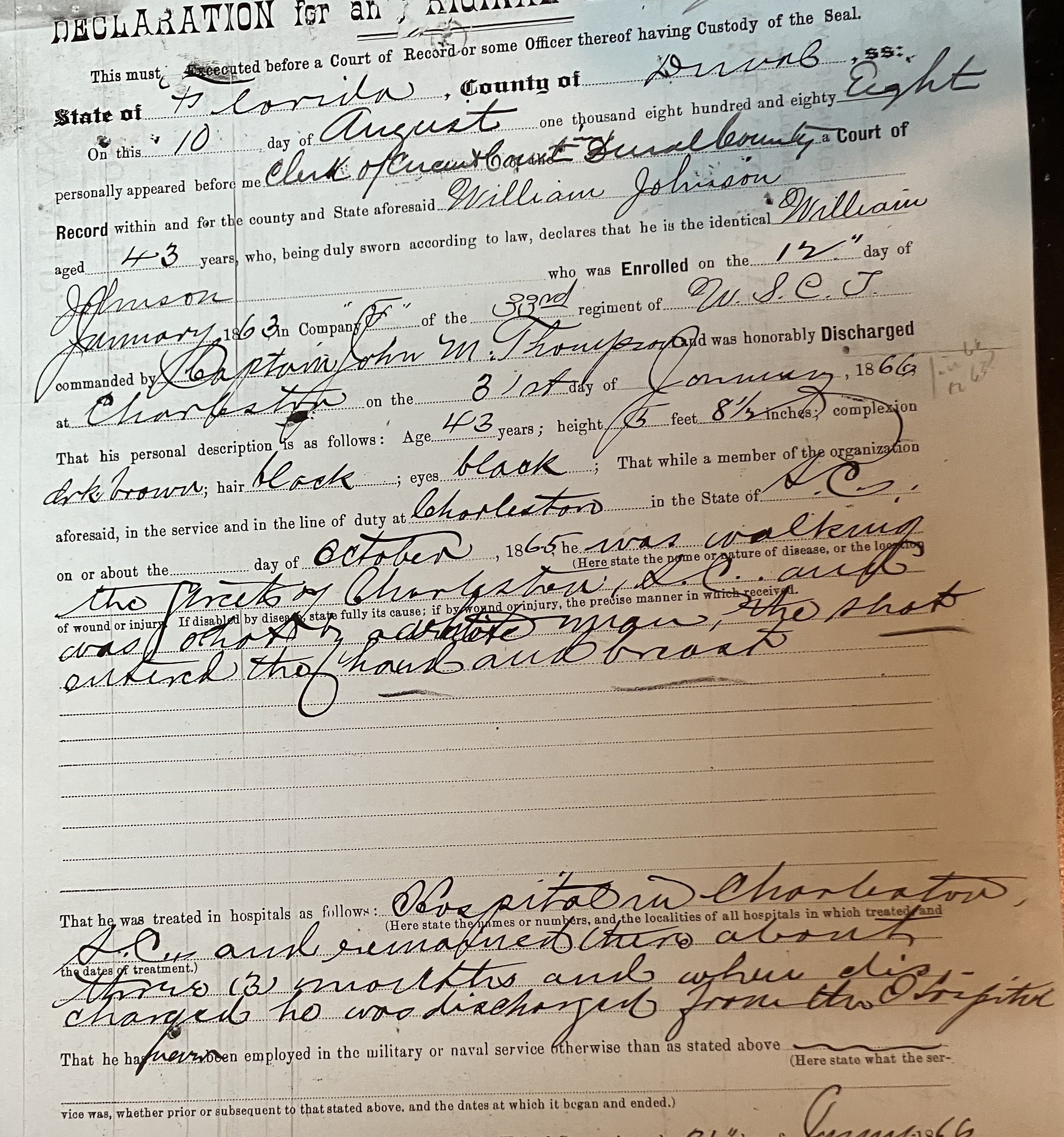
Pension records (below) show Johnson was shot in the hand and chest by a bushwhacker in October 1865, leaving him partially disabled. He was discharged the following year.

William Johnson's pension request details wounding (click to enlarge)
Johnson later lived in the Arlington neighborhood of Jacksonville and attended a church that was once located on Jacksonville University land. He married Fanny Jackson, who survived him by more than a decade after his 1892 passing. He was believed to be 51 when he died, Buettinger says.

“Because of his wounds, he could only do light gardening and he said he could only earn half of what an able-bodied worker earned,” said the professor.

Johnson has no living survivors. The exact location of his grave in the cemetery is not known.

Now is the time to replace a stone headstone

Established in 1934, Jacksonville University has five colleges, 11 schools and four institutes. Its 235-acre riverfront campus is “minutes from downtown and from beautiful area beaches.”

Dr. Craig Buettinger provides details about cemetery (Jacksonville University)
The last known burial at what was called Chaseville Cemetery was in about 1932. The burial ground served two African-American churches in Chaseville, a largely Black community on the northern end of Arlington. It’s possible Black Jacksonville police officers are interred there as well.

By 1962, the cemetery had fallen into neglect. There are no records, so officials don’t know how many graves are on the site and few, if any, remain marked.

“When it was rediscovered by JU staff member Jim Golden in 1989, only Johnson’s marble veteran’s headstone remained. Golden, himself a veteran, cleared up the grounds and held a ceremony for Johnson. Regrettably, that military headstone was later stolen,” Buettinger wrote in a summary about Johnson and the cemetery.

Buettinger and Ray Oldakowski, professor of geography, led the university effort to replace the headstone.

Artifacts recovered from the cemetery parcel (Jacksonville University)
The wooded site is on the edge of the campus, east of the Jacksonville University warehouse, near the Green Street gate, along University Boulevard. The cemetery is maintained by Jacksonville University.

Smith, with LISC Jacksonville, said it is too early to place cost estimates on the cemetery revitalization and the organization is working on funding sources.

The Haskell Company, which does design, engineering and construction work, is providing pro bono help to LISC and Jacksonville University through design and scoping documents. A company spokesman told the Picket it’s possible Haskell will eventually become involved in contracted work.

“Haskell will continue its pro bono work leading up to Nov 2024 when we anticipate having funding commitments and (a) final design in place for the cemetery,” said Smith. (At left, the current rendering for the overhaul of the campus cemetery, courtesy Jacksonville University)

JU President Tim Cost says the school is committed to honoring veterans. “It’s not only important to us, but especially to the Arlington community, to honor those who occupied this beautiful piece of land before us.”

Beasley, of UNF, said, “It’s been extremely inspiring to see how looking for information and conducting research has led to the physical manifestation of the headstone being created. No matter how small what you’re doing in the classroom is, it might have a large effect in the community,” Beasley added.

Buettinger believes the community and university have an opportunity to honor those buried on the campus.

“We must make sure that this cemetery is not again forgotten,” he said.

Tuesday, March 26, 2024

Black veterans formed GAR posts to remember their service, do public good. The Lincoln Presidential Library is ensuring precious post documents endure

(Clockwise from top left) Delany post charter, Maj. Martin R. Delany, damaged charter from other post
(charter photos: ALPLM), Gustavus or Henry Booth with 5th Mass. Cavalry; same unit as Lewis Thompson
(Richard Carlile Collection as printed in Military Images; click all to enlarge)
Pvt. Enos Bond and the 17
th U.S. Colored Troops fought at the Battle of Nashville. Pvt. Lewis H. Thompson’s 5th Massachusetts Cavalry took part in an assault on Confederates near Petersburg. And Sgt. Shederick Conaway of the famed 54th Massachusetts Infantry Regiment survived the pitched fighting at Fort Wagner, the climactic scene in the film “Glory.”

Years later, these three men and seven other African-American veterans in Chicago founded Martin R. Delany Post #663 of the Grand Army of the Republic, a fraternal organization of Union Civil War veterans. (Delany, an influential abolitionist and author, was the first Black field officer in the U.S. Army. Photo below)

The Delany post met for at least a few years to socialize, discuss their war experiences and trauma, and support monuments, memory and charity – no doubt proud to have helped end slavery in the United States.

The charter of Post #663, which cemented the bond among Conaway and the others, recently underwent conservation at the Abraham Lincoln Presidential Library and Museum in Springfield, Ill. Experts at ALPLM, which has 269 charters of GAR posts in its collection, have been cleaning, mending and rehousing scores of the documents.

“During their active lives (as documents) the charters were very often displayed, framed or unframed and exposed to light and unfavorable storage conditions,” Christopher Schnell, ALPLM manuscripts manager, told the Picket in an email.

Schnell says the GAR charters, made official with signatures and foil seals, are a boon for researchers and historians, and that’s why restoration is crucial.

“By working on individual documents, or by taking the time to examine an individual set of records, we can raise up the stories of underrepresented members of our collective past,” Schnell wrote in an article about the GAR foundational documents.

Member of 54th Massachusetts survived Fort Wagner

We don’t know exactly how the 10 men who started the Delany post may have known each other. Two, Lewis McGowan and Moses McGowan, served in the 109th USCT and may have been related. It’s also difficult to ascertain how many may have been born into slavery.

1850 census lists Robert Conaway and  his children, including Shederick
Conaway is believed to have been born free in New Bern, which on the eve of the war had one of the largest concentrations of free people of color in North Carolina, according to the Craven County visitors center. (One source says he was actually born in Newton, N.C.)

His family moved to Cleveland, where Conaway worked as a waiter before enlisting in the 54th Massachusetts.

A look at fold3.com, military and pension records and genealogy indexing services show multiple variations of the soldier’s first name (Shad, Shadrack, Shedrick, Shederick, Shaderick, Shadrick) and last name (Conway, Conaway).

List of Delany post members, including Conaway. Click to enlarge (Chicago History Museum)
Conaway was 19 when he enlisted in a Boston neighborhood in April 1863. One history says he was wounded at Fort Wagner.

The 54th Massachusetts saw action at Olustee in Florida (Conaway was in the hospital at the time) and on islands around the Charleston area of South Carolina.

Conaway participated with Company G in the Battle of Honey Hill west of Beaufort, S.C, in November 1864, according to Schnell.

The soldier, who was promoted twice, was mustered out in August 1865.

The soldiers home in Milwaukee, which still provides services today (Wikipedia)
“After the war he went back to work in Cleveland and Chicago restaurants and hotels, married, and had at least one child. Near the end of his life, he moved into the Soldiers Home hospital in Milwaukee suffering from ’asthma’ and ‘heart disease,’” Schnell told the Picket.

Conaway died in February 1894 at age 50. He’s buried at a national cemetery in Milwaukee. I have been unable to come up with a photo of Conaway or any of the other nine charter members.

GAR was widespread, powerful and integrated

The names of the Delany post’s charter members – Bond (a retired police officer), Conaway, the McGowans, Thompson, William Banks of 1st Michigan Colored Infantry, William French of the 109th USCT, Peter French of the 6th U.S. Colored Cavalry, Walter E. Johnson of 14th Regiment, Rhode Island Heavy Artillery, and Alexander Jackson, 17th USCT, were written into history through the September 1888 charter. (Schnell believes the post eventually had 26 members.)

The GAR got its start in Illinois in 1866 and posts spread across the United States, with a peak membership of 400,000 in 1890. The Delany charter was issued three years after the death of its namesake. Illinois had nearly 800 posts.

It had a profound effect on late-19th century politics, with its membership providing the Republican Party, the party of Lincoln and Grant, with a solid voting bloc in Northern states,” according to ALPLM. “The organization used this political power to encourage the federal government to establish a robust veteran’s pension program.” (GAR medal left, courtesy of ALPLM)

By being a racially integrated public institution, the GAR was extremely unusual for its time. Illinois had about 48 integrated posts, while Chicago has at least two all-Black (including Delany #663) and 37 all-white posts.

Historian Barbara A. Gannon, in “The Won Cause: Black and White Comradeship in the Grand Army of the Republic” (UNC Press, 2011),” wrote that “although black veterans still suffered under the contemporary racial mores, the GAR honored its black members in many instances and ascribed them a greater equality than previous studies have shown.”

Gannon told the Picket that before her book, people often described the GAR as a segregated group under the assumption that the posts were segregated by direction of the organization. Instead, she says, black veterans asked the state GAR to charter their posts and they had reasons for doing so.

“For example, they named their post after a famous African-American in the Civil War as was their prerogative.” Gannon says. “They did so to remind white Americans of their Civil War experience.”

According to Schnell, black posts participated alongside white and integrated posts in traditional GAR  activities “to observe Memorial Day cemetery exercises and church services to honor the Civil War dead, to march together in patriotic parades, such as one held in Chicago to commemorate the Constitution centennial in 1887, and to attend annual meetings, like when the Martin R. Delany post joined the 7,000 member Illinois delegation to attend the national ‘encampment’ at Detroit in 1891.”

James Lewis Henry (right, ALPLM photo), a veteran in the John Brown post in Chicago, was a statewide leader in the organization and helped organize suc activities. A free black man, Lewis fought in Federal cavalry units and later became a lawyer.

The Delany post, like others, maintained a small charity account for members in need, but other than holding meetings, “we don’t know about the inner workings of the group,” said Schnell.

The Chicago History Museum has a roster book and minute book for the Delany GAR post.

While the surviving charter at ALPLM is from 1888, the CHM roster book is marked 1879-1890. It’s possible the post’s first charter had to be replaced.

CHM reference librarian Maggie Cusick says the minute book is more narrative and contains about 60 pages of content.

One of the pages about the post’s activity is written by acting adjutant Bushrod Washington.

A soldier by that name served in the 26th USCT, according to the National Park Service. Washington, a Virginian, died in Chicago in 1890, just a month after making the entry.

One of the Delany post volumes at the Chicago History Museum (Courtesy of CHM)
Mending these important documents follows a formula

When GAR posts ceased operating (the date for the Martin R. Delany post is unclear), records were turned to headquarters and folded several times. Charters often were 17 inches by 22 inches. The Illinois State Historical Society for many years held them once the GAR became inactive. The ALPLM eventually took charge of the documents.

“When retrieving post records for researchers, ALPLM staff would occasionally find charters, or the remains of them, that had to be placed on hold for conservation before they could be viewed or imaged,” says Schnell.

In 2019, conservators Bonnie Parr and Ginny Lee began the exacting work of carefully “relaxing,” or unfolding long-folded documents, cleaning, mending, removing acid and rehousing them (Mylar sleeves and oversize folders stored in flat drawers).

While the Delany charter needed just basic cleaning and mending, other documents are in pieces, officials say. About 40 GAR charters in the most serious condition are yet to be treated. (At left, a Delany post record with names of members. Courtesy ALPLM, click to enlarge)

“There have been a few charters with notes to the effect that they are replacements for originals destroyed by fire (and even one destroyed by a tornado). I’ve wondered about those incidents and how they affected the GAR members of those posts,” says Parr.

As an example of her work, Parr sent a photo of the much-folder, yellowed and brittle charter for Post #468 in Downers Grove. She believes some of its wear is due to long-term light exposure while in a GAR hall.

Parr recently completed work on a charter for the Gov. Richard Yates Post #687, an African American chapter, in Jacksonville, Ill. She put the document in a humidity chamber – made up of a rack in a sink, with damp towels nearby. The sink was covered with plastic. During the day, she gradually unfolded the paper as it “relaxed” from high humidity. The paper was dried and flattened between blotters.

“My satisfaction comes from taking the folded paper – which can’t be handled without damage – through conservation treatments that unfold and stabilize the fragile paper so that it can be read and be accessible for research,” says Parr.

Post #687 charter before unfolding, treatment area and the dried document (Courtesy ALPLM)
Parr uses specific tools during the process of lining – which involves a support system for the document while undergoing the final stages of conservation.

“I use a sheet of acid-free Japanese tissue for the lining and wheat starch paste to attach the GAR document to the tissue. I let it air dry for several days,” she says.

"Then, I use a metal spatula to carefully lift the tissue/charter off the lining surface, trim the excess tissue from the edges, deacidify the document, place it in a polyester film (a chemically inert plastic) sleeve, and send it back to the Manuscripts Department (where it ‘lives’).

The #687 charter during the lining process and the final product (Courtesy ALPLM)
Schnell tells the Picket the GAR charters are among the most heavily used manuscripts at the library.

“People interested in family history use the records to search for their veteran forebearer. Local historians seek information about the veterans (and their activities) who lived in their communities in the past,” he says.

Museums have asked for reproductions of the documents for purposes of exhibit. The charter conservation project was started because a county historical society asked for a scan of their local post charter and it needed repair before digital scanning.

With restored charters as a starting point, we can continue the GAR’s work of honoring the sacrifices of Civil War veterans by going beyond the ink and paper to recover the stories of the people who once fought to restore the Union and end slavery,” Schnell wrote in his blog post.