|
New headstone, exterior of cemetery and old marker before it was stolen (Jacksonville University)'
Sketch of Black soldiers in Florida (State Library and Archives of Florida) |
Perhaps they
rest under a live oak or Sabal palm in an overgrown and forgotten plot, tucked
away in what is now forest. A few may be
beneath unmarked graves along a busy thoroughfare.
Regardless of
the setting, a nonprofit in Jacksonville, Fla., is attempting to track down the
graves of African-American soldiers – many of them formerly enslaved -- who
served in a United States Colored Troops regiment during the Civil War.
The idea is
to place government-approved headstones marking their service to country and,
when possible, to rehabilitate abandoned USCT gravesites, “bringing these
soldiers and their descendants the redemption they have so deserved.”
That initiative got some attention recently after Jacksonville University and the
nonprofit, Local Initiatives Support Coalition (LISC) Jacksonville, announced plans to improve a fenced cemetery on campus that holds the remains of Cpl.
William Johnson, Company F, 33rd USCT. A new VA-approved headstone, expected to be
erected by Veterans Day, will replace one stolen after a university staffer
rediscovered the neglected cemetery in the late 1980s.
In a larger effort, LISC Jacksonville, in partnership with the Digital Humanities Institute
at the University of North Florida, will use pension and other records to apply
for grave markers for other USCT members in the area. (At right, soldiers believed to the be in the 1st South Carolina Volunteers, later the 33rd USCT)
“After the
Civil War, Black veterans and their families fought a completely different
battle; however, this one was a true logomachy, a war of words,” says the
introduction to a UNF page about the pensioners. “From pleading with Army
officials that they were who they said they were to widows who wouldn’t quit,
these pension records tell the stories of resilience in the face of
institutionalized discrimination and racism.”
Jacksonville
University emeritus professor of history Craig Buettinger notified LISC about
the unmarked Johnson grave in 2022 when the organization launched its Operation Final Hours initiative. The
aim is to help Duval County families receive and install headstones from the
Department of Veteran Affairs for an unmarked burial site. About 25 families
have been helped thus far, LISC says.
Kristopher Smith, community development program officer at LISC Jacksonville, told the Civil
War Picket in an email there could be other African-American soldiers buried in
the former Chaseville Cemetery, which predates Jacksonville University.
Buettinger said “fragments suggest another USCT veteran.”
Smith (left) said in the coming weeks, LISC will try to track
down the locations of other members of Johnson’s
Company F of the 33rd USCT.
“I won't have a total number until after we
complete our preliminary review in mid-June,” Smith said.
James
Beasley, director of the UNF institute, told the Picket he is honored to help
preserve the memory of the USCT pensioners and help students “engage in
research that impacts the community. Students were able to take the skills that
we teach in our classes and have it affect social change.”
From enslavement to serving the United States
Buettinger
said Cpl. Johnson's “life
is also mostly hidden from us, especially before his enlistment.”
The soldier
was likely born enslaved in Duval County and was believed to be a field hand. He traveled
to the Union lines at Fernandina, enlisting at Fort Clinch with one of the
first Black regiments to be raised after the 1863 Emancipation Proclamation.
(Confederate and Union forces battled over Jacksonville throughout the war.)
 |
| The 1st South Carolina before it became the 33rd USCT (Library of Congress) |
Johnson was
believed to be about 21 when he and two friends enlisted with the 1st
South Carolina Colored Infantry in January 1863.
The 33rd
USCT was later formed from the 1st South Carolina, according to the
National Park Service. It served in South Carolina and took part in several
expeditions. The regiment was in occupied Charleston at war’s end and was
stationed there several months.
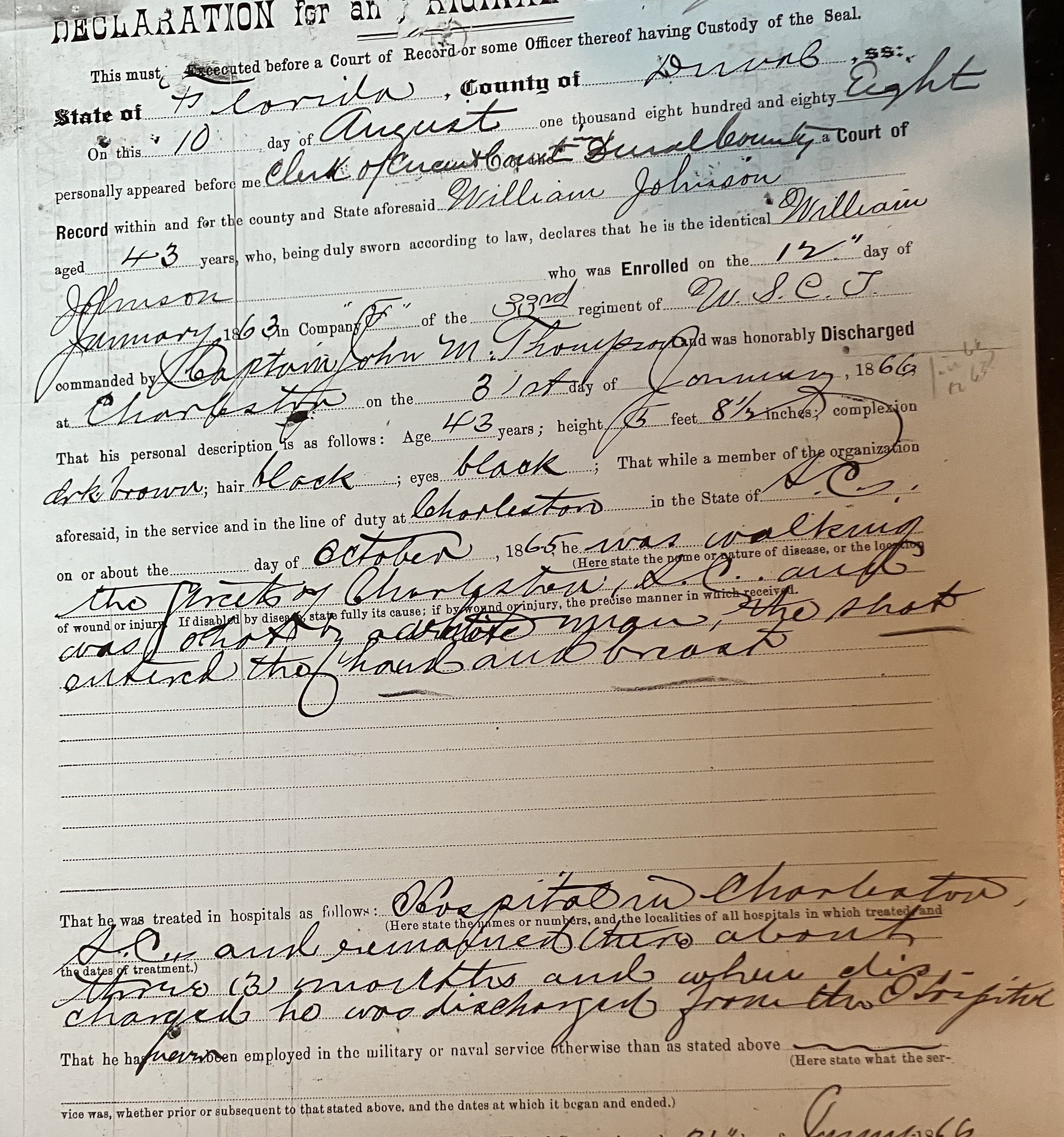
Pension records (below) show Johnson was shot in the hand and chest by a bushwhacker in October 1865, leaving him partially disabled. He was discharged the following year.
 |
| William Johnson's pension request details wounding (click to enlarge) |
Johnson
later lived in the Arlington neighborhood of Jacksonville and attended a church
that was once located on Jacksonville University land. He married Fanny
Jackson, who survived him by more than a decade after his 1892 passing. He was
believed to be 51 when he died, Buettinger says.
“Because of
his wounds, he could only do light gardening and he said he could only earn
half of what an able-bodied worker earned,” said the professor.
Johnson has
no living survivors. The exact location of his grave in the cemetery is not
known.
Now is the time to replace a stone headstone
Established
in 1934, Jacksonville University has five colleges, 11 schools and four
institutes. Its 235-acre riverfront campus is “minutes
from downtown and from beautiful area beaches.”
 |
| Dr. Craig Buettinger provides details about cemetery (Jacksonville University) |
The
last known burial at what was called Chaseville Cemetery was in about 1932. The
burial ground served two African-American churches in Chaseville, a largely Black community on
the northern end of Arlington. It’s possible Black Jacksonville police officers
are interred there as well.
By 1962,
the cemetery had fallen into neglect. There are no records, so officials don’t
know how many graves are on the site and few, if any, remain marked.
“When it was
rediscovered by JU staff member Jim Golden in 1989, only Johnson’s marble
veteran’s headstone remained. Golden,
himself a veteran, cleared up the grounds and held a ceremony for Johnson. Regrettably, that military headstone was
later stolen,” Buettinger wrote in a summary about Johnson and the cemetery.
Buettinger
and Ray Oldakowski, professor of geography, led the university effort to
replace the headstone.
 |
| Artifacts recovered from the cemetery parcel (Jacksonville University) |
The wooded site is on the edge of the campus, east of the Jacksonville University warehouse, near the Green Street gate, along University Boulevard. The cemetery is maintained by Jacksonville University.Smith, with
LISC Jacksonville, said it is too early to place cost estimates on the cemetery revitalization and the organization is working on funding sources.
The Haskell Company, which does design,
engineering and construction work, is providing pro bono help to LISC and
Jacksonville University through design and scoping documents. A company
spokesman told the Picket it’s possible Haskell will eventually become involved
in contracted work.
“Haskell will continue its pro bono work leading up to Nov
2024 when we anticipate having funding commitments and (a) final design in
place for the cemetery,” said Smith. (At left, the current rendering for the overhaul of the campus cemetery, courtesy Jacksonville University)
JU President
Tim Cost says the school is committed to honoring veterans. “It’s not only important to us, but especially to the
Arlington community, to honor those who occupied this beautiful piece of land
before us.”
Beasley, of UNF, said, “It’s been extremely inspiring to see how looking for information and conducting research has led to the physical manifestation of the headstone being created. No matter how small what you’re doing in the classroom is, it might have a large effect in the community,” Beasley added.
Buettinger
believes the community and university have an opportunity to honor those buried on
the campus.
“We must make
sure that this cemetery is not again forgotten,” he said.