Showing posts with label florida. Show all posts

Wednesday, October 15, 2025

He fought Confederates. He tangled with Indian fighters. Now John Upham's St. Augustine cottage is for sale again -- for a whopping $3.2 million

An eye-catching design, bath with a view and a welcoming outside area (Evan Ulsh/Good Things Homes)
If Lt. Col. John Jaques Upham were alive today, he would be pleased to see that the interior of the winter cottage he built in St. Augustine, Fla., for his bride has been returned to something he would recognize.

That’s because the owners have spent about as much money renovating the striking residence at 268 Saint George St. as they did after purchasing it in late 2023 for $1.045 million.

If you are brave – and rich – enough to take on the upkeep and hefty taxes, the 5,800-square-foot dwelling can be yours for a cool $3.2 million – three times its previous purchase price.

When it was built in 1892-1893, the Queen Anne Victorian was a real showpiece in a neighborhood full of showpieces.

Upham, 54, married Caroline Hoppin Williams – 10 years his junior -- in Milwaukee on Sept. 23, 1891. Having soldiered through bouts of poor health, the Civil War veteran and U.S. 8th Cavalry officer (Indian Wars) retired just four months later. He focused on building the cottage. (At left, photo of Upham while cadet, courtesy of U.S. Military Academy Library)

The couple happily wintered in St. Augustine and summered in Wisconsin until 1898, when Upham died of kidney disease.

The Uphams could not have foreseen what would happen to the luxury house years later.

“The last time we listed it, the property was difficult to sell because it needed a lot of work, and it had a disjointed – and somewhat confusing – layout,” said Elizabeth Jennings. She and Kate Mitchell have marketed the property for ONESotheby’s International Realty in St. Augustine.

“Because it had been converted to five units at some point, there were additional staircases and a landing space to enter the units,” said Jennings in an email. “Although it had been used as a single-family home for a few decades, none of the previous owners had done the work that it needed in order to restore it to a single-family home with a cohesive layout.”

A staircase was built to the third floor (Evan Ulsh/Good Things Homes)
That's all been remedied through an exhaustive renovation.

Upham Cottage is part of the St. Augustine historic district, which is listed on the National Register of Historic Places; the National Park Service says the three-story cottage is one of a few remaining of that style in the coastal city.

The Upham Cottage’s sales price has varied widely in the past 15 or so years, according to Zillow. Like other houses of that age with such features, upkeep is paramount.

Upham took part in Civil War, Indian Wars

John J. Upham was born in Wilmington, Del., in 1837. His family moved to Milwaukee, where his father, Don A.J. Upham, served as mayor in 1849 and 1850. The younger Upham attended West Point, graduated in 1859 and joined the regular army.

First in the infantry, the officer was stationed at Governor’s Island, N.Y., and California before the Civil War broke out.

He was engaged in the defense of Washington, D.C., the 1862 Peninsula Campaign in Virginia and the Battle of Gettysburg, where he was promoted to brevet major for “gallant and meritorious service,” according to his The Milwaukee Sentinel obituary (provided to the Picket by the Wisconsin Historical Society). He later became a disbursing officer in the North and occupied South.

Cullum’s Register, an index of graduates of the U.S. Military Academy, had a biography of Upham, listing numerous stations in the West during the Indian Wars, after he had switched to the cavalry. The officer took several leaves of absence, at least some for health reasons. The register said he served “despite constant poor health.”

Upham was in a few regiments in his time in Texas, Kansas and Indian Territory. He took command of Oklahoma’s Fort Gibson in 1875 and was in the field in the summer of 1876 as part of the Yellowstone and Big Horn expeditions (George A. Armstrong and much of his command were killed at Little Big Horn in June 1876).

Upham fought at War Bonnet Creek and Slim Buttes and later was stationed at Fort D.A. Russell, Fort Wahaskie and Fort Niobrara, according to his obituary.

Jennings said the owner – is from the Atlanta area – is intrigued with the Upham story. They had planned to stay in the house longer, but had a change of plans.

Property is not for the 'faint of heart'

(Evan Ulsh / Good Things Homes)
The sellers created a more cohesive and less funky interior by removing two
staircases, building one new staircase to the third floor, converting the landing space into a modern sized primary bath and adding a new staircase that flows directly from the second floor to the third floor.

Upgrades included a new roof, kitchen renovation, lighting and extensive landscaping.

Historic properties like this are very delicate and not for the faint of heart. Because of the current price point of $3.2 million, the new buyer will be someone with high net worth,” said Jennings.

In other words, most folks aren’t in the running for the seven-bedroom, five-bathroom house.

“They will be someone who loves history, loves St. Augustine and someone who likes the hustle and bustle of downtown living. This home is located on historic St. George Street, which is the most well-known street in St. Augustine. All of the shops, restaurants and cultural icons – like the Bridge of Lions, the Lightner Museum, the Castillo San Marcos – are only steps away.”

The global real estate adviser said the sellers have done all the hard work. The buyer will have to be serious, too, taking on high taxes, insurance and the unforeseen on the quarter-acre property.

“The last time we had this property listed, we showed it to dozens and dozens of buyers. Most of them were afraid to take on this project because the costs associated with renovations are largely unknown,” said Jennings.

(Evan Ulsh / Good Things Homes)
The payoff?

Lots of admiring eyes, spaces to socialize and a place for multigenerational living or a means to earn extra income.

‘This remarkable home showcases the graceful blend of Queen Anne Victorian architecture with examples of Moorish Revival in the courtyard arches,” says the listing. “With stunning original millwork, wood floors and unique octagonal shape, this home will take you back to the splendor of the Gilded Age.”

The Upham Cottage is in the white rectangle toward the center bottom of aerial photo

Thursday, June 6, 2024

William Johnson was born enslaved, died a Civil War veteran. A Jacksonville consortium will revitalize a campus cemetery and restore his headstone amid larger effort to honor area USCT soldiers

New headstone, exterior of cemetery and old marker before it was stolen (Jacksonville University)'
Sketch of Black soldiers in Florida (State Library and Archives of Florida)
Perhaps they rest under a live oak or Sabal palm in an overgrown and forgotten plot, tucked away in what is now forest.
 A few may be beneath unmarked graves along a busy thoroughfare.

Regardless of the setting, a nonprofit in Jacksonville, Fla., is attempting to track down the graves of African-American soldiers – many of them formerly enslaved -- who served in a United States Colored Troops regiment during the Civil War.

The idea is to place government-approved headstones marking their service to country and, when possible, to rehabilitate abandoned USCT gravesites, “bringing these soldiers and their descendants the redemption they have so deserved.”

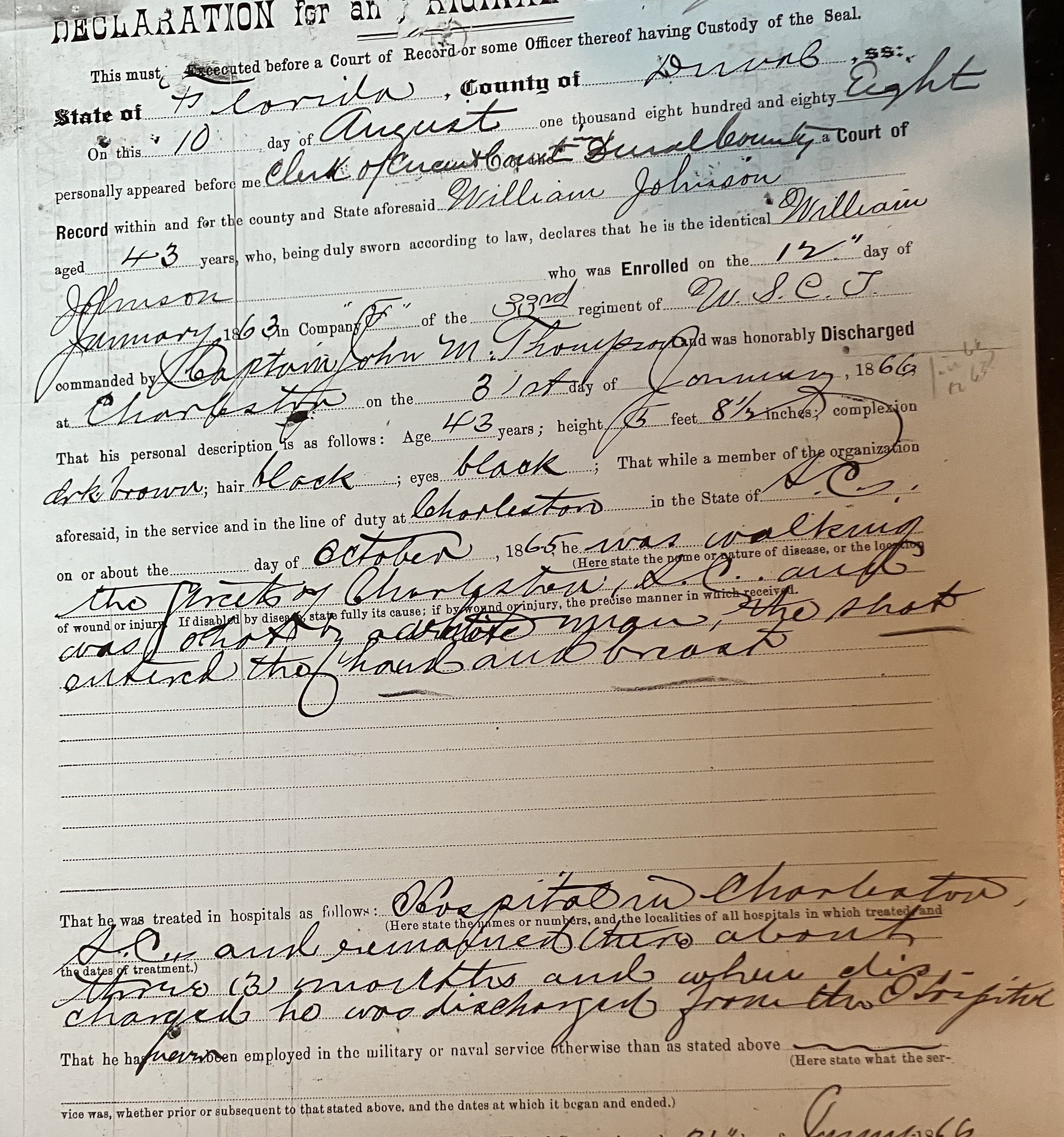
That initiative got some attention recently after Jacksonville University and the nonprofit, Local Initiatives Support Coalition (LISC) Jacksonville, announced plans to improve a fenced cemetery on campus that holds the remains of Cpl. William Johnson, Company F, 33rd USCT.  A new VA-approved headstone, expected to be erected by Veterans Day, will replace one stolen after a university staffer rediscovered the neglected cemetery in the late 1980s.

In a larger effort, LISC Jacksonville, in partnership with the Digital Humanities Institute at the University of North Florida, will use pension and other records to apply for grave markers for other USCT members in the area. (At right, soldiers believed to the be in the 1st South Carolina Volunteers, later the 33rd USCT)

“After the Civil War, Black veterans and their families fought a completely different battle; however, this one was a true logomachy, a war of words,” says the introduction to a UNF page about the pensioners. “From pleading with Army officials that they were who they said they were to widows who wouldn’t quit, these pension records tell the stories of resilience in the face of institutionalized discrimination and racism.”

Jacksonville University emeritus professor of history Craig Buettinger notified LISC about the unmarked Johnson grave in 2022 when the organization launched its Operation Final Hours initiative. The aim is to help Duval County families receive and install headstones from the Department of Veteran Affairs for an unmarked burial site. About 25 families have been helped thus far, LISC says.

Kristopher Smith, community development program officer at LISC Jacksonville, told the Civil War Picket in an email there could be other African-American soldiers buried in the former Chaseville Cemetery, which predates Jacksonville University. Buettinger said “fragments suggest another USCT veteran.”

Smith (left) said in the coming weeks, LISC will try to track down the locations of other members of  Johnson’s Company F of the 33rd USCT.

“I won't have a total number until after we complete our preliminary review in mid-June,” Smith said.

James Beasley, director of the UNF institute, told the Picket he is honored to help preserve the memory of the USCT pensioners and help students “engage in research that impacts the community. Students were able to take the skills that we teach in our classes and have it affect social change.”

From enslavement to serving the United States

Buettinger said Cpl. Johnson's “life is also mostly hidden from us, especially before his enlistment.”  

The soldier was likely born enslaved in Duval County and was believed to be a field hand. He traveled to the Union lines at Fernandina, enlisting at Fort Clinch with one of the first Black regiments to be raised after the 1863 Emancipation Proclamation. (Confederate and Union forces battled over Jacksonville throughout the war.)

The 1st South Carolina before it became the 33rd USCT (Library of Congress)
Johnson was believed to be about 21 when he and two friends enlisted with the 1st South Carolina Colored Infantry in January 1863.

The 33rd USCT was later formed from the 1st South Carolina, according to the National Park Service. It served in South Carolina and took part in several expeditions. The regiment was in occupied Charleston at war’s end and was stationed there several months.

Pension records (below) show Johnson was shot in the hand and chest by a bushwhacker in October 1865, leaving him partially disabled. He was discharged the following year.

William Johnson's pension request details wounding (click to enlarge)
Johnson later lived in the Arlington neighborhood of Jacksonville and attended a church that was once located on Jacksonville University land. He married Fanny Jackson, who survived him by more than a decade after his 1892 passing. He was believed to be 51 when he died, Buettinger says.

“Because of his wounds, he could only do light gardening and he said he could only earn half of what an able-bodied worker earned,” said the professor.

Johnson has no living survivors. The exact location of his grave in the cemetery is not known.

Now is the time to replace a stone headstone

Established in 1934, Jacksonville University has five colleges, 11 schools and four institutes. Its 235-acre riverfront campus is “minutes from downtown and from beautiful area beaches.”

Dr. Craig Buettinger provides details about cemetery (Jacksonville University)
The last known burial at what was called Chaseville Cemetery was in about 1932. The burial ground served two African-American churches in Chaseville, a largely Black community on the northern end of Arlington. It’s possible Black Jacksonville police officers are interred there as well.

By 1962, the cemetery had fallen into neglect. There are no records, so officials don’t know how many graves are on the site and few, if any, remain marked.

“When it was rediscovered by JU staff member Jim Golden in 1989, only Johnson’s marble veteran’s headstone remained. Golden, himself a veteran, cleared up the grounds and held a ceremony for Johnson. Regrettably, that military headstone was later stolen,” Buettinger wrote in a summary about Johnson and the cemetery.

Buettinger and Ray Oldakowski, professor of geography, led the university effort to replace the headstone.

Artifacts recovered from the cemetery parcel (Jacksonville University)
The wooded site is on the edge of the campus, east of the Jacksonville University warehouse, near the Green Street gate, along University Boulevard. The cemetery is maintained by Jacksonville University.

Smith, with LISC Jacksonville, said it is too early to place cost estimates on the cemetery revitalization and the organization is working on funding sources.

The Haskell Company, which does design, engineering and construction work, is providing pro bono help to LISC and Jacksonville University through design and scoping documents. A company spokesman told the Picket it’s possible Haskell will eventually become involved in contracted work.

“Haskell will continue its pro bono work leading up to Nov 2024 when we anticipate having funding commitments and (a) final design in place for the cemetery,” said Smith. (At left, the current rendering for the overhaul of the campus cemetery, courtesy Jacksonville University)

JU President Tim Cost says the school is committed to honoring veterans. “It’s not only important to us, but especially to the Arlington community, to honor those who occupied this beautiful piece of land before us.”

Beasley, of UNF, said, “It’s been extremely inspiring to see how looking for information and conducting research has led to the physical manifestation of the headstone being created. No matter how small what you’re doing in the classroom is, it might have a large effect in the community,” Beasley added.

Buettinger believes the community and university have an opportunity to honor those buried on the campus.

“We must make sure that this cemetery is not again forgotten,” he said.

Thursday, November 2, 2023

John J. Upham fought in the Civil War and Indian Wars. He and his bride built a charming St. Augustine cottage that is now for sale

(Evan Ulsh photo, courtesy of ONE Sotheby's International Realty)
After 30 years of military service, including fighting in the Civil War and the Indian Wars, Lt. Col. John Jaques Upham was ready for a new adventure -- and a warmer place to spend his winters.

So the bachelor, 54, married Caroline Hoppin Williams – 10 years his junior -- in Milwaukee on Sept. 23, 1891. Having soldiered through bouts of poor health over the years, the U.S. 8th Cavalry officer retired just four months later.

Besides seeking marital bliss, Upham (right) must have wanted escape from the current cold Wisconsin winter and memories of bone-chilling blizzards on the Great Plains while he rode horses or shivered in a fort.

He and Mrs. Upham decided to build a winter retreat on St. George Street in St. Augustine, Fla. The striking cottage went up over the winter of 1892-1893 and the couple happily wintered there and summered in Wisconsin until 1898, when Upham died of kidney disease at a Milwaukee hotel where they were staying before their return south. He was 61.

Today, the house, which has had numerous additions and owners over the years, is for sale, currently at $1.3 million. Upham Cottage, with eight bedrooms and 5,800 square feet, is part of the St. Augustine historic district, which is listed on the National Register of Historic Places; the National Park Service says the three-story cottage is one of a few remaining of that style in the city.

“This remarkable home showcases the graceful blend of Queen Anne Victorian architecture with extraordinary examples of Moorish Revival in the courtyard arches,” says the listing by Kate Mitchell and Elizabeth Jennings of ONE Sotheby’s International Realty, St. Augustine.

(Evan Ulsh photos for ONE Sotheby's International Realty)

“From its stunning original millwork and wood floors to its unique octagonal shape, this home will take you back to the splendor of the Gilded Age.” Photos of the property, which is just blocks from the water, show a welcoming home still steeped in the Victorian era.

The likes of novelist Henry James and painter Martin Johnson Heade paid visits more than a century ago. “Over time, the cottage evolved along with the ever-changing tides of history. The original owners continuously added onto the property, building a ballroom, rooftop garden and atrium,” the listing states.

The Upham Cottage later became a multi-family property until it was converted back to a single-family dwelling in the late 1980s, and it is a different cat than its neighbors. Its sales price has varied widely in the past 15 or so years, according to Zillow. Like other houses of that age with such features, upkeep is paramount.

(Evan Ulsh photo, courtesy of ONE Sotheby's International Realty)
“Today, as you step foot within these storied walls, you become an integral part of the Upham Winter Cottage's narrative. Embrace the opportunity to restore its grandeur and assume the role of its guardian, preserving the heritage of the past while crafting a new chapter in its history,” says the listing.

Upham battled health issues along with the enemy

John J. Upham was born in Wilmington, Del., in 1837. His family moved to Milwaukee, where his father, Don A.J. Upham, served as mayor in 1849 and 1850. The younger Upham attended West Point, graduated in 1859 and joined the regular army.

First in the infantry, the officer was stationed at Governor’s Island, N.Y., and California before the Civil War broke out.

Arched entrance at the cottage in St. Augustine (Evan Ulsh photo)
He was engaged in the defense of Washington, D.C., the 1862 Peninsula Campaign in Virginia and the Battle of Gettysburg, where he was promoted to brevet major for “gallant and meritorious service,” according to his The Milwaukee Sentinel obituary (provided to the Picket by the Wisconsin Historical Society). He later became a disbursing officer in the North and occupied South.

Cullum’s Register, an index of graduates of the U.S. Military Academy, had a biography of Upham, listing numerous stations in the West during the Indian Wars, after he had switched to the cavalry. The officer took several leaves of absence, at least some for health reasons. The register said he served “despite constant poor health.” (At left, photo of Upham while cadet, courtesy of U.S. Military Academy Library)

Upham was in a few regiments in his time in Texas, Kansas and Indian Territory. He took command of Oklahoma’s Fort Gibson in 1875 and was in the field in the summer of 1876 as part of the Yellowstone and Big Horn expeditions (George A. Armstrong and much of his command were killed at Little Big Horn in June 1876).

Upham fought at War Bonnet Creek and Slim Buttes and later was stationed at Fort D.A. Russell, Fort Wahaskie and Fort Niobrara, according to his obituary.

Man holds rifle as two others ride off (Courtesy of Wisconsin Historical Society)
The Wisconsin Historical Society has 12 drawings made by a Native American on blank pages of discarded ledger books that once belonged to an Indian agent. Upham acquired the sketches done in pencil, wax, crayon and earth colors by a Plains Indian, about 1880-1890.

'Distinguished son of a distinguished sire'

Upham’s later service included time at Fort Leavenworth and brief deployments to Turkey and France as a military observer. “He was at that time decorated with the cross of the Legion of Honor, a distinction enjoyed by few Americans,” according to his obituary.

Upham was promoted to colonel on Jan. 14, 1892, and put on the retired list on Jan. 30, 1892.

The retired officer was a member of the Military Order of the Loyal Legion of the United States, a Civil War officers group. He was invited to the May 30, 1897, unveiling of the Battle Monument of the regular army at West Point (Wikipedia photo, at left).

The Uphams shared seven years together and they returned to Milwaukee in spring 1898. But John never saw Florida again. He died on Oct. 21 and was buried at Forest Home Cemetery. Caroline died in 1934. They had no children.

Upham’s lengthy obituary, which called him one of Wisconsin’s best-known military men, included these remarks made by a friend:

“Milwaukee has lost the distinguished son of a distinguished sire. Large of frame and equally large of heart; generous; genial; unassuming; unselfish; this endeared him to all who had the privilege of his close friendship. On the pages of our country’s military history one may read the record of the deeds that won for him promotion and popularity, but from his own modest lips one never heard mention of his gallant and meritorious conduct.”

Sunday, May 7, 2023

Fort Jefferson: Archaeological divers at Dry Tortugas National Park in Gulf survey submerged Civil War-era graves

Grad student Devon Fogarty at John Greer's grave (C. Sproul/NPS)
A submerged Gulf of Mexico island reportedly spotted from the air a few years ago contains a cemetery holding the grave of a laborer who died at Fort Jefferson, the Civil War-era fortress.

Dry Tortugas National Park recently announced the discovery of the cemetery and the remains of a small 19th-century quarantine hospital. The latter was used to treat yellow fever patients at the fort between 1890 and 1900. The park is 70 miles west of Key West, Fla.

Laborer John Greer died in the first year of the Civil War. The isolated Fort Jefferson is mostly associated with that time, when it held Confederate prisoners and Lincoln assassination conspirators.

Water color depicts hospital and cemetery on Dry Tortugas island (NPS)
The park released photos and video of the fascinating August 2022 find near Garden Key, with a maritime diver checking out Greer’s grave not far from the surface.

Research shows the post cemetery contains dozens of graves of US military personnel, prisoners and civilians who were at Fort Jefferson or nearby islands. Greer died at the fort on Nov. 5, 1861. His cause of death is currently unknown.

His grave was marked with a well-preserved large slab of greywacke, the material used to construct the first floor of Fort Jefferson. The slab was carved into the shape of a headstone and inscribed with his name and date of death. Greer’s is the only currently identified grave on the sand.

Greer's grave stone is still legible (C. Sproul/NPS)
“This intriguing find highlights the potential for untold stories in Dry Tortugas National Park, both above and below the water,” Josh Marano, maritime archeologist for the south Florida national parks and project director for the survey, said in a statement. “Although much of the history of Fort Jefferson focuses on the fortification itself and some of its infamous prisoners, we are actively working to tell the stories of the enslaved people, women, children and civilian laborers.”

Marano told The New York Times he noticed a strange pattern in the water while he was flying over the Gulf of Mexico in 2016. He then pored over nautical charts. “There was dry land here at one point. There was a structure on that island at one point,” Marano told the newspaper. “When did it disappear?”

The archaeologist and students surveyed the island last summer and have since been conducting more research.

John Greer's name appears on 1861 roll at Fort Jefferson (NPS)
Park officials note a couple factors that may explain why this island is now below water.

“While the facilities identified in this survey were originally built on dry land, the dynamic conditions caused many of the islands to move over time. Climate change and major storm events have even caused some islands to settle and erode beneath the waves.”

Fort Jefferson was ringed by other islands used for various purposes, including quarantine sites for ill military members, prisoners and civilians.

As the population of Fort Jefferson swelled, the risk of deadly communicable diseases, particularly the mosquito-borne yellow fever, drastically increased. Major outbreaks of disease on the island killed dozens throughout the 1860s and 1870s.

Fort Jefferson is surrounded by submerged and above surface islands (NPS)
The National Park Service’s South Florida National Parks Cultural Resources Program will monitor the archaeological site, and officials remind visitors it is protected by federal law.

Park cultural resources staff, assisted by members of the NPS Submerged Resources Center, the Southeast Archeological Center and a University of Miami graduate student conducted the 2022 survey. The park is not divulging the exact location of the site.

Fort Jefferson is accessible only by boat or seaplane. Visitors are required to provide their own food, water and all other supplies while at the park. 

Sunday, October 3, 2021

Hurricane Ida left a calling card at Pensacola Bay in Florida. 194 cannonballs were uncovered along beach near Civil War Fort McRee

Shells were found Sept. 3-5 and 21-23 (Gulf Islands National Seashore)
Fort McRee did not resemble most other coastal fortifications erected in the U.S. after the War of 1812. The fort was shaped somewhat like a wing or boomerang so that it could be squeezed onto a narrow barrier island separating Florida’s Pensacola Bay and the Gulf of Mexico.

McRee’s brief moment of fame – until last month – came in November 1861, when it was in Confederate hands during the Civil War. The garrison engaged in gunfire with nearby Union-held Fort Pickens and a couple warships -- and came up on the losing end. The heavily damaged brick fort, built on sand, was abandoned, only to fall into further ruin over the years.

Inaccessible by road, McRee’s main visitors are sea birds, boaters and beachgoers who come to Gulf Islands National Seashore. The park is home to McRee, Pickens and Fort Barrancas, another Civil War outpost.

Soldiers at Fort McRee, year unknown (Gulf Islands National Seashore)
Category 4 Hurricane Ida -- bringing heavy rain and wind -- paid its own visit in late August, and its impact left quite a surprise: Days later and over three weeks, park staff discovered 194 Civil War-era cannonballs, deposited in a couple clusters along the beach.

The shells weighed between 25 and 35 pounds and are believed to be of the same type, park public information officer Susan Teel told the Civil War Picket in an email. They are hollow, potentially black powder filled cannonballs considered discarded military munitions.”

Experts from the Air Force’s Hurlburt Field (below) detonated the artillery shells on site, officials said.

“What’s unclear is whether they are Union or Confederate, whether they were associated with Fort McRee or another type of facility,” GUIS Superintendent Darrell Echols told TV station WKRG.

It appears the cannonballs had been discarded or buried; that may be determined in coming weeks during a cultural resource survey of the find. 

Erosion regularly occurs on these barrier islands and park officials say the ordnance was likely placed in a spot that was inland at the time. Echols told WEAR-TV the artifacts do not appear to have been fired upon the island.

The park has closed a portion of the beach on the Perdido Key Area’s southeastern end, at the Fort McRee site, and is monitoring it should more ordnance appear.

“Our goal is to ensure that the area is safe for the public and staff and that cultural resources are protected,” Teel said late last week. “In an abundance of caution, the park has closed the area surrounding where the cannonballs were located. This closure is signed and visitors walking or boating in this area are prohibited from entering. Staff will be monitoring and patrolling the area regularly.

A park news release says it is illegal for the public to handle, deface or remove such artifacts.

Cannonballs likely were further inland during the Civil War (GUIS)
This is not the first time a storm uncovered Civil War munitions. For example, 2019’s Hurricane Dorian revealed two cannonballs on South Carolina’s Folly Beach.

In almost all cases, military or local emergency services employees destroy discovered ordnance because of the potential for them to explode. On some occasions, they are defused or found not to still contain harmful material.

Asked whether a discussion was held on whether the rounds could be saved, Teel wrote: “As a federal agency, we have arrangements with the military to detonate munitions or unexploded ordinance found in the park. Munitions have been found in national parks across the USA and the military has assisted the National Park Service to successfully mitigate the danger these munitions may pose to the public and staff.

Teel said if someone comes across munitions, they should not disturb the items. They should leave the area and contact local emergency services, she said.

A Virginia relic collector died in 2008 when a cannonball he was restoring exploded.

(Wikipedia Commons)
McRee had 12 casemates and an associated water battery, which may be underwater today. Virtually nothing remains today, with the exception of part of the fort's foundation. (After the Picket posted this article on social media, a few readers commented they believe the ordnance was made for a 32-pounder cannon.)

A GUIS web page details its history and service. The federal government built the fort in the 1830s at part of defenses of Pensacola Bay and a naval yard. Interestingly, Fort Pickens was one of the few forts in the South that remained in Union hands throughout the Civil War.

McRee was seized by state militia in early 1861 and guns were mounted by Confederate troops. On Nov. 22, 1861, Pickens opened fire on shore batteries, the navy yard and McRee and Barrancas.

“Under heavy artillery fire, Fort McRee was exposed to severe bombardment at its front, flank, and rear,” the park service says. “Two Union warships, U.S.S. Niagara and U.S.S. Richmond joined the bombardment of Fort McRee. This massive artillery exchange shook houses ten miles away and concussion-stunned fish which floated to the surface of the bay.” Confederate guns were able to damage one of the Federal warships.

But damage to the fort and its vulnerability put it out of action for the next day.

Rebel forces abandoned the outpost by March 1862.

“The once imposing fortification had been reduced to a burned-out and fragmented brick shell. Essentially abandoned after the Civil War, the toll of warfare and of the elements continued to take Fort McRee into further ruin,” according to the website. “By the early 1900s, what little was left of this once imposing defensive structure was rapidly crumbling. Today, nothing visible remains of this Third System fortification, although later coastal defense structures built in the area are commonly referred to as old Fort McRee.”

A battery was built near the old fort about the time of the Spanish-American War and it had guns during World War II. It was deactivated shortly after the war ended.

Aerial view of a battery on island in 1928 (National Archives

The region during the Civil War (Wikipedia Commons)

Tuesday, February 27, 2018

Civil War shell found at Florida residence; will be used by Air Force for EOD training

Authorities have removed a Civil War-era artillery shell that a man who lives 35 miles north of Tampa, Fla., found while going through a shed, officials said.

(Hernando County Sheriff's Office)
explosive ordnance disposal (EOD) technician from a nearby military base used an X-ray at the scene to determine that the 30-pound Dahlgren shell had no fuse or powder.

"They didn't need to dispose of it," said 2nd Lt. Allison Mills of MacDill Air Force Base.

In a series of Facebook posts and an incident report, the Hernando County Sheriff’s Office detailed what occurred Monday afternoon at a home in Spring Hill.

The man who had called deputies said he was in the shed of a friend when he made the discovery, an Hernando County incident report said. The shed owner said that the cylindrical, cone-shaped round had belonged to his deceased stepfather and had been in the shed for years. "The object appeared to have a metal plug inserted into the tip."

Deputies who received a call in turn called in the bomb squad from the sheriff’s office in nearby Citrus County. That group then reached out MacDill Air Force Base, which sent the expert to remove the object.

Roads were closed, but no homes were evacuated.

Mills, who is with the public affairs office of the 6th Air Mobility Wing at MacDill, told the Picket that the sand-filled shell will be kept for future EOD training on base.

"The EOD flight has found munitions from the WWI, WWII, and Civil war eras several times over the years in the Tampa Bay area," Mills said. "On average, we respond to about 5-6 events like this a year."