Showing posts with label divers. Show all posts

Sunday, May 7, 2023

Fort Jefferson: Archaeological divers at Dry Tortugas National Park in Gulf survey submerged Civil War-era graves

Grad student Devon Fogarty at John Greer's grave (C. Sproul/NPS)
A submerged Gulf of Mexico island reportedly spotted from the air a few years ago contains a cemetery holding the grave of a laborer who died at Fort Jefferson, the Civil War-era fortress.

Dry Tortugas National Park recently announced the discovery of the cemetery and the remains of a small 19th-century quarantine hospital. The latter was used to treat yellow fever patients at the fort between 1890 and 1900. The park is 70 miles west of Key West, Fla.

Laborer John Greer died in the first year of the Civil War. The isolated Fort Jefferson is mostly associated with that time, when it held Confederate prisoners and Lincoln assassination conspirators.

Water color depicts hospital and cemetery on Dry Tortugas island (NPS)
The park released photos and video of the fascinating August 2022 find near Garden Key, with a maritime diver checking out Greer’s grave not far from the surface.

Research shows the post cemetery contains dozens of graves of US military personnel, prisoners and civilians who were at Fort Jefferson or nearby islands. Greer died at the fort on Nov. 5, 1861. His cause of death is currently unknown.

His grave was marked with a well-preserved large slab of greywacke, the material used to construct the first floor of Fort Jefferson. The slab was carved into the shape of a headstone and inscribed with his name and date of death. Greer’s is the only currently identified grave on the sand.

Greer's grave stone is still legible (C. Sproul/NPS)
“This intriguing find highlights the potential for untold stories in Dry Tortugas National Park, both above and below the water,” Josh Marano, maritime archeologist for the south Florida national parks and project director for the survey, said in a statement. “Although much of the history of Fort Jefferson focuses on the fortification itself and some of its infamous prisoners, we are actively working to tell the stories of the enslaved people, women, children and civilian laborers.”

Marano told The New York Times he noticed a strange pattern in the water while he was flying over the Gulf of Mexico in 2016. He then pored over nautical charts. “There was dry land here at one point. There was a structure on that island at one point,” Marano told the newspaper. “When did it disappear?”

The archaeologist and students surveyed the island last summer and have since been conducting more research.

John Greer's name appears on 1861 roll at Fort Jefferson (NPS)
Park officials note a couple factors that may explain why this island is now below water.

“While the facilities identified in this survey were originally built on dry land, the dynamic conditions caused many of the islands to move over time. Climate change and major storm events have even caused some islands to settle and erode beneath the waves.”

Fort Jefferson was ringed by other islands used for various purposes, including quarantine sites for ill military members, prisoners and civilians.

As the population of Fort Jefferson swelled, the risk of deadly communicable diseases, particularly the mosquito-borne yellow fever, drastically increased. Major outbreaks of disease on the island killed dozens throughout the 1860s and 1870s.

Fort Jefferson is surrounded by submerged and above surface islands (NPS)
The National Park Service’s South Florida National Parks Cultural Resources Program will monitor the archaeological site, and officials remind visitors it is protected by federal law.

Park cultural resources staff, assisted by members of the NPS Submerged Resources Center, the Southeast Archeological Center and a University of Miami graduate student conducted the 2022 survey. The park is not divulging the exact location of the site.

Fort Jefferson is accessible only by boat or seaplane. Visitors are required to provide their own food, water and all other supplies while at the park. 

Monday, March 7, 2022

Cannons and cribs: Archaeologists provide details on Revolutionary War weapons and Confederate water obstructions found in Savannah River

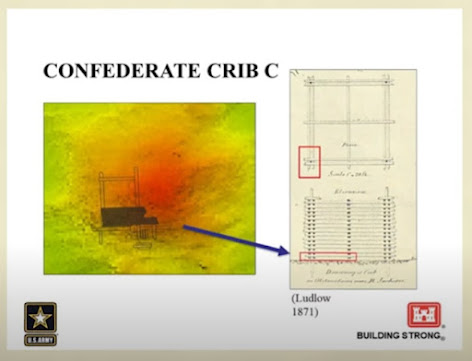
Planks at the bottom of this obstruction are shown in dark area (USACE)
Over the years, underwater archaeologists have found that amid all the junk littering the bottom of the Savannah River is a trove of treasure.

Such was the case in 2021, when they spotted 15 Revolutionary War-era cannons and explored obstructions placed in the river 85 years later during the Civil War.

Contractors working for the US Army Corps of Engineers surveyed and dived two Confederate “cribs” -- or tall wooden boxes filled mostly with brick – that discouraged the approach of Union ships to the port city. Forces towed the wooden obstructions, believed to be 40 feet by 40 feet, and put them in place near Fort Jackson and the ironclad CSS Georgia, a floating battery that was part of the Savannah River defenses.

Archaeologists last month provided details of the Revolutionary War and Civil War artifacts during a public event at the Savannah History Museum. Three cannons were recovered last year, while the other 12 were pulled up in January.

The Army Corps’ Savannah district funded the hard-hat dives as part of the busy Georgia port’s channel deepening.


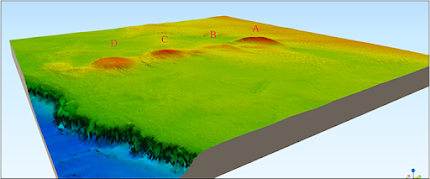
About a half dozen severely degraded cribs are on the South Carolina side of the river. Crews focused on what are called cribs C and D.

Commonwealth Heritage Group divers found some planks used to build Crib C.

“On top of the planks it was tons of bricks that we dug through, and then underneath the planks it was sterile sand and Miocene clay, which is the base of the river,” said archaeologist Stephen James. “That basically told us we were at the bottom of the crib.”

They found an intact corner at Crib D. While C won’t be impacted by the deepening, the remnants of D were documented and then largely destroyed by dredging, James said. “There is very little of the cribs left.”

The Confederacy used a wide array of weapons and obstructions to deter advances on Savannah from the sea. Besides forts and warships, wooden cribs, pile dams, torpedoes (mines), snags, logs and shipwrecks were employed.

Divers located an intact corner on this obstruction (USACE)
Time and dredging have taken their toll on the cribs over the past 160 years. But that’s not all.

After the Civil War ended in 1865, the city wanted to reopen the port and it hired salvage companies to remove river obstructions, including the cribs and pieces of the scuttled CSS Georgia. 

“They had their own demolition. Surprisingly, they had divers back then, had pretty heavy-duty machinery to pull that stuff down,” said Will Wilson of Commonwealth Heritage Group. Of course, not all of the objects were removed or recovered in the 19th century.

Topographic view of four cribs from survey. Dredged channel is in blue (USACE)
The Corps is in charge of the ongoing deepening of the Savannah harbor and the dives are part of an investigation of historical resources that have been or could be affected.

Officials referred to period maps and descriptions from Union Corps of Engineers Capt. William Ludlow and a Capt. Boutelle for information on the cribs.

The CSS Georgia is on the National Register of Historic Places and the cribs are eligible for inclusion, officials say.

Sunday, November 1, 2020

Gordon Watts has dived many historic shipwrecks. Here's what the archaeologist wants you to know about the CSS Georgia recovery

Possible configuration of ironclad, drawn from research over the years (USACE/Savannah

Post-Civil War salvage operations, dredging damage in more recent times and a dearth of historical records make it impossible to come up with firm conclusions on many aspects of the CSS Georgia, a floating battery that defended the entrance to Savannah’s port during the Civil War.

Archaeologists and historians pored over data that resulted from 2015 and 2017 recovery operations in the Savannah River, and from earlier dives. While they learned much about the underpowered ironclad, a report they issued earlier this year says the derisively nicknamed “Mud Tub” will continue to hold mysteries because some vital parts are missing or so disarticulated that it is impossible to come up with a complete picture of the vessel’s design and operation.

There are, however, some critical findings.

“The most specific information concerns the dimensions and construction details of the armored casemate with evidence indicating it was approximately 120 feet long by 44 feet wide,” Panamerican Consultants wrote in a report to the U.S. Army Corps of Engineers.

Three pieces of casemate were lifted during the recovery and they were studied extensively. (Other portions of the armor were in a tangle on the river bed or had been salvaged in the two decades after the war. The armored roof likely was salvaged, experts say.)

Propeller during 2015 recovery (Department of Defense)

Researchers also were stymied by the disappearance of the lower hull and the loss of much of the original machinery. The two steam cylinders, one of two propellers and other engine parts were found and have been or are being conserved by Texas A&M's Conservation Research Laboratory.

The builders and supporters of the locally built ironclad had hoped it was would be able to tangle with Union vessels should the need arise. But early trials proved the CSS Georgia couldn’t generate enough power to deal with swift currents and tides. Instead, it served as a floating battery off Fort Jackson, anchored at an angle to deliver firepower downstream. It never fired a shot in anger and was scuttled by its crew as Union forces rushed to Savannah in late 1864.

The report includes this wry passage:

“The engines did, however, serve a functional purpose, as one writer in 1862 stated, ‘Our iron floating battery is a splendid failure. She has been taken down between the forts and they are obliged to keep her engines at work the whole time to prevent her sinking, she leaks so badly’ (Swanson and Holcombe 2003:75). It is thought that the vessel’s leaking was most likely a result of building her with unseasoned wood, a common practice in Confederate vessel construction.”

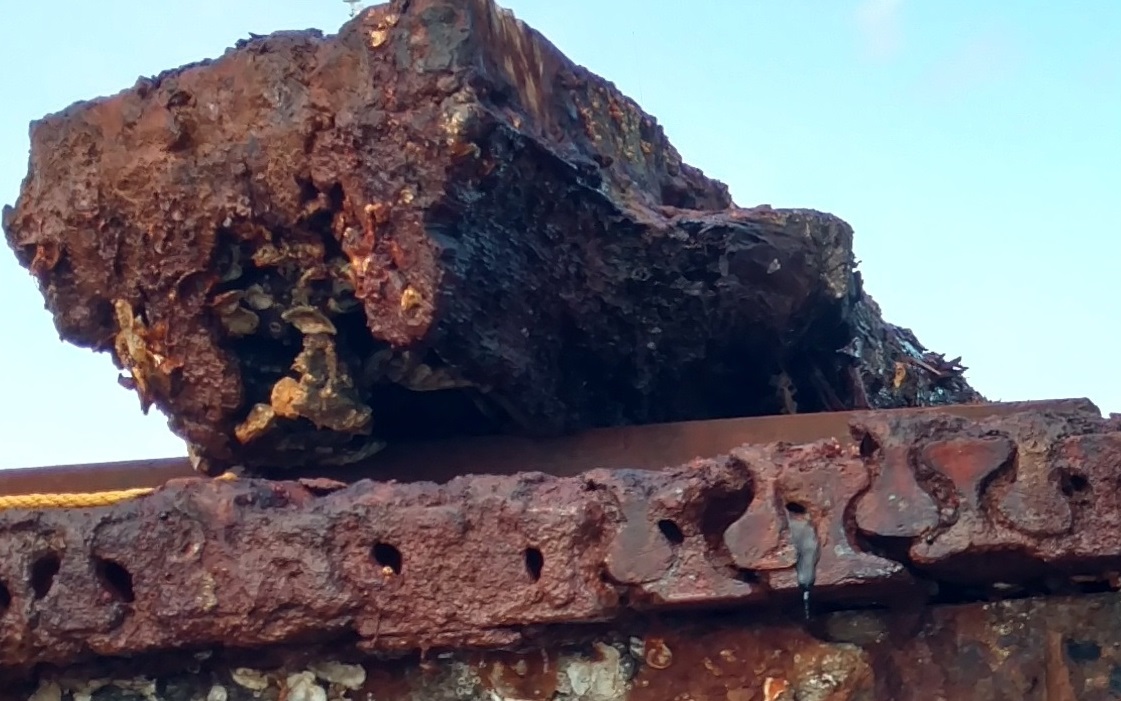
Railroad iron (bottom row) used as armor in casemate (Picket photo)

The massive report provides an inventory of recovered artifacts and states that archaeologists garnered insight that does help with understanding of the CSS Georgia.

The conclusion lays out the challenge.

“Although the CSS Georgia played a critical role in the Confederate defenses of Savannah, historical documentation associated with the ship is marginal at best. Design, engineering, and construction data are virtually nonexistent. Life aboard the ‘floating battery’ was apparently so mundane that most surviving correspondence from those aboard ship relates to dispersions associated with the vessel’s speed and handling or the miserable living conditions within the casemate and hull. Many questions associated with the design, construction, and operation of the Georgia may never be answered.”

Over the years, the Picket has corresponded with underwater archaeologist Gordon P. Watts Jr. about the project. We spent some time with him in summer 2017 at the recovery site. He has been involved in dozens of shipwreck investigations, including the USS Monitor.

Watts, who has worked on the CSS Georgia site over several decades, recently answered some questions from the Picket. He was a co-author of the final report on the project. His answers have been edited for brevity:

Gordon Watts in 2017 during CSS Georgia recovery (Picket photo)

Q. What do you think should be the public’s chief takeaways on your findings regarding the CSS Georgia?

A. The design and construction CSS Georgia has always been a mystery due to the lack of historical documentation. While the CSS Georgia site was a salvage site and not a wreck (site), our investigation generated considerable information about the design and construction of the casemate and the steam machinery.  In addition, the investigation produced an extensive and valuable collection of artifacts associated with CSS Georgia's ordnance and life aboard the "Mud Tub.” Our report is the most comprehensive documentation of any archaeological record of vessel structure and life aboard a Confederate ironclad to date. While no museums have apparently expressed serious interest in exhibiting structural material or artifacts recovered from the site, a massive collection has been conserved and is being stored so public exhibit options will be available in the future.

Q. There has always been a lot of mystery about the CSS Georgia: Its length, weight, propulsion system, design, etc.  Were you able to make firm conclusions on any of those?

A. Due to the fact that the site reflected the evidence of salvage activity and not a wreck, firm conclusions about the CSS Georgia's design and construction were limited. However, information about the casemate, the only structural evidence at the site, and recovered elements of the steam machinery permitted the casemate to be reliably computer reconstructed. Based on the configuration of the casemate and recovered steam machinery, several possible hull design concepts were identified and computer-reconstructed. 

Q. The report says the ironclad had two engines and two propellers. Besides the vessel, being underpowered, do you know enough yet to determine the efficacy of the propulsion system? Were there any surprises, or signs of ingenuity? 

A. Due to funding limitations and scheduling for analysis and reporting, no comprehensive assessment of the machinery efficiency, or lack thereof, has been carried out to date.  Elements of the steam machinery, engine cylinders, frames, flywheel, a propeller and shaft and other parts provided the most comprehensive evidence of why CSS Georgia was, as historical sources confirm, seriously underpowered.

Q. Your report describes the Georgia as being unique. In what way?

Casemate was out of water briefly in 2017 (Picket photo)

A. Unique in the fact that CSS Georgia was an ironclad "floating battery" and never really functioned as a warship like other Confederate ironclads.

Q. It appears from the introduction and conclusion that the profusion of the artifacts is among the most important things about the project. The report says their discovery filled in some knowledge gaps. How so?

A. Recovered machinery filled in one of the largest gaps in knowledge about CSS Georgia.  Evidence of small arms confirmed much about the weapons, personal and military, that were in use aboard the battery. Buttons provided insight into uniforms and clothing. Tools provided insight into the operation, maintenance and repairs requiring the attention of engineers and mechanics.

Q. You have been on many wrecks. What stands out about the CSS Georgia, when it comes to the nature of its artifacts?

A. Artifacts from the CSS Georgia site reflect activities associated with the priorities of a salvage operation likely terminated prematurely.

Q.  Are there any artifacts still being conserved or analyzed that could substantially add to the vessel’s story or to add principal questions?

A. Conservation is still ongoing in the facility at TAMU. Many elements of the steam machinery remain to be cleaned, conserved and documented. Those artifacts will likely continue to enhance our knowledge of the battery and its operation.

Watts' drawings of railroad iron used for armor (Picket photo)

Q. The report says the Georgia likely had a flat barge hull. Was that surprising?

A. We are not at all sure about the configuration of the hull. A barge configuration would have been the simplest to construct and would have certainly contributed to her poor performance as a vessel. However, we have no physical evidence to confirm historical suggestions to the nature of the hull design. It is possible that wreck remains near the South Carolina shore could be associated with CSS Georgia. To date, no archaeological diver investigation of the structure at that site have been undertaken.

Q. Anything else to add about the project? Are there remaining mysteries?

A. Archaeological investigation can resolve questions. However, it is frequently the case that archaeological investigation is just as likely to identify many questions previously not even considered. With the "Mud Tub," I suspect that there will always be unsolved mysteries. Our investigation certainly confirmed both to be the case.

Sunday, February 5, 2017

Mysteries of the not so deep: More dives ahead on blockade runner Agnes E. Fry

Knife handle and deck light found on Fry (NCDNCR)

For having endured so much – being run aground, shelled by the enemy, partially salvaged and decapitated by a giant wire – the wreck of the blockade runner Agnes E. Fry still has a precious story to tell.

Archaeological divers with the North Carolina Department of Natural and Cultural Resources will return, likely in May,  to the Confederate shipwreck about a half mile off Oak Island.

In water where visibility of 2 feet is a rare treat, they’ll continue to explore the Fry and collect data to create a 3D model. The vessel ran aground on Dec. 27, 1864, while trying to reach Wilmington.

“The Fry is not a difficult dive. It is fairly easy to get to. We can drop buoy right on the wreck,” says dive supervisor Greg Stratton.

But once in the shallow water, it’s easy to get disoriented.

The Llama resembled the Agnes E. Fry 

“Light cup of coffee with creamer” is the description Stratton uses to describe the underwater environment.

This will be a big year for assessing the state of the Scottish-made Fry and what cargo remains in its two holds.

Bill Ray Morris, North Carolina deputy state archaeologist, said his office has filed a report on its work thus far to the National Park Service, which provided a research grant through its American Battlefield Protection Program.

“We have received another grant, from NC Sea Grant, to revisit Fry this spring and create a research design and methodology for further investigation and recordation of this significant site,” he told the Picket.

Wreck of the Agnes E. Fry (NCDNCR)

Last year, officials announced “unprecedented detail” captured by sector-scanning sonar. A mosaic image shows the broken iron hull, smoke stack sections, I-beam frames, outer hull plating and more.

Stratton has made five dives for the project. “There is tremendous amount of structure scattered throughout the wreck.” He estimated the debris field to be 239 feet long and 50 feet wide.

Divers, since the discovery of the Fry in early 2016, have removed a chunk of coal, a deck light and remains of a handmade knife “literally laying on the deck.”

Stratton said sheet lead was rolled as a handle for an iron blade. There are thumbprints on the handle; just a small piece of the iron remains. The intact deck light is a 6-inch circle. “They put these small glass pieces on the deck or bulkhead to allow light into the cargo spaces.”

Agnes E. Fry
Officials said the cargo holds are in cavities under the structure. While machinery was removed, there are no records of the cargo being taken;  no one really knows what the Fry carried on its voyage from Nassau, Bahamas.

Blockade runners carried an odd mix of war materiel and goods intended for Southern civilians. Enterprising owners wanted to offset the risk of running the gauntlet of U.S. Navy ships trying to keep them away from vital ports, including Wilmington, N.C.

In mid-1863, the Confederacy ordered captains to carry 50 percent in war goods, such as uniforms, rifles, artillery and munitions. Most items came from Europe via the Bahamas and Bermuda.

Joseph Fry
Serving on the fast blockade runners was tough duty, and full of risks. According to a timeline, the Fry tried seven times in autumn 1864 to get through the blockade, but was unsuccessful until Nov. 5. “She also deals with a bad sickness aboard that kills several of her crew members.”

Records for the ship are scattered or nonexistent, but the end came a few miles below Southport, below Wilmington.

“While running down the shoreline toward the Cape Fear River entrance, another ship was sighted in front of the Fry, the pilot panicked and turned toward shore to miss it,” said Stratton. “Instead, he ran her aground. He was later court-martialed for this and for extorting Capt. (Joseph) Fry for more money to make the run. We think the vessel in front of her was the wreck of the Georgiana McCaw, as no Yankee vessels made mention of being there until the next day.”


For years, the top of the ship was above the water line and it was considered a navigational obstruction for the Cape Fear River.

To counter that, two tugboats anchoring a large wire 10 feet below the surface ran over the wreck site, slicing off the top of the Fry.

The National Park Service grant isn’t just covering the Fry. The state is working to locate and study other historic shipwrecks around Wilmington, including two other blockade runners that went down near the Fry. Several are just offshore and in water 14-16 feet deep.

You can just make out a porthole (NCDNCR)

“The wrecks were way more uncovered than they have ever been,” said Stratton.

Officials hope scuba divers one day will be able to visit some of the vessels. Archaeologists want to open the first state dive park off Kure Beach, featuring the well-preserved Condor.

The divers hope to complete a full assessment of the Fry this year, and apply for other grants to further the research. But don’t expect a rush of artifacts to be brought to the surface.

“For every dollar you spend in the water, you will spend 30 and 40 dollars conserving it,” Stratton said.

Monday, September 14, 2015

Scoop and grapple: New phase of CSS Georgia recovery bringing rush of artifacts

The grapple in action on Sept. 15 (Courtesy of USACE)

A dozen young archaeologists, 150-year-old chunks of iron and wood and an inexhaustible supply of mud are the ingredients for what could be an exciting new phase in the recovery of the CSS Georgia in the Savannah River.

A team working from two barges a couple miles east of downtown Savannah, Georgia, on Monday used a device called a five-finger grapple to bring up artifacts and pieces of the Civil War ironclad.

They brought up 13 loads from the glistening water, said archaeologist Jim Jobling, a project manager with Texas A&M University’s Conservation Laboratory. He has been on the site for several months as the recovery has progressed.

“It is very, very exciting, a real wide array was recovered,” Jobling said from a barge during a late-afternoon phone call.

Just Monday, the archaeologist brought up ceramics, a brass door handle, gun carriage pieces, hinge parts, parts of two shoes and hooks for hanging coats.

The U.S. Army Corps of Engineers, which is overseeing the recovery of the remnants of the Confederate ironclad as part of a harbor deepening project, calls this the mechanized phase. It follows hand retrieval of artifacts by contract divers and the recovery of large items by a U.S. Navy salvage team.
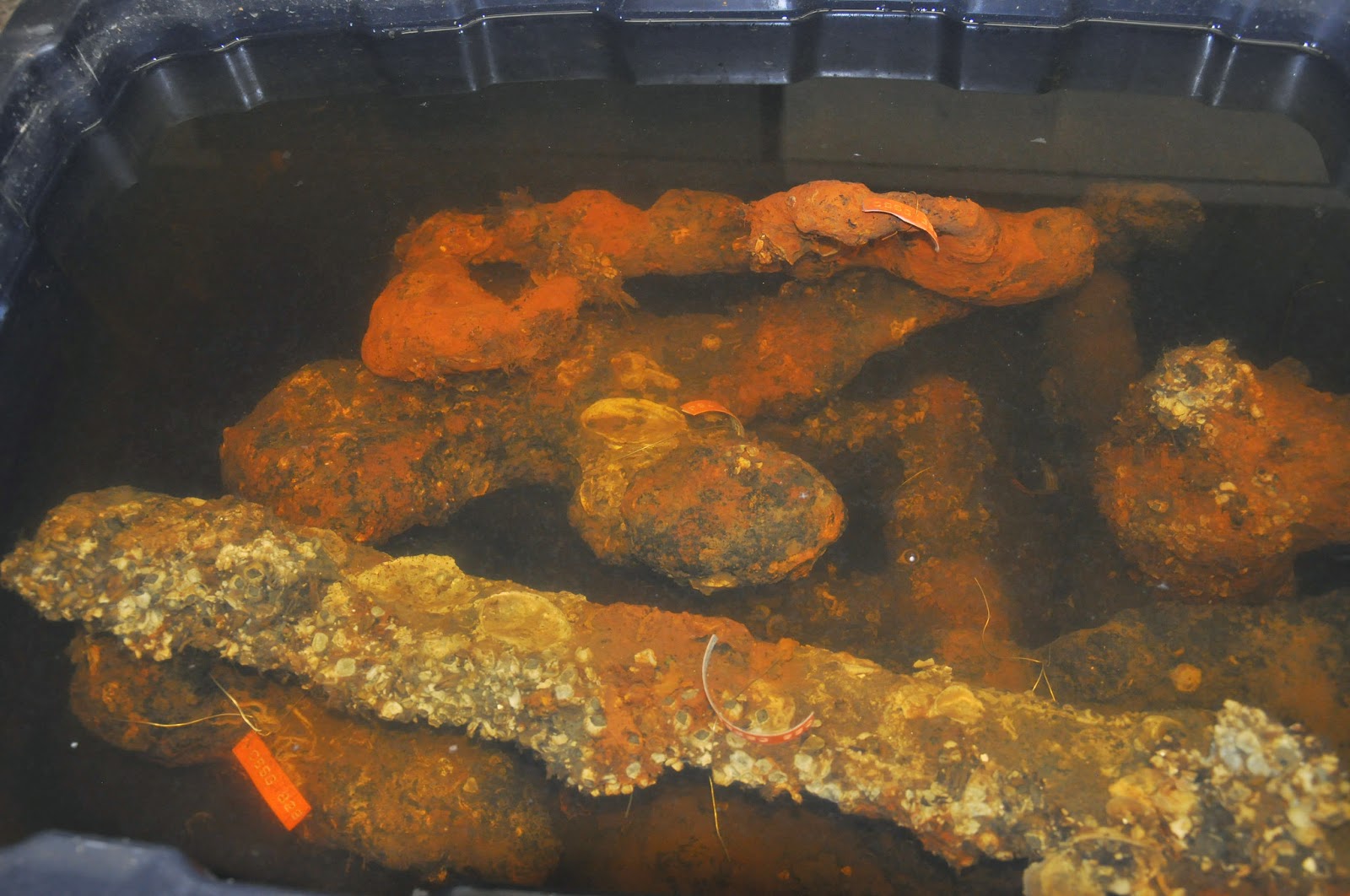
Machinery parts from river bottom on Sept. 15
An anvil amid pieces of timber (Photos: USACE)

The grapple and a clamshell scoop are in place after the departure of the Navy team, which was on site for about two months. So far, at least 1,750 artifacts have been recovered this year.

“MDSU (Mobile Diving Salvage Unit) 2 did a fantastic job salvaging large artifacts and casemate sections from the wreck,” said Jobling. “Their help was invaluable to the archaeologists and we would not have been able to do it without them.”

Navy divers completed their work Sept. 9, said Corps spokesman Russell Wicke. 

Mechanized recovery is scheduled to last through late October, officials said. “Our teams have done, and continue to do an excellent job in this recovery process,” said Wicke.

Conditions for diving and salvage operations have been challenging.

Navy divers, working in low visibility, heavy currents and brief diving windows, brought up the vessel’s four remaining cannon, 133 pieces of ordnance, a propeller with attached shaft, remaining parts of the propulsion system and more than 43,500 pounds of small casemate sections.

But there are at least another 100 tons of the CSS Georgia strewn across the river bottom, Jobling said. While the Navy was able to get much of the casemate, there’s more to go. And officials expect to find many additional artifacts.

The CSS Georgia was part of the so-called Savannah Squadron, which included the ironclads Atlanta, Savannah and Milledgeville. The leaky ship lacked much engine power and became a floating battery as part of the city’s defenses. Its Confederate crew scuttled the ironclad in December 1864 shortly before Federal forces took the city.

Jobling said the grapple is dropped into archaeological “squares” on the river bottom. The crew also places the grapple on the intersection of four squares so that it picks up additional pieces of the ship. 
The grapple’s jaw closes by gravity and it is brought to the surface.

Remnants of a CSS Georgia gun carriage (U.S. Navy)

“It lands on the concrete deck of the barge and we have a partition and we have a fire hose and sluice all the mud through the screen,” said Jobling.

Sometimes, only five artifacts may be found in the pile of muck. Other times, there are dozens of items inside. But the volume of artifacts has increased markedly with the introduction of the grapple.

The dozen archaeologists, some of whom are working on their masters degrees, received additional training on the barges and are helping separate artifacts from the mud.

“They are young, bright and extremely motivated,” said Jobling. “Today is the roller coaster because you are downhill when the artifacts start coming in. Wow. How do we start processing?”

Not all of the items brought up will be conserved. Those that don’t make the cut, such as broken pieces or twisted piping, will be reburied.

Dredging for the harbor deepening, meanwhile, officially began Monday in the outer channel off Tybee Island.

Saturday, July 11, 2015

More ordnance coming up than expected at CSS Georgia site in Savannah

Spencer Puett prepares for dive (U.S. Navy)

A team of Navy divers has recovered about 100 pieces of unexploded ordnance and munitions on the bottom of the Savannah River at the CSS Georgia wreck site – a number higher than what archaeologists first expected.

Navy officials expect dozens more will be lifted from the Confederate ironclad’s grave in Savannah this month before they remove remaining cannon, pieces of casemate, the propeller and other components of the warship.

The recovery operation, which includes previous artifact removal by divers contracted by the U.S. Army Corps of Engineers, is part of a larger project to deepen the river channel to carry containers vessels to and from the Georgia city without being dependent on the tide.

“I’m just really proud of my sailors, and we are all very proud to work on this piece of history,” diving and salvage commander Chief Warrant Officer Jason Potts said in a Navy article.

The CSS Georgia was scuttled in December 1864 to prevent it from falling into Union hands.

Friday, May 15, 2015

Navy team soon will begin removing CSS Georgia guns, artillery rounds from river

Previously recovered CSS Georgia gun (Old Fort Jackson)

[Update note: Navy dives described below will now begin in mid-June]

A U.S. Navy explosive ordnance disposal team is expected to begin operations June 1 at the ongoing recovery site of the CSS Georgia, the Confederate ironclad resting in pieces on the river bottom in Savannah, Ga.

Initially, officials believed perhaps five to 10 artillery rounds might need to be removed and rendered safe.

But Russell Wicke, a spokesman for the U.S. Army Corps of Engineers in Savannah, told the Picket on Thursday that divers “kept finding more and more” – for a total of perhaps 30.

Wreckage and artifacts of the CSS Georgia are being removed from the Savannah River in the first phase of the deepening of the city’s harbor. The vessel, which served as a defensive floating battery, was scuttled by its crew in late 1864, just before Savannah fell to Federal forces.

The Navy disposal group, working from a barge, will be on site at least two weeks, lifting four remaining cannon and the artillery rounds, with a Marines team rendering them safe, said Wicke.

Officials are finalizing plans for a “safe zone” during the ordnance recovery -- meaning the public will have to be outside of that boundary.

Casemate section pulled up in 2013 (USACE)

After that work is done, the recovery shifts to the large pieces of the ship: The casemates, propeller and engine, Wicke said. Many of the pieces will be conserved for future display.

The public can learn more about the story of the CSS Georgia and its recovery at a free lecture June 2 (new date) at the Savannah History Museum, 303 Martin Luther King Jr. Blvd.

Two of the lead underwater archaeologists, Steven James and Gordon Watts, will talk about the vessel’s construction, life aboard it and how divers are documenting the wreck site. The speakers will bring some recently recovered artifacts. The museum will be open for light refreshments before the 7 p.m. talk.

Friday, May 1, 2015

New CSS Georgia artifacts: Bayonet hilt, grapeshot, gun sight and much more

Stand of artillery grapeshot with cap (All photos U.S. Army Corps of Engineers)

While TV cameras and the public may be more interested when the big stuff – cannon, the propeller and pieces of casemate – are lifted from the Savannah River, it may be the smaller items currently being carried up by divers that tell the bigger story about the operation and crew life on the Confederate ironclad CSS Georgia.

“The artifacts have just been more fascinating than I would have expected, and I think they are telling a better story than what people realized at first,” said Russell Wicke, a spokesman for the U.S. Army Corps of Engineers office in the Georgia city.

More than 1,000 artifacts have been recovered so far from the 1864 wreck site. The underpowered CSS Georgia ended up serving as a defensive floating battery off Fort Jackson, just east of the historic waterfront. It was scuttled hours before Union forces took Savannah.

The dive area is about 150 feet by 250 feet. Visibility is near nil. Interestingly, pieces of pottery that pre-date the Civil War have been recovered from the debris field.

The current dives will continue into June, when a Navy barge and crane arrive on scene to begin the heavy lifting.

Wicke this week gave the Picket an overview of some of the items divers recovered in April.

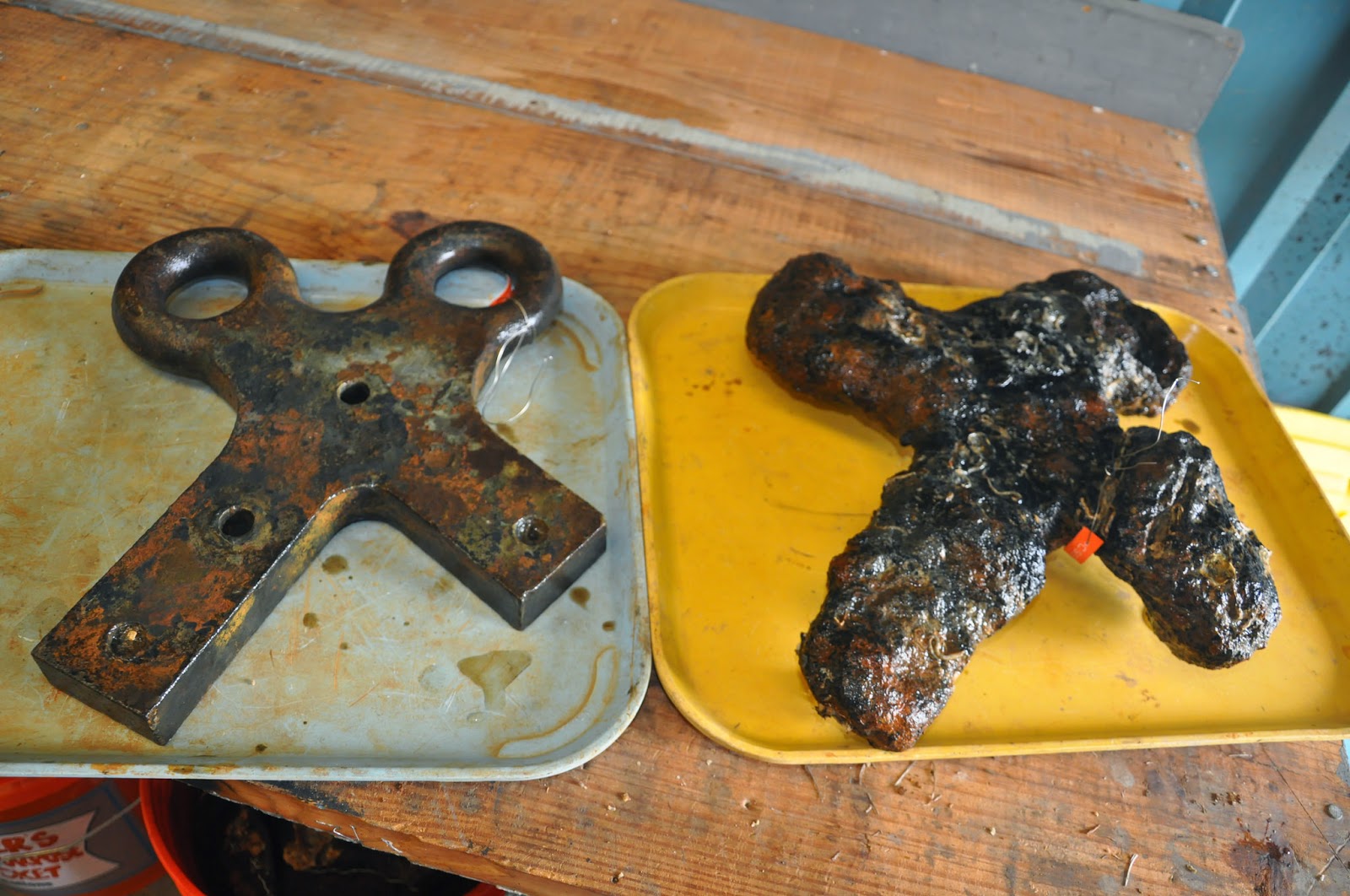
Misbehave? Watch out for the leg irons
Divers have recovered two sets of these contraptions, intended either for prisoners or crew members that were in trouble or prone to desert. The image in the center is an X-ray and the one at right an epoxy mold that can be referred to while the actual artifact undergoes extensive conservation.

Remnants of a bayonet hilt
According to a Corps article, the P.S. Justice rifle bayonet, model 1861, type II, was not of the highest quality. The company was based in Philadelphia.

Eyes for tackle from pivot gun carriage
These shaped pieces of brass (left) and iron were part of the rope and wood assembly used to aim and direct fire (though the ironclad never fired a combat shot). Wicke said research by Texas A&M University showed the cannon were not fixed in position, as once believed. These eyes for tackle allowed the crew to fire the cannon from different articles.

Grapeshot and stand
Here’s one of the more remarkable finds. Wicke says the crew wrapped these pieces with leather straps, which have long ago disintegrated in the river. He likens the golfball-sized grapeshot to giant shotgun pellets – able to clear the deck. A cap was placed at the top.

Assorted fasteners and spikes
The CSS Georgia was believed to have about 24 inches of pine and oak beneath her iron cladding. These metal items were used to link the railroad track armor to the protective wood and other components of the vessel. Many of these pieces are covered in concretion, the result of sand and shell forming sediment. Wood used on the ironclad is now largely “mush,” said Wicke, because of ravenous worms.

Rear gun sight
Jim Jobling, a project manager with Texas A&M’s Conservation Research Laboratory, looks over a sight for a 32-pound rifled cannon on the CSS Georgia. He noticed the faint presence of a serial number.

Ever hear of a sabot?
This small metal disc was at the back end of artillery shells and helped in the rifling process, says Wicke.