Showing posts with label wreck. Show all posts

Tuesday, December 9, 2025

This old soldier won't fade away: Residents of Ohio village can now look eye-to-eye at Civil War statue reassembled after a big rig crushed monument into pieces

The old statue was moved into village administration building (LHS and Village of LaGrange)
“Sherman,” the Ohio Civil War statue that was shattered by a big rig and put back together again, has come in from the cold.

LaGrange village and township employees – using machine and muscle – late last week moved the granite man from the unheated old fire station to the village’s administration building.

“They rented a gun safe dolly. They used a lot of muscle, too,” said Jan King, treasurer of the LaGrange Historical Society. “He is inside where it is temperature controlled.”

The new home for the statue brings the story full circle for the Picket, which first reported on the matter in summer 2022 after a tractor trailer driver apparently fell asleep at the village’s traffic circle. The rig smashed the 1903 memorial into pieces.

The community was determined to make things whole.

Master stone carver Nicholas Fairplay glued “Sherman” back together and used him as a model for a replica. Cleveland Quarries rebuilt the monument base below the soldier.

Both were installed on the rural village’s circle in May 2025.

The old “Sherman” was moved around the same time to the fire station (photo, left), where he stood for seven months before the recent move.

The statue, which weighs about 1,500 pounds, is now in a hallway close to the historical society (he’s too big to fit inside the group’s small museum and learning center). It is being kept for now in a protective wooden frame.

“We will have to anchor him down,” said King. “There is a possibility he could be pushed over.”

That would be especially tragic for the old fellow, having already suffered the indignity of losing his head (it broke off) when the truck pulverized the original memorial. (Photos below from LaGrange Township)


Local folks call the statue “Sherman,” but King was quick to quash that moniker during our phone call.

The correct name is “the statue” or “the flag bearer,” she said.

So how did the stone soldier come to be called “Sherman”?

The monument base carried the names of LaGrange area residents who served during the war, the names of a few battles and of Union generals Ulysses S. Grant, William T. Sherman, Philip Sheridan and George Thomas. Sherman was an Ohioan.

Sherman’s name on the monument base was directly below the front of the statue, so that name stuck.


I asked King, whose family has lived in the community southwest of Cleveland for generations, to describe the old statue, now that he is on ground level.

The retired seamstress is impressed by the craftsmanship – the flag’s carved stars, stitch marks on his lapel and the deep-set eyes. “There is a lot of detail to it.” (Photos above, LaGrange Historical Society)

The society and village office are in a former school building on Liberty Street. “Sherman” is next to a trophy case.

The historical society is open on the third Sunday of each month and on special request. There are old records, photos and a buggy inside, all signaling LaGrange’s rural roots. “It used to be an agricultural city but it is getting more away from that,” said King.

A group of third-graders once stopped by and King was able to show some of them graduation photos of their grandparents.

New statue at studio in Vermilion and monument installation in LaGrange (Courtesy Cleveland Quarries)
Safety measures have helped reduce intrusions into the traffic circle, which is at the intersection of routes 301 and 303 (Main Street).

Villagers used to blow horns and drive around the circle when they got married; school buses still take victory laps when athletes return victorious from competitions elsewhere, King added.

Whatever he is called, the replica Union flag bearer is a fixture in LaGrange and watches over those passing through.

Monday, October 27, 2025

There's a whole lot of fungus among the USS Cairo's wooden timbers. Scientists conduct study to help find ways to slow decay of historic ironclad at Vicksburg

The USS Cairo and an image of one of the fungus types found in the wood (Reprinted from Journal of Fungi); Claudia Chemello and Bob Blanchette examining Cairo timbers in 2024. (Paul Mardikian photo)
Confederate ships Little Rebel, Colonel Lovell and General Beauregard proved harmless, but Alternaria, Cladosporium and Curvularia are doing a real number on famed Civil War ironclad USS Cairo.

That’s because the latter are among a host of fungi eating away at the star attraction of Vicksburg National Military Park. The Cairo was the first armored vessel sunk by an electrically detonated torpedo and has been on display for decades.

A recent study found the wooden wreck is suffering continued fungal degradation, despite the application of chemical treatments over the years. Scientists who cleaned and examined the ironclad at Vicksburg National Military Park last year were alarmed by what they witnessed and have since analyzed.

“Finding so many fungi that cause wood decay alive in the ship timbers was a surprise,” said lead author Robert "Bob" Blanchette, a professor of plant pathology at the University of Minnesota.

Larger timber pieces inside the Cairo wreckage (Reprinted from Journal of Fungi)
“The wood surfaces are decayed and many of the timbers have had their strength properties compromised -- but many of the timbers are large and thick and still have moderately good integrity,” Blanchette wrote in an email to the Civil War Picket. “However, the presence of active decay fungi indicates they are progressively causing additional decay.”

The study, published in the Journal of Fungi, urges the Cairo -- which sits beneath a fabric canopy, but has open sides -- be moved indoors to a climate-controlled space to combat the toll from high humidity and heat.

Blanchette and his co-authors said keeping relative humidity below 55 percent would help arrest fungal action.

“An enclosed structure would also prevent dust, insects and animals from interacting with the ship. Undoubtedly, the condition of the wood will continue to deteriorate if the existing biodeterioration and biodegradation processes underway in the ship are left unaddressed,” they wrote.

The team was brought in by the National Park Service to evaluate the fungi and provide guidance on long-term preservation. The agency knows moving the ironclad indoors is necessary, but funding has not been secured.

Visitors can see gunboat during govt. shutdown

The Cairo and accompanying museum officially opened in 1980 (NPS photo)
The Picket reached out to the NPS and the park for comment on the study. An email said officials would respond to non-government shutdown queries once “appropriations have been enacted.”

Visitors to the park along the Mississippi River can still see the gunboat seven days a week. The Cairo museum has been open a few days but after Tuesday will be closed until the shutdown ends and money flows again to national historic sites.

Blanchette and Benjamin Held, also with the University of Minnesota, and Paul Mardikian and Claudia Chemello of Terra Mare Conservation say more study of the fungi is needed.

“Decades after various preservative treatments were applied, we now find soft rot and white rot fungi are in the wood,” Blanchette told the Picket. “Many of these fungi have not been studied and we do not know much about their biology and ecology. Others have received some investigation and some of these are known to tolerate various wood preservation treatments.”

The end comes in the Yazoo River above Vicksburg

The USS Cairo at anchor in 1862 (Library of Congress)
The USS Cairo’s fame has far exceeded its brief history. Built in a hurry in Mound City, Ill., and commissioned in January 1862, the ironclad sank only 11 months later. In between, it helped lead to the fall of Fort Pillow and Memphis, Tenn.

At 175 feet long and with a top speed of six knots, the vessel carried 13 guns and 251 officers and men. Seven shallow-draft City Class river ironclads prowled the Mississippi River and connecting shallow waterways, menacing Confederate supply lines and shore batteries, the National Park said.

Before the Federal attack on Haynes Bluff, Cairo skipper Lt. Cmdr. Thomas O. Selfridge Jr. led a small flotilla of gunboats into the hazardous confines of the Yazoo River on Dec. 12, 1862.

“Tasked with destroying Confederate batteries and clearing the river of torpedoes (underwater mines) the flotilla inched its way up the murky waters. As the Cairo reached a point seven miles north of Vicksburg the flotilla came under fire and the aggressive Selfridge ordered his guns to the ready and called for full steam, bringing the ironclad into action,” the NPS says.

“Seconds later, disaster struck. Cairo was rocked by two explosions in quick succession. The first tore and gaping hole into the port (left) bow of the wooden hulled ironclad. The second detonated a moment later near the armored belt amidships on the starboard side. The hole on the bow proved to be catastrophic.”

Selfridge ordered the Cairo to be beached and the crew to abandon ship. The Cairo slid from the river bank into 36 feet of water with no loss of life. About a half dozen sailors were injured.

Mud protected the ironclad for almost 100 years

The ill-fated ironclad disappeared into history for nearly a century.

Using maps and an old military compass, the legendary Ed Bearss, a historian at Vicksburg National Military Park at the time, and two comrades found the mud-encased ironclad in 1956.

A portion of the casemate rests on a barge in the 1960s (NPS photo)
Despite financial shortfalls, barge problems and a zero-visibility river that deposited silt at an alarming rate, the vessel was eventually 
raised in 1960 and 1964-65.

Hopes of lifting the ironclad and her cargo of artifacts intact were crushed in October 1964 when the three-inch cables being used to lift the Cairo cut deeply into its wooden hull. It then became a question of saving as much of the vessel as possible. The decision was made to recover the USS Cairo in three sections.

Barges carried the remnants to Pascagoula, Ms. The wreck was moved in 1977 to the Vicksburg park, where it was partially reconstructed and placed on a concrete foundation. The Cairo has been treated with a variety of chemical sprays and coatings since the 1970s. 

Frame that holds the Cairo's timbers in good shape

Diagram showing where samples were taken (Adapted from Library of Congress for Journal of Fungi article)
While submerged and under river sediments, bacterial degradation and soft rot took place, said Blanchette. After recovery, lots of different types of decay took place, including aggressive brown rot and white rot.

He and the other researchers gazed at the microstructure of the wood to see the effects of fungi. “Micromorphological characteristics observed using scanning electron microscopy showed that many of the timbers were in advanced stages of degradation,” they wrote.

They took 66 samples of wood – oak, pine and poplar -- from the wreck. “The large number of diverse fungal taxa that are present in the ship’s wood raises concerns about the future preservation of the ship,” the journal article said.

Blanchette (left) said fungi tolerant of preservation treatments applied to the Cairo found their way into the wood over time, causing decay.

 “The fungal isolation results and presence of so many fungi with the capacity to degrade wood also suggest that there is a need for additional studies to better understand how soft rot and white rot fungi tolerate and interact with aging wood that has been previously treated with wood preservation compounds,” the study said.

The park also asked the U.S. Forest Service to study the 1980s Glulam structure that holds the boat in place. It appears the frame is in pretty good condition, except for a few areas. (That team did not examine any of the ship’s timbers.)

Blanchette said his team did not find evidence of termites, though it did not include insects in the study. “As indicated in the Forest Products Lab paper, this must be monitored in the future since they can be a serious threat.”

The Forest Service also recommends moving the Cairo inside.

“The canopy currently is shedding precipitation from the actual frame, but the entire assembly is subject to substantial swings in relative humidity and temperature that could exacerbate issues with mold and decay fungi. The structure is also currently exposed to the risk of swarming insects such as termites, powder post beetles and carpenter bees.”

Thursday, April 24, 2025

Following Memorial Day parade, a Ohio community near Cleveland will dedicate a replacement for its Civil War statue shattered by a big rig in 2022

The new monument is at left in first photo, right in second image (Photos courtesy N. Fairplay)
Nearly three years after a tractor trailer slammed into a Civil War monument in northern Ohio, knocking it to pieces, a replica will be unveiled on Memorial Day, a symbol of community pride in veterans and their sacrifice.

Officials in LaGrange were determined to replace the 1903 granite memorial that was obliterated in June 2022. The monument, which was made up of several pieces, topped by a Union soldier, was shattered. Even his head was broken off.

The metro Cleveland and farm community determined the damage was too severe for a repair.

After finalizing a $923,244 settlement with the trucking company’s insurance company, LaGrange Township hired master carver Nicholas Fairplay and Cleveland Quarries to make new versions of the statue and other parts of the monument in the downtown square.

They worked from the original statue -- painstakingly glued together by Fairplay and an assistant to use as a template for the new one. He worked in a studio at Cleveland Quarries, which milled the raw form of the replacement statue at its operation in Vermilion.

The piece was shattered into dozens of pieces, including its head (Photos LaGrange Township)
Fairplay told the Picket he expects to have the work completed late this week. He provided a few photos showing results of the detail work he and the assistant performed.

“The space between the legs and hand are now pierced. We are now working on the surface detail,” he said. Of one photo he sent, the carver said, “You can see red pencil marks showing where we have to carve deeper shadow.”

LaGrange Township trustee Rita Canfield said the plan is to have the so-called Sherman statue installed the week of May 12. The soldier's figure will be covered until Memorial Day (May 26).

Return of the fixture at the intersection of routes 301 and 303 (Main Street) coincides with the 200th anniversary of the township and the 150th for the village. (They are separate political entities).

Joint events on May 24-26 include a car show, pancake breakfast, 5K run, carnival, parade and the statue unveiling on Memorial Day. Members of the LaGrange Historical Society will be present all three days. (More details here)

Faint red marks on new statue (left) show areas needing refining (Photo courtesy N. Fairplay)
“We hope to have a good turnout and will be hosting fireworks and other events as part of the return celebration and the founding of the community at the same time,” said Canfield.

Below the statue is the monument base, which carried the names of LaGrange area residents who served during the war, the names of a few battles and of Union generals Ulysses S. Grant, William T. Sherman, Philip Sheridan and George Thomas. Cleveland Quarries replaced all of the pieces comprising the base.

“I must say that Nick has done a fabulous job,” said Canfield. “His work has been impeccable. Cleveland Quarries owner Zach Carpenter and his team have given us our heritage back. They have been the type of partner that we all want to work with: Transparent, honest, fair and very highly skilled with an insane attention to detail in their recreation of our monument.”

He has stood tall for more than 120 years

To say the Sherman statue, as locals call it, is vital to the area’s identity might be an understatement. It sits smack dab in the middle of the community, which has about 2,500 residents.

The memorial, made of Vermont granite, was erected in 1903 (some sources say 1904) for about $3,000. The project was a joint project of LaGrange Village and LaGrange Township, a separate political entity. They are in Lorain County.

The monument is owned by the township and is the center point of the village. (At left, the monument before its destruction, photo LaGrange Township)

The township was determined the new Sherman is faithful to the old one in every way, from the pose and flag of the Federal soldier to the stacked blocks below him that feature battles and the names of area men who served and died in the war.

After the traffic accident, officials ensured that virtually every piece, down to chips, of the monument were stored so they could serve as a guide for the replica.

Fairplay describes the soldier as having undersized feet and hands. “I think his legs are a little shorter for this height.”

“He is carved quite simple but (is) a heroic, nostalgic statue. It is not a Greek or Roman statue emphasizing portraiture.” The work will include the U.S. flag leaning out and a tree stump next to the right leg. “Most have tree stumps or drapery because the weight of the statue will not be (supported) by the ankles,” said Fairplay.

I asked him why the new statue is lighter than the original.

“The original statue is darker due to pollution on the surface which could be cleaned off. You could see the original color of the granite when the statue was in pieces.” By that, he means granite below the surface was not discolored and when the memorial was broken, you could see the difference (photo below).

Safeguarding the soldier's future

Canfield said the insurance settlement will fund the monument, a new flagpole, lights and other infrastructure on the circle. 

Truckers often use Route 301 through town. A series of crashes, culminating with the loss of the soldier, prompted officials to place bright yellow metal poles – known as bollards – to warn motorists of the vulnerable circle.

In the 2022 incident, an incident report from the Ohio State Highway Patrol said the driver told a responding officer that he fell asleep and went through a stop sign. The driver was not found to be impaired.

Cleveland Quarries is donating large sandstone blocks to replace the bollards.

“We are pretty confident if someone fails to stop, if they hit the couple tons they will come to a stop,” Canfield said in a bit of understatement.

The Sherman statue suffered another indignity 65 years ago, according to a Lorain County nostalgia blog. A newspaper article in November 1957 said pranksters tarred and feathered the base.

So what will happen to the original monument after Memorial Day?

“At this time, the … old statue of Sherman will be placed in the old Society Hall/fire station. The remaining base pieces will be placed in the cemetery,” said Canfield. “The epoxy used to glue the statue back together will not tolerate the weather and would degrade over time.”

One of the Civil War campaigns being noted in the new monument (Cleveland Quarries)

Monday, April 11, 2016

3D sonar imaging will help confirm identity of Rebel blockade runner off N.C.

(Courtesy N.C. Office of State Archaeology)

A 3D sonar imaging device will aid divers next week as they continue to explore what’s believed to be the largely intact remains of the Civil War blockade runner Agnes E. Fry.

The North Carolina Office of State Archaeology on Monday said the Charlotte Fire Department offered the use of the technology for the investigation just off Oak Island, south of Wilmington.

Deputy state archaeologist Bill Ray Morris, in a statement, said the remains of the iron-hulled steamer match up with the Scotland-made Agnes E. Fry, one of three blockade runners that sank in the area.

“Fry was 236 feet long, and the vessel remains we have are 225 feet in length. The other runners, Georgianna McCaw and Spunkie are both considerably shorter and a much earlier design than Fry,” said Morris. “The boiler type, as well as the hull design of the wreck, are both indicative of a more modern vessel than either McCaw or Spunkie. The difference in the lengths has to do with the damage to the bow and stern.”

The wreck was first studied in late February with side-scan sonar images during remote sensing operations. Both engines and the paddlewheel shaft are missing, matching salvage records. Divers noted the missing pieces during a March 22 dive.

"Every piece of evidence we have examined to date, from sonar images to primary documentation, points directly to this shipwreck being Agnes E. Fry," said Gordon Watts of the Institute for International Maritime Research. "We look forward to working with the Charlotte team to confirm our suspicions." 

The Llama resembled the Agnes E. Fry (NCOSA)

Fire officials in Charlotte arranged for Nautilus Marine Group International, the company that provides sonar systems to its dive team, to bring the latest version of a sector-scanning imaging sonar to confirm the vessel’s identity

"This instrument will allow us to make a complete, multi-dimensional map of the site in a matter of days," Morris said in the statement. "Unlike usual methods, imaging sonar does not require good visibility and is considerably faster than on-site mapping. Visibility underwater on the site is so murky that it rarely exceeds 18 inches."

The Agnes E. Fry made several successful runs for the Confederacy before it ran aground near Wilmington in the closing months of the war.

Friday, May 1, 2015

New CSS Georgia artifacts: Bayonet hilt, grapeshot, gun sight and much more

Stand of artillery grapeshot with cap (All photos U.S. Army Corps of Engineers)

While TV cameras and the public may be more interested when the big stuff – cannon, the propeller and pieces of casemate – are lifted from the Savannah River, it may be the smaller items currently being carried up by divers that tell the bigger story about the operation and crew life on the Confederate ironclad CSS Georgia.

“The artifacts have just been more fascinating than I would have expected, and I think they are telling a better story than what people realized at first,” said Russell Wicke, a spokesman for the U.S. Army Corps of Engineers office in the Georgia city.

More than 1,000 artifacts have been recovered so far from the 1864 wreck site. The underpowered CSS Georgia ended up serving as a defensive floating battery off Fort Jackson, just east of the historic waterfront. It was scuttled hours before Union forces took Savannah.

The dive area is about 150 feet by 250 feet. Visibility is near nil. Interestingly, pieces of pottery that pre-date the Civil War have been recovered from the debris field.

The current dives will continue into June, when a Navy barge and crane arrive on scene to begin the heavy lifting.

Wicke this week gave the Picket an overview of some of the items divers recovered in April.

Misbehave? Watch out for the leg irons
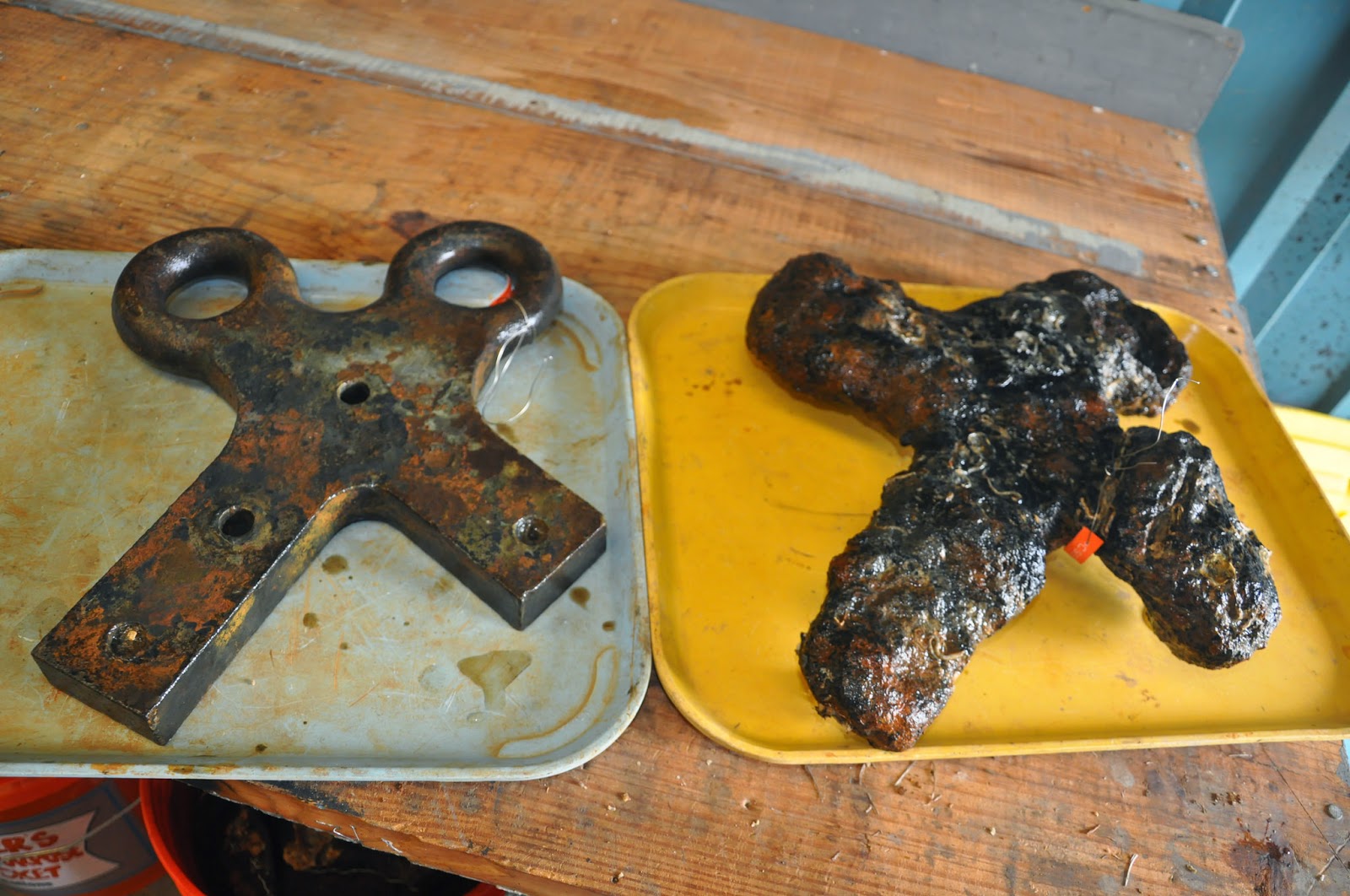
Divers have recovered two sets of these contraptions, intended either for prisoners or crew members that were in trouble or prone to desert. The image in the center is an X-ray and the one at right an epoxy mold that can be referred to while the actual artifact undergoes extensive conservation.

Remnants of a bayonet hilt
According to a Corps article, the P.S. Justice rifle bayonet, model 1861, type II, was not of the highest quality. The company was based in Philadelphia.

Eyes for tackle from pivot gun carriage
These shaped pieces of brass (left) and iron were part of the rope and wood assembly used to aim and direct fire (though the ironclad never fired a combat shot). Wicke said research by Texas A&M University showed the cannon were not fixed in position, as once believed. These eyes for tackle allowed the crew to fire the cannon from different articles.

Grapeshot and stand
Here’s one of the more remarkable finds. Wicke says the crew wrapped these pieces with leather straps, which have long ago disintegrated in the river. He likens the golfball-sized grapeshot to giant shotgun pellets – able to clear the deck. A cap was placed at the top.

Assorted fasteners and spikes
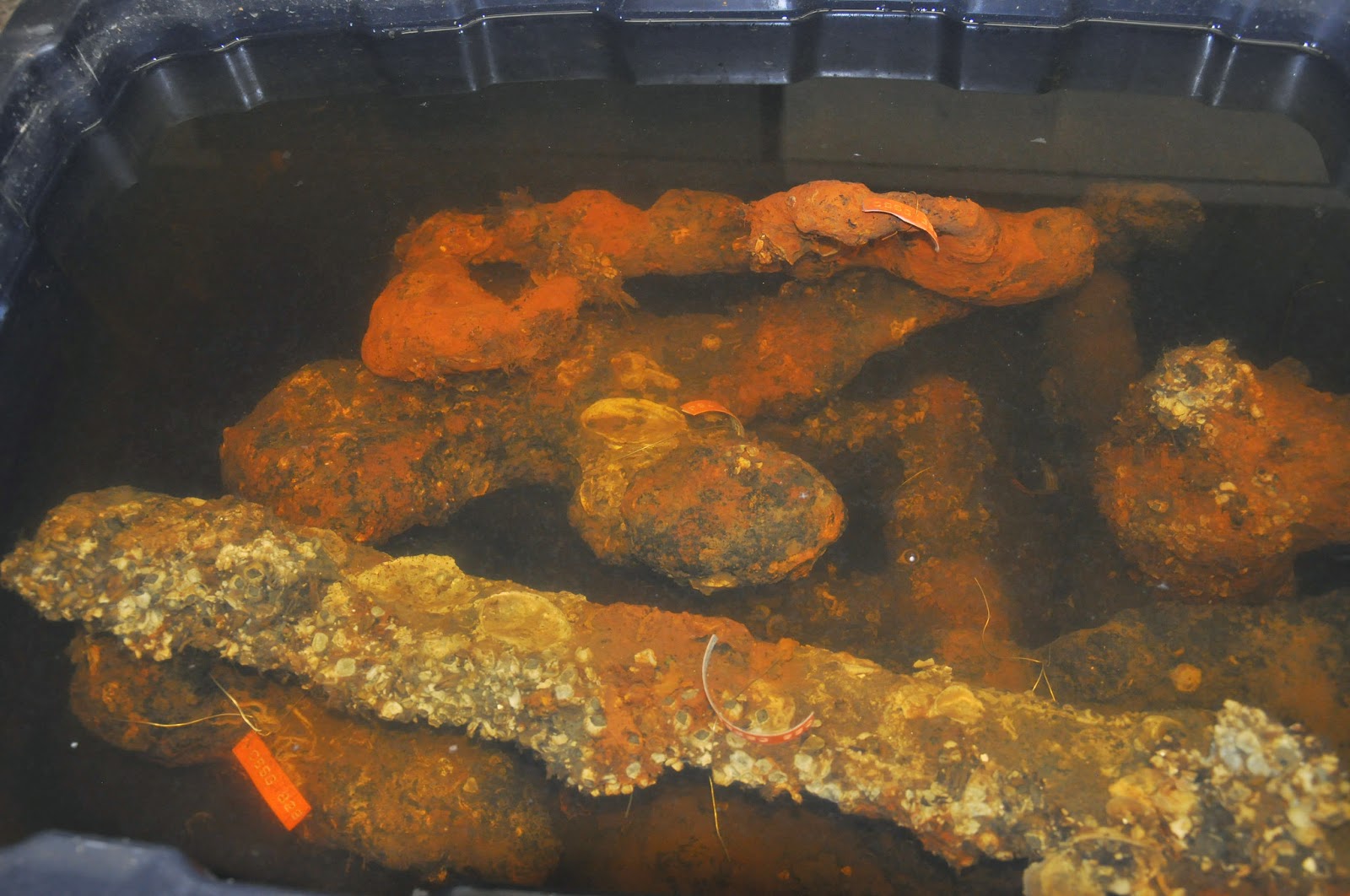
The CSS Georgia was believed to have about 24 inches of pine and oak beneath her iron cladding. These metal items were used to link the railroad track armor to the protective wood and other components of the vessel. Many of these pieces are covered in concretion, the result of sand and shell forming sediment. Wood used on the ironclad is now largely “mush,” said Wicke, because of ravenous worms.

Rear gun sight
Jim Jobling, a project manager with Texas A&M’s Conservation Research Laboratory, looks over a sight for a 32-pound rifled cannon on the CSS Georgia. He noticed the faint presence of a serial number.

Ever hear of a sabot?
This small metal disc was at the back end of artillery shells and helped in the rifling process, says Wicke. 

Thursday, February 19, 2015

Inside the CSS Georgia's armor: Without preferred rolled plate, railroad iron had to do

(USACE, Savannah District)

I’ve researched and written about the Confederacy’s CSS Georgia for years, noting that the vessel had armor made of railroad iron. But I never really pictured what the outer layer of its casemates might have looked like – until recently.

The U.S. Army Corps of Engineers’ Savannah office, in charge of removing the wreckage in the Savannah River as part of a massive harbor deepening project, released a photograph of a cross section of one of the three casemate chunks remaining on the river bottom.

There they are. Five sliced pieces of T-shaped railroad track wedged in an iron box, corrosion and river sediment filling the gaps. Wow.

It seems almost everything about the CSS Georgia -- which lacked the locomotion to fight the enemy in open water, and instead became a floating battery defending the city – is currently up for study: Exactly how long was the ironclad? How did its propulsion system work? How was the casemate, which housed the Georgia’s guns, put together?

The CSS Georgia was believed to have about 24 inches of pine and oak beneath her iron cladding. Historians and archaeologists are eager to see how all of that was held together. They don’t have blueprints from which to work.

(USACE)

Alvin N. Miller’s machine and shipbuilding business in Savannah produced the “one-off” CSS Georgia in 1862. Estimates on the vessel's length range from 150 to 250 feet.

Bob Holcombe, a naval historian living in Columbus, Ga., said the builders relied on railroad iron for armor because that’s what was available.

Most Confederate ironclads were armored with rolled plate.

“Rolled plate was considered stronger than railroad iron. Railroad iron was used as an expedient,” Holcombe told the Picket. “It was readily available and it did not have to go through the process of being heated and rolled flat; indeed, there were only a couple of rolling mills in the Confederacy capable of rolling 2-inch plate: Tredegar in Richmond and Schofield & Markham in Atlanta.”

What does that mean in battle?


The CSS Georgia, with its casemates at a nearly 45-degree pitch, likely would have stood up to smaller artillery pieces. But, the 11-inch 15-inch Dahlgren might be another matter.

Commenters on the Legacy of the USS Monitor Facebook page have been discussing the photograph of the railroad iron, asserting that the CSS Georgia would have been vulnerable to the Passaic class of Union monitors.

One cites the testing by Texas A&M University on a section of casemate brought up from the CSS Georgia in late 2013. An 8-inch section of rail featured “relatively large impurity inclusions,” an indication of some weakness in the iron.

Holcombe said the Arkansas, Manassas and Louisiana were among the Confederate ironclads fitted with railroad iron armor.

“After the (CSS) Atlanta was pounded by the monitors off Savannah the Confederate States Navy started adding additional plate, which seems to have better resisted the 15-inch guns.”

Cross-section of CSS Georgia rail (USACE)

While some material from the CSS Georgia was recovered after the war, four artillery pieces, parts of the propeller and propulsion system, a boiler and three casemates remain in the swift, dark waters, according to a CNN article. One of the casemates is huge: 68 feet by 24 feet.

Divers have begun preliminary work and recovery; the larger pieces are expected to be brought up in the spring and summer.

The Corps of Engineers said previous recovery efforts, the absence of the lower hull and extensive damage from dredging many years ago will hinder their effort to give a full picture of the CSS Georgia’s operations, which ended in December 1864 when her crew scuttled her as Federal forces rushed to the city.

Still, archaeologists and others want to glean as much as they can during and after the $15 million recovery.


“A detailed examination of the surviving elements of the casemate might support the hypothesis that it was designed to accommodate standard lengths of available iron,” the Corps says on its new website on the CSS Georgia. “Documentation of the rails … could provide evidence that would identify different types of rail used and provide insight into the companies that supplied that material.”

The Corps is not sure all of the casemate can be brought up intact, given most of the wood that held it the vessel is long gone. The wreck site includes disjointed pieces of railroad near the casemates.

Holcombe, who has studied the CSS Georgia and followed developments, said the reason for vessel’s lack of motive power “is the $64,000 question and one I don't think can be fully answered until the machinery comes up and, hopefully, some sections of the hull.

“My gut feeling is that it has more to do with machinery issues and/or hull design than weight of armor, but until everything comes up and is examined it's just a guess.”

Wreck site in the Savannah River (USACE)