 |
| Postcard of the Ulster Iron Works (I Like Saugerties Facebook page) |
 |
| A lighthouse is a big draw today (Courtesy of Saugerties Lighthouse) |
Saugerties, New York, has all the right visuals for a
gift calendar: a quaint village, vibrant art studios, horse competitions, an
army of mums that bloom in the fall and a welcoming lighthouse perched on the
bank of the Hudson River.
In the mid-19th century, Ulster Iron Works --
one of its burgeoning manufacturing sites – was lauded, too, for its setting.
“The mill is very picturesquely situated below the falls
of the Esopus (Creek) and when in operation, especially in the evening, it
presents a very attractive appearance,” notes the 1880 “History of Ulster
County, New York.”
While Saugerties today is a tourist town (and the
hometown of “The Tonight Show” host Jimmy Fallon), life was somewhat gritty
during Ulster Iron Works’ heyday. There were occasional problems with
intoxicated workers kicking up a bit too much excitement.
“They actually had to pass a law in the village … a lot
of the guys mining the bluestone were using dynamite. The guys were coming
through with the wagons, having a few drinks before going on.” A law forbade
dynamite-carrying wagons from stopping.
 |
| Remains may be of later factory (Courtesy of Saugerties Historical Society) |
In his volume, Nathaniel
B. Sylvester defies the dry writing one might expect in a county history,
imbuing the iron mill with virile might.
“Workmen, naked to the waist, running about with great
red-hot bars of iron; the flames shooting out of those tall chimneys; the weird
shadows falling grotesquely around; the sharp contract between the brilliant
light and the dense darkness beyond – all unite to suggest the scenes of
Dante’s ‘Inferno.’”
Saugerties’ population bloomed and industry employed
thousands – at iron works, lead and paper production and the excavation of bluestone for New York City’s sidewalks.
But times, and tastes, changed. Those industries today are long gone. Those who
trace their lineage back to pre-Revolutionary War days rub shoulders with
visitors and New York City expats who decided to retire in this bucolic
location. It’s a tourist town.
So it may not be surprising that many townspeople were a
bit surprised when word came this spring that a small part on the famous Civil
War ironclad USS Monitor was found to have the mark “ULSTER.” Officials believe an aft diagonal support brace in
the turret was produced by Ulster Iron Works in Saugerties. It was the first time a maker’s
mark was found in the turret.
The company, which operated from about 1827 to 1888, took advantage of iron deposits in Ulster County or ore ferried through
nearby canals. For a time, it was a U.S. Navy contractor.
Some local observers say residents have
little knowledge of the important industrial history of Saugerties. “The
collective memory is pretty weak,” said Chester Hartwell, who maintains the “I Like Saugerties” Facebook page.
But the Ulster discovery at a museum in
Newport News, Va., has brought those days to the surface.
“This has spurred an interest in the
historical society and we are going to take a look at it,” said Block.
Saugerties,
N.Y.: The one and only
Dutch settlers were among the first Europeans to live in
this region at the base of the Catskills, some 100 miles north of New York
City. British forces burned homes, barns and sloops in Saugerties during the
American Revolution.
The river town of Ulster was prospering by the early 19th
century. Its name was changed in 1855 to Saugerties, the only community by that
name in the United States.
 |
| Saugerties Historical Society is based in 1727 Kiersted house |
A volume in the early 20th century gave the story: “The Sawyer’s Creek, or Sawkill of local maps, was
the scene of an unaccountable activity on the part of a man whose name,
antecedents, residence, mode of life, and fate are all unknown, yet from whom a
populous town drives its appellation. The ‘Little Sawyer,’ who established
himself on the bank of a stream some ten miles above Kingston and antedated the
earliest settlers whose names are recorded, has been referred to in old
accounts as de Zaagertje and his mill as Zaargertje’s, of which Saugerties is a
simple corruption.”
In the 1820s, entrepreneur Henry
Barclay established Ulster Iron Works and later a paper mill. John Simmons, an
Englishman, was brought in to run the iron mill.
Audrey Klinkenberg, Saugerties town historian, said Barclay wanted a family-friendly community. “He didn’t want his
men to be drunk.” He sold land for three churches that would perhaps moderate
behavior.
 |
| (Courtesy of Saugerties Historical Society) |
Ulster Iron Works (above) sat on the lower side
of Esopus Creek in Saugerties. A dam and a long raceway cut by Erie Canal
builders through rock provided water power for the mill. The mill had
an annual capacity of 6,700 net tons of iron products.
Where did the raw materials come from?
Some came from ore deposits in the
region. Saugerties and Kingston, downstream on the Hudson, also were transportation hubs and produced goods from coal and ore brought by canal from
Pennsylvania.
The iron manufacturer was known for
using European technology. A process called “double puddling” could produce
appreciable amounts of high-grade bar, rod and hoop iron. Two giant wheels
powered by the creek powered 13 furnaces and a hammer at Ulster Iron Works by
the time it closed.
When Barclay died in 1851, a paper mill near
Ulster Iron Works was taken over by the Sheffield Co., manufacturers of writing
paper.
Penchant for government contracts
 |
| 1875 map shows factory at tip, paper mill below (Saug. Public Library) |
Ulster Iron Works records kept at the
William L. Clements Library at the University of Michigan in Ann Arbor include
this summary:
“Among the factors that contributed to
the success of the Ulster Iron Works was the ability of the owners of the
corporation to arrange for government contracts, especially contracts with the
Navy, for providing iron products for use in rockets, ships, and other
materials.”
Sylvester, who wrote the county history,
details the manufacture of a chain with small links for the military. It passed
a series of stress tests at the Navy yard in Washington. Lore has it that the
chain was so strong the machine used to test its strength broke.
 |
Brace in USS Monitor turret (Mariners' Museum and Park)
|
Officials believe an aft diagonal
support brace in the USS Monitor turret was produced by Ulster Iron Works. The
brace is between two guns and is separate from the large turret
"ring."
“While this firm was never mentioned as
a supplier during the Monitor’s construction at Continental Iron Works, it is
now believed that Ulster provided materials for modifications to the ship
while it was undergoing sea trials at the Brooklyn Navy Yard,” said the Mariners’
Museum and Park in Newport
News, which houses the USS Monitor Center.
Will Hoffman, USS Monitor project
manager, told the Picket his team is hypothesizing that when the ironclad was
turned over to the Navy and the turret was tested, “they used Ulster to make
modified parts. This makes sense, too, because the company was located just up
the Hudson River.”
 |
| The New York Times details Ulster Iron Works (Courtesy of SHS) |
Klinkenberg said she had previously
heard of a connection. “We’ve always had in our literature that Ulster Iron
Works had made … plates for the Monitor.” Block and Hartwell said they had been
unaware of Saugerties’ contribution to the ironclad.
“But it makes sense, a small industry in which everyone
knows everybody,” Hartwell said.
A
multicultural workforce
The Clements Library also makes this notation about
Ulster Iron Works:
“In civilian applications, Ulster was an
important purveyor of iron products for railroads and shipping. Also contributing
to the success of the works was the unusual diligence of the owners in
importing foreign technologies for use at Ulster, and in soliciting the
emigration of highly skilled workmen from Welsh and English foundries to fill
their employment demands, particularly during the 1830s when skilled labor was
at a premium. The owners appear to have been quite successful at using high
wages as a lure to skilled workers during such periods, but they were equally
ruthless at cutting wages when labor was abundant.”
 |
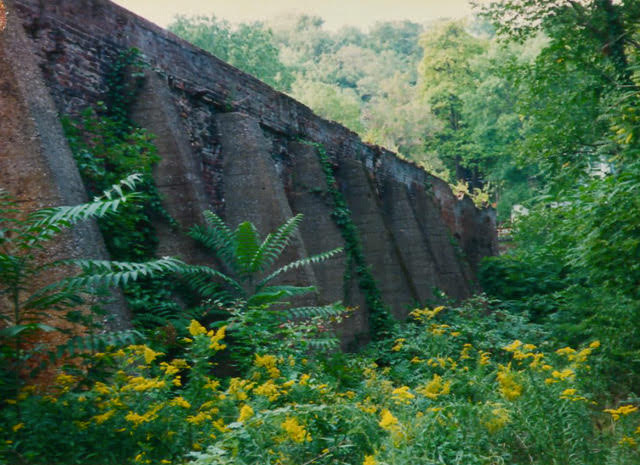
| Remains of wall on Cantine's Island (Courtesy of SHS) |
The workforce of 300-400 was a panoply
of diverse European ancestry: English, Welsh, Dutch, Italian and Scots, among
others. For a few decades, business was generally good, even through ownership
changes.
The Saugerties Public Library's holdings on this era includes a pamphlet, “Focus on
Saugerties,” mentions the demise of the company after steel, which was
stronger, began to surpass iron in demand.
According to local artist
Michael Sullivan Smith, author of “A Brief History of Saugerties,” the iron
works was replaced in 1887 by an early experimental mill producing paper
pulp from wood fiber run by William Parsons. “This, too, was replaced by a
crepe paper manufacturing operation in 1914, and then by storage sheds for clay
used for the paper coating operations of the Martin Cantine Co.
“We are fortunate to have Civil War era photographs of
the iron works when it was in operation or there would be nothing remaining,
even archaeologically, of it besides the slag used to even out the rugged
terrain of the village over the years,” Smith told the Picket. He is involved with the Friends of Historic Saugerties group.
 |
| Courtesy of I Like Saugerties Facebook page |
An 1891 newspaper letter to the edit about the Ulster
Iron Works’ demise is both funny and sad.
The second or third owner, William Mulligan, sold it in
1886 below value to William R. Sheffield. George R. Matthews, who was involved in the transaction, wrote in the Daily
Post: “I have not said that William R. Sheffield made Mr. Mulligan drunk, but I
do say that Mr. Mulligan was taken to Sheffield’s house sober, and he came away
from there very drunk, and during that time the mill was sold.”
Within two years, the mill was closed and 300 people were
without a job. Many had worked in the mills for as long as 50 years. “They were
nearly all compelled to seek homes elsewhere,” wrote Matthews, describing the
whole business as “a great wrong.”
Hospitality
rules roost today
By the early to mid-20th century, other businesses were taking hold in Ulster County. IBM’s plants were mainstays in
the region, but a major financial loss in 1992 led to numerous layoffs.
The Ulster County Office of Economic Development today
touts a strategic location to population centers in the Northeast, an educated
workforce, “four-season living” and aggressive business incentive programs.
Manufacturing accounts for only 8 percent of a
diversified business sector. That’s well behind leisure and hospitality (16
percent), which reflects Saugerties, a town of about 20,000, being a tourist mecca.
Block, of the historical society, said Saugerties has a
strong tie to the Hudson River.
“I think it is a way of life. The river in the past
brought us industry and helped build the town. Now it is used recreationally,”
she said. “It seems everything leads to the river.”
 |
| Opus 40 is made of bluestone (Courtesy of SHS) |
Officials point to a host of attractions, among them:
Opus 40, a large bluestone sculpture that artist Harvey Fite spent decades building;
Seamon Park; Horses in the Sun, part of a large circuit that includes show
jumping; a garlic festival; Esopus Bend Nature Preserve; and the Saugerties Lighthouse.
 |
| (National Archives) |
The lighthouse can be reached by a 1/2-mile trail. “The
other lighthouses in the mid-Hudson Valley remain isolated islands in the
river, while ours is unique with land access,” said keeper Patrick Landewe.
The nonprofit Saugerties Lighthouse Conservancy restored
the lighthouse and a bed and breakfast helps fund preservation efforts.
Hartwell, who grew up on Long Island and has lived in
Saugerties for 15 years, touts the arts scene in a network of area cities.
Years ago, he worked at the famous Woodstock Playhouse. Woodstock is about 12
miles west of Saugerties. “A lot of bohemians in the ‘20s would make hippies seem
tame,” he said.
 |
| Jimmy Fallon at a local event (Saugerties Historical Society) |
Fallon, of “The Tonight Show,” attended Saugerties High
School and earlier this year donated $100,000 to the school. He has made
numerous fond references to the town during his career.
In 2016, Fallon interviewed musician Robbie Robertson of
the Band, and Saugerties got a mention. A home dubbed “Big Pink” in West
Saugerties was the setting for Bob Dylan’s and the Band’s “Basement Tapes”
sessions in 1967. Robertson said the house is where the group found its sound.
‘A
rich, rich history’
Hartwell said the well-preserved main street, other
venues and events have expanded Saugerties’ reach beyond weekenders. Retirees
and others, many from New York City, have moved to this corner of Upstate New
York.
Block, of the historical society, said her family has
been in the area since 1680. She describes Saugerties as eclectic. “This
community has a rich, rich history.”
 |
| Cantine's Island Cohousing (Courtesy of SHS) |
Ulster Iron Works is long gone. Across Esopus Creek is
the Diamond Mills Hotel. On the site of the iron and paper mill are The Mill at
Saugerties, a housing complex, and Cantine’s Island Cohousing, which promotes a
collective lifestyle.
Eighteen private households live on Cantine’s Island’s 10
acres, sharing management and work needed for the property’s upkeep.
“By design, folks must walk by their neighbor’s homes
when they leave or return. There is a parking lot located outside of the green.
In cohousing tradition, this arrangement encourages interaction with
neighbors.”




.jpg)


