Showing posts with label Corps. Show all posts

Sunday, July 23, 2017

A trip to the CSS Georgia recovery site: Nine really cool things and a couple bummers for researchers, conservators

Clamshell prepares to lift mud (and possible artifacts) to deck
Spikes used to join armor components (Picket photos)

I couldn’t let a narrow window of opportunity close, so I drove most of the night to Savannah, Ga., to spend a few hours Saturday aboard barges recovering the last significant portions of the Confederate ironclad CSS Georgia. That on-site project will be completed in the coming days. Thanks to the Savannah office of the U.S. Army Corps of Engineers for having me on board. All photos by the Picket unless noted otherwise.

Protected by railroad iron

I finally got face-to-iron with two large casemate sections that were lifted from the Savannah River this summer (by the way, they are being placed in a different spot back river this weekend for safekeeping).

I still am trying to get my head around this innovative way of building armor when you don’t have more raw resources and manufacturing capabilities.

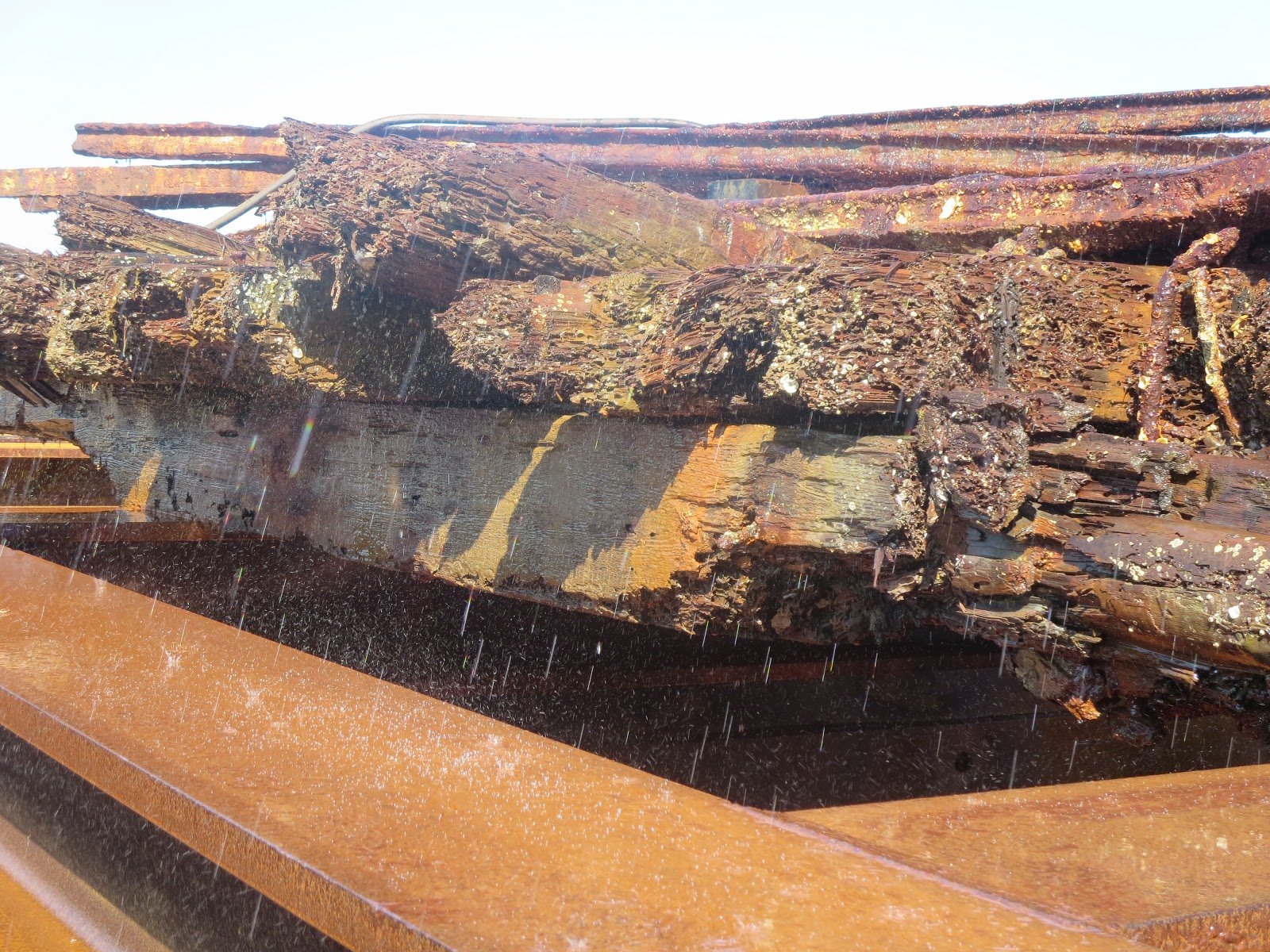
Sprinklers are used to keep casemate safe from corrosion

Jim Jobling, with the Conservation Research Laboratory at Texas A&M University -- which is conserving much of the CSS Georgia’s 16,200 artifacts -- said each rusted rail is 4 inches by 4 inches, 24 feet long and weighs about 400 pounds. The iron is backed by 8 inches of pine and another 12 inches of heavy lumber.

Archaeologist Gordon Watts, who has dived and studied the wreck site for decades, said there were at least seven patterns of interlocking railroad iron used to make the casemate in 1862.

Where did the ship builders get the railroad iron?

Two rail pieces, lower right, with tar used to stop leaks (USACE)

“They were likely to be confiscated,” Watts said – specifically from Northern-owned companies, including a line from Brunswick, Ga., to Jacksonville, Fla. The nephew of US Navy Secretary Gideon Welles came to Savannah after the war to try to recover iron and other material, he said.

The CSS Georgia was prone to leaking, from above and below, and crew members used tar, plaster and other materials to fill gaps in the armor. Experts believe the engine was in service at all times, to power pumps that kept the leaky gunboat from sinking.

“It was obviously a pretty miserable place,” said Watts.

Detailed drawings bring artifacts to life

Gordon Watts measures portion of casemate armor ...
... and documents the different patterns of railroad iron used for armor

Gordon Watts, a contract archaeologist from North Carolina, has produced numerous detailed sketches of CSS Georgia components, something I first noticed during a visit to the 2015 recovery operation involving U.S. Navy divers.

“If I draw it, than I have to think about it,” Watts said of each item. He said he can get more interpretation that way than from just observing mosaic images.

He points to components of engine (Picket photos)

Find of the summer: Engine cylinders

They are not exactly sexy, but two steam cylinders brought up by a grappling hook will tell a lot about the ironclad’s propulsion. It’s known the CSS Georgia was underpowered and thus became a floating battery near Fort Jackson to repel any Federal naval advance on the city.

Jim Jobling washes off engine cylinders, frame mount (USACE photos)

Officials don’t know where the engines made; it’s possible they were taken from another vessel. The cylinders were part of the piston system that drove shafts for two propellers (only was of the props has been found and brought up).

Watts said he is aware of two or three other Confederate vessels, including the Arkansas, that featured railroad iron armor.

Now there’s enough of the machinery – with boiler and shaft parts – to get a better sense of the power and speed capabilities of the ironclad. Jobling said propeller and engine data, along with photos, are being sent to the U.S. Naval Academy for analysis.

“We can then figure out how strong the engine was, how efficient the propeller was and figure out the size and weight it carried,” he said. “How underpowered was she?”

Gun port and end piece

Note openings near rope that were part of a gun port
Casemate end piece had angle at top (Picket photos)

Three fascinating sections of casemate headed for conservation in Texas rested on the end of one barge. Sprinkler water kept them protected from corrosion until they can be placed in tanks.

One was a portion of a gun port. Five guns, including 9-inch Dahlgrens and a 6-pounder, were recovered in 2015, but others were brought up earlier. The CSS Georgia could carry 10, but it probably carried fewer when it was scuttled in December 1864.

The end piece could be used in a museum exhibit that explores the design of the vessel. There are no surviving plans, and archaeologists are not even sure of the ironclad’s size or weight. Watts said evidence points to it being 45-50 wide at the beam and between 180 and 200 feet long. Officials said with five guns in service, a crew of between 100 and 125 was likely serving the CSS Georgia.

Buckets of artifacts

Wood roller with brass fitting. Its use? Not yet known
Piece of artillery grapeshot (Picket photos)

During this past month’s mechanized recovery, archaeologists have placed smaller finds in water-filled white buckets lining the side of one barge.

Crews this year, unlike in 2015 and earlier, have found very few personal items beyond uniform buttons and a couple bullets, but it was interesting to see what was in the buckets: Various CSS Georgia artifacts, including parts of a pulley/rigging, and pre-Columbian pottery that washed into the salvage site.

Clamshell, shovels and hard labor


A dozen or so archaeologists worked the hot deck of a barge on Saturday, using large fire hoses and shovels to go through hundreds of pounds of mud placed in separate bays by a crane.

Each bay featured a screen on one end that would trap possible artifacts as the high-volume water cut through the muck. On this half day, 13 dips of the clamshell were made (repairs on the crane reduced the haul); there were as many as 80 scoops performed on longer days.

Screen on right traps artifacts during washing
Zones used by grapple and clamshell device (Picket photos)

Will Wilson of Panamerican Consultants utilized USBL, a method of underwater acoustic positioning, to direct the crane where to drop a large clamshell device to pick up the scoops from grid squares.


The recovery operation also has used a large grapple to pick up bigger items from the river bottom 40-45 feet down.

Replicas made from 3D plastic

Jim Jobling with replica of propeller recovered in 2015 and since conserved

Jobling, Watts and Stephen James, lead archaeologist on-site for Panamerican Consultants, will speak at a Corps public event in Savannah on Aug. 2.

The program includes portions of a documentary, "Dredging up the Past: Recovery of the CSS Georgia Shipwreck."

Columbiad gun sight, but not the gun, was pulled up.
Replica of pre-Civil War artillery sword hilt (Picket photos)

Jim Jobling of the Texas A&M conservation lab has procured small educational replicas of some of the artifacts found in recent years. “I scanned the artifacts using an accurate laser scanner” and they were sent to a printer to have them rendered in plastic.

Dealing with recovered ammo

The last part of this year’s final CSS Georgia recovery will be the deactivation of artillery shells found in the muck. Thus far, a Brooke shell with an Archer fuse and a 9-inch Dahlgren round rest in baskets below the surface awaiting this operation. But more rounds could be found in coming days.

The CSS Georgia may have had 500 shells for the five recovered guns. But how many went down with the ship and are still in the Savannah River? Jobling said 99 were brought up and saved in the 1980s, 240 in 2015, and two thus far this year. All precautions are being taken.

… And a couple not so cool things

The Georgia’s hull is gone, eroded by time, dredging and destructive teredo worms.

That makes it extremely difficult to configure components. “If we had a hull, we could tell how things were arranged,” said Watts.

While finds in 2015 and this year have added to the CSS Georgia’s story, Watts said, the absence of the hull and other information may leave many mysteries unanswered.

(Picket photos)

Jobling, on a tour of the casemate sections, pointed to the myriad holes (above) left by teredo worms. Crews were asked to gain wood samples from the casemate for dendrochronology – to learn the age and condition of the trees cut for the job in 1862. But given the damage, they had to get samples from other CSS Georgia lumber.

“There was a lot of old-growth wood in Georgia in that time period,” said Jobling. “They were probably cut in early 1862 … she was built with green wood. They had to cork her and fill the cracks between the timbers.”

Sections of rusting railroad iron (Picket photo)

The ‘Mud Tub’ a winner after all?

A 2015 article by the Army Corps of Engineers details frustration among the ironclad’s crew, relegated to the back lines and on a vessel that was stationary, and residents of Savannah who raised money to build a ship that didn’t have much engine power. The lure of desertion and drinking were common on the CSS Georgia.

One woman wrote: “Our iron floating battery is a splendid failure. She has been taken down between the forts and they are obliged to keep her engines at work the whole time to prevent her sinking, she leaks so badly. The officers had a consultation, a day or two after she went down, to decide on the propriety of throwing over her coal to keep her afloat. During the long storm last week, she leaked also from the roof, so that there was not a dry spot for the men or anything else in the vessel, even their beds were wet.”

Gordon Watts takes break from examination of casemate

But Watts has a more forgiving view. The CSS Georgia was a valuable part of the city’s defenses for two years, in concert with Fort Jackson, torpedo mines, pilings and other vessels.

“When you get down to it, it was really effective,” he said.


Casemate section stays cool in summer heat. (Picket photo)

Tuesday, July 11, 2017

Getting on board with exhibits? Museums to get first-hand look at CSS Georgia recovery

So-called west casemate is brought to surface (USACE-Savannah)

Officials from a half dozen museums in the South have been invited to board a barge in Savannah, Ga., this week and explore ways to breathe new life into the story of an ironclad that guarded the city during the Civil War.

The invitees who have expressed interest in potential exhibits are the Coastal Heritage Society (which operates museums in Savannah, including Old Fort Jackson, near the wreck site); the Friends of the Hunley in North Charleston, S.C.; the Georgia Aquarium in Atlanta; the Hampton Roads Naval Museum in Norfolk, Va.; the National Civil War Naval Museum in Columbus, Ga.; and the South Carolina Confederate Relic Room and Military Museum in Columbia.

The U.S. Navy and the Army Corps of Engineers on Thursday will show off recent artifacts and two pieces of armor casemate from the CSS Georgia that have been raised this summer before the deepening of a crucial shipping channel.

They also will detail a 2015 recovery operation on the Savannah River in which several cannons, a propeller and thousands of artifacts were brought up for conservation.

This propeller has since been conserved (USACE)

The goal is for museums “to obtain a vision of what will be available for exhibit and the historical and scientific aspects of the Georgia,” said Robert Neyland, head of the underwater archaeology branch of the U.S. Naval History and Heritage Command.

The presentation is among the first steps for officials who are mulling whether to include the Confederate vessel’s story at their museums. There are all kinds of considerations -- from construction and maintenance costs, to whether such an exhibit would fit their mission and draw visitors.

Corps and Navy officials are hopeful some of them will get on board. They’ve touted different angles about the Georgia, which served as a floating battery off Fort Jackson. It never fired a shot on the enemy and was scuttled by its crew in December 1864 when Savannah was on the verge of capture. Previous salvage attempts and dredging left the boat in pieces on the river floor.

Belt buckle recovered from ironclad (USACE)

Potential exhibits could cover the unusual armor (railroad iron) of the CSS Georgia, mysteries of its design and construction, how and why it was underpowered, particular artifacts (including gun sights), its history, and what life might have been life for the crew (hint: long stretches of boredom in the summer heat punctuated by occasional drills).

“We are going to visit the CSS Georgia site for an update on their efforts,” said Kellen Correia, president and executive director of the Friends of the Hunley. “Our museum planning is at early stages so it would be premature to say what artifacts will or will not be on display.  Either way, we are excited to see their progress and learn more about this impressive project.”

The National Civil War Naval Museum’s executive director, Holly Wait, and Jeff Seymour, director of history and education, will attend.

Leg irons likely used to discipline crew members

“We're excited for the opportunity and hope that at least a few artifacts will find a new home here in Columbus,” Seymour said.

The Confederate Relic Room, which is sending a representative, touts its large collection of South Carolina battle flags and items associated with the state’s military history.

Joe Wade, curator of education, tells the Picket that the venue also has extensive records on blockade runners and the financial papers of Confederate purchasing agent Colin J. McRae. It has worked with the Friends of the Hunley on South Carolina’s Southern Maritime Collection, he said.

Surprise Dahlgren was lifted in 2015 (USACE)

Joseph Judge, curator for the Hampton Roads Naval Museum (one of nine operating under the Naval History and Heritage Command), said while the venue wouldn’t be sending a representative, “We have followed the activity surrounding CSS Georgia with interest and are examining the possibility of exhibiting some of the artifacts as instances of Confederate ironclad technology. The CSS Virginia was constructed across the river from our museum.”

“As with all museum projects, we have to address the questions of funding, exhibit space, etc. We are at the beginning of that process,” Judge wrote in an email.

The Coastal Heritage Society and the Georgia Aquarium did not respond to requests for comment. The society earlier this year said it might consider a permanent CSS Georgia exhibit, but had to weigh other factors, including funding, space and theme. Several Georgia-related artifacts are on display at Old Fort Jackson.

Thursday, June 22, 2017

Out of the water: CSS Georgia casemate section is remarkably preserved


(Video by Panamerican Consultants Inc., via USACE)

One down, and one much bigger piece to go.

Crews working from barges in Savannah, Ga., on Wednesday evening lifted a 20-foot-by-24-foot piece of casemate that once protected the Confederate ironclad CSS Georgia.

Officials are excited because it includes a corner of the structure

Timbers used to support the armor – which was made from joined railroad iron – were “massive and so impressive,” said Jeremy S. Buddemeier, new media and social media manager for the U.S. Army Corps of Engineer’s Savannah office.

Stephen James, leader archaeologist with Panamerican Consultants, one of the contractors on site, told the Picket on Thursday afternoon that the wood "is shiny smooth, just like it was cut." The piece was lying in the mud, with the armor up and the wood down.

A bottom timber appears to be a foot in diameter, while the upper layer is about 6 inches in diameter, he said.

Corps senior archaeologist Julie-Morgan Ryan said that a mix of roots, biomass and mussels had covered and preserved the artifact with up to 3 feet of sediment, Buddemeier said. That layer protected the 47-ton casemate from wood-damaging Teredo worms that were evident in 2015 recovery dives.

The Corps is removing the scuttled vessel’s wreckage as part of a massive harbor deepening project.

They placed a prefabricated frame under this particular piece of armor, which is called the east casemate because of its position in the debris field.

Section of CSS Georgia casemaste (USACE)

Divers are having to deal with the Savannah River’s strong current and are working around “slack tides” that can have them in the water longer. They were able to do three dives Wednesday and the daylight and the tides lined up for the east casemate lift, officials said.

Next up is the west casemate, which is about 68 feet by 24 feet and weighs an estimated 120 tons. Lifting that one intact will be a bigger challenge, requiring beams and two cranes.

The earliest that lift will occur is next weekend, the Corps said. Following that comes the mechanized phase, in which a clamshell device will scoop up remaining artifacts from the river floor.

The U.S. Navy, which owns the shipwreck, would like to see artifacts and a reconstructed section of casemate to be displayed in a museum. James said in order to conserve the two casemate sections, conservators would have to separate the iron and wood.

And while the timbers that came up Wednesday are remarkably preserved, he said, they probably wouldn't hold up in the open air, even after extensive conservation. A display could feature the iron armor and new wood.

The crews will rebury the casemate sections in a secure part of the river until a decision is made on future conservation. For now, the east casemate, resting on a barge, is being kept wet with sprinklers.

Saturday, June 17, 2017

CSS Georgia recovery: Crews back on river will try to lift 2 casemate sections intact

(All photos USACE)

Julie Morgan
Two years after the recovery of much of the jumbled remains of the CSS Georgia in Savannah, Ga., divers and crews will be back on the Savannah River starting next week (June 19) to go after two prize casemate sections and more artifacts. The ironclad, which served as a floating battery, was scuttled in December 1864 before Federal forces took the city. Julie Morgan, an archaeologist with the U.S. Army Corps of Engineers, which is overseeing the removal of the CSS Georgia as part of a harbor deepening project, spoke this week about what’s new this time around. Update! Casemate section lifted

Will this be as interesting as the 2015 effort?

“It is another chapter. The possibility of seeing these large sections of casemate is pretty exciting. It is the casemate that makes the Georgia pretty unique,” said Morgan. “To bring up something this size intact is an amazing engineering feat.” She cautions officials may have to go to a Plan B of separating sections if the casemate doesn’t have the integrity to be brought up in a single lift. Much of the wood backing has deteriorated. Officials said their hope is to bring up a “corner” of the casemate to demonstrate how the sloped pieces of wood-backed armor were designed and fastened.


What’s the importance of the casemate?

It was the protective armor that covered both sides of the Confederate vessel and housed the artillery pieces. What’s unusual about the Georgia was instead of rolled plate, the casemate was composed of railroad iron (above) attached to multiple layers of supporting wood. The recovery will be no easy task, and crews did not have the proper equipment (and big enough cranes) to lift the two sections in 2015, Morgan said. The west section, about 68 feet by 24 feet, weighs about 120 tons. The largest piece of the east casemate, at 40 tons, is about 27 feet by 24 feet. 

Frame that will be used on east casemate (USACE photo)

What’s the approach this summer?

“We are approaching this as an intact recovery,” said Morgan. The team will go first after the east casemate and will strap a prefabricated frame beneath to serve as support. For the much larger and heavier west casemate, beams will be used and two cranes will make the lift to a barge.

A 5,000-pound casemate after recovery in 2013.

What else may be recovered?

The project will be done in two phases, with the casemates first. In 2015, the east section was moved and many artifacts beneath were scooped or brought up. But crews couldn’t get to the other section, lending a bit of mystery as to what may still be there. “There is no telling. What is under that west casemate won’t be discovered until we get it up,” said Morgan. The mechanized phase follows. Crews will use a large clamshell device to bring up items from the river floor. All manner of artifacts were brought up that way in 2015.

What has been learned about the gunboat in the past couple years?

“Even from the artifacts we recovered in 2015 it really did verify a lot of the archival accounts of the inadequacies of power and components,” said the archaeologist. Conservators have found maker’s marks on cannon and gun sights. “She was built underpowered and the rationale for why is an interesting question.”

Artist's rendering of the CSS Georgia

What’s going to happen to the casemate?

They’ll be placed back into the river by the end of this summer’s work, in a “secure location” away from the shipping lane. As Morgan explains, there needs to be a spot and plan for conservation before they are taken from the water and exposed to the air, which would hasten corrosion. The CSS Georgia conservation has been going on at Texas A&M University, but it still has many items from 2015.

What is the long-term prospects for displaying CSS Georgia items?


As the Picket has previously reported, the U.S. Navy, which owns the vessel, wants to see artifacts on display somewhere rather than in a conservation lab or warehouse. It is in touch with museums and other venues on the prospects. “A larger collection gives a better story, but I think there’s also the possibility of some traveling exhibits to get more exposure, especially throughout the state of Georgia,” said Morgan. She understands why it may be difficult to show an entire section of the west casemate. “We are talking about something so large you would almost have to design a building around it.”

Saturday, March 11, 2017

CSS Georgia update: Divers, crews this summer will lift large casemate sections

Sections of CSS Georgia casemate (USACE, Savannah)

Divers this summer will be back on the wreckage of the CSS Georgia, working to remove 160 tons of the ironclad’s protective casemate from the Savannah River.

Julie Morgan, an archaeologist with the U.S. Army Corps of Engineer’s Savannah office, said she expects this second recovery operation to begin in mid- to late June. It will last about 45 days.

“There will a smaller crew this time because the work site is smaller,” she told the Picket. In summer 2015, U.S. Navy divers spent weeks on the site near downtown Savannah, bringing up heavy pieces of the vessel, including several pieces of artillery.

They won’t be on site this year. Commercial divers, working with the Corps and Panamerican Consultants, will attempt to lift the remainder of the east and west casemates – with an eye on keeping the large pieces as intact as possible.

It will be no easy task. The west section, about 60 feet by 24 feet, weighs about 120 tons. The east casemate, at 40 tons, is about 20 feet by 24 feet. Divers will again work in near-zero visibility and swift currents on a vessel that’s in many pieces.

Crews in 2015 wash off railroad iron used as armor (USACE)

Nearly 30,000 artifacts – including portions of the casemate -- already been recovered from the Confederate ironclad, with thousands undergoing conservation in Texas.

The vessel, which served as a floating battery to defend entrance to the city, was set afire and scuttled in December 1864 to keep it out of the hands of Union troops closing in on Savannah.

The CSS Georgia must be moved as part of a project benefiting the Port of Savannah. With the expansion of the Panama Canal, even larger ships are traveling to and from U.S. cities. That requires deeper channels.

While the CSS Georgia is not directly in the shipping lane, it must be raised so that vessels will have more room to maneuver as they make their way to and from the Atlantic Ocean.

Divers and archaeologists had hoped to remove all of the casemate in 2015, but the weight and size of the still-intact sections provided challenges that need to be addressed with tweaked rigging and lifting techniques.

A sliced section of casemate shows railroad iron, USACE)

Officials said their hope is to bring up a “corner” of the casemate to demonstrate how the sloped pieces of wood-backed armor (in the Georgia’s case, railroad iron) were designed and fastened.

“The west casemate has a lot of potential,” said Morgan.

Following the casemate work, a clamshell device will bring up remaining smaller pieces of the CSS Georgia and artifacts. With that, you never know what you might find. So far, the river has yielded prehistoric Native American pottery and post-Civil War debris.

Officials said inner-harbor dredging is at least a year away.

Coming soon: Update on artifacts conservation

Monday, May 16, 2016

Mystery Science Classroom 1864: Teachers delve into CSS Georgia discoveries

(USACE drawing and photos)

You might pity the CSS Georgia. It never got to fire on the enemy. The crew labored in dreadfully dull duty and a hot, inhospitable setting. To top if off, the ironclad was scuttled, the remnants lying in a jumble on the Savannah River bottom.

Nearly 152 years later, a more encouraging picture has emerged, along with a sizable portion of the shipwreck. The CSS Georgia’s most exciting time is now – as a tool of education, rather than war.

The ship’s lack of power and mobility were initially a disappointment to the Confederate navy. Rather than roving the river and sounds, the locally made ironclad was consigned to floating-battery duties in Savannah, Ga., before it was sent to the bottom when Federal forces reached the outskirts of the city.

With its many mysteries -- including its design, length and exact means of propulsion – the vessel has much to teach us.

Up to 20 4th -12th grade teachers will attend a hands-on workshop about the CSS Georgia that is focused on STEM (science, technology, engineering and mathematics) topics. They’ll use their experience to create lesson plans that will engage students beyond the textbook.

“Participants may use elements from the wreck, its history, and underwater archaeology to engage students in achieving state performance standards as well as Next Generation Science Standards,” says the U.S. Army Corps of Engineers.

Navy diver prepares for CSS Georgia salvage in 2015

The May 31-June 3 “From STEM to Stern” workshop will be held at Georgia Tech’s Chatham County campus. Among the highlights is a field trip to the site of the Civil War wreck and a video conference with Jim Jobling of the Conservation Research Lab at Texas A&M University. Much of the vessel was recovered in 2015 as part of the Savannah harbor deepening. Jobling will provide educators a tour of the lab and describe the conservation process.

“It is a perfect opportunity” for participants to enhance STEM-related teaching approaches, said Rita Elliott, a researcher helping to organize the workshop, which will be hosted by the Corps' Savannah office and the Georgia Tech Center for Education Integrating Science, Mathematics and Computing.

First off, there’s the matter of the CSS Georgia’s design and construction. Pending artifacts analysis, little is known because no blueprints exist. Archaeologists and researchers are trying to figure out the ship’s dimensions and power train. 

Last year, contract and U.S. Navy divers used sonar, GPS and other disciplines to lift small and massive pieces – including cannon -- from the river bottom. A CNN article last summer provided some details of the rigors of documentation:

“The sonar system provides a 3-D, real-time image of what the divers are doing. Moving dots on some computer screens show the location of the divers and the I-beam used to lift some items. One of the divers carries a tracking beacon and crew members can follow the divers with an image of the plume made by their bubbles.”

Reinforced armor included pieces of train rails.

A boat will take the teachers to the wreck site east of downtown Savannah after they review a PowerPoint presentation on the research. Archaeologist Stephen James will show them a side-scan sonar sweep, said Elliott.

“They are going to have very professional exposure to the science,” she told the Picket.

The educators from three Georgia counties and two in South Carolina will have time to mull ideas for lesson plans before returning to the Savannah campus on July 29 for feedback and further discussion. They will make final presentations.

All the lesson plans will go the website of the Museum of Underwater Technology (MUA), where they will be available to teachers nationwide. The website is a repository of CSS Georgia images, documents, videos, educational outreach and more.

Elliott has been tasked with helping the Army Corps of Engineers provide public outreach about the ironclad.

CSS Georgia artifacts on display at Old Fort Jackson

A public lecture is planned in early June and a CSS Georgia documentary is being produced. A traveling “teaching trunk” is being developed. It will contain lesson plans and 3-D objects for use in classrooms. Rack cards were developed for the trunk and to give out at festivals and other events in the region.

The “Raise the Wreck! “ festival last summer at Old Fort Jackson gave the public the opportunity to learn about the CSS Georgia recovery dive just a few hundred yards away.

The unknowns about the Georgia show that history is not always in black and white, said Elliott. “It lends itself to critical thinking outside the box.”

Of course, the CSS Georgia’s artifacts tell a lot of the story. Divers found six pair of leg irons, or manacles, used to confine and punish crew members who went AWOL.

“That shows so much what life was like on this vessel,” said Elliott. “It was horrible. It was like being in a boiler, so hot, with it raining inside because of the humidity.”

Rack card to be handed out at festivals