Showing posts with label ulster. Show all posts

Sunday, January 21, 2024

Brace yourself as we update you on U.S.S. Monitor mystery maker's mark and explain how two rods stabilized ironclad's remarkable revolving turret

Braces under, near guns in recovered turret (top); rendering of them with crew (MMP, Andy Hall)
The 600-page “Drawings of the U.S.S. Monitor, published in 1985, depicts the venerable Civil War ironclad from practically every angle. Scores of sketches demonstrate the exacting work of the draftsmen – with some components drawn to the inch.

“To the men who had the imagination, knowledge and skill to produce these drawings and the Monitor,” reads the dedication in the volume, written by Ernest W. Peterkin for the North Carolina and federal governments.

I continue to marvel at the design and engineering skills of those who made the vessel that changed naval warfare in a single battle with the CSS Virginia in March 1862. My recent foray into learning a bit more about the vessel’s circular, ingenious turret – and its supporting braces -- put me back in touch with experts on Monitor.

As I further studied the turret after communicating with them – I had an amusing observation.

A drawing (below) at the top of the publication – “transverse section through turret” -- features a cross-section of Monitor, with the turret resting on top of a spindle.

Oh my, I thought. The turret and rod combined look like a child’s spinning top!

Transverse section through turret shows spindle beneath (Drawings of the Monitor)
The revolving turret was no toy, however. It housed two XI-inch Dahlgren guns that could smash both ship and man. But to make the setup work, designer John Ericsson had to overcome challenges with the turret, dubbed a “cheesebox on a raft.”

“It was enormously heavy … (and) was designed to be turned by machinery rather than by hand,” Civil War naval expert Andy Hall told me in a recent email.

“To improve this efficiency, Ericsson recognized that it was necessary to relieve part of the weight of the turret on the rollers around its perimeter by ‘jacking up’ the turret a bit, temporarily placing much of its weight on its central vertical spindle. To prevent the turret structure from sagging, Ericsson included diagonal braces from the central roof beam to the base forward, aft and on either side of the turret that could be adjusted using enormous turnbuckles.”

Aft diagonal brace with ULSTER, highlighted at right, click to enlarge (Courtesy Mariners' Museum and Park)
Maker's mark 'Ulster' leaves questions

The two diagonal support braces (forward and aft) inside the turret have been of interest to me following the 2017 announcement by The Mariners’ Museum and Park in Newport News, Va., that Monitor conservators removing corrosion from the aft brace uncovered the word “ULSTER.” It’s the first time a maker’s mark was found in the turret.

Officials theorized the two wrought-iron braces – which have undergone conservation since 2016 -- were produced by Ulster Iron Works in Saugerties and added to the turret interior. The scenic city along the Hudson River is about 100 miles north of New York City, where Monitor was assembled in late 1861 and early 1862.

The company, which operated from 1827 to 1888 and took advantage of iron deposits in the area, was a Navy contractor.

Cannon damage on USS Monitor after clash with Virginia (Library of Congress)
“While this firm was never mentioned as a supplier during the Monitor’s construction at Continental Iron Works, it is now believed that Ulster provided materials for modifications to the ship while it was undergoing sea trials at the Brooklyn Navy Yard,” says the museum, which houses the USS Monitor Center, home to artifacts and items still being conserved after they were recovered off Cape Hatteras, N.C., more than two decades ago.

I have been mesmerized since the announcement by the mystery of the Ulster mark.

I reached out last month to Will Hoffman, Monitor project manager, to see whether conservators have since confirmed any link between the vessel and Ulster Iron Works.

The short answer: No.

Hoffman has cited papers from Ulster Iron Works in the collection of William L. Clements Library at the University of Michigan in Ann Arbor.

A summary of the collection includes this line: “Among the factors that contributed to the success of the Ulster Iron Works was the ability of the owners of the corporation to arrange for government contracts, especially contracts with the Navy, for providing iron products for use in rockets, ships, and other materials.” (At left, the forward and aft braces, courtesy of Mariners' Museum and Park.)

I reached out to the library to ask whether Ulster Iron Works records make specific mention of Monitor.

Terese Murphy, head of reader services, says a bound volume has entries through 1863 – a year after Monitor was lost in a storm.

Murphy wasn’t able to find mention of Monitor, but kindly sent me photos of the pages that would have mentioned the ironclad. I wasn’t able to make all the writing, but I, too, didn’t see the Monitor in the notes – many descriptions of technology and project summaries. It is possible that the names of the vessels for projects were not inscribed. The descriptions are very technical.

The manufacturer, which drew workers from as far away as England and Wales, was known for using European technology. A process called “double puddling” could produce appreciable amounts of high-grade bar iron.

1862 page from volume on Ulster Iron Works (Courtesy Clements Library, U. of Michigan)
Hoffman says, despite some research by his staff, he has not learned much more.

“It kind of went dead after that,” he says of the search for the Ulster connection. “We know these braces are additions.” They are not shown in original blueprints.

I reached back out to Audrey Klinkenberg, Saugerties town historian, about whether anyone there have come across any mention of the USS Monitor and Ulster Iron Works since the 2017 news. She said no.

A delicate balancing act during battle

With the Ulster mystery still out there, I asked Hoffman and Hall, who writes the Dead Confederates blog, about the six braces that reinforced the turret. (BTW, it’s possible the forward diagonal supporting brace also had an ULSTER mark and it was eaten by corrosion or is still covered.)

The diagonal braces were installed near the two guns in a claustrophobic space manned by an executive officer and 16 sailors. Like Hall, Hoffman says the 160-ton turret had a revolutionary design for the time.

 Braces highlighted, “U.S.S. Monitor: The Ship that Launched a Modern Navy” by Edward Miller

“The turret is like a suspension bridge,” with the diagonal braces providing balance to “keep it from tipping while firing the gun,” the lead conservator told me. One crew fired a Dahlgren while the other reloaded the second.

Hall says turnbuckles on the braces were a particular benefit at close quarters, as in the Monitor-Virginia battle in Hampton Roads.

“The crew in the turret adopted the practice of firing as the gun muzzles rotated past the target, rather than trying to rotate the turret, lock it in place, and then fire,” he says.

“With both ships maneuvering for advantage, almost at point-blank range, keeping Monitor’s turret moving during the action was essential. The officer commanding in Monitor’s turret, Samuel Dana Greene, described this as the turret’s ‘whirligig motion.’”

In a post on Dead Confederates, Hall describes the turret as “a very crowded and chaotic place.”

Clevis used in aft diagonal support brace (Courtesy The Mariners' Museum and Park)
The “Ulster” brace and its mate have undergone extensive conservation.

Hoffman says in 2016 both got their first round of dry-ice cleaning, followed by another round in 2018, and the aft “Ulster” braces was disassembled. Conservation of its aft clevis (fastener) was completed in 2019. Last year, the forward brace and remaining after-brace components received additional cleaning.

Unroll the turret for cleaning, or leave as is?

The turret currently rests on a lower support pad in a giant Mariners’ Museum and Park tank where it has undergone conservation for two decades.

The guns and braces have been treated in separate areas.

More than 50 maker’s marks associated with Monitor have been noticed over the years, says Hoffman. Roman numerals were spotted on the turret armor plates (the roof is upside down in the tank) and there are Roman numerals on sockets of the canopy stanchion.

The next big thing will be the full cleaning of the turret – but that is still a couple years off. (At right, dry-ice cleaning. Courtesy of Mariners' Museum and Park)

 And there are two considerations:

1. Should the turret be left in its current ring configuration for cleaning? While unrolling the plating might allow conservators to get into its curved layers, replacing rivets afterward may be impossible. Hoffman says the decision was to keep it as is.

2. The team has studied ways to treat wrought iron, which is forged and several inches deep. The turret is too big to clean by hand, so the likely scenario is dry ice, going from solid to gas. The whole idea is to remove ocean salt (chlorides) from the metal, to stem further corrosion.

The lab is working on a plan for the turret treatment, which could take up to eight months.

The turret will be turned right-side up, and the roof taken apart. “There are potentially artifacts still to be found” in the roof because some may be captured in concretion, according to Hoffman. (The remains of two sailors and numerous artifacts were found in the turret.)

Using scaffolding, conservators will clean the ring.

Turret bracing goes down in history, literally

Monitor and Virginia fought to a tactical draw at the 1862 Battle of Hampton Roads.

Hall, author of “Civil War Blockade Running on the Texas Coast,” says Monitor earned the strategic victory because the Confederate ironclad never ventured out again to attack the U.S. fleet.

“The U.S. Navy immediately contracted for new monitors, with several classes of the type entering service before the war ended in 1865. Each new class of monitor was built on the hard-won lessons of those before, with incremental technical improvements in armament, machinery and armor,” he says. (At left, part of the aft diagonal brace assembly. Courtesy of Mariners' Museum and Park)

Monitor sank in the Atlantic storm on Dec. 31, 1862, with the loss of 16 lives.

The value of Ericsson’s bracing to keep the iron cylinder of the turret rigid proved to be beneficial to history as well, as it ensured that when Monitor capsized and sank in December 1862 after only a few months’ service, the turret fell off the ship but remained intact on the sea floor, from where it would be recovered in one piece in 2002,” says Hall.

Saturday, August 5, 2017

What may USS Monitor and Jimmy Fallon have in common? Saugerties, NY. This town morphed from industrial 'Inferno' to a cool tourist spot

Postcard of the Ulster Iron Works (I Like Saugerties Facebook page)
A lighthouse is a big draw today (Courtesy of Saugerties Lighthouse)
Saugerties, New York, has all the right visuals for a gift calendar: a quaint village, vibrant art studios, horse competitions, an army of mums that bloom in the fall and a welcoming lighthouse perched on the bank of the Hudson River.

In the mid-19th century, Ulster Iron Works -- one of its burgeoning manufacturing sites – was lauded, too, for its setting.

“The mill is very picturesquely situated below the falls of the Esopus (Creek) and when in operation, especially in the evening, it presents a very attractive appearance,” notes the 1880 “History of Ulster County, New York.”

While Saugerties today is a tourist town (and the hometown of “The Tonight Show” host Jimmy Fallon), life was somewhat gritty during Ulster Iron Works’ heyday. There were occasional problems with intoxicated workers kicking up a bit too much excitement.

By the late 1800s, said Marjorie Block, president of the Saugerties Historical Society, the town had 49 taverns.

“They actually had to pass a law in the village … a lot of the guys mining the bluestone were using dynamite. The guys were coming through with the wagons, having a few drinks before going on.” A law forbade dynamite-carrying wagons from stopping.

Remains may be of later factory (Courtesy of Saugerties Historical Society)
In his volume, Nathaniel B. Sylvester defies the dry writing one might expect in a county history, imbuing the iron mill with virile might.

“Workmen, naked to the waist, running about with great red-hot bars of iron; the flames shooting out of those tall chimneys; the weird shadows falling grotesquely around; the sharp contract between the brilliant light and the dense darkness beyond – all unite to suggest the scenes of Dante’s ‘Inferno.’”

Saugerties’ population bloomed and industry employed thousands – at iron works, lead and paper production and the excavation of bluestone for New York City’s sidewalks. But times, and tastes, changed. Those industries today are long gone. Those who trace their lineage back to pre-Revolutionary War days rub shoulders with visitors and New York City expats who decided to retire in this bucolic location. It’s a tourist town.

So it may not be surprising that many townspeople were a bit surprised when word came this spring that a small part on the famous Civil War ironclad USS Monitor was found to have the mark “ULSTER.” Officials believe an aft diagonal support brace in the turret was produced by Ulster Iron Works in Saugerties. It was the first time a maker’s mark was found in the turret.

The company, which operated from about 1827 to 1888, took advantage of iron deposits in Ulster County or ore ferried through nearby canals. For a time, it was a U.S. Navy contractor.

Some local observers say residents have little knowledge of the important industrial history of Saugerties. “The collective memory is pretty weak,” said Chester Hartwell, who maintains the “I Like Saugerties” Facebook page.

But the Ulster discovery at a museum in Newport News, Va., has brought those days to the surface.

“This has spurred an interest in the historical society and we are going to take a look at it,” said Block.

Saugerties, N.Y.: The one and only

Dutch settlers were among the first Europeans to live in this region at the base of the Catskills, some 100 miles north of New York City. British forces burned homes, barns and sloops in Saugerties during the American Revolution.

The river town of Ulster was prospering by the early 19th century. Its name was changed in 1855 to Saugerties, the only community by that name in the United States.

Saugerties Historical Society is based in 1727  Kiersted house
A volume in the early 20th century gave the story: “The Sawyer’s Creek, or Sawkill of local maps, was the scene of an unaccountable activity on the part of a man whose name, antecedents, residence, mode of life, and fate are all unknown, yet from whom a populous town drives its appellation. The ‘Little Sawyer,’ who established himself on the bank of a stream some ten miles above Kingston and antedated the earliest settlers whose names are recorded, has been referred to in old accounts as de Zaagertje and his mill as Zaargertje’s, of which Saugerties is a simple corruption.”

In the 1820s, entrepreneur Henry Barclay established Ulster Iron Works and later a paper mill. John Simmons, an Englishman, was brought in to run the iron mill.

Audrey Klinkenberg, Saugerties town historian, said Barclay wanted a family-friendly community. “He didn’t want his men to be drunk.” He sold land for three churches that would perhaps moderate behavior.

(Courtesy of Saugerties Historical Society)
Ulster Iron Works (above) sat on the lower side of Esopus Creek in Saugerties. A dam and a long raceway cut by Erie Canal builders through rock provided water power for the mill. The mill had an annual capacity of 6,700 net tons of iron products.

Where did the raw materials come from?

Some came from ore deposits in the region. Saugerties and Kingston, downstream on the Hudson, also were transportation hubs and produced goods from coal and ore brought by canal from Pennsylvania.

The iron manufacturer was known for using European technology. A process called “double puddling” could produce appreciable amounts of high-grade bar, rod and hoop iron. Two giant wheels powered by the creek powered 13 furnaces and a hammer at Ulster Iron Works by the time it closed.

When Barclay died in 1851, a paper mill near Ulster Iron Works was taken over by the Sheffield Co., manufacturers of writing paper.

Penchant for government contracts

1875 map shows factory at tip, paper mill below (Saug. Public Library)
Ulster Iron Works records kept at the William L. Clements Library at the University of Michigan in Ann Arbor include this summary:

“Among the factors that contributed to the success of the Ulster Iron Works was the ability of the owners of the corporation to arrange for government contracts, especially contracts with the Navy, for providing iron products for use in rockets, ships, and other materials.”

Sylvester, who wrote the county history, details the manufacture of a chain with small links for the military. It passed a series of stress tests at the Navy yard in Washington. Lore has it that the chain was so strong the machine used to test its strength broke.

Brace in USS Monitor turret (Mariners' Museum and Park)
Officials believe an aft diagonal support brace in the USS Monitor turret was produced by Ulster Iron Works. The brace is between two guns and is separate from the large turret "ring."

“While this firm was never mentioned as a supplier during the Monitor’s construction at Continental Iron Works, it is now believed that Ulster provided materials for modifications to the ship while it was undergoing sea trials at the Brooklyn Navy Yard,” said the Mariners’ Museum and Park in Newport News, which houses the USS Monitor Center.

Will Hoffman, USS Monitor project manager, told the Picket his team is hypothesizing that when the ironclad was turned over to the Navy and the turret was tested, “they used Ulster to make modified parts. This makes sense, too, because the company was located just up the Hudson River.”  

The New York Times details Ulster Iron Works (Courtesy of SHS)

Klinkenberg said she had previously heard of a connection. “We’ve always had in our literature that Ulster Iron Works had made … plates for the Monitor.” Block and Hartwell said they had been unaware of Saugerties’ contribution to the ironclad.

“But it makes sense, a small industry in which everyone knows everybody,” Hartwell said.

A multicultural workforce

The Clements Library also makes this notation about Ulster Iron Works:

“In civilian applications, Ulster was an important purveyor of iron products for railroads and shipping. Also contributing to the success of the works was the unusual diligence of the owners in importing foreign technologies for use at Ulster, and in soliciting the emigration of highly skilled workmen from Welsh and English foundries to fill their employment demands, particularly during the 1830s when skilled labor was at a premium. The owners appear to have been quite successful at using high wages as a lure to skilled workers during such periods, but they were equally ruthless at cutting wages when labor was abundant.”

Remains of wall on Cantine's Island (Courtesy of SHS)
The workforce of 300-400 was a panoply of diverse European ancestry: English, Welsh, Dutch, Italian and Scots, among others. For a few decades, business was generally good, even through ownership changes.

The Saugerties Public Library's holdings on this era includes a pamphlet, “Focus on Saugerties,” mentions the demise of the company after steel, which was stronger, began to surpass iron in demand.

According to local artist Michael Sullivan Smith, author of “A Brief History of Saugerties,” the iron works was replaced in 1887 by an early experimental mill producing paper pulp from wood fiber run by William Parsons. “This, too, was replaced by a crepe paper manufacturing operation in 1914, and then by storage sheds for clay used for the paper coating operations of the Martin Cantine Co.

“We are fortunate to have Civil War era photographs of the iron works when it was in operation or there would be nothing remaining, even archaeologically, of it besides the slag used to even out the rugged terrain of the village over the years,” Smith told the Picket. He is involved with the Friends of Historic Saugerties group.

Courtesy of I Like Saugerties Facebook page
An 1891 newspaper letter to the edit about the Ulster Iron Works’ demise is both funny and sad.

The second or third owner, William Mulligan, sold it in 1886 below value to William R. Sheffield. George R. Matthews, who was involved in the transaction, wrote in the Daily Post: “I have not said that William R. Sheffield made Mr. Mulligan drunk, but I do say that Mr. Mulligan was taken to Sheffield’s house sober, and he came away from there very drunk, and during that time the mill was sold.”

Within two years, the mill was closed and 300 people were without a job. Many had worked in the mills for as long as 50 years. “They were nearly all compelled to seek homes elsewhere,” wrote Matthews, describing the whole business as “a great wrong.”

Hospitality rules roost today

By the early to mid-20th century, other businesses were taking hold in Ulster County. IBM’s plants were mainstays in the region, but a major financial loss in 1992 led to numerous layoffs.

The Ulster County Office of Economic Development today touts a strategic location to population centers in the Northeast, an educated workforce, “four-season living” and aggressive business incentive programs.

Manufacturing accounts for only 8 percent of a diversified business sector. That’s well behind leisure and hospitality (16 percent), which reflects Saugerties, a town of about 20,000, being a tourist mecca.

Block, of the historical society, said Saugerties has a strong tie to the Hudson River.

“I think it is a way of life. The river in the past brought us industry and helped build the town. Now it is used recreationally,” she said. “It seems everything leads to the river.”

Opus 40 is made of bluestone (Courtesy of SHS)
Officials point to a host of attractions, among them: Opus 40, a large bluestone sculpture that artist Harvey Fite spent decades building; Seamon Park; Horses in the Sun, part of a large circuit that includes show jumping; a garlic festival; Esopus Bend Nature Preserve; and the Saugerties Lighthouse.

(National Archives)
The lighthouse can be reached by a 1/2-mile trail. “The other lighthouses in the mid-Hudson Valley remain isolated islands in the river, while ours is unique with land access,” said keeper Patrick Landewe.

The nonprofit Saugerties Lighthouse Conservancy restored the lighthouse and a bed and breakfast helps fund preservation efforts.

Hartwell, who grew up on Long Island and has lived in Saugerties for 15 years, touts the arts scene in a network of area cities. Years ago, he worked at the famous Woodstock Playhouse. Woodstock is about 12 miles west of Saugerties. “A lot of bohemians in the ‘20s would make hippies seem tame,” he said.

Jimmy Fallon at a local event (Saugerties Historical Society)
Fallon, of “The Tonight Show,” attended Saugerties High School and earlier this year donated $100,000 to the school. He has made numerous fond references to the town during his career.

In 2016, Fallon interviewed musician Robbie Robertson of the Band, and Saugerties got a mention. A home dubbed “Big Pink” in West Saugerties was the setting for Bob Dylan’s and the Band’s “Basement Tapes” sessions in 1967. Robertson said the house is where the group found its sound.

‘A rich, rich history’

Hartwell said the well-preserved main street, other venues and events have expanded Saugerties’ reach beyond weekenders. Retirees and others, many from New York City, have moved to this corner of Upstate New York.

Block, of the historical society, said her family has been in the area since 1680. She describes Saugerties as eclectic. “This community has a rich, rich history.”

Cantine's Island Cohousing (Courtesy of SHS)
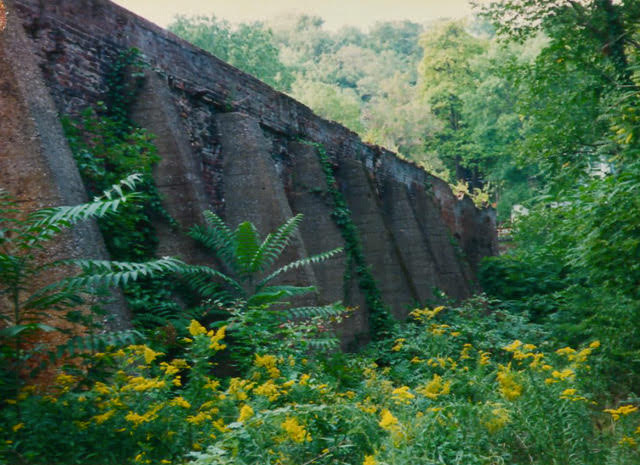
Ulster Iron Works is long gone. Across Esopus Creek is the Diamond Mills Hotel. On the site of the iron and paper mill are The Mill at Saugerties, a housing complex, and Cantine’s Island Cohousing, which promotes a collective lifestyle.

Eighteen private households live on Cantine’s Island’s 10 acres, sharing management and work needed for the property’s upkeep.

“By design, folks must walk by their neighbor’s homes when they leave or return. There is a parking lot located outside of the green. In cohousing tradition, this arrangement encourages interaction with neighbors.”

Thursday, April 13, 2017

USS Monitor: Maker's mark uncovered in turret believed to be from iron foundry in Hudson Valley

(Photos courtesy of Mariners' Museum and Park)
A discovery in the turret of the famed Civil War ironclad USS Monitor has brought to light the story of an iron mill that for decades was the industrial heartbeat of a Hudson Valley town.

The Mariners’ Museum and Park in Newport News, Va., announced this week that conservators removing corrosion from a brace uncovered the word “ULSTER.” It’s the first time a maker’s mark was found in the turret.

Officials believe an aft diagonal support brace was produced by Ulster Iron Works in Saugerties, about 100 miles north of New York City. The brace is between two guns and is separate from the large turret "ring."

“While this firm was never mentioned as a supplier during the Monitor’s construction at Continental Iron Works, it is now believed that Ulster provided materials for modifications to the ship while it was undergoing sea trials at the Brooklyn Navy Yard,” said the museum, which houses the USS Monitor Center.

Ulster Iron Works, which operated from 1827 to 1888 and took advantage of iron deposits in Ulster County, was a Navy contractor.

Will Hoffman, Monitor project manager, told the Picket his team is hypothesizing that when the ironclad was turned over to the Navy and the turret was tested, “they used Ulster to make modified parts. This makes sense, too, because the company was located just up the Hudson River.”  

Audrey Klinkenberg, historian for the town of Saugerties, said she had previously heard of a connection, but the find was compelling. “We’ve always had in our literature that Ulster Iron Works had made … plates for the Monitor.”

Interior of Monitor turret (Mariners' Museum and Park)
Beginning last August, conservators in Virginia used dry ice to remove corrosion from large wrought iron artifacts on the Monitor. Among the cleaned items were engine room structural bulkheads, gun slides and the forward and aft diagonal support braces from the turret, the museum said.

The turret, which housed the warship’s guns, currently rests on a lower support pad. Hoffman said his team is preparing for this summer’s placement of a new support system.

Remember, the turret is upside down, and therefore, all the weight of the guns and carriages were resting on (the roof). The roof was not designed to hold that amount of weight,” Hoffman wrote in an email. “Currently, the turret is still sitting on that support pad, which inhibits our ability to remove the roof and subsequently turn the object over.”

Officials said they want to do more research on the role of Ulster Iron Works.

The manufacturer, which drew workers from as far away as England and Wales, was known for using European technology. A process called “double puddling” could produce appreciable amounts of high-grade bar iron.

Damage to the USS Monitor turret (Library of Congress)
Histories kept at the Saugerties Public Library provide accounts of the foundry’s history.

“History of Ulster County, New York,” written by Nathaniel B. Sylvester in 1880, details the manufacture of a chain with small links for the Navy. It passed a series of stress tests at the Navy yard in Washington.

Ulster Iron Works sat on the lower side of Esopus Creek in Saugerties. A dam and a long raceway cut through rock provided water power for the mill. The mill had an annual capacity of 6,700 net tons of iron products.

An old pamphlet, “Focus on Saugerties,” mentions the demise of the company after steel, which was stronger, began to surpass iron in demand.

The mill’s buildings are long gone. “The wheels have stopped turning and the Esopus Creek does no work.” The site, according to the book, serves as a “monument to advancing achievement.”

COMING SOON: More on Ulster Iron Works and what Saugerties is known for today