Showing posts with label barrels. Show all posts

Wednesday, May 13, 2026

A trip to the lab: It was a thrill to briefly hold a conserved Enfield rifle and see one going into a preservation tank at Georgia state park. These weapons and 18 others were found in a blockade runner wreck. The goal is to put them on exhibit

Josh Headlee prepares to place an Enfield in preservative dolution (top right); at bottom are a brass trigger guard and a piece of the wooden crate used to keep rifles in place during shipment from England (Civil War Picket photos)
There are fun days and then there are really, really fun days. Today was one of the latter.

I began my adventure by hopping into my old SUV for the leafy drive to Panola Mountain State Park near Stockbridge, Ga., below Atlanta. I was excited about finally meeting Josh Headlee, curator and historic preservation specialist with the Georgia Department of Natural Resources.

We have stayed in touch by phone or email for nearly 13 years about a conservation project he calls “a labor of love.”

Of course, I was equally excited about seeing the fruits of that project: Two Civil War Enfield rifles that were part of a crate of 20 lost when a Confederate blockade runner ran aground in Charleston, S.C., in 1863. South Carolina divers brought them up in the late 1980s; the artifacts eventually came to Georgia, which had larger facilities to handle them.

The conservation of the rifles last year reached a significant milestone, with the first walnut stock emerging from treatment and appearing to be doing well outside a wet environment.


I had a chance to briefly hold the rifle stock this morning before we drove over to a laboratory housed in a former golf course building. Adrian Fox, interpretive ranger at Sweetwater Creek State Park, and I had the honor of watching Headlee dip the second gun into a preservation for a two-month bath (Picket video, above).

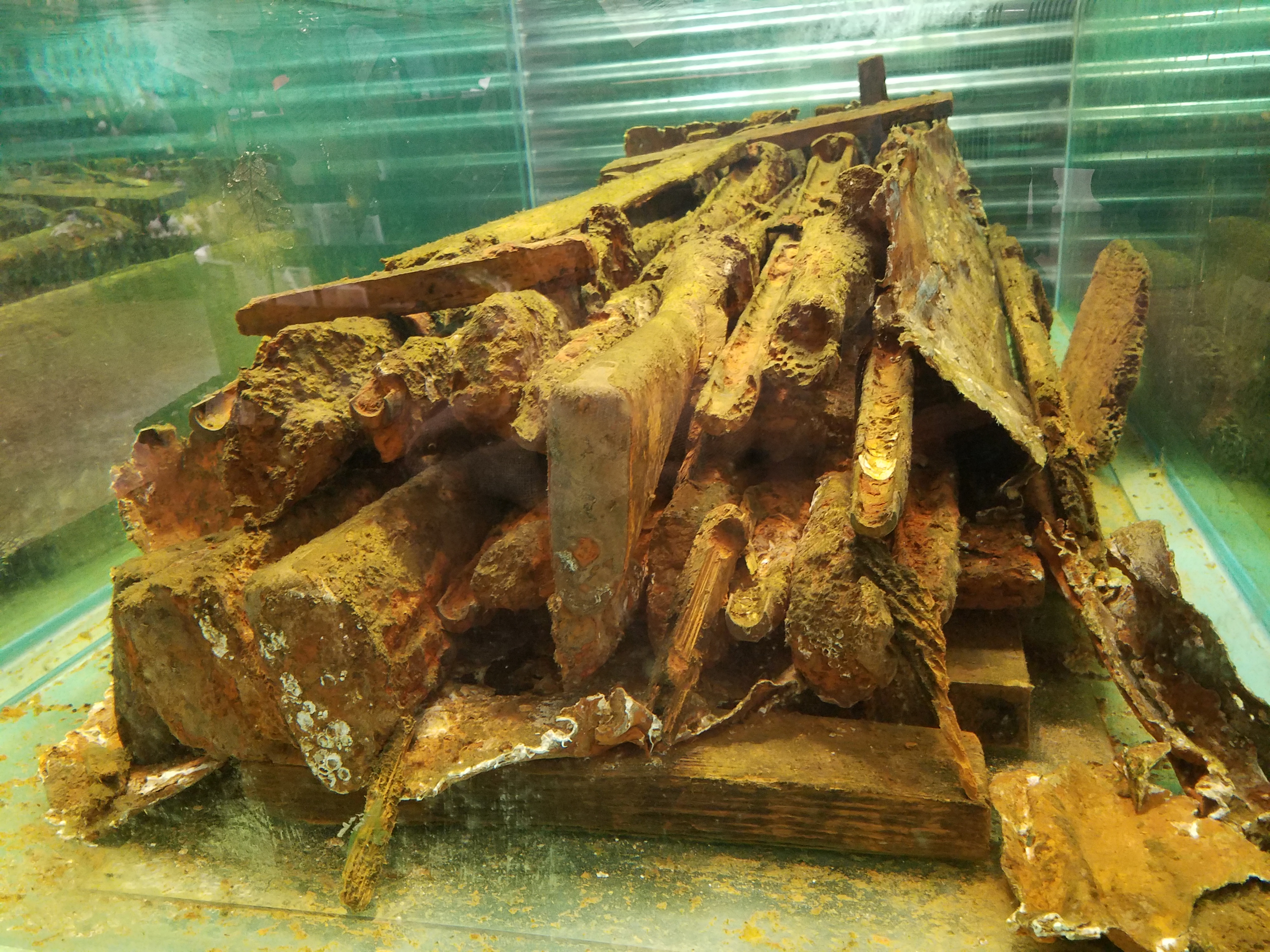
The British-made weapons have been displayed for nearly 15 years in a 300-gallon aquarium at Sweetwater Creek State Park in Douglas County as corrosive salts are removed. Headlee, who cleans the tank a couple times a year, chose guns 9 and 10 as the first to be treated with a preservative.

Visitors to Sweetwater Creek – about 50 miles from Panola Mountain - are a bit puzzled when they first see the aquarium, said Fox and Headlee. After all, shouldn’t it contain fish or turtles? And the mass of guns, a crate and lead lining appear to be a jumble.

Park employees tell them the gun cache is inherently interesting.

Rifles in aquarium at Sweetwater Creek State Park; below a replica used to provide context (Georgia DNR)
“It gives folks a rare glimpse to see historic preservation in action,” Fox told me. Staffers often hold a replica rifle near the tank to help them visualize what’s inside.

Conservation is a long process, so there is no timetable on when the weapons  – which have been in salt or freshwater for 163 years -- are completed. And there has been no decision on where they might be exhibited, finally free of a watery environment.

Headlee says Fort McAllister State Park below Savannah might be appropriate, given the Rebel blockade runner CSS Nashville was sunk there by the Union ironclad USS Montauk.

Blockade runner wreck served up a treasure


The Pattern 1853 Enfields were carried by the blockade runner CSS Stono and were bound for Charleston, S.C., in 1863. The rifles, stored in a wooden crate, were placed in an alternating butt-to-muzzle pattern, and blocks were used to prevent the weapons from shifting. 

The Stono, laden with precious arms, munitions and goods from Europe, ran aground on a submerged sandbar off Fort Moultrie in Charleston Harbor while trying to evade Federal ships.

The crate likely took a hard fall, breaking a few rifles, according to Headlee. (Picket video above and photo, right, of conserved rifle, piece of crate)

Saltwater destroyed most of the iron components, including barrels, locks and bayonets. The trigger guards, butt plates and nose caps at the end of the barrels are made of brass and are still intact.

Interestingly, the nose cap is the only metal piece still attached to the wooden stock of the treated rifle. It appears to be riveted in place and conservators don't want to risk breaking the fragile stock to remove it for treatment. 

Officials did not initially know how many of the highly prized Pattern 1853 rifles were inside, their position or condition. 

Each weapon originally weighed about 9 pounds and was approximately 53 inches long. The bore is .577-caliber. 

The treated rifle I hoisted weighed probably half of that, because much of the metal (iron) had corroded away.

The brass pieces survived. The iron, not so much

Adrian Fox and Josh Headlee with untreated rifle, gun parts and piece of crate (Picket photo)
The craftsmanship involved in the manufacture of the guns was very good, Headlee previously said. “Enfield was top quality.” It was the second-most widely used infantry weapon in the Civil War after the Springfield.

The 1851 and 1853 Enfields, made for the British army, were an important technological advance from smoothbore to rifled muskets, increasing the accuracy and distance.

At least one of the weapons bears the mark, “T. Turner,” believed to be a Confederate inspector of the rifle. His name was on a stamped cartouche in the wood.

Iron in barrel (left) and ramrod area (right) of treated gun are gone; at center is the end of the stock where brass butt plate was attached (Picket photos; click to enlarge)
A tin and lead lining that sealed the cargo from salt air and ensured the rifles were not tampered with is in bad condition. Officials are not sure how much of that can be salvaged for display. The wooden lid to the box did survive and is resting in a freshwater tank with other components.

There is a silver lining to all of this: Components made of brass withstood the onslaught of corrosive saltwater.

Iron or steel screws holding the butt plates in place deteriorated over the years and the plates just slid off, said Headlee.

Conservators years ago found in the crate a bullet mold, tools and tampions -- cork and brass plugs inserted into the muzzle to ward off moisture. The team counted 20 tampions “in various states” of condition. 

Tampions are used on cannons and rifles to keep debris from falling into their barrels. (Picket photo, left, of tampion and other items at Panola Mountain.)

Headlee reached out to Enfield experts in England and elsewhere about the half dozen remnants of iron bayonets found stacked together. They told him bayonets normally would be shipped in a separate box.

“Why bayonets were in this crate I have no idea,” Headlee told the Picket last year. “They are all but gone. The fact we have this much is amazing.” The pieces are about an inch and a half long.

The Enfield fired a Minie ball. No ammunition was found in the crate.

A jug of preservative and a case of nerves

Headlee in 2022 selected two rifles  to be treated with a solution made by Preservation Solutions. Conservators previously used SP-11 to treat an intact coffin found in 2013 on the edge of the marsh at Fort McAllister, a Confederate river outpost below Savannah. Results on the coffin led to use on the Enfields.

Before the chemical treatment, the rifles are kept in water, which protects their cellular structure. 

Josh Headlee pours SP-11 preserver into tank with Enfield rifle (Picket photo)
The treatment takes about two months and the rifle is turned once.

Without immersion in a preserver, pieces of wood will shrink, warp and crack.

“They could literally just fall apart,” Headlee previously told the Picket.

SP-11 is designed to displace water in the wood with preservatives that help to solidify the wood so it can be permanently exposed to the air. (At left, butt plate and other components, Picket photo)

The curator has been watching the preserved rifle to see whether there is leaching, cracking or splitting of the wood. 

He has seen no problems; a white film appeared on some of the stock as it emerged from the tank, but it was successfully cleaned off, he added.

“So far, it looks good,” Headlee said during my visit.

If the second rifle does as well as the first, another two rifles will be selected for the preservation treatment, perhaps this summer. In the meantime, he will travel back to Sweetwater Creek in the coming weeks to clean the tank and inspect and care for its contents. Fox, the interpretive ranger, said the staff there is very interested in the progress of the work.

The curator concedes he was nervous when the first gun emerged from its bath, and he will probably want to babysit the second a bit, as well.


As for me, it was exciting to see the Enfield components up close, especially the wooden block (Picket video above) that held the rifles in place when they were crated more than 160 years ago. I just imagined a craftsman cutting the grooves in which the barrels rested.

Oh, what a day.

Tuesday, November 11, 2025

First of 20 Enfield rifles to be preserved emerges from wood treatment at Georgia lab. After 160 years in water, weapon made for South appears to be doing fine

Right side of treated rifle, bottom portion, nose cap at end of barrel, two rifles chosen for treatment (Georgia DNR)
Conservation in Georgia of 20 Enfield rifles has reached a significant milestone, with the first walnut stock emerging from treatment and appearing to be doing well outside a wet environment.

“I was thinking about it; this is the longest this rifle has been out of water in over 160 years,” said Josh Headlee, curator and historic preservation specialist with the state’s Department of Natural Resources.

“I want to give it a little time to monitor it closely and make sure nothing bad is going to happen to it. However, I think it’s going to work. The rifle seems pretty stable,” he said.

The British-made weapons – which went down with a Confederate blockade runner in Charleston Harbor -- have been displayed for nearly 15 years in a 300-gallon aquarium at Sweetwater Creek State Park in Douglas County as corrosive salts are removed.

The stack of Enfield rifles in lining and crate at Sweetwater Creek State Park.
Saltwater destroyed most of the iron components, including barrels, locks and bayonets. The trigger guards, butt plates and nose caps at the end of the barrels are made of brass and are still intact.

The state’s aim is to eventually exhibit the wooden remnants of the rifles.

Lab picked two rifles for initial treatment

Headlee in 2022 selected two rifles (left, Georgia DNR) to be treated with a solution made by Preservation Solutions. Conservators previously used SP-11 to treat an intact coffin found in 2013 on the edge of the marsh at Fort McAllister, a Confederate river outpost below Savannah.

Before chemical treatment, the rifles are kept in water, which protects their cellular structure. 


Without immersion in a preserver, pieces of wood will shrink, warp and crack. “They could literally just fall apart,” Headlee previously told the Picket. (Treated rifle above, Georgia DNR. View shows were the lock and hammer would have been.)

SP-11 is designed to displace water in the wood with preservatives that help to solidify the wood so it can be permanently exposed to the air.

The curator said he is watching the preserved rifle to see if there is leaching, cracking or splitting of the wood as it continues to dry.


If this weapon remains stable, Headlee said, the second Enfield will undergo the treatment. “We’re slowly picking the hard crusty layer off of it before we put it in the wood preserver,” he added. (Left side of the rifle, above)

The items are being treated at a facility at Panola Mountain State Park east of Atlanta.

Divers pulled up prized weapons decades ago

The Pattern 1853 Enfields were carried by the blockade runner CSS Stono and were bound for Charleston, S.C., in 1863. The rifles, stored in a wooden crate, were placed in an alternating butt to muzzle pattern, and blocks were used to prevent the weapons from shifting.

The Stono, laden with precious arms, munitions and goods from Europe, in 1863 ran aground on a submerged sandbar off Fort Moultrie in Charleston Harbor while trying to evade Federal ships.

An archaeological diver pulled up the box carrying the 20 rifles in the late 1980s. One end was damaged, apparently when the ship sank. Some of the Enfields were damaged.

Officials did not initially know how many of the highly prized Pattern 1853 rifles were inside, their position or condition. 

Each weapon originally weighed about 9 pounds and was approximately 53 inches long. The bore is .577-caliber. (At right, treated gun, Georgia DNR. It shows were the trigger guard and assembly would have been.)

The craftsmanship involved in the manufacture of the guns was very good, Headlee previously said. “Enfield was top quality.”

The Enfield was the second-most widely used infantry weapon in the Civil War after the Springfield.

The 1851 and 1853 Enfields, made for the British army, were an important technological advance from smoothbore to rifled muskets, increasing the accuracy and distance.

At least one of the weapons bears the mark, “T. Turner,” a reference to well-known English gunmaker Thomas Turner, who turned out quality weapons in the mid-19th century.

Barrel plugs called tampions remarkably survived

 A tin and lead lining that sealed the cargo from salt air and ensured the rifles were not tampered with is in bad condition.

But there is a silver lining to all of this: Components made of brass withstood the onslaught of corrosive saltwater. Conservators are still trying to determine how to treat them.

Iron or steel screws holding the butt plates in place deteriorated over the years and the plates just slid off, said Headlee.


Conservators years ago found in the crate a bullet mold, tools and tampions -- cork and brass plugs inserted into the muzzle to ward off moisture.

The team counted 20 tampions (above, Georgia DNR) “in various states” of condition. Tampions are used on cannons and rifles to keep debris from falling into their barrels.

Headlee finds it remarkable much of the cork used for the Enfield tampions remains.

“They were just found in a grouping. We feel like they were in a box or bag in the crate.”

A closer look at chains and bayonet remnants

The Enfields featured a nipple protector, which kept the hammer away from the firing mechanism when not in use. A chain was attached to a plug placed over the weapon’s nipple.

Headlee last year sent me a photo of one chain from the Stono guns (above, Georgia DNR). “Some of them are still on the rifles.”

He reached out to Enfield experts in England and elsewhere about the half dozen remnants of iron bayonets found stacked together. They told him bayonets normally would be shipped in a separate box.

“Why bayonets (remnant below, Georgia DNR) were in this crate I have no idea,” Headlee said. “They are all but gone. The fact we have this much is amazing.” The pieces are about an inch and a half long.

The Enfield fired a Minie ball. No ammunition was found in the crate.

Eventually, if all goes as hoped, the 20 rifles will go on display somewhere in the state.

“Even up to the end of the (Civil War), the Enfield rifle was kind of the M16 rifle of the day,” said Headlee. “It had been used for years and years. Bang for the buck, it was as good as any standard weapon.”

Springfield and Enfield rifles were neck and neck in effectiveness, he added. “They were like a Ford and a Chevy.”

Interestingly, the  nose cap is the only metal piece still attached to the wooden stock of the treated rifle. It appears to be riveted in place and conservators don't want to risk breaking the fragile stock to remove it for treatment. 

Wednesday, August 3, 2022

Two Civil War Enfield rifles that have been kept in water are chosen for wood conservation. The hope is to put them and 18 others on display

Conservation of 20 British-made rifles intended for Confederate use is in a significant new phase, as specialists have removed two of them from an aquarium tank so they can be treated with a wood preservative.

Josh Headlee, curator and historic preservation specialist with the Georgia Department of Natural Resources, and parks division archaeologist Aimee Bouzigard last month cleaned the tank that contains the wooden rifle crate and weapons.

The Pattern 1853 Enfields -- carried by a blockade runner and lost when it hit a sandbar in Charleston, S.C, in 1863 -- are in water at Sweetwater Creek State Park in Douglas County, Ga., as corrosive salts are removed.

The tank also safeguards the rifles while the state develops means to one day exhibit them in open air.

Headlee told the Picket he will use SP-11 treatment made by Preservation Solutions. Conservators recently used SP-11 to treat an intact coffin found in 2013 on the edge of the marsh at Fort McAllister, a Confederate river outpost below Savannah.

They were pleased with the results and decided to try the chemical on the rifles.

“We feel optimistic about it,” said Headlee, adding the two removed weapons will remain in water until treatment.

“We are going to pick around each one, try to get the crusty stuff off the wood.” He said the rifles are coated with hardened materials, including rusted iron from the barrels.

Headlee travels to the park a couple times a year to do maintenance, which includes cleaning the tank and using a light stream from a hose to remove gathered muck and sediment from the crate and its contents. He adds fungicide to limit algae growth in the tank, which holds filtered freshwater.

Unfortunately, the iron rifle barrels, locks and bayonets are heavily deteriorated or gone. A tin and lead lining that sealed the cargo from salt air and ensured the rifles were not tampered with likewise is in bad condition.

Josh Headlee and Aimee Bouzigard handle rifles in July (Photos, Georgia DNR)
The trigger guards, butt plates and nose caps at the end of the barrels are brass and are still intact.

“The wood is in remarkably great shape. There are rifles we have that are broken. I assume that was damage they sustained when they were sinking,” Headlee said. One end of the crate was damaged, apparently when the CSS Stono sank.

The rifles were placed in an alternating butt to muzzle pattern before shipment, and blocks were used to prevent the weapons from shifting.

Headlee transported the rifles, a piece of the crate and a short wooden block. The items will be treated at a facility at Panola Mountain State Park.

While SP-11 worked well as a composite for the coffin, likely made of pine, Headlee is mindful that the rifles have stocks made of walnut, a harder wood.

Without chemical treatment, pieces of wood taken out of water will shrink, warp and crack. “They could literally just fall apart,” Headlee said last year.

The product is designed to displace water in the wood with preservatives that help to solidify the wood so it can be permanently exposed to the air.

Treating each rifle could take several months, so there is no timetable on completion of the project. The brass items will be treated separately and the conservators hope one day to reassemble them on the rifle stocks and what’s left of the barrels.

The CSS Stono, laden with precious arms, munitions and goods from Europe, in 1863 ran aground on a submerged sandbar off Fort Moultrie in Charleston Harbor while trying to evade Federal ships. Headlee believes the captain scuttled the vessel so the items could not fall into Union hands.

An archaeological diver pulled up the pine crate from the shipwreck in the late 1980s. Officials did not initially know how many of the highly-prized Pattern 1853 rifles were inside, their position or condition. Each weapon originally weighed about 9 pounds and was approximately 53 inches long. The bore is .577-caliber.

The craftsmanship involved in the manufacture of the guns was very good, Headlee said. “Enfield was top quality.” The Enfield was the second-most widely used infantry weapon in the Civil War after the Springfield.

The 1851 and 1853 Enfields, made for the British army, were an important technological advance from smoothbore to rifled muskets, increasing the accuracy and distance.


Researchers years ago found in the crate a bullet mold, tools and tampions, or cork and brass plugs inserted into the muzzle to ward off moisture.

At least one of the weapons bears the mark, “T. Turner,” a reference to well-known English gunmaker Thomas Turner, who turned out quality weapons in the mid-19th century.

Only three intact cases of the single-shot weapon are known, according to a 2007 Atlanta Journal-Constitution article.

The CSS Stono was previously known as the USS Isaac Smith, a steamer that saw Federal service before its capture by Confederate land forces.

Example of a Civil War Enfield rifle (NPS photo)
Some of the CSS Stono’s contents were retrieved by the South, but others, including the crate of Enfields, could not be salvaged at the time, apparently because they were below the water line. In 1865, the “stuck” ship was burned to prevent it from falling into the hands of Federal troops.

The crate was originally curated by the South Carolina Institute of Archaeology and Anthropology (at the University of South Carolina), say Georgia officials. The South Carolina institute did conserve smaller items, but donated the rifle crate to Georgia for extensive conservation treatment and display. 

Headlee said “the sky is the limit” on how the weapons can eventually be presented and interpreted to the public, should conservation of the wood and remaining metal components be successful.

“To bring them to the light of day would be a huge success,” he said.