Showing posts with label hunley. Show all posts

Friday, February 14, 2025

These tools helped keep submarine Hunley running -- whether on the surface or underwater. The gizmos are now on exhibit at conservation lab near Charleston

Conserved glass bottle, wrench and hammer carried by sub crew (Friends of the Hunley)
In-depth research and tinkering went into the design and construction of the stealthy submarine H.L. Hunley. While there were predecessors, the Confederate vessel was the first to be an effective weapon, sinking a Union ship off Charleston Harbor.

“We think it was very watertight. The construction was very sound, according to the riveting,” said Nick DeLong, among the Clemson University archaeologists conserving the Hunley at a lab in North Charleston, S.C.The rivets were inverted, creating a smooth exterior and reducing drag in the water.

“They knew a lot more about hydrodynamics than people thought,” DeLong told the Picket on Thursday as the Friends of the Hunley announced “Tools & Tides,” a new exhibit at the Warren Lasch Conservation Center.

The submarine had a rather complex system of drawing, pumping and discharging water, so the moving parts required regular maintenance. The Hunley was a “work in progress” that required the crew to keep it seaworthy with common tools. Adding to the challenge was a tiny environment that featured limited lighting and likely condensation from water, sweat and breathing.

The small exhibit, timed to the anniversary of the Feb. 17, 1864, sinking of the USS Housatonic, features tools that would be useful for quick repairs. The display (left) includes bolts, a wrench, chisel and hammer -- items you would find in a Home Depot, for example, but took years of conservation to be made ready for their debut.

The exhibit opens to the public this weekend.

“It was a very basic tool set to help (with) anything on the fly,” said DeLong. “While the submarine was revolutionary, they had to use what they knew to solve problems they could not foresee.”

The eight-man crew perished after the Hunley went down after jamming a torpedo into the Housatonic’s wooden hull. To this day, historians and others disagree on what caused the loss of the Hunley shortly after it became the first submarine to sink an enemy vessel.

It’s tempting to engage in conjecture on how the artifacts could have been used to save the ship. For example, if there was a problem with the ballast tank, perhaps the wrench or a T-shaped tool would have been helpful in making a repair, allowing the Hunley to rise to the surface. But we just don’t know what failed.

Here’s a look at the recently conserved items in the new exhibit, with all photos and most of the captions provided by the Friends of the Hunley. Several tools were discovered beneath Capt. George Dixon’s bench. DeLong said the artifacts likely did not shift much when the Hunley went to the bottom. This is the first time they have been put on exhibit.


Glass bottle

The 12-sided glass apothecary bottle was found on the crew bench still holding liquid from 1864 (The hand-cranked submarine was recovered in 2000 and has proved to be a time capsule holding precious artifacts).

The contents of the bottle remained a mystery until testing revealed it was mercury, which was most likely used for the submarine’s depth gauge. DeLong says the remaining fluid in the container matches the amount of mercury needed to operate the gauge.

T-shaped tool

(Friends of the Hunley)
The artifact was found between the pump mechanism and the frame ring, suggesting it was used to adjust or remove portions of the forward ballast pump. The Hunley had a forward and aft pump, with the crew department in between, DeLong told the Picket.

“They (the pumps) were quite effective. They were connected through piping so if one failed the other would pump water.” The crew opened a valve that would allow water in, making the Hunley descend. The pumps pushed water out so that it could rise to the surface.

Chisel

This wrought-iron tool was uncovered next to the forward bulkhead. It was stuck to the hull and bilge pump pipe due to heavy concretion. It has a flat-blade edge and would have been used for general utilitarian tasks.

Bolts/wedges


The tools served as flat-head wedges, according to DeLong. They were used to hold some of the submarine’s frame rings.

The bolts, with an attached nut, were found beneath the forward pump outflow pipe under the captain seat and could have been integral components in the ballast and pump system's operation.

They were treated using a sub-critical chamber, a cutting-edge conservation technique developed by the Hunley scientific team, officials said in a press release. 

Ball-peen hammer

Clemson conservator Johanna Rivera cleans hammer (Friends of the Hunley)
Made of different materials, the ball-peen hammer required different conservation methods. For example, the treatment used for the iron can be detrimental for the wood handle. The Clemson team removed the head of the hammer and placed it in sodium hydroxide. The handle was immersed in polyethylene glycol.

Wrench

This large adjustable monkey wrench underwent desalination in sodium hydroxide and then was rinsed in deionized water and placed in the lab oven to quickly dry. Next, it was cleaned with air abrasion and a special coating was applied to protect the metal from corrosion.

They plan to dive deeper into use of the tools

Chisel, top left, and other items in display case (Friends of the Hunley)
The Clemson archaeologists intend to do a deeper analysis of the use of these tools and their interaction. The T-shaped item may have been a key, but the project does not know how it was used, said DeLong.

“We want to look at the submarine as a functioning artifact,” he said. Among the topics to be studied was the Hunley’s air intake system

DeLong is among those completing a volume on the crew members and their personal belongings.

The Hunley museum is open from 10 a.m.-5 p.m. on Saturdays and 10 a.m.-3 p.m. on Sundays. The Warren Lasch Conservation Center is at 1250 Supply St. in North Charleston. Tickets for tours can be purchased online here. The cost is $18 for adults and $10 for youth ages 6-12, plus a service charge

Friday, June 3, 2022

H.L. Hunley: Skipper's gold pocket watch goes on display. What does it tell us about the night the famed submarine disappeared?

Of the myriad personal belongings discovered among the remains of the crew of the Confederate submarine H.L. Hunley, it seemed one piece in particular could help establish or affirm a timeline for the vessel’s disappearance.

That hope thus far hasn’t panned out.

The hands of the gold watch belonging to Capt. George Dixon, commander of the eight-man crew, stopped at 8:23 – at least 20 minutes before survivors of the USS Housatonic, the Union ship sunk by the Hunley, say the moonlight attack occurred.

For the first time, beginning this weekend, the public will get its first look at the meticulously conserved watch and chain.

They are in a display case at Clemson University’s Warren Lasch Conservation Center in North Charleston, S.C. “Treasures of the Past” includes jewelry Dixon kept in his pockets and a disfigured gold coin that absorbed a bullet during the April 1862 fighting at Shiloh and saved his leg.

A Friends of the Hunley news release on the exhibit outlines questions surrounding the watch.

“The watch could help answer a lingering mystery: How long did the crew survive after the sinking of the USS Housatonic? If Dixon set his timepiece accurately before entering the submarine, the watch represents the first opportunity to place a timeline on events that transpired the night of the attack.

Watch hands are at 8:23 (Photos courtesy of Friends of the Hunley)
On Feb. 17, 1864, Hunley made history by becoming the first submarine to sink an enemy warship. The 40-foot iron vessel -- bullets pinging off its iron exterior -- planted a torpedo in the hull of the USS Housatonic, setting off a charge that sent the warship and five crew members to the sandy bottom within minutes.

The Hunley then disappeared beneath the waves and entered the realm of legend. To this day, historians, scientists and others debate what caused it to end up on the ocean floor. While one researcher says the crew died from torpedo blast injuries, others say the sinking may have been caused by other factors.

Discovered a few miles off Charleston in 1995, and raised in 2000, the Hunley is being conserved at the Lasch Center. The interior of the vessel was a time capsule, and conservators recovered items and human remains from mud and silt.

Dixon’s watch would have helped the crew time their mission to ride the tide out and back to land without having to propel the hand-cranked vessel against the currents, the Friends of the Hunley say. It would have stopped working if it was wet or suffered a hard blow from the explosion that night.

Union records show that those on board the Housatonic said the attack occurred between 8:45 p.m. and 9 p.m.

The Friends of the Hunley said that raises three questions:

-- Did Dixon’s watch work properly?

-- Did Federal forces use the same time as Confederates on shore? If not, and if the Union forces kept time about 20 minutes ahead, perhaps the times will line up. Standard time was not instituted in the United States until about 20 years after the Civil War.

-- Will the watch help solve the mystery of what happened to the Hunley?

Kellen Butler, president and executive director of the Friends of the Hunley, told the Picket there is no current active research on the artifact. But that could change if evidence points to possible conclusions.

Watch with brooch, ring and gold coin in background (Friends of the Hunley)

Dixon’s watch is now in a case with other items he carried during the mission: The coin, a ring featuring nine diamonds totaling one carat and a 15-carat brooch with 37 small diamonds. The jewelry was meant to be worn by a man as a statement of wealth and success.

Experts told the Post and Courier in Charleston that the internal mechanism of the watch was made in England in the 1830s or 1840s. The case may have been fashioned shortly before the Civil War.

Archaeologist Nicholas DeLong told the newspaper the watch was in pristine condition and its main spring intact, indicating it was working the evening of the attack.

The watch was found in Dixon's clothing (Friends of the Hunley)

Wednesday, January 5, 2022

H.L. Hunley: Knife, field glasses and other items belonging to submarine's commander are on display at conservation center

Field glass before and after conservation (Courtesy Friends of the Hunley)
The third and final skipper of the Confederate submarine H.L. Hunley was second to none when it came to stylishness. Capt. George E. Dixon wore a cashmere suit and brought along a gold coin and jewelry on the February 1864 voyage that made history.

Some of the other conserved items belonging to the dapper Dixon – such as a knife and binoculars -- have been on special display since Thanksgiving at the home of the Hunley -- the Warren Lasch Conservation Center in North Charleston, S.C.

“This is the first time (Dixon) artifacts other than the gold coin and jewelry have been displayed,” said Kellen Butler, executive director of the Friends of the Hunley, who support ongoing conservation efforts on the vessel and thousands of crew artifacts found inside. The coin and jewelry are in a separate case and have been displayed for many years.

The reception has been very positive,” Butler told the Picket this week of the “War & Wardrobe” exhibit case. “Visitors are excited to see personal artifacts of a Hunley crew member.”

On Feb. 17, 1864, H.L. Hunley made history by becoming the first submarine to sink an enemy warship. The 40-foot iron vessel -- bullets pinging off its iron exterior -- planted a torpedo in the hull of the Union ship USS Housatonic in Charleston Harbor, setting off a charge that sent the Federal vessel and five crew members to the sandy bottom within minutes.

But Dixon and seven volunteers on the Hunley also perished. The Hunley was recovered in 2000 and the remains of the crew were buried in 2004.

Dixon carried this knife on mission (Courtesy Friends of the Hunley)
Dixon-associated items in the revolving exhibit are the field glasses, an antler and silver pocketknife, silver suspender buckles and loops, copper alloy suspender buttons, copper vest and trousers buckles, decorative buttons and metal alloy coat buttons likely fabric covered at the time.

Like his gold watch’s fob and life-saving coin, he had (the suspenders) engraved with his initials. He was the only one of the eight-man crew who had any items engraved, perhaps indicating he was proud of his name and wanted to be remembered,” the Friends group says.

Dixon’s 4-inch wide field glasses are among items that underwent extensive conservation and must be checked often so that they do not degrade while on exhibit. “The exhibit case is constantly monitored for humidity and any changes,” said Butler.

Suspender loops were found by conservators (Courtesy Friends of the Hunley)
According to the Friends group, historical accounts say Dixon would lie on the beach and use the field glasses and use them to survey the Union blockade and select the best target.

“While commanding the submarine, he likely opened the forward hatch periodically to give the crew fresh air. Dixon no doubt took this opportunity to stick his head out and use the binoculars to help gain his bearings. The binoculars were partially disassembled for conservation, and the result is a beautiful example of the capabilities of conservation science.”

The conservation team may eventually add another display to include leather objects and other fragile pieces, the Post and Courier reported in November.

The $20 gold coin is the most famous Dixon item from the mission. Dixon carried the disfigured item, which absorbed a bullet during the Battle of Shiloh in 1862 and saved his leg. “My life Preserver” was engraved on one side of the coin.

Thursday, December 30, 2021

2021's top 11 Picket posts: Hurricane leaves a surprise, Cockspur Lighthouse, submarine Hunley skipper, Longstreet and more

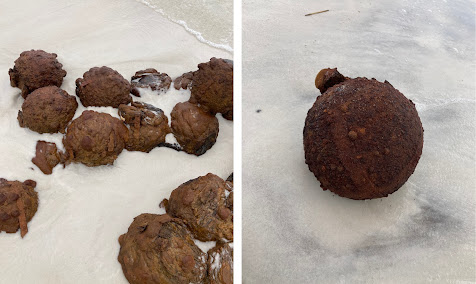
Hurricane Ida uncovered these artillery shells in Florida (Gulf Islands National Seashore)
The top 11 Civil War Picket posts -- by page views -- in 2021 covered the spectrum. Among them: a bayonet found in a yard, cannonballs uncovered by Hurricane Ida and the lingering mystery of a coffin found near Fort McAllister in Georgia.

We’ve got a few items in the works and we look forward to rolling those and others out in 2022. Thanks so much for your continued interest. Please tell a friend or two about us. Happy New Year!

11. USS MONITOR: The little ironclad that could sported two Dahlgren guns in its famous rotating turret. Conservators at the Mariners’ Museum and Park in Newport News, Va., were honored this year by the Navy for cleaning their barrels of salts and sediment, keeping them on the path for one day being put on display. -- Read more

10. JAMES LONGSTREET: The Longstreet Society in Gainesville, Ga., acquired a brief but fascinating letter from the legendary Confederate general seeking a federal pension 20 years after the Civil War’s end. Longstreet expressed guarded hope that his valiant service in the U.S. Army in the Mexican-American War would outweigh any concerns about him later donning the gray uniform. -- Read more

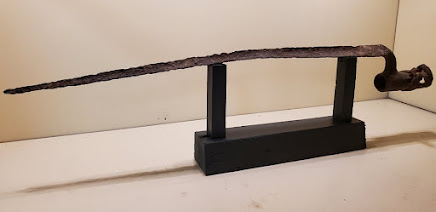
9. UNEARTHED BAYONET: An Illinois man tilling a garden came across something way the down the list of possible surprises: A rusted bayonet. Did it belong to a soldier serving in Ulysses S. Grant’s first Civil War command?  -- Read more

The bayonet in its temporary exhibit (Nick Little, Market House Antiques)
8. “FIGHTING JOE WHEELER”: A quick jaunt to the Brown’s Mill cavalry battlefield below Atlanta recalls one horrible day for Federal troopers in 1864. Riders under the command of Confederate Lt. Gen. Joseph “Fighting Joe” Wheeler raised hell and sent a Yankee general fleeing across the river into Alabama. -- Read more

7. MYSTERY COFFIN: We invited you to come read the adventure of one coffin, 20 rifles and two caretakers of Georgia history. And you did. The coffin found at Fort McAllister State Park near Savannah is being conserved and officials might use the same chemical treatment on Enfield rifles (right) that were smuggled into Charleston Harbor but were lost when the blockade runner ran aground. -- Read more

6. IRONCLAD REMOVAL CONCLUDED: The CSS Georgia, while woefully underpowered, did its job in Savannah, Ga. It was among a myriad of stationary defenses that kept Federal forces from sailing into the city during the Civil War. Federal officials have now wrapped up their removal of the gunboat’s debris as part of a harbor deepening project. -- Read more

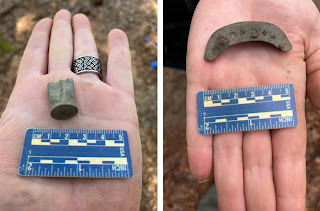
5. CAMP LAWTON SKIRMISH: Archaeology students at a Georgia university found artifacts that might derive from a skirmish between Union and Confederate cavalry during Maj. Gen. William T. Sherman’s March to the Sea. The fighting took place near a Confederate POW camp that held Union prisoners for several weeks in autumn 1864.  -- Read more

Spencer rifle casing and toe tap with nails
(Courtesy Camp Lawton Archaeological Project)
4. HURRICANE IDA: The Category 4 storms -- bringing heavy rain and wind – hit Gulf Islands National Seashore in late August, and its impact left quite a surprise: Days later and over a period of three weeks, park staff discovered 194 Civil War-era cannonballs, deposited in a couple clusters along a Florida beach. -- Read more

3. COCKSPUR LIGHTHOUSE: Fort Pulaski National Monument near Savannah, Ga completed a project aimed at protecting the small but resilient lighthouse. The 46-foot structure has endured high tides, hurricanes, waves from ever-growing container ships, vandals and – for a deafening 30 hours – the April 1862 bombardment of Fort Pulaski during the Civil War. -- Read more

2. HUNLEY’S SHARP-DRESSED SKIPPER: He was dressed more for a night on the town than for a moonlit submarine journey toward Union vessels blocking Charleston Harbor. Lt. George Dixon was decked out in a three-piece outfit, mid-calf suede boots and silver suspender buckles bearing his initials. Conservators have been analyzing the incredible array of artifacts found inside the submarine since it was raised two decades ago and are now working on a volume about the doomed crew, including personal effects such as clothing, buttons and shoes. -- Read more 

1. CONFEDERATE “CRIBS”: Archaeologists using sonar to scan the bottom of the Savannah River located the remnants of four underwater obstructions placed by Confederate defenders during the Civil War. Dubbed cribs, the wooden structures held bricks and other debris meant to thwart ships. -- Read more

Sonar image of four Confederate cribs in Savannah River (USACE, Savannah)

Thursday, July 8, 2021

H.L. Hunley: Sub's commander was a sharp-dressed man. Experts are piecing together a report on what crew wore when they made history

Nick DeLong and Johanna Rivera with Dixon clothing (Friends of the Hunley)
He was dressed more for a night on the town than for a moonlit submarine journey toward Union vessels blocking Charleston Harbor. Lt. George Dixon was decked out in a three-piece outfit, mid-calf suede boots and silver suspender buckles bearing his initials. Dixon’s clothing clearly demonstrated attention to how the young man presented himself.

So when he led his eight-man crew of Confederates on their mission, the soldier (rendering below) brought along the confidence that had sustained him since the early years of the Civil War. In addition to jewelry and a gold pocket watch, he carried a disfigured gold coin that absorbed a bullet during the April 1862 fighting at Shiloh and saved his leg.

“My life Preserver” was engraved on one side of the coin.

On Feb. 17, 1864, H.L. Hunley made history by becoming the first submarine to sink an enemy warship. The 40-foot iron vessel -- bullets pinging off its iron exterior -- planted a torpedo in the hull of the Union ship USS Housatonic, setting off a charge that sent the Federal vessel and five crew members to the sandy bottom within minutes.

The Hunley disappeared beneath the waves and entered the realm of legend. To this day, historians, scientists and others debate what caused it to end up on the ocean floor. Discovered a few miles off Charleston in 1995, and raised in 2000, the Hunley is being conserved at Clemson University’s Warren Lasch Conservation Center in North Charleston.

Experts have been analyzing the incredible array of artifacts found inside the submarine and are now working on a volume about the crew, including personal effects such as clothing, buttons and shoes. They hope to have the volume, which they are preparing for the U.S. Navy, finished later this year.

"The Hunley as a crew did not have a set uniform at all. They wore what they were comfortable or what they were used to,” said Nick DeLong, maritime archaeologist at the center. Six of the eight wore something that was part of a military uniform. 

G.E.D. is engraved in the suspender buckles (Friends of the Hunley)
Dixon’s clothing was the best-preserved of the group. Like the others, his remains were found at his station. “A lot of it (looked) like a disarticulated ball of wool and fabric,” DeLong told the Picket.

The Friends of the Hunley -- which supports the ongoing conservation of the submarine -- a few months ago posted photographs of much of Dixon’s clothing. The items had completed conservation a few years before.

DeLong and others are trying to put together a deeper picture of the crew from the many artifacts and the clothing they left behind. “He has interesting garments and we want to know a little more about the man himself,” he said of Dixon.

One of the first people brought in on the project to help with the analysis of the textiles was Mary Ballard, senior textile conservator at the Smithsonian Institution.

Conrad Wise Chapman depiction of the Hunley (Wikipedia)
“She was crucial in the identification of some of the fibers and helped the team determine that Dixon was wearing cashmere,” DeLong said. Textile curator Virginia Theerman of the Charleston Museum also was consulted and provided examples of clothing that might have matched what Dixon wore on the mission. It's possible he was wearing a sack coat, which is designed to fit more loosely than a tailored jacket.

The conservators are seeking additional experts to help determine what the crew members were wearing.   

DeLong and senior conservator Johanna Rivera have been carefully studying Hunley artifacts. Because the interior of the submarine was intact and filled with sediment, virtually everything the crew was wearing or carrying survived, although much of it is in fragments.

Dixon’s clothing had an impressive array of 19th century buttons (below, courtesy of Friends of the Hunley) made of several materials, including bone, brass and mother of pearl.

“We probably have all the buttons associated with him. Missing one or two can drastically change our understanding of what the garment looks like,” DeLong said.

The fabric itself is piecemeal, extremely fragile and it’s impossible to fully recreate each garment. Dixon’s undergarments, likely made of cotton, did not survive 135 years of being underwater, even in relative air-tight conditions.

The clothing appears to be brown, but experts are pretty certain its original color was black. DeLong said the cashmere wool was of high quality.

Conservators once thought that the clothing remnants included a cashmere vest, but DeLong says they have determined the vest no longer exists. It may have been made of a silk blend that deteriorated.

“We are trying to piece it all together. It’s a big puzzle and no picture to put it together,” he says of the endeavor to present some kind of picture of each man’s appearance.

The team hopes to get a fuller understanding what Dixon was wearing. “It could tell us more of the man himself, and the thought process going into the night of the attack.”

Traditional methods of excavating the human remains and textiles were not particularly effective because of the Hunley’s unique situation. Instead, a block-lift technique was used nearly 50 times to minimize damage to the items. Here’s how the center describes the process:

“The block-lifting technique consisted of probing the sediment and dividing the areas along major bone groups and sensitive artifacts. Steel plates were then slid under each block to separate the section from the rest of the sediment. The purpose of using block lifts was to safely retrieve the extremely fragile textiles that archaeologists were unable to excavate using traditional archaeological methods. The block lift would be removed intact and later x-rayed, documented, and excavated for small or fragile artifacts.”

A section of Dixon's cashmere coat (Friends of the Hunley)
DeLong said not much is known about Dixon before Shiloh. He was a Mason and is not believed to be Southern-born, though it appears he had some kind of social stature. In 1860, he was a steamboat engineer on the Mississippi River.

He enlisted in the Confederate army, likely in Mobile, Ala., and served with the 21st Alabama. At Shiloh, Dixon suffered a serious wound to the upper thigh when a bullet hit the gold coin, which is on display at the Lasch Center. Conservators found evidence of a healed wound while examining his skeletal remains.

At some point, Dixon returned to Mobile during the construction of the Hunley and became involved in the effort.

Dixon was perhaps in his mid- or late 20s when he became the Hunley’s third captain (two previous crews had died in sinkings). He had sandy hair and an athletic build, scientists determined from his remains. Gold fillings are another indication of some wealth.

As commander, Dixon navigated the submarine, using only a compass bearing and the limited visibility provided by the view ports in the forward conning tower,” the Friends of the Hunley say in an online biography. “Dixon controlled the movement of the rudder and the dive planes, which dictated the inclination and level of submersion of the submarine.

"Ultimately, Lt. Dixon was the crewmember who triggered the explosive device that would send the USS Housatonic  to the bottom of the Atlantic ocean, a maritime first that changed the landscape of naval warfare worldwide.”

DeLong said the Dixon clothing, as depicted in the photographs, will likely stay in those positions. It’s possible the center can do a more visual presentation if it knows how the items were constructed and pieced together. (The photo above left includes suspender parts and buttons.)

“There will be no stitching back together,” he said of the fragile cloth.

A portion of Dixon's clothing before conservation (Friends of the Hunley)

Thursday, May 7, 2020

H.L. Hunley fascination: Social media post about past conservation of bandana found in Civil War submarine quickly goes viral

James A. Wicks' conserved bandana (Photos courtesy of Friends of the Hunley)
The item shortly after recovery and during the conservation process
When it comes to interest in the innovative Civil War submarine H.L. Hunley, items pertaining to its crew are near the top, just behind the ongoing debate over what caused the vessel to be lost in battle

A Friends of the Hunley social media post Wednesday about the conservation of a knotted bandana worn around the neck of crew member James A. Wicks garnered more than 950 shares within 24 hours.

James A. Wicks
The exacting work on the artifact was detailed in the winter 2007 issue of The Blue Light, the newsletter of the Friends group.

“We will at times showcase past work on the project,” Kellen Butler, president and executive director of the nonprofit museum, told the Picket via email.

Since its recovery from the Charleston (S.C.) Harbor in 2000, the Confederate submarine has been undergoing extensive conservation at the Warren Lasch Conservation Center in North Charleston. From time to time, the Friends of the Hunley posts photographs of an item before and after conservation. Such was the case with Wicks' silk bandana.

When what appeared to be nothing more than a blob of mud was found in the Hunley crew compartment during excavation, it was hard to detect is was a fascinating – and beautiful – piece of history,” reads a Facebook post.

Wicks and seven others lost their lives in the Hunley during a mission that made history.

On the moonlit evening of Feb. 17, 1864, the 40-foot iron vessel -- bullets pinging off its iron exterior -- planted a torpedo in the hull of the Union ship USS Housatonic, setting off a charge that sent the Federal vessel and five crew members to the sandy bottom outside Charleston Harbor within minutes. The Hunley became the first submarine to sink an enemy warship.

Conservators several years ago at lab in North Charleston (Friends of the Hunley)
The Hunley, too, was lost, but exactly why remains a mystery. A host of theories -- from pressure emitted by the explosion, suffocation, a "lucky shot," drowning or other factors -- has been debated for decades. The position of the crew found during conservation showed no signs of panic. 

Wicks and the conservation of his fragile garment each have an interesting story.

Mary W. Ballard, a senior textile conservator at the Smithsonian Institution, consulted by phone and traveled to the museum and assisted in the challenging work of bringing the bandana back to life.

“Saving this unique artifact created a challenging question for conservators: how do you dry a fabric that has been waterlogged for over a century? Complicating matters, the bandana was also completely covered with mud and a metallic-like concretion,” reads The Blue Light article.

Conservators first tested dozens of detached small samples with various chemical treatments before deciding how to treat the bandana itself.

Details of the bandana during and after conservation (Friends of the Hunley)
To remove water, they applied a technique called vacuum freeze-drying. The process dries the fabric without applying tension to its fragile fibers.

“We will never know the true color of the bandana since the fabric’s vegetable dye was lost long ago,” the article states. “Still, the completed artifact speaks to the delicate skill of conservation and offers a rare insight into the divided loyalties many may have felt during the Civil War.”

What divided loyalties?

Wicks -- a Southerner by birth -- was in the U.S. Navy at the outbreak of the Civil War. When the USS Congress was crippled by the Confederate warship CSS Virginia at the Battle of Hampton Roads in March 1862, he switched sides, according to the Friends of the Hunley. 

He was about 45 years old when he died in the Hunley mission.

Given his personal history, it is not surprising Wicks is the only crew member known to be wearing a bandana around his neck, a common practice for enlisted Union sailors during that time,” The Blue Light surmises.

Exhibit at the Hunley museum in North Charleston (Civil War Picket photo)
Wicks served on the CSS Indian Chief before Hunley skipper Lt. George Dixon chose him to be part of the eight-member crew.

The Friends of the Hunley says the father of four girls stood nearly 5 feet 10 inches tall and was a heavy tobacco user. He had blue eyes and brown hair, according to records. His family was living in Florida when war broke out.

Wicks had the Hunley’s sixth crank position and in an emergency, his job was to release the aft keel block, should weight needed to be jettisoned so that the submarine could rise from the ocean floor.

His remains were found associated with seven US Navy buttons, which is consistent with his military service, according to the Friends of the Hunley.