Showing posts with label prisons. Show all posts

Wednesday, April 10, 2024

At Andersonville and elsewhere, crossing the 'deadline' meant death. Whatever the number of incidents, the existence of these barriers kept men in line

A.J. Klapp's drawing of a deadline shooting at Andersonville (Brown University Library)
Before the word deadline became synonymous with getting something done by a specific time, it was associated with a deadly feature of Civil War prisons. A captive crossing the deadline risked death, and there are instances of guards on both sides shooting them.

The deadline was intended to prevent the prison’s growing population from getting too close to the stockade wall, making escape more difficult. It was also supposed to reduce fraternization and trading between the prisoners and guards, according to the National Park Service.

Andersonville National Historic Site on Sunday marked the 160th anniversary of the completion of the deadline at the site (April 7, 1864). Stockade commander Capt. Henry Wirz had made this a priority.

The light railing was made from posts 3 to 4 feet long and driven into the ground. Horizontal pieces of wood topped the design, which was roughly 18-19 feet inside the stockade wall.

Confederate guards in sentry boxes kept a sharp eye for POWs who extended any part of their body past the deadline. (Not all camps had such features).

The first Union POW to die at Andersonville for crossing the deadline was Caleb Coplan (Copeland), a young Ohioan shot just two days after it was completed.

The prisoner was wandering the northeast corner of the stockade, apparently in search of material to patch his shelter or clothing, wrote William Marvel in “Andersonville: The Last Depot.” (Photo at left courtesy of John Banks' Civil War Blog)

“Something under the dead line caught his eye -- a scrap of flannel, some said -- and he ducked under the line to retrieve it. The guard brought his cumbersome old smoothbore to his shoulder and let fly with a charge of buck-and-ball. The range was too short to miss, and the .75-caliber ball bored through Coplan’s breast near the heart. Onlookers carried him to the hospital tents a few yards away, where he died the next day -- the first man killed at the dead line.” (Photo below of his grave at Andersonville courtesy of Kevin Frye.)

There would be more to come, at Andersonville and other prisons. Archaeology at Camp Lawton near Millen, Ga., has uncovered two Confederate bullets possibly fired at captives.

Those who have researched these prisons express caution about try to tabulate the number of shootings at the deadline.

Prisoners often exaggerated the number; at Andersonville this claim amounted to hundreds. “Sometimes this was done on purpose and sometimes they were simply mistaken or remember incorrectly,” says Teri A. Surber, park guide at Andersonville.

Regardless of where they occurred, shootings at the deadline had a profound psychological impact on POWs.

Surber and Michael Gray, a history professor and author of “Crossing the Deadlines: Civil War Prisons Reconsidered,” said Union prisoners might receive more pension money by showing they suffered during confinement. There was an incentive to lie about being a prisoner or witnessing horrific incidents, they say.

Bob Crickenberger, president of the Friends of Point Lookout (a Union prison in Maryland), said people should be leery of  hearsay stories told years after the war, particularly those that begin with, “I was told”, “I heard,” or “it’s been said.”

“Unless a prisoner was there and was an eyewitness to the shooting, and there were many witnesses, should (a story) be taken as truth. Kind of like all those folks that said Sherman burned their farms when they were miles out of the way when he came through.”

Was this .57-caliber bullet fired at a POW at Camp Lawton? (Georgia Southern U.)
Gray notes that in the last two years of the war, prisoners were often manned by older, extremely young or disabled soldiers and training was an issue. “You are going to send the best men to the front.”

By any measure, life in a Civil War prison was marked by privation and despair. Matters worsened after prisoner exchanges ended by mid-war, resulting in a huge increase in camp populations on both sides.

Between the skill of the guards and the desperation of prisoners, there are documented cases of shootings at the deadline or elsewhere in a camp. Firm numbers are impossible to ascertain, but here’s a look at several, including Elmira, Camp Lawton and Point Lookout:

ANDERSONVILLE/CAMP SUMTER (Georgia – Confederate camp)

A.J. Riddle photo of prisons in August 1864 (Library of Congress)
At Andersonville alone, nearly 13,000 men died over 14 months – an average of more than 30 a day in that span. (Overall, 30,000 Union and 26,000 Confederate soldiers died in captivity during the Civil War). A relative few were shot by guards.

“Drawings of men being shot at the deadline were widely reprinted in Northern newspapers, and today, the term is almost synonymous with Andersonville prison,” according to the NPS.

Surber said there are eight documented cases of a guard shooting a prisoner.. A firm number will likely never be known.

"The only time guards shot at prisoners was when they crossed the deadline or if someone near them crossed it. There is an instance where a man reached over the line to get something, and the guard accidentally shot the man sleeping next to him," the park guide says.

(If someone had a gunshot wound from a battle, they were usually listed as having died of "wounds.")

“One confirmed shooting that I would say was the (wounding) of a man the prisoners called ‘Chickamauga.’ Robert Kellogg and several others wrote about the incident in their diaries or memoirs and also testified about it during the (Henry) Wirz trial. Another is Pvt. William Stewart, 9th Minnesota Infantry, whose cause of death is recorded as ‘gunshot.’"

During the trial, prisoner George Gray testified that Wirz himself shot Stewart and took some money from him. Wirz (left) denied anything to do with Stewart. “There were rumors that guards were given a 30-day furlough for shooting a prisoner, but there is no actual evidence of that,” Surber says, adding there is no evidence Wirz shot prisoners.

Albert Harry Shatzel of the 1st Vermont Cavalry wrote that he saw a shooting at the deadline.

“One of the poor Boys shot dead by Guard while geting a cup of watter,” Shatzel wrote, according to Civil War blogger John Banks. “The Ball passed through his head. He stuck his head under the Dead Line to get some watter but he will never go there again. Dam the laws of such men as those are hear for they consider it an honor to murder a man …all in all they are not to blame for they a Furlough of 35 days for every man they kill.”

Surber provided a list of the rare successful escapes at Andersonville.

None of the 33 dug out from the inside; they were already outside or on a work detail when they made a break for freedom.

“The answer to how many were shot while trying to escape is fairly easy,” Surber says. “None, as far as we know. All eight of these men were shot for crossing the deadline and were inside the prison. Of course, it is possible that someone could have been shot while trying to escape, as would be the practice of the day, but there is no way to know for certain.”

(Photo above, re-creation of POWs arriving at Camp Sumter / NPS)

CAMP LAWTON (Georgia – Confederate camp)

POW Robert Knox Sneden's map shows deadline and sentry boxes (Library of Congress)
Camp Lawton operated for about six weeks in the fall of 1864. Prisoners were sent from Andersonville amid worries Union raiders would try to liberate the camp. Of 10,000 troops held at Lawton, at least 750 Federal soldiers died.

Ryan McNutt, director of the Camp Lawton archaeological project at Georgia Southern University, said historical sources are not complete enough to come up with a full count of POWs shot by guards.

“As ever, there are confused and scattered references,” he tells the Picket. “(POW John) McElroy states that he couldn't recall anyone being shot at Lawton for crossing the deadline, and he raised it as a curiosity since every other camp he was at had at least a few instances of executions by guards. However, Cpl. Aldrich said, ‘Once in a while the guards would shoot a poor fellow just to keep his hand in it, still, there was not as much shooting as at Andersonville. One poor fellow was shot within 10 feet of my tent one night and he was not within 10 feet of the deadline.’"

John K. Derden, author and professor emeritus of East Georgia College, said while there are diary accounts mentioning shootings, he found only one incident that was seemingly corroborated. Regardless, there were fewer shootings than at Andersonville.

James Vance wrote in his diary for Nov. 6, 1864). “2 men shot 1 killed. The first ones.” Sgt. Amos Yeakle wrote in his diary the same day, “There was one shot dead by the guard and one wounded for getting over the dead-line.”  

Work more than a decade ago at Confederate barracks area (GSU)
Derden, author of “The World’s Largest Prison: The Story of Camp Lawton,” contends prisoners might hear a guard firing to clear a musket and assume the round was meant for a Federal soldier.

“As for the climate in the prison, I believe that things were a bit less fractious because of the lack of overcrowding, the water situation that allowed prisoners to bathe and even swim, and (at least initially) the somewhat better food supply. Also, Commandant Vowles was generally well liked by the prisoners as opposed to their bitter attitudes toward Wirz at Camp Sumter.”

Regarding the deadline, archaeology seems to indicate about a 30-foot clear space between shebang remains and the wall, says Derden.

McNutt said students have recovered at least two Confederate bullets that may have been fired at the inside of the Lawton stockade. The team in early 2023 found a poorly cast ball, likely fired from a Springfield Model 1842 percussion cap musket (photo below, courtesy of Camp Lawton project).
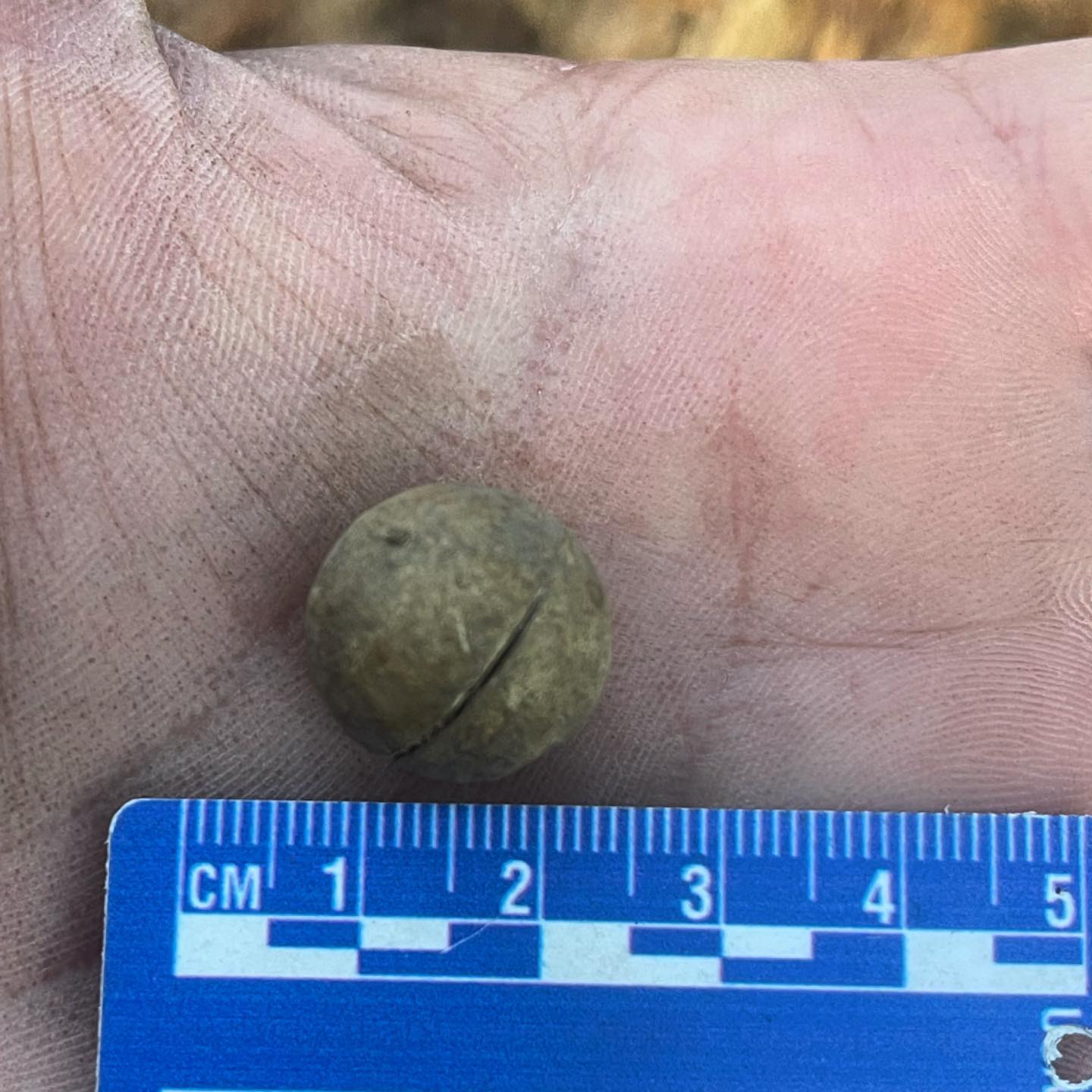
“Produced in large numbers, and floating around most of the arsenals in the South, these were still used despite the lack of accuracy and range in both the front lines and on the home front by militia. With a maximum range of 365 meters, and an average effective range from 90 to 275 meters, the location of the ball is well within range of the guard towers. And while most of the POWs at Camp Lawton recalled few instances of guards shooting POWs, our fired musket ball, along with other fired rounds from previous work inside the stockade, is a sobering reminder that Lawton still had many ways to die,” the professor writes.

Students led by Lance Greene, his predecessor, in 2010 found a spent .57-caliber bullet at the stockade. The round “has clear signs of rifling from being fired: deformation on the tip seems to show it only striking sand, though this doesn't preclude it having impacted a human,” McNutt says

Later analysis showed three groves and a right-hand twist indicating it was probably fired from a Pattern 1853 Enfield rifled musket. “Deformation on the nose matches experimental archaeology of impacts into soft surfaces, like sand or loamy soil,” according to McNutt. 

ELMIRA (New York – Union camp)

Confederate POWs at Elmira (Library of Congress)
Elmira did not have a deadline, even though it was a stockade prison. The camp was dubbed “Hellmira” by prisoners because of its 24 percent mortality rate. Gray said there are records of a Union guard shooting a Confederate prisoner.

According to the Star Gazette newspaper, Granville Garland shot A.P. Potts of the 38th Georgia Infantry during a July 31, 1864, disturbance. Potts survived.

Inmates at Elmira weathered hunger, illness and melancholia and, even worse, exposure to the cold weather, according to the National Park Service.

POINT LOOKOUT (Maryland – union camp)

(Library of Congress)
The overcrowded prison saw 4,000 Confederate prisoners succumb to various causes, especially disease. Some were killed by guards, according to experts and histories. About 52,000 Union soldiers went through the prison.

The camp’s deadline was a ditch inside the prison approximately 15 feet from the parapet wall. The ditch was a foot wide by a foot deep.

Official records show African-American guards, some formerly enslaved, sometimes shot prisoners for crossing the deadline or trying to escape, says Gray. The prison is known for its racial tension.

“One commanding officer claimed that the black guards were more zealous than the white when it came to enforcement of prison regulations and were apt to fire first while calling for the corporal of the guard,” says Crickenberger.

He estimates 19 prisoners were shot and killed or wounded by white and black guards between November 1863 and August 1864 alone. Prisoners reported that there were instances where guards fired at prisoners without inflicting casualties. (Photo, Friends of Point Lookout)

“They shot frequently but missed more often than they hit,” Crickenberger says. “Regardless of the accuracy of the guard, such incidents kept prisoners on their toes making them wary and continually fearful of being shot either night or day.”

A Confederate prisoner drew notable watercolors of life at the prison, including interactions with guards. It should be noted that black POWs held at Andersonville faced discrimination from friend and foe alike.

The friends group has helped restore the fort, the southwest corner of the stockade and assists with living histories and demonstrations of camp life.

ROCK ISLAND (Illinois-Iowa – Union camp)

The deadline at Rock Island consisted of a series of white stakes (left, photo Rock Island Arsenal Museum) that were illuminated by lanterns at night, according to the NPS.

The barracks were enclosed by a stockade fence 1,300 feet long, 900 feet wide and 12 feet high. Sentry boxes were placed every 100 feet.

During the 20 months the prison was open, 1,960 prisoners and 171 Union guards died.

The North had reduced rations in retaliation for the treatment of Union prisoners at Andersonville. Conditions at Federal prisons often were deplorable.

Friday, November 4, 2022

Sultana will rise from the ashes as Arkansas city breaks ground on permanent museum focused on the Civil War maritime disaster

Haizlip Studio's museum rendering for the moment of explosion (SHPS)
An Arkansas town close to where the steamboat Sultana exploded and caught fire at the Civil War’s end will see a decade-long dream fulfilled on Veterans Day when it breaks ground for a new museum that will honor soldiers who died in the disaster and residents who helped save others plunged into the Mississippi River.

Officials in Marion -- a bedroom community just a 15-minute drive from Memphis, Tenn. -- say it’s important that the little-known story of greed, fraud, valor and sacrifice be told in a bigger way than what’s covered in a tiny museum that opened in 2015.

The Sultana Historical Preservation Society last month announced it had reached its $6 million goal for phase 1 of the project at the gymnasium-auditorium in the town’s old high school. Officials are hopeful the museum will be ready for business in early 2024.

Survivor William Lugenbeal claimed he killed an alligator on board
to use a crate to escape. He made this box afterward (SHPS)
It’s been a protracted and dogged march to raise awareness of the episode in Civil War history and bring in a large amount of money for a permanent museum. The Picket has written several articles on the museum, dating to 2012.

“Not only will the tragic story of the Sultana be remembered forever, but the new museum will be a wonderful storehouse of Sultana-related artifacts, photos, research and documentation,” said Norman Shaw of the Association of Sultana Descendants and Friends (Sultana Association).

The Sultana exploded and caught fire on April 27, 1865, killing about 1,200 passengers and crew. Hundreds of Federal soldiers, many recently freed from Confederate prisons, including Andersonville and Cahaba, perished on their way home, a cruel fate after enduring months or years of privation.

A photo of the overcrowded Sultana a day before the fire (Library of Congress)
No one was formally held accountable for putting too many men on the Sultana, despite documented concerns about the safety of one of the boat's boilers. Accounts of the largest maritime tragedy in U.S. history were overshadowed by headlines about the assassination of President Abraham Lincoln.

Authors Gene Salecker and Jerry Potter have written about a kickback scheme between the vessel's financially strapped captain and an Army quartermaster, Lt. Col. Reuben B. Hatch. According to Potter, the transport fee was $5 for an enlisted man, $10 for an officer. Capt. J. Cass Mason agreed to take the enlisted men for $3; Hatch kept the $2.

The Sultana Historical Preservation Society, which has spearheaded the project in collaboration with the city, believes a compelling museum and effective marketing can bring in up to 50,000 visitors a year who collectively will spend millions of dollars to support the economy in Marion and nearby communities.

The main focus will be on those who endured the ordeal (SHPS)
“I’m just very excited for the City of Marion, as I’m glad to see this historic (school) space put to use – a use that will bring in thousands upon thousands of visitors to our town. I’m also glad to see the victims of the Sultana disaster finally get a fitting memorial,” Wyly Bigger, director of special operations and projects for the Sultana Disaster Museum, told the Picket in an email.

The expanded museum will include scores of artifacts or memorabilia related to the disaster and exhibits on steamboats on the Mississippi River, the Sultana’s service, Civil War prisons, corruption involved in its overloading, the explosion, the struggle for survival, rescue efforts and the disaster’s aftermath. Many of the artifacts were donated by Salecker.

Among the items be displayed are bricks and shaker plates from the doomed vessel's furnace, a cotton bale hook, a cartridge box sling, combs carved by soldiers while they were in prison and items created by passengers after the fire. Numerous items made for annual reunions of survivors (left) also will be showcased.

Haizlip Studio in Memphis took the lead in architectural and exhibit plans. The Picket reached out this week to the company about its part in the project but did not receive a response.

In 2021, architect Mary Haizlip said among the design features at the converted school building on Military Road  -- a few blocks from the current museum -- will be exterior smokestacks meant to evoke images of the Sultana. Visitors will be provided “experiential moments” in the lives of passengers, from their departure from prison camps to the moment of the explosion and the aftermath.

Backers say the 1939 gymnasium’s 35-foot ceilings will help provide “for a new, modern, high-tech museum that will entertain and educate visitors of all ages. It also allows us to preserve and repurpose one of the most historical buildings in eastern Arkansas.” Officials say the new venue will encompass more than 22,000 square feet.

The museum will include exhibits on the era of steamboats (Haizlip Studio/SHPS)
Bigger said the $6 million is the anticipated cost for renovations of the existing gymnasium structure and construction of the new addition to be built on the south end of the building. About $3.1 million of the current funding comes from government sources. Another $761,000 is from foundations and $1.58 million is linked to businesses who hope the museum will boost tourism spending in the area.

“As we are starting this phase, we will be continuing to raise money, with our next goal being $4 million to go towards constructing the actual exhibit within the building. After that phase is complete, fundraising will continue with a goal of another $3 million for an endowment to be put towards early operational expenses as the new museum is getting off the ground,” Wyly wrote.

First steps will include abatements (removing any traces of hazardous substances, for example lead paint or asbestos). Construction will ideally start by New Year’s Day, “but it could be March before any visible work is started. The schedule is not firm just yet, but the process is underway,” said Bigger.

Some local residents have questioned whether the project is the best use of money and will bring in enough visitors. “I think Marion needs a lot more things to be more attractive than a Sultana museum right now. Let’s bring things that will actually grow marion and help lower our taxes," one commenter wrote on the city's Facebook page in 2021.

A Reddit page on the Civil War has spirited comments about the museum, with some saying it will tell an important story while others say the story could be included in an existing venue. One reader said more populous areas are struggling to draw big numbers to maritime-related museums and that Marion will also encounter a general declining interest in history.

Gene Salecker's 14-foot model will be displayed at the new site (SHPS)
Museum supporters disagree, citing the museum’s anticipated economic impact and the unique story of the disaster.

The story of the Sultana runs deep in the blood of Judge John Fogleman, president of the Sultana society, and his cousin Frank, the city’s longtime mayor who is leaving office after this term. Their great-great-grandfather, John Fogleman, after lashing two or three logs together, poled his way through the current of the Mississippi River and toward survivors.

The Fogleman and Barton families, descendants of local men who were part of that rescue effort, donated $100,000 for the project.

Survivors of the Sultana disaster lobbied 25 years for Congress to provide money for a monument along the Mississippi River. It never happened.

“The survivors of this tragedy and those family members of those that died deserve better,” John Fogleman said during a capital campaign kickoff event in 2021.

Shaw, founder of the Sultana Association, said the goal of the Sultana’s survivors was to ensure their ordeal would not be forgotten.

1920 Knoxville survivors reunion; Pleasant Keeble at far left, John H. Simpson
second from right (Knox County Public Library, McClung Historical Collection)
“That's why they held annual reunions, to which many people attended, most importantly their families, to carry on the legacy,” Shaw said. This has always been our group's driving motivation -- keep the story alive. I feel the old veterans would be proud of our efforts.”

He touted the Foglemans’ leadership and the role of Salecker as historical consultant.

The association meets every year in different cities. It will hold its annual reunion in Marion the same year the museum opens, Shaw said. Sultana survivor descendants have been encouraged to consider donating or loaning their items to the museum.

The groundbreaking is set for 10 a.m. CT on Nov. 11 at the former Marion High School gymnasium and auditorium at 54 Military Road, Marion, Ark.

COMING SOON: A closer look at the planned exhibits and artifacts

Previous Sultana coverage:
• Disaster took lives of those who had endured so much
• Siblings recall learning of disaster

Haizlip Studio rendering of new museum features replica smokestacks (Courtesy SHPS)

Sunday, November 4, 2018

The trauma endured by Civil War POWS was passed on to their sons. Here's what experts say about study that found a genetic link.

Union soldiers in the trenches at Petersburg (Library of Congress)
Trauma experienced by a father, it turns out, can be passed along to the next generation -- in a perhaps unexpected way.

A new study has found that postwar sons of many Union POWS had shorter lives than sons of soldiers who weren’t held captive during the Civil War. And it suggests an interesting genetic explanation.

Dr. Dora Costa led a team that used military, pension and other records and determined that by age 45, sons of POWs who suffered severe privation and trauma at Confederate prisons were 11 percent more likely to die at any given age than sons of men who were not imprisoned.

The study, published in the Proceedings of the National Academy of Sciences, showed that these sons were more than twice as likely to die at the same age than their brothers born before the conflict. The researchers said the excess mortality of younger sons was largely from cerebral hemorrhage and cancer. The paper said the deterioration of Rebel prisons after inmate exchanges ended increased the trauma on captives (after mid-1863).

Because a father’s POW status had no impact on the health of daughters, the researchers determined something else was at play: the Y chromosome belonging to males.

“I originally thought the key factor in the children’s longevity would be socioeconomic status,” Costa said in a news article at UCLA, where she is on the faculty. “But then I started to notice the effect was only happening in the sons -- which is in keeping with an epigenetic cause -- and only to the sons born after the war.”

Epigenetics is the study of inherited biological triggers that affect genes and how cells in the body react to genetic information, but that do not alter underlying DNA sequences. Basically, the study found that fathers’ prison hardships, including food shortages, altered the function of his genes in ways that could be passed on to sons.

A Los Angeles Times article on the study had this to say about maternal nutrition offsetting that paternal stress. “The life-shortening effect of a father’s POW status was magnified for the sons who were born in April, May and June, when food supplies tended to be leanest. But that effect virtually disappeared among sons born during September, October and November, when harvests are in and food is typically more plentiful.”

The Picket reached out to several Civil War prison experts to comment on Costa’s findings. Here’s what they had to say:
Gray
MICHAEL P. GRAY: Where you were imprisoned matters

“Intergenerational transmission of paternal trauma among Civil War US Civil War Ex-Prisoners” is an interesting study, but I am not sure how much this really tells us about entire post war-prisoner narrative, nor true consequences of Civil War incarceration on generations beyond. 

This analysis adds to a conversation started by Dr. Angela Riotto, historian at the Army University Press, who has addressed such numbers in her scholarship, particularly with Civil War prisoners and PTSD, which ultimately led to suicides. “Intergenerational transmission of paternal trauma among Civil War US Civil War Ex-Prisoners” would be greatly improved under the lens of a professional historian, like Riotto, so a better historical framework might be understood.

Although the article lacks historical context on a number of fronts, it does raise a variety of questions. In its grand scheme, the sample size is too small. The analysts write “2,342 children of 732 no-exchange period ex-POWs, 2,416 children of 715 exchange-period ex-POWs, and 15,145 children of 4,920 non-POW veterans, all born after 1866 and surviving to age 45.” However, more than 56,000 prisoners died during the conflict, and even that number most likely falls short of the actual amount of deaths. Moreover, the comparative with non-prisoners would be so large and daunting in tracking down family members generationally, it might seem impossible to even try. But at the very least, the authors do make an attempt.

However, their statistics are taken from sanitized pension records that might not deliver on the true experience of their captivity. Perhaps more investigation might be taken from other primary sources?  Furthermore, they need to address what prisons their sample size comes from. They write, “Thirty-five years after the end of the war, camp survivors faced greater mortality and health risks and had worse socioeconomic outcomes, if they had been imprisoned when camp conditions were at their worst compared with non-POW veterans and ex-POWs imprisoned when conditions were better.”

Andersonville prisoners in August 1864 (Library of Congress)
Well, they are assuming they were at their worst, but this may not be the case at all prisons.  

Civil War prisons were very unique and diverse and socio-economic not only come into play after the war regarding health concerns, but during the war. For example, the death rate at Richmond’s Libby Prison would be much lower to that of Georgia’s Andersonville. Or, if we venture into the North, the death rate at Elmira was 25% and Johnson's Island less than 2%. The authors might want to consider the difference between the enlisted men’s prison, like Andersonville and Elmira, to that of officer-only prisons, like Libby and Johnson's Island -- where death rates were lower, since “class” mattered.

Besides socio-economics in captivity, the authors generalize a bit, writing “Most POWs were exchanged immediately until mid-1863…”  This is not the case, as prisoners might be held for some time before being officially exchanged. The authors conclude, “There is growing concern that health can be transmitted across generations, leading to the persistence of poor health and socioeconomic status within families.” This might be very true, but what about the common Civil War solder campaigning in Virginia during 1864? And how would you track their sample size from a generational standpoint? Did Civil War captivity mean that your children were going to be in poor health?

This reader is not convinced as there are too many limitations and variables in their findings. But they have added to the conversation, and one only hopes their work will continue to add to the Civil War incarceration narrative.

Gray is professor of history at East Stroudsburg University in Pennsylvania. He has extensively studied Civil War prisons and is the author of a new book, “Crossing the Deadlines: Civil War Prisons Reconsidered.”

Greene
LANCE GREENE: Epigenetic effects getting more attention

The recent study looks at Union veterans of the Civil War who were held in POW camps late in the war and who suffered horrible conditions during their captivity. It also looks at their children and compares them with the children of Union veterans who served in the war but were not POWs. The study focuses on the effect of paternal POW trauma and attempts to identify the impact of negative effects on their children and identify the cause of these impacts.

The study focuses on possible epigenetic effects. Epigenetics is a study that has grown dramatically in the past decade. It studies how changes to a person’s genetic expression occur without changes to the DNA. For example, exposure to carcinogens may alter genetic expression by inhibiting the release of an enzyme. There are also natural occurrences in the body that can cause similar changes. Although these kinds of events do not change a person’s genetic make-up (DNA) they are potentially inheritable traits. Therefore, these changes that occur in a person’s life can be passed on to their children.

For their research, the authors collected data on almost 5,000 adult children of 1,400 Union POWs and data on 15,000 children of 5,000 non-POW veterans. Most of the data came from military, pension, and census records. The authors performed statistical analysis using the Cox proportional hazard model, which looks at a variety of traits (e.g. paternal POW status, sex of the child, socioeconomic status, birth order, maternal and paternal lifespan, etc.), and calculates the impact on survival of these different traits.

Lawton exhibits at Magnolia Springs State Park in Georgia
The results show a significant difference in mortality rates for the children of Civil War veterans. Boys born after the war to men who had been POWs were 1.10 times more likely to die than the offspring in the other categories, including children born to POWs before the war, girls whose fathers had been POWs, and boys whose fathers were Civil War veterans but who had not suffered the conditions of prisoners.

Because they looked at so many factors, the study suggests that having a POW father did not have a negative impact on your financial status but had a delayed negative impact on health. Excess death of sons was largely due to cerebral hemorrhage and to a lesser extent cancer, in the states where cause of death was recorded.

The study also makes a strong argument that the effects on sons were not driven by the behaviors of their father; those negative impacts did not affect the daughters of POWs or their sons born before the war. It strongly suggests an epigenetic effect, one that was passed on through the Y chromosome and therefore to sons only.

The study is important in many respects. Dr. Costa’s previous research has shown conclusively that the trauma suffered by these POWs had significant negative impacts on their health after the war. This research goes one step further and shows the continued intergenerational impact. It also supports a growing body of literature on the significance of epigenetic effects.

Greene is an historical archaeologist with Wright State University in Dayton, Ohio. He was the first director of the Camp Lawton research project, based out of Georgia Southern University. Camp Lawton held Federal prisoners for six weeks in late 1864, but did little to ease the suffering of POWs moved from Andersonville.

McNutt
RYAN McNUTT: Socioeconomic, other factors should be considered

I'm not necessarily surprised by the findings that the POW experience of harsh physical and psychological trauma could have an effect on descendants; previous research suggests this possibility for Native Americans and Holocaust survivors. However, there are problems with how some of these relate to epigenetics, as well as issues like small sample size, and some papers not addressing sociocultural factors, like the transmission of trauma via family stories and accounts, rather than through genetics. 

And in fact, this was one of my concerns with the article. I don't disagree with the premise that there is likely an epigenetic transfer of trauma -- but I'm not convinced the mortality correlation in sons of POWS from the non-exchange period can be satisfactorily linked to this, because it doesn't address some pretty big socioeconomic factors.

The non-exchange period in the article for example (between July 1863 and July 1864), corresponds almost exactly with the Enrollment Act, or Civil War Military Draft Act, enacted in March 1863. Every male citizen, and immigrants who had applied for citizenship, between the ages of 20 and 45, were required to enroll. Substitutes and commutations by those who could afford it meant, arguably, that the burden of military service fell on immigrants and lower classes to a great degree. The perception of this unfairness of the act led to the New York City draft riots in July 1863. And, indeed, it's likely that the first batches of draftees would have begun entering into the POW system in July of 1863, just at the period that exchanges stopped. 

My suspicion is that the high mortality rate of offspring of non-exchange period POWs is tied to this lower socioeconomic status of their fathers, rather than any causative link to experience trauma. Furthermore, cerebral hemorrhage is a catch-all term for cause of death in the early 20th century, so it is difficult to parse how this may be connected to the father's poor health.

Students conduct Camp Lawton field work during 2015 field school (GSU)
Finally, while the fact that sons of ex-POWs were 1.11 times likely to die (I'm not sure where the 11 percent is coming from -- I couldn't find it anywhere in the article) than the sons of non-POWs is statistically significant, it's still not to my mind high enough to prove a causative link for higher mortality rates outside of socioeconomic and psychological factors. 

It's very clear from the postwar career of ex-POWS that many of them struggled with ongoing health issues, almost certainly PTSD, and various other psychological issues as a result of their confinement.

This impacted their ability to keep employment, as did the massively high levels of substance abuse among veterans, including POW., all of which would have a down-the-line effect on the quality of life for their children, particularly the sons who may have had to shoulder more a of a burden of caring for the family both through adolescence, and into adulthood. And the lack of a similar mortality rate among daughters is par for the course: by the 1900s, the death rate for men was twice as high as for women. So the lack of a similar mortality rate for daughters of POWS is in line with other demographic trends of the day, as opposed to being a comparative marker for their male siblings’ epigenetic shortened life spans.  

It's a very interesting article, and I certainly think epigenetic transmission of historical trauma is a worthwhile avenue of research, but I'm not convinced that epigenetic transfer of trauma is sole direct causative reason for higher mortality rates among the children of ex-POWs.

I think that there are a host of socioeconomic, cultural, and historical factors that were not considered with due weight in the interpretation and conclusion -- which to be fair, the authors acknowledge as potential issues in their discussion. 

McNutt is assistant professor of anthropology at Georgia Southern University in Statesboro and director of the university’s Camp Lawton project. His research in conflict archaeology have included sites in the United Kingdom, France and Poland.

Wallsmith
DEBBIE WALLSMITH: Trauma seeps down to new generation

The article by Costa, Yetter and DeSomer is very interesting and provides the foundation for future research on POWs from other wars.  It is not surprising that being a POW would result in long-lasting effects.  However, it was not expected that these effects would impact the health of their sons. In some cases, the former POWs had difficulty returning to civilian life but there were some who became very successful.

A common factor among most of them was that they had health issues related to the malnutrition and diseases they experienced while imprisoned that plagued them the rest of their lives.

It is not surprising that both physical and mental health issues would have affected family life. Although many died while relatively young, some POWs lived into their 80s and 90s.

Wallsmith is environmental review archaeologist with the Georgia Department of Natural Resources’ Historic Preservation Division. She has researched prisoners held at Camp Lawton and has maintained a database about them.

The Camp Lawton POW database contains the names of 3,750 men. Age at death information is available for 680 former POWs. Age at enlistment ranges from 13 to 53. The youngest to die was 16, the oldest was 98. The table below indicates the age ranges at which those men died:

Age @ death
# dead
20 or younger
19
21 - 30
152
31 - 40
55
41 - 50
33
51 - 60
42
61 - 70
102
71 - 80
129
81 - 90
119
91 - 100
29
Total
680