Showing posts with label elmira. Show all posts

Wednesday, April 10, 2024

At Andersonville and elsewhere, crossing the 'deadline' meant death. Whatever the number of incidents, the existence of these barriers kept men in line

A.J. Klapp's drawing of a deadline shooting at Andersonville (Brown University Library)
Before the word deadline became synonymous with getting something done by a specific time, it was associated with a deadly feature of Civil War prisons. A captive crossing the deadline risked death, and there are instances of guards on both sides shooting them.

The deadline was intended to prevent the prison’s growing population from getting too close to the stockade wall, making escape more difficult. It was also supposed to reduce fraternization and trading between the prisoners and guards, according to the National Park Service.

Andersonville National Historic Site on Sunday marked the 160th anniversary of the completion of the deadline at the site (April 7, 1864). Stockade commander Capt. Henry Wirz had made this a priority.

The light railing was made from posts 3 to 4 feet long and driven into the ground. Horizontal pieces of wood topped the design, which was roughly 18-19 feet inside the stockade wall.

Confederate guards in sentry boxes kept a sharp eye for POWs who extended any part of their body past the deadline. (Not all camps had such features).

The first Union POW to die at Andersonville for crossing the deadline was Caleb Coplan (Copeland), a young Ohioan shot just two days after it was completed.

The prisoner was wandering the northeast corner of the stockade, apparently in search of material to patch his shelter or clothing, wrote William Marvel in “Andersonville: The Last Depot.” (Photo at left courtesy of John Banks' Civil War Blog)

“Something under the dead line caught his eye -- a scrap of flannel, some said -- and he ducked under the line to retrieve it. The guard brought his cumbersome old smoothbore to his shoulder and let fly with a charge of buck-and-ball. The range was too short to miss, and the .75-caliber ball bored through Coplan’s breast near the heart. Onlookers carried him to the hospital tents a few yards away, where he died the next day -- the first man killed at the dead line.” (Photo below of his grave at Andersonville courtesy of Kevin Frye.)

There would be more to come, at Andersonville and other prisons. Archaeology at Camp Lawton near Millen, Ga., has uncovered two Confederate bullets possibly fired at captives.

Those who have researched these prisons express caution about try to tabulate the number of shootings at the deadline.

Prisoners often exaggerated the number; at Andersonville this claim amounted to hundreds. “Sometimes this was done on purpose and sometimes they were simply mistaken or remember incorrectly,” says Teri A. Surber, park guide at Andersonville.

Regardless of where they occurred, shootings at the deadline had a profound psychological impact on POWs.

Surber and Michael Gray, a history professor and author of “Crossing the Deadlines: Civil War Prisons Reconsidered,” said Union prisoners might receive more pension money by showing they suffered during confinement. There was an incentive to lie about being a prisoner or witnessing horrific incidents, they say.

Bob Crickenberger, president of the Friends of Point Lookout (a Union prison in Maryland), said people should be leery of  hearsay stories told years after the war, particularly those that begin with, “I was told”, “I heard,” or “it’s been said.”

“Unless a prisoner was there and was an eyewitness to the shooting, and there were many witnesses, should (a story) be taken as truth. Kind of like all those folks that said Sherman burned their farms when they were miles out of the way when he came through.”

Was this .57-caliber bullet fired at a POW at Camp Lawton? (Georgia Southern U.)
Gray notes that in the last two years of the war, prisoners were often manned by older, extremely young or disabled soldiers and training was an issue. “You are going to send the best men to the front.”

By any measure, life in a Civil War prison was marked by privation and despair. Matters worsened after prisoner exchanges ended by mid-war, resulting in a huge increase in camp populations on both sides.

Between the skill of the guards and the desperation of prisoners, there are documented cases of shootings at the deadline or elsewhere in a camp. Firm numbers are impossible to ascertain, but here’s a look at several, including Elmira, Camp Lawton and Point Lookout:

ANDERSONVILLE/CAMP SUMTER (Georgia – Confederate camp)

A.J. Riddle photo of prisons in August 1864 (Library of Congress)
At Andersonville alone, nearly 13,000 men died over 14 months – an average of more than 30 a day in that span. (Overall, 30,000 Union and 26,000 Confederate soldiers died in captivity during the Civil War). A relative few were shot by guards.

Drawings of men being shot at the deadline were widely reprinted in Northern newspapers, and today, the term is almost synonymous with Andersonville prison,” according to the NPS.

Surber said there are eight documented cases of a guard shooting a prisoner.. A firm number will likely never be known.

"The only time guards shot at prisoners was when they crossed the deadline or if someone near them crossed it. There is an instance where a man reached over the line to get something, and the guard accidentally shot the man sleeping next to him," the park guide says.

(If someone had a gunshot wound from a battle, they were usually listed as having died of "wounds.")

“One confirmed shooting that I would say was the (wounding) of a man the prisoners called ‘Chickamauga.’ Robert Kellogg and several others wrote about the incident in their diaries or memoirs and also testified about it during the (Henry) Wirz trial. Another is Pvt. William Stewart, 9th Minnesota Infantry, whose cause of death is recorded as ‘gunshot.’"

During the trial, prisoner George Gray testified that Wirz himself shot Stewart and took some money from him. Wirz (left) denied anything to do with Stewart. “There were rumors that guards were given a 30-day furlough for shooting a prisoner, but there is no actual evidence of that,” Surber says, adding there is no evidence Wirz shot prisoners.

Albert Harry Shatzel of the 1st Vermont Cavalry wrote that he saw a shooting at the deadline.

“One of the poor Boys shot dead by Guard while geting a cup of watter,” Shatzel wrote, according to Civil War blogger John Banks. “The Ball passed through his head. He stuck his head under the Dead Line to get some watter but he will never go there again. Dam the laws of such men as those are hear for they consider it an honor to murder a man …all in all they are not to blame for they a Furlough of 35 days for every man they kill.”

Surber provided a list of the rare successful escapes at Andersonville.

None of the 33 dug out from the inside; they were already outside or on a work detail when they made a break for freedom.

The answer to how many were shot while trying to escape is fairly easy,” Surber says. “None, as far as we know. All eight of these men were shot for crossing the deadline and were inside the prison. Of course, it is possible that someone could have been shot while trying to escape, as would be the practice of the day, but there is no way to know for certain.”

(Photo above, re-creation of POWs arriving at Camp Sumter / NPS)

CAMP LAWTON (Georgia – Confederate camp)

POW Robert Knox Sneden's map shows deadline and sentry boxes (Library of Congress)
Camp Lawton operated for about six weeks in the fall of 1864. Prisoners were sent from Andersonville amid worries Union raiders would try to liberate the camp. Of 10,000 troops held at Lawton, at least 750 Federal soldiers died.

Ryan McNutt, director of the Camp Lawton archaeological project at Georgia Southern University, said historical sources are not complete enough to come up with a full count of POWs shot by guards.

“As ever, there are confused and scattered references,” he tells the Picket. “(POW John) McElroy states that he couldn't recall anyone being shot at Lawton for crossing the deadline, and he raised it as a curiosity since every other camp he was at had at least a few instances of executions by guards. However, Cpl. Aldrich said, ‘Once in a while the guards would shoot a poor fellow just to keep his hand in it, still, there was not as much shooting as at Andersonville. One poor fellow was shot within 10 feet of my tent one night and he was not within 10 feet of the deadline.’"

John K. Derden, author and professor emeritus of East Georgia College, said while there are diary accounts mentioning shootings, he found only one incident that was seemingly corroborated. Regardless, there were fewer shootings than at Andersonville.

James Vance wrote in his diary for Nov. 6, 1864). “2 men shot 1 killed. The first ones.” Sgt. Amos Yeakle wrote in his diary the same day, “There was one shot dead by the guard and one wounded for getting over the dead-line.”  

Work more than a decade ago at Confederate barracks area (GSU)
Derden, author of “The World’s Largest Prison: The Story of Camp Lawton,” contends prisoners might hear a guard firing to clear a musket and assume the round was meant for a Federal soldier.

“As for the climate in the prison, I believe that things were a bit less fractious because of the lack of overcrowding, the water situation that allowed prisoners to bathe and even swim, and (at least initially) the somewhat better food supply. Also, Commandant Vowles was generally well liked by the prisoners as opposed to their bitter attitudes toward Wirz at Camp Sumter.”

Regarding the deadline, archaeology seems to indicate about a 30-foot clear space between shebang remains and the wall, says Derden.

McNutt said students have recovered at least two Confederate bullets that may have been fired at the inside of the Lawton stockade. The team in early 2023 found a poorly cast ball, likely fired from a Springfield Model 1842 percussion cap musket (photo below, courtesy of Camp Lawton project).
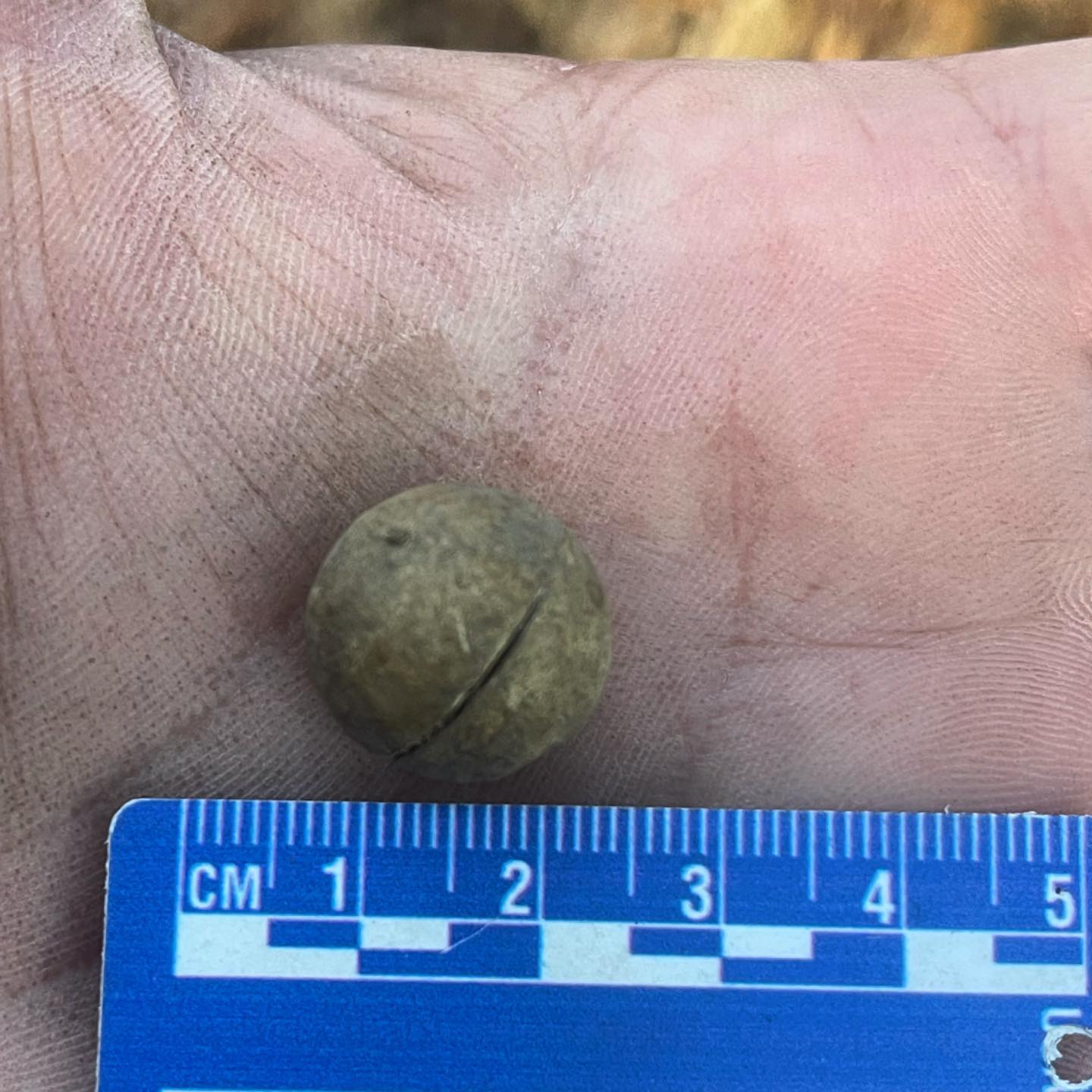
Produced in large numbers, and floating around most of the arsenals in the South, these were still used despite the lack of accuracy and range in both the front lines and on the home front by militia. With a maximum range of 365 meters, and an average effective range from 90 to 275 meters, the location of the ball is well within range of the guard towers. And while most of the POWs at Camp Lawton recalled few instances of guards shooting POWs, our fired musket ball, along with other fired rounds from previous work inside the stockade, is a sobering reminder that Lawton still had many ways to die,” the professor writes.

Students led by Lance Greene, his predecessor, in 2010 found a spent .57-caliber bullet at the stockade. The round “has clear signs of rifling from being fired: deformation on the tip seems to show it only striking sand, though this doesn't preclude it having impacted a human,” McNutt says

Later analysis showed three groves and a right-hand twist indicating it was probably fired from a Pattern 1853 Enfield rifled musket. “Deformation on the nose matches experimental archaeology of impacts into soft surfaces, like sand or loamy soil,” according to McNutt. 

ELMIRA (New York – Union camp)

Confederate POWs at Elmira (Library of Congress)
Elmira did not have a deadline, even though it was a stockade prison. The camp was dubbed “Hellmira” by prisoners because of its 24 percent mortality rate. Gray said there are records of a Union guard shooting a Confederate prisoner.

According to the Star Gazette newspaper, Granville Garland shot A.P. Potts of the 38th Georgia Infantry during a July 31, 1864, disturbance. Potts survived.

Inmates at Elmira weathered hunger, illness and melancholia and, even worse, exposure to the cold weather, according to the National Park Service.

POINT LOOKOUT (Maryland – union camp)

(Library of Congress)
The overcrowded prison saw 4,000 Confederate prisoners succumb to various causes, especially disease. Some were killed by guards, according to experts and histories. About 52,000 Union soldiers went through the prison.

The camp’s deadline was a ditch inside the prison approximately 15 feet from the parapet wall. The ditch was a foot wide by a foot deep.

Official records show African-American guards, some formerly enslaved, sometimes shot prisoners for crossing the deadline or trying to escape, says Gray. The prison is known for its racial tension.

“One commanding officer claimed that the black guards were more zealous than the white when it came to enforcement of prison regulations and were apt to fire first while calling for the corporal of the guard,” says Crickenberger.

He estimates 19 prisoners were shot and killed or wounded by white and black guards between November 1863 and August 1864 alone. Prisoners reported that there were instances where guards fired at prisoners without inflicting casualties. (Photo, Friends of Point Lookout)

“They shot frequently but missed more often than they hit,” Crickenberger says. “Regardless of the accuracy of the guard, such incidents kept prisoners on their toes making them wary and continually fearful of being shot either night or day.”

A Confederate prisoner drew notable watercolors of life at the prison, including interactions with guards. It should be noted that black POWs held at Andersonville faced discrimination from friend and foe alike.

The friends group has helped restore the fort, the southwest corner of the stockade and assists with living histories and demonstrations of camp life.

ROCK ISLAND (Illinois-Iowa – Union camp)

The deadline at Rock Island consisted of a series of white stakes (left, photo Rock Island Arsenal Museum) that were illuminated by lanterns at night, according to the NPS.

The barracks were enclosed by a stockade fence 1,300 feet long, 900 feet wide and 12 feet high. Sentry boxes were placed every 100 feet.

During the 20 months the prison was open, 1,960 prisoners and 171 Union guards died.

The North had reduced rations in retaliation for the treatment of Union prisoners at Andersonville. Conditions at Federal prisons often were deplorable.

Tuesday, September 7, 2021

In 1864, drunken soldiers caused a deadly fracas in Elmira, N.Y.

The so-called Battle of Chemung occurred on Feb. 24, 1864, in Elmira, N.Y. It was indirectly related to the Civil War – and did not involve Confederate troops. Books and newspaper accounts over the years detailed deadly fights between  soldiers, including alcohol-fueled cavalry troopers from Michigan who were in town. A 1923 article called it a “real battle between two heavily armed forces resulting in the killing and wounding of many of the combatants." Civilians were among the casualties -- Article

Wednesday, June 6, 2018

Renovated home will tell Elmira's story

An Elmira, N.Y., home used during the Civil War is getting a 21st-century touch-up. The Foster House on West Water Street will undergo some major renovations. The Friends of the Elmira Civil War Prison Camp teamed up with the building's owner to mix history with function. The ground floor will be dedicated to Civil War research. A library will be built with reference material. And residential apartments will be on the top floors. • Article

Tuesday, August 4, 2015

Can Elmira building be visitor focal point?

The reconstruction of a building that was once part of Elmira’s Civil War prison camp is only the beginning for what is ultimately envisioned to become a Civil War tourist attraction in New York. But in the meantime, the immediate goal of the Friends of the Elmira Civil War Prison Camp is to reassemble the lumber that made up the building, which is 150 years old. “This project has become much more cumbersome and much more costly than we ever anticipated,” said Martin Chalk, president of the group, during a news conference Tuesday. It is now anticipated that $100,000 will be needed to complete the project. • Article

Monday, September 15, 2014

Only surviving Elmira prison camp building to be reassembled, serve as museum

A view of the Federal prison camp in Elmira, N.Y. (Library of Congress)

Two loads of lumber brought into Elmira, New York, last Friday on flatbed trailers will start taking shape soon as volunteers and roofers reconstruct what's believed to be the sole surviving building of the Civil War prison camp there.

Minus a few cracks and a little rot, the lumber – thought to be pine -- is in pretty good shape for having been out in the elements and in storage for 150 years. Even a couple of windows are intact.

Years of study and conjecture have failed to bring a firm conclusion on how the building was used.

“There are rumors, theories,” said Marty Chalk, president of the Friends of the Elmira Civil War Prison Camp.

Possibilities include a commissary, a pharmacy or a “death house” that contained the bodies of Confederate prisoners before burial. Or it may have been a granary.

“In the interior, some of the wood is a little pitted,” said Chalk. “It is believed the pitted area came from loading and unloading grain. That’s just a theory.”

One thing for certain is the friends group, working with government officials and the Chemung County Historical Society, plans to use the building as a visitor/learning center and museum.

The building has been on a long journey before its return to the prison site, near a pumping station operated by the Elmira Water Board.

Once a Union recruiting center, the camp, sometimes called “Helmira,” was transformed into a prison facility that opened in July 1864 and eventually housed 12,123 Confederates. Nearly 3,000 died, a staggering 24% death rate.

Chalk said the building was moved after the war to nearby Hoffman Street, where the owner used it as an outbuilding for storage. It eventually was taken down and moved to a couple locations before ending up in a barn about five miles outside the city.

The Friends of the Elmira Civil War Prison Camp has a budget of about $9,000 for the project, but has benefited largely from volunteer work and donations. It is trying to raise more money.

The site will include a foundation for the old building and a fence. The nonprofit group has found a source for square nails and will bring in a roofing company for that part of the work. Chalk said he expects the building will need to be augmented about 20 percent by new lumber.

Officials hope to reassemble the building by early spring 2015, with the learning center ready for visitors by mid-2015. “Our plan is to have a climate-controlled environment,” said Chalk.

The center is expected to include artifacts, rifles, interpretive panels, an 1863 artillery piece and original or copied prisoner letters, including some in possession of a North Carolina man.

Chalk said visitors to Elmira currently stop by Woodlawn National Cemetery and the Chemung County Historical Society to learn about what occurred at the Union prison.

An original flag pole and a marker greet those who walk part of the prison site.

“There really isn’t much there. We have numerous people from the South who come to that site, asking questions. They take all the pictures they can,” he told the Picket. “Unfortunately, there is not much to see right now.”

The friends group hopes the city and county get a little tourism boost from the welcome center, which will be a tangible link to the past. “Elmira probably should be more of a Civil War town than it is,” Chalk said.

He said Southerners who visit want to see graves of loved ones and where they were imprisoned. “If I had a relative who died at Andersonville, I’d want to know as much as I could.”

Re-enactors who have been on site treat the grounds along the Chemung River as hallowed.

“I got a phone call from a woman in South Carolina,” said Chalk. “Her comment was interesting. She said, ‘Don’t you dare glorify what happened in the Elmira Civil War prison camp.’ I told her our purpose is not to celebrate anything. It is to educate.” 

Friday, August 15, 2014

Elmira prison exhibit shows the struggle to survive, desire to make a fast buck

Items made by prisoners at Elmira (Chemung County Historical Society)

“There were people trying to help. There were people trying to cash in.”

Rachel Dworkin, archivist with the Chemung County Historical Society, succinctly summed up the two sides of human nature as they played out at the famed Civil War prison camp in Elmira, N.Y.

The society’s Chemung Valley History Museum on Thursday night opened “So Far From Home: Life in Elmira's Confederate Prison Camp.” The exhibit, the fourth in a series on the Civil War, is open until July 2015, the 150th anniversary of the camp closure.

Once a Union recruiting center, the camp was transformed into a prison facility that opened in July 1864 and eventually housed 12,123 Confederates. Nearly 3,000 died, a staggering 24% death rate.

Ball and chain and other items (CCHS)

The exhibit, which features panels and descriptions of prisoner and guard life and the camp’s connection to the city, includes a small structure that represents two competing, commercial observation towers that sat just outside the stockade walls.

Owners charged 10 to 15 cents for the curious to gawk at the prisoners below. Visitors also could buy photographs and snacks.

James Huffman, a soldier from Virginia, blamed the Northern press for sending "a constant stream of people winding their way to the top of these observatories to get a glimpse of the Rebs, as they supposed us to be some kind of curious, monkey-shaped animals,” writes Michael Gray in his book about the prison, “The Business of Captivity.”

Life was extremely difficult, as the exhibit points out. Prisoners weathered hunger, illness, melancholy and exposure to the elements. Not enough of the men had stoves during the harsh winter.

All that remains today of Elmira Prison is a well-kept cemetery along the banks of the Chemung River, according to the National Park Service.

Dworkin told The Picket that officials hope visitors “come away with a better sense with what life was like for both sides during the conflict here.”

Coat belonging to Union guard
Townspeople were both fearful and fascinated with the camp, and many took part in charitable efforts to ease the suffering. The towers, however, were typical of a “circus element” until they were closed.

The prisoners generally fared better when they had skills, such as carpentry, that benefited the operation of the camp. They tended to get better rations and shelter. “The unpleasantness varied widely,” said Dworkin.

Prisoners maintained a strange economy providing services to comrades, Dworkin said. 

“There were people who taught people French in exchange for rats.”

Others made furniture and jewelry to be sold outside the camp. The exhibit features a chair made by a prisoner.

The historical society’s previous exhibits focused on soldier life, the home front and artifacts owned by local residents. Officials are working on creating digital versions of those programs.

Civilian artifacts include telegraph machine from train station (left)

Wartime photograph of prison camp (Library of Congress)


Thursday, June 21, 2012

Author contacts descendants of Elmira POWs

Nearly 150 years after they died in one of the Civil War's worst prison camps, the nearly 3,000 Confederate soldiers buried in an upstate New York cemetery are remembered in a recently published book, a private quest to account for those buried in the Woodlawn National Cemetery • Article

Sunday, December 11, 2011

Elmira prison granary may be rebuilt

The sole remaining building from the infamous Elmira Civil War prison camp in New York may be reconstructed close to its original site. The granary building, which was painstakingly dismantled and its pieces numbered, has been in storage at various locations for years as historians and others try to figure out what to do with it. • Article