Showing posts with label alexander. Show all posts

Monday, February 6, 2023

The use of spy balloons took off during the Civil War. Were they effective? How have their role and technology evolved over the years?

Union troops inflate Intrepid at Fair Oaks in Virginia (Library of Congress)
Thaddeus Lowe likely never imagined that balloons would one day sail in the stratosphere at 60,000 feet and up. Lowe and other aeronauts during the Civil War reached only 1,000 feet or so, and their balloons were tethered to ships or ground stations.

But, unlike the Chinese suspected spy balloon that was shot down off the coast of South Carolina this weekend by a U.S. fighter jet, no Union or Confederate airships were lost. They were behind front lines and too difficult to hit.

The flight of the unmanned Chinese craft over multiple states was a reminder that spy balloons have been used since the 19th century, seeing particular service in Lowe’s Union Army Balloon Corps.

For two years – until the corps was disbanded due to bureaucratic and logistical issues and indifference – Lowe’s brainchild provided valuable, if limited, service in spotting Rebel positions and putting them on the defensive.

Thaddeus Lowe observes Battle of Fair Oaks from the Intrepid (Library of Congress)
He was a patriot and knew he had the technology (of the time) to help commanders reduce the total time of the war and the total number of casualties,” says Kevin Knapp, a retired Army officer and former professional hot-air balloon pilot.

The Picket reached out to historians and writers who have documented the use of seven Federal and two Confederate balloons during the Civil War. We asked Knapp, historian Michael G. Stroud, author Russell K. Dutcher III and Gail Jarrow about their use during the conflict, changes in technology and the role of military balloons today.

Did the use of balloons have a major impact on the conduct of the Civil War?

Before we tackle that, a little previous balloon history is in order.

“Most people may not be aware that the use of balloons was proposed to the hierarchy of the U.S. Army during the Mexican-American War. Unfortunately, the use of the balloons was discounted by higher command authority,” says Dutcher, author of the book “Union Army Balloon Corps.”

“The introduction of military ballooning was proposed during the Seminole War, but again, fell upon the short-sightedness and unwillingness of the U.S. Army to accept new technology,” he said.

While the use of balloons never really got off the ground for the Confederacy, they did garner advantages for Federal forces in the first half of the Civl War.

After the Union disaster at the Battle of Bull Run (Manassas) in July 1861, both sides regrouped and expanded recruiting. Concerned that Confederates would cross the Potomac River and take Washington, Federal aeronauts took to the air.

Balloons went up in multiple locations from Edwards Ferry to Buds Ferry making observations and reporting which helped calm the general public and gave the North a greater chance at regrouping,” says Knapp. (Intrepid at left, Library of Congress photo)

The balloons gave observers a bird’s-eye view of the topography that was previously unheard of or unthinkable, according to Stroud. Two of the more well-known Federal craft were the Intrepid and Union. The small Confederate fleet included the Gazelle.

In and around the capital over the coming months, engineer Brig. Gen. John Gross Barnard designed and built 68 forts, a task made much more urgent by the ignominious Union defeat Manassas. Rebel troops weren’t far from the capital – in Falls Church, Va. The Union Army Balloon Corps spied on them from Fort Corcoran.

In Virginia, along the Potomac River, among the most imposing Confederate defenses was Cockpit Point Battery in Prince William County. Perched atop a 70-foot bluff, the fort had an air of mystery from the beginning. It was built in secret, with trees left in front to better hide the construction. Curious Federal troops on the Maryland side of the river eventually used a balloon to try to figure out how many men were at Cockpit Point and other batteries in the area.

At Island No. 10 in the Mississippi River, John Steiner’s Eagle balloon surveilled Rebel strength and defenses. Steiner directed Federal fire from 500 feet up, tethered to a ship. The island was eventually taken.
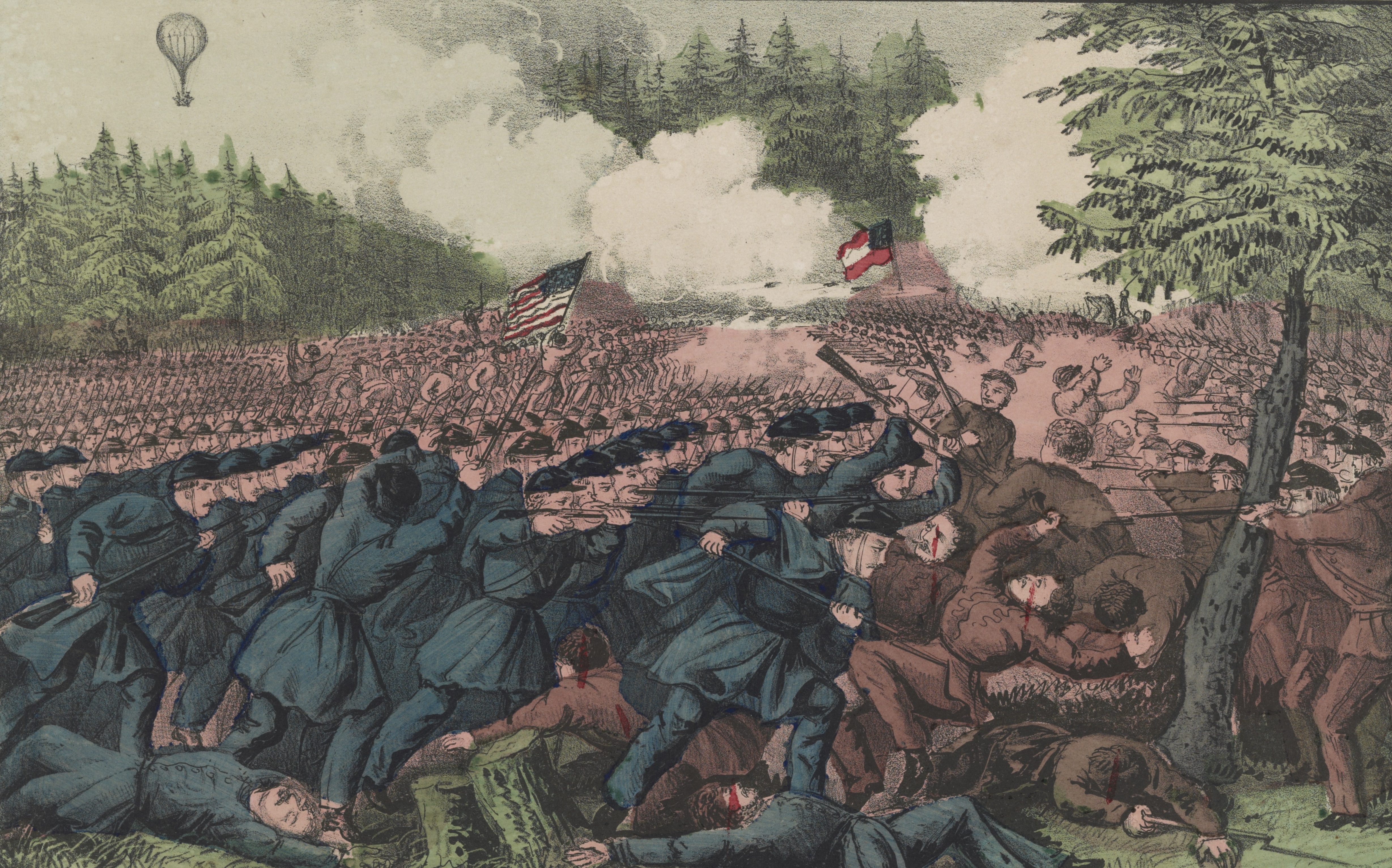
Balloon Intrepid watches fighting at Fair Oaks in May 1862 (Library of Congress)
Union balloons played a significant part of offensive operations in Virginia in 1862, including Fair Oaks.

Outside Richmond when Union forces were separated in two by a flooded Chickahominy River, multiple ascents and reports by Lowe helped reunite the forces and saved hundreds of lives,” says Knapp, who has portrayed Lowe at events and talks.

“Any time the balloons went aloft, the Confederates had to move their positions. They made false camps; matched in circles to kick up dust to give the impression they had more forces on the ground and they made false campfires at night,” he says. “All (of) this distracted and took time away from actual fighting. Look at all of the attention the China balloon (distracted) us from other more important things.”

In the end, Rebel aeronauts made fewer than 10 ascensions in 1862. Their enemies made about 3,000 flights from 1861 to 1863.

“I never understood why the enemy abandoned the use of military balloons,” wrote Confederate Brig. Gen. and artillerist Edward Porter Alexander. “Even if the observers never saw anything, they would have been worth all they cost for the annoyance and delays they caused us in trying to keep our movement out of sight.”

Kevin Knapp in a reproduction balloon and at site where Thaddeus Lowe landed in South Carolina
How has balloon technology changed since the Civil War?

By the Civil War, balloons had moved from construction of linen and paper filled with hot air to those made of durable varnished silk, powered by hydrogen and helium gasses.

Thaddeus Lowe made his a balloon inside of a balloon knowing they’d be used in a field environment: corn stubble, bush and tree stumps – anything but a freshly mowed lawn,” says Knapp.

Aeronauts could reach altitudes between 500 and 3,000 feet. Lowe tethered his balloons to the ground to provide a stable platform for aerial observation and so information collected could be delivered to the ground commander immediately, says Knapp. Observations were made by line of sight, aided by binoculars or telescope. Wind, trees and obstructions could limit the visibility.

According to Stroud (left), balloons would remain largely unchanged until the 1960s, “when Edward Yost utilized a propane burner to control a balloon’s ascension and descent thus allowing for a degree of balloon control that had not before existed.” Balloons now could carry their own fuel.

Today’s balloons have a thick vinyl envelope, and the helium or hydrogen allows significant lifts that are limited only by the size of the envelope.

Lifting gas expands with increased altitude, according to Knapp, and observation equipment may include radar, infrared, photo imaging and radio frequency sensing -- "all at the same time, in every direction for miles.”

How has their use in military/surveillance matters evolved since the 1860s?

The bulky and cumbersome balloons of the Civil War, with their labor-intensive field hydrogen gas generators, where outfitted with the highest tech of the day for field observation and reporting.

“Militarily, balloons has been used by various world powers since the 1850s predominately as an observation platform, but there were instances where it was used as a bombing platform such as the siege of Venice in 1849,” says Stroud. “The U.S. military considered using balloons as early as the 1830s during the Second Seminole War and even more so during the Mexican-American War of 1846-1846 to break strong Mexican defenses, but none were executed.”

Barrage balloons protected against aircraft at Normandy (Wikipedia)
It would only be during the Civil War when ballooning was given an official military role in both the North and South (though the South lacked the resources to properly outfit and run a ballooning corps), according to the historian.

Military balloons took major steps forward during World War I, and the conflict also saw the use of dirigibles, including the Zeppelin raids of Britain.

“WWII would see the use of barrage balloons or blimps by the UK as part of their defense network to thwart German bombers and V-1 attacks, the Japanese use fire balloons with explosives to cause terror to Americans on the West Coast, the Soviets used them to assist in artillery spotting and the U.S. Navy utilized balloons in their anti-submarine operations,” says Stroud.

While not receiving much publicity, balloons continue to be used as strong surveillance tools and assets by many countries. “The cheap cost structure, when combined with a balloons ability to stay aloft longer and over targets of interests, have made it an ideal platform for intelligence and information gathering,” according to Stroud.

Does this event give you any new thoughts on the practical role (or limits) of balloons to conduct surveillance?

Even with super sophisticated technology, there is something to be said for simplicity, Stroud says.

“Balloons in the military continue to surprise in their value and role diversity from nuclear test detection, to observation and most importantly, intelligence gathering. This alone shows world powers and nations that one does not have to spend millions if not billions on complex military platforms or spy satellites when a fraction of the cost can be invested in disposal yet effective balloons outfitted with surveillance gathering equipment to spy on a geopolitical adversary.”

They still provide a high rate of return

Stroud says military balloons provide a high rate of return for the investment.

“We have yet to develop and implement a relatively cheap surveillance platform that allows one to rise to 60,000 feet (or higher) and therefore out of the range of most fighters, keep eyes on a target for longer than satellites can and provide valuable intelligence on said target like a balloon can,” he says.

Navy Lt. Cmdr. Steven D. Culpepper, writing in 1994, said the usefulness of information gleaned by balloons matured during the Civil War. Logistical problems decreased as aeronauts gained experience.


Knapp, who has participated in balloon races, says colleagues have had “to thread the needle” to avoid going into Chinese airspace. And he recalls when two Americans died when their balloon was shot down over Belarus in 1995.

He criticized U.S. leaders for waiting for the Chinese balloon to go over the ocean before it was taken down. Officials had said they were worried about shooting it down over land, were debris could potentially harm people or structures. China has insisted the balloon was used for civilian purposes.

“All of the information collected was immediately received by China as it was collected. We should have shot it down as soon as it entered our airspace, period,” Knapp says.

What would Thaddeus Lowe think of all this?

The aeronaut and scientist, as head of the balloon corps, would be impressed with modern ballooning and electronic technology, according to Knapp.

Lowe would feel extremely vindicated in the longevity of the balloon as a platform and as a military asset,” Stroud says. “He argued vehemently as to its value with President Lincoln and continued to do so up until his dismissal from the Union and the disbanding of the balloon corps.

“He instinctively and fortuitously saw the need for the military to be able to gain greater situational awareness of its surrounding and to gather data, with balloons being the only way to do that. He was only limited by the resources and primitive technology of the time, but his vision became a reality in both our military and those throughout the world.” 

One interesting side note on Lowe (above) involved his own adventure only weeks before the Civil War erupted.

Reading about the path of the Chinese balloon reminded her of Thaddeus Lowe’s flight from Ohio to the Atlantic Ocean (Washington, D.C., area) in April 1861, says Jarrow, author of “Lincoln’s Flying Spies: Thaddeus Lowe and the Civil War Balloon Corps.”

Lowe had future plans to cross the Atlantic in his balloon, and this was his test flight.

“Unfortunately, he came down in South Carolina eight days after Fort Sumter. The locals weren’t too pleased when they realized he was a Yankee,” says Jarrow. “Lowe was arrested, and some wanted to hang him as a spy. No one, including Lowe, knew that within three months, he would be a Union spy. He was eventually released and took a train north immediately.”

Wednesday, April 29, 2015

Alexander Gardner's 'Sketch Book,' on display in Toledo, showed power of war photos

John Reekie's photo of the dead at Cold Harbor
Curator Ed Hill looks through one volume (Photos Toledo Museum of Art)

Alexander Gardner and a cadre of fellow Civil War photographers had a huge impact on the way Americans looked at war through their compelling compositions, notably of the dead.

The Scotsman took haunting images at Antietam and included photographs by others of the fallen in his seminal “Gardner’s Photographic Sketch Book of the War,” a two-volume work featuring 100 photographs.

The familiar “A Harvest of Death” by Timothy O’Sullian depicts a half dozen dead Union soldiers at Gettysburg, their boots removed and their pockets picked.

“Such a picture conveys a useful moral,” Gardner wrote. “It shows the blank horror and reality of war, in opposition to its pageantry.”

A rare copy of Gardner’s sketchbook is on display through July 5 at the Toledo (Ohio) Museum of Art. The American Civil War: Through Artists’ Eyes” uses paintings, drawings, sculpture, photographs and artifacts to retell the events of the time.

(Toledo Museum of Art)

“(Gardner’s is) one of the most important books published in American history and one of the most significant works of photojournalism,” the museum said in a press release about the exhibit. “The fragile volumes are rarely on display.”

Because of its $150 price tag in 1866 (about $2,000 today) and war fatigue, only about 200 copies of the photographic opus were published, according to an article by Middle Tennessee State University. An estimated 15 survive, including the one in the museum’s collection.

(NPS photo)
“Photographic book illustration in the 1860s was a cumbersome undertaking,” the George Eastman House says. “Lacking the ability to photomechanically reproduce photographs as ink on paper, photographic illustration required that original photographs be pasted onto boards that were then bound together with the text. These limitations help to account for the rather small number of copies of the Sketch Book that were produced and the high price of $150.”

The museum patron will recognize many of the works – because of their publication for stereo views, newspapers (as woodcuts), carte de visites and galleries.

Gardner’s September 1862 photographs of the Antietam dead were featured in the studio of his employer, Matthew Brady. A New York Times reporter wrote, “Mr. Brady has done something to bring home to us the terrible reality and earnestness of war. If he has not brought bodies and laid them in our door-yards and along streets, he has done something very like it.”

Gardner – who midday through the war emerged from the shadow of Brady and started his own studio -- wanted to create a lasting tribute to innovative Civil War photography. Forty-four of the 100 images are credited to O’Sullivan. Ten other photographers, including Gardner, produced the rest. (Unlike Brady, Gardner credited individual photographers. He took 16 of the photographs).

Alfred Waud created title page (Library of Congress)
Lincoln at Antietam, 1862 (Toledo Museum of Art)
Gardner's brother, James, took this photo (Toledo Museum of Art)

Other subjects of the albumen-silver photographs are military and civilian leaders,homes, camps, forts and general battlefield scenes. Gardner is believed to have written the text for the books. The volumes were bound in brown morocco and gilt-stamped.

The free exhibit in Toledo is meant to spotlight artists’ take on the Civil War and the impact those works still have on the public.

“These were stirring images at the time they were released, and they are equally moving now,” curator Ed Hill said. “Our country split itself in two, so the enemy could have been a brother, a cousin, a neighbor. It wasn't as easy to demonize people, yet the level of violence was still astounding."

Alexander Gardner
Battles covered in the sketchbook were largely restricted to the theater of operations of the Union Army of the Potomac. Scholars have in recent years argued that Gardner and a few other photographers may have moved corpses for staged shots -- a strict no-no today.

A kiosk in the exhibit features a slideshow presentation of all 100 photographs in the sketchbook.

Gardner, who later got into the insurance business, died at age 61 in 1882.

Saturday, December 24, 2011

Alexander Gardner: Lasting images

Although often overshadowed by his former employer, Mathew B. Brady, Alexander Gardner was the one who actually took many of the Civil War’s most famous, and unsettling, pictures, including the dead at Antietam and Gettysburg. With the sesquicentennial of the Civil War, the National Portrait Gallery is preparing a major exhibit on Gardner’s work. • Article

Monday, June 21, 2010

The first cannonball fired at Fort Sumter sits outside a Georgia courthouse. Or does it?

Virginia planter Edmund Ruffin’s first foray into South Carolina seemed peaceful enough. He came to preach advancements in agriculture, crop rotation among them.

When he returned to Charleston on the eve of the Civil War, however, Ruffin brought with him the seeds of Southern independence.

At 4:30 a.m. on April 12, 1861, the 66-year-old slaveholder, "fire eating" secessionist and Palmetto Guards volunteer tucked his long white mane under his hat and fired one of the first shots of a war that would kill more than 600,000 Americans.

“The first shell from Columbiad No. 1, fired by the venerable Ruffin burst directly upon the parapet of the southwest angle of the fort,” wrote Capt. G. B. Cuthbert of the Palmetto Guards.

Thirty-four terrifying and exhausting hours after Ruffin put fire to fuse on Cummings Point, Col. Robert Anderson and his Union garrison surrendered.

The bombardment, of course, had thousands of eyewitnesses. Legends were born instantly.

One of them involves P.W. Alexander, an intrepid correspondent from Thomaston, Ga., who made a bee line to Fort Sumter with a purpose. He wanted to retrieve that historic first shot fired by Ruffin.

“The big 10-inch ball fell within Fort Sumter without doing any damage,” reads an old Thomaston Times article. “Alexander, who for years had boarded in the home of Mr. and Mrs. B. B. White, was an eyewitness to this scene. He saw just where the ball fell and immediately after the surrender procured it and sent it to his friend, B.B. White."

Today, nearly 800,000 people each year take the ferry ride to Fort Sumter to see where the carnage and restoration of the Union began. Many fewer tread on the grounds of the Upson County courthouse in Thomaston, 300 miles from Charleston and 60 miles south of Atlanta.

If they do, they’ll see a tall monument to Confederate dead and that cannonball retrieved by Alexander, perched on a marble monument with this 1953 inscription:

"Presented to the UDC [United Daughters of the Confederacy] by Mrs. Sallie White to whom it was given in 1861 by P.W. Alexander, leading Confederate war correspondent who was present when the ball was fired and knew it to be the first. The first marker stating these facts was erected on this square in 1919."

The cannonball had a more practical household purpose before it was ensconced on the monument pedestal.

“A colorful Upson tale says that P.W. Alexander retrieved the first cannonball fired in the Civil War from the mud in front of the fort, and brought it back to the B. B. White family in Thomaston,” according to a 1998 article by USGenWeb Archives. “The story maintains that this relic served as a door stop at the house, or lay under the porch, for several decades before being elevated to the marble pedestal on which it graces Thomaston's courthouse square today.”

Alexander, a lawyer and noted Confederate war correspondent who wrote about the brutality of war, can’t confirm the tale. He died in 1886.

Penny Cliff, director for the Thomaston-Upson Archives, and her staff have to do the talking for him.

"Whenever I give tours around the square I use the word 'allegedly' in regards to the 'first' cannonball fired at Fort Sumter," Cliff said.

"I do, however, believe it is definitely one of the 'hot shots' fired at the fort. Even if it is not the first, it is historically important in the fact that it is one of the cannonballs fired at Fort Sumter."

History, of course, is subjective and never 100 percent accurate. It’s fair to say that we really don’t know if this iron ball was, in fact, the first shot fired during the Civil War. Historians even disagree on whether another Confederate battery first fired on Sumter, cheating Ruffin of the honors.

But one thing is for certain.

In June 1865, two months after the South surrendered, a despondent Edmund Ruffin took up another firearm.

He propped his rifle on a trunk between his feet, stuck the barrel into his mouth and opened fire.

The war was over.

Monday, April 5, 2010

A man of contradictions: Visiting the home of 'Little Alec' Stephens, Confederate VP

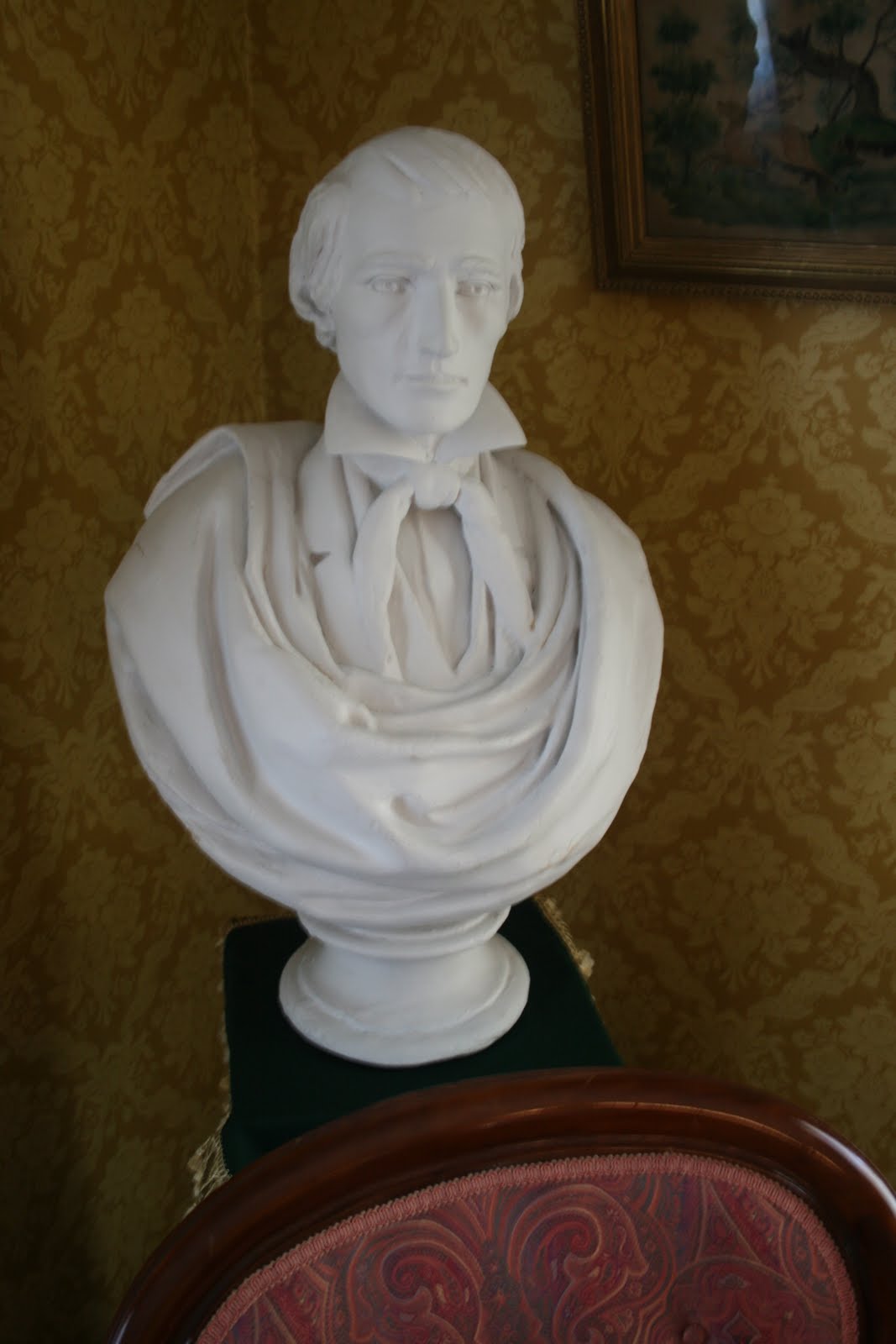
Diminutive and sickly in life, Alexander Stephens stands taller in marble.

From the pedestal on the fresh-cut lawn of his home, Liberty Hall, the Georgia statesman looks south toward the downtown of Crawfordville, a small town that sits on the sidelines of Interstate 20 and prosperity.

Most known for serving as vice president of the Confederacy, Stephens lived nearly 50 years at this residence that served relatives and wayfarers traveling between Atlanta and Augusta, which is about an hour east of Crawfordville.

I visited A.H. Stephens State Historic Park on Easter Sunday, while my family was away. Walking first through the small downtown was a journey back in time. Kudzu vines climbed red brick walls of abandoned businesses. And while the main street (U.S. 278) has a few antique businesses, many of the buildings are shuttered.

A courthouse expansion and a branch of Athens Technical College seem like the only new touches in Crawfordville. 2010 Census signs hang near the Taliaferro (pronounced Tolliver) County courthouse. The tiny county has only 2,000 residents, and is trying desperately to hang on to every one.

“When they put I-20 out there [in the 1960s] the town just dried up,” said parks employee Margie Edwards, who gave me a fine tour of Liberty Hall and a museum housing a collection of Confederate and civilian artifacts from the period.

The mid-19th century surely was a busier time for Crawfordville. The trains dropped off passengers while others rode carriages to and from Atlanta and Augusta.

Born in 1812 a few miles outside town, “Little Aleck" Stephens, an accomplished orator, topped out at 96 pounds and was frail most of his life. An accident ruined his hip. He often used a wheelchair and crutches.

While his voice was described as shrill and unpleasant, at the beginning of the Civil War a northern newspaper described the statesman, who also suffered from depression, as "the Strongest Man in the South" because of his intelligence, judgment and eloquence.

The brilliant attorney was elected governor, U.S. senator and U.S. representative. In 1848, he was stabbed by a political foe in Atlanta.

Stephens appears to me a man of contradictions.

Stephens at first opposed secession, but became vice president of the Confederacy. Believing that President Jefferson Davis was dictatorial, the vice presidency was a string of frustrations for Stephens, who favored states rights, opposed conscription and eventually sought peace negotiations.

“Little Alec” served nearly five months in prison after the South surrendered In 1865. He wrote, “A Constitutional View of the Late War between the States” (1868-70), his two-volume apology for the Confederacy.

Stephens had about 35 slaves on his farm. By all accounts, he treated them better than many and ensured many were educated, even after the war. Some sources said he personally opposed slavery. Publicly, however, he declared slavery as the natural condition of blacks. (Above, two of his slaves, Harry and Eliza Stephens)

Fond of wine and games of whist at Liberty Hall, Stephens was a longtime friend of Robert Toombs, a robust and blustery politician who appeared in many ways his opposite. An upstairs room at Liberty Hall was reserved for Toombs when he made a visit. Relatives of Stephens lived upstairs.

Liberty Hall, while by no means sumptuous, was a comfortable stopping point. Because of his infirmities, Stephens, a lifelong bachelor who was orphaned when 14, lived on the first floor of the home, next to the men’s sitting room.

“The beds Stephens would sleep in were in the north-south direction,” Edwards told me. “Someone told him the magnetic currents were good for him.”

Many of the pieces in Liberty Hall, including an earthen commode and sofa, are original. A building in the back of the home served as a library for Stephens, who died in 1883 while serving as Georgia governor. He is buried with his stepbrother, Linton, in front of the home.

The museum isn’t long on interpretation but has a few nice belongings and many quotations from the Civil War.

One of my favorites, penned by a Georgia private on the march to Gettysburg, reads, “I saw a little girl probably about eight years of age, standing on the stoop in front of her house and heard her say, ‘Mama, are these men rebels?’ ‘Yes my daughter.’ ‘Why Mama, they haven’t got horns. They are just like our people.”

Parking at the state park is $5. The tour of the home and museum costs an additional $4.

Click here for more information of the historic site.