Showing posts with label bible. Show all posts

Tuesday, May 23, 2023

Sinking of the Sultana: Will journal and Bible belonging to Ohio soldier John Clark Ely, victim of the disaster, go to a museum?

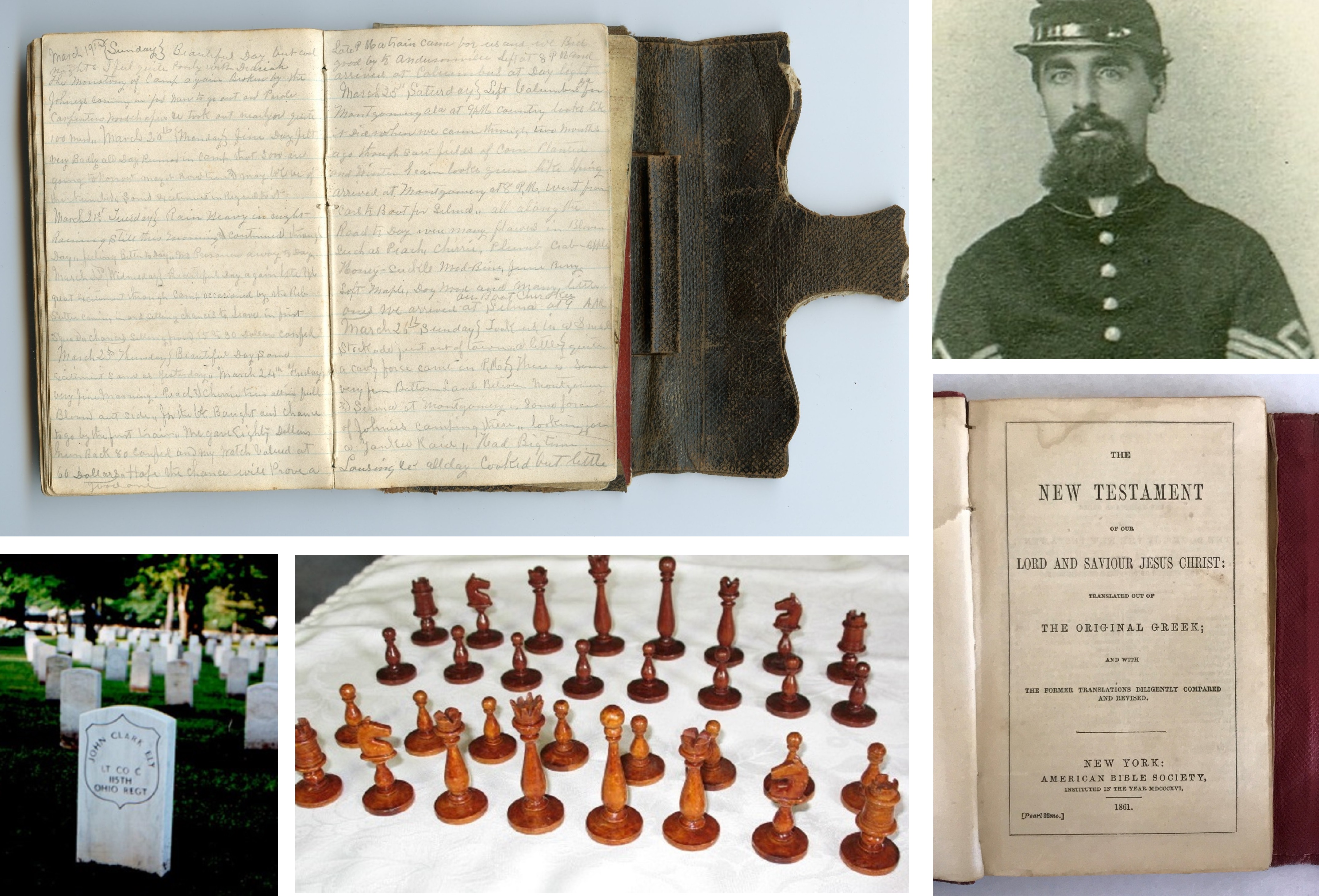
(Clockwise from top left: Pages from journal, Sgt. John Clark Ely, his Bible, chess set pieces,
and his grave in Memphis. (Photos courtesy of John M. Ely, David C. Ely and Jerry O. Potter)
Sgt. John Clark Ely of Ohio left behind a brokenhearted family when he perished in the Sultana disaster on the Mississippi River. He is emblematic of the heartbreaking stories of former Civil War prisoners who died when they were just days away from home.

Beyond stories about Ely, there are tangible reminders of his life.

John M. Ely of the Aspen, Colo., area, has his great-great-grandfather’s two chess sets and a journal (below) that survived the sinking of the steamboat on April 27, 1865, above Memphis, claiming 1,200 lives. The journal is believed to be the only one describing the days leading up to the tragedy.

John M. Ely’s second cousin, David Clark Ely of Placerville, Calif., has a Bible bestowed upon his ancestor before he went off to war.

The two men and David’s sister, Sharon Ely Pearson, are open to the idea of the heirlooms being available to the public through an exhibit or the like.

“I wish we had those items for the museum,” says Sultana expert and author Jerry O. Potter.

By museum, Potter means the Sultana Disaster Museum across from Memphis in Marion, Ark. Supporters are raising the last of the dollars and pledges needed to build a larger and permanent venue at an old high school gymnasium.

Marion was the closest town to the disaster and residents helped rescue those thrown into the river after the fire and explosion on the Sultana.

The tiny current museum in Marion, Ark. A new location is in the works.
Officials say it’s important that the little-known story of greed, fraud, valor and sacrifice be told in a bigger way than what’s covered in a tiny museum that opened in 2015.

While the journal has been excerpted in some form for years, the whereabouts of the Bible weren’t known to Potter and Gene Salecker, another renowned Sultana author.

“I have never heard of the Ely Bible, so this is something new to me,” Salecker, author of “Destruction of the Steamboat Sultana,” told the Picket in an email.

I made the story of the Bible known to the museum supporters after contacting David C. Ely, who I spoke to several years ago, and John M. Ely, who I tracked down a couple months back. The Picket has written numerous articles about the Sultana and Ely, and I wanted to update readers on all the items known to be associated with him. (David C. Ely and John M. Ely have not been in touch with each other or the Marion museum.)

Sgt. Ely, 37, of Company C, 115th Ohio Volunteer Infantry, was jammed on the overcrowded steamboat with hundreds of other recently released Union prisoners. (He is at left in the photo, next to Company C comrade Sgt. Charles W. Way, who also died on the Sultana).

The Ohio schoolteacher, who was supposed to get a promotion to lieutenant at the end of the war, had been captured by Confederate forces under Nathan Bedford Forrest on Dec. 5, 1864, near LaVergne, Tenn.

Ely (pronounced ee-lee) spent time in a few prisons, most notably Andersonville, before he was paroled at war’s end near Vicksburg, Ms.

“He is my hero,” Potter, author of “The Sultana Tragedy: America’s Greatest Maritime Disaster,” told the Picket in April. “I guess I know more about Lt. Ely than just about any other soldier on the Sultana. In reading his diary, I was able to see things through his eyes and to learn of his hopes and dreams.”

Several years ago, Potter told the Picket: “While we have many accounts written later, his is the only one that we have that gives a day-to-day account leading up to the disaster. Plus, he is one of the few buried at the (Memphis) national cemetery with a headstone with his name. Finally, he became my hero who through his own words I got to know him.”

In his journal (the only one of two belonging him to survive), Ely writes about his service, family, capture and time in prison.

On Dec. 25, 1864, Ely wrote,
“Such a day for us prisoners. Hungry, dirty, sleepy and lousy. Will another Christmas find us again among friends and loved ones?”


The soldier, born in Franklinville, N.Y., moved with his family as a child to the Cleveland area. The 1850 census shows Seth and Laura Ely and their children living in Cuyahoga County. John Clark was 21.

In the 1860 count (above, click to enlarge), Ely is described as a farmer living with his wife, Julia, and two children in Stow township in the same county.

Ely married Julia Richmond (right) in 1856; after his death, she received a pension and moved to Norwalk, Ct., where she died at age 42 in August 1873.

Sharon Pearson told me in 2015 that Julia moved to Norwalk to be closer to her husband’s family and she is buried in Union Cemetery.

“She lived in Danbury, CT, with several of the other female members of the family who were widowed or ‘spinsters.’" 

The journal, chess pieces and Bible eventually went to the fathers of the cousins. John M. Ely’s father, Norman, had the journal and chess sets, while the small Bible went to Norman’s cousin, Clifford Seth Ely Jr., father of David and Sharon.

Julia Richmond Ely's application for a Federal pension (click to enlarge)
Norman Ely told the Picket in 2012 that the cousins and their wives traveled to a reunion of Sultana descendants. They visited Andersonville in Georgia. (Andersonville National Historic Site has a transcript of Ely's journal made by Norman)

Norman Ely's mother had told him about the small diary, which captures the soldier's despair, anguish, privations -- and hope. (Norman Ely, of Glenwood Springs, Colo., died in March 2013.)

Clifford Ely, a businessman in Norwalk, told the Picket in 2012 he was touched by his ancestor's time at Andersonville. "There was a lot of sickness around. Other people stole things from him. It was just a sad thing, day by day. People tried to escape, (but) he never did."

"He had all the great hopes. He couldn't wait to get home," said Clifford Ely. "When he got on the steamboat, he kept writing to her (Julia)." (Clifford died in October 2013.)

David Clark Ely, 64, and retired from the U.S. Coast Guard, says he wonders how the Bible survived.

“Did he leave this behind with his wife or did he take it into the Army? Did he carry it with him? At one point, it was it separated from him.”

New Testament given to John C. Ely in summer 1862 (David C. Ely)
Ely sent the Picket several photos of the Bible he pulled out from a box. One of the pages is missing, he said. A yellowed page (above) says the Bible was presented to John Clark Ely “upon the event of his going to the war in Aug. 1862.” David said he does not know the Bible's history.

Another line appeared to David and I to read the volume was from “the Church at Stone.” The last word was hard to decipher so I started checking around the internet. My query on a Facebook page for Andersonville descendants led me to learn it was “Stow” in Ohio, where the Elys were living.

The city of Stow has a page about its history, saying eight soldiers from the area were onboard the Sultana and four perished. The Picket reached out to a local historical society for more information but received no reply.

John M. Ely (left), the county attorney in Pitkin County, Colo., confesses he did not pay much attention to John Clark Ely’s story while growing up. “Why did I not listen?”

He saw the chess sets as a child and as he got older he began to express interest in filling in the gaps of what he knew.

Ely wonders why the soldier and others like him would leave spouses and children to go to combat. “To me it is a continual fascination and wonderment about this guy. What was he thinking?”

The attorney has visited Julia’s grave in Connecticut and a few years after his father passed, he and his children stopped by Memphis to see John Clark Ely’s grave.

Like David Ely, John M. Ely isn’t certain how the items survived being thrown into the river. It’s possible, with the exception of the journal, they were kept at the sergeant’s home in Stow. As for the diary, perhaps it was found among the debris in the Mississippi or its banks.

John M. Ely told the Picket he never played with the chess sets. “It seems fragile and I have never messed with them.”

He is mulling what will become of them and the journal.

If he does not give them to his children, Ely says he would be interested in an organization, foundation or museum having them so that they could care for the heirlooms and exhibit them.

His cousins have not discussed donating the Bible (right), but after talking with the Picket, David says they might be interested in seeing it exhibited as part of a larger narrative.

“There is a story with it,” he says.

Time will tell whether the items will one day be displayed in Marion, telling one part of the Sultana’s compelling story.

No one was formally held accountable for putting too many men on the steamboat, despite documented concerns about the safety of one of the boat's boilers. Accounts of the tragedy were overshadowed by headlines about the assassination of President Abraham Lincoln.

Potter and Salecker have written about a kickback scheme between the vessel's financially strapped captain and an Army quartermaster, Lt. Col. Reuben B. Hatch. According to Potter, the transport fee was $5 for an enlisted man, $10 for an officer. Capt. J. Cass Mason agreed to take the enlisted men for $3; Hatch kept the $2.

But John Clark Ely knew nothing about that.

Three days before he died, their great-great grandfather was looking forward to being home. He wrote of a sunny day and boarding the Sultana in Vicksburg.

Mere hours before the explosion, John Clark Ely wrote simply: “Very fine day, still upward we go.”

Additional pages from the Sgt. Ely's journal (Courtesy of John M. Ely)
Previous Sultana coverage:

Wednesday, July 10, 2019

"It saved instant death": Bible struck by bullet during 1864 fighting is on display at Monocacy battlefield in Maryland

(Tracy Evans, Monocacy National Battlefield)
(Courtesy of Perry Adams Antiques)

A Confederate-issued Bible is on display at Monocacy National Battlefield in Maryland, where visitors can learn about the bullet that passed through it and wounded a Virginia soldier.

Pvt. Thomas Cox, a member of the Red House Volunteers, Company A, 21st Virginia Infantry, was captured after on July 9, 1864, at the battlefield near Frederick, Md. He was fighting near the Thomas farm when he was wounded.

The 33-year-old farmer from Carroll County died on Aug. 15 at a Baltimore hospital. 

Tracy Evans, curator and park ranger at Monocacy, said this is the first time the Bible has formally been on display. The exhibit was opened in May and the volume is expected to be out for a few more months.

The small Bible is closed, but visitors can see a photograph of it when opened and read some messages that were written on its pages.

“It’s not completely falling apart but to display it open could potentially cause it to,” said Evans. “If we turn it to a certain page the binding is fragile and you don’t want to tear loose the binding.”

Bible includes handwritten notations (Courtesy of Perry Adams Antiques)

The Bible is remarkable in its own way. There’s a gaping hole in the center of the book left by the bullet. “We are thinking it must have gone in sideways,” Evans previously told the Picket, adding that is perhaps the reason Cox was not killed outright.

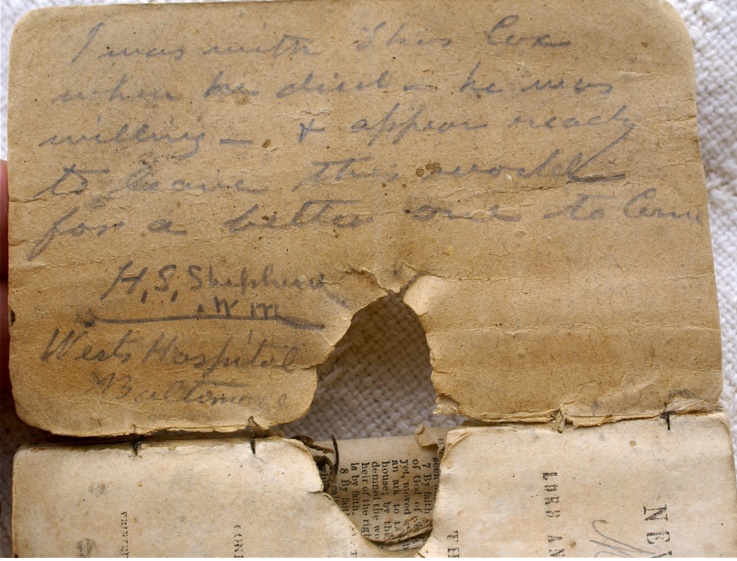
Cox asked a fellow prisoner at the squalid West Building’s Hospital in Baltimore to inscribe a message in his battered Bible.

“The ball that struck this book entered my left brest (sic) and came out of right – it saved instant death & will be the means of saving my soul. Thomas Cox,” reads the penciled writing on the margins of a few pages. On succeeding pages is written: “Blessed are the dead that die in the Lord.”

(Monocacy National Battlefield)
In 2015, the park purchased the New Testament for $12,500 from brokers Perry Adams Antiques in Petersburg, Va. Attempts to find a Cox descendant have been unsuccessful, Evans told the Picket.

The park said the Bible is among the few items in its collection to have known Confederate provenance.

Cox said a conservationist examined the Bible and said it was best to keep it as is.

“It is a unique item,” she said. “I think people are interested in it because it has entries in it.”

Sunday, October 2, 2016

Monocacy learns more about fallen Rebel soldier and the Bible that took a bullet

(Courtesy of Perry Adams Antiques)

Park rangers at Monocacy National Battlefield have seen success and setbacks in their bid to learn more about the life and death of a Confederate soldier wounded when a bullet passed through his Bible and went through his chest.

Pvt. Thomas Cox, a member of the Red House Volunteers, Company A, 21st Virginia Infantry, was wounded and captured on July 9, 1864, at the battlefield near Frederick, Md. The 33-year-old farmer from Carroll County died on Aug. 15, 1864, at a Baltimore hospital.

A park intern conducting research this past summer learned that Baltimore hospital records had been damaged or destroyed, possibly in a fire, curator Tracy Evans told the Picket.

What is known about Cox’ final weeks was that he asked a fellow prisoner at the squalid West Building’s Hospital to inscribe a message in his battered Bible.

“The ball that struck this book entered my left brest (sic) and came out of right – it saved instant death & will be the means of saving my soul. Thomas Cox,” reads the penciled writing on the margins of a few pages. On succeeding pages is written: “Blessed are the dead that die in the Lord.”

In 2015, the park purchased the New Testament from $12,500 for brokers in Petersburg, Va.

The park intern learned that Cox and his wife had two children before the war and one on the way when he enlisted in 1861. The soldier was able to return to his farm several times during the war and fathered two more children. He recuperated from two illnesses at home while on medical leave.

(Courtesy of Perry Adams Antiques)

The 21st Virginia had seen considerable action, including at Gettysburg, before the fight at Monocacy.

“After the men forded the Monocacy River, they formed up in battle line and assaulted the Union line. 5 According to Sgt. John Worsham, the men in the 21st tore down a fence railing and with the years of hardened experience behind them, rushed forward in a charge against Union positions without orders from their officers. Somewhere in this rush and exchanging volleys of fire, Private Cox was struck by a bullet,” intern Chris Sniezek and ranger Kelly Henderson wrote.

Cox died five weeks later of infection and was buried in Baltimore, where he remains buried.

Evans said the research led to emails to potential descendants, but officials have not heard back. They did learn from research of a relative in the Confederate unit that Cox’ widow remarried and was believed to have additional children.

The bullet-struck Bible is remarkable in its own way. There’s a gaping hole in the center of the book. “We are thinking it must have gone in sideways,” said Evans, adding that is perhaps the reason Cox was not killed outright.

Officials want to display the Bible next year, but they know it likely can hold up only to certain lighting conditions, and perhaps for brief periods of exposure. They are looking for more information on Cox and other soldiers whose names and information were written on the Bible’s pages. There is no known photo of the soldier.

“The Bible itself has been given an initial condition assessment and will likely go for light preservation next year with recommendations on how it should be put on display and for how long,” said Evans. “We would also like to have a better analysis done of possible blood on the Bible.” She cautioned there is no evidence of blood, but officials are curious as to whether small traces remain on the pages.

(Perry Adams Antiques)

Conservation experts at the National Park Service’s Harpers Ferry Center also will give advice on mounting of the Bible and whether it should be displayed opened or closed.

In an article prepared for an upcoming issue of Civil War News, the park researchers also delved into the story of the Bible’s publication. This one was published in 1862 by Wood, Hanletter, Rice and Company of Atlanta.

“Prior to the Civil War, Bibles were mostly printed and distributed by the American Bible Society based in New York. When the war broke out, the American Bible Society decided to continue distributing Bibles to Confederate soldiers, but a Union blockade soon left the South in a severe shortage. Faced with this shortage, the Confederate States Bible Society was established to print and distribute new Confederate Bibles.”

The dying Cox got the writing assistance from Pvt. H.S. Shepherd, a Confederate who was captured at Gettysburg in July 1863 and assisted sick comrades while serving as a ward master at the Baltimore hospital.

“I was with Thos. Cox when he died,” Shepherd wrote in the Bible. “He was willing … & appear ready to leave this world for a better one to come."

Another inscription indicates Cox asked that his ring be sent to his widow, Frances.

Friday, April 1, 2016

'Saving my soul': Bullet-struck Bible's poignant story will be told at Monocacy battlefield

(Courtesy of Perry Adams Antiques)

On a hot summer day in 1864, Pvt. Thomas Cox, hospitalized in Baltimore, Maryland, with a grievous chest wound, asked a fellow prisoner to inscribe a message in his battered Bible.

“The ball that struck this book entered my left brest (sic) and came out of right – it saved instant death & will be the means of saving my soul. Thomas Cox,” reads the penciled writing on the margins of a few pages. On succeeding pages is written: “Blessed are the dead that die in the Lord.”

Cox, a member of the Red House Volunteers, Company A, 21st Virginia Infantry, would not live to return home to his family.

Cox, 33, died on or about Aug. 15, 1864, and was buried in Baltimore, home to the gloomy and unventilated hospital where he languished after suffering the wound five weeks earlier at the Battle of Monocacy near Frederick, Md.

The rare, bullet-struck Bible that belonged to the Confederate soldier is now at Monocacy National Battlefield, where officials have big plans to eventually display it in a special exhibit. (The site last month displayed the artifact for a day.)

(Perry Adams Antiques)

“We overwhelmingly have Union artifacts. We would like to have a more balanced nature to our artifacts,” said Tracy Evans, acting chief of education and visitor services at the National Park Service site. “It is a very personal artifact and belonged to a man who sacrificed his life fighting for his company here. We want to do it justice.”

Before then, Evans plans to conduct extensive genealogical research about Cox (or Cock or Cocke, according to various regimental and other spellings), the hospital and the 21st Virginia.

The NPS last summer purchased the Bible for $12,500 from brokers in Petersburg, Virginia.

Monocacy got a tip from Emmanuel Dabney, a curator with Petersburg National Battlefield, who saw the “unique” item advertised online by Perry Adams Antiques.

“There are many Bibles that belonged to soldiers but there was only one of this particular soldier,” Dabney told the Picket. “This one has been struck by a bullet on a field that the nation has preserved at Monocacy National Battlefield. This man believed that he would be preserved on Earth and took the time to write that in his Bible, only to not survive in the end. To me it exemplified the concern with the ‘Good Death’ by so many soldiers in Union and Confederate armies who were Christian as they went to war.”

Binding shows damage from bullet
(Courtesy of Perry Adams Antiques)

Officials currently know very little about Cox. The cover of the Confederate Bible, which was printed in Atlanta in 1862, indicates he was from Morris Church, in southwest Virginia’s Carroll County. He is believed to have enlisted in June or July 1861.

The 21st Virginia counted Jackson, Lee and Early among its commanders, and saw action in many engagements, including Cold Harbor, Chancellorsville, Cedar Mountain and Seven Days’.

Cox was wounded and captured on July 9, 1864, at Monocacy Junction, where his unit served under Brig. Gen. William Terry.

Lt. Gen. Jubal A. Early’s Confederates were menacing Washington, D.C., and were met at Monocacy by a makeshift Union force led by Maj. Gen. Lewis Wallace. Early prevailed over stiff resistance, but Grant rushed Federal troops to the capital’s defense.

According to an NPS battle summary: “Wallace’s defeat at Monocacy bought time for these veteran troops to arrive to bolster the defenses of Washington. Early’s advance reached the outskirts of Washington on the afternoon of July 11, and the remaining divisions of the VI Corps began disembarking that evening. Monocacy was called the ‘Battle that Saved Washington.’”

Evans said she has not opened the fragile New Testament since the purchase. The item will need care from a conservator before it is permanently displayed.

Perry Adams photos show a gaping hole in the center of the book.

“We are thinking it must have gone in sideways,” said Evans, adding that is perhaps the reason Cox was not killed outright.

(Photos courtesy of  Joe Canner)

The soldier presumably died from his Monocacy wound. Another prisoner who was treated at West Building’s Hospital, located near a Baltimore dock, described it as unhygienic, with poor food and water.

Cox got the writing assistance from Pvt. H.S. Shepherd, a Confederate who was captured at Gettysburg in July 1863 and assisted sick comrades while serving as a ward master at the Baltimore hospital.

“I was with Thos. Cox when he died,” Shepherd wrote in the Bible. “He was willing … & appear ready to leave this world for a better one to come."

Another inscription indicates Cox asked that his ring be sent to his wife in Virginia. The soldier was buried at Loudon Park Cemetery in Baltimore. A Sons of Confederate Veterans chapter in recent years raised money for new gravestones, replacing a Cox marker that had become unreadable.

Interestingly, Shepherd by early 1865 had taken an oath of allegiance to the United States, saying he had become “heartily disgusted with the Confederacy.” President Abraham Lincoln approved the request.

Ben Greenbaum, co-owner of Perry Adams Antiques, said his firm brokered the Bible for a reputable collector.

“We had it for about a year or two and took it to a number of shows,” he said.

Greenbaum said there are multiple elements that made the Bible and its poignant messages attractive to buyers.

“Not only could you make conclusions from the shape of the hole in the Bible, this was a Confederate imprint, which is rare … in addition, there were all the annotations and the period writing.”

The appraiser said bullet-struck items always have an appeal. But he noted that buyers should be cautious. “When you get into certain hard items, buckles or buttons, they can be forged or faked.”

Greenbaum said, “I absolutely had no concern whatsoever” about the Cox Bible’s authenticity.

(Courtesy of Perry Adams Antiques)

Evans, with Monocacy National Battlefield, said the park did its due diligence. She asked a few experts to take a look at the artifact.

“Normally, it is hard to get quality artifacts at a premium like that,” she said. “Everything came together that we had the funding to be able to purchase it. It is the first Confederate-identified artifact we have.”

The Bible is believed to have been in the family for many years before it was sold to an individual in 1995.

Evans said the Monocacy museum needs a revamp and she hopes the Cox Bible will be the centerpiece of an exhibit, perhaps to open in mid-2017.

Petersburg’s Dabney, who engineered the acquisition by Monocacy, said it is “extremely rare” for Confederate objects to turn up, given so many have been donated to museums, historical societies or university research libraries.

“This Bible can connect with people who can view it in an exhibition and then go see where Cocke was wounded and captured,” he said.