Showing posts with label journal. Show all posts

Tuesday, May 23, 2023

Sinking of the Sultana: Will journal and Bible belonging to Ohio soldier John Clark Ely, victim of the disaster, go to a museum?

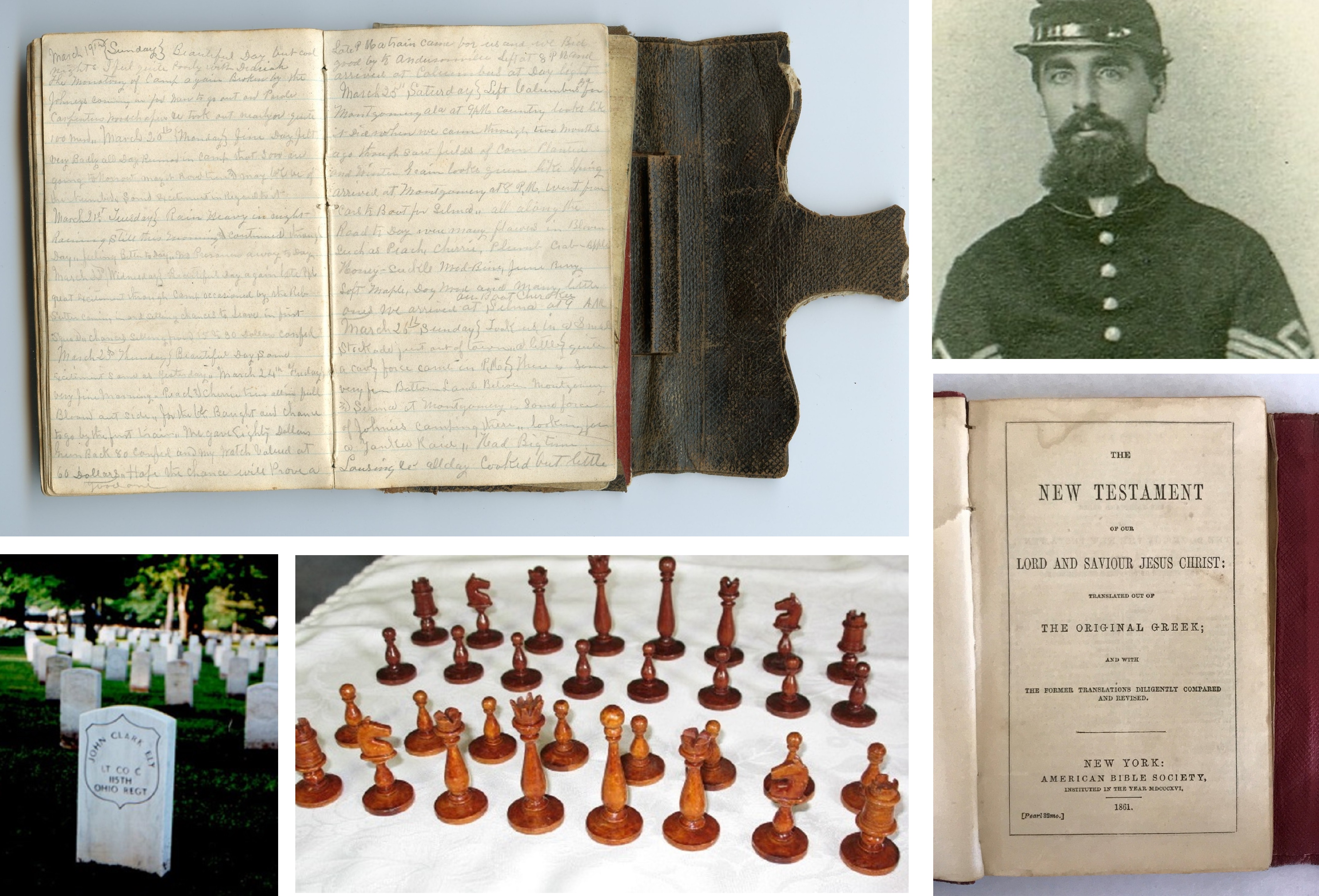
(Clockwise from top left: Pages from journal, Sgt. John Clark Ely, his Bible, chess set pieces,
and his grave in Memphis. (Photos courtesy of John M. Ely, David C. Ely and Jerry O. Potter)
Sgt. John Clark Ely of Ohio left behind a brokenhearted family when he perished in the Sultana disaster on the Mississippi River. He is emblematic of the heartbreaking stories of former Civil War prisoners who died when they were just days away from home.

Beyond stories about Ely, there are tangible reminders of his life.

John M. Ely of the Aspen, Colo., area, has his great-great-grandfather’s two chess sets and a journal (below) that survived the sinking of the steamboat on April 27, 1865, above Memphis, claiming 1,200 lives. The journal is believed to be the only one describing the days leading up to the tragedy.

John M. Ely’s second cousin, David Clark Ely of Placerville, Calif., has a Bible bestowed upon his ancestor before he went off to war.

The two men and David’s sister, Sharon Ely Pearson, are open to the idea of the heirlooms being available to the public through an exhibit or the like.

“I wish we had those items for the museum,” says Sultana expert and author Jerry O. Potter.

By museum, Potter means the Sultana Disaster Museum across from Memphis in Marion, Ark. Supporters are raising the last of the dollars and pledges needed to build a larger and permanent venue at an old high school gymnasium.

Marion was the closest town to the disaster and residents helped rescue those thrown into the river after the fire and explosion on the Sultana.

The tiny current museum in Marion, Ark. A new location is in the works.
Officials say it’s important that the little-known story of greed, fraud, valor and sacrifice be told in a bigger way than what’s covered in a tiny museum that opened in 2015.

While the journal has been excerpted in some form for years, the whereabouts of the Bible weren’t known to Potter and Gene Salecker, another renowned Sultana author.

“I have never heard of the Ely Bible, so this is something new to me,” Salecker, author of Destruction of the Steamboat Sultana,” told the Picket in an email.

I made the story of the Bible known to the museum supporters after contacting David C. Ely, who I spoke to several years ago, and John M. Ely, who I tracked down a couple months back. The Picket has written numerous articles about the Sultana and Ely, and I wanted to update readers on all the items known to be associated with him. (David C. Ely and John M. Ely have not been in touch with each other or the Marion museum.)

Sgt. Ely, 37, of Company C, 115th Ohio Volunteer Infantry, was jammed on the overcrowded steamboat with hundreds of other recently released Union prisoners. (He is at left in the photo, next to Company C comrade Sgt. Charles W. Way, who also died on the Sultana.

The Ohio schoolteacher, who was supposed to get a promotion to lieutenant at the end of the war, had been captured by Confederate forces under Nathan Bedford Forrest on Dec. 5, 1864, near LaVergne, Tenn.

Ely (pronounced ee-lee) spent time in a few prisons, most notably Andersonville, before he was paroled at war’s end near Vicksburg, Ms.

“He is my hero,” Potter, author of The Sultana Tragedy: America’s Greatest Maritime Disaster,” told the Picket in April. “I guess I know more about Lt. Ely than just about any other soldier on the Sultana. In reading his diary, I was able to see things through his eyes and to learn of his hopes and dreams.”

Several years ago, Potter told the Picket: “While we have many accounts written later, his is the only one that we have that gives a day-to-day account leading up to the disaster. Plus, he is one of the few buried at the (Memphis) national cemetery with a headstone with his name. Finally, he became my hero who through his own words I got to know him.”

In his journal (the only one of two belonging him to survive), Ely writes about his service, family, capture and time in prison.

On Dec. 25, 1864, Ely wrote,
“Such a day for us prisoners. Hungry, dirty, sleepy and lousy. Will another Christmas find us again among friends and loved ones?”


The soldier, born in Franklinville, N.Y., moved with his family as a child to the Cleveland area. The 1850 census shows Seth and Laura Ely and their children living in Cuyahoga County. John Clark was 21.

In the 1860 count (above, click to enlarge), Ely is described as a farmer living with his wife, Julia, and two children in Stow township in the same county.

Ely married Julia Richmond (right) in 1856; after his death, she received a pension and moved to Norwalk, Ct., where she died at age 42 in August 1873.

Sharon Pearson told me in 2015 that Julia moved to Norwalk to be closer to her husband’s family and she is buried in Union Cemetery.

“She lived in Danbury, CT, with several of the other female members of the family who were widowed or ‘spinsters.’" 

The journal, chess pieces and Bible eventually went to the fathers of the cousins. John M. Ely’s father, Norman, had the journal and chess sets, while the small Bible went to Norman’s cousin, Clifford Seth Ely Jr., father of David and Sharon.

Julia Richmond Ely's application for a Federal pension (click to enlarge)
Norman Ely told the Picket in 2012 that the cousins and their wives traveled to a reunion of Sultana descendants. They visited Andersonville in Georgia. (Andersonville National Historic Site has a transcript of Ely's journal made by Norman)

Norman Ely's mother had told him about the small diary, which captures the soldier's despair, anguish, privations -- and hope. (Norman Ely, of Glenwood Springs, Colo., died in March 2013.)

Clifford Ely, a businessman in Norwalk, told the Picket in 2012 he was touched by his ancestor's time at Andersonville. "There was a lot of sickness around. Other people stole things from him. It was just a sad thing, day by day. People tried to escape, (but) he never did."

"He had all the great hopes. He couldn't wait to get home," said Clifford Ely. "When he got on the steamboat, he kept writing to her (Julia)." (Clifford died in October 2013.)

David Clark Ely, 64, and retired from the U.S. Coast Guard, says he wonders how the Bible survived.

“Did he leave this behind with his wife or did he take it into the Army? Did he carry it with him? At one point, it was it separated from him.”

New Testament given to John C. Ely in summer 1862 (David C. Ely)
Ely sent the Picket several photos of the Bible he pulled out from a box. One of the pages is missing, he said. A yellowed page (above) says the Bible was presented to John Clark Ely “upon the event of his going to the war in Aug. 1862.” David said he does not know the Bible's history.

Another line appeared to David and I to read the volume was from “the Church at Stone.” The last word was hard to decipher so I started checking around the internet. My query on a Facebook page for Andersonville descendants led me to learn it was “Stow” in Ohio, where the Elys were living.

The city of Stow has a page about its history, saying eight soldiers from the area were onboard the Sultana and four perished. The Picket reached out to a local historical society for more information but received no reply.

John M. Ely (left), the county attorney in Pitkin County, Colo., confesses he did not pay much attention to John Clark Ely’s story while growing up. “Why did I not listen?”

He saw the chess sets as a child and as he got older he began to express interest in filling in the gaps of what he knew.

Ely wonders why the soldier and others like him would leave spouses and children to go to combat. “To me it is a continual fascination and wonderment about this guy. What was he thinking?”

The attorney has visited Julia’s grave in Connecticut and a few years after his father passed, he and his children stopped by Memphis to see John Clark Ely’s grave.

Like David Ely, John M. Ely isn’t certain how the items survived being thrown into the river. It’s possible, with the exception of the journal, they were kept at the sergeant’s home in Stow. As for the diary, perhaps it was found among the debris in the Mississippi or its banks.

John M. Ely told the Picket he never played with the chess sets. “It seems fragile and I have never messed with them.”

He is mulling what will become of them and the journal.

If he does not give them to his children, Ely says he would be interested in an organization, foundation or museum having them so that they could care for the heirlooms and exhibit them.

His cousins have not discussed donating the Bible (right), but after talking with the Picket, David says they might be interested in seeing it exhibited as part of a larger narrative.

There is a story with it,” he says.

Time will tell whether the items will one day be displayed in Marion, telling one part of the Sultana’s compelling story.

No one was formally held accountable for putting too many men on the steamboat, despite documented concerns about the safety of one of the boat's boilers. Accounts of the tragedy were overshadowed by headlines about the assassination of President Abraham Lincoln.

Potter and Salecker have written about a kickback scheme between the vessel's financially strapped captain and an Army quartermaster, Lt. Col. Reuben B. Hatch. According to Potter, the transport fee was $5 for an enlisted man, $10 for an officer. Capt. J. Cass Mason agreed to take the enlisted men for $3; Hatch kept the $2.

But John Clark Ely knew nothing about that.

Three days before he died, their great-great grandfather was looking forward to being home. He wrote of a sunny day and boarding the Sultana in Vicksburg.

Mere hours before the explosion, John Clark Ely wrote simply: “Very fine day, still upward we go.”

Additional pages from the Sgt. Ely's journal (Courtesy of John M. Ely)
Previous Sultana coverage:

Thursday, September 17, 2015

Writings show the emotional toll of war

The journals of a Civil War veteran have been rediscovered and are the basis of an exhibit at the Pritzker Military Museum and Library in Chicago.  Erasmus Corwin Gilbreath gave vivid accounts of his service in the 20th Indiana Volunteer Regiment. Said a museum official: “He was kind of like a Forrest Gump of 19th century American history, quite frankly, the things that he saw, the people that he met, you could very easily make a play or movie out of these journals.• Article

Wednesday, April 8, 2015

Journal of Sgt. John Clark Ely: Prisoner rejoices over Lee's surrender to Grant

Journal courtesy of Norman Ely

Over the next week at the parole camp in Mississippi, John Clark Ely increasingly mentions his wife, Julia Richmond Ely, who was from Euclid, Ohio. They were married in 1856 and became parents to three daughters and a son. Julia died in 1873 at age 43. Ely, a sergeant with the 115th Ohio Volunteer Infantry, has a lot of good news that trumps rainy conditions. Journal entries are courtesy of Andersonville National Historic Site.

April 8, 1865 (Saturday)
Very cold and cloudy all night and this morning, feeling quite unwell, cold all day, wrote Julia.

April 9, 1865 (Sunday)
Rain in night and this morning, feeling some better this morning, quite a number of ladies out yesterday p.m. from town.  Looks like being among humans again. War news good, cloudy and rain all day.  Clothing was issued to company today.

Sgt. Ely
April 10, 1865 (Monday)
Cloudy, foggy, rainy, muddy and disagreable.  Tracy went today and will probably go up river this p.m.

April 11, 1865 (Tuesday)
Clear cool wind, cloudy p.m., usual routine in camp

April 12, 1865 (Wednesday)
Raining this morning, feeling pretty well, rainy all day, heavy p.m. and evening.

April 13, 1865 (Thursday)
Cool wind, cloudy and lowrey, no very important doing, a few men exchanged most every day.  Oh! How I wish I could hear from Julia, it seems as if it would do me more good than anything else.  Went our with Boody and got some sweet river roots for pipes.  Heavy cannonading in Vicksburg, tis reported that Lee has surrendered and that Mobile is taken.  Wrote Julia p.m.  Was news glorious, Lee has caved to Grant, bully, bully, glorious bully, if any man can save the union, why General Grant is the man, rumored that Johnson has also surrendered to Sherman, if this be ture, the confederacy is most certainly pretty nearly played out for this time, bully news bully.

April 14, 1865 (Friday).
Today Maj. Anderson again raises the same old flag again over Sumpter and today the North rejoice over their victories and today came an order from General Daney (Dana) for us to be paroled and sent North.  Bully, may we soon see our sweethearts.  P.M. tis rumored that General Forrest is negotiating to surrender his command. Hope tis true.

Wednesday, March 4, 2015

Journal of Sgt. John Clark Ely: Prison brew and Lincoln's 2nd inauguration

Confederates buying beer at prison Point Lookout (Library of Congress)

Those Andersonville prisoners industrious enough to scrape up a little money or some form of barter could avail themselves of all kinds of goods and services inside the stockade – from green corn to a haircut.

They also could imbibe on beer, although, understandably, it was not premium stuff. Some referred to it as sour. Prisoner Robert Knox Sneden wrote of the crowds on busy and noisy Market Street.

“Hundreds are yelling all day, ‘Here’s your fine cold beer; coldest in the stockade for only 5 cents a cup,’ or, ‘Who’ll swap beans for soup?’ or ‘Who’ll give a chew of tobacco for half a raw ration?’ ” he wrote.

Ohio Sgt. John Clark Ely, 150 years ago this month, made a reference in his journal to beer at Andersonville.

Sale of the suds wasn’t just about Union POW entrepreneurship. Capt. Henry Wirz, camp commandant, began the brewing of "corn beer" at the urging of his medical staff.

The concoction was given to those suffering from scurvy. The beer was made from cornmeal and whole corn scalded in hot water until it turned to mash. Some yeast was added to promote fermentation, and in a few days a sharp acid beverage was produced, according to the National Park Service.

Pvt. W.F Lyon, of the 96th Regular Massachusetts Volunteers, 40 years later wrote a book about his Andersonville experiences.

“We had a great many breweries in the prison — in fact, there were a whole lot of breweries and saloon combined, for each one sold his own product,” he wrote, according to a 2013 Washington Post article about the prison. As soon as the mixture of cornmeal and sassafras root fermented, “the proprietor would go out on the street, find a stand, seat himself behind the tub of beer and cry, ‘Who wants a glass of this nice sassafras beer; only 10 cents a glass?’ ”

Here is this week’s installment of the journal of Sgt. Ely of Company C, 115th Ohio Infantry. Entries are courtesy of Andersonville National Historic Site.

March 4, 1865 (Saturday)
Big rain early this morning, feeling pretty bad today.  Old Abe Lincoln inaugeration at Washington, maybe in a few months see the end of this war.

March 5, 1865 (Sunday)
Fine day, feeling quite sick, good news relative to exchange.  Received note from Eadie.  Three months 1 day since our capture.

March 6, 1865 (Monday)
cloudy, hazy day.  Wrote note to Eadie.

March 7, 1865 (Tuesday)
Beautiful day, feeling some better.

March 8, 1865 (Wednesday)
Rainy morning, had a sick night, pleasant p.m., all division sergeants out at headquarters receiving instructions about beer for camp.

March 9, 1865 (Thursday)
Cloudy morning, some rain a.m., very heavy p.m.

March 10, 1865 (Friday).
Clear cool morning, felt no better.

Wednesday, February 18, 2015

Journal of POW Sgt. John Clark Ely: 'Scalloway' steals his clothing, food rations


Sgt. John Clark Ely of Company C, 115th Ohio Infantry, was captured in Tennessee in late 1864. Following his transfer from Confederate prison camps in Mississippi and Alabama, Ely was imprisoned at infamous Camp Sumter in Georgia. His journal entries are courtesy of Andersonville National Historic Site. (By "scalloway," Ely probably meant "scalawag.")

Feb. 18, 1865 (Saturday)
Beautiful morning and day. P.M. some 800 prisoners came in, were the sick left at Meridian, captured of Hood.

Feb. 19, 1865 (Sunday)
Slight frost, fine morning, some rumors of exchange. 9th Division drew cooked rations again.

Feb. 20, 1865 (Monday)
Fine day.

Feb. 21, 1865 (Tuesday)
Lowery in morning, pleasant p.m. Wrote note to Lt. Eadie.

Feb. 22, 1865 (Wednesday)
Washington birthday. How different from where I was a year ago, some scalloway opened our tent at bottom and stole from me one shirt, one pair drawers, one () and haversack with 4 days rations meal.

Feb. 23, 1865 (Thursday)
Slight shower in night, many rumors of exchange in rebel papers yesterday. Drew more cooking vessels p.m. division sergeants sent communication to Capt. Wirtz relative to changing quarters, refused.

Feb. 24, 1865 (Friday)
Rainy night, showery day with some thunder.

Wednesday, February 11, 2015

Journal of POW Sgt. John Clark Ely: "Johnnys are getting very much alarmed"

Thomas O'Dea drawing of cooking rations (ANHS)

In February 1865, one year after it began operations, Camp Sumter, Ga., had about 5,100 prisoners, well below its high the summer before. Halfway through February, though, about 700 prisoners are moved to the stockade from Meridian, Ms. 
  
Sgt. John Clark Ely of Company C, 115th Ohio Infantry, captured in Tennessee, by then had been at the camp for about three weeks, following his transfer from Confederate prison camps in Mississippi and Alabama. His journal entries are courtesy of Andersonville National Historic Site.

Feb. 11, 1865 (Saturday)
Fine morning and day, white frost, seems like April at home. J.S. Cook went out on parole work at his trade. Some reb came in and preached. Johnnys commenced putting up sheds.

Feb. 12, 1865 (Sunday)
Again a fine day, news that Sherman has taken Branchville near Charleston, may it be true.  Feel much depressed in feeling today, anxiety of home weighs heavy.

Feb. 13, 1865 (Monday)
Pleasant, cool East wind. Johnnys are getting very much alarmed on our account, fearful that we may break out, took out the wood squad and searched them before letting them go for wood.  Sent in the men from the bakery and took some one armed men. Brought in raw rations and very small cooking utensils.

Feb. 14, 1865 (Tuesday)
Rainy morning, cold rain all day and such rations for prisoners and so abundant.

Feb. 15, 1865 (Wednesday)
Rainy all night, cloudy and misty this morning, cleared up a.m., some rumors.

Feb. 16, 1865 (Thursday)
Fine morning and day. Many rumors in camp.

Feb. 17, 1865 (Friday)
Beautiful day, very high wind, sand blew very bad. Some prisoners brought in from Macon, they being exchange rumors big.

Wednesday, January 28, 2015

Journal of prisoner Sgt. John Clark Ely

(Courtesy of Norman Ely)
Sgt. John Clark Ely and 200 comrades in Company C, 115th Ohio Infantry were captured by Nathan Bedford Forrest’s forces on Dec. 5, 1864, near La Vergne, Tenn. After a couple weeks at a holding facility in Meridian, Miss., Ely, a schoolteacher with a family, was transported to Confederate Camp Sumter in middle Georgia on Jan. 23, 1865.

Ely kept two journals of his wartime experiences, one of which survived. The passages by the soldier, who enlisted in 1862, cover everything from food and horrible conditions to rumors of possible prisoner exchange.

The Civil War Picket is picking up his story after his arrival at Camp Sumter, and once a week will post his daily entries. The transcript is courtesy of Andersonville National Historic Site.

Jan. 28, 1865 (Saturday)
Fine morning, finished chimney, over to hospital 4 men died, bunk fell on them, pretty hard place.

Jan. 29, 1865 (Sunday)
Cloudy, not as cold, again rumors of an exchange, tis most probable a move of us to some other prison. F.H. said our officers came up and were sent on to Merritus where officers were kept

Jan. 30, 1865 (Monday)
Fine morning, white frost, not as cold as usual. Received note from Lt. Eadie, sent note to Capt. Wirz to see Eadie, received no answer.

Jan. 31, 1865 (Tuesday)
Fine morning, sent note to Eadie and again to see him, received no reply, tis reported that old Rosa occupiesMeridian. Hope it may be true.

(Courtesy of Norman Ely)

Feb. 1, 1865 (Wednesday)
Fine morning, all goes on as usual, same routine each day. P.M. 155 prisoners came in from Macon and were put in my division, making 3 hundred. News that the exchange is now put in Grant hands.

Feb. 2, 1865 (Thursday)
Lowery morning and looks like rain. Received note from Eadie.

Feb. 3, 1865 (Friday)

Rained a little in night, very cloudy this morning a little rain. P.M. all rain, man in stocks for not coming in with wood squad.