Showing posts with label john clark ely. Show all posts

Tuesday, May 23, 2023

Sinking of the Sultana: Will journal and Bible belonging to Ohio soldier John Clark Ely, victim of the disaster, go to a museum?

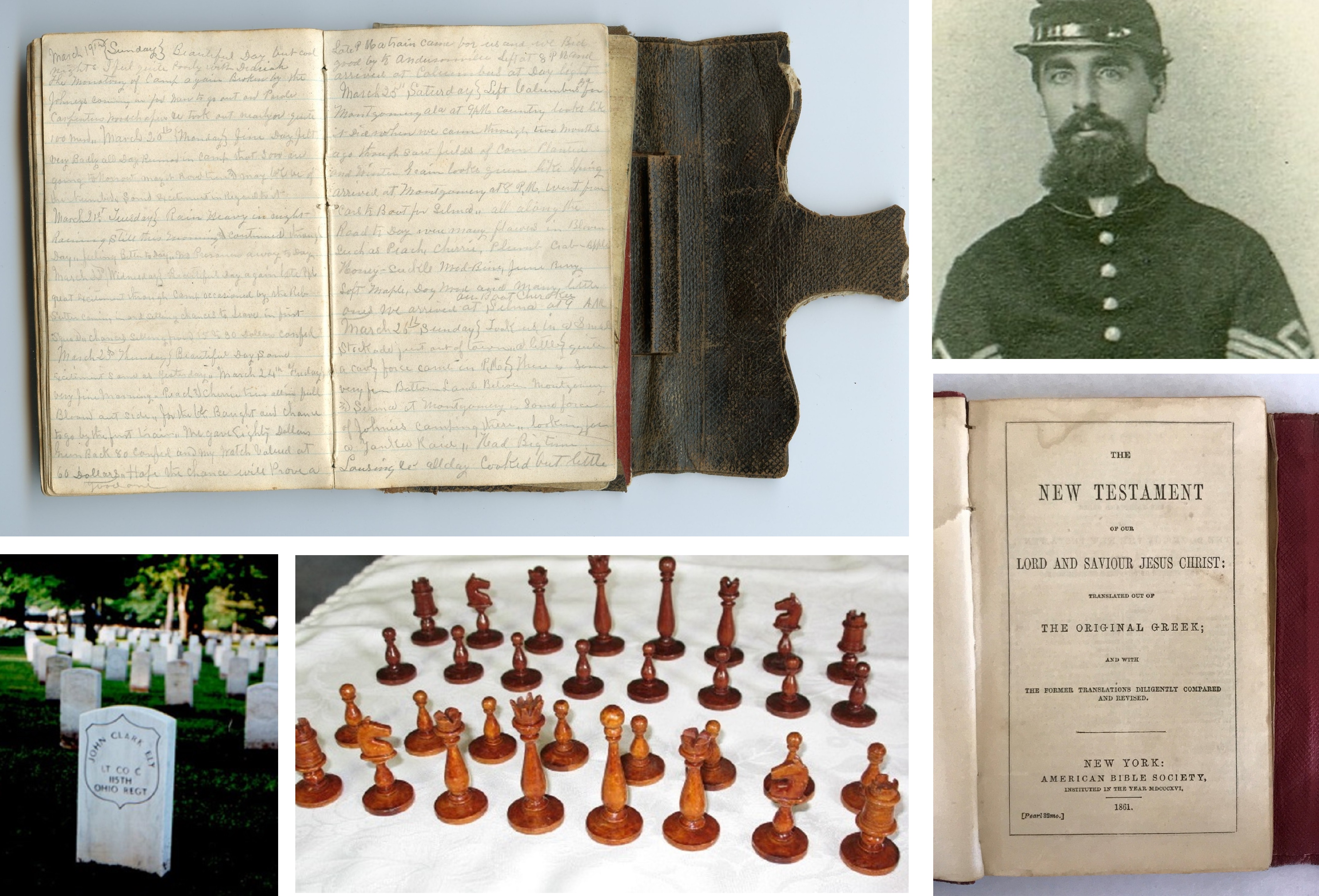
(Clockwise from top left: Pages from journal, Sgt. John Clark Ely, his Bible, chess set pieces,
and his grave in Memphis. (Photos courtesy of John M. Ely, David C. Ely and Jerry O. Potter)
Sgt. John Clark Ely of Ohio left behind a brokenhearted family when he perished in the Sultana disaster on the Mississippi River. He is emblematic of the heartbreaking stories of former Civil War prisoners who died when they were just days away from home.

Beyond stories about Ely, there are tangible reminders of his life.

John M. Ely of the Aspen, Colo., area, has his great-great-grandfather’s two chess sets and a journal (below) that survived the sinking of the steamboat on April 27, 1865, above Memphis, claiming 1,200 lives. The journal is believed to be the only one describing the days leading up to the tragedy.

John M. Ely’s second cousin, David Clark Ely of Placerville, Calif., has a Bible bestowed upon his ancestor before he went off to war.

The two men and David’s sister, Sharon Ely Pearson, are open to the idea of the heirlooms being available to the public through an exhibit or the like.

“I wish we had those items for the museum,” says Sultana expert and author Jerry O. Potter.

By museum, Potter means the Sultana Disaster Museum across from Memphis in Marion, Ark. Supporters are raising the last of the dollars and pledges needed to build a larger and permanent venue at an old high school gymnasium.

Marion was the closest town to the disaster and residents helped rescue those thrown into the river after the fire and explosion on the Sultana.

The tiny current museum in Marion, Ark. A new location is in the works.
Officials say it’s important that the little-known story of greed, fraud, valor and sacrifice be told in a bigger way than what’s covered in a tiny museum that opened in 2015.

While the journal has been excerpted in some form for years, the whereabouts of the Bible weren’t known to Potter and Gene Salecker, another renowned Sultana author.

“I have never heard of the Ely Bible, so this is something new to me,” Salecker, author of Destruction of the Steamboat Sultana,” told the Picket in an email.

I made the story of the Bible known to the museum supporters after contacting David C. Ely, who I spoke to several years ago, and John M. Ely, who I tracked down a couple months back. The Picket has written numerous articles about the Sultana and Ely, and I wanted to update readers on all the items known to be associated with him. (David C. Ely and John M. Ely have not been in touch with each other or the Marion museum.)

Sgt. Ely, 37, of Company C, 115th Ohio Volunteer Infantry, was jammed on the overcrowded steamboat with hundreds of other recently released Union prisoners. (He is at left in the photo, next to Company C comrade Sgt. Charles W. Way, who also died on the Sultana.

The Ohio schoolteacher, who was supposed to get a promotion to lieutenant at the end of the war, had been captured by Confederate forces under Nathan Bedford Forrest on Dec. 5, 1864, near LaVergne, Tenn.

Ely (pronounced ee-lee) spent time in a few prisons, most notably Andersonville, before he was paroled at war’s end near Vicksburg, Ms.

“He is my hero,” Potter, author of The Sultana Tragedy: America’s Greatest Maritime Disaster,” told the Picket in April. “I guess I know more about Lt. Ely than just about any other soldier on the Sultana. In reading his diary, I was able to see things through his eyes and to learn of his hopes and dreams.”

Several years ago, Potter told the Picket: “While we have many accounts written later, his is the only one that we have that gives a day-to-day account leading up to the disaster. Plus, he is one of the few buried at the (Memphis) national cemetery with a headstone with his name. Finally, he became my hero who through his own words I got to know him.”

In his journal (the only one of two belonging him to survive), Ely writes about his service, family, capture and time in prison.

On Dec. 25, 1864, Ely wrote,
“Such a day for us prisoners. Hungry, dirty, sleepy and lousy. Will another Christmas find us again among friends and loved ones?”


The soldier, born in Franklinville, N.Y., moved with his family as a child to the Cleveland area. The 1850 census shows Seth and Laura Ely and their children living in Cuyahoga County. John Clark was 21.

In the 1860 count (above, click to enlarge), Ely is described as a farmer living with his wife, Julia, and two children in Stow township in the same county.

Ely married Julia Richmond (right) in 1856; after his death, she received a pension and moved to Norwalk, Ct., where she died at age 42 in August 1873.

Sharon Pearson told me in 2015 that Julia moved to Norwalk to be closer to her husband’s family and she is buried in Union Cemetery.

“She lived in Danbury, CT, with several of the other female members of the family who were widowed or ‘spinsters.’" 

The journal, chess pieces and Bible eventually went to the fathers of the cousins. John M. Ely’s father, Norman, had the journal and chess sets, while the small Bible went to Norman’s cousin, Clifford Seth Ely Jr., father of David and Sharon.

Julia Richmond Ely's application for a Federal pension (click to enlarge)
Norman Ely told the Picket in 2012 that the cousins and their wives traveled to a reunion of Sultana descendants. They visited Andersonville in Georgia. (Andersonville National Historic Site has a transcript of Ely's journal made by Norman)

Norman Ely's mother had told him about the small diary, which captures the soldier's despair, anguish, privations -- and hope. (Norman Ely, of Glenwood Springs, Colo., died in March 2013.)

Clifford Ely, a businessman in Norwalk, told the Picket in 2012 he was touched by his ancestor's time at Andersonville. "There was a lot of sickness around. Other people stole things from him. It was just a sad thing, day by day. People tried to escape, (but) he never did."

"He had all the great hopes. He couldn't wait to get home," said Clifford Ely. "When he got on the steamboat, he kept writing to her (Julia)." (Clifford died in October 2013.)

David Clark Ely, 64, and retired from the U.S. Coast Guard, says he wonders how the Bible survived.

“Did he leave this behind with his wife or did he take it into the Army? Did he carry it with him? At one point, it was it separated from him.”

New Testament given to John C. Ely in summer 1862 (David C. Ely)
Ely sent the Picket several photos of the Bible he pulled out from a box. One of the pages is missing, he said. A yellowed page (above) says the Bible was presented to John Clark Ely “upon the event of his going to the war in Aug. 1862.” David said he does not know the Bible's history.

Another line appeared to David and I to read the volume was from “the Church at Stone.” The last word was hard to decipher so I started checking around the internet. My query on a Facebook page for Andersonville descendants led me to learn it was “Stow” in Ohio, where the Elys were living.

The city of Stow has a page about its history, saying eight soldiers from the area were onboard the Sultana and four perished. The Picket reached out to a local historical society for more information but received no reply.

John M. Ely (left), the county attorney in Pitkin County, Colo., confesses he did not pay much attention to John Clark Ely’s story while growing up. “Why did I not listen?”

He saw the chess sets as a child and as he got older he began to express interest in filling in the gaps of what he knew.

Ely wonders why the soldier and others like him would leave spouses and children to go to combat. “To me it is a continual fascination and wonderment about this guy. What was he thinking?”

The attorney has visited Julia’s grave in Connecticut and a few years after his father passed, he and his children stopped by Memphis to see John Clark Ely’s grave.

Like David Ely, John M. Ely isn’t certain how the items survived being thrown into the river. It’s possible, with the exception of the journal, they were kept at the sergeant’s home in Stow. As for the diary, perhaps it was found among the debris in the Mississippi or its banks.

John M. Ely told the Picket he never played with the chess sets. “It seems fragile and I have never messed with them.”

He is mulling what will become of them and the journal.

If he does not give them to his children, Ely says he would be interested in an organization, foundation or museum having them so that they could care for the heirlooms and exhibit them.

His cousins have not discussed donating the Bible (right), but after talking with the Picket, David says they might be interested in seeing it exhibited as part of a larger narrative.

There is a story with it,” he says.

Time will tell whether the items will one day be displayed in Marion, telling one part of the Sultana’s compelling story.

No one was formally held accountable for putting too many men on the steamboat, despite documented concerns about the safety of one of the boat's boilers. Accounts of the tragedy were overshadowed by headlines about the assassination of President Abraham Lincoln.

Potter and Salecker have written about a kickback scheme between the vessel's financially strapped captain and an Army quartermaster, Lt. Col. Reuben B. Hatch. According to Potter, the transport fee was $5 for an enlisted man, $10 for an officer. Capt. J. Cass Mason agreed to take the enlisted men for $3; Hatch kept the $2.

But John Clark Ely knew nothing about that.

Three days before he died, their great-great grandfather was looking forward to being home. He wrote of a sunny day and boarding the Sultana in Vicksburg.

Mere hours before the explosion, John Clark Ely wrote simply: “Very fine day, still upward we go.”

Additional pages from the Sgt. Ely's journal (Courtesy of John M. Ely)
Previous Sultana coverage:

Saturday, December 19, 2015

Sultana disaster: Sister and brother recall learning of Mississippi River tragedy in family's long U.S. history

(Photos courtesy of Ely family)
David Ely and Sharon Ely Pearson grew up as proud descendants of four brothers who came to the colonies only decades after the Mayflower Pilgrims landed on the shores of Massachusetts.

And while they could trace their family’s long American history to English ancestors who settled in Boston and Connecticut, it was only as young adults that they learned the full story of perhaps the most famous Ely of them all.

Sgt. John Clark Ely, an Ohio schoolteacher, was among about 1,200 passengers – most of them Union soldiers released from prison camps – to die in the April 1865 explosion and fire on the steamboat Sultana above Memphis. It was the deadliest maritime disaster in U.S. history.

What made Ely notable, according to Sultana author Jerry Potter, is that he maintained a journal that includes entries on the journey up the Mississippi River.

Sgt. John Clark Ely
To my knowledge, his diary is the only one that is in existence,” Potter recently told the Picket. “While we have many accounts written later, his is the only one that we have that gives a day-to-day account leading up to the disaster. Plus, he is one of the few buried at the (Memphis) national cemetery with a headstone with his name. Finally, he became my hero who through his own words I got to know him.”

Pearson, 60, of Norwalk, Ct.; and David Ely, 57, of Alameda, Calif.; recalled learning the details of their great-great-grandfather’s Civil War experiences.

Their late father, Clifford Seth Ely Jr., and Clifford’s cousin, Norman Ely, had some of the soldier’s belongings – including one of two journals (the other is lost) and a Bible -- and began doing research. Norman had a chess set that was carved by John Clark Ely.

Norman Ely told the Picket in 2012 that the cousins and their wives traveled to a reunion of Sultana descendants. They visited Andersonville, the notorious prison in Georgia where John Clark Ely was held shortly after his December 1864 capture in Tennessee.

Norman Ely's mother told him about the small diary, which captures the soldier's despair, anguish, privations -- and hope. Ely said he became interested in the family's genealogy later in life.

"The fact that he went through this ordeal, the fact that he died there and left four children is very sad," he said. (Norman Ely, of Glenwood Springs, Colo., passed away in March 2013.)

Pages from the diary recovered after Sultana disaster (Ely family)
Sharon Ely Pearson said she is not sure how John Clark Ely got to Ohio. He was born in Franklinville, N.Y. His widow, Julia, returned to Norwalk, where she died in 1873.

Clifford and Norman Ely pursued their interest in the Sultana while retired, and they set about writing their own memories.

Pearson was in her 20s when she heard of the diary. “My Dad didn’t share that kind of stuff.”

Pearson has since pursued an interest in genealogy and has wandered through cemeteries. “I think it’s very cool. It is not just my side. I have done (research) on my husband’s side, too. We are New Englanders.”

(Courtesy of David Ely)
David Ely, retired from the U.S. Coast Guard, has a daily reminder of John Clark Ely’s Civil War service and sacrifice. On a wall of his home is a collage of photos of men in his family. From left:

-- John Clark Ely, Civil War

-- Clark Mead Ely, John’s son

-- Clifford Mead Ely Sr., Clark’s son and a U.S. Army veteran of World War I, European campaign

-- Clifford Seth Ely Jr., David and Sharon’s father, U.S. Navy, 1943-1946, Pacific campaign. He died in October 2013.

David and Sharon did not participate in observances this year marking the 150th anniversary of the sinking of the Sultana and are not active in the descendants group. They are busy with other matters. But nearly a decade ago, David made mention of John Clark Ely during a Memorial Day observation.

“It was Memorial Day and I brought the frame and four photographs and talked about the sacrifices our service members do. Sometimes, it is not in the heat of battle that they give their lives. But in this case, it can tell a story of men who were released from prison at end of war and on the way home to families, making that journey -- how tragedy strikes.”

Quilt made by Trinette Ely
One of last things he did with his father was to visit the Gettysburg battlefield. Clifford Ely’s late wife, Trinette, made a quilt honoring those on board the Sultana.

“It is inspiring to have that connection. The Elys came over in the 1600s from England but we don’t know much about a lot of the individuals, except for John Clark,” David Ely said. “The diary and story of Sultana is a very strong connection to the Civil War to our family …Now there is an incredible story.”

The surviving journal provides vivid details of the soldier’s transit to and time in Confederate prison camps.

Clifford Ely, who was a businessman in Norwalk, told the Picket in 2012 he was touched by his ancestor's time at Andersonville. "There was a lot of sickness around. Other people stole things from him. It was just a sad thing, day by day. People tried to escape, (but) he never did."

"He had all the great hopes. He couldn't wait to get home," Clifford Ely said. "When he got on the steamboat, he kept writing to her (Julia)."

Sgt. John Clark Ely, Company C, 115th Ohio Volunteer Infantry, boarded the overcrowded Sultana near Vicksburg, Ms. His last diary entry, written two days later, read: “Very fine day, still upward we go.”

Sharon Ely Pearson said her great-great-grandfather should have lived to see his family. Instead, he would perish in the April 27, 1865, disaster.

“It was sad and tragic, but so typical for what happened in the Civil War,” she said.

Wednesday, April 22, 2015

POW Sgt. John C. Ely: His journal and dreams boarded with him on ill-fated steamboat Sultana

Sgt. John Clark Ely, Company C, 115th Ohio Volunteer Infantry, was finally heading home. He had endured captivity at Andersonville and other Confederate prison camps. On April 24, 1865, Ely and hundreds of others were sent from near Vicksburg, Ms., to board the Sultana for the journey north. (Journal entries courtesy Andersonville National Historic Site).

April 22, 1865 (Saturday)
Fine day, very cool last night, almost frost, wrote to Julia.

April 23, 1865 (Sunday)
Beautiful day, all men parolled were taken away today. Ohio, Indiana, Kentucky and Tennessee are yet left.

April 24, 1865 (Monday)
Beautiful day but very warm sun, about 10 a.m. we were ordered to take train for Vicksburg and then up the river, went from cars to boat Sultana, a large but not very fine boat. Vicksburg is truly a city set on not only a hill but hills. Left sometime in night for Cairo.

April 25, 1865 (Tuesday)
Fine day, still going up river very high over country everywhere, no places along the river where white people live but very many monuments of where people had been.

April 26, 1865 (Wednesday)
Very fine day, still upward we go.

END OF DIARY

Sultana a day before the catastrophe (Library of Congress)
Early on the morning of April 27, 1865, the gaunt school teacher’s dreams of home and the embrace of Julia and his four children came to an end.  Ely and nearly 1,200 others, most of them freed Union prisoners, would die in the horrific explosion and fire on the steamboat Sultana. 

The disaster, a few miles above Memphis, Tenn., on the Mississippi River, is the worst in U.S. history. The boat was licensed to carry 376 passengers; up to 2,400 actually were on board. 

Ely, from south of Cleveland, was buried at the national cemetery in Memphis. His grave marker lists him as a lieutenant, a rank he was supposed to be awarded in life. The Franklinville, New York, native was 36 or 37.

Ely's journal, one of two (the first disappeared), was found on his body. It is cared for today by descendants.

The small diary captured the soldier's despair, anguish, privations -- and hope. On Christmas Day 1864, three weeks after his capture in Tennessee, Ely wrote: "Christmas Day and such a day for us prisoners. Hungry, dirty, sleepy and lousy. Will another Christmas find us again among friends and loved ones?"

It was not to be.

Wednesday, April 15, 2015

Journal of POW Sgt. John C. Ely: Curse on Copperheads after Lincoln death

(Library of Congress)

Sgt. John Clark Ely saw highs and lows over the next week. The member of the 115th Ohio Volunteer Infantry mourned the loss of President Abraham Lincoln while at the same time seeing comrades being sent to freedom from their parole camp near Vicksburg, Ms. The former Andersonville POW awaited his turn. (Journal entries courtesy of Andersonville National Historic Site.)

April 15, 1865 (Saturday)
Very heavy rain in night but cleared up through day. P.M. prisoners from Andersonville had meeting and passed resolutions expressive of thanks to the sanitary and Christian commissions for their good things so generously given.

April 16, 1865 (Sunday)
Beautiful morning and day, wrote to Julia. The Illinois men were paroled today and getting ready for going North to Benton Barracks St. Louis.

(top of page torn off)
sad, sad (  ) of this morning our president, honest old Abe was shot by J. Wilks Booth in Washington on Friday night in theater and also W.H. Seward, Secr. of State, his throat cut from ear to ear and cannot live. The greatest man of the day and the best friends of the South, none would do for them as they. Oh, may the curse of Almighty fall upon northern sympathizers and copperheads who by their aid and countenance have helped this thing, our president gone, can it be true, too true

April 19, 1865 (Wednesday)
Fine morning, Mosuria men parolled today.

April 20, 1865 (Thursday)
Fine day, the men who have been parolled were sent away today, some 1600, may our turn come soon.  Reported that Secr. Seward is likely to recover. Hope he may so as to still preside over the affairs of our nation.

April 21, 1865 (Friday).
Camp reorganized, each state troops put in same company. Have charge of Co. I, all eastern and middle state troops parolled today.

---------

By the time of these journal entries, Ely had been away from Andersonville for a little more than three weeks. What were conditions like in April 15-20, 1865, back at the infamous camp in central Georgia? Here's what Stephanie Steinhorst of Andersonville National Historic Site tells the Picket:

"Prisoners are being pushed in and out of Andersonville, they get repeatedly marched out, loaded on trains and then turned back to the stockade proving the chaotic nature of the last weeks of war. …

"Prison population remains about 3,400 men, with single deaths reported. The last part of the week most of the 3,000 men are moved to Macon and Jacksonville. By the 21st, there are 361 in the stockade and for the rest of the month less than 50"

Wednesday, April 8, 2015

Journal of Sgt. John Clark Ely: Prisoner rejoices over Lee's surrender to Grant

Journal courtesy of Norman Ely

Over the next week at the parole camp in Mississippi, John Clark Ely increasingly mentions his wife, Julia Richmond Ely, who was from Euclid, Ohio. They were married in 1856 and became parents to three daughters and a son. Julia died in 1873 at age 43. Ely, a sergeant with the 115th Ohio Volunteer Infantry, has a lot of good news that trumps rainy conditions. Journal entries are courtesy of Andersonville National Historic Site.

April 8, 1865 (Saturday)
Very cold and cloudy all night and this morning, feeling quite unwell, cold all day, wrote Julia.

April 9, 1865 (Sunday)
Rain in night and this morning, feeling some better this morning, quite a number of ladies out yesterday p.m. from town.  Looks like being among humans again. War news good, cloudy and rain all day.  Clothing was issued to company today.

Sgt. Ely
April 10, 1865 (Monday)
Cloudy, foggy, rainy, muddy and disagreable.  Tracy went today and will probably go up river this p.m.

April 11, 1865 (Tuesday)
Clear cool wind, cloudy p.m., usual routine in camp

April 12, 1865 (Wednesday)
Raining this morning, feeling pretty well, rainy all day, heavy p.m. and evening.

April 13, 1865 (Thursday)
Cool wind, cloudy and lowrey, no very important doing, a few men exchanged most every day.  Oh! How I wish I could hear from Julia, it seems as if it would do me more good than anything else.  Went our with Boody and got some sweet river roots for pipes.  Heavy cannonading in Vicksburg, tis reported that Lee has surrendered and that Mobile is taken.  Wrote Julia p.m.  Was news glorious, Lee has caved to Grant, bully, bully, glorious bully, if any man can save the union, why General Grant is the man, rumored that Johnson has also surrendered to Sherman, if this be ture, the confederacy is most certainly pretty nearly played out for this time, bully news bully.

April 14, 1865 (Friday).
Today Maj. Anderson again raises the same old flag again over Sumpter and today the North rejoice over their victories and today came an order from General Daney (Dana) for us to be paroled and sent North.  Bully, may we soon see our sweethearts.  P.M. tis rumored that General Forrest is negotiating to surrender his command. Hope tis true.