Showing posts with label graffiti. Show all posts

Wednesday, September 24, 2025

Oorah! Marine Corps makes sure a recovered Schenkl artillery shell is safe, hands it over to Liberia House in Manassas, Va., ahead of its 200th birthday bash

Photos of returned shell (top) and after its discovery in April (below, City of Manassas)
The Liberia House in Manassas, Va., recently received an unwrapped present ahead of its 200th birthday celebration. The hand-delivered item arrived with no fanfare or box, but it did include a rather unique card.

“The following ordnance items have been certified free from bulk explosives, have been certified inert, indicated by an accompanying inert certification.”

U.S. Marines stationed about 25 miles away returned a Civil War Schenkl artillery shell that was found in April by contractors using heavy equipment at a creek near Liberia House, which has a rich history.

“At my request, they did not clean the shell up except to remove loose dirt. So it looks very much like it did when it was discovered, except now it has a big hole in the top from being worked on,” said Mary Helen Dellinger, curator at the city-run Manassas Museum, which manages the historic site.

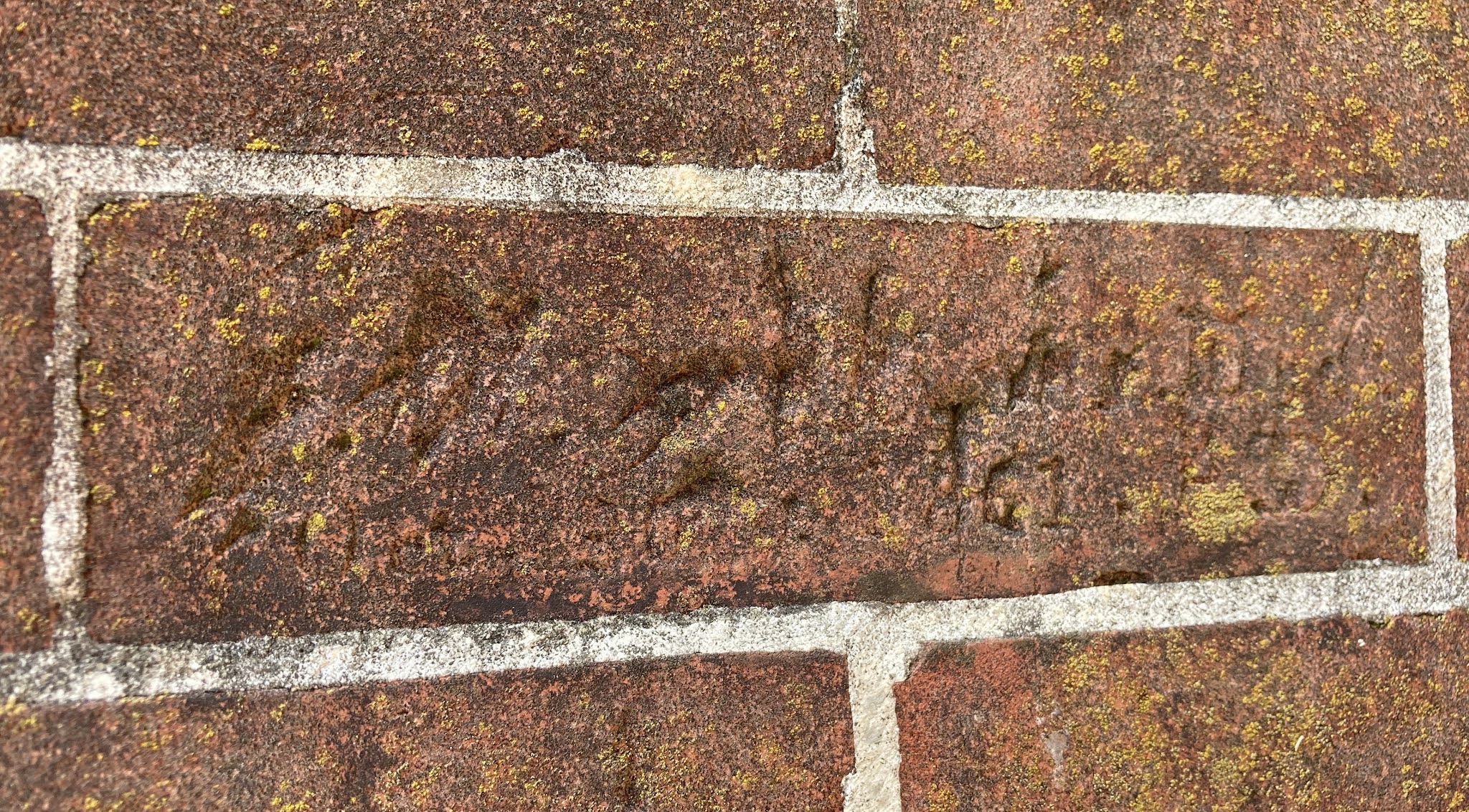
The striking Liberia House was made from bricks fashioned from red clay on site (City of Manassas)
The fuse was not present at the time of discovery, but Virginia State Police considered the small shell to be a live round. They held it until explosive ordnance disposal (EOD) technicians at Marine Corps Base Quantico could take custody.

The Schenkl shell would have contained black powder but the Picket was unable to determine whether it still was present 160 years later. An EOD technician at the base who answered questions Tuesday about explosive ordnance said he did not have details on this shell.

The technician said if any black powder was present the item would have been carefully pressure washed and cleaned with a filtration system.

Hard to say which side had this particular round

Local officials believe the shell will be a great addition to Oct. 11 programming marking the 200th anniversary of Liberia House. The 10 a.m.-4 p.m. event includes tours, music, 19th century games, a demonstration of quilting and storytelling.

Manassas, obviously, is associated with two major battles and numerous smaller operations and skirmishes.

The Schenkl was primarily used by Federal artillerymen in a variety of cannons, including the Parrott.

“As far as Federal vs. Confederate shell – it’s difficult to say,” said Dellinger (left in city Instagram post) of this example.

“We do know that during the Battle of Bull Run Bridge the 2nd New York was stationed on the property (exact location unknown) and were firing at the Confederates at Fort Beauregard (located about ½ mile from Liberia). Because of the history of both sides being on the property during the war, it’s really hard to say which side left the shell behind.”

About 400,000 Schenkl shells were made during the Civil War. They came in several styles, including ones that contained case shot. It had a Papier-mache sabot.

Shell will make its public debut Oct. 11

The Prince William County property served as headquarters for Confederate and Union forces early in the war. Jefferson Davis (in 1861) and Abraham Lincoln (in 1862) came here to confer with their generals. “Proof of occupation is displayed as faded graffiti left by Union soldiers is visible on interior walls,” the city says.

Soldiers from both sides wrote graffiti in many structures in the region. Those surviving at Liberia Hall are Union.


Dellinger previously told the Picket past archaeological digs at Liberia yielded numerous Civil War-related pieces, among them
 buttons, bullets, small bits a pieces of metal that relate to horse equipage, other accoutrements and a sword -- “the coolest thing until this shell.”

Manassas touts its extensive Black history through a trail for residents and visitors. Liberia House tells the story of the enslaved people on the land at the time of the war.

Liberia House was built for William J. and Harriett Weir in 1825. Enslaved laborers did most of the construction on the two-story, Federal style brick home. They are believed to have crafted much of the stylish interior, too. Its 1,600 acres made Liberia a large working farm and plantation.

Dellinger said the birthday party will not have a Civil War focus but there will be come wartime components, including the debut of the Schenkl round.

”After that, I plan on leaving the shell at the house so when we have it open for public events it’s on hand for people to see.”

Marines keep busy with calls about ordnance

19th century photo of house shows men in fashionable clothing (Library of Congress)
Quantico routinely gets requests to handle possible explosive ordnance, including some dating to the Revolutionary War and Civil War. Calls come in from the National Park Service, museums and state and local governments, among other agencies.

The Quantico EOD technician told the Picket the team will try to render them safe if possible.

“Everybody has stockpiles they need certified, looked at, or inerted, on top of people finding (items) in their yards in Northern Virginia.”

Liberia House is located at 8601 Portner Ave., Manassas. The house is open for special events and tours and an annual bee festival. The grounds are open from sunrise to sunset. For more information, contact the Manassas Museum at 703-368-1873.

Wednesday, September 17, 2025

Someone carved initials on a New York monument at Gettysburg's Little Round Top. Now the park is seeking the public's help in holding him accountable

Man being sought after vandalism;12th New York plaque is on the tower, behind leaves (NPS photos)
A man etched initials on a bronze tablet at the “Castle” monument on Gettysburg's Little Round Top, and the park is seeking the public's help in its investigation.

“Acts of vandalism will not be tolerated in our national parks, and we are committed to holding those responsible accountable,” Gettysburg National Military Park spokesman Jason Martz told the Picket following the Sunday afternoon incident at the 44th and 12th New York monument.

The park posted an image of a bearded, white male on social media and asked for the public’s help.

A good Samaritan, heard scratching, took the photo and alerted authorities, said Martz. The individual carved the initials “LJR” on the edge of a tablet about the 12th New York. The tablet is affixed to the Castle’s tower and abuts the second-floor parapet/landing. Martz told Fox 43 a pocket knife was likely used.

Dedicated in 1893, the large stone monument sits near the summit of Little Round Top, famous for dogged fighting on July 2, 1863, that left about 1,800 casualties. It was designed by Col. Daniel Butterfield of the 12th New York and stands 44 feet high.

Martz said the park will make repairs, but the timing is uncertain. “Our preservationists are amazing.”

Heavily visited Little Round Top reopened in July 2024 after a two-year rehabilitation.

The 44th New York monument underwent repairs and upgrades to its base and sidewalks. (The 12th plaque is on the far left in this NPS photo)

According to news reports, boulders at Little Round Top had graffiti damage in August 2024, and park officials similarly decried defacement of sacred ground where men were killed, wounded or left missing.

Those with information on Sunday’s incident are asked to call the National Park Service tip line at 888-653-0009.

Monday, July 26, 2021

Civil War graffiti at Fort Pulaski: Yankee and Rebel soldiers and a POW left their mark near Savannah through paint and carvings

(National Park Service illustration, modifications by Andrew Gast)
Among the 25 million bricks brought in to construct Fort Pulaski are some used for graffiti by Union soldiers and a Confederate who was held prisoner at the sentinel in the marshes near Savannah, Ga. They silently speak of homesickness, patriotism and defiance.

Reminders of those who spent time there include paintings in two casemates and carved names on various walls. Fort Pulaski was a U.S. military fort before the state of Georgia seized it after secession. It fell to Union forces in April 1862 and was occupied for the rest of the Civil War, serving as a garrison and prison.

The Civil War Picket last month visited Fort Pulaski National Monument. Park guide Elizabeth Smith showed us the graffiti and a few marks left by people who did not consciously decide to do so. They are fingerprints and a hand print of enslaved persons who shaped these bricks.

There’s no place like home, but this place will do

"The Union Now and Forever" painted above gold emblem (Picket photo)
The 48th New York Volunteer Infantry is perhaps the best known of Federal regiments that had garrison and other duty at Pulaski after it fell to a furious bombardment from batteries built on nearby Tybee Island. These boys from Brooklyn kept boredom at bay through a band, baseball games and a drama club, among other activities.

Two casemates still have messages painted into whitewash over the red bricks. Over one embrasure (window) is “HQ Drum Corps.” In the next casemate, on the ceiling are the remnants of the message “The Union Now and Forever.”

"HQ Drum Corps/" "This Way Out" created by 48th NY troops (Picket photos)
On the walls nearby are “This Way Out” and “A Soldier’s Home.” An interpretive sign nearby tells visitors the regiment was trying to find humor during its time at Pulaski while they were cut off from civilization.

“They were literally making this space feel more like theirs in a time when they were often very homesick for their real homes.”

The 48th was stationed at Fort Pulaski for about a year in 1862-63. The unit remained vigilant, always prepared for a Confederate counterattack, but that never materialized.

After it departed, the 48th saw extensive combat for the remainder of the war, taking part in battles in South Carolina (Fort Wagner), Virginia (Cold Harbor and Petersburg) and North Carolina (Fort Fisher), among others.

This 48th soldier was a carpenter by trade

John Charters was stationed at Pulaski for about a year (Picket photo)
A wall near the northwest staircase and powder magazine at Pulaski contains many carved names, some dating to the Civil War, some more recent. Among the best-preserved is that of Pvt. John Charters, a soldier with the 48th. Below his name he wrote Brooklyn, NY.

Smith provided this synopsis:

The Brooklyn-born soldier was a teen when he enlisted in 1861. His occupation was listed as carpenter. On the muster roll, John Charters was noted as being 5 feet 8 inches tall with brown hair, blue eyes and a “florid” complexion. 

When the regiment was sent south in late 1861, Charters and his comrades built and manned gun emplacements on islands near Hilton Head, S.C. “The islands were barely more than piles of mud, giving the 48th and other units a very difficult job of maneuvering heavy cannons into position to blockade the river and prevent ships from getting past to resupply Fort Pulaski,” Smith wrote on a park Facebook page.

Members of the 48th NY band in NW corner (Library of Congress)
During their garrison time at Pulaski, the unit helped repair the fort’s walls and made a few military incursions into South Carolina, though it’s not known whether Charters took part in those raids.

The 48th was officially mustered out of service on September 1, 1865, with Charters having achieved the rank of sergeant.

Park Guide Elizabeth Smith points out some of the names (Picket photo)
He returned to Brooklyn and resumed his carpentry trade. He was married and had two children. Newspaper articles show he was involved with the Grand Army of the Republic.

He died on May 10, 1909, at age 65. The park has been unable to local a photograph of him.

Near Charter’s name is an engraving for the 157th New York Infantry, which also saw duty at Fort Pulaski.

Confederate left his name, but you can't make it out

Fort Pulaski was built in the 1830s and 1840s to protect Savannah from a naval attack. Of course, at this time, it was a U.S. fortification.

In January 1861, shortly before Georgia seceded from the Union, state troops occupied the deteriorated outpost. The moat was filled with mud and no cannons were in proper place when they swept in, according to the New Georgia Encyclopedia. Companies from Macon and Savannah formed the garrison.


Slaves impressed from rice plantations aided in the cleanup and preparations for possible contact with U.S. forces, and by the time Col. Charles H. Olmstead took command in December 1861, the fort's defenses had improved dramatically.

The mostly illegible carving above was made by an unknown Confederate on Oct. 30, 1861, Smith said.

Experience at Pulaski left Capt. Lemon bitter

Capt. James Lile Lemon served with Company A, 18th Georgia Infantry, part of John Bell Hood’s Texas Brigade. He enlisted as a second lieutenant in 1861 for a three-year term. Lemon was described as having a “light complexion, dark hair, blue eyes, [and] 6 feet” in height, according to Smith, whose research included Ancestry, Fold3 and the officer's diary.

The regiment fought in numerous eastern battles – including Antietam, Fredericksburg, Second Manassas and Chancellorsville. The farmer and merchant from Acworth had a close call at Gettysburg, when a Yankee bullet struck his canteen, causing it to strike his head. His combat days came to a close in November 1863, when Lemon was severely wounded by a Minie ball in the pharynx and taken prison after an assault on Fort Sanders in Knoxville, Tenn. 

Lemon recalled his wounding in his journal, saying: “I had left my sword in the mud & had drawn my pistol & moved up firing as fast as I could when I suddenly felt a tremendous blow to my head & lost consciousness & next regained my faculties later that day & it was then I knew we were repulsed & I a prisoner. A Yankee doctor told me of my wound which was very painful & which prevented me from swallowing. He told me I had nearly died from blood & fluid in my lungs but that my wound had been cleaned & drained & I should recover soon.”

By the time he arrived at Fort Pulaski in October 1864, Lemon had already been in at three Federal prisons: One in Louisville, Ky; Camp Chase in Ohio and Fort Delaware, Delaware. 

The captain’s brief time at Pulaski is part of the story of the “Immortal 600,” a fascinating footnote to the conflict. The story is involved, but here’s a summary:

In summer 1864, Confederate Maj. Gen. Samuel Jones essentially used 600 captured Union officers as human shields, in a section of Charleston, S.C., in the line of fire. The North retaliated by transporting 600 POWs from Fort Delaware to Morris Island, S.C., in direct line of Rebel guns.

“For nearly three months, the stalemate continued. It wasn’t until yellow fever broke out in the city of Charleston that the Confederacy removed the Union prisoners to newly erected prison camps further inland,” the National Park Service says. “With the Union prisoners removed from Charleston and no longer under fire from Union artillery, there was no need to keep the Confederate prisoners on Morris Island. With this realization, the next phase of their journey began and the Immortal 600 began the journey south, to Cockspur Island and Fort Pulaski.”

Capt. James L. Lemon's  name etched in 1864 (Picket photo, click to enlarge)
The officers arrived on Oct. 23, 1864. “They presented a forlorn picture. Uniforms in tatters, barefooted, suffering from diarrhea and hacking coughs, their ranks had already been reduced to 520," according to an old park brochure.

"He was one of the approximately 300 prisoners who remained at the fort -- about 200 had been removed after only a few weeks to be held at Hilton Head due to a lack of space at the fort -- and at some point in the five months he remained, it appears he carved his name into the whitewash," said Smith. "The name can be found above the embrasure in Casemate 18, though it is not often pointed out to people as the nature of the whitewash makes the carving very fragile."

The Rebel officers were guarded by the 157th New York Infantry and for a time their lot improved. The regiment’s commander apparently resisted efforts to put the prisoners on a starvation diet – as retaliation for the treatment of Union soldiers at Confederate prisons -- but he eventually relented and they were placed on the harsh diet for more than a month.

A Virginia cavalry officer wrote that corn meal was rotten and contained bugs and worms.

“About December 10th scurvy made its appearance in our prison amongst the weakest of the prisoners. Most every man in the prison was suffering more or less with dysentery and a large majority were from the starvation diet, unable to leave their bunks."

Marker just outside walls describing POW deaths (Picket photo, click to enlarge)
By January 1865, when a Union surgeon ordered the POWs be given full rations and medicine, 13 had died, mostly of dehydration due to dysentery. They are buried outside the fort, where a sign tells the story and a stone monument bears their names. Lemon apparently did not write a journal during his few months at Fort Pulaski.

In March, the Rebel officers, including Lemon, were returned to Fort Delaware, where they were held until the end of the war. Shortly after their return to Delaware, the captain’s diary describes harsh conditions at Fort Pulaski and alleged mistreatment by his captors. 

 “We have recently returned to this place after a most brutal & cowardly outrage against humanity. I cannot now speak of the sufferings & deprivations & humiliations we were subjected to. Many among us are now dead from starvation, disease, shot or beaten to death and the rest of us are about used up from the shameful journey forced upon us by the Yanks. I know not of the reason for this but we are told it is for some reported offense against a few of their prisoners in Charleston.”

At war's end a few months later, Lemon refused to take an oath of allegiance to the United States, citing his treatment, but he eventually did take it in June 1865, according to Smith.

A descendant lives in captain's home (Acworth Tourism Bureau Authority)

In his journal, which the park has in its collections, Lemon wrote: “I have done the unspeakable but I am now paroled & to day set out for home. My duty to my country is done, mine to my family remains.”

Lemon returned to Acworth and had 11 children with his wife Eliza. He was a retail merchant and then a bank executive. He was serving as president of the bank when he died on June 12, 1907, at age 72.

A descendant lives in the home today and has written extensively about the captain. The residence is shown on the city’s tourism website and is on a walking tour.

Enslaved persons left reminders of a harsh life

Smith in the southeast corner of the fort (Picket photo)
Millions of bricks were shipped to Cockspur Island during the fort’s construction from 1829-1847. Most were made by enslaved people. In Casemate 16, near where Lemon and others were held, are two bricks – one gray and one red -- in the embrasure. They contain fingerprints left by their makers. On one side is a small handprint.

Smith said enslaved people played a large role in the construction and maintenance of Fort Pulaski, "though sadly very little information is known about any individuals or even what it was like."

The red bricks were made in Baltimore and Alexandria, Va., and transported to the site. 

Smith's hand is next to handprint left in brick (Picket photo)
“The grey bricks, however, were made right here in Savannah on the Hermitage Plantation, hence the nickname Savannah Greys. The Hermitage relied on the enslaved men, women and children to make the bricks, which is most likely when the fingerprints were left in the bricks.”

The embrasure is in Pulaski’s southeast corner, which took the most damage during the Union bombardment in April 1862. “You can still see that damage in this embrasure in the width of the window and the lack of bricks. The fingerprints and handprint in this embrasure used to be hidden beneath a layer of bricks, but the battle damage removed those bricks and exposed the fingerprints and handprint," Smith told the Picket.

In February, the park wrote about the fingerprints in a Facebook post, saying “they serve as a tangible reminder that while the architecture and the military history of the fort may be impressive, there is another vitally important story that sits right in front of our eyes if we only just look for it.”

Fingerprints left by enslaved person (Picket photo)

Thursday, January 26, 2012

Kilroy was here: Uncovering soldiers' graffiti inside historic Virginia building

The walls talk to Chris Mills, but they yield their secrets slowly.

The architectural conservator works inches away from the grimy plaster, which is covered by a blue whitewash. He works methodically, using swabs, razors and other equipment to go back in time at the Graffiti House in Brandy Station, Va.

Mills this week was wrapping up his latest stint at the two-story frame house named for graffiti left by Union and Confederate soldiers, principally in 1863.

“It’s tedious work, but I am the first person to see this since 1870,” Mills told the Picket in a phone interview Wednesday. “My job is to protect what is here without a loss to it.”

Three upper rooms have yielded a mother lode of information about the men who fought in the Battle of Brandy Station or moved through the Northern Virginia town during other campaigns.

H.D. Specht, Co. G, 6th Regiment, Pennsylvania Reserves Volunteers Corps was here.

So was a proud member of the 3rd Corps. The federal soldier wrote the unit’s name in huge letters, making it the John Hancock of signatures on one wall in the room named for Maj. Gen. J.E.B. Stuart.

Mills, 48, works at the behest of the Brandy Station Foundation, which has a museum downstairs in the home. The structure is believed to have been built in 1858, three years before the Civil War began. Tradition holds it served as a hospital during the conflict.

Soldiers used charcoal to make their mark, pulling charred wood from the building’s fireplaces.

“It looks like it came right out of a fire,” said Mills, a Pittsburgh native whose business operates out of New York City. “The penmanship is remarkably good.”

The foundation has identified about 35 soldiers, most content to list their name and unit. Several were with the Confederate Stuart Horse Artillery.

Others wrote the name of battles, such as Gettysburg, Rappahannock and Kelly Ford’s.

A Gettysburg notation includes this message: “The Rebels got licked.”

And because victors write the history – or graffiti – they often added their message on top of another. “It appears to be them marking their territory,” said Mills.

One wall in the Stuart room features what’s believed to be the signature of the famous Confederate cavalier, who died in 1864 at Yellow Tavern, Va.

Interestingly, a soldier wrote either a supply or packing list on one wall: Three undershirts, one overshirt, two pair of drawers and three hose (socks).

Graffiti, of course, is not new. Conquerors or passers-through have left messages for centuries.

In Brandy Station and other cities affected by war, it was a sure sign of unrest, Mills said. “Graffiti has always been vandalism.”

The Battle of Brandy Station, in Culpeper County, was one of the greatest cavalry engagements in history.

On June 9, 1863, about 22,000 troops tangled when Union horsemen under Maj. Gen. Alfred Pleasonton launched a surprise attack on Stuart. After an all-day fight in which fortunes changed repeatedly, the Federals retired without discovering Lee’s infantry camped near Culpeper.

Some of the 1,000 estimated casualties may have received medical treatment at the Graffiti House, which the foundation says could have served as a hospital for Union and Confederate forces.

“This battle marked the apogee of the Confederate cavalry in the East,” the National Park Service writes in its summary of the battle. “From this point in the war, the Federal cavalry gained strength and confidence. Brandy Station was the largest cavalry battle of the war and the opening engagement of the Gettysburg Campaign.”

The house, not far from railroad tracks, once faced potential demolition. It housed a telemarketing operation for some time. The foundation acquired it in 2002.

Over time, some sections of graffiti were removed, much of which was returned. Other examples were damaged or destroyed over the years. Someone tried to make wall repairs in the 1970s or 1980s, Mills said.

“The walls were literally falling down,” before the foundation did significant work to stabilize them, according to Mills.

Those structural improvements likely saved the graffiti and the walls from collapsing during the East Coast earthquake last year.

Mills believes the graffiti, which was etched on plaster, was covered within several years of the war. After all, residents in the vanquished South may not have wanted to see daily reminders.

Before then, smoke, nicotine and grime slowly covered the graffiti. That actually helped protect it from lime wash used to cover the walls.

The conservator painstakingly removes as much whitewash as he can to bring the graffiti to the surface. But Mills must work carefully, and he injects acrylic resin into plaster cracks to further strengthen the walls.

In some cases, he leaves an area alone if he can’t do the conservation without damaging the graffiti. Future technology one day may make it easier to remove the lime wash, Mills said.

The foundation, which uses the building as its headquarters, is funding the work and is conducting research on the findings.

Mills has not gotten yet to one wall in the Stuart room, which he says should yield a lot more graffiti.

“We really do rely on donations to do the work,” foundation secretary Peggy Misch recently told the Culpeper Star Exponent. “We feel we step back in time when we come to this house.”

Mills has felt the same way.

He mentioned the discovery of a message left by a soldier who recorded the first snowfall of the year. Such ordinary notations give him a glimpse of the people who were there.

“I like seeing the person,” the conservator said.

Photos courtesy of the Graffiti House, Brandy Station Foundation.

More information on the house, foundation