Showing posts with label Devil's Den. Show all posts

Friday, March 27, 2026

Gettysburg begins draining beaver pond near Devil's Den and below Little Round Top. Observers have chewed on the Plum Run controversy for years

Water from the dammed up Plum Run has occasionally reached the 40th New York monument (NPS)
It appears the beavers of Gettysburg National Military Park became a little too eager.

After complaints about a family of the furry critters that in recent years created dams and a pond -- thereby diminishing the historic integrity of Little Round Top and Devil’s Den -- the National Park Service has begun lowering water levels.

The work is meant to encourage the beavers to consider new housing elsewhere in the park.

Conservationists, including the South Mountain Audubon Society, are not happy with the decision, saying the pond has drawn nature lovers and new animal species.

In a statement, the park said:

Over the next two months, the National Park Service will gradually lower water levels in the pond created by beaver activity. This action is designed to rehabilitate the 1863 cultural landscape by restoring visibility of Plum Run as a stream and maintaining the wetland around it described in first person accounts of the Battle of Gettysburg. Beaver activity occurs in several locations throughout the park, and they will continue to be present in the future. The National Park Service will carry out the work gradually to protect both the cultural and natural resources the park preserves.”


Park officials did not respond to several questions posed by the Picket, including what was the impetus for the decision. The Audubon Society chapter said in a Facebook post earlier this month the park was instructed to take action.

“If you were to add together all the roadways, buildings, monuments, and signs (that weren’t on the battlefield in 1863 either), I am certain you would come up with a much larger area than the area that has been changed by the beaver colony,” the group said. “Have we learned nothing since the eradication of the beavers in colonial days? Do we still have to engage in a ‘war’ on these grounds instead of learning to co-exist with nature?”

The Picket reached out Thursday to the group for additional comment.

Shortly after she became superintendent at Gettysburg in early 2024, Kris Heister responded to a Picket question about the status of the beavers of Plum Run, along Crawford Avenue.

“Beavers are not new to the park and have taken up residence off and on in the Plum Run area for many years -- this is a natural process. The park is managing them in accordance with NPS policy and the Cultural Landscape Report for Little Round Top, which recommends that the Plum Run riparian corridor be managed to promote species diversity while ensuring vegetation does not block key historic views from Plum Run Valley to the face of Little Round Top.”

Map shows Crawford Avenue, Plum Run and the 40th New York Infantry monument (NPS)
In 2023, park staff installed devices called "beaver deceivers" to de-water a portion of the pond that had formed due to infringement on the 40th New York Infantry Monument and the subsequent inability of park visitors to access the monument.

Civil War historian and former park employee D. Scott Hartwig last week weighed in on the controversy, saying in a Facebook post visitors expect the park service to manage the landscape to the best of its ability to resemble that of 1863. He called the area the most "iconic part" of the battlefield.

“The reason we have arrived at this moment, where officials from the Department of Interior are ordering park management to do something about the beavers, is because this current management did not balance managing the historic landscape and native species. They instead allowed the native species to manage the landscape.”

Saturday, March 30, 2024

Q&A: Gettysburg's new superintendent Kris Heister on big projects, rentals, volunteers, her Civil War ancestors and a place she'd like to see more visitors

Kris Heister, Little Round Top rehabilitation, Spangler Farm (NPS photos)
Kristina “Kris” Heister, the new superintendent at Gettysburg National Military Park and Eisenhower National Historic Site, comes from a family with deep roots in Pennsylvania. Her ancestors came over from Germany in about 1732 and produced congressmen and other political leaders in the state.

Heister, who has held numerous positions with the National Park Service over a 30-plus year, was deputy superintendent at Gettysburg before the promotion.

“I have been amazed by the dedication of my colleagues, our partners and our community,” she said in a news release earlier this month. “Their collective commitment to preserving and protecting these hallowed grounds inspires me every day. I look forward to continuing to work together and maintaining an open dialogue with our partners and our community to address both the challenges and opportunities the future holds for these exceptional places.”

The Picket asked Heister about her priorities and initiatives, current and future projects and her ancestors. Many fought in the Civil War and two were at Gettysburg. The favorite Heister family meal (Chicken Divan) is a recipe Julie and David Eisenhower served for Christmas one year.

Heister this week responded to my questions by email. A few have been edited for brevity.

Q. You have held leadership posts at the park for about four-five years. During this time, did you work on specific initiatives or projects that resonated with visitors?

A. An example of a specific initiative that I led in the last four years was the leasing of historic structures for Airbnb-style rentals. This program will create a new and immersive visitor experience as well as generate revenue for the preservation of park facilities. This year, we are initiating a pilot with two structures that witnessed the battle of Gettysburg - the Slyder farmhouse and Bushman farmhouse (NPS photo, left). Both are in close proximity to special places on the battlefield, including Devil's Den and Little Round Top. For the first time, park visitors will be able to stay at these homes for between 2 and 6 days at a time. If successful, we will expand the program to two additional battlefield homes in the next 3-5 years.

Q. As the new superintendent, do you have any early ideas on initiatives or programming?

A. Currently, I am focused on existing initiatives including the reopening of Little Round Top in spring/early summer 2024, rehabilitation of the reception center at Eisenhower National Historic Site, building the Spangler Trail connecting the museum and visitor center to the Spangler Farm (owned and operated by the Gettysburg Foundation), kicking off summer interpretive programming and preparing for battle anniversary on July 1-3, 2024. Upcoming initiatives include rehabilitation of the National Cemetery and historic structures on the battlefield.

A. The news release mentions your strength in employee development and community engagement. Are you able to pinpoint specifics from the past or possible in the future on these two areas?

Q. I see many possibilities for engagement with the Gettysburg community in the future and am excited to investigate our shared goals and how we can achieve them together. One I look forward to the most is reinvigorating our volunteer program. By this summer, we will have hired a permanent volunteer coordinator -- a new position at the park. My goal is to develop a vibrant, safe, inclusive volunteer program that promotes engagement with the community (locally and nationally) through meaningful service, is focused on needed work and contributes to creation of the next generation of public land stewards.

Q. What is your favorite part of the battlefield? Is there a spot you wish more visitors knew about?

A. There are so many beautiful areas of the battlefield. My favorite place is anywhere I can experience peace and tranquility (that) allows me to both renew my spirit and contemplate the meaning and significance of what happened here. I wish more visitors knew about Eisenhower National Historic Site (above, NPS photo), which is located directly adjacent to Gettysburg National Military Park and tells the story of our 34th president as well as having significant connections between President Eisenhower and the Gettysburg battlefield.

Q. Gettysburg has seen a lot of wear from visitors, hence the projects at Little Round Top and Devil's Den. What do you believe to be the impact of those improvements and are there other such areas in the park you would like to address?

A. I believe the impacts of our improvements on Little Round Top and Devil’s Den relate to providing a high-quality visitor experience and resource protection to ensure those resources are available to future generations in good condition. For example, at Little Round Top heavily eroded trails have been stabilized, circulation patterns have been improved, individuals with mobility issues (whether considered handicapped or not) will now be able to visit the hill, breastworks have been rehabilitated, new wayside exhibits are being installed, some social trails have been removed and others have been formalized, providing access to areas of the hill and monuments that haven't been accessible in years, designated bus parking has been added and gathering spaces have been formalized to reduce off-trail use and facilitate the many groups that visit. Our next large scale rehabilitation effort will focus on the National Cemetery.

40th New York Monument is in a water-prone area.Photo Craig Swain, HMdb.org
Q. Some people have been concerned about beavers forming ponds/lakes along Crawford Avenue. The park in 2019 said they are native to Plum Run and it was monitoring potential impact on Devil's Den and Little Round Top. What is the current situation with that?

A. Beavers are not new to the park and have taken up residence off and on in the Plum Run area for many years - this is a natural process. The park is managing them in accordance with NPS policy and the Cultural Landscape Report for Little Round Top, which recommends that the Plum Run riparian corridor be managed to promote species diversity while ensuring vegetation does not block key historic views from Plum Run Valley to the face of Little Round Top. The NPS has identified all historic resources within this area as well as potential impacts to those resources from the presence of beavers. We are monitoring those potential impacts and taking action as appropriate to address them. In 2023, we installed devices called "beaver deceivers" to de-water a portion of the pond that had formed due to infringement on the 40th New York Infantry Monument and the subsequent inability of park visitors to access the monument. We will continue to monitor and take action as necessary and appropriate.

Q. The press release says you had 18 ancestors who fought for the Union. Do you know from which states some of them hailed?

A. The majority were from Pennsylvania. I have just begun to research my family this far back but it appears my family touched many facets of the war. To date, I have identified two individuals – Cyrus Heister and Washington K. Hiester who fought at the Battle of Gettysburg -- both with the Pennsylvania infantry, 93rd  and 151st regiments respectively. (The superintendent notes the names Heister and Hiester were sometimes used interchangeably.)

William C. Hiester (131st regiment, Pennsylvania infantry) died at Fredericksburg at age 19. At age 18, Daniel M. Heister mustered into the 101st regiment just in time to be captured at Plymouth, N.C., and spend the rest of the war in Andersonville prison. One family member served in the Pennsylvania Senate during the war. One was designated a mustering officer, with the rank of major, by the governor in 1863, and mustered into service eight regiments of volunteers (they assembled at an encampment called Camp Hiester in Reading. One was a judge in Dauphin County who adjudicated claims associated with damages caused by Confederates during the war.

Lastly, Dr. Joseph Hiester treated Capt. Henry W. Freedley, who commanded the 3rd United States Infantry at the Battle of Gettysburg. (Hiester's grave at right, photo courtesy of Findagrave contributor 47099775)

Freedley was severely wounded in the leg and Hiester arrived in Gettysburg shortly after the battle to tend to him on the floor of the David Wills House (now NPS property), where Abraham Lincoln later stayed on the night of November 18, 1863, and completed writing the Gettysburg Address. Cool stuff!

Postscript: I asked Superintendent Heister about Hiester’s daughter, Maria, whom Freedley had written before and after the battle. The officer called her a friend, but was there more to the relationship? “Maybe it was a long-distance romance between two people in their 30s, one a homemaker, one a soldier,  who had known each other since childhood and she waited for him as he travelled extensively with the military -- until he broke her heart and married someone nearly 20 years her junior.” Maria apparently never married and Henry was wed just a few months before his death in 1889.

Thursday, September 29, 2022

Breaking news: Devil's Den will reopen Friday after six-month rehabilitation project, Gettysburg park officials say

The landmark in 1909, at the advent of the car era (NPS photo)
Devil’s Den, scene of fierce fighting during the July 1863 battle, will reopen on Friday after a six-month project that tackled erosion and unauthorized trails that created safety hazards, Gettysburg National Military Park announced Thursday.

The project reestablished the features that make up this segment of the battlefield and will allow visitors to better immerse themselves into the historic landscape that is essential to understanding the three-day Battle of Gettysburg,” park said in a social media post.

The work tripled trail access to those with disabilities, increased overall greenspace by trimming some trail space and added features that will help with water runoff. Slip-resistant steps replaced uneven and worn stone steps, officials said.

“Although the area will reopen to visitors, one central area will remain fenced to allow more time for further vegetation growth. The fencing in this area will remain until native grasses have fully established. This process may take up to two growing seasons – up to 2024. In the interim, all non-native vegetation will continue to be treated within the entire project area.

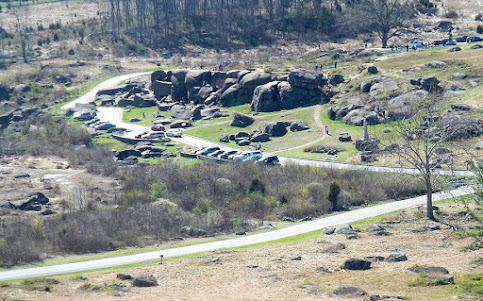
View of Devil's Den from Little Round Top (Wikipedia, Wilson44691)
The reopening comes amid similar work on Little Round Top, which closed to visitors in July. “The rehabilitation of Little Round Top will address overwhelmed parking areas, poor accessibility and related safety hazards, significant erosion, and degraded vegetation,” the park said.

After the park earlier this year announced the Devil's Den closure in a Facebook post, critics and supporters weighed in. One said the need for work at both areas has been known for years and the public will be disappointed that two landmarks would be closed at the same time. Others said people should be grateful the work is happening to perpetuate the memory of those who fought there.

Park spokesman Jason Martz told the Picket in a March email that the timing of the projects was a coincidence, but they are both meant to address problem areas.

Devil’s Den was the scene of fierce fighting on July 2, 1863, during the decisive battle. The boulder-strewn hill was the object of forces under Confederate Lt. James Longstreet. Rebels took the position and engaged in fire with Union troops on Little Round Top.

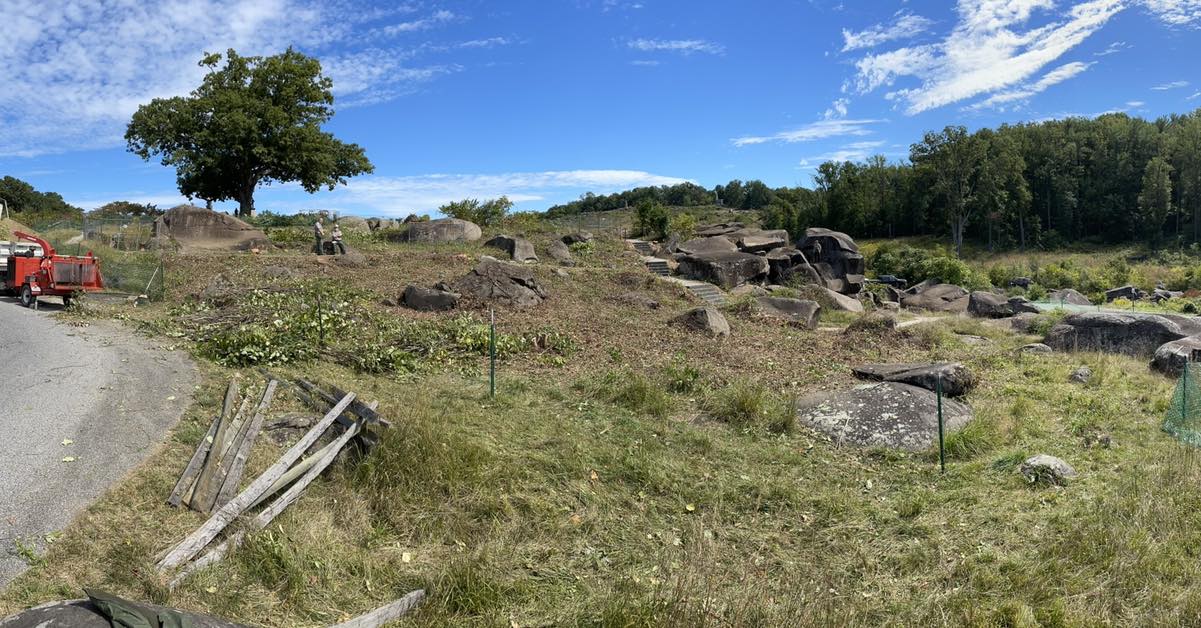
Volunteers recently assisted the park with clearing vegetation overgrowth at Devil's Den as it neared reopening. Park officials then treated stumps to prevent sprouting.

View of Devil's Den after volunteers cleared vegetation (NPS)

Friday, March 11, 2022

Devil's Den, a rocky focal point on the second day of Gettysburg, will close for 6 months as park addresses erosion and safety issues

Visitors to Devil's Den a few years after the battle (Library of Congress)
A second landmark at Gettysburg National Military Park will close for several months this year for major rehabilitation.

Park officials announced Thursday that work at Devil’s Den is expected to begin on March 21. The closure will last five to six months as crews address “significant erosion and safety issues in this highly visited area of the battlefield.”

Devil’s Den was the scene of fierce fighting on July 2, 1863, during the decisive battle. The boulder-strewn hill was the object of forces under Confederate Lt. James Longstreet. The Rebels took the position and engaged in fire with Union troops on Little Round Top.

The park said the work is needed because of the erosion along existing walkways and from unauthorized social trails that have created safety hazards.

“The scope of the project will reestablish, preserve, and protect the features that make up this segment of the battlefield landscape,” it said in a statement. “These improvements will allow visitors to better immerse themselves into the historic landscape that is essential to understanding the three-day Battle of Gettysburg.

Crawford Avenue, Sickles Avenue and the Devil’s Den parking area will remain open as much as possible for visitor use. Adjacent battlefield locations, such as the Slaughter Pen, Devil’s Kitchen, and the Triangular Field, will all remain open. The construction contractor will occasionally need to close all road access around the area, but notices will be posted ahead of time, the park said.

View of Devil's Den from Little Round Top (Wikipedia, Wilson44691)
The announcement came about a month after the National Park Service detailed a rehabilitation project on Little Round Top, where Union forces fought off a furious Confederate assault, also on July 2.

Park officials said they are addressing ongoing problems at the overcrowded site. They cited erosion, overwhelmed parking areas, poor accessibility and related safety hazards, and degraded vegetation.

“This project will also enhance the visitor experience with improved interpretive signage, new accessible trail alignments, and gathering areas. These improvements will allow visitors to better immerse themselves into the historic landscape that is essential to understanding the three-day Battle of Gettysburg,” a news release said. 

An update this week said tree cutting was completed last month and the overall project is out for bid, with two contracts: one for overall construction and the second for revegetation of Little Round Top.

The closure of Little Round Top is expected to begin sometime between March 20 and June 21. The project will take up to 18 months to complete, officials previously said.

After the park announced the Devil's Den closure in a Facebook post, critics and supporters weighed in. One said the need for work at both areas has been known for years and the public will be disappointed that two landmarks will be closed at the same time. Others said people should be grateful the work is happening to perpetuate the memory of those who fought there.

Park spokesman Jason Martz told the Picket in an email that the timing of the projects is coincidence, but they are both meant to address problem areas.