Showing posts with label shaw. Show all posts

Tuesday, April 29, 2025

'Persevere, don't give up': Georgia preservation group honors team for saving tabby building in Darien that survived fire during Civil War. The Adam Strain has a new life

In July 2023 (Picket photo), nearing completion (Marion Savic), and side view (Ethos Preservation)
The tabby Adam Strain building in coastal Darien, Ga., looked forlorn, lonely and, frankly, about to collapse in 2008 when it was listed among the state’s “Places in Peril.”

The Georgia Trust for Historic Preservation cited residential development pressure and the demolition of an 18th century house north of town. Local concern for the Strain, which was built around 1815 and survived the Burning of Darien during the Civil War, had reached “a new high,” the nonprofit said.

Someone needed to step up and purchase “this rare survivor” and come up with a vision for its use as part of Darien’s heritage tourism program, the Trust urged.

That finally occurred in January 2020, when Milan and Marion Savic bought the Strain and began a long and expensive restoration of the distinctive warehouse perched on a riverfront bluff.

Marion Savic holds award with the Adam Strain team. Milan Savic is at far right (Photo GTHP)
The Trust this past weekend recognized the work by the Savics, consultants and preservation companies with its Marguerite Williams Award, presented annually to the project that has had the greatest impact on preservation in the state.

Last November, the Savics opened Tabby House Brewing in the Adam Strain and a restored bank building next door. The couple is developing an upstairs museum about the project and its ties to the local culture.

“It is an important example of a building that many thought was too far gone (left) being saved through perseverance and a commitment to quality craftsmanship,” Ben Sutton, director of preservation and legislative advocacy for the Trust, told the Picket in an email Monday.

The commerce building’s connection to the Federal burning of Darien in 1863 first drew me to its story, but the passion of the Savics and local residents kept me plugged into the daunting project.

We had an amazing team that came together to do what was near impossible -- save the beautiful Adam Strain,” the Savics said in a Facebook post about the award.

I asked Marion Savic about the five-year effort and what advice she might give to someone taking on such an involved and complex project.

“It takes dedication, perseverance, good quality contractors, engineers, architects, etc. to make it work -- and money,” she replied. “State and federal tax credits definitely help offset some of the cost. Persevere, don’t give up and the outcome will be worth it.”

It weathered a firestorm during the Civil War

The Adam Strain has stood amid palm trees on a bluff of the small, interior port city above St. Simons Island for more than two centuries. Tabby ruins of other businesses lie just below the site and Darien’s famous shrimp fleet is just to the east.

Scene from "Glory" shows troops arriving in Darien in June 1863.
Tabby is a type of cement made from crushed oyster shells, lime and other materials and was popular in Georgia and Florida for several centuries leading up to the Civil War. Stucco was placed on the exterior to protect it from water damage.

The warehouse was used to store cotton prior to shipment in 1861 and 1862 before the Union naval blockade clamped down on Georgia’s coast during the Civil War.

In June 1863, Darien held little strategic value to the Union, but Col. James Montgomery (below), commanding the African-American 2nd South Carolina Volunteers, supposedly believed it was a safe haven for blockade runners.

He had another reason for shelling, looting and burning Darien, leaving only a few buildings standing among the charred ruins. The destruction was depicted in the award-winning 1989 film "Glory."

Steven Smith, site manager for nearby Fort King George Historic Site in 2013 when the Picket first wrote about the town’s burning, said Montgomery “wanted to make a political statement. Here was a town built on the backs of slaves.”

After most townspeople had fled, Montgomery ordered Col. Robert Gould Shaw and the famed 54th  Massachusetts Infantry to participate. While Shaw didn’t mind the looting to help resupply his troops, he opposed setting the town to torch. He apparently relented under threat of court-martial.

The Strain survived the fire but much of its interior was destroyed. The episode caused a howl of protest across the South and even in newspapers in the North.

'A case study in tabby preservation'

The warehouse was repaired after the Civil War and saw a rebirth for several decades before it was used for storage following World War II. It then sat empty for about 50 or so years.

The Strain, perhaps the oldest surviving in Darien, was beloved by its 2,000 residents, who worried for its future as its appearance worsened. The years rolled on.

Downtown has grown since this view of the Strain (Courtesy of Kit Sutherland)
It came within whiskers of being demolished before the Savics stepped in and bought the property. Two hundred-plus years had done its damage. A wall had a pronounced lean, the back wall facing the river was hanging by a prayer and other areas were in need of structural stability. The building was at risk of being toppled by strong winds.

Now, the building is an additional tourist draw in the city near St. Simons and Jekyll islands.

On Saturday, the Trust presented numerous preservation awards in Brunswick, Ga., during its annual Spring Ramble of historic homes and sites. The organization seeks partners to revitalize properties it has acquired or, as in the case of the strain, raise awareness of other endangered historic resources.

A press release on the award reads in part:

“From 2020 to 2024, the Savics and their team undertook a complex, multi-phase rehabilitation -- restoring historic tabby walls, wood floors, windows, and even a rooftop hoist system -- while installing a concealed steel frame to ensure stability. The adjacent 1880s-era Darien Bank building was also restored and incorporated into the project.

The large upstairs room features a bar, event space and artifacts found during work (Picket photo)
“Today, the buildings house the Tabby House Brewing Company and Museum, reinvigorating Darien’s waterfront and drawing new energy to the historic district. With techniques that now serve as a case study in tabby preservation, this project stands as a powerful example of vision, perseverance and the profound impact historic preservation can have in shaping Georgia’s cultural and architectural legacy.”

The recipients of the Marguerite Williams Award for 2025 are: Marion and Milan Savic, Bennett Preservation Engineering, Ethos Preservation, GEL Engineering, archaeologist NicholasHonerkamp and Myrna Crook, Landmark Preservation, LKS Architects, Method Engineering and Saussy Engineering.

The Strain team recognized Fred Ecker of Landmark Preservation for  his leadership and expertise.

Wednesday, December 4, 2024

A coastal Georgia warehouse survived the 1863 burning of Darien, a scene in the movie 'Glory.' The tabby building fell on hard times, but after a long restoration it's again a center of commerce -- as a brewery

In July 2023 (Picket photo) nearing completion (Marion Savic) and side view (Ethos Preservation)
This is a classic story of standing the test of time. The Adam Strain Building was at a crossroads at the time of a 2011 talk about historic structures along the Darien, Ga., waterfront.

One of just a few tabby structures remaining on the Georgia coast, the weathered warehouse had survived a controversial fire during the Civil War, hurricanes, economic downturns, Father Time and decades of emptiness. 

A Brunswick News article previewing the event had this prophetic line: “Today the building sits in its solemnity, waiting for an adventurous soul or business to once more give life to the building that would not die.”

Now, nearly five years after they invested a lot of money and heart into the project, entrepreneurs Milan and Marion Savic. working with a team of specialists, have completed the painstaking restoration of the Adam Strain Building and turned it into an aptly named business: Tabby House Brewing Company. The two-story building perched above a waterfront bluff has literally been saved from falling in on itself. And part of its charm is that the venue still shows its age in places, including curved walls.

The main floor of Tabby House Brewing (Courtesy Ethos Preservation)
The nanobrewery – through word of mouth and social media – had a soft opening November 15. Visitors have posted favorable comments on the beer, food and the building’s features and atmosphere.

A Darien-McIntosh County Chamber of Commerce ribbon cutting is set for 11 a.m. Dec. 13.

Patrons can sample cocktails and a red ale, “The Altie,” an IPA, “The Double Darien,” and a stout, “The Celtic Cross,” inside the stylish interior or a rooftop patio that overlooks the Darien River. The food menu includes sandwiches, flatbreads and grazing boards. The brewery, working from two tanks, will eventually produce six beers in a rotation. Chef Jack Persinger is handling the brewing and food service.

“We’ve had a great reception,” wrote Marion Savic in an email to the Civil War Picket. ”It’s been a great journey. We have an excellent team, all experts in their respective fields. The building has been restored so people can see what it would have looked like back in the 1800s. We are thrilled with how it turned out and with the support we have received from the community.” (Photo of patio overlooking Darien River by Joe Kasper)

I have written about the daunting project since April 2020 and I paid a visit to the circa 1815 building to check the work on a sultry day in early July 2023.

The commerce building’s connection to the Federal burning of Darien in 1863 first drew me to its story. My current interest is a museum the Savics hope to open by February. They are currently devising exhibits for the second floor, which includes an event space.

“The museum will house a rotating display of our artifact finds and some things that have been given to us from locals,” Savic said. “We also have a few things that were found in the building. There are old newspapers from the Darien News and we’ll have a couple of those scanned and framed.”

Scenes of the Adam Strain interior and roof in 2020 (Courtesy Landmark Preservation)
The aim is to spotlight the Georgia town’s rich maritime history – from rice, cotton and lumber to fishing and shrimping, architecture and stories from local people.

Savic told the Picket last year they want to present it in an inclusive way. Some have suggested mention of Gullah-Geechee culture and history passed down by descendants of enslaved people who for years were the backbone of the Darien economy.

“It certainly would be asset to the Darien waterfront section to have a museum focused on the 19th century maritime history of the town,” said Buddy Sullivan, a coastal Georgia historian and author. “Something like that has long been needed.”

The venue now is a financial and cultural anchor in the small downtown.

"Considered a public safety hazard at project outset, the resolve to stabilize the building and preserve as much historic material as possible was not an easy endeavor but rather one that took extra thought and creative solutions from experts and dedicated craftsmen," said Rebecca Fenwick of Ethos Preservation, one of several firms that worked with the Savics.

"Historic buildings are community assets that contribute significantly to sense of place and serve as storytellers of the past. Without them, a place's history becomes less tangible and authenticity is lost. The Strain Building project embodies these values and, collectively, we all benefit," Fenwick wrote in an email.

Infamous burning of town earned scene in 'Glory'

The Strain has stood amid palm trees on a bluff of the small, interior port city above St. Simons Island for more than two centuries. Tabby ruins of other businesses lie just below the site and Darien’s famous shrimp fleet is just to the east.

Scene from "Glory" shows troops arriving in Darien in June 1863.
Tabby is a type of cement made from crushed oyster shells, lime and other materials and was popular in Georgia and Florida for several centuries leading up to the Civil War. Stucco was placed on the exterior to protect it from water damage.

The warehouse was used to store cotton prior to shipment in 1861 and 1862 before the Union naval blockade clamped down on Georgia’s coast during the Civil War. The downtown area was a much busier place than it is today, though the Strain and other projects signal a small, but growing resurgence.

In June 1863, Darien held little strategic value to the Union, but Col. James Montgomery, (left) commanding the African-American 2nd South Carolina Volunteers, supposedly believed it was a safe haven for blockade runners.

He had another reason for shelling, looting and burning Darien, leaving only a few buildings standing among the charred ruins. The destruction was depicted in the award-winning 1989 film "Glory."

Steven Smith, site manager for nearby Fort King George Historic Site in 2013 when the Picket first wrote about the town’s burning, said Montgomery “wanted to make a political statement. Here was a town built on the backs of slaves.”

After most townspeople had fled, Montgomery ordered Col. Robert Gould Shaw and the famed 54th  Massachusetts Infantry to participate. While Shaw didn’t mind the looting to help resupply his troops, he opposed setting the town to torch. He apparently relented under threat of court-martial.

The Strain survived the fire but much of its interior was destroyed. The episode caused a howl of protest across the South and even in newspapers in the North.

Bullet made for Enfield rifle was found along bluff

Civil War bullet found during archaeological dig (Courtesy Marion Savic)
Among the items found by an archaeological team in 2020 was a Civil War-era bullet -- likely an Enfield round. The team found it on the bluff, Savic told the Picket. The so-called Pritchett bullet was used in the Pattern 1853 Enfield rifle. The rifle was used by both sides during the conflict, and the Confederacy imported thousands from England.

It’s not known how the bullet came to be there, when it was deposited and to whom it belonged. The building did not come to be named for businessman Adam Strain – a Civil War veteran of the 5th Georgia Cavalry -- until after the conflict.

Another find during the project were Savannah grey bricks behind the walls of a small building that adjoins the Strain. It had been used as a bank and law offices following the Civil War and now houses the business' kitchen, bathrooms and brewery.

The rear of the former bank building, which adjoins the Strain (Courtesy Ethos Preservation)
The Savics turned to the Savannah-based Coastal Heritage Society to catalog the numerous artifacts found during the work. A 2021 report listed hundreds of items.

“Much of the research that was successfully carried out at the Strain Site was unantici­pated, to say the least,” said a report. “Evidence of prehistoric occupations, some dating 5000 years to the Late Archaic Period is found throughout the site.”

Over the years, the Strain was used for a variety of purposes, including a ship's chandlery, a pharmacy, and a mercantile (hardware) business, the last of which was as a clothing manufacturer or storage site, according to the report. At some point over the years, it was used to store antiques and house or produce shoes. 

Fenwick, with Ethos Preservation, said the restoration offers a visual representation to visitors of Darien's life in the 19th century.'

"Evidence of the building's craftsmanship, to include brick lintels embedded in the tabby above door and window openings and even the buttresses added to the west elevation to prevent earlier decay, are significant and worthy of celebration," she said. 

(Example of tabby in the building, Picket photo, and supports used to stabilize the west wall, courtesy Marion Savic)

Missy Brandt Wilson, who grew up in Darien and still owns a home there, has long supported the revitalization of the Strain building. She loves how an old pulley has been retained.

“I went into the building before restoration and now I can actually see how the warehouse worked on the Darien riverfront,” the Athens, Ga., resident said.

New life after sitting empty for about 55 years

The Strain Building survived the 1863 flames, was repaired after the Civil War and saw a rebirth for several decades before it was used for storage following World War II. It then sat empty for about 50 or so years, said Savic.

Downtown has grown since this view of the Strain (Courtesy of Kit Sutherland)
The structure, perhaps the oldest surviving in Darien, was beloved by its 2,000 residents, who worried for its future as its appearance worsened. The years rolled on. The building’s condition had become so precarious by 2008 that the Georgia Trust for Historic Preservation placed it on its "Places in Peril" list.

It came within whiskers of being demolished before the Savics stepped in and bought the property in January 2020. Local residents were integral in the effort to save the Strain, and there was a Facebook page dedicated toward saving the landmark.

Two hundred-plus years had done its damage. A wall had a pronounced lean, the back wall facing the river was hanging by a prayer and other areas were in need of structural stability. The building was at risk of being toppled by strong winds.

In the 1920s, five years ago and a few weeks ago (Courtesy Ethos Preservation)
The Atlanta-area couple turned to an array of contracted historic preservation experts to shore up the building and create something new, and also pursuing innovative tax credits. The work often had to break for permits, updated engineering plans and supplies. (The Savics have kept the leaning wall to emphasize its story and durability.)

Research and close attention to what the old building had to say has paid off. Fenwick said missing elements were discovered during construction, including a central warehouse style opening on the front façade. That was restored during the project.

The Strain Building has become a good example of how the historic tax incentives in Georgia make such projects possible, said Fenwick.

“A combined 45% back on rehabilitation expenses from state and federal credits plus a 8-year tax freeze alleviated some of the cost associated with a project that had a significant financial burden. Structural costs for stabilization alone were substantial. Labor of love is fitting.”
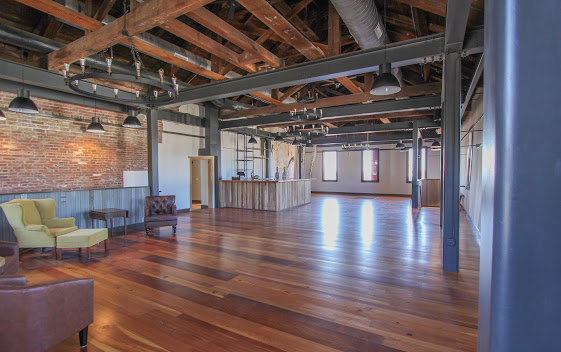
Upstairs area will feature event space and museum, note figures on back left wall (Courtesy Ethos Preservation)
The Savic family operates a nearby modern-day general store and restaurant in Darien, about 60 miles below Savannah. They also have operated businesses in Marietta, near Atlanta.

The preservation of the Strain building, which sits on the southeast corner of Broad and Screven streets, is just one piece – albeit a significant one – in plans to boost the small downtown district.

Darien, hit hard by the economic slowdown about 15 years ago, wants to attract more retirees who live along coastal Georgia and motorists who get off Interstate 95 to take in history, the small shrimping fleet and the natural beauty of the area.

Ben Sutton, director of preservation for the Georgia Trust, told the Picket the Strain Building is significant due to its age, size and method of construction.

“The Savics have been strong supporters of the Georgia Trust, so we are even more excited that the project has been done by such good friends. It is a fantastic example of reimagining a use for a historic building -- and just goes to show that a building is rarely too far gone to be brought back into useful service,” he said.

After many years, she feels good about Strain's future

I spoke this week by phone with Joe Kasper, a home builder and carpenter who showed me around during my 2023 visit to Darien. He did wood work at the Strain for Savannah contractor Landmark Preservation, and found the restoration to be challenging and rewarding.

About 75 percent of the wood – mostly Southern yellow pine – is original. Two sets of stairs he built had to be customized because of the age of the building. “Because the building is not level, I made it work with the building.” He said that was among the most enjoyable of his tasks. (Photo courtesy Joe Kasper)

And there were other challenges. “All the walls are bowed out, out of plumb and they just changed from foot to foot,” he said.

The crews made the Strain stable by building an interior steel frame, reinforcing the walls and using rods and stars to strengthen the structure. Crews paid as much attention to detail as possibly, including taking apart the main floor and reassembling it for a modern finish.

They were able to retain much of the original tabby but some eroded areas were reworked with new oyster shell and material, Kasper said.

Fenwick said historic material was salvaged whenever possible, including framing, flooring, ceiling boards, tabby, trusses and other details such as a mural painted on plaster and a hoist system on the second floor.

"Additionally, in order for the building's structural system to be successful, additional tie rods were installed, in keeping with those visible on the exterior at the start of the project. This is a great example of the addition of new elements designed to be harmonious with the historic building."

The rear of the Strain in 2020 (Landmark Preservation and post-restoration (Ethos Preservation)
Tabby House Brewing features a ground-floor brick patio in the back and a patio deck upstairs. Both command a view of the Darien River, which connects the city to the Atlantic Ocean and the world.

Wilson, former chairman of the McIntosh County Historic Preservation Commission, told me several years ago she used to pray over the building before the Savics stepped in.

“I hope it’s the economic engine the vast economic reports have predicted if it was restored,” she said recently. “I can honestly say for the first time since I’ve been a child in Darien, I can drive by the building and not hold my breath waiting for something bad to happen. It’s lovely seeing the people who said there was no hope to see hope happen.”  

Tabby House Brewing Company is at 111 Broad St. in Darien. Click here for hours and more.

Wednesday, December 13, 2023

Andre Braugher, who played Cpl. Thomas Searles in 'Glory,' dies at 61

Andre Braugher, who gained fame portraying a member of the 54th Massachusetts Infantry Regiment in the 1989 film “Glory,” has died at age 61, according to news reports.

Braugher played Cpl. Thomas Searles, a sensitive African-American recruit who had a difficult time adjusting to army life and was ridiculed by many of his comrades.

But the bookish Searles, who was a family friend of white regimental commander Col. Robert Gould Shaw, toughened up and volunteered to carry the flag should the color bearer fall during the Union assault on Fort Wagner near Charleston, S.C., in July 1863.

When Shaw asks whether anyone would pick up the staff, Searles stepped forward and said, “I will” to cheers.

“I’ll see you in the fort, Thomas,” said an emotional Shaw, played by Matthew Broderick, who before then ordered the soldier not to speak to him by first name.

Shaw, Searles and many other members of the regiment died in the failed assault.

“Glory” also starred Denzel Washington, Cary Elwes and Morgan Freeman.

Braugher  (left, Peabody Awards photo via Wikipedia) later starred in a number of movies and television shows, including “Homicide: Life on the Street” and the comedy series “Brooklyn Nine-Nine,” according to CNN.

In 2015, the actor introduced “Glory” when it was broadcast on USA Network.

“It was an incredible honor to be involved in ‘Glory’ and work amongst a tremendous cast to highlight some of our nation’s first black military heroes,” said Braugher, according to The Wrap.

“The film pays tribute to the brave soldiers and inspires us to defy adversity when all odds are against us, while paying tribute to those who selflessly fought to preserve the union during the American Civil War."

Wednesday, June 12, 2013

Burning of Darien: Festival will recall one of war's most controversial moments

Scene from the movie "Glory"

By summer 1863, coastal towns in the Deep South knew that where the Union army was going, emancipation of slaves was soon to follow.

That fact permeated society in Darien, Ga., where rice was king and slave labor served it. Most of the town’s 500 souls had fled before June 11, frightened by the Federal blockade and the deployment of African-American troops on nearby St. Simons Island.

On that day, the town, its buildings perched on tabby foundations, was vacant.

It held little strategic value to the Union, but Col. James Montgomery, commanding the 2nd South Carolina Volunteers, supposedly believed it was a safe haven for blockade runners.

Montgomery -- virulently opposed to slavery -- apparently had another reason for shelling, looting and burning Darien, leaving only a few buildings standing among the charred ruins.

“There was not much justice for burning Darien,” said Steven Smith, site manager for Fort King George Historic Site in Darien. “He wanted to make a political statement. Here was a town built on the backs of slaves.”

Darien’s destruction by two black regiments caused a howl of protest across the South and even in newspapers in the North. Those favoring emancipation were split on whether the act was barbarity or a necessary evil as it became clearer to many that the Civil War was about slavery.

Smith is among local leaders who launched a “Burning of Darien” website and Facebook page as a way to elevate knowledge of the incident and increase tourism in McIntosh County, long one of the poorest in Georgia.

Lectures about the 150th anniversary and the recent opening of a related museum culminate this Saturday (June 15, 10 a.m.-5 p.m.) with a daylong festival and living history in the city better known these days for its seafood fleet and as a gateway to the Golden Isles and retirement communities.

Among re-enactors that will be on hand is a Charleston, S.C., contingent that portrays the famed  54th Massachusetts Volunteer Infantry, which also participated in the burning of Darien.

The incident is featured in the 1989 movie “Glory.”

Col. James Montgomery
Montgomery ordered Col. Robert Gould Shaw and the 54th  Massachusetts to participate. While Shaw didn’t mind the looting to help resupply his troops, he opposed setting the town to torch. He apparently relented under threat of court-martial.

In a letter to his wife, Annie, a couple months before he died during his regiment’s assault on Battery Wagner near Charleston, Shaw gave this description of Montgomery:

“The reasons he gave me for destroying Darien were, that the Southerners must be made to feel that this was a real war, and that they were to be swept away by the hand of God, like the Jews of old.”

At the same time, the colonel said Montgomery was a “conscientious man” and believed he was faithfully executing his duty.

Shaw further wrote his wife, “Besides my own distaste for this barbarous sort of warfare, I am not sure that it will not harm very much the reputation of black troops and of those connected with them.”

After the war, the Shaw family worked diligently to exonerate their loved one’s reputation by saying he did not order Darien’s burning.

Col. Robert G. Shaw
Montgomery was an extreme character, even among abolitionists, according to historian Colin Woodward, archivist for the University of Arkansas at Little Rock’s Center for Arkansas History and Culture.

Historians debate whether Montgomery was acting under orders of Gen. David Hunter, commander of the Union’s department in the region. Hunter is known for an unauthorized 1862 edit emancipating slaves.

But it’s clear where Montgomery, a Kansas Jayhawker, stood on slavery.

“He had this religious Old Testament idea of an eye for eye and I hate slavery and I will do whatever it takes, even if this town is undefended,” Woodward told the Picket. “It’s almost like if John Brown had not been hanged and went into the army. That’s how this guy operated.”

Woodward, who also authors the Southern Historian blog, said the burning of Darien foreshadowed further Union efforts to take the war to the Southern people, and not just at the battle lines.

“I call Montgomery a Sherman in miniature,” Woodward said. “This is how the Union is going to prosecute the war further out.”

Buddy Sullivan, a historian in coastal Georgia, has given lectures about Darien and he is quick to point out that the raid occurred well before Sherman’s March to the Sea.

He told the Picket that the Burning of Darien initiative might help get more tourists off Interstate 95, which cuts through McIntosh County, off the road and into its communities.

Darien in recent years has gotten on the “train of progress” in promoting itself for eco-heritage tourism,” Sullivan said. This year’s events are a way to reach people “who haven’t even heard of this place.”

Buddy Sullivan
“This area has a lot of natural beauty and history,” Sullivan said. “We want people to come back and take a second look.”

Organizers of events have attempted to have an expanded view of the burning of Darien, to include the story of slavery.

“We are trying to draw a more diverse element,” said Sullivan. “We don’t just want Civil War buffs. It may be unpleasant history for some, but it is history.”

The 2nd South Carolina Volunteers was largely comprised of freed slaves, while the 54th Massachusetts had many freedmen and business professionals.

Steven Smith told the Picket the 54th Massachusetts was in the area to recruit freed slaves, destroy Southern crops and take out Confederate assault works.

Darien was slow to rebound from the war, and a now-gone timber industry for decades replaced the rice-based economy.

Like Sullivan, Smith said eco-heritage tourism is beginning to take off.

“It is a pretty town, a quintessential Southern town, with live oaks,” he said. “It is a perfect town for recreational boating.”

The Burning of Darien has provided educational opportunities and this week a museum opened at the town’s Trailhead Center.

Colin Woodward
Scholars have long debated the significance of the event and what it meant to the reputation of African-American troops, led by white officers. Hence, Shaw’s concerns about the image of his troops following the “wanton destruction.”

Historian Keith Wilson, in an article about Union officers who waged war in the region, has said when it came to Darien, “condemnation was not a universal response” in the North.

Woodward said there was varying reactions to the event.

“In the abolitionist movement it created a divide between those saying the ends justify the means and those thinking it was going too far, we don’t need to do this.”