Wednesday, December 4, 2024

A coastal Georgia warehouse survived the 1863 burning of Darien, a scene in the movie 'Glory.' The tabby building fell on hard times, but after a long restoration it's again a center of commerce -- as a brewery

In July 2023 (Picket photo) nearing completion (Marion Savic) and side view (Ethos Preservation)
This is a classic story of standing the test of time. The Adam Strain Building was at a crossroads at the time of a 2011 talk about historic structures along the Darien, Ga., waterfront.

One of just a few tabby structures remaining on the Georgia coast, the weathered warehouse had survived a controversial fire during the Civil War, hurricanes, economic downturns, Father Time and decades of emptiness. 

A Brunswick News article previewing the event had this prophetic line: “Today the building sits in its solemnity, waiting for an adventurous soul or business to once more give life to the building that would not die.”

Now, nearly five years after they invested a lot of money and heart into the project, entrepreneurs Milan and Marion Savic. working with a team of specialists, have completed the painstaking restoration of the Adam Strain Building and turned it into an aptly named business: Tabby House Brewing Company. The two-story building perched above a waterfront bluff has literally been saved from falling in on itself. And part of its charm is that the venue still shows its age in places, including curved walls.

The main floor of Tabby House Brewing (Courtesy Ethos Preservation)
The nanobrewery – through word of mouth and social media – had a soft opening November 15. Visitors have posted favorable comments on the beer, food and the building’s features and atmosphere.

A Darien-McIntosh County Chamber of Commerce ribbon cutting is set for 11 a.m. Dec. 13.

Patrons can sample cocktails and a red ale, “The Altie,” an IPA, “The Double Darien,” and a stout, “The Celtic Cross,” inside the stylish interior or a rooftop patio that overlooks the Darien River. The food menu includes sandwiches, flatbreads and grazing boards. The brewery, working from two tanks, will eventually produce six beers in a rotation. Chef Jack Persinger is handling the brewing and food service.

“We’ve had a great reception,” wrote Marion Savic in an email to the Civil War Picket. ”It’s been a great journey. We have an excellent team, all experts in their respective fields. The building has been restored so people can see what it would have looked like back in the 1800s. We are thrilled with how it turned out and with the support we have received from the community.” (Photo of patio overlooking Darien River by Joe Kasper)

I have written about the daunting project since April 2020 and I paid a visit to the circa 1815 building to check the work on a sultry day in early July 2023.

The commerce building’s connection to the Federal burning of Darien in 1863 first drew me to its story. My current interest is a museum the Savics hope to open by February. They are currently devising exhibits for the second floor, which includes an event space.

“The museum will house a rotating display of our artifact finds and some things that have been given to us from locals,” Savic said. “We also have a few things that were found in the building. There are old newspapers from the Darien News and we’ll have a couple of those scanned and framed.”

Scenes of the Adam Strain interior and roof in 2020 (Courtesy Landmark Preservation)
The aim is to spotlight the Georgia town’s rich maritime history – from rice, cotton and lumber to fishing and shrimping, architecture and stories from local people.

Savic told the Picket last year they want to present it in an inclusive way. Some have suggested mention of Gullah-Geechee culture and history passed down by descendants of enslaved people who for years were the backbone of the Darien economy.

“It certainly would be asset to the Darien waterfront section to have a museum focused on the 19th century maritime history of the town,” said Buddy Sullivan, a coastal Georgia historian and author. “Something like that has long been needed.”

The venue now is a financial and cultural anchor in the small downtown.

"Considered a public safety hazard at project outset, the resolve to stabilize the building and preserve as much historic material as possible was not an easy endeavor but rather one that took extra thought and creative solutions from experts and dedicated craftsmen," said Rebecca Fenwick of Ethos Preservation, one of several firms that worked with the Savics.

"Historic buildings are community assets that contribute significantly to sense of place and serve as storytellers of the past. Without them, a place's history becomes less tangible and authenticity is lost. The Strain Building project embodies these values and, collectively, we all benefit," Fenwick wrote in an email.

Infamous burning of town earned scene in 'Glory'

The Strain has stood amid palm trees on a bluff of the small, interior port city above St. Simons Island for more than two centuries. Tabby ruins of other businesses lie just below the site and Darien’s famous shrimp fleet is just to the east.

Scene from "Glory" shows troops arriving in Darien in June 1863.
Tabby is a type of cement made from crushed oyster shells, lime and other materials and was popular in Georgia and Florida for several centuries leading up to the Civil War. Stucco was placed on the exterior to protect it from water damage.

The warehouse was used to store cotton prior to shipment in 1861 and 1862 before the Union naval blockade clamped down on Georgia’s coast during the Civil War. The downtown area was a much busier place than it is today, though the Strain and other projects signal a small, but growing resurgence.
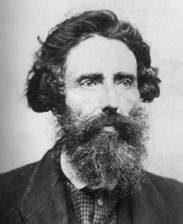
In June 1863, Darien held little strategic value to the Union, but Col. James Montgomery, (left) commanding the African-American 2nd South Carolina Volunteers, supposedly believed it was a safe haven for blockade runners.

He had another reason for shelling, looting and burning Darien, leaving only a few buildings standing among the charred ruins. The destruction was depicted in the award-winning 1989 film "Glory."

Steven Smith, site manager for nearby Fort King George Historic Site in 2013 when the Picket first wrote about the town’s burning, said Montgomery “wanted to make a political statement. Here was a town built on the backs of slaves.”

After most townspeople had fled, Montgomery ordered Col. Robert Gould Shaw and the famed 54th  Massachusetts Infantry to participate. While Shaw didn’t mind the looting to help resupply his troops, he opposed setting the town to torch. He apparently relented under threat of court-martial.

The Strain survived the fire but much of its interior was destroyed. The episode caused a howl of protest across the South and even in newspapers in the North.

Bullet made for Enfield rifle was found along bluff

Civil War bullet found during archaeological dig (Courtesy Marion Savic)
Among the items found by an archaeological team in 2020 was a Civil War-era bullet -- likely an Enfield round. The team found it on the bluff, Savic told the Picket. The so-called Pritchett bullet was used in the Pattern 1853 Enfield rifle. The rifle was used by both sides during the conflict, and the Confederacy imported thousands from England.

It’s not known how the bullet came to be there, when it was deposited and to whom it belonged. The building did not come to be named for businessman Adam Strain – a Civil War veteran of the 5th Georgia Cavalry -- until after the conflict.

Another find during the project were Savannah grey bricks behind the walls of a small building that adjoins the Strain. It had been used as a bank and law offices following the Civil War and now houses the business' kitchen, bathrooms and brewery.

The rear of the former bank building, which adjoins the Strain (Courtesy Ethos Preservation)
The Savics turned to the Savannah-based Coastal Heritage Society to catalog the numerous artifacts found during the work. A 2021 report listed hundreds of items.

“Much of the research that was successfully carried out at the Strain Site was unantici­pated, to say the least,” said a report. “Evidence of prehistoric occupations, some dating 5000 years to the Late Archaic Period is found throughout the site.”

Over the years, the Strain was used for a variety of purposes, including a ship's chandlery, a pharmacy, and a mercantile (hardware) business, the last of which was as a clothing manufacturer or storage site, according to the report. At some point over the years, it was used to store antiques and house or produce shoes. 

Fenwick, with Ethos Preservation, said the restoration offers a visual representation to visitors of Darien's life in the 19th century.'

"Evidence of the building's craftsmanship, to include brick lintels embedded in the tabby above door and window openings and even the buttresses added to the west elevation to prevent earlier decay, are significant and worthy of celebration," she said. 

(Example of tabby in the building, Picket photo, and supports used to stabilize the west wall, courtesy Marion Savic)

Missy Brandt Wilson, who grew up in Darien and still owns a home there, has long supported the revitalization of the Strain building. She loves how an old pulley has been retained.

“I went into the building before restoration and now I can actually see how the warehouse worked on the Darien riverfront,” the Athens, Ga., resident said.

New life after sitting empty for about 55 years

The Strain Building survived the 1863 flames, was repaired after the Civil War and saw a rebirth for several decades before it was used for storage following World War II. It then sat empty for about 50 or so years, said Savic.

Downtown has grown since this view of the Strain (Courtesy of Kit Sutherland)
The structure, perhaps the oldest surviving in Darien, was beloved by its 2,000 residents, who worried for its future as its appearance worsened. The years rolled on. The building’s condition had become so precarious by 2008 that the Georgia Trust for Historic Preservation placed it on its "Places in Peril" list.

It came within whiskers of being demolished before the Savics stepped in and bought the property in January 2020. Local residents were integral in the effort to save the Strain, and there was a Facebook page dedicated toward saving the landmark.

Two hundred-plus years had done its damage. A wall had a pronounced lean, the back wall facing the river was hanging by a prayer and other areas were in need of structural stability. The building was at risk of being toppled by strong winds.

In the 1920s, five years ago and a few weeks ago (Courtesy Ethos Preservation)
The Atlanta-area couple turned to an array of contracted historic preservation experts to shore up the building and create something new, and also pursuing innovative tax credits. The work often had to break for permits, updated engineering plans and supplies. (The Savics have kept the leaning wall to emphasize its story and durability.)

Research and close attention to what the old building had to say has paid off. Fenwick said missing elements were discovered during construction, including a central warehouse style opening on the front façade. That was restored during the project.

The Strain Building has become a good example of how the historic tax incentives in Georgia make such projects possible, said Fenwick.

“A combined 45% back on rehabilitation expenses from state and federal credits plus a 8-year tax freeze alleviated some of the cost associated with a project that had a significant financial burden. Structural costs for stabilization alone were substantial. Labor of love is fitting.”

Upstairs area will feature event space and museum, note figures on back left wall (Courtesy Ethos Preservation)
The Savic family operates a nearby modern-day general store and restaurant in Darien, about 60 miles below Savannah. They also have operated businesses in Marietta, near Atlanta.

The preservation of the Strain building, which sits on the southeast corner of Broad and Screven streets, is just one piece – albeit a significant one – in plans to boost the small downtown district.

Darien, hit hard by the economic slowdown about 15 years ago, wants to attract more retirees who live along coastal Georgia and motorists who get off Interstate 95 to take in history, the small shrimping fleet and the natural beauty of the area.

Ben Sutton, director of preservation for the Georgia Trust, told the Picket the Strain Building is significant due to its age, size and method of construction.

“The Savics have been strong supporters of the Georgia Trust, so we are even more excited that the project has been done by such good friends. It is a fantastic example of reimagining a use for a historic building -- and just goes to show that a building is rarely too far gone to be brought back into useful service,” he said.

After many years, she feels good about Strain's future

I spoke this week by phone with Joe Kasper, a home builder and carpenter who showed me around during my 2023 visit to Darien. He did wood work at the Strain for Savannah contractor Landmark Preservation, and found the restoration to be challenging and rewarding.

About 75 percent of the wood – mostly Southern yellow pine – is original. Two sets of stairs he built had to be customized because of the age of the building. “Because the building is not level, I made it work with the building.” He said that was among the most enjoyable of his tasks. (Photo courtesy Joe Kasper)

And there were other challenges. “All the walls are bowed out, out of plumb and they just changed from foot to foot,” he said.

The crews made the Strain stable by building an interior steel frame, reinforcing the walls and using rods and stars to strengthen the structure. Crews paid as much attention to detail as possibly, including taking apart the main floor and reassembling it for a modern finish.

They were able to retain much of the original tabby but some eroded areas were reworked with new oyster shell and material, Kasper said.

Fenwick said historic material was salvaged whenever possible, including framing, flooring, ceiling boards, tabby, trusses and other details such as a mural painted on plaster and a hoist system on the second floor.

"Additionally, in order for the building's structural system to be successful, additional tie rods were installed, in keeping with those visible on the exterior at the start of the project. This is a great example of the addition of new elements designed to be harmonious with the historic building."

The rear of the Strain in 2020 (Landmark Preservation and post-restoration (Ethos Preservation)
Tabby House Brewing features a ground-floor brick patio in the back and a patio deck upstairs. Both command a view of the Darien River, which connects the city to the Atlantic Ocean and the world.

Wilson, former chairman of the McIntosh County Historic Preservation Commission, told me several years ago she used to pray over the building before the Savics stepped in.

“I hope it’s the economic engine the vast economic reports have predicted if it was restored,” she said recently. “I can honestly say for the first time since I’ve been a child in Darien, I can drive by the building and not hold my breath waiting for something bad to happen. It’s lovely seeing the people who said there was no hope to see hope happen.”  

Tabby House Brewing Company is at 111 Broad St. in Darien. Click here for hours and more.

Wednesday, November 20, 2024

This ID tag belonged to a Ohio private who likely died at Monocacy. The battlefield in Maryland will display 3 disks on a rotating basis after its museum overhaul

The Edward Mathess tag (NPS) and ranger Matt Borders with photo of Gen. Wallace
In early July 1864, the 126th Ohio Volunteer Infantry and other regiments were rushed from Petersburg, Va., to Baltimore and then Frederick, Md., in a desperate attempt to blunt Confederate Lt. Gen. Jubal Early’s move on Washington, D.C.

The 126th OVI, part of Ricketts’ Division, subsequently put up a furious fight on July 9 at Monocacy, repelling at least one attack in the heart of the battle. The outnumbered Federal army, under the command of Maj. Gen. Lew Wallace, eventually was pushed off the field, albeit buying time for more reinforcements to reach and save the nation’s capital.

Among the scores of 126th OVI casualties was Pvt. Edward Mathess, Company B, listed as missing in a newspaper article and in the regimental history. (The 126th was formed in Belmont County in September 1862)

I learned about Mathess this past summer during a visit to Monocacy National Battlefield, a beautiful park set among western Maryland farms and a busy highway. There, I asked the staff (curator Brian Robinson, left, Picket photo) to show me identification badges that belonged to soldiers who fought there.

The U.S. military did not provide dog tags during the Civil War or have any formal way of tracking the status soldiers beyond roll call. Sometimes, soldiers would write their name on paper and pin it to their uniform before going into action.

Those who could afford it bought metal tags with their names so loved ones would know their fate should they die in battle.

Robinson, wearing white gloves, brought the boxed artifacts to a counter. I was familiar with two tags, having written about Pvt. Samuel M. Weigel (below) and Sgt. Nicholas G. Wilson of the 138th Pennsylvania

But I was unaware of the corroded metal disk for Mathess. One side shows an image of Union general George B. McClellan and the words “Union and Liberty.” On the reverse is stamped “E. Mathess, Co. B, 126 REG OVI.”

The three disks have not yet been displayed in the visitor center’s upstairs museum, which is closing in early December for a long-planned overhaul. "Everything is getting torn down," said Tracy Evans, chief or resource education and visitor services. The goal is to reopen the museum in April.


Evans said she expects the ID tags will be displayed on rotation once the museum reopens.

What we know about the Edward Mathess tag

Park officials believe Mathess died at Monocacy. I wonder when the Ohio private became separated from his ID tag. We’ll likely never know.

But I got a few details from Lynn Bristol, president of the Monocacy National Battlefield Foundation, a nonprofit that supports the park. The foundation purchased the disk for $1,500 in March 2023. It was described as very rare and possibly made from pewter.

The most intriguing part of the sale and packaging of the item, to me, was the word “excavated.”

Did someone dig this up on the battlefield before the park was established in 1934? Even then, many parcels had not been acquired. The Thomas Farm, near where the 126th OVI fought, wasn’t purchased until 2001, when it then gained federal protection from relic hunting.
Dealer packaging for the Mathess tag (Monocacy National Battlefield Foundation)
Cal Packard, owner of Museum Quality Americana, told the Picket in an email he doesn’t have record or notes on the Mathess tag he sold to the foundation. “As I recall, that was one of 20 or so ID (tags) that we offered from a lifetime collection.”

Joe Stahl, an ID disks collector and author on the subject, told the Picket the tags were effective in identifying a killed comrade.

In “Forty-Six Months with the Fourth R.I. Volunteers,” Cpl. George H. Allen of Company B wrote about finding a casualty at the Battle of the Crater (Petersburg) in 1864, said Stahl.

Comrade Thomas Arnold and myself made our way out to the field in search of any dead or wounded of our company,” Allen wrote. “The dead were then unrecognizable, except by medals or letters found upon them. -- We found Augustus T. Thornton of our company --- I removed what few trinkets he had about him, and his medal, and a few days after sent them home to his father.”

Photo and ID tag of KIA Cpl. Alvin Williams of the 11th New Hampshire (Library of Congress)
It’s hard for Americans to understand the chaos of mass casualties and trauma during the Civil War.

I asked followers of the Authentic Campaigner Facebook page to explain why so men were listed as missing. Their take: Some men were taken prisoners, some wandered off in shock for some time or became stragglers, while others were obliterated by artillery fire. Others might be hospitalized or trying to escape capture.

“Keep in mind battles are confusion, and the reports are taken in the aftermath,” said one respondent. “Some men saw one thing, some saw another. And in the follow up the NCOs and officers are filling reports based usually on the men’s response to roll call. If no one came forward saying they saw x,y,z happen that soldier is ‘missing.’”

Tags were affordable, a way to leave behind a name

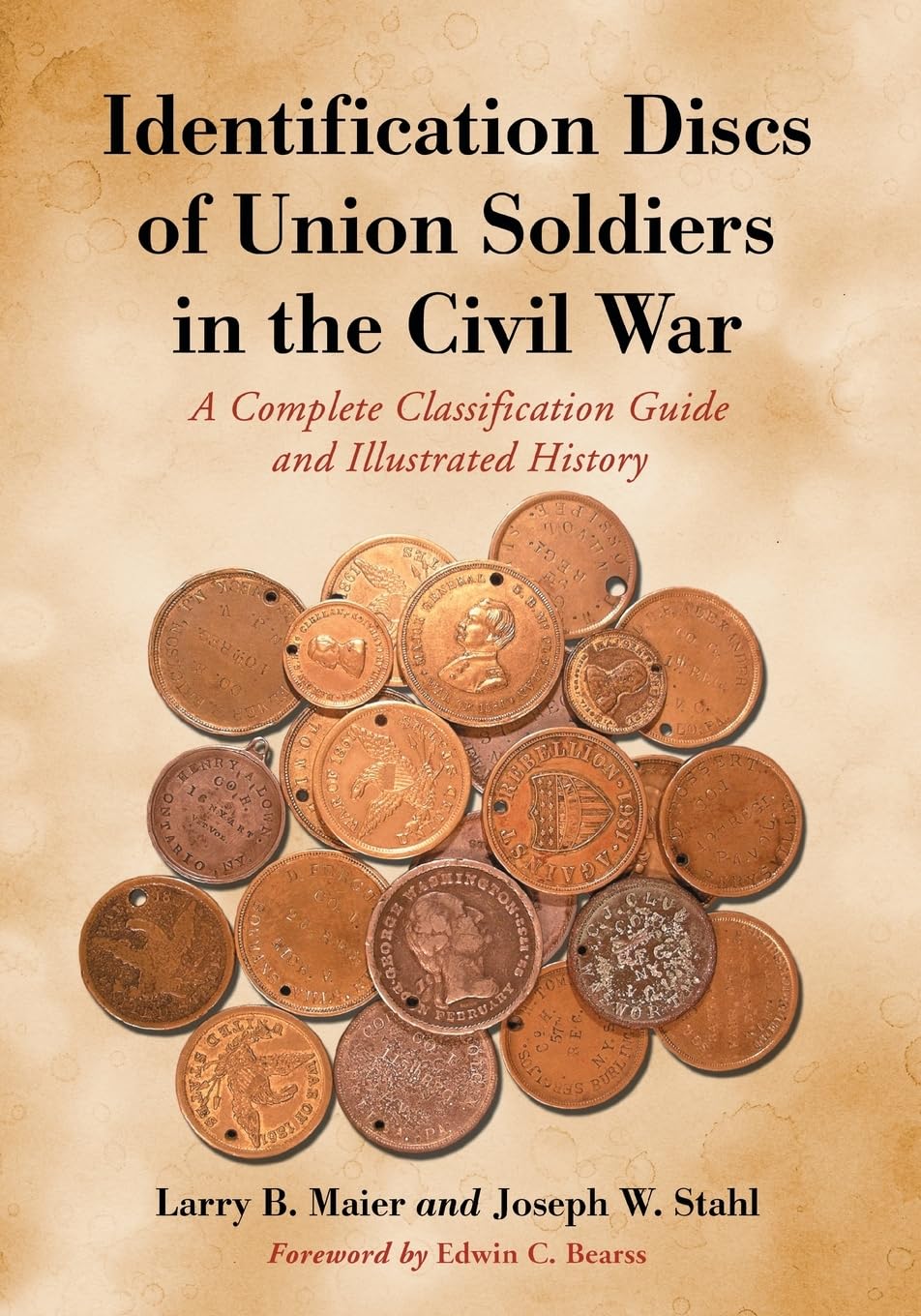
Stahl co-authored with Larry B. Maier the 2010 volume “Identification Discs of Union Soldiers in the Civil War.” They detailed 49 designs, including eagles and patriotic motifs, sold by vendors at camps and elsewhere.

The first thing to note, he said, is such disks were not available to Southern soldiers. Brass was too coveted and used solely in artillery and other military purposes.

Coin and token manufacturers such as Scoville could turn out discs for 5 cents to 10 cents, with a design on the front. They were probably sold to soldiers for less than 50 cents. One side was left blank so sutlers could stamp the buyer’s name and unit. A hole was typically drilled in at the bottom for a string or rawhide. Soldiers sometimes bought two; they wore one and sometimes sent one home as a love token.

Higher-end, more expensive tags made of silver were generally sold to officers. They were often engraved.

Stahl, who has about 110 ID badges, said he began collecting in the early 1980s. The items were affordable while manuscripts and signatures became expensive. 

Legendary Civil War historian Ed Bearss encouraged Stahl to submit articles about individual soldiers and disks to Gettysburg Magazine.

“When I started buying they were a couple hundred bucks.  If you can find something (today) less than $1,000 you are doing good,” said the collector. (At left, reverse of Sgt. Wilson pin at Monocacy, Picket photo)

Stahl warns buyers to be wary of counterfeits.

“The thing that is usually a dead giveaway for a modern reproduction is the fonts on the letters are incorrect.”

He mentioned the letter F as an example. While the originals have a line for the short bar of the letter, forgers might get lazy and punch a small triangle instead. Stahl’s also known of one soldier’s name appearing on tags for different regiments.

Ohio soldier's fate, family history are unknown

Besides digging deeper into ID disks, I wanted to know more about Mathess – but I did not get very far. The 1860 census lists a 25-year-old Edward Mathess from Ross County, Ohio. His occupation is listed as engineer.

Listed with him is a young woman, Notura Mathess, 17, Idia, 1, and William, a baby. I assume they were a family. The only other document I came across was an 1890 military pension request by his father, Obijah (right). I could not glean anything about these individuals.

Edward enlisted in August 1862 for a three-year term. An 1888 volume about Ohio soldiers in the “War of Rebellion” only says he was missing. “No further record found.”

I wondered: Did Edward fall on the battlefield and his remains never found? Was he buried elsewhere? Or did he somehow survive? The latter seems unlikely.

Pvt. Mathess is listed as missing at Monocacy in regimental history, with no further mention
“It is always possible that there are still partial remains on the battlefield, however the vast majority of the dead were removed from the field and buried in Mt. Olivet Cemetery here in Frederick shortly after the battle,” said Monocacy ranger Matt Borders. “The Confederate dead remain there to this day. The Federal dead were disinterred and reburied in Antietam National Cemetery in 1866/67 in time for the opening of the National Cemetery in 1867.”

Mathess does not appear in the roster of Antietam National Cemetery, so most likely he is one of the 1,400 unknowns buried there, Borders told the Picket.

Foundation bought 2 tags, photo of Confederate officer

Bristol said the foundation has purchased two tags – Weigel and Mathess -- and a CDV image of Confederate Col. William Raine Peck, who also fought at Monocacy.

Robinson said the colonel was at Monocacy with Hays’ Louisiana Brigade. “He would have been part of the main effort under Gen. John Brown Gordon's division that assaulted the Federal flank and forced a retreat.”

The image (right) was not signed.

“Given the paucity of Confederate artifacts overall, it is my humble opinion that the Peck CDV is well worth its price, quite possibly appreciating in value as time goes by,” said Bristol.

The tags and Peck photo are in the park’s collection.

“Matt Borders is a sleuth in identifying objects of interest and he has directed us toward those items. I myself am a collector of letters and prints: three letters I own are from Grant, Sherman and Lincoln, respectively,” Bristol wrote in an email.

Wilson’s ID tag was made of silver and Weigel’s made of brass. Vendors who sold these disks priced them on a sliding scale to meet a soldier’s income: Silver, brass to other/pewter, said Bristol.

Upstairs museum finally getting a refresh

The two-story visitor center at Monocacy National Battlefield opened in 2007 and the upstairs museum is due for a refresh, with enhanced technology. Park officials said the museum will  close after December 3 for several months.

One big change will be a new map of the battle and troop movements. The map "will be a projection onto a white surface. Then we don't have to worry about specialty parts breaking that are no longer made," said Evans

The park has made repairs on the feature (Picket photo, left) over the years but it is near its end of life. “We are looking into a second life for the topographic portion of the program. Other elements of the museum that involved any type of technology, which includes at least five exhibits, no longer work," said Evans.

The new map will physically be more accessible. "We are including the action at the Jug Bridge into the battle map as well,” Evans told the Picket. 

The revamped  exhibits will tell a wider story, officials said.

 “We will be focusing on both the civilians and soldiers who were here throughout the Civil War and specifically the day of the battlefield,” said Evans. “Their stories overlap and those relationships are important to the story of Monocacy, and we want to focus on more personal stories,” she said.

Robinson pointed out people were forced at act quickly when war came to Monocacy Junction. That included fleeing to a basement or cellar, hiding valuables and sending away livestock and horses.

The park also focuses on free and enslaved African-Americans whose lives and actions were integral to the battle and the Civil War as a whole. A recruiting station for the U.S. Colored Troops was established at Monocacy Junction.

Among the signature items in the museum are a bullet-struck Bible, a captured Confederate battle flag, Union Maj. Gen. Lew Wallace’s frock coat, cavalry items, an engraved musket and a frock coat worn by the 14th New Jersey’s Maj. Peter Vredernburgh Jr., who survived Monocacy but died two months later at Third Winchester.

"Certain elements, such as the tent/field office set up, and Glenn Worthington watching the battle through the boarded-up windows will be integrated back into the exhibit," said Evans.

The Monocacy visitor center is currently closed on Tuesday and Wednesday.

Friday, November 15, 2024

In the 'things I did not know department but learned at a museum': Likeness of famous Civil War eagle Old Abe was used as logo on Case farming threshers

Tour guide Oro Ball, closeup of eagle logo (Picket photos) and the real Old Abe in 1870s
After an embarrassingly long time without having paid a visit, I traveled with a church group Thursday to the Southeastern Railway Museum in Duluth, Ga. It did not disappoint: Inside and outside are an amazing array of railroad engines, boxcars, cabooses, schedule boards, crew uniforms and much more. We even took a short train ride on a side track.

I was pleasantly surprised to see a collection of commercial and transit buses toward the back.

But what really got my attention near that area was a 1906 Case traction steam engine with a bald eagle embossed on its boiler. 

Tour guide Oro Ball explained the logo depicted Old Abe from the Civil War. I instantly thought of the 8th Wisconsin Volunteer Infantry, which carried the mascot in three dozen battles and skirmishes, including Vicksburg and Corinth, Ms., according to tradition and records.

Honestly, I had no idea Old Abe was the logo of J.I. Case and Company for nearly 75 years and was a fixture on farm equipment across the country.

Old Abe was just weeks old in 1861 when a Chippewa Indian took him from a nest in northern Wisconsin. The bird was subsequently traded to an individual and it ended up with Company C of the Eau Claire Badgers, which later became part of the 8th Wisconsin.

This was about the time Jerome Increase Case, a native of New York, was in Eau Claire on business.

“Company C was on parade, and the eagle’s cry could be heard over the drums. Mr. Case asked a boy where the bird had come from, and he told him Old Abe’s story. Case immediately determined to make Old Abe his business trademark as soon as the war was over,” according to an article in The Post-Journal in Jamestown, N.Y.

(Civil War Picket photo)
Old Abe quickly became a darling of Union troops in the field, who saw his as a symbol of freedom and bravery.

“A perch was built for him of shield shape, with the stars and stripes painted thereon, to which he is attached by a small rope, giving him liberty of his limbs and wings for a distance of several yards,” says the Wisconsin Historical Society. “He became an inspirational symbol to the troops, akin to a ceremonial flag carried by each regiment.”

Col. Rufus Dawes of the Iron Brigade recalled, "Our eagle usually accompanied us on the bloody field, and I heard [Confederate] prisoners say they would have given more to capture the eagle of the Eighth Wisconsin, than to take a whole brigade of men."

After the war, Old Abe lived in the state Capitol and was used for fund-raising efforts. He died in 1881 from smoke inhalation after a fire.

Click to read sign about Old Abe (Picket photo), at right, J.I. Case
As for Case, he got his big start in Racine, Wis., in the early 1840s and he produced threshers and his first steam engine tractor in 1869. Old Abe was adopted as the company trademark in 1865, at war’s end, and it was in use until 1969.

Over time, a globe replaced a branch in Abe's claws and cast iron eagle statues were placed in buildings where Case did business.

The steam engine on display in Duluth is a Case 110 model made in 1906. This was an early form of what would become a tractor. A version in the Manitoba Agricultural Museum in Canada says they were designed for “heavy plowing, threshing and freighting – for all kinds of work necessitating a large amount of horsepower.”

The farm equipment company is known today as Case IH.

And now I know the rest of the story.

Tuesday, November 12, 2024

A history sleuth from Michigan wanted to know: Was Wallace W. Wight of the Iron Brigade buried at Fredericksburg? He and a park researcher figured it out

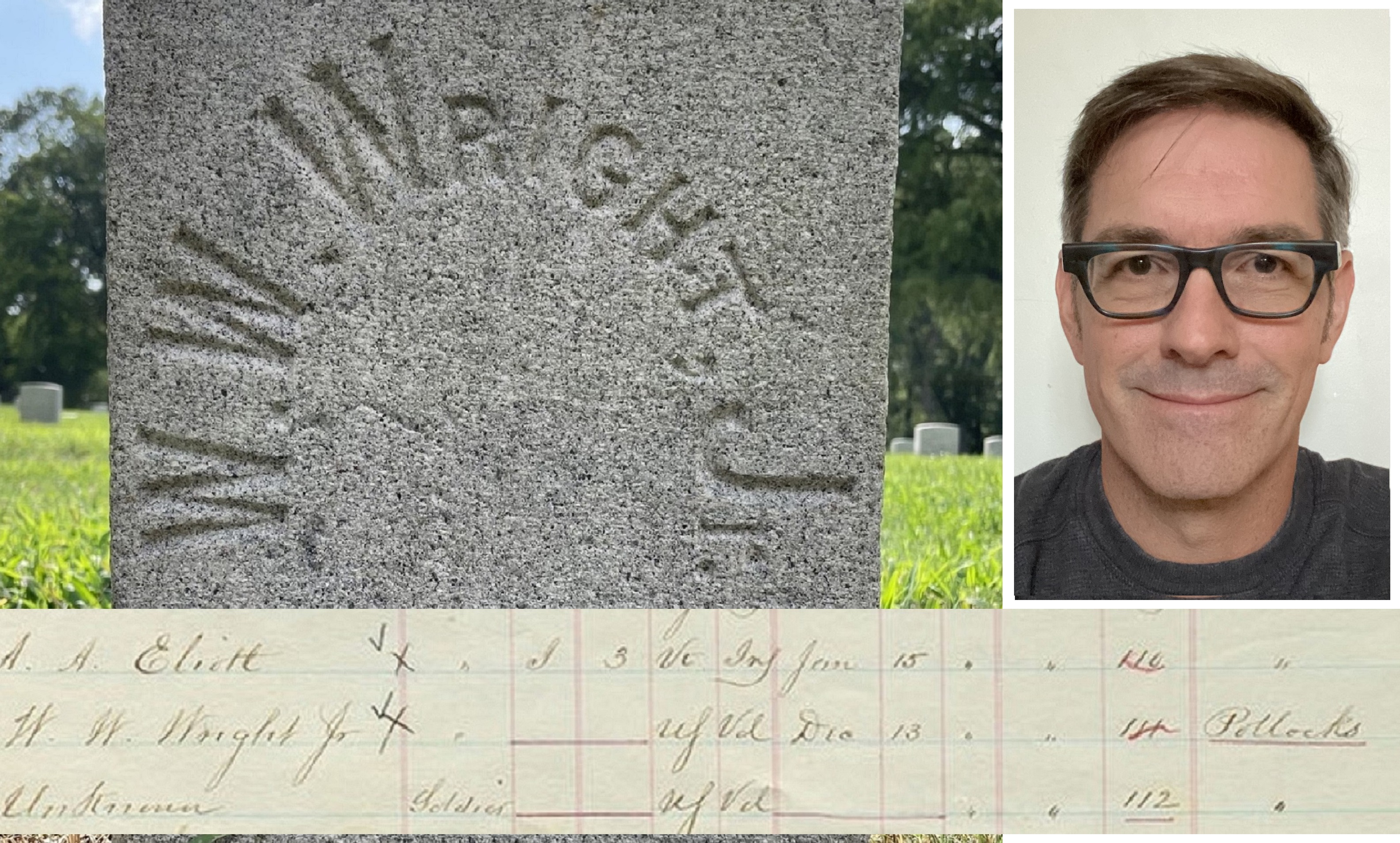
The grave in question (Peter Maugle/NPS), the registry for a W.W. Wright Jr. and citizen historian Mark Fischer
The recent identification of graves for two
Iron Brigade soldiers killed near Fredericksburg, Va., is due to persistent research by a citizen historian and a retired FBI researcher who dug up an 1870 newspaper article that provided crucial information.

Officials credit Mark Fischer of Livonia, Mich., and Steve Morin, a volunteer at Fredericksburg and Spotsylvania National Military Park, for gleaning information used to properly identify the graves of Sgt. Wallace Winfield Wight of the 24th Michigan and Pvt. John S. Waller of the 19th Indiana.

Wight’s grave at Fredericksburg National Cemetery has the wrong surname and Waller’s has only initials (photo below by Peter Maugle/NPS). Records now have been updated to show who lies beneath each stone. 

The turning point in the quest for identification was the discovery of a Detroit Free Press article, something the park said was akin to finding a needle in the haystack.

The effort is remarkable for a number of reasons, starting with how it came to be. Usually, the park initiates an ID search, sometimes from markers that might only have initials or scant information.

An email from Fischer to the park in 2023 was an exception to the rule.

“What makes Wight unique is someone out of the blue contacts the park on his own mission. He started with a name, we start with a grave,” said park historian and ranger Peter Maugle. “This has happened only one other time (to) my knowledge.”

Wight’s headstone at Fredericksburg National Cemetery is mislabeled as W.W. Wright Jr. -- one letter off from Wight. While one would think the mystery should have been solved easily, it took some digging for everything to add up, Maugle told the Picket.

Both soldiers were members of the Army of the Potomac’s Iron Brigade, known for its unflinching courage and high casualties during the war. They were known for wearing black felt Hardee hats.

The brigade, made up of several Midwestern regiments saw limited action at Fredericksburg, but was bloodied at First and Second Manassas, Antietam, South Mountain and Gettysburg. (Iron Brigade hat, below, worn by Elmer D. Wallace, 24th Michigan //  University of Michigan Bentley Historical Library)

While cemetery records have now been updated for Wight (Grave 4953) and Waller (Grave 5588), officials say the discoveries are not definitive. Without DNA samples, it is impossible to formally identify any of the 12,000 soldiers marked as unknown at Fredericksburg.

“We feel like this is 99.9% accurate,” says Maugle of Wight’s identity. “We don’t exhume.”

The headstones will not be corrected, due to their historical nature and other factors. (More about that below).

Fischer’s research actually began with Wight’s father, an officer in the same regiment and who is buried in Livonia. A nearby stone with Wallace Wight’s named appeared to be a cenotaph -- an empty grave for someone who is believed to rest elsewhere. But that was not a certainty.

Fischer reached out the park, wanting to know whether the younger Wight rests there. “I could not find an obituary for Wallace that would have suggested his remains” had been taken home to Michigan.

That first contact did not prove fruitful because park officials could not find a Wight in their cemetery records (though the register did show a Wright, as later research came to show). So Fischer kept at it, looking at diaries, letters and old newspapers.

Subsequent correspondence between Fischer and Morin led to the latter eventually finding the Detroit article, which broke the whole story open.

The lengthy article in December 1870 about a Grand Army of the Republic reunion included information about the deaths of Wight, Waller and other men in 1862 and 1863.

It said the meeting was the second of the regimental association and involved toasts and speeches, resulting in a "pleasant and successful" gathering at Young Men's Hall in Detroit.

After the Wight identification, Morin was able to do the same for Waller, whose grave is marked simply “J.S.W.”

Maugle credits Fischer for instigating the gathering “of the pieces of the puzzle.”

“This guy figured it out for us. He was persistent.”

He became curious about graves in his Michigan town

Fischer, 52, grew up in Ann Arbor, Mich., and lives in Livonia, where he works in IT.

When he and wife moved back to Livonia from Pennsylvania, Fischer stopped by a “cemetery that I have driven by thousands of times.”

He saw the 24th Michigan on several tombstones. The regiment had fought at Gettysburg. “That struck a chord with me.” Among those buried there was Lt. Col. William Walker Wight (photo below is cenotaph for Wallace W. Wight, courtesy Mark Fischer)

A self-described books guy, Fischer dug into histories, learning the father, then a captain, recruited his son, Wallace, and commanded him at Fredericksburg with Company K. (Another son, Gurdon, was wounded and survived the war.)

Fischer got service records from the National Archives. “The central question to me was, did Wallace make it home?”

He could not find any documentation. The fact that the marker in Livonia is shared with a brother-in-law and is not a government-provided stone made him curious whether Wallace Wight was buried at the Fredericksburg cemetery or nearby.

Morin asked for photos of Wallace’s grave. “The appearance of stone led him to think it to be just a marker.”

Wallace’s cenotaph is about six feet from his father’s grave and close to that of his sister. The marker also lists his brother-in-law, according to Fischer.

“How does the father lose the son and carry on? That is what I am trying to understand.”

Fredericksburg team's dogged pursuit to honor dead

Over the years, Maugle (right) and his team have been able to “better” identify about 200 graves at Fredericksburg. The process comes with a host of challenges.

First off, those who opened and operated the cemetery 160 years ago had little time to pursue identification, and there was no national cemetery system.

Remains -- sometimes only a few bones – arrived in dribs and drabs between 1866 and 1868. Most came with no name or, as possible in Wight’s case, with a weathered wooden marker. Stone markers did not replace wooden ones for several years.

The park pointed out in a Facebook post in September no soldier with the name Wight appears on Army rolls or casualty lists. The soldier and several comrades were killed on Dec. 13, 1862, and buried twice, including at Pollock’s Farm in Stafford County, before Wight was moved to Fredericksburg National Cemetery.

The graves at Fredericksburg were wooden until the mid-1870s (NPS).
Maugle told the Picket the wooden marker placed above Wight had to survive three years until reburial parties cam. “It may have been degraded until it is barely visibly.”

Morin wrote in his report about the grave it is possible that the misinterpretation of the surname ‘Wight’ as ‘Wright,’ sergeant as private and the missing company and regimental designations could be due to the grave marker’s exposure to the Virginia elements for several years, particularly if the inscriptions were written in pencil.

Initial emails led to no match for soldier

Most soldiers did not carry ID tags and unlike at other Civil War cemeteries, Maugle said, few of the Union soldiers passed away at nearby hospitals, where identification would have been easier. “They were buried on the field very hastily.”

The Fredericksburg cemetery has dead from four major battlefields and names were entered on the register – which, of course, is unsearchable – apparently when they arrived.

In Wight’s case, he was listed in the register as W.W. Wright Jr., along with a notation of burial at Pollock’s Farm prior to relocation to Fredericksburg. No regiment or rank was listed and the soldier was mistakenly identified as a private. The notation says “US Vol.” (Click image, courtesy NPS, to enlarge. Wright is near the bottom)

When Fischer first contacted the park, they only discussed a soldier named Wight. No one brought up the possibility of him being listed as Wright. Officials searched the register for anyone with the 24th Michigan and the name Wight. No match.

Unfortunately, no one had yet seen the newspaper article, which showed the sergeant was buried at Pollock’s Farm before the postwar move of remains to the current cemetery.

The email exchange ended in a dead end. “We kind of threw our hands up,” said Maugle.

Fischer got back to work.

One find led to another, to another, to another

Sgt. Wallace Winfield Wight, 18, and several others in the 24th Michigan were killed on December 13, 1862. He and at least one other soldier were believed to be decapitated by a Confederate shell.

Wight’s remains were recovered by his father (left).

The history of the 24th Michigan by O. B. Curtis says, "It was truly a mournful event when the Captain of Company K, that night, searched for the trunkless head of his son upon the battlefield, while the canister was whistling above him, and placed it with the young boy's remains for burial."

The men were first buried on the south side of the Rappahannock River.

“During the Chancellorsville campaign, his body was disinterred on April 30, 1863, and reburied at the Pollock House on the north side of the river. According to a May 1, 1863, letter written by Sullivan Dexter Green, Company F, 24th MI, Sergeant Wight’s grave was still fully marked when his body was moved.” Morin wrote. “Diary entries written on June 10, 1863, by Lieutenant Colonel Mark Flanigan, 24th MI, detailed a visit he made to the grave of ‘W.W. Wight, Jr.’ near the Pollock House on the north side of the Rappahannock River.”

Much of the above information was researched by Fischer and relayed to Maugle and Morin (right, NPS photo), who then found the newspaper article. Fischer said Green was essentially an embedded reporter for the Free Press while serving with the regiment.

Maugle said the newspaper article, while it does not mention the Pollock house by name, makes reference to "the hospital building ... on the opposite side of the road near the bank of the rive," narrowing it down. 

At that point, the park thumbed through the register looking for burials at Pollock’s Farm.

They came across W.W. Wright Jr.

“That name stuck out then,” said Maugle.

Bingo.

The mislabeled Wright marker includes a “Jr.”, likely because the teen and his father had the same initials.

Morin then turned his attention to Waller, whose grave is marked “J.S.W.”

According to the park, his grave lies between two casualties from the Army of the Potomac's crossing of the Rappahannock River at the outset of the Chancellorsville campaign in late April 1863. Cemetery records indicate the occupant is a U.S. soldier who died in 1863 and was initially buried at Fitzhugh's Farm in Stafford County.

Overlay shows Pollock's Mill/Farm in center, farm of Henry Fitzhugh (NPS)
“The 1870 article lists the names of several soldiers originally interred at the farm. One of them, Private John S. Waller of the 19th Indiana, fit the description and is likely the occupant of this grave. Cemetery records were updated to reflect that deduction.”

There are no known photos of Waller or Wallace Wight.

Why the NPS does not alter historic markers

When the park publicized the Wight story in September, some commenters asked why his marker could not be replaced with appropriate information.

In a nutshell, National Park Service policy does not allow the altering of historic gravestones due to errors of fact.

Lt. Col. Flanigan wrote about visit to Wight grave at Pollock's Farm (NPS)
Maugle said one reason is the cost and labor for replacing them. Some would receive a stone with a newer design, affecting the historic nature of the original.

There are some exceptions, such as if a tree fell and destroyed a marker.

There is another reason – going back to the concept that identification cannot be 100 percent confirmed. “What if someone comes in and says it belongs to someone else. We are in a quandary and we decided to make an adjustment to the grave,” said Maugle.

The citizen historian is invited to memorial event

Back in Michigan, Fischer wants to concentrate on what started this journey – a biography of William Walker Wight.

“Researching the father is how I became aware of the uncertainty about his son's final resting place,” he said. “A father lost his son under extraordinary circumstances.”

Lt. Col. Wight soldiered on as an officer – he was wounded at Gettysburg -- a citizen and a patriot.

Fischer has been invited to the park’s 2025 Memorial Day activities, notably a May 24 luminaria. Some 15,300 candles will be placed in bags to brighten the Fredericksburg National Cemetery. (Photo NPS)

Maugle said Fischer will primarily speak about Wallace Wight’s life and service.