Wednesday, August 7, 2024

At Nashville's renovated Sunnyside mansion, you can look through windows at Civil War battle damage, view artifacts found in rifle pit and click to cool 3D images

Augmented reality view of Sunnyside and reveal windows showing battle and bullet damage (MNHC)
Visitors to Nashville’s Sunnyside mansion, which was struck by bullets from a Federal assault during the Civil War, now have a variety of ways – including the use of augmented reality – to experience the site’s rich history.

Built in 1852 in what is now Sevier Park, Sunnyside and a connected log cabin have undergone an extensive rehabilitation since 2022. While visitors can see the outside of the home and peer through windows to see the cabin logs and bullet damage, offices of the Metro Nashville Historical Commission open to the public Aug. 19.

Sunnyside’s main room now has architectural and historical displays; interpretive markers outside cover its early history, enslaved people, the Battle of Nashville, later owners and the 20-acre Sevier Park, near the 12South neighborhood.

“It is truly exciting to see how much history we were able to recover and to provide to the public,” said Adam Fracchia, an archaeologist with the commission. “The aim is to tell a wider story.”

Bottom floor of extension (ell) has five small windows showing bullet damage (MNHS)
I first spoke with Fracchia last year about a project involving Nashville police and archaeologists. The team has been analyzing the trajectory and proximity of gunfire from a Union attack from the north and west during the Dec. 15-16, 1864, battle. They wanted to solve the mystery regarding embedded bullets and holes discovered last year in the cabin walls. 

It has long been known that dozens of bullets, including Minie balls, were left on the porch door and columns on the big house at Sunnyside, which was occupied by Confederates. They were eventually forced to retreat.

A rifle pit was found during the renovation, along with evidence of a trench. A new display case in the commission’s main room has artifacts from the battle, including percussion caps, melted lead and burned iron nails found in the rifle pit.

A ribbon cutting and open house was held in mid-July (MNHC photo)
The commission, working with partners, has created Nashville Sites, which provides overviews of city fixtures, with text, audio and virtual tour options. “We want them to get an understanding of what the building looked like,” Fracchia said of Sunnyside

The tour menu includes civil rights, a Civil War driving program, downtown Nashville and certain neighborhoods. The tour on Sunnyside covers its history since indigenous dwellers.

“Recovered artifacts from the pit, like burned nails and charcoal, suggest that soldiers made fires to stay warm using wooden planks from the side of the house or outbuildings After the battle, Sunnyside was used as a field hospital for wounded soldiers.”

I called Fracchia (left) this spring and we have since communicated via email about the renovation. His responses to my questions have been edited for brevity:

Q. What is your overall impression of the work and how it adds to the story of the site? You told me the new exhibits/upgrades will tell a wider story.

A. The renovations at Sunnyside attempt to preserve as much of the building as possible while making the mansion a usable office space for the Metro Historical Commission.  Along with the renovations, we have added several features to the site to allow interpretation of the long history of the property.

We have added six interpretative panels telling the history of the site from its Indigenous inhabitants to the Civil War to the modern urban park. One of the panels also discusses the details we know about the peoples enslaved at Sunnyside. With three of these panels we have added augmented reality views of the building to allow visitors to use their phones to see what the building may have looked like at different points at time. The tour is also available digitally as a Nashville Sites tour.
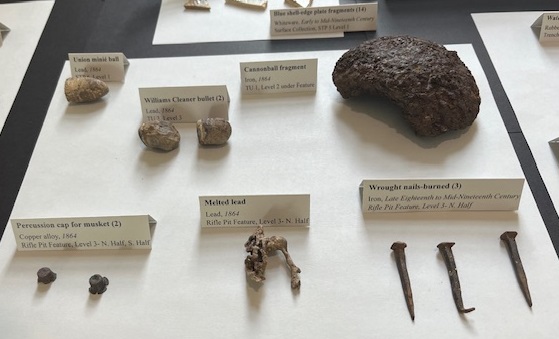
(Clockwise, top) Bullets, artillery fragment, wrought iron nails, melted led and percussion caps
We were able to add Plexiglass windows to the log cabin façade to show some of the damage to the cabin from the battle. One of the log outbuildings will receive additional interpretative panels and a glass window in the floor so that a pier and a log sill plate will be visible.

Additionally, in the office, we have added an exhibit case of the artifacts excavated in the last 1.5 years ahead of the renovation and a wall of historic architectural pieces from Nashville. We hope that another exhibit case could be used as a floating exhibit in other locations.

Q. How many static exhibits are in the renovated office? Can you tell me the range of topics they cover?

A. The display case has artifacts from 3,000 to 5,000 years ago to the mid-20th century and is meant to cover the history of the site. This includes artifacts from the Civil War. The architectural wall has several different architectural elements that were salvaged or donated from around Nashville.

Civil War Williams Cleaner bullets and iron nails found last year in rifle pit (MNHC)
Q. What specifically from the Civil War-era/the battle are now on display, and in what context?

A. On display, we have artifacts recovered from the battle such as bullets as well as melted lead, burnt nails and percussion caps from the rifle pit. We recently found more artifacts during the removal of the roadbed in front of the mansion. We recovered fragments of a cannonball, top of a tent stake, a gun tool and bullets.

Q. Are any of the interpretive displays outside, or they all inside, or a mix? You mentioned there might be five-six panels. Does one pertain to the Battle of Nashville?

A. All artifacts are inside the building but we have the five panels on the north face of the log cabin that show bullet damage and projectile damage. People can also see the construction of the log building including different chinking material and Roman numerals used to match the logs.

Q. You said three of the panels might have QR codes and viewers will be able to use their phones to move. Can you describe, please?

A. One of the AR (augmented reality) images shows the building in 1864 with lines representing the bullet trajectories. These AR images are now accessible and were built in collaboration with the MHC and the Vanderbilt Institute for Spatial Research.

Q. Do any of the new features tell the story of a specific person/people related to Sunnyside’s history before, during or shortly after the battle?

A. We tried to focus on the enslaved persons and later owners with the panels, specifically, Granville Sevier and Dr. L. G. Noel.  

Q. Can you tell me about the two cabins that were at Sunnyside during the Civil War?

A. The historic building had a historic ell (perpendicular building extension) that had fallen into disrepair. Inside the ell, there were two log cabins, one of which had to be partially deconstructed. The other log structure was incorporated into the new building that is connected via a glass connector and serves as a conference/meeting room.

One of six interpretive markers surrounding the mansion and buildings (MNHC)
Q. Anything recent on the police and forensic examination and analysis of the bullet trajectories?

A. We are trying to find more information on the battle at Sunnyside and determine the distance at which the Union firing lines were at. We hope we can find information from a metal detection survey in the fall.  We received a grant from the Tennessee Historical Commission to conduct a systematic and metal detector survey with the public.

Q. Anything new on the dendrochronology of the timbers used in the cabins? You told me at least one building had wood felled from the winter of 1823-1824.

A. We have not received any update on the dendrochronology yet. 

---------------

Postscript: Work at Sunnyside will continue into the fall. One area is what was believed to be the original smokehouse but, instead, is a domestic structure from the 19th century. “When we test below the floor we found evidence of earlier piers for another building,” said Fracchia, adding there were household artifacts and a trash pit. An investigation of that area will continue, as well as the reconstruction of a summer house near the well, the city says.

The commission also had this tidbit in its August "History Gram":

"The removal of the gravel roadbed around Sunnyside has exposed more history of the park. Artifacts from the Civil War were recovered just below the gravel, including cannon ball fragments, a bullet, tent hardware, and a gun tool (right). These artifacts were uncovered directly in front of the mansion along with charcoal stains in the soil which indicate the location of a Federal or Confederate encampment likely associated with the Battle of Nashville."

The items will be treated and eventually displayed.

---------------

Guidelines for visiting Sunnyside mansion

“When you visit the park, start at the pedestrian entrance near 12th Ave. S/ Granny White Pike and read the historical marker, then follow the path around the house to see all six interpretive panels, as well as the viewing windows to the original cabins (now in the rear ell of the building) and the interpretation in the log outbuilding (formerly called the Smokehouse).

You can scan the QR codes on the panels to learn more about each era of Sunnyside’s history through the Nashville Sites walking tour; some of the panels also have 3-D augmented reality (AR) models so you can picture yourself in the past.

“Feel free to enter the office lobby Monday-Friday from 7:30 am-4 pm. Additional photos, artifact  and brochures are available there. The rest of the house is not open to the public or available for tours. Public restrooms are available behind the house in the white building between the log outbuilding and the Carriage House café."

Architectural features and cabin door at Sunnyside (Photos MNHC)

Sunday, August 4, 2024

The little-remembered ironclad Tecumseh was sunk by a mine 160 years ago. Farragut then ordered 'Damn the torpedoes!' His ships rallied and took Mobile Bay

The Tecumseh buoy is off Fort Morgan; Dauphin Island is in background (Civil War Picket photo)
In mid-April, I traveled with my wife and mom to Gulf Shores, Ala., for a few days away from the hustle and bustle of metro Atlanta. We enjoyed views of Little Lagoon from our porch, nibbled on seafood and, of course, enjoyed the bright sand and blue-green sea.

We added a dollop of Civil War adventure one day, as my wife and I stopped by Fort Morgan on the west end of the peninsula before taking a ferry across Mobile Bay to a reenactment at Fort Gaines -- another Confederate fort -- on Dauphin Island.

From the Fort Morgan State Historic Site parking lot, we walked toward the narrow beach that on Aug. 5, 1864, was right in the middle of the Battle of Mobile Bay. Rebel guns thundered at a Union flotilla just a few hundred yards away. Adm. David Farragut was intent on disabling or sinking the CSS Tennessee and other ships, taking control of the bay and bringing an end to blockade running to and from the port.

USS Tecumseh hits a mine and sinks; Rebel ships are to the left (Library of Congress)
“Where is the USS Tecumseh wreck site?” we asked a park employee who was painting part of a large 32-pounder gun. He pointed toward the beach and signaled we should not expect to see much.

We passed a family that was fishing and eventually saw a multicolored buoy about 300 hundred yards offshore, between channel markers. Mobile Bay’s signature oil platforms and Dauphin Island were in the distance.

Is that the spot where 93 Tecumseh sailors and their commander perished when the ironclad monitor had the misfortune to hit a Confederate mine and sink within minutes, perhaps even 30 seconds?

There’s no sign or marker on the beach, but when I zoomed in with my iPhone camera, I saw a large white “T.”

USS Tecumseh model and Confederate mine replica at Fort Morgan museum (Picket photos)
As we stood there, and in the months since, I have thought about the incongruity of this grave and its recreational and commercial surroundings. It’s hard sometimes to put things into perspective.

I will be thinking Monday of the sacrifice of these men and the valor of the sailors on both sides who clashed near Fort Morgan 160 years ago on that day.

Although the state park has a few relics and a model of the USS Tecumseh in its visitor center, and a sign atop a west-facing parapet mentioning its loss, I wondered whether many folks know the story of the brave crew that led the Union charge.

Americans certainly are familiar with Farragut’s line, “Damn the torpedoes, full speed ahead.”

Less known and among Civil War historians and enthusiasts are the reported last words of Tecumseh Commander Tunis Craven (left, photo Library of Congress) moments before the monitor slipped beneath the waves (more on that later in the blog).

This week, I came across an Emerging Civil War blog post that summarized my thinking better than any words I can conjure.

Editor-in-chief Chris Mackowski wrote about the loneliness and constancy of the buoy, which is maintained by the U.S. Navy as a war grave. The site is protected by the Coast Guard.

He mentioned what a colleague wrote: There are no memorials at sea to Civil War sailors who died in combat.

“The buoy used to be farther offshore, but the shore itself has crept closer during the past 159 years,” Mackowski wrote in August 2023. “How can someone lost at sea ever get back to land when the land itself keeps moving?

“That lonely offshore buoy serves as a kind of exception to (the) rule. Something does mark the graves of those men lost at sea. But unless you know what that buoy is, you don’t know it’s a grave marker, a monument, a memorial. Thirty feet below, ninety-four men lay entombed in a capsized iron hulk.”

Why the Navy decided to sail into Mobile Bay

I asked Andy Hall, A Civil War naval expert and author, for his thoughts on the battle and the USS Tecumseh, which he says is shown on modern charts as an unnamed wreck.

“Mobile Bay is an interesting action, and it doesn't get as much notice as it warrants. (None of the naval stuff does.),” he replied in an email. “Mobile was the last port of significance in the Gulf of Mexico that was supplying the Confederates in the Western Theater. Galveston (Texas) remained accessible through the end of the war, but it was honestly too far removed to be of great consequence in the conduct of the war itself.”

American Battlefield Trust map provides overview of campaign
Farragut’s brazen assault was one half of a Union operation. Troops landed on Dauphin Island and laid siege to Fort Gaines, which had few ships to help in its defense. Confederate Col. Charles D. Anderson had half his infantry foe’s number. (Hall wrote about Anderson in his Dead Confederates blog.)

“He is something of a heel among the Confeds for surrendering, but it you read the detailed accounts he really had little choice, with disaffected and near-mutinous troops,” said Hall. “Anderson surrendered his sword to Farragut, who later had it returned to Anderson in respect for his defense of Gaines.”

Hall said the fall of the bay marked a jump in large-scale blockade running in Galveston, which is his focus.

We attended an April battle reenactment at Fort Gaines (Picket photo)
“Denbigh was one of the last runners out of Mobile in 1864, and was destroyed as one of the last two runners trying to get into Galveston in May 1865. I was part of the project that excavated that ship in 1997-2004.”

After the fall of Fort Gaines, Yankee troops moved on Fort Morgan across the bay, forcing its surrender on Aug. 23, 1864. (The state park had a 160th anniversary living history on Saturday, Aug. 3.)

Mobile was heavily fortified and the Union command moved on after securing the bay. The city surrendered in April 1865, three days after Appomattox.

Ironclad braved minefield to protect wooden ship

In its rather brief life, the Tecumseh first experienced Confederate mines and obstructions during operations in the James River in Virginia. Thomas E. Nank, in two articles for the American Battlefield Trust, provides copious details on the “Forgotten Monitor.”

The Union Navy was intent on neutralizing CSS Tennessee, shown after the war. (U.S. Navy)
Before Mobile Bay, Farragut asked for more monitors to challenge the Tennessee and other Confederate warships. The Tecumseh was sent south, and it needed engine work twice on way, including in Pensacola, Fla.

Between 16 and 18 Federal ships, in two lines, would storm past Fort Morgan, trying to get under the guns, enter the bay and take the fight to opposing ships. Craven, who had expressed some doubts about the effectiveness of monitors but agreed to serve, was first in line on Aug. 5.

The commander, as he entered a mine field, decided to make a turn so he could take on the CSS Tennessee and protect USS Brooklyn, a wooden vessel that had faltered amid gunfire from Fort Morgan and the Confederate ships nearby.

Sign on Fort Morgan parapet describes battle, loss of Tecumseh; buoy is beyond (Susan C. Gast)
While Confederate mines were often faulty, at 7:40 a.m. a torpedo (or mine) detonated on the starboard side, according to Nank. The ironclad rolled over to port as water rushed in and panic ensued.

Gunners mate Samuel Shinn, one of about 20 survivors, wrote, “It seemed as if we were lifted right out of the water. At the same time, a blinding flash like lightning came through the porthole. A large hole was stove in the vessel's side, and the men below commenced to cry that the vessel was sinking.”

'After you, pilot.' Chivalry amid disaster

Almost all men below deck on Tecumseh were doomed, but Craven and a few others who were in the turret, pilot house or elsewhere topside had a chance.

Alfred R. Waud's account of Craven's heroics (Library of Congress)
Civil War historian and author Ronald S. Coddington wrote two articles about the USS Tecumseh in his Military Images magazine. He and Hall make special note of what its commander said as the vessel was in its death throes.

Craven and civilian harbor pilot John Collins, in the conning tower or pilot house, stepped toward a ladder that would take them to safety. “After you pilot,” said Craven, who never made it out an drowned in the maelstrom. His act of chivalry is venerated in the annals of naval tradition.

In the March 2020 issue of Military Images, Coddington laid out other versions of what Craven said. He included excerpts of a poem that detailed the officer’s chivalry and sacrifice. (At right, Tecumseh paymaster George Work / Library of Congress)

Collins, quoted in the 1888 “Battles and Leaders of the Civil War,” said after he spoken with the skipper, “When I reached the upmost round of the ladder, the vessel seemed to drop under me.”

In another telling of the story, Coddington wrote, Craven yelled to Collins, “You first, sir.” 

An 1879 account of the encounter offers another version of events. It appeared in “A Sketch of the Battle of Mobile Bay” by William F. Hutchinson, assistant surgeon of the sloop Lackawanna.

“Captain Craven was already partly out, when the pilot grasped him by the leg, and cried ‘Let me get out first, Captain for God’s sake; I have five little children!’ The Captain drew back, saying ‘Go on, sir,’ gave him his place, and went down with the ship while the pilot was saved.”

Farragut's sailors regrouped and won the day

After the Tecumseh sank, amid "immense bubbles of steam, as large as cauldrons," Farragut realized his mix of wooden and iron vessels, now in disorder, had to plow ahead.

William H. Overend's 1883 painting of the USS Hartford at Mobile Bay (Wikipedia)
“The vision of Farragut lashed with rope to the rigging of his flagship Hartford is indelibly etched into the American memory,” wrote Coddington. “His stirring words, paraphrased as ‘Damn the torpedoes, full speed ahead,’ are part of our national vocabulary.”

The Federal fleet went on to victory, capturing the Tennessee, while other Rebel ships slipped away, were captured or sank. Admiral Franklin Buchanan, commander of the Confederate fleet, was on the Tennessee and was gravely wounded and captured. (The conquest of Mobile Bay also gave a huge boost to President Abraham Lincoln's re-election bid.)

In a brief congratulatory order issued the next day, Farragut paid tribute to Craven, paymaster George Work and their crewmates, Military Images detailed in December 2014.

“It has never been his good fortune,” Farragut stated in the third person, “to see men do their duty with more courage and cheerfulness, for although they knew that the enemy was prepared with all devilish means for our destruction, and though they witnessed the almost instantaneous annihilation of our gallant companions in the Tecumseh by a torpedo, and the slaughter of their friends, messmates, and gunmates on our decks, still there were no evidences of hesitation in following their commander in chief through the line of torpedoes and obstructions.”

Gunner Charles Baker, serving on the USS Metacomet, helped save 10 Tecumseh crewmembers while under fire and later received the Medal of Honor (photo above, U.S. Navy)

Protection and dignity for a war grave

After the war, Tecumseh families railed against granted salvage rights, and the wreck was left undisturbed for a century. Heather Tassin, site manager at Fort Morgan, says the site is believed to be the largest maritime war grave in the continental United States.

A Smithsonian Institution expedition in the 1960s rediscovered the wreck, and surveys were later conducted, including one in 2018. There was talk of raising the Tecumseh, but it never happened. The Naval History and Heritage Command has about 65 artifacts from the wreck, according to an article. Items include ceramics, ship fittings and hull and deck plank samples.

The NHCC said a management plan continues protection and preservation of the site.

"It is a common misconception that anyone can dive on the Tecumseh," Tassin told the Picket in an email. "No one is permitted to dive on the Tecumseh. It is respected and protected as a war grave."

(Atlas of the Official Records, Plate LXIII, map 6)
A 1975 National Register of Historic Places form says most of the wreck (circled in green above) was covered in mud. "It was this coverage of silt which has given the ship and her contents protection against the ravages of underwater encrustation."

The federal government does periodic remote sensing to monitor the Tecumseh and ensure that it is still protected by anaerobic mud, said Tassin. Alabama officials monitor the work.

Any proposed research would require a permit from the Alabama Historical Commission and the Navy. “There would have to be a very compelling reason to conduct said research because of the Tecumseh’s status as a war grave and the fact that it has been investigated in an archaeological study in the past,” said Tassin.

In his Emerging Civil War article, Mackowski wrote about memorials to the USS Arizona (Hawaii), USS Indianapolis (Indiana) and USS Monitor (Virginia) – places where people can walk to, unlike the Tecumseh.

“But in those moments I stood at the mouth of Mobile Bay off the shore of Fort Morgan, I heard that lone buoy speak volumes. It reminded me of all the stories lost at sea, untold, unremembered. There are no monuments on the ocean.”

Friday, July 26, 2024

"Fighting Joe" Wheeler slept here in Newnan, Ga., after likely his finest day in uniform -- at Brown's Mill. The cavalry clash anniversary will be marked Saturday

Wheeler, fought at Brown's Mill, lower right) and stayed at Buena Vista (Picket photos and Library of Congress) 
Twenty-four hours of hard riding while chasing a large Union cavalry force paid off for Confederate Maj. Gen. Joseph Wheeler and his outnumbered troops on July 30, 1864, when they routed the Yanks at Brown’s Mill, a few miles outside Newnan, Ga.

After the battle, “Fighting Joe” – wearing a blacked plume hat, gray uniform and red sash, according to observers – tiredly rode back to Newnan and Buena Vista. He walked up the stairs at the home of Confederate officer Hugh Buchanan, a future congressman who was in Virginia with Phillips' Legion and recovering from a combat wound to his lung.

Wheeler's men were still in pursuit of the remnants of the Federal command, but the cavalry leader, just 27 years old, needed time to regroup.

Wheeler, according to legend, asked to use the home as his headquarters. Buchanan’s wife, who had hidden their children in the cellar during the day, happily obliged upon realizing there weren't Union troops outside. Mary Buchanan offered Wheeler and staff food and use of the dwelling.

“Shown to the study, Wheeler sat down behind a big plantation desk, spread his maps before him, and fell asleep,” historian David Evans wrote in his seminal “Sherman’s Horsemen: Union Cavalry Operations in the Atlanta Campaign.”

One of about a half dozen interpretive markers at Brown's Mill (Picket photo)
There was no real rest for the weary. Wheeler was back in the saddle the next day, and pressed his officers about the successes and failures of the pursuit as Union survivors tried to get back to safety near Atlanta.

Charlie Crawford, president emeritus of the Georgia Battlefields Association, said the Battle of Brown’s Mill was probably Wheeler’s best day in Confederate uniform, although the soldier is also recognized for his service at Shiloh and Perryville by protecting the Rebel army's rear guard during its retreat.

If Nathan Bedford Forrest was the “The Wizard of the Saddle,” perhaps Wheeler should be dubbed the “Prince of Pursuit.”

Some 160 years after the clash, the Brown’s Mill Battlefield Association will host a public commemorative gathering at 7 p.m. Saturday at the site. The Coweta County park is just a few miles from picturesque Newnan, which was home to a half dozen Confederate hospitals during the Civil War.

“As for General Wheeler, I think his relentless pursuit of McCook's Raid was nothing short of remarkable,” Evans has written. “Outnumbered, outgunned, and hopelessly outdistanced, he rode down, routed, and scattered what he called ‘the most stupendous cavalry operation of the war.’”

Union Maj. Gen. William Sherman had tasked Brig. Gen .Edward McCook (left) and Maj. Gen. George Stoneman with cutting vital railroads south of Atlanta so that he would not have to engage in a prolonged siege of Atlanta. McCook, after damaging some track at Lovejoy Station, hoped to rendezvous with Stoneman. He had nearly 3,000 men under his command.

But Stoneman had chosen to ride toward Macon, with the hope of reaching the large Confederate prison at Andersonville to the south. 

With no rendezvous, McCook hurried toward the Chattahoochee River and Federal lines to the north. Early the morning of July 30, after skirmishes at Line Creek and Shake Rag, troopers of the 8th Indiana rode into Newnan. They were surprised to find dismounted Confederate cavalry at the railroad depot. McCook decided to avoid battle and continue his push for the river.

Wheeler chased them from Newnan.

“O, how joyfully we hailed them,” Confederate nurse Kate Cumming wrote in her diary. “They came galloping in by two different roads; the enemy in the meantime hearing of their approach, were retreating.”

Children attempted to follow the Union troopers, but were told to go home.

The park opened about a decade ago after a community campaign (Civil War Picket photo)
The Rebels ambushed the exhausted Federal forces at Brown's Mill. “This is where McCook lost control and was broken up,” said Crawford.

McCook held a brief council of war, suggesting the force surrender. Other officers decided to fight and McCook basically gave up command. It was every man for himself then, with separate columns attempting to break out from the trap.

Men fled toward the river and more than 1,200 men were taken prisoner over the new few days. Some men, including an officer who was naked, except for his hat, managed to swim or take a few ferries to safety. McCook got away.

Wheeler's force of about 1,400 riders also freed about 500 Confederate prisoners and seized supplies. It was a bloody debacle, in which there was saber-to-saber fighting, a trail of bodies and the heroic actions of a Union trooper who received the Medal of Honor. About 100 Federal men were killed or wounded, while Confederate casualties were about half that.

A day later, Stoneman was defeated and captured at the Battle of Sunshine Creek.

Painting at Newnan depot shows moment Union troops arrived (Picket photo)
Evans based his brief account of Wheeler’s stay on a 1952 book, “White Columns in Georgia,” Medora Field Perkerson’s account of antebellum residences.

After the McCook defeat, Sherman wrote to generals in Washington, DC:

“August 1, 1864 … Colonel Brownlow reports from Marietta that he has just reached there, having escaped from a disaster that overtook General McCook’s cavalry expedition at Newnan.” He expressed surprise such a large Federal force would be defeated and so many captured.

Wheeler, Perkerson wrote, brought the disaster referred to by Sherman.

The Newnan-County Historical Society's book "Coweta Chronicles" includes Wheeler's official report on Brown's Mill. He wrote of catching up with many of the dismounted Federals about three and half miles south of Newnan. "I determined to attack immediately, notwithstanding the great disparity of numbers."

Buena Vista was built in about 1830. (Civil War Picket photo)
Hugh Buchanan’s son, Edward, was 12 when the Confederates came to Buena Vista after the fight. The boy, who lived to nearly 84, never forgot the excitement. Called Eddie at the time, he tiptoed downstairs in the evening and found Wheeler asleep at the desk, according to a family letter kept by the historical society.

“All over Georgia they remembered Wheeler … a man small in stature but a fine leader and fighter, fine enough for the United States Army to make him a major general in the Spanish American War,” wrote Perkerson.

The house, built in 1830, gained its Greek Revival style when Buchanan added a second floor, according to the Newnan-Coweta History Center. Buchanan and a son bottled a medicine called "Horn of Salvation" at the residence. The attic was said to hold government records before the courthouse was built. An older building was used as slave quarters, according to a 1986 tour of homes.

The home was full of period furnishings and hand-crafted walls and mantels, according to the tour guide.

The seven-fireplace home, fronted by Doric columns, is owned now by Michael and Leah Sumner, who purchased it in 1990. The home did take a hit in a 2021 tornado that caused widespread damage in the area.

Old post card of Buena Vista (Newnan-Coweta Historical Society)
Loran Smith, a columnist and announcer associated with the Georgia Bulldogs football team, paid a visit a year ago and Leah Sumner told him the residence is on the highest ground in Newnan, giving Wheeler an excellent view of the area. Hence, the name Buena Vista, or beautiful view.

“We cherish the opportunity to live in and raise our family in such a special home,” she told the Picket in a recent email.

The area around the Brown's Mill battlefield used to be largely rural but, like most of the Atlanta region, that has changed.

“The farms over which the battle was fought have been subdivided and farmhouses that were present then no longer exist,” said Sandra Parker of the friends group.

Carolyn Turner, head of the battlefield association, said the desk where Wheeler fell asleep is believed to have been lost.


Brown’s Mill, she said, has been added to the National Register of Historic Places (above). “We are very proud of that.”

Bicyclists, hikers, runners and history enthusiasts use the park. Signs provide details on the Atlanta Campaign, the battle and personal accounts by and about soldiers, Turner said.

Evans told the Picket the Confederate cavalry victory at Brown’s Mill, one of few during the Atlanta Campaign, was the result of sheer force of will.

“Outnumbered more than 3 to 1, over the course of fifty-five miles and twenty-four hours, Wheeler and his men killed, wounded, or captured more than 1,300 Yankee cavalrymen, almost half of McCook's entire force. “

The Union defeat at Brown’s Mill forced Sherman to change tactics and besiege Atlanta and use infantry at Jonesboro, Evans wrote in “Sherman’s Horsemen.”

While Southern newspapers lauded his triumph, Wheeler was not without his critics. Cumming, the nurse in one of the Confederate military hospitals in Newnan, noted she heard "many complaints against General Wheeler."

Evans said among the critics was Capt. George Knox Miller of the 8th Confederate Cavalry, who wrote to his wife, "Our forces were handled miserably . . . . If we had a commanding officer with any brains not one of them [McCook's raiders] would have escaped."

"Oh! for a few more Forrests and Whartons to command our cavalry," added Chaplain Robert F. Bunting of the 8th Texas Cavalry.

“Just goes to show, you can't please all the people all the time, no matter what you do,” quipped Evans.

The anniversary “Toast and Taps” will occur 7 p.m. Saturday (July 27) at the Brown’s Mill battlefield, 155 Millard Farmer Road, Newnan, Ga. 30263. The battlefield association, said Carolyn Turner, will read the names of all who died on the property, salute them and play Taps and sing “Dixie.”

Tuesday, July 23, 2024

Williams Cleaners, Enfields and three-ringers: Each of these bullets found by Battle of Nashville Trust on acquired battlefield property has a story

Recovered Federal and Confederate spent and dropped bullets (Courtesy of BONT)
When I came across a bit of news this week from the Battle of Nashville Trust about efforts to prepare a portion of Shy’s Hill for public access, I marveled at a photo of fired and dropped bullets found during recent clearing of brush.

I confess to knowing little about Civil War ammunition, so my curiosity led me to ask the nonprofit to describe each bullet and artifact by row.

Lo and behold, I had the answer within minutes (see below).

Bobby Whitson, president of BONT, is a history enthusiast and expert in metal detecting. He provided the details and said Confederate pickets, probably from Georgia or Florida, were deployed on the newly acquired 1.2-acre site. The 5th Minnesota and 9th Minnesota on Dec. 16, 1864, rushed up the hill, signaling the beginning of the end of the Battle of Nashville, a major Union victory.

Howard Pyle's depiction of the Minnesota brigade charging Shy's Hill
BONT found evidence of fighting that occurred as the Confederate line, above and to the east, fired on the Union soldiers.

“Even though Civil War relic hunters have scanned Shy’s Hill for decades in their search for artifacts, the clearing of the property led to BONT recovering a number of bullets left undetected over the years, along with other relics including a Union uniform button and unidentified shrapnel,” the group said.

The organization emphasized relic hunting/metal detecting is prohibited on this and other battlefield ground it owns or maintains. That includes Shy’s Hill and Redoubt 1, a few miles north.

“Digging without permission on someone else's property violates many rules,” Whitson wrote in an email to the Picket.

His identification of bullets and other artifacts (photo courtesy Battle of Nashville Trust):

Top row: Silver-washed pewter button, .58-caliber three-ringer, the next eight are .570ish Confederate three-ringers.

Middle row: U.S. general service eagle button, fired three-ringer, six dropped Enfields (one is stepped on), dropped Williams Cleaner, fired three-ringer.

Bottom row: Fired three-ringer, fired Williams Cleaner with separated disk, fired Confederate three-ringer (note the difference in width of the base ring), fired Enfield, two fired Williams Cleaners, two fired three-ringers.

Also recovered were a sabot fragment from an artillery round and an unidentified brass piece (below, Battle of Nashville Trust).

Whitson said the Williams Cleaners are probably Federal “but the dropped three-ringers do not have even thickness in the bases of them, which almost always points to being a Confederate bullet; plus they mic' at .57 with a couple being spot on .577.”

“While not all Enfields can just be assumed to be Confederate, the location of these Enfields on the hillside and the arc across the land on which they were found, combined with the other Confederate drops, give them an extremely high probability of being Confederate drops. The fired bullets are a combination of Federal and Confederate,” he wrote.

The trust, with the assistance of American Battlefield Trust, bought the small “core battlefield” vacant lot in April and is hoping to open it to visitors this fall in time for the 160th anniversary of the battle. There are plans for parking at some point.

“BONT is working with Civil War Trails to install interpretive signage, both at the 4601 Benton Smith Road site and the plateau further up the hill where BONT has placed field artillery pieces in the area most likely used for Beauregard’s battery on Dec. 16, 1864.”

The site was the location of the Federal assault against Rebel troops holding the summit of Shy’s Hill on the second day of the battle. The boys in blue broke the line and routed Hood’s troops, and permanently disabling the Confederacy’s military capability in the Western Theater of the Civil War.

Looking up from the vacant lot toward the summit of Shy's Hill (BONT photo)
“We are devoting the highest level of expertise, time, energy, and resources to preserve fully this hallowed ground on which so many Minnesotans and others were wounded and killed assaulting the Confederate position on the hill,” Whitson said in the news release.

The tract is a short walk from BONT’s Shy’s Hill historic site and trailhead.

Whitson sometimes gives presentations on Tennessee metal detecting, including one in April at Lipscomb University in Nashville.

“What interests each detectorist is different; some do it to get outside and get exercise, some do it for the thrill of the hunt, some do it to save the history, some do it to learn from what is in the ground, and some do it for all of the above reasons. We are simply stewards of the past and of the history; the more we find, the more we validate the history that we are trying to interpret for the community,” he said.

A monument to the 114th Illinois was dedicated at Shy's Hill last fall (BONT)
Items found on trust property are being kept separate from other collections and may eventually become part of a hoped-for museum.

“Unlike treasure hunters, we are historians with detectors that document everything in order to validate what we think we know from the written history,” Whitson said. “What's in the ground does not lie, and each artifact tells a unique story.”