 |
| The Tecumseh buoy is off Fort Morgan; Dauphin Island is in background (Civil War Picket photo) |
In mid-April, I traveled with my wife and mom to Gulf Shores, Ala., for
a few days away from the hustle and bustle of metro Atlanta. We enjoyed views
of Little Lagoon from our porch, nibbled on seafood and, of course, enjoyed the
bright sand and blue-green sea.
We added a dollop of Civil War adventure one day, as my wife and I stopped
by Fort Morgan on the west end of the peninsula before taking a ferry across
Mobile Bay to a reenactment at Fort Gaines -- another Confederate fort -- on
Dauphin Island.
From the Fort Morgan State Historic Site parking lot, we walked toward
the narrow beach that on Aug. 5, 1864, was right in the middle of the Battle of
Mobile Bay. Rebel guns thundered at a Union flotilla just a few hundred yards
away. Adm. David Farragut was intent on disabling or sinking the CSS Tennessee
and other ships, taking control of the bay and bringing an end to blockade
running to and from the port.
 |
| USS Tecumseh hits a mine and sinks; Rebel ships are to the left (Library of Congress) |
“Where is the USS Tecumseh wreck
site?” we asked a park employee who was painting part of a large 32-pounder
gun. He pointed toward the beach and signaled we should not expect to see much.
We passed a family that was fishing and eventually saw a multicolored
buoy about 300 hundred yards offshore, between channel markers. Mobile Bay’s
signature oil platforms and Dauphin Island were in the distance.
Is that the spot where 93 Tecumseh sailors and their commander perished
when the ironclad monitor had the misfortune to hit a Confederate mine and sink
within minutes, perhaps even 30 seconds?
There’s no sign or marker on the beach, but when I zoomed in with my
iPhone camera, I saw a large white “T.”
 |
| USS Tecumseh model and Confederate mine replica at Fort Morgan museum (Picket photos) |
As we stood there, and in the months since, I have thought about the
incongruity of this grave and its recreational and commercial surroundings.
It’s hard sometimes to put things into perspective.
I will be thinking Monday of the sacrifice of these men and the valor of
the sailors on both sides who clashed near Fort Morgan 160 years ago on that
day.
Although the state park has a few relics and a model of the USS Tecumseh
in its visitor center, and a sign atop a west-facing parapet mentioning its
loss, I wondered whether many folks know the story of the brave crew
that led the Union charge.
Americans certainly are familiar with Farragut’s line, “Damn the
torpedoes, full speed ahead.”
Less known and among Civil War historians and enthusiasts are the reported last
words of Tecumseh Commander Tunis Craven (left, photo Library of Congress) moments before the monitor slipped beneath the waves (more on that later in the
blog).This week, I came across an Emerging Civil War blog post that summarized
my thinking better than any words I can conjure.
Editor-in-chief Chris Mackowski wrote about the loneliness and constancy
of the buoy, which is maintained by the U.S. Navy as a war grave. The site is protected by the Coast
Guard.
He mentioned what a colleague wrote: There are no memorials at sea to
Civil War sailors who died in combat.
“The buoy
used to be farther offshore, but the shore itself has crept closer during the
past 159 years,” Mackowski wrote in August 2023. “How can someone lost at sea ever get back to land when the
land itself keeps moving?
“That lonely offshore buoy serves as a kind of exception to (the) rule.
Something does mark the graves of those men lost at sea. But unless you know
what that buoy is, you don’t know it’s a grave marker, a monument, a memorial.
Thirty feet below, ninety-four men lay entombed in a capsized iron hulk.”
Why the Navy decided to sail into Mobile Bay
I asked Andy Hall, A Civil War naval expert and author, for his thoughts
on the battle and the USS Tecumseh, which he says is shown on modern charts as
an unnamed wreck.
“Mobile
Bay is an interesting action, and it doesn't get as much notice as it warrants.
(None of the naval stuff does.),” he replied in an email. “Mobile was the last
port of significance in the Gulf of Mexico that was supplying the Confederates
in the Western Theater. Galveston (Texas) remained accessible through the
end of the war, but it was honestly too far removed to be of great consequence
in the conduct of the war itself.”
 |
| American Battlefield Trust map provides overview of campaign |
Farragut’s brazen assault was one half of a Union operation. Troops landed on Dauphin
Island and laid siege to Fort Gaines, which had few ships to help in its
defense. Confederate Col. Charles D. Anderson had half his infantry foe’s
number. (Hall wrote about Anderson in his Dead Confederates blog.)
“He
is something of a heel among the Confeds for surrendering, but it you read the
detailed accounts he really had little choice, with disaffected and near-mutinous
troops,” said Hall. “Anderson surrendered his sword to Farragut, who later had
it returned to Anderson in respect for his defense of Gaines.”
Hall
said the fall of the bay marked a jump in large-scale blockade running in
Galveston, which is his focus.
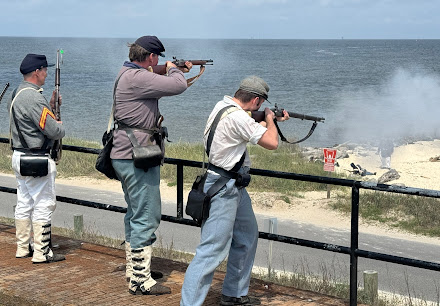 |
| We attended an April battle reenactment at Fort Gaines (Picket photo) |
“Denbigh
was one of the last runners out of Mobile in 1864, and was destroyed as one of
the last two runners trying to get into Galveston in May 1865. I was part of
the project that excavated that ship in 1997-2004.”
After
the fall of Fort Gaines, Yankee troops moved on Fort Morgan across the bay,
forcing its surrender on Aug. 23, 1864. (The state park had a 160th anniversary
living history on Saturday, Aug. 3.)
Mobile
was heavily fortified and the Union command moved on after securing the bay.
The city surrendered in April 1865, three days after Appomattox.
Ironclad braved minefield to protect wooden ship
In
its rather brief life, the Tecumseh first experienced Confederate mines and
obstructions during operations in the James River in Virginia. Thomas E. Nank,
in two articles for the American Battlefield Trust, provides copious details on
the “Forgotten Monitor.”
 |
| The Union Navy was intent on neutralizing CSS Tennessee, shown after the war. (U.S. Navy) |
Before
Mobile Bay, Farragut asked for more monitors to challenge the Tennessee and
other Confederate warships. The Tecumseh was sent south, and it needed engine
work twice on way, including in Pensacola, Fla.
Between 16 and 18 Federal ships, in two lines, would storm past Fort Morgan, trying to get under
the guns, enter the bay and take the fight to opposing ships. Craven, who had expressed some doubts about the effectiveness of
monitors but agreed to serve, was first in line on Aug. 5.
The commander, as he
entered a mine field, decided to make a turn so he could
take on the CSS Tennessee and protect USS Brooklyn, a wooden vessel that had faltered amid gunfire from Fort Morgan and the Confederate ships nearby.
 |
| Sign on Fort Morgan parapet describes battle, loss of Tecumseh; buoy is beyond (Susan C. Gast) |
While
Confederate mines were often faulty, at 7:40 a.m. a torpedo (or mine) detonated on the
starboard side, according to Nank. The ironclad rolled over to port as water
rushed in and panic ensued.
Gunners
mate Samuel Shinn, one of about 20 survivors, wrote, “It seemed as if we were lifted right out of the water. At the same time,
a blinding flash like lightning came through the porthole. A large hole was
stove in the vessel's side, and the men below commenced to cry that the vessel
was sinking.”
'After you, pilot.' Chivalry amid disaster
Almost all men below deck on Tecumseh were doomed, but Craven and a few others who were in the turret, pilot house or
elsewhere topside had a chance.
 |
| Alfred R. Waud's account of Craven's heroics (Library of Congress) |
Civil War historian
and author Ronald S. Coddington wrote two articles about the USS Tecumseh in
his Military Images magazine. He and Hall make special note of what its
commander said as the vessel was in its death throes.
Craven and civilian harbor pilot
John Collins, in the conning tower or pilot house, stepped toward a ladder that
would take them to safety. “After you pilot,” said Craven, who never made it
out an drowned in the maelstrom. His act of chivalry is venerated in the annals of naval tradition.
In the March 2020 issue of Military Images, Coddington laid out other versions of what Craven
said. He included excerpts of a poem that detailed the officer’s chivalry and
sacrifice. (At right, Tecumseh paymaster George Work / Library of Congress)Collins, quoted in the
1888 “Battles and Leaders of the Civil War,” said after he spoken with the
skipper, “When I
reached the upmost round of the ladder, the vessel seemed to drop under me.”
In another telling of
the story, Coddington wrote, Craven yelled to Collins, “You first, sir.”
An 1879
account of the encounter offers another version of events. It appeared in “A
Sketch of the Battle of Mobile Bay” by William F. Hutchinson, assistant surgeon
of the sloop Lackawanna.
“Captain
Craven was already partly out, when the pilot grasped him by the leg, and cried
‘Let me get out first, Captain for God’s sake; I have five little children!’
The Captain drew back, saying ‘Go on, sir,’ gave him his place, and went down
with the ship while the pilot was saved.”
Farragut's sailors regrouped and won the day
After the Tecumseh
sank, amid "immense bubbles of steam, as large as cauldrons," Farragut realized his mix of wooden and iron vessels, now in disorder, had to plow ahead.
 |
| William H. Overend's 1883 painting of the USS Hartford at Mobile Bay (Wikipedia) |
“The vision
of Farragut lashed with rope to the rigging of his flagship Hartford is
indelibly etched into the American memory,” wrote Coddington. “His stirring
words, paraphrased as ‘Damn the torpedoes, full speed ahead,’ are part of our
national vocabulary.”
The Federal
fleet went on to victory, capturing the Tennessee, while other Rebel ships
slipped away, were captured or sank. Admiral Franklin Buchanan, commander of
the Confederate fleet, was on the Tennessee and was gravely wounded and
captured. (The conquest of Mobile Bay also gave a huge boost to President Abraham Lincoln's re-election bid.)
In a brief
congratulatory order issued the next day, Farragut paid tribute to Craven, paymaster
George Work and their crewmates, Military Images detailed in December 2014.
“It has never
been his good fortune,” Farragut stated in the third person, “to see men do
their duty with more courage and cheerfulness, for although they knew that the
enemy was prepared with all devilish means for our destruction, and though they
witnessed the almost instantaneous annihilation of our gallant companions in
the Tecumseh by a torpedo, and the slaughter of their friends, messmates, and
gunmates on our decks, still there were no evidences of hesitation in following
their commander in chief through the line of torpedoes and obstructions.”Gunner Charles Baker, serving on the USS Metacomet, helped save 10 Tecumseh crewmembers while under fire and later received the Medal of Honor (photo above, U.S. Navy)
Protection and dignity for a war grave
After the
war, Tecumseh families railed against granted salvage rights, and the wreck was
left undisturbed for a century. Heather Tassin, site manager at Fort Morgan, says the site is believed to be the largest maritime war grave in the continental United States.
A Smithsonian
Institution expedition in the 1960s rediscovered the wreck, and surveys were
later conducted, including one in 2018. There was talk of raising the Tecumseh, but it never happened. The Naval History and Heritage Command
has about 65 artifacts from the wreck, according to an article. Items include ceramics, ship fittings
and hull and deck plank samples.
The NHCC said a management plan continues protection and preservation of the site.
"It is a common misconception that anyone can dive on the Tecumseh," Tassin told the Picket in an email. "No one is permitted to dive on the Tecumseh. It is respected and protected as a war grave."
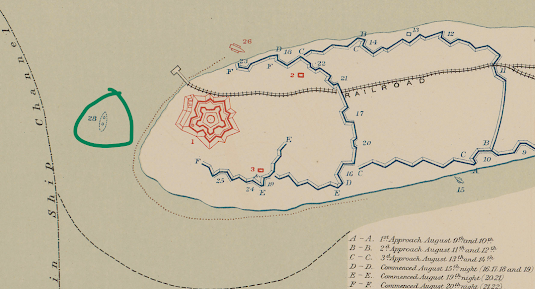 |
| (Atlas of the Official Records, Plate LXIII, map 6) |
A 1975 National Register of Historic Places form says most of the wreck (circled in green above) was covered in mud. "It was this
coverage of silt which has given the ship and her contents protection
against the ravages of underwater encrustation."
The federal government does periodic remote sensing to monitor the Tecumseh and ensure that it is still protected by anaerobic mud, said Tassin. Alabama officials monitor the work.
Any proposed research would require a permit
from the Alabama Historical Commission and the Navy. “There would have to be a
very compelling reason to conduct said research because of the Tecumseh’s
status as a war grave and the fact that it has been investigated in an archaeological
study in the past,” said Tassin.
In his
Emerging Civil War article, Mackowski wrote about memorials to the USS Arizona
(Hawaii), USS Indianapolis (Indiana) and USS Monitor (Virginia) – places where
people can walk to, unlike the Tecumseh.
“But in those moments I stood at the mouth of Mobile Bay off the shore
of Fort Morgan, I heard that lone buoy speak volumes. It reminded me of all the
stories lost at sea, untold, unremembered. There are no monuments on the ocean.”


