Showing posts with label battlefields. Show all posts

Thursday, December 25, 2025

Where sabers crossed and 'Stonewall' Jackson roamed: A burgeoning Virginia state park prepares to eventually manage Brandy Station, other Culpeper battlefields

Cunningham Farm wall remnants at Brandy Station (Chuck Laudner/American Battlefield Trust)
The growing staff at Virginia’s Culpeper Battlefields State Park is learning more about the power and potential of Civil War properties it will manage once they are transferred from the American Battlefield Trust.

An office manager and park ranger (maintenance) were recently hired, said Kim Wells, spokeswoman at Virginia State Parks, and a law enforcement ranger will be added soon. Park manager Drew Gruber is leading the group.

The ABT, Friends of Culpeper Battlefields, the Brandy Station Foundation, Friends of Cedar Mountain Battlefield and other groups have worked for decades to purchase and interpret a cluster of imperiled Civil War battlefields in Culpeper County. The sites are Brandy Station, Cedar Mountain, Kelly’s Ford, Rappahannock Station and Hansbrough's Ridge.

While the state park opened 18 months ago, development is relatively still in its early stages. The park staff is working from the Friends of Cedar Mountain Battlefield information center at 9465 General Winder Road, Rapidan (photo below).


“We are already talking in detail with visitors, tour guides (including Culpeper Battlefield Tours), friends’ groups, municipal offices and more to assess what they enjoy about the properties now, their aspirations, the efficacy of existing programming,” Wells said in a recent email. “One thing is certain. Culpeper will continue to offer a unique battlefield experience where you can explore on horseback or paddle between battles.”

The ABT – which will be chief steward of the properties until 2027 -- plans to make several additional donations to the Commonwealth over the next couple years, said Jim Campi, chief policy and communications officer.

The Culpeper Battlefields State Park team has not started the master planning process, but it will be helped by friends groups and the ABT, which oversaw a cultural landscape report at Brandy Station, site of a mammoth cavalry clash in 1863 that signaled the beginning of the Gettysburg campaign.

Preliminary results of the Brandy Station report were unveiled to the public in late June, according to a news article by the Culpeper Times (InsideNOVA).

A staffer with MIG, a landscape architectural firm, said the study identified traces of roads, artillery and gun pits, family cemeteries and archaeological sites -- all of which need further study.

Stone walls marking the edges of fields and property boundaries on the battlefield were believed to have been built by enslaved people, according to the speaker. (At right, ABT map of parcels at Brandy Station; click to enlarge). One wall separated the Cunningham and Green farms.

Campi told the Picket this study focused on a portion of the Brandy Station battlefield, including St. James Church and Elkwood. A final version of the report viewed by the Picket cites concerns about unauthorized relic hunting at the site.

The Picket has reached out multiple times to MIG for comment and visual images but has not heard back.

The various friends groups are hosting tours and “working on programs and projects across the breadth of the properties which are slated to transfer to the Commonwealth,” said Wells. No state employees are currently handling interpretation.

She said the new park ranger in charge of maintenance will be developing a stewardship plan and will work alongside three part-time maintenance rangers to ensure the properties are well maintained and cared for.

Interpretation at Brandy Station's Fleetwood Hill sector (American Battlefield Trust)
“While we’ve been focused on ordering furniture, tools, equipment and more, we’ve found time to explore the properties owned by the American Battlefield Trust which are set to transfer to the Commonwealth in the years to come. There is a lot of ground to cover as we learned about the park’s six Civil War battles, Revolutionary War history and its Civilian Conservation Corp history, too,” wrote Wells.

The master planning process will likely begin once all acquired parcels have been transferred to the state. It will take a few years to complete.

I asked the spokesperson about which of the sites are vulnerable or need extra protection.

“State Park Rangers conduct regular assessments of their parks to identify potential vulnerabilities and to determine whether additional protective measures are needed for sensitive natural, cultural and historic resources at these sites. Actions are handled on a case-by-case basis, and the outcomes of such reviews may or may not be publicly shared. There are no new updates regarding Culpeper Battlefields State Parks in relation to this matter.”

Click map to get a closer view of planned state park properties (American Battlefield Trust)
The ABT previously said it and other groups worked together to stave off much of the commercial development that would take in battlefield land.

“At various times, pieces of land that we are now gifting to the Commonwealth of Virginia were slated to become housing tracts, industrial parks, water retention and management areas — even a Formula One racetrack,” it says.

In the meantime, visitors can walk on several trails and read ABT and Civil War Trails signs.

“We are always going to be involved,” said Campi. “The park is not done yet. There is more land to acquire.”

Wednesday, January 29, 2025

30th edition of the Civil War show in Dalton, Ga., offers boatloads of relics, three lectures and a familiar place for collectors and vendors to network

The Bullet and Shell table at the 2018 weekend event in Dalton, Ga  (Picket photos)
Patrons at this weekend’s 30th edition of the Chickamauga Civil War Show in Dalton, Ga., can take in lectures on battlefield preservation, religion during the conflict and Reconstruction.

The annual firearms, artifacts and relics show at the Dalton Convention Center, 2211 Tony Ingle Parkway, takes place Saturday and Sunday. During dealer move-in Friday, people can pay $50 for an “early buyer” badge that gives them the first crack at many items. They can use the pass through the weekend.

Show organizer Mike Kent, who has been producing Civil War shows for 34 years, including 20 at Dalton, said nearly 200 vendors will set up items on 450 tables.

“Standout displays of Confederate buckles by Dr. Bill Blackman, Kenny Copelin and Scott Riddle are always one of the top attractions at the show and Father Bob Miller, who is one of our guest speakers, will also have a display on religion during the war,” Kent (left) told the Picket.

Kent said all Civil War shows have evolved over the years. What started out as mainly a show for dug relics from the Civil War has developed into an all era, militaria-type show with relics, artifacts, weapons and memorabilia from the Revolutionary War up through World War ll.

“As Civil War material becomes more difficult and expensive to acquire, collectors are tending toward items from more recent eras such as WW ll, but the Dalton show is still 80% to 90% Civil War related.” Kent also runs the larger Franklin Civil War Show in Tennessee, held in December.

Beyond sales, relic shows are a major place for sellers, museum curators, authors, collectors and others to network.

While there is a fee to enter the Dalton hall, three lectures Saturday in Room 1-A on the first floor of the trade center are free and those interested do not need to enter the show to listen. The schedule:

11 a.m.: Anthony Hodges, head of the Tennessee Civil War Preservation Association, and Joe Trahan, president of the Georgia Battlefields Association, will discuss battlefield preservation.

Noon: Father Bob Miller, a Catholic priest and historian, speaks on “Religion is what makes soldiers brave: Seven reasons why faith was important during the Civil War.”

1 p.m.: Historian and author Scott Sallee lectures on Reconstruction following the Civil War, and its three phrases.

Civil War photo collector and expert David Wynn Vaughan of Atlanta plans to attend Friday’s VIP session. “I (always) hope to find a nice Confederate image.”

Ronald S. Coddington,  author, historian and publisher of Military Images magazine, has previously set up shop at the Dalton show -- interacting with patrons by scanning tintypes, ambrotype images and cartes de visite for possible print and online galleries for this magazine, getting story ideas and weighing in on a card’s value.

While he is unable to attend this year, Coddington said he enjoys meeting the public.

“The passion and knowledge these caretakers have for artifacts is inspiration. And the opportunity to be physically present to touch the artifacts is not something you can get in the digital world -- at least not yet.”

A prospective buyer checks out firearms in 2010 (Civil War Picket)
Kent says photo collector and dealer Paul Reeder, known for his Confederate images, will be at the show. Military Images has published some of his collection.

Show hours are 9 a.m.-5 p.m. on Saturday and 9 a.m.-3 p.m. on Sunday.  Admission is $12 for adults; children 12 and under are free. Friday’s VIP session ($50) is 10 a.m.-7 p.m.

Thursday, November 10, 2022

National Park Service awards $345K in new grants to help restore battlefields in Virginia and Pennsylvania

Huntsberry farm near Winchester, Va. (SVBF via NPS)
With a focus on restoring “day of battle” conditions at historic sites, the National Park Service has awarded $345,000 in grants for the study of and improvements at Civil War battlefields in Pennsylvania and Virginia.

The agency this week announced the inaugural Battlefield Restoration Grants, emphasizing they will conserve open spaces and restore landscapes.

Here’s a brief look at the five projects that “build on collaborative conservation efforts among state and local governmental and nonprofit partners,” said NPS Director Chuck Sams in a news release.

Pennsylvania

Seminary Ridge at Gettysburg ($62,500 to the American Battlefield Trust): With financial support from a Battlefield Restoration Grant from the American Battlefield Protection Program, the American Battlefield Trust will synthesize research on the civilian landscape at Seminary Ridge, including the Mary Thompson House, the James Thompson House, the Dustman Barn and the ruins of the Alexander Riggs House; all properties that witnessed the opening stages of the battle. The Trust’s plan will build upon previous research to gain a complete understanding of the Seminary Ridge landscape and provide a roadmap to restoring day-of-battle conditions to a view shed essential to visitors’ experience at the Gettysburg battlefield.– Details here

Virginia

Edwin Forbes' illustration of the clash at Brandy Station (Library of Congress)
Brandy Station 1863 cavalry battle ($175,000 to the American Battlefield Trust): “The American Battlefield Trust will develop a comprehensive report on the landscape features of the Brandy Station Battlefield, including the archaeological remains of fighting and historic buildings that witnessed the battle. The report will also explore lesser-known stories, such as the experiences of enslaved and freed African Americans as the battle came to Elkwood Downs plantation. The American Battlefield Trust hopes that the report’s findings will lead to the continued preservation of these resources and narratives ahead of the battlefield’s incorporation into Virginia’s new Culpeper Battlefields State Park.– Details here

Third Winchester in 1864 ($79,428 to the Shenandoah Valley Battlefields Foundation): NPS’s award supports the foundation’s on-going restoration of the Third Winchester Battlefield with the installation of period fencing at both portions of the (Huntsberry) farm. The fences that once brought order to the property will now give a sense of place to the farm and help visitors understand the battlefield’s landscape: how it was used by the people who called this place home, how it was traversed by the soldiers who fought here, and how it can be a place of renewal today.– Details here

New Market battle in 1864 ($28,277 to the Shenandoah Valley Battlefields Foundation):  “The Shenandoah Valley Battlefields Foundation (SVBF) will pave the way to advance the New Market Greenway Trail, an interpreted greenway linking New Market’s downtown with nearly 400 acres of protected battlefield” – Details here

The federal money for the new grants program comes from the Land and Water Conservation Fund.

The NPS’s American Battlefield Protection Program administers the new program, along with Battlefield Land Acquisition, Preservation Planning, and Battlefield Interpretation grants.

“Battlefield Restoration Grants empower preservation partners to inspire wonder, understanding, and empathy at the places that witnessed some of our nation’s most challenging events,” the park service says.

Saturday, October 29, 2022

Legendary Georgia football coach Vince Dooley had a passion for Civil War history. Here's what those who knew him say about that

With Ed Bearss in Athens, Ga., and Carolyn Turner in Newnan, Ga. (Skip Johnson, Charlie Crawford, GBA)
Former University of Georgia football coach and athletics director Vince Dooley brought celebrity and a real passion for history when he toured and backed preservation of battlefields or attended meetings of the Atlanta Civil War Roundtable.

Dooley, who died Friday at age 90, is being remembered, of course, for his sports accomplishments: college football’s National Championship in 1980 and six Southeastern Conference titles, among others. But he immersed himself in other interests, including gardening, political science and history. The Marine Corps veteran was a philanthropist and mentor.

“The Civil War probably is the most critical time in our history. It defined who we are,” Dooley told me in 2010. He later when on to write a book about a Georgia officer.

The Mobile, Ala., native had an ancestor who fought for the Confederacy. Pvt. George Stanter (the surname shared by Dooley’s mother) served with the 24th Alabama Infantry. Dooley was a fan of Patrick Cleburne, the Irish-born Confederate general who was “ahead of his time” in pressing for African-Americans to fight for the South. The idea was squashed until late in the war.

Dooley at a 2010 meeting of the Atlanta Civil War Roundtable (Picket photo)
The Picket asked those who knew him about their memories and thoughts on Dooley's legacy in the Civil War field. The coach made numerous trips to sites with others.

Below that list is reaction on social media from other individuals or groups. Some responses have been edited for brevity. This will be updated.

Gordon Jones, senior military historian and curator, Atlanta History Center:

What I respected most about Vince Dooley is that you would never know he was famous. When you met and talked with him, he was just an ordinary guy with an extraordinary interest in (and knowledge of) the Civil War. So it is with organizations like the (Atlanta) Civil War Roundtable – you know your friends not by their day jobs but by their particular historical interests. Someone at their first roundtable meeting would come up to me and say “Hey, isn’t that Vince Dooley?” and I’d reply, “Yeah it is. And we’re talking about Sherman.” His day job, however spectacular, was at that moment irrelevant. I love that. I think he did, too.   

Charlie Crawford, president emeritus, Georgia Battlefields Association (Dooley was a GBA member and attended many tours):

I first met Coach in 2003 when I led an Atlanta Campaign tour for him and his oldest grandson (then 16).  He was still UGA athletics director at the time and was frequently answering cell phone calls relating to the status of student-athletes in all the sports: women's basketball, women's gymnastics, swimming, baseball, equestrian, etc. How many times did he make a decision about a young man or young woman that affected their lives forever?

(It was) very enjoyable to watch the interaction and listen to the collective wisdom when Coach was with Ed Bearss and Bud Robertson, both of whom he knew very well. In addition to being a premier historian, Bud had also been a college football official for 28 years and officiated some Georgia games, including the last game that Vince coached. (Against Michigan State in the 1988 Gator Bowl.)

With Jack Davis and Dan Hanks in Macon, Ga. (Charlie Crawford)
Coach had an M.A. in history, and I think his passion was about learning from history, specifically, how knowing what occurred helps us understand and react to current situations. Certainly, he was well-informed about the Civil War, but he knew much about many topics.

Hard to predict his legacy relating to preservation. Much as we can't know every way in which his example of discipline, leadership, knowledge, fair play, love of learning and decency influenced the thousands of men he coached, neither can we know every way in which those qualities and his commitment to preservation have inspired (and will continue to influence) anyone who saw him on a battlefield or heard him at an American Battlefield Trust board meeting.

His fame had an effect when a GBA tour group would arrive at a historic site or eat at a restaurant. Every waiter or waitress would drop by his table even if they were not responsible for that table. Docents at museums or park staff would come by to shake his hand or ask to have a photo taken with him, and he was always very accommodating.  Somewhat in contrast, I think he appreciated being treated the same as everyone else among the other tour participants. I also think he enjoyed talking about history rather than football.

With Ed Bearss, GBA's Cindy Wentworth in Augusta, Ga. (Charlie Crawford)
Ronald S. Coddington, author and editor, Military Images magazine:

I am deeply saddened to learn of his passing. I met Coach Dooley about 10 years ago. Somehow he got my telephone number and called. I was shocked and stunned to hear his easily recognizable voice! At first, I thought it was one of my college pals from UGA days pranking me. Turns out the Coach was visiting Washington, D.C., for a Civil War Trust meeting and invited me to lunch to discuss his research about Lt. Col. William Gaston Delony, the subject of the book he co-authored with Sam Thomas, The Legion's Fighting Bulldog.” I had written about Delony in my 2008 book, Faces of the Confederacy” and he wanted to compare research notes. We met in person a few weeks later and I was struck by his gentle manners and humble nature. I was also impressed with the depth and breadth of his research and his passion for history. It was a memorable afternoon, and one I'll never forget. 

Jim Ogden, chief historian, Chickamauga and Chattanooga National Military Park:

Vince's interest in Civil War history and battlefield preservation was real and long-standing.  A lot of folks forget that he was the Georgia Honorary Chairman (Dixie Carter being the Tennessee Honorary Chairman) of the Friends of Chickamauga and Chattanooga National Military Park's Centennial campaign in the late 1980s-1990. He attended a number of the campaign big events in at least 1990, including the broiling Centennial day events on August 19, 1990.  I can still see he and Dixie just inside the Centennial addition's new front door hoping, mostly in vain, for some air conditioning relief, Dixie sitting on a bench fanning herself furiously.

Subsequently, he would frequently stop and visit when UGA AD business brought him this way; we had a big Auburn fan who worked the information desk for us for years who'd recognize Vince........know thy at least one-time "enemy," right? ... and he would buzz my office when he again saw Vince in the lobby so I could come out and talk with him a minute.

Georgia football fans were always surprised that I'd been with Coach Dooley at some Civil War (!?!?) event !?!?!  But his interest in History was real, witness his and Sam Thomas' “The Legion's Fighting Bulldog.” He helped promote the Georgia Historical Society, the Georgia Battlefields Association, the American Battlefield Trust's missions, but he visited sites and went on the tours and attended talks and lectures because he wanted to LEARN.  He was a real Scholar Athlete with more emphasis on the first, a Scholar.

Mary-Elizabeth Ellard, GBA and Atlanta Civil War Roundtable

He was just a history buff like all the rest of us, even though he was NOT like all the rest of us. "Passion" is not a word I would apply to what I saw. Rather, he always seemed so at ease. Perhaps it was a relief to be around people who just wanted to talk CW history and not SEC sports.

Legacy regarding history and preservation: Largely unsung, I imagine. First, because his football record will always (understandably) draw the most attention. Second, because many things he did remained quiet. Times we think he made a phone call to introduce the organization or an idea or to overcome an obstacle. Times where we can't prove it was he, but where we think no one else could have cleared the way.

We all called him, "Coach." He didn't seem to mind and took in the spirit of respect and affection that we intended. Also, it brought the group no little amusement to see the faces of people react as Coach Dooley would walk by in this otherwise very unimpressive parade of history nuts.

Regarding leadership: It always seemed so natural, to my mind, that someone who coached football would see value in understanding battlefield history.

One favorite memory was during our tour a few years ago in Columbus, Georgia. The group was arriving at the meeting room where were to have our supper. I had come in at the tail of the group, so Coach was already inside. I passed a lovely camellia bush in full bloom on the way in.  I went inside and asked Coach if he thought he might know what kind it was. So out we went to ID a camellia. He confessed they weren't where his gardening expertise lay, but he gave a few likely possibilities. He was so happy to chat flowers and so gracious to take the time.

I.J. Rosenberg, former The Atlanta Journal-Constitution sports reporter, on Facebook:

For me, Dooley was so much more than a coach or AD ... his interests away from work varied, such as the incredible gardens he built at his home and ability to name every Civil War general from both the North and South and the battles they won and lost.

Ed Bearss (left) with Vince Dooley on battlefield tour (GBA)
American Battlefield Trust, with which Dooley served three terms on the Board of Trustees:

“Few earn the title of ‘Renaissance Man’ as fully Coach Dooley, who was as at home on the football field as he was on the battlefield, never mind the garden,” said American Battlefield Trust President David Duncan. “He leaves behind a permanent and tangible legacy in numerous fields, and I count myself lucky to have called him a friend. Our thoughts are with his beloved wife Barbara and the entire Dooley family.” Dooley was  instrumental in the protection of 180 acres associated with the February 14, 1779, Revolutionary War Battle of Kettle Creek in Washington, Ga., which enlarged the park by 233 percent. 

Georgia Historical Society, on Facebook:

Along with his exceptional record as football coach and athletics director at the University of Georgia, Coach Dooley served as Chairman of the GHS Board of Curators from 2016 to 2018 and was appointed by the Office of the Governor and GHS as a Georgia Trustee in 2011. As in every other thing he led, Dooley took GHS to new heights with his remarkable leadership and enthusiasm for our educational and research mission. His service to the people of Georgia, to athletics, to history and gardening, are unmatched. GHS established the Dooley Distinguished Fellowship in 2018, which honors and secures his legacy for his lifelong commitment to history and higher education. GHS is proud to house the Vince Dooley Papers, ensuring that his documentary legacy will live on forever. The GHS Board and Staff join our fellow Georgians in remembering this extraordinary man and send our deepest condolences to his incredible family.

Wednesday, January 12, 2022

He teaches people about battlefield sites that are not recognizable. Georgia Historical Society honors Charlie Crawford for marker efforts

Crawford leads a 2014 tour of downtown Atlanta Civil War site (Picket photo)
Charlie Crawford believes that making people aware of historic sites – through roadside markers, site tours and presentations -- increases the likelihood that they will support preservation.

Crawford, president emeritus of the nonprofit Georgia Battlefields Association, is the recipient of the Georgia Historical Society’s 2021 John Macpherson Berrien Award for a lifetime of achievement in and service to the state’s history – particularly in support of the society’s Civil War markers.

“All of us at GBA are so pleased on his behalf,” organization secretary Mary-Elizabeth Ellard told the Picket in an email.”

Crawford, 72, served 24 years in the Air Force, including service in Vietnam, and worked nearly the same amount of time at an information technology and consultant company in Atlanta. History has been his lifelong and passionate avocation.

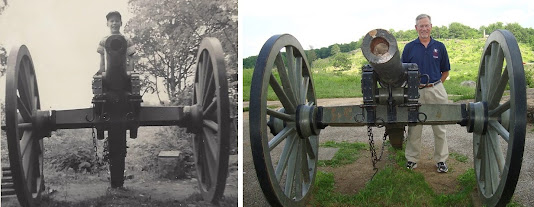
Charlie Crawford at Gettysburg in 1956 and in later years (Courtesy of GBA)
The bug bit him early while he grew up outside Philadelphia, visiting the Liberty Bell, Valley Forge and Gettysburg. And he got deeper into it during his service at the Pentagon, where he lived near Civil War sites in Virginia.

“Historical markers are important because so many battlefields and historic sites are no longer recognizable as such,” said the retired colonel. “Peachtree Creek [Atlanta] is a prime example. Tens of thousands of people traverse (on foot but mostly in vehicles) that battlefield every day, but they would never know they were on a battlefield except for the historical markers.”

“Further, historical markers will sometimes prompt anyone who notices them to find out more about the site,” he said, mentioning the society’s online database of thousands of markers.

The state of Georgia ran the Georgia historical marker program from the 1950s until the mid-1990s. The historical society began to erect new markers in 1998 and Crawford has been involved in researching several of them.

“A key player in the Civil War 150 Initiative, Charlie and the association helped fund 10 historical markers and advised on the overall project,” GHS market manager Elyse Butler wrote in an article about the award.

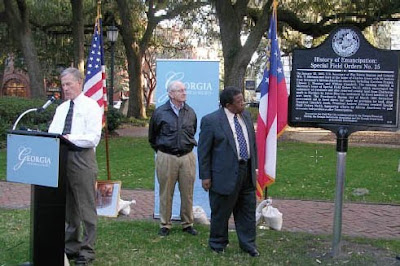
Crawford at a 2011 marker dedication  in Savannah.
“Since the end of the Civil War sesquicentennial, the friendship between GHS and Charlie has grown. Charlie's interest in preserving Georgia's Civil War battlefields to educate the public naturally lends itself to the Georgia Historical Marker Program,” Butler wrote. “The marker program provides an opportunity for place-based learning, and often, as Charlie says, ‘tells the stories to the uninitiated.’”

The GBA and volunteers have assisted the historical society by reporting missing or damaged markers and assisting in repairs

Crawford, a graduate of Georgia Tech, has given over 100 presentations and led over 50 tours relating to battlefield preservation and has been a member of the American Battlefield Trust and its predecessor organizations since 1991. The trust honored him in 2011 for preservation efforts. "Charlie Crawford is an indispensable source of information on all aspects of the preservation movement in the state," the trust said.

Since 2000, Crawford has been a member of the Atlanta Civil War Round Table and is the group’s trivia master. He served as GBA president for nearly two decades and still produces its monthly newsletter and is a trustee.

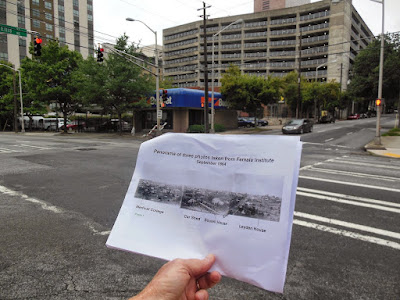
Crawford uses period photos to help in interpretation (Picket photo)
Regarding the status of battlefield preservation in Georgia, Crawford said Covid-19 has restricted GBA trustees from freely traveling to sites “and the dearth of in-person county commission meetings has dampened our ability to interact with local decision makers.  We have five projects in the hopper, so to speak, but our preservation efforts depend primarily on willing sellers. We don’t have eminent domain power and don’t advocate for the state government to use it.”

High selling prices can make efforts difficult.

“If I had to characterize the current state of preservation, generally, I’d have to say it was frustratingly stalled. On the other hand, a frustrating stall is a recurrent theme in preservation efforts. As long as a battlefield is not permanently lost to development, we remain hopeful and persistent.”  

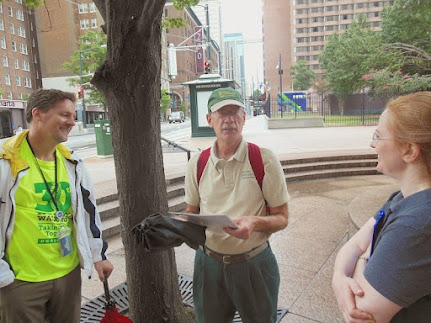
Crawford leads downtown Atlanta tours for the Atlanta Preservation Center and he shows period photos to participants so that they can envision the sites. “On many tours, especially around Atlanta, people will tell me they had no idea they lived on a battlefield.”

Most of the GBA tours are attended by participants who have much more Civil War knowledge than the average citizen,” he told the Picket.

“We also have many repeat participants, who unsurprisingly are some of our most steadfast supporters, not only with memberships and donations but also with (communication) to state representatives and county commissioners and media reporters. We’re not making these folks aware of historical sites as much as providing depth and context to their existing knowledge, which they also spread by word of mouth.”

Thursday, October 9, 2014

Read up, then walk Civil War battlefields

There are more than 300 miles of trails to explore in the 24 national parks designated as significant battlegrounds of the Civil War, according to the National Park Service. “The war really did touch pretty much every corner of America,” said Mary Koik of the Civil War Trust, an organization that works to preserve the battlefields. “You have battles fought from Pennsylvania all the way out through New Mexico.” • Article

Read more here: http://www.miamiherald.com/living/travel/article2624889.html#storylink=cpy

Read more here: http://www.miamiherald.com/living/travel/article2624889.html#storylink=cpy

Saturday, May 24, 2014

Peachtree Creek 2: Charlie Crawford's expert overview and tour of battle sites


C. Crawford
Earlier this week, we had a post about my visit to the site of the Battle of Peachtree Creek in north Atlanta. It gave very general information and had some photos. I asked Charlie Crawford, president of the Georgia Battlefields Association, for his thoughts on the battle’s significance and places to see. By permission, the Picket offers here his wonderful and detail-rich tour overview, along with maps showing the battle movements and wartime and current roads in Buckhead. The post starts with his thoughts on the battle and how a sound plan ultimately went wrong for Gen. John Bell Hood, his subordinates and Confederate troops on July 20, 1864.

CRAWFORD’S OVERVIEW OF BATTLE:

Overview of troops, roads and other Atlanta fixtures. Click to enlarge (GBA)
The plan was to have seven Confederate divisions (French, Walthall, Loring, Maney, Walker, Cleburne, Bate) attack four Union divisions (Williams, Geary, Ward, Newton), but the plaque wording (at Tanyard Creek Park) makes it appear that this was another charge by Confederates who knew they would be outnumbered from the get-go.

It was the Confederates’ fault that they didn’t get the three missing brigades from Stewart’s Corps (one each from French’s, Walthall’s, and Loring’s divisions) into position in time.  Likewise, Maney’s division didn’t fight well, Cleburne’s division was held back to exploit the hoped-for breakthrough, and Bate’s division got lost in the swampy ground around Clear Creek.

John Bell Hood
Consequently, the participating brigades form Walthall’s and Loring’s divisions and the entirety of Walker’s division did almost all the fighting.  In that sense, the Confederates were outnumbered, but it wasn’t by design.

Hood was trying to bring superior numbers to bear (i.e., his plan was sound), but coordination and execution of the plan were poor. Certainly, Hood is ultimately responsible, but he wasn’t well-served by his subordinate commanders (particularly Bate and Maney, and partly Hardee).  So this wasn’t the oft-portrayed circumstance of the outnumbered, ill-clad, starving, brave Southern boys charging the immigrant, well-supplied, overwhelming Yankee hosts.

The Confederates came close to breaking the Federal line and achieving at least part of their objective, though not at all in the manner in which they hoped.

CRAWFORD’S TOUR

Confederate assault. Click to enlarge (GBA)
Normally, I start at the north end of West Peachtree St.  The Land Lot 104 marker at the crest of the hill (on WSB property) refers to the Confederate outer line that ran through the site, and I stop at the small parking lot (just above where the MARTA tracks go underground) and explain the Confederate position on the morning of 20 July 1864 and the intended advance northward.

I then drive north on Peachtree Street and turn east on Palisades (another marker is there) to talk about Bate's inability to advance up the Clear Creek Valley.  I follow Palisades to Huntington and Wakefield, showing how low the ground is there and explaining how swampy it was at the time.  I turn left on Brighton to show the high ground occupied by Bradley's brigade as they repulsed the Confederates.

I emerge from Brighton at Peachtree Road (two more markers) and show the 1944 monument on the grounds of Piedmont Hospital, turn south on Peachtree to show the misplaced stone dedicated to Howell's battery, and continue to a right (west) on 28th Street, the old Montgomery Ferry Road, pausing at the marker that refers to Stevens' mortal wounding.  Continuing west on 28th, I turn north on Ardmore Road, passing Ardmore park on the left, with its one correct marker (Featherston's brigade) and two relocated (and now misleading) markers to Wood's and Coburn's brigades

George Barnard image of grave headboards (LOC)
I go north on Ardmore to a left on Collier (Mississippi brigade marker at corner), point to the location of Barnard's photo of the grave headboards, then turn into the parking lot at Tanyard Creek Park. The plaques have a wealth of information but a decidedly Confederate viewpoint (especially regarding the size of opposing forces).  If I have enough time, I walk the group south through the park, talking about the capture of the 33rd New Jersey flag (marker on east side of Walthall Drive) and the advance of Scott's brigade across this ground.  We walk under the railroad trestle, through Ardmore park (past the three markers again), north on Ardmore Road, cross Collier to pause at the site of the Barnard photo, then north on Dellwood to a left on Redland, where the clash was intense as Ward's division advanced to fill the gap in the Federal line (marker on Collier Road).  At the bottom of the hill is about where Collier's Mill stood, and we turn south along the creek to Harrison's brigade marker at the intersection with Collier. Scott's brigade marker is across Collier Road.

Next, it's west along Collier, then north on Overbrook to Northside to explain how Geary's line was bent back by Walthall. Rather than a dangerous (heavy traffic) walk along Northside, I normally head back to the bus or car to leave the Tanyard Creek parking lot and go west on Collier (past a marker for Geary's division) to north on Northside and turn right into the Bitsy Grant tennis center. The marker to Williams' division has always been at the corner (on the back slope of a green on Bobby Jones golf course), but three other markers have recently been relocated there (and are consequently misleading): one (O'Neal's brigade at the ravine) was at the point where the ravine crossed Northside; two (Geary's refused line and O'Neal's brigade) were at the intersection of Northside Drive and Collier Road. The markers were relocated because they were difficult to reach on foot.  At least now, there's a better chance that they'll be read as a group.

Turn around at the tennis center and go back south on Northside Drive a short distance to a right on Norfleet Road to point out the still existing ravine on the south side and the high ground (Williams' position) on the north side. Following Norfleet to Howell Mill, I may mention the marker farther north on Howell Mill that indicates the right of the 20th corps. Then I turn left on Howell Mill and stop at the shopping center on the right to dismount and talk about the Preston marker that faces on Howell Mill. I usually end the tour there.

There are a few other markers that could be seen, but the Preston story is evocative for many and is a neat way to summarize what Hood was trying to accomplish and all the ways in which he failed, mostly through bad luck, bad coordination among his subordinates and a competent opponent rather than bad planning.