Showing posts with label Georgia battlefields association. Show all posts

Friday, April 17, 2026

Georgia Battlefields Association meets at 'Great Locomotive Chase' depot in Dalton. Nonprofit based there will showcase its importance to commerce, culture and history

Iconic Western & Atlantic Railroad depot in downtown Dalton (Picket photo) and locomotive General in town in early 1960s for the Civil War centennial (Courtesy Bandy Heritage Center for Northwest Georgia)
Three dozen members of the Georgia Battlefields Association recently enjoyed dinner in Dalton, Ga., and received an update on the group’s preservation efforts, which began in March 1995.

Fittingly, the gathering occurred at the old Western & Atlantic train depot, itself the beneficiary of a commitment to honoring the past while looking to the future. The recently restored depot was one stop along the legendary “Great Locomotive Chase” of April 1862.

The Community Foundation of Northwest Georgia hosted the event during the GBA’s annual tour of sites, which this year focused on Union army preparations for the spring 1864 Atlanta Campaign and actions through the Battle of Resaca on May 15, 1864.

GBA president Joe Trahan said the nonprofit gave $150,000 last year toward Civil War battlefield preservation efforts. Joe Gaskin, who leads fundraising efforts, said several people have increased their membership levels and donations to the GBA’s “Limber Chest” fund.

Members of the Georgia Battlefields Association at the Dalton Depot (Courtesy CFNWG)
The foundation last year moved into the depot. One half of the restored building is leased by the philanthropic group; the other side currently is being converted into an English pub.

The foundation’s community gathering space features 25-foot ceilings, charming brick and Civil War-era architectural features. But it is a very up-to-date environment -- from modern furniture to TV monitors that are designed to prompt collaboration in today’s world.

The foundation is working with the Bandy Heritage Center for Northwest Georgia, part of Dalton State College, to develop a presentation or two in the building to provide context to visitors about the role of the depot in the city’s history and economy.

Andrews Raiders and pursuers rushed by in 1862

The Western and Atlantic Railroad line from Atlanta to Chattanooga, Tenn., was completed in the early 1850s and the Dalton depot opened in 1852 to provide passenger and freight service.

Union raiders on the General set fire to a river crossing in North Georgia (Wikipedia)
The depot was the hub for commercial growth in the Dalton area and the point of origin for surveys and maps.

The 12,100-square-foot brick building is “a pretty high-style example of Georgia depot architecture” and has Greek Revival features, with stone lintels, brick pilasters and door entablatures. (Picket photo, below)

The building had its moment of fame on April 12, 1862, when Northern raiders (the South labeled them spies) commandeered the locomotive General in Big Shanty. They chugged toward Chattanooga, intent on destroying parts of the railroad.

The pursuing locomotive Texas picked up a 17-year-old telegraph operator who rushed to the Dalton depot and wired Confederate troops to the north.

Although not all his message got through, Edward Henderson’s alarm sent troops toward the track. The Andrews Raiders were captured near Ringgold when the General ran out of steam. They had accomplished little. Many were hanged while others escaped. Several were the first to receive the Medal of Honor.

The depot remained in use as a rail stop for more than a century.

Center will help depot showcase area history

Foundation president David Aft (At left, with one of his painting, Picket photo) has communicated with Bandy Heritage Center director Matthew Gramling about ways to convey the depot’s vital role in the development of Dalton.

The focus will be on the cultural and economic networks the Western & Atlantic Railroad facilitated for Northwest Georgia.

Depot and other downtown buildings in 1932 (Courtesy of Bandy Heritage Center for Northwest Georgia)
“I am still in discussion with David regarding the exact display medium he wishes to use in different areas within the depot,” Gramling said in an email. “We will be providing him with local historical images on a jump drive for slide displays on a flat screen television in the main meeting area within the foundation.”

Among those images are a bank note issued during the Civil War, an old aerial shot and another of the locomotive General as it visited Dalton during the Civil War centennial. It is now housed at the Southern Museum of Civil War and Locomotive History in Kennesaw, Ga., while its pursuer Texas is featured at the Atlanta History Center.

Bob Jenkins, a local attorney active in Civil War land preservation and head of Save the Dalton Battlefields, said he is impressed with the renovation work on the long building in the heart of downtown on Depot Street. (Picket photo of depot interior, right)

“For the first 100 years of Dalton‘s existence, the depot was the entry point for those traveling here as they would have disembarked a passenger train at the depot and gone through it prior to entering the streets into Dalton for the first time. Today, most travelers enter Dalton via one of the interstate exits from I-75 and are graded by a multilane road with multiple fast-food restaurants, gas stations and strip malls,” he wrote in an email.

Local bank note issued during the Civil War (Courtesy of Bandy Heritage Center for Northwest Georgia)
Between the 1840s and 1940s, the Dalton Depot was a gathering place as well as a place of exchanging of information, goods and services, Jenkins said. “(The foundation) recaptures that opportunity for the exchanging of information, goods and services for the greater good for our community and her people,” he added.

Choo-choos add character to meeting spaces

The building’s future was very uncertain just a few years ago.

Locals remember Dalton Depot, a longtime restaurant and club which operated in the brick building until about 10 years ago. 

The depot fell into hard times after the restaurant closed. The city contracted with the Georgia Trust for Historic Preservation to market the vacant and deteriorated building. Officials wanted $500,000, but eventually sold it to local Barrett Properties in 2018 for $300,000. It took another seven years before the renovation and reopening occurred.

The foundation’s five employees work in an office nearly twice as big as its longtime more traditional offices across town. They facilitate meetings in a glass-lined board room and smaller “collaboration zones.” (At left David Aft with one of his paintings, Picket photo)

Working with charitable givers, the nonprofit provides grants and funding for organizations in the area. Some of the endeavors involve mental health programs, historic preservation, neighborhood revitalization and other civic projects. It also provides space for outside groups to hold meetings.

Affordable housing is a problem in Dalton and Whitfield County. That has an impact on charitable giving. “People give where they live,” said Aft.

Northern half of depot is being developed as an English-style pub (Picket photo)
Last month, I stopped by the depot. People marvel at the renovated space, Aft said. A large weight scale in the lobby area is a reminder of the depot’s role in commerce, he said.

I asked him whether the building has some particular characteristics because of its history and proximity to busy CSX and Norfolk Southern rail lines.

Heating the building on cold days is a challenge, he said.

Employees have gotten used to the train traffic and say it is not distracting. Aft noted empty trains are louder because they bounce on the tracks and send out a clickety clack signal.

“It adds novelty to the space,” said Aft.

Central meeting area in the refurbished Dalton Depot (Picket photo)

Monday, May 1, 2023

Fort Wimberly: A large remnant of battery outside Savannah survives. Its guns were trained on what is now the famous Moon River

1990s survey shows Confederate earthworks (Larry Babits, Armstrong State College)
In war, commanders depend on manpower and materiel. But for Federal forces during the Civil War there also were intangibles, such as the strategy of “always keep them guessing.” The Union’s taking of Fort Pulaski near Savannah in 1862 – for example -- led the Confederacy to pour precious resources into building and manning seaward defenses, just in case of an invasion.

Ultimately, most of those outposts ringing Savannah were never tested.

One such fortification was Fort (Battery) Wimberly on the Isle of Hope. While the taking of Pulaski essentially made the Savannah port useless, there were other reasons for the South to build defenses that would blunt further incursions inland.

“A lot of the pressure for coast defense comes from the slave owners and coastal residents because of concerns about the real and potential loss of African-American slaves,” says Jim Ogden, Chickamauga and Chattanooga National Military Park staff historian. “The loss of Port Royal, and then Pulaski, caused a lot of owners to move many of their slaves inland at least for a while, but there were still enough slaves in the region to grow the apparently extensive rice crop Sherman found in December 1864.”

The fort overlooks what is now called Moon River (GBA photo)
Ogden served as guide during the Georgia Battlefields Association’s mid-April tour of Savannah, which included a walk to Fort Wimberly and stops at other Confederate defenses.

The well-preserved earthen fortification is just off the orange trail at Wormsloe State Historic Site, which interprets colonial settlement in the 18th century. The fort overlooks what is now called Moon River – yes, the one mentioned in the classic Johnny Mercer/Henry Mancini tune. During the Civil War, it was called the Back River.

Wimberly “represents, along with the nearby Rose Dhu earthworks, Fort Screven on Green Island and portions of the Fort Bartow works on Causton’s Bluff, the finest extant remaining examples of Confederate earthen fortifications,” wrote archaeologist Larry Babits in his 1992 survey for Armstrong State College (now part of Georgia Southern University.”

Made up of parapets, traverses and terrepleins, Fort Wimberly basically had two long, parallel lines of earthworks and featured several artillery pieces and perhaps a few dozen troops. It was built to protect an old causeway and internal communications.

A small portion of Fort Wimberly (Georgia Battlefields Assn.)
The first period of construction was in 1861-1862, possibly continuing into 1863. Enslaved persons and soldiers built walls up to 20 feet high. The second phase took part during the second half of 1864. The Confederacy’s upgrades failed to make a real difference – because the site was never attacked.

Rebel troops evacuated the area in December when Federal forces were on the verge of taking Savannah by land. Union troops occupied the works for a time afterward and dismantled a portion of the fort.

Charlie Crawford, president emeritus of the GBA, and Ogden argue the US Navy had little incentive to spend a lot of resources trying to reduce all the batteries in the years following the fall of Fort Pulaski. But, as Crawford points out, the defenses did serve somewhat as a deterrent.

Savannah was ringed by fortifications, click to enlarge (Georgia Battlefields Assn)
The North did expend a lot of effort and resources against Charleston. But pushing into a major concentration of coastal defenses was the exception.

“Even the North, with a lot more shipping capacity than the Confederates, didn't have/chose not to have -- versus expending resources on other efforts -- the shipping capacity to mount extensive over-the-shore (to use a modern term) operations,” Ogden wrote the Picket. 

Today, Fort Wimberly – like many of the other Savannah defenses – remains off the beaten path. It is cloaked by trees in the southwestern edge of Wormsloe, though noise from the nearby Diamond Causeway does intrude upon a visit to the site. Park staff do not conduct programs at the site, instead concentrating on Wormsloe's rich colonial history.

Lewis H. Strickland, writing for the Isle of Hope Historical Association, says: “This unimproved woods road that skirts the marsh in many areas provides several imposing vistas. Scenic fresh water ponds, views of the Intracoastal Waterway, destroyed whiskey stills and atypical coastal woodlands greet the hiker. Access is not presently open to the public but arrangements can be made for groups to visit the fort.”

A marker on the trail provides some information on the obscure fort, but tells visitors to stay well away from the earthworks.

Jim Ogden (far left) led interpretation at Wormsloe, other sites (GBA photo)
Officials in the past have decried the effects of relic hunting and worried about people crawling over the earthworks. The Picket has reached out to park management about public access but has received no reply.

Mary-Elizabeth Ellard, GBA secretary and trustee, said the group had communicated with the park before its Ogden-led tour of the 200 yards of earthworks. There is a small trail around the fortification.

“Multiple people commented that how well it is preserved was the most noteworthy part of that visit,” Ellard to the Picket in an email. “Also, circling the works gives a sense of size and its proximity to the water (hence its value for locating a fort).”

A recent GBA newsletter said Wimberly “illustrated how the many Confederate sand and earth forts were both substantial and -- compared to masonry forts -- quickly reparable.”

Fort Wimberly might not be as well-known or important as the larger Confederate Fort Jackson or Fort McAllister, but “it is part of a system, along with Causten's, Thunderbolt, and the others, that is a window into several other usually overlooked aspects of the Civil War era,” says Ogden.

Saturday, October 29, 2022

Legendary Georgia football coach Vince Dooley had a passion for Civil War history. Here's what those who knew him say about that

With Ed Bearss in Athens, Ga., and Carolyn Turner in Newnan, Ga. (Skip Johnson, Charlie Crawford, GBA)
Former University of Georgia football coach and athletics director Vince Dooley brought celebrity and a real passion for history when he toured and backed preservation of battlefields or attended meetings of the Atlanta Civil War Roundtable.

Dooley, who died Friday at age 90, is being remembered, of course, for his sports accomplishments: college football’s National Championship in 1980 and six Southeastern Conference titles, among others. But he immersed himself in other interests, including gardening, political science and history. The Marine Corps veteran was a philanthropist and mentor.

“The Civil War probably is the most critical time in our history. It defined who we are,” Dooley told me in 2010. He later when on to write a book about a Georgia officer.

The Mobile, Ala., native had an ancestor who fought for the Confederacy. Pvt. George Stanter (the surname shared by Dooley’s mother) served with the 24th Alabama Infantry. Dooley was a fan of Patrick Cleburne, the Irish-born Confederate general who was “ahead of his time” in pressing for African-Americans to fight for the South. The idea was squashed until late in the war.

Dooley at a 2010 meeting of the Atlanta Civil War Roundtable (Picket photo)
The Picket asked those who knew him about their memories and thoughts on Dooley's legacy in the Civil War field. The coach made numerous trips to sites with others.

Below that list is reaction on social media from other individuals or groups. Some responses have been edited for brevity. This will be updated.

Gordon Jones, senior military historian and curator, Atlanta History Center:

What I respected most about Vince Dooley is that you would never know he was famous. When you met and talked with him, he was just an ordinary guy with an extraordinary interest in (and knowledge of) the Civil War. So it is with organizations like the (Atlanta) Civil War Roundtable – you know your friends not by their day jobs but by their particular historical interests. Someone at their first roundtable meeting would come up to me and say “Hey, isn’t that Vince Dooley?” and I’d reply, “Yeah it is. And we’re talking about Sherman.” His day job, however spectacular, was at that moment irrelevant. I love that. I think he did, too.   

Charlie Crawford, president emeritus, Georgia Battlefields Association (Dooley was a GBA member and attended many tours):

I first met Coach in 2003 when I led an Atlanta Campaign tour for him and his oldest grandson (then 16).  He was still UGA athletics director at the time and was frequently answering cell phone calls relating to the status of student-athletes in all the sports: women's basketball, women's gymnastics, swimming, baseball, equestrian, etc. How many times did he make a decision about a young man or young woman that affected their lives forever?

(It was) very enjoyable to watch the interaction and listen to the collective wisdom when Coach was with Ed Bearss and Bud Robertson, both of whom he knew very well. In addition to being a premier historian, Bud had also been a college football official for 28 years and officiated some Georgia games, including the last game that Vince coached. (Against Michigan State in the 1988 Gator Bowl.)

With Jack Davis and Dan Hanks in Macon, Ga. (Charlie Crawford)
Coach had an M.A. in history, and I think his passion was about learning from history, specifically, how knowing what occurred helps us understand and react to current situations. Certainly, he was well-informed about the Civil War, but he knew much about many topics.

Hard to predict his legacy relating to preservation. Much as we can't know every way in which his example of discipline, leadership, knowledge, fair play, love of learning and decency influenced the thousands of men he coached, neither can we know every way in which those qualities and his commitment to preservation have inspired (and will continue to influence) anyone who saw him on a battlefield or heard him at an American Battlefield Trust board meeting.

His fame had an effect when a GBA tour group would arrive at a historic site or eat at a restaurant. Every waiter or waitress would drop by his table even if they were not responsible for that table. Docents at museums or park staff would come by to shake his hand or ask to have a photo taken with him, and he was always very accommodating.  Somewhat in contrast, I think he appreciated being treated the same as everyone else among the other tour participants. I also think he enjoyed talking about history rather than football.

With Ed Bearss, GBA's Cindy Wentworth in Augusta, Ga. (Charlie Crawford)
Ronald S. Coddington, author and editor, Military Images magazine:

I am deeply saddened to learn of his passing. I met Coach Dooley about 10 years ago. Somehow he got my telephone number and called. I was shocked and stunned to hear his easily recognizable voice! At first, I thought it was one of my college pals from UGA days pranking me. Turns out the Coach was visiting Washington, D.C., for a Civil War Trust meeting and invited me to lunch to discuss his research about Lt. Col. William Gaston Delony, the subject of the book he co-authored with Sam Thomas, The Legion's Fighting Bulldog.” I had written about Delony in my 2008 book, Faces of the Confederacy” and he wanted to compare research notes. We met in person a few weeks later and I was struck by his gentle manners and humble nature. I was also impressed with the depth and breadth of his research and his passion for history. It was a memorable afternoon, and one I'll never forget. 

Jim Ogden, chief historian, Chickamauga and Chattanooga National Military Park:

Vince's interest in Civil War history and battlefield preservation was real and long-standing.  A lot of folks forget that he was the Georgia Honorary Chairman (Dixie Carter being the Tennessee Honorary Chairman) of the Friends of Chickamauga and Chattanooga National Military Park's Centennial campaign in the late 1980s-1990. He attended a number of the campaign big events in at least 1990, including the broiling Centennial day events on August 19, 1990.  I can still see he and Dixie just inside the Centennial addition's new front door hoping, mostly in vain, for some air conditioning relief, Dixie sitting on a bench fanning herself furiously.

Subsequently, he would frequently stop and visit when UGA AD business brought him this way; we had a big Auburn fan who worked the information desk for us for years who'd recognize Vince........know thy at least one-time "enemy," right? ... and he would buzz my office when he again saw Vince in the lobby so I could come out and talk with him a minute.

Georgia football fans were always surprised that I'd been with Coach Dooley at some Civil War (!?!?) event !?!?!  But his interest in History was real, witness his and Sam Thomas' “The Legion's Fighting Bulldog.” He helped promote the Georgia Historical Society, the Georgia Battlefields Association, the American Battlefield Trust's missions, but he visited sites and went on the tours and attended talks and lectures because he wanted to LEARN.  He was a real Scholar Athlete with more emphasis on the first, a Scholar.

Mary-Elizabeth Ellard, GBA and Atlanta Civil War Roundtable

He was just a history buff like all the rest of us, even though he was NOT like all the rest of us. "Passion" is not a word I would apply to what I saw. Rather, he always seemed so at ease. Perhaps it was a relief to be around people who just wanted to talk CW history and not SEC sports.

Legacy regarding history and preservation: Largely unsung, I imagine. First, because his football record will always (understandably) draw the most attention. Second, because many things he did remained quiet. Times we think he made a phone call to introduce the organization or an idea or to overcome an obstacle. Times where we can't prove it was he, but where we think no one else could have cleared the way.

We all called him, "Coach." He didn't seem to mind and took in the spirit of respect and affection that we intended. Also, it brought the group no little amusement to see the faces of people react as Coach Dooley would walk by in this otherwise very unimpressive parade of history nuts.

Regarding leadership: It always seemed so natural, to my mind, that someone who coached football would see value in understanding battlefield history.

One favorite memory was during our tour a few years ago in Columbus, Georgia. The group was arriving at the meeting room where were to have our supper. I had come in at the tail of the group, so Coach was already inside. I passed a lovely camellia bush in full bloom on the way in.  I went inside and asked Coach if he thought he might know what kind it was. So out we went to ID a camellia. He confessed they weren't where his gardening expertise lay, but he gave a few likely possibilities. He was so happy to chat flowers and so gracious to take the time.

I.J. Rosenberg, former The Atlanta Journal-Constitution sports reporter, on Facebook:

For me, Dooley was so much more than a coach or AD ... his interests away from work varied, such as the incredible gardens he built at his home and ability to name every Civil War general from both the North and South and the battles they won and lost.

Ed Bearss (left) with Vince Dooley on battlefield tour (GBA)
American Battlefield Trust, with which Dooley served three terms on the Board of Trustees:

“Few earn the title of ‘Renaissance Man’ as fully Coach Dooley, who was as at home on the football field as he was on the battlefield, never mind the garden,” said American Battlefield Trust President David Duncan. “He leaves behind a permanent and tangible legacy in numerous fields, and I count myself lucky to have called him a friend. Our thoughts are with his beloved wife Barbara and the entire Dooley family.” Dooley was  instrumental in the protection of 180 acres associated with the February 14, 1779, Revolutionary War Battle of Kettle Creek in Washington, Ga., which enlarged the park by 233 percent. 

Georgia Historical Society, on Facebook:

Along with his exceptional record as football coach and athletics director at the University of Georgia, Coach Dooley served as Chairman of the GHS Board of Curators from 2016 to 2018 and was appointed by the Office of the Governor and GHS as a Georgia Trustee in 2011. As in every other thing he led, Dooley took GHS to new heights with his remarkable leadership and enthusiasm for our educational and research mission. His service to the people of Georgia, to athletics, to history and gardening, are unmatched. GHS established the Dooley Distinguished Fellowship in 2018, which honors and secures his legacy for his lifelong commitment to history and higher education. GHS is proud to house the Vince Dooley Papers, ensuring that his documentary legacy will live on forever. The GHS Board and Staff join our fellow Georgians in remembering this extraordinary man and send our deepest condolences to his incredible family.

Wednesday, January 12, 2022

He teaches people about battlefield sites that are not recognizable. Georgia Historical Society honors Charlie Crawford for marker efforts

Crawford leads a 2014 tour of downtown Atlanta Civil War site (Picket photo)
Charlie Crawford believes that making people aware of historic sites – through roadside markers, site tours and presentations -- increases the likelihood that they will support preservation.

Crawford, president emeritus of the nonprofit Georgia Battlefields Association, is the recipient of the Georgia Historical Society’s 2021 John Macpherson Berrien Award for a lifetime of achievement in and service to the state’s history – particularly in support of the society’s Civil War markers.

“All of us at GBA are so pleased on his behalf,” organization secretary Mary-Elizabeth Ellard told the Picket in an email.”

Crawford, 72, served 24 years in the Air Force, including service in Vietnam, and worked nearly the same amount of time at an information technology and consultant company in Atlanta. History has been his lifelong and passionate avocation.

Charlie Crawford at Gettysburg in 1956 and in later years (Courtesy of GBA)
The bug bit him early while he grew up outside Philadelphia, visiting the Liberty Bell, Valley Forge and Gettysburg. And he got deeper into it during his service at the Pentagon, where he lived near Civil War sites in Virginia.

“Historical markers are important because so many battlefields and historic sites are no longer recognizable as such,” said the retired colonel. “Peachtree Creek [Atlanta] is a prime example. Tens of thousands of people traverse (on foot but mostly in vehicles) that battlefield every day, but they would never know they were on a battlefield except for the historical markers.”

“Further, historical markers will sometimes prompt anyone who notices them to find out more about the site,” he said, mentioning the society’s online database of thousands of markers.

The state of Georgia ran the Georgia historical marker program from the 1950s until the mid-1990s. The historical society began to erect new markers in 1998 and Crawford has been involved in researching several of them.

“A key player in the Civil War 150 Initiative, Charlie and the association helped fund 10 historical markers and advised on the overall project,” GHS market manager Elyse Butler wrote in an article about the award.

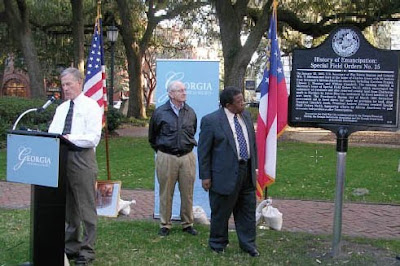
Crawford at a 2011 marker dedication  in Savannah.
“Since the end of the Civil War sesquicentennial, the friendship between GHS and Charlie has grown. Charlie's interest in preserving Georgia's Civil War battlefields to educate the public naturally lends itself to the Georgia Historical Marker Program,” Butler wrote. “The marker program provides an opportunity for place-based learning, and often, as Charlie says, ‘tells the stories to the uninitiated.’”

The GBA and volunteers have assisted the historical society by reporting missing or damaged markers and assisting in repairs

Crawford, a graduate of Georgia Tech, has given over 100 presentations and led over 50 tours relating to battlefield preservation and has been a member of the American Battlefield Trust and its predecessor organizations since 1991. The trust honored him in 2011 for preservation efforts. "Charlie Crawford is an indispensable source of information on all aspects of the preservation movement in the state," the trust said.

Since 2000, Crawford has been a member of the Atlanta Civil War Round Table and is the group’s trivia master. He served as GBA president for nearly two decades and still produces its monthly newsletter and is a trustee.

Crawford uses period photos to help in interpretation (Picket photo)
Regarding the status of battlefield preservation in Georgia, Crawford said Covid-19 has restricted GBA trustees from freely traveling to sites “and the dearth of in-person county commission meetings has dampened our ability to interact with local decision makers.  We have five projects in the hopper, so to speak, but our preservation efforts depend primarily on willing sellers. We don’t have eminent domain power and don’t advocate for the state government to use it.”

High selling prices can make efforts difficult.

“If I had to characterize the current state of preservation, generally, I’d have to say it was frustratingly stalled. On the other hand, a frustrating stall is a recurrent theme in preservation efforts. As long as a battlefield is not permanently lost to development, we remain hopeful and persistent.”  

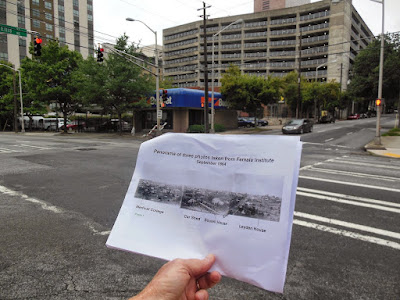
Crawford leads downtown Atlanta tours for the Atlanta Preservation Center and he shows period photos to participants so that they can envision the sites. “On many tours, especially around Atlanta, people will tell me they had no idea they lived on a battlefield.”

Most of the GBA tours are attended by participants who have much more Civil War knowledge than the average citizen,” he told the Picket.

“We also have many repeat participants, who unsurprisingly are some of our most steadfast supporters, not only with memberships and donations but also with (communication) to state representatives and county commissioners and media reporters. We’re not making these folks aware of historical sites as much as providing depth and context to their existing knowledge, which they also spread by word of mouth.”

Tuesday, May 4, 2021

The Atlanta Campaign threw thousands of men at each other in combat. Guest columnist Charlie Crawford tells us about 8 of them

One of the Rebel forts seized in Atlanta (George Barnard/Library of Congress)
This week marks the 157th anniversary of the beginning of the Atlanta Campaign, a prolonged Federal offensive that would have a profound impact on the outcome of the Civil War.

The Picket asked Charlie Crawford (left), president emeritus of the Georgia Battlefields Association, to write about individuals involved in the fighting. Crawford, who has led or taken part in countless tours of battlefields in the region, focuses, with one exception, on soldiers who were non-military before the war and – if they survived -- returned to civilian life. The following biographies have been edited.

You can make a good argument that the Atlanta Campaign, as it later came to be known, began when Generals Grant and Sherman discussed strategy during a train trip from Nashville to Cincinnati on 18 and 19 March 1864. Grant indicated he would take command of U.S. forces in Virginia with the objective of destroying Confederate forces in that state, principally the army commanded by General R.E. Lee, while Sherman should advance with his forces south from the Chattanooga area with the objective of destroying Confederate forces in Georgia, principally the army commanded by General J.E. Johnston.

For the remaining days of March and the month of April, Sherman would order a concentration around Chattanooga of U.S. forces from Mississippi, Alabama, Tennessee, Kentucky and Georgia. Gathering supplies and planning for their subsequent movement was also critical. 

Around Dalton, Ga., Gen. Johnston had done much to restore the capabilities and morale of Confederate forces over the first four months of 1864. He, too, had to concentrate his forces and plan a strategy for the U.S. advance he knew would be coming once the spring rains abated and the roads dried enough to allow for movement of the combined 180,000 men and up to 100,000 horses and mules that the opposing forces would concentrate in northwest Georgia. 

On 7 May 1864, Sherman and a group of his subordinate generals stood on the slightly elevated ground in front of a doctor’s house and watched as the U.S. 4th Army Corps turned southward toward Tunnel Hill and the U.S. 23rd Army Corps marched east before turning south toward Dalton.

The movement of these troops is often cited as the beginning of the campaign, and a historical marker at the intersection of GA 2 and GA 209 is titled “Campaign for Atlanta Began Here.”

Many men would find their fates conjoined over the next four months.

Leonidas Polk and Peter Simonson, Pine Mountain

Leonidas Polk (left) was from North Carolina and graduated from the U.S. Military Academy in 1827, but within six months, he resigned from the Army to study for the ministry. When the Civil War began, he was Episcopal bishop of Louisiana but approached his West Point friend Jefferson Davis and offered to serve the Confederate States army.

Davis made Polk a brigadier general. Polk proved to have an inclination to misunderstand orders or refuse to follow them and he had an uneven record on the battlefield.

By early May 1864, he was a lieutenant general leading Confederate forces in Mississippi and was ordered to bring three divisions to Georgia to reinforce Gen. Johnston. By 14 June 1864, he was commanding a corps in Johnston’s army, and his headquarters was at the Hardage house on the north side of Burnt Hickory Road a few miles from Kennesaw Mountain. A Georgia Historical Commission marker marks the site.

Gen. Johnston passed the house along with Lt. Gen. William Hardee on the way to inspect the position of one of Hardee’s divisions on Pine Mountain. Johnston invited Polk to come along. Once atop the mountain, the generals and some of their staffs stood near the position of a four-gun artillery battery and observed the U.S. Army lines to the north and west. 

Position of 5th Indiana where it fired at Confederates (Courtesy of GBA)
Riding along the U.S. Army position were Gen. Sherman and some of his subordinate generals.  Through field glasses, Sherman noticed the conspicuous group atop Pine Mountain and surmised that it included general officers trying to get a better perspective on the situation.

Sherman directed Maj. Gen. Oliver O. Howard, commanding the 4th Corps, to have cannon fire directed at the group. Howard turned to the commander of the artillery of his first division, Capt. Peter Simonson, to execute Sherman’s order. Nearby, Simonson found a familiar artillery unit, the 5th Indiana Artillery Battery, which Simonson had formerly commanded. The firing commenced, and the third shell passed through Polk’s chest, killing him instantly. His successor, Alexander P. Stewart, proved to be a more successful corps commander.

Simonson himself would be killed two days later by a rifle shot while he was directing the placement of an artillery battery.

It was unusual for a captain to be acting chief of division artillery, and the comments made when he was killed reflected not only sorrow that his personality would be missed but also concern about replacing his military skills.  

A monument marking Polk’s death site (left) is on Pine Mountain, and a Cobb County historical marker relating to Simonson’s death is on the east side of Frank Kirk Road.  Despite the extensive development of Cobb County, which now has nearly 800,000 residents, three of the gun positions at the Polk death site are still discernible, as is the position of the 5th Indiana Battery that fired the shots. 

Both sites are on private land, so they are in danger of being bulldozed away.

Edward Walthall and John Geary, Peachtree Creek

The 20 July 1864 Battle of Peachtree Creek in Atlanta brought Walthall and Geary together to oppose each other.


Edward Walthall (left) was a lawyer, not a professional soldier. When the Civil War began, he left his position as a district attorney and joined a Mississippi regiment as a first lieutenant. By July 1864, he was a major general commanding a Confederate division. He led that division at Peachtree Creek. His attack had initial success, collapsing the right flank of the U.S. division led by Maj. Gen. John Geary. 

He is most positively remembered for being better than his predecessor as division commander and for his later rearguard action, along with Forrest, that prevented the destruction of the Army of Tennessee during Hood's retreat from Nashville in December 1864.

Geary was also not a professional soldier but a surveyor and railroad builder. He was wounded five times while serving as a volunteer officer in the Mexican War but returned to civilian life until he was appointed postmaster of San Francisco in 1849. He was elected mayor of San Francisco in 1850 and then appointed territorial governor of Kansas in 1856. He returned to his home state of Pennsylvania and remarried after his first wife died.

He joined the volunteer army when the Civil War began and fought in several battles in the Eastern Theater, including Gettysburg, before his division was transferred west in September 1863.

Peachtree Creek map locates Walthall and Geary on the left (Courtesy of GBA)
On 20 July 1864, Geary rallied his men and ultimately repulsed Walthall’s attack at Peachtree Creek. When U.S. forces captured Atlanta on 2 September 1864, Sherman logically appointed the former mayor and territorial governor as military administrator of the city. He would serve the same role in Savannah when that city was occupied by U.S. forces in December 1864. 

His height (6 feet, 6 inches) and his proficiency at administration -- rather than his tactical or leadership skills -- were the features most used to describe his Civil War performance.

After the war, Walthall returned to the practice of law in Mississippi until appointed in 1885 to the U.S. Senate, where he served until his death in 1898. Most people living in the Collier Hills section of Atlanta would not be able to explain why a road in their neighborhood is named Walthall Drive. 

Geary returned to Pennsylvania and served as governor from 1867 to 1873. In February 1873, less than a month after leaving office, he died of a heart attack while preparing breakfast for his infant son. 

Sul Ross and John Croxton, Brown’s Mill 


Lawrence Sullivan “Sul” Ross (left) was born in 1838 in Iowa but raised in Texas, a territory when his family moved there in 1839, and a state by 1845. He attended Baylor University and then Wesleyan University in Alabama but fought Comanches during the summer breaks, being badly wounded in 1858. In the summer of 1860, he again fought Comanches while serving with the Texas Rangers.

When the Civil War came, Ross enlisted in the Confederate army as a private but was soon made an officer. He distinguished himself as a cavalry officer in several battles in the Western Theater. By July 1863, a brigade was created specifically for Ross to lead as a brigadier general, though he suffered recurring attacks of fever and chills every three days from September 1863 to March 1864 due to malaria.

He was a combative sort, which is a desirable trait for a cavalry commander, but sometimes it got in the way of mission success.

He was still leading the brigade when it was transferred along with Polk’s infantry to northwest Georgia in May 1864, and it endured 86 engagements with U.S. forces over the next four months. At the cavalry Battle of Brown’s Mill on 30 July 1864, Ross was briefly captured but was recovered by Confederate forces within minutes. His brigade led Hood’s forces into Tennessee in November 1864. By the time Ross was granted a furlough in March 1865, he had participated in 135 combat actions. 

After the war, Ross prospered as a farmer and rancher and fathered eight children over the next 17 years. In 1873, Ross became a county sheriff.  In 1875, he served for over two months at a state constitutional convention and then served as a state senator 1880-1882. He was governor of Texas 1887-1891, declining to run for a third two-year term. He was a very successful president of the Agricultural and Mechanical College of Texas (now Texas A&M University) from 1891 until his death in 1898. Sul Ross State University is named in his honor.

Bench at Brown's Mill battlefield park (Picket photo)
John Croxton was born in 1837 and raised in Kentucky by a slave-holding family, from which he became estranged because of his ardent abolitionism. He graduated from Yale University and practiced law until being commissioned as a lieutenant colonel in the 4th Kentucky U.S. Infantry in October 1861. He commanded infantry units at the battles of Perryville and Chickamauga. 

His regiment was reorganized in February 1864 as mounted infantry, and it served in a cavalry brigade during the Atlanta Campaign, skirmishing frequently from May through July when the Battle of Brown’s Mill in Coweta County brought it face to face with Sul Ross’s Confederate brigade.

Croxton’s regiment lost heavily at Brown’s Mill (a Confederate victory). Croxton, along with every other officer serving under McCook at Brown's Mill, lost a large part of his command.  He had already performed well enough before then to be promoted to brigadier general once he finished his two-week trek on foot back to Federal lines. 

(Civil War Picket photo)
He led a brigade opposing Hood’s invasion of Tennessee in late 1864, where he again faced Ross’s cavalry at the 15 December 1864 Battle of Nashville and clashed with Confederate cavalry almost daily during Hood’s retreat.

In late March 1865, Croxton led a brigade during Wilson’s raid across Alabama into Georgia.  Maj. Gen. James Wilson detached Croxton’s brigade to operate independently against the Confederate supply depot and military academy at Tuscaloosa, and Croxton burned not only military stores but also several buildings of the University of Alabama before defeating a Confederate cavalry force near Talladega on 23 April 1865. He finally rejoined Wilson in Macon, Ga., after operating independently for almost a month.

After the Confederate surrenders, Croxton served as military governor of southwest Georgia until December 1865, when he returned to Kentucky to practice law. In 1872, President Grant appointed Croxton as U.S. minister to Bolivia. Croxton died there from tuberculosis in 1874.

The Atlanta Campaign brought together Ross and Croxton, two men who had rich lives outside their time as soldiers.

Walter Gresham and Randall Gibson
Bald (Leggett’s) Hill, Battle of Atlanta
 

Walter Q. Gresham (left) was from Indiana and a conservative Democrat who opposed slavery. He practiced law starting in 1854. When the war came, he sought a commission in the volunteer army but was rebuffed by the governor because of a political disagreement. Instead, he enlisted in the army and by March 1862 was a colonel commanding an infantry regiment that he then led at Corinth and through the Vicksburg Campaign.

By the time the 17th Corps in which he served arrived in Georgia in June 1864, he was leading a division as a 32-year-old brigadier general. He didn't have that long to demonstrate his capabilities and his command didn’t see heavy action until July. On 20 July 1864, as his division approached Atlanta after passing through Decatur, he was shot in the knee near the Bald Hill, now the site of the Moreland Avenue interchange with I-20, a disabling wound that left him with a permanent limp.

Like Gibson, Ross, Walthall and Croxton, his performance during the Atlanta Campaign was competent.

Gresham returned to the practice of law until 1869, when President Grant appointed him to the U.S. District Court, where he served until April 1883, when President Arthur appointed him postmaster general.  He next served as secretary of the treasury for two months until President Arthur appointed him to the U.S. Circuit Court in October 1884. President Cleveland selected Gresham to be Secretary of State in March 1893, and he died in that office in 1895.

Randall L. Gibson was raised in Louisiana. His great-great-grandfather was a free man of color who married a white woman, though this fact was hidden from public view. Gibson went north for education and graduated from Yale University in 1853. He became a lawyer, served as U.S. attaché in Madrid, and raised sugar cane in Louisiana. When the war began, he became captain of a Louisiana artillery battery until being appointed colonel of an infantry regiment. He led the regiment at Shiloh, Perryville and Stones River, serving several times as acting brigade commander, as he did again at Chickamauga and Chattanooga.

Gibson's brigade was not sent forward to exploit the 22 July 1864
Confederate assault, a central focus of the Atlanta Cyclorama. (Library of Congress)
When the Atlanta Campaign began, he had his own brigade as a 31-year-old brigadier general. On 22 July 1864, despite being in support of the Confederate attack a mile north of the Bald Hill, an action that is the central focus of the Atlanta Cyclorama, Gibson’s brigade was not ordered to exploit the breach.

Gibson and his brigade participated in Hood’s invasion of Tennessee in late 1864, and Gibson ended the war defending Mobile, Alabama.  He returned to Louisiana, practicing law and trying to raise sugar cane in the absence of slave labor. He served in the U.S. House of Representatives 1875-1883 and the U.S. Senate 1883-1892, also serving as a regent of the Smithsonian Institution and president of the board of administrators of Tulane University. Like Gresham, he died in office.

Though their units never fought each other directly, Gresham and Gibson exemplify the many men in their early 30s who became generals by the third year of the war, then went back to their civilian occupations and lives of public service.           

Epilogue

Except for Capt. Simonson, the above biographies focus on generals; but what of the 180,000 or so other soldiers who participated in the Atlanta Campaign? In round numbers, about 8,000 were killed in action, 42,000 were wounded, and 18,000 were captured or reported missing. 

Many of the wounded survived, though some with permanent disabilities, and others survived prison camps. Many of those not killed in action would die of disease, the war’s greatest killer, and others would live with the after effects of malaria, typhoid, dysentery, measles, and other diseases they caught while serving.

Most would go home and try to reconstruct their lives, but they would all be able to say that they had been in the great Civil War that tested whether this nation would long endure. They could also say that they participated in the campaign that likely determined the outcome of that war, because the fall of Atlanta in September 1864 significantly bolstered Lincoln’s chances for reelection, and it was clear that a Lincoln administration would accept nothing less than victory in the fight for a reunited nation that was free of slavery.