The
reconstruction of a building that was once part of Elmira’s Civil War prison
camp is only the beginning for what is ultimately envisioned to become a Civil
War tourist attraction in New York. But in the meantime, the immediate goal of
the Friends of the Elmira Civil War Prison Camp is to reassemble the lumber
that made up the building, which is 150 years old. “This
project has become much more cumbersome and much more costly than we ever
anticipated,” said Martin Chalk, president of the group, during a news
conference Tuesday. It is now anticipated that $100,000 will be needed to
complete the project. • Article
Tuesday, August 4, 2015


Thursday, July 30, 2015
Camp Lawton dig director leaving, assesses findings and mysteries at prison site
 |
| Students conduct work during this summer's field school (GSU) |
Assistant Professor Lance Greene, who
directed Georgia Southern University archaeology students conducting field work
and research at Camp Lawton, a Civil War prison, is leaving the school after
three years to take a position at Wright State University in Dayton, Ohio.
Greene, 51, has spoken often with the Picket about the Lawton project. We talked this week about his future and the status of efforts to learn more
about Lawton, which held nearly 10,000 Federal soldiers for six weeks in fall
1864. Hundreds of artifacts have been recovered. The questions and responses below
have been edited.
Q. Tell me about what you will be
doing at Wright State.
A. I’ll be the only archaeologist on staff. In the fall, I
will be teaching introduction to archaeology, field methods and archaeology. I’ll
actually start a new project on Shawnee archaeology. This will cover southwest
Ohio and the last 500 years, with a focus on the Revolutionary War period. They
were resisting British and American intrusion. There are several villages from
the 1770s and 1780s within 5 and 10 miles of our campus. This will be good for
field school. The two I am most interested in were sizable villages. Old
Chillicothe had 50 to 60 houses. I conducted research on the Cherokee before I
came to Georgia Southern.
 |
| Greene |
Q. What’s going to happen with the
Camp Lawton project after your departure?
A. Next year will be tough for archaeology. Professor Sue
Moore just retired this past spring (though she will continue to give
lectures). This summer GSU went from three archaeologists to one. The coming
semester will focus on hiring a replacement to me. The new Camp Lawton person
will start in fall 2016.
Q. What will that mean to the field
work?
A. There will be a one-year down time. Camp Lawton will be
inactive for about a year. There will be no excavation for fall 2015 and spring
2016 semesters and no public days (to witness the digs). They will probably
continue to give presentations.
Q. What’s the impact of this halt in
excavations?
A. We hope it won’t be much of an interruption. This has
been going full steam for about five years. I finished up a comprehensive site
report of excavations since 2010. (The school and federal and state agencies)
will look at it as a year to study and look at where the next phase of work
should be. From their perspective, this is a good thing. It is a good stopping
point to take a breath and look at what is coming next.
Q. Tell me about the most recent work.
(Camp Lawton sat on what is now Magnolia Springs State Park and an old federal
fish hatchery near Millen).
A. We had 12 students all together and did a lot during
mid-May to mid-June during summer field school. We spent almost all of our time
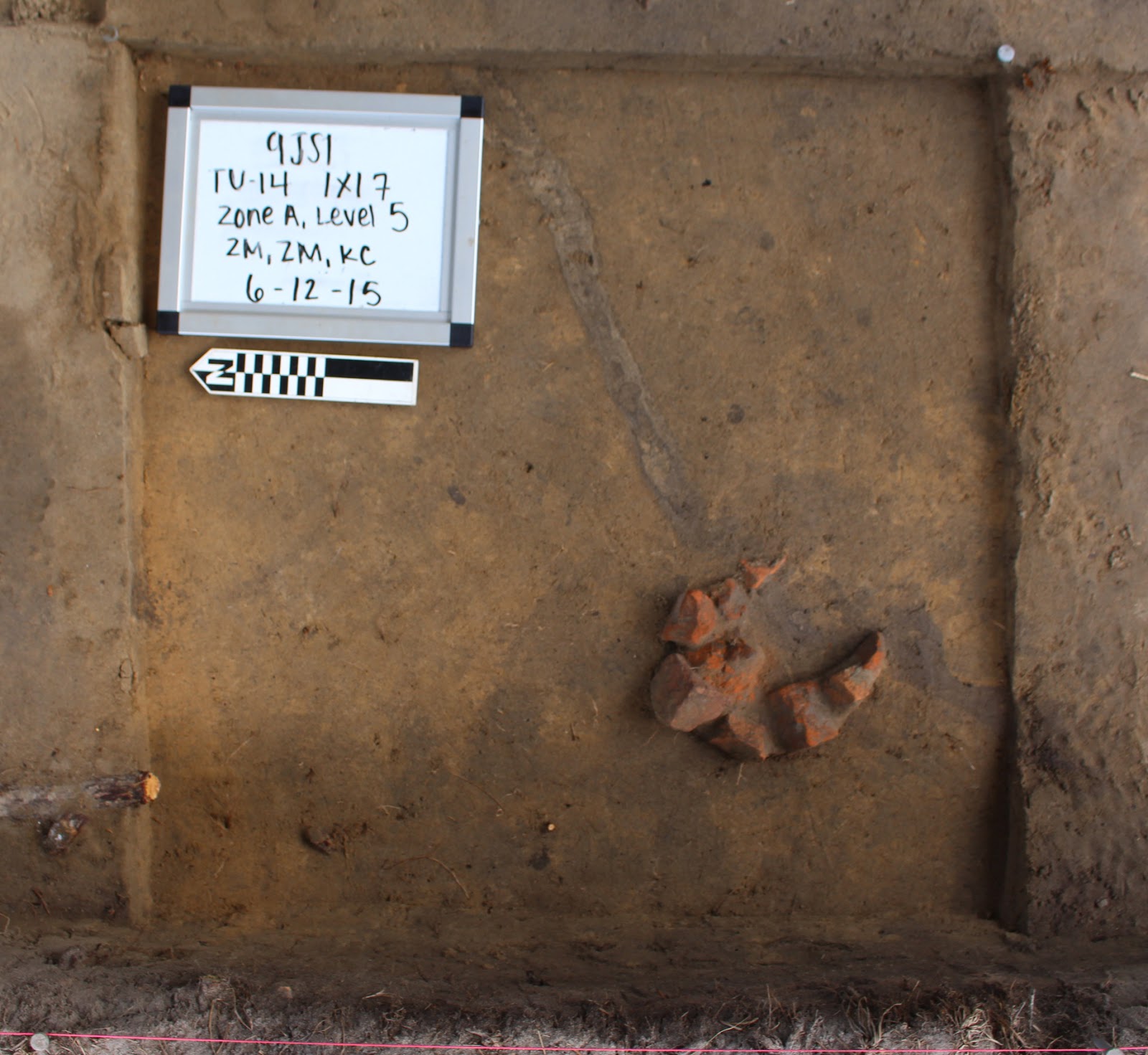
in the prisoner area. We continued the excavation of a brick oven and a hut. We
wanted to get those finished and back-filled. I think that my conclusions add
to what we interpreted last year. The brick oven (made for prisoners) was more
of a substantial structure than what we thought. We found evidence of posts.
The stratified layer was a lot deeper than what we thought it was. The
Confederacy built these really substantial brick ovens as opposed to haphazard.
The prisoners used this oven a lot more than we thought. They are focal points
and used for food, warmth and social interaction. These may be hubs for a lot
of the prisoners. About five or six were built.
 |
| Remains of prisoner residence (GSU) |
Q. How about the hut?
A. There were not too many artifacts, thought we found a
few machine-cut nails. It was a big, basin-shaped pit, roughly square. They
stole the bricks to build a tiny chimney at the end. It probably housed two or
three men. All of the bricks in the prisoner hut were complete. There were only
brick fragments in the oven. It appears civilians after the war took the good
bricks from there.
Q. Tell me some of the conclusions in
your status report.
A. We’re finding out that the best-preserved part of the
site is the prisoner encampment area. Everything within the stockade wall is
very well preserved. We have yet to identify definite Confederation portions of
the site. We don’t know if they have been destroyed or we are digging in the
wrong place. Future work inside the stockade will be slow and will concentrate
on feature deposits. Outside the stockade wall (in the Confederate area) will
be a survey (as more is learned).
 |
| One of two brass harmonica reeds found at Lawton (GSU) |
Q. What about the remains of an old
residence in the Confederate area, where you found artifacts from different
periods?
A. We believe that is Confederate. I think it was prewar
frame house, probably tenant farmer. It was lived in again until 1870 or 1880,
then burned. We do have an officer’s quarters there. That is the one good
location we have that is Confederate occupation.
Q. What else?
A. In the prisoner area, the excavations are beginning to
support that prisoner accounts are true. We have found a cow mandible. They
were given cow heads. They are breaking these pieces of skull to hand out to prisoners
to be more democratic. We are getting other pieces of bones, but they need
analysis. It shows the Confederacy will impress livestock. Heads were carried
by wagon into the prison. Very telling is the lack of things we see. There is no
glass or ceramics in prison area. They are having to do with tin cups. The
Confederacy is giving them nothing and they are getting bad cuts of meat if
they get anything at all. A tin cup was used for water and to eat soup. They
have nothing else. They reused items, railroad piece and metal scrap.
Q. Did you make any recommendations
for future work on the project?
A. For me, personally, the question is the difference in quality of life between prisoners
and guards. This is one of the questions that drive the research design.
Methodology I have suggested is that inside the stockade they need to dig
slowly and methodically. This is feature excavation. Of course, my replacement
may go somewhere else with this.
 |
| Darker soil shows evidence of stockade wall (GSU) |
Q. Has Camp Lawton lived up to its
billing from a few years ago as a virtual time capsule because of its remote location?
A. The site integrity is as big as they say it is. The
prisoner area is one of the best preserved sites I have ever seen. We can
reflect on what is going on during the Civil War in a lot of ways: The
treatment of prisoners, race and more. I
continue to think Camp Lawton is an incredibly important site.
Q. How have students benefited from
the field work and research?
A. I think
that Camp Lawton is an excellent training ground for students -- graduate and
undergraduate. Right now we have graduated three master’s students with thesis
research on Camp Lawton. We have two more about to finish up. There is a lot of
historical research.
Q. Any special memories of the work on
the site?
A. There are just a lot of moments. They often hinge on th
discovery of really specific things in the field. I remember the moment we discovered
a good example of stockade trench. It amazed everyone, including myself. This
past summer, I had several students uncovering what was left of brick rubble and they were troweling, exposing material. Just in the floor,
there was an old post hole with brick rubble shoved into it. It kind of took my
breath away and it was a teaching moment for my students. We started finding
evidence of how they built this structure. I am going to miss the site, doing
research because it is one of the most incredible sites I have ever worked on.
It will be tough to top that. I will miss the students and faculty.
Saturday, July 25, 2015
Tuesday, July 21, 2015
Clemens, U.S. Grant and Hannibal, Mo.
 |
| Samuel Clemens |
Friday, July 17, 2015
Navy divers bring up first cannon from wreck
 |
| (U.S. Navy) |
One down .... three to go.
That's the cannon count for U.S. Navy divers working from a barge in Savannah, Ga., as part of an operation to remove the remnants of the Confederate ironclad CSS Georgia from the shipping channel.
Divers on Wednesday brought up a small artillery piece called a "six-pounder" -- a reference to the weight of the cannonball. It's the first time the cannon has been above the Savannah River surface since the CSS Georgia was scuttled by its crew in December 1864.
The Navy has been in town a few weeks to assist the U.S. Army Corps of Engineers in collecting artifacts and removing pieces of the vessel -- including its guns, ordnance, casemate and propeller -- in the first phase of a deepening of the channel to the Atlantic Ocean.
The ironclad may have had as many as 10 large guns onboard during its operation. Two were recovered years ago and are on display at Old Fort Jackson, near the wreck site. Four have remained in the river and are being brought up by Navy divers, who have recovered about 150 pieces of ordnance and munitions from the murky depths. They'll remove the boat's larger pieces after the cannon are out of the water.
• U.S. Army Corps of Engineers wreck photos
• Facebook page for U.S. Navy divers
Subscribe to:
Posts (Atom)